ignition system SUZUKI GRAND VITARA 2001 2.G Workshop Manual
[x] Cancel search | Manufacturer: SUZUKI, Model Year: 2001, Model line: GRAND VITARA, Model: SUZUKI GRAND VITARA 2001 2.GPages: 656, PDF Size: 14.31 MB
Page 242 of 656
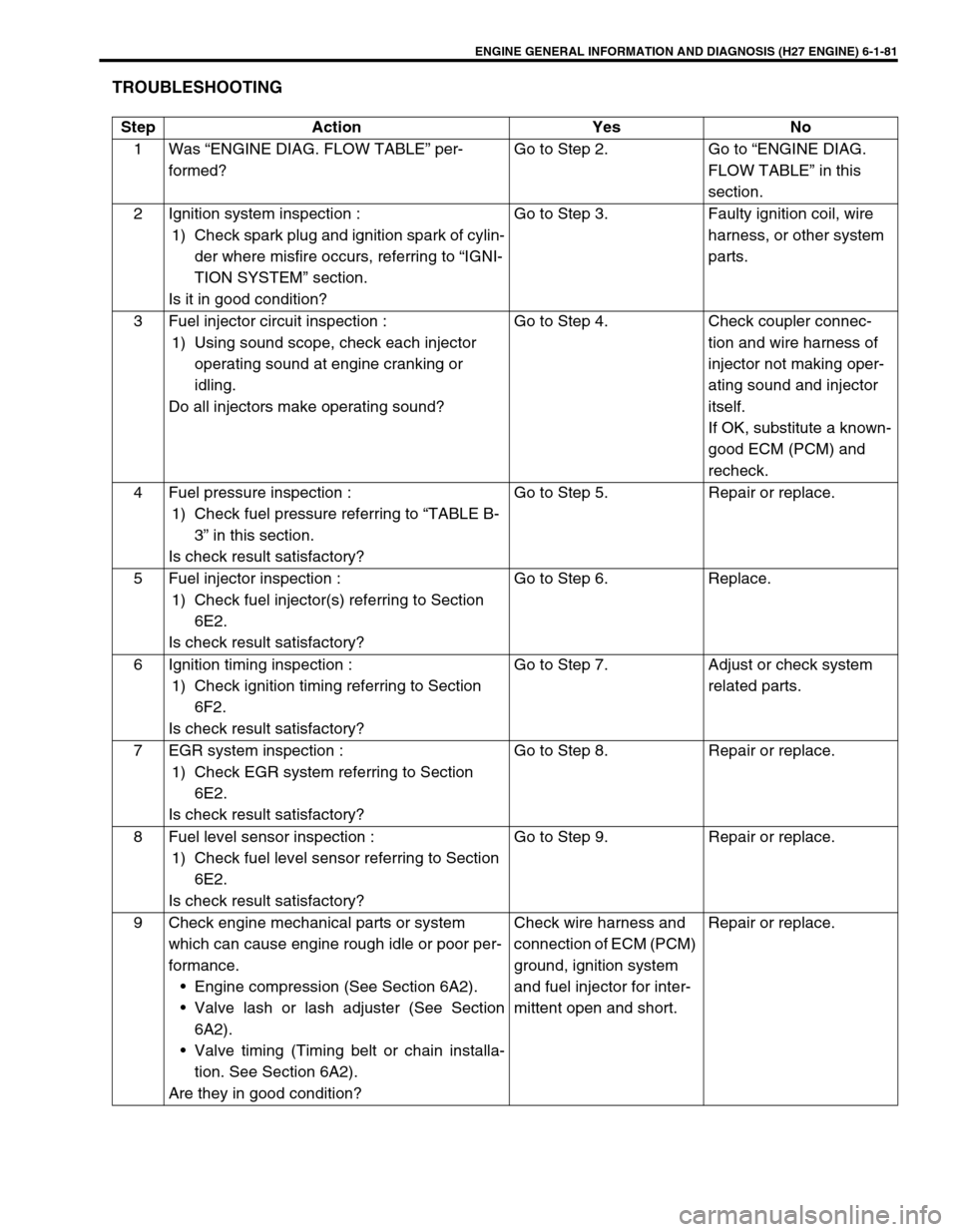
ENGINE GENERAL INFORMATION AND DIAGNOSIS (H27 ENGINE) 6-1-81
TROUBLESHOOTING
Step Action Yes No
1 Was “ENGINE DIAG. FLOW TABLE” per-
formed?Go to Step 2. Go to “ENGINE DIAG.
FLOW TABLE” in this
section.
2 Ignition system inspection :
1) Check spark plug and ignition spark of cylin-
der where misfire occurs, referring to “IGNI-
TION SYSTEM” section.
Is it in good condition?Go to Step 3. Faulty ignition coil, wire
harness, or other system
parts.
3 Fuel injector circuit inspection :
1) Using sound scope, check each injector
operating sound at engine cranking or
idling.
Do all injectors make operating sound?Go to Step 4. Check coupler connec-
tion and wire harness of
injector not making oper-
ating sound and injector
itself.
If OK, substitute a known-
good ECM (PCM) and
recheck.
4 Fuel pressure inspection :
1) Check fuel pressure referring to “TABLE B-
3” in this section.
Is check result satisfactory?Go to Step 5. Repair or replace.
5 Fuel injector inspection :
1) Check fuel injector(s) referring to Section
6E2.
Is check result satisfactory?Go to Step 6. Replace.
6 Ignition timing inspection :
1) Check ignition timing referring to Section
6F2.
Is check result satisfactory?Go to Step 7. Adjust or check system
related parts.
7 EGR system inspection :
1) Check EGR system referring to Section
6E2.
Is check result satisfactory?Go to Step 8. Repair or replace.
8 Fuel level sensor inspection :
1) Check fuel level sensor referring to Section
6E2.
Is check result satisfactory?Go to Step 9. Repair or replace.
9 Check engine mechanical parts or system
which can cause engine rough idle or poor per-
formance.
• Engine compression (See Section 6A2).
• Valve lash or lash adjuster (See Section
6A2).
• Valve timing (Timing belt or chain installa-
tion. See Section 6A2).
Are they in good condition?Check wire harness and
connection of ECM (PCM)
ground, ignition system
and fuel injector for inter-
mittent open and short.Repair or replace.
Page 251 of 656
6-1-90 ENGINE GENERAL INFORMATION AND DIAGNOSIS (H27 ENGINE)
DTC DETECTING CONDITION AND TROUBLE AREA
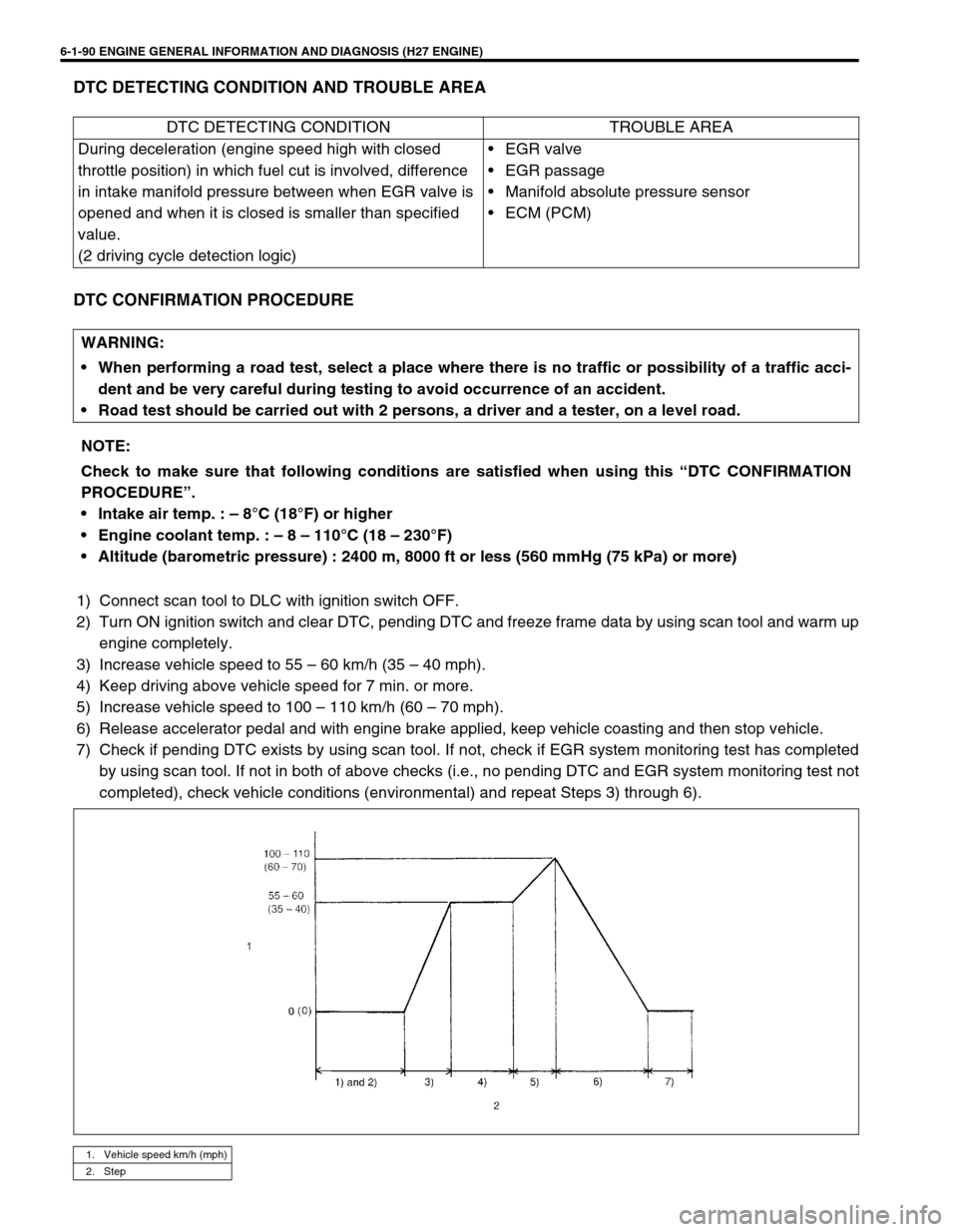
DTC CONFIRMATION PROCEDURE
1) Connect scan tool to DLC with ignition switch OFF.
2) Turn ON ignition switch and clear DTC, pending DTC and freeze frame data by using scan tool and warm up
engine completely.
3) Increase vehicle speed to 55 – 60 km/h (35 – 40 mph).
4) Keep driving above vehicle speed for 7 min. or more.
5) Increase vehicle speed to 100 – 110 km/h (60 – 70 mph).
6) Release accelerator pedal and with engine brake applied, keep vehicle coasting and then stop vehicle.
7) Check if pending DTC exists by using scan tool. If not, check if EGR system monitoring test has completed
by using scan tool. If not in both of above checks (i.e., no pending DTC and EGR system monitoring test not
completed), check vehicle conditions (environmental) and repeat Steps 3) through 6).DTC DETECTING CONDITION TROUBLE AREA
During deceleration (engine speed high with closed
throttle position) in which fuel cut is involved, difference
in intake manifold pressure between when EGR valve is
opened and when it is closed is smaller than specified
value.
(2 driving cycle detection logic)•EGR valve
• EGR passage
• Manifold absolute pressure sensor
•ECM (PCM)
WARNING:
When performing a road test, select a place where there is no traffic or possibility of a traffic acci-
dent and be very careful during testing to avoid occurrence of an accident.
Road test should be carried out with 2 persons, a driver and a tester, on a level road.
NOTE:
Check to make sure that following conditions are satisfied when using this “DTC CONFIRMATION
PROCEDURE”.
Intake air temp. : – 8°C (18°F) or higher
Engine coolant temp. : – 8 – 110°C (18 – 230°F)
Altitude (barometric pressure) : 2400 m, 8000 ft or less (560 mmHg (75 kPa) or more)
1. Vehicle speed km/h (mph)
2. Step
Page 252 of 656
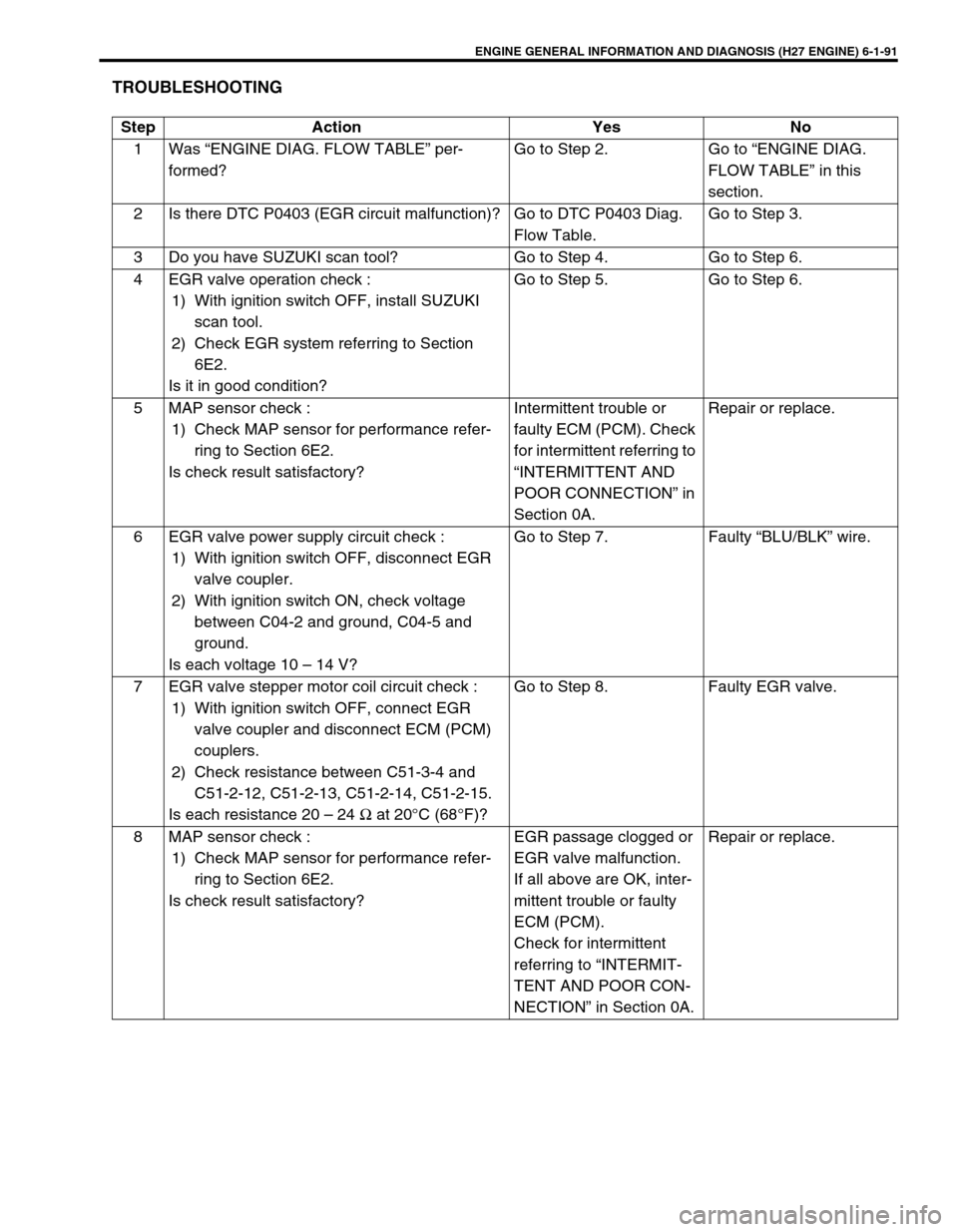
ENGINE GENERAL INFORMATION AND DIAGNOSIS (H27 ENGINE) 6-1-91
TROUBLESHOOTING
Step Action Yes No
1 Was “ENGINE DIAG. FLOW TABLE” per-
formed?Go to Step 2. Go to “ENGINE DIAG.
FLOW TABLE” in this
section.
2 Is there DTC P0403 (EGR circuit malfunction)? Go to DTC P0403 Diag.
Flow Table.Go to Step 3.
3 Do you have SUZUKI scan tool? Go to Step 4. Go to Step 6.
4 EGR valve operation check :
1) With ignition switch OFF, install SUZUKI
scan tool.
2) Check EGR system referring to Section
6E2.
Is it in good condition?Go to Step 5. Go to Step 6.
5 MAP sensor check :
1) Check MAP sensor for performance refer-
ring to Section 6E2.
Is check result satisfactory?Intermittent trouble or
faulty ECM (PCM). Check
for intermittent referring to
“INTERMITTENT AND
POOR CONNECTION” in
Section 0A.Repair or replace.
6 EGR valve power supply circuit check :
1) With ignition switch OFF, disconnect EGR
valve coupler.
2) With ignition switch ON, check voltage
between C04-2 and ground, C04-5 and
ground.
Is each voltage 10 – 14 V?Go to Step 7. Faulty “BLU/BLK” wire.
7 EGR valve stepper motor coil circuit check :
1) With ignition switch OFF, connect EGR
valve coupler and disconnect ECM (PCM)
couplers.
2) Check resistance between C51-3-4 and
C51-2-12, C51-2-13, C51-2-14, C51-2-15.
Is each resistance 20 – 24 Ω at 20°C (68°F)?Go to Step 8. Faulty EGR valve.
8 MAP sensor check :
1) Check MAP sensor for performance refer-
ring to Section 6E2.
Is check result satisfactory?EGR passage clogged or
EGR valve malfunction.
If all above are OK, inter-
mittent trouble or faulty
ECM (PCM).
Check for intermittent
referring to “INTERMIT-
TENT AND POOR CON-
NECTION” in Section 0A.Repair or replace.
Page 254 of 656
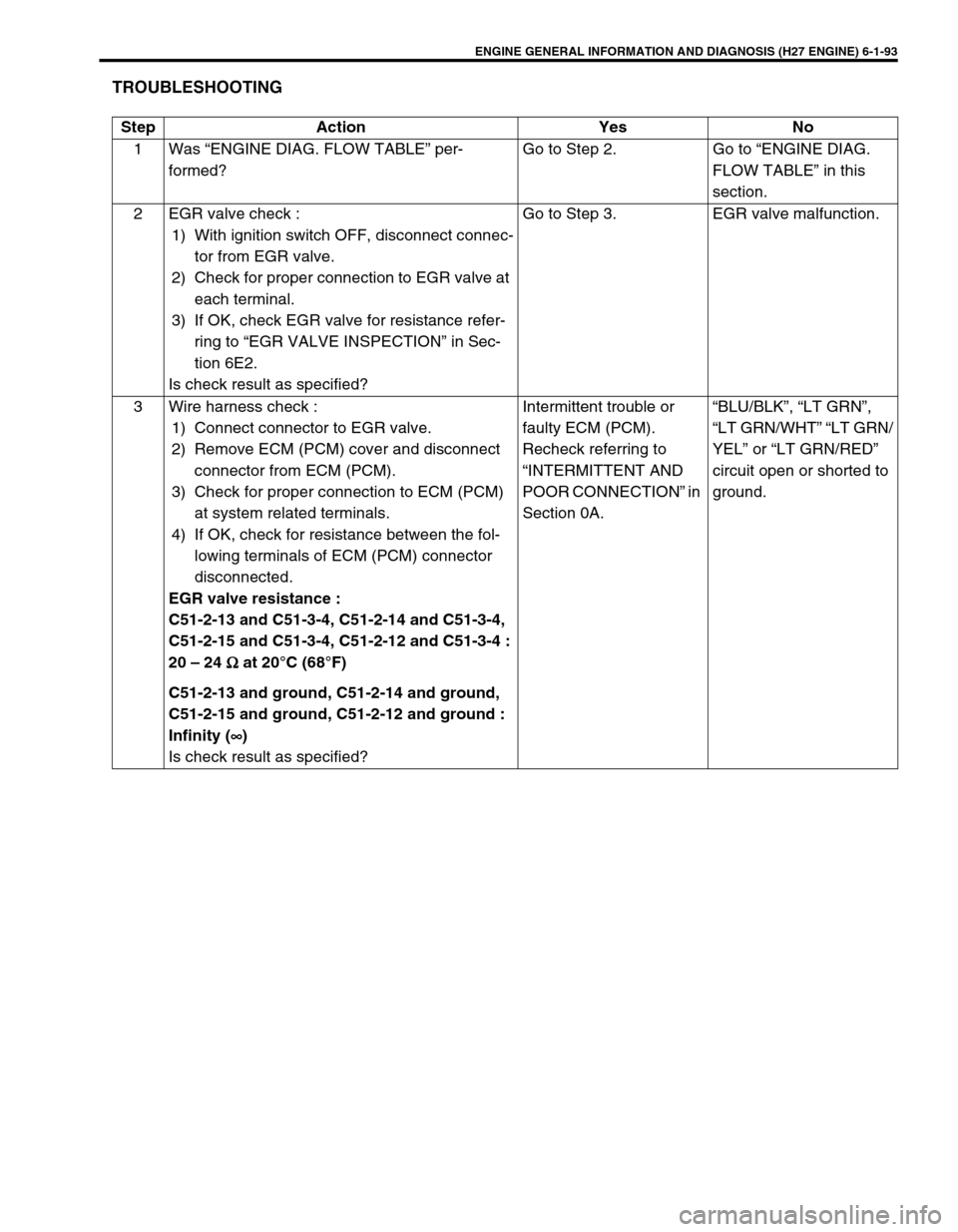
ENGINE GENERAL INFORMATION AND DIAGNOSIS (H27 ENGINE) 6-1-93
TROUBLESHOOTING
Step Action Yes No
1 Was “ENGINE DIAG. FLOW TABLE” per-
formed?Go to Step 2. Go to “ENGINE DIAG.
FLOW TABLE” in this
section.
2 EGR valve check :
1) With ignition switch OFF, disconnect connec-
tor from EGR valve.
2) Check for proper connection to EGR valve at
each terminal.
3) If OK, check EGR valve for resistance refer-
ring to “EGR VALVE INSPECTION” in Sec-
tion 6E2.
Is check result as specified?Go to Step 3. EGR valve malfunction.
3 Wire harness check :
1) Connect connector to EGR valve.
2) Remove ECM (PCM) cover and disconnect
connector from ECM (PCM).
3) Check for proper connection to ECM (PCM)
at system related terminals.
4) If OK, check for resistance between the fol-
lowing terminals of ECM (PCM) connector
disconnected.
EGR valve resistance :
C51-2-13 and C51-3-4, C51-2-14 and C51-3-4,
C51-2-15 and C51-3-4, C51-2-12 and C51-3-4 :
20 – 24
Ω
ΩΩ Ω at 20°C (68°F)
C51-2-13 and ground, C51-2-14 and ground,
C51-2-15 and ground, C51-2-12 and ground :
Infinity (
∞
∞∞ ∞)
Is check result as specified?Intermittent trouble or
faulty ECM (PCM).
Recheck referring to
“INTERMITTENT AND
POOR CONNECTION” in
Section 0A.“BLU/BLK”, “LT GRN”,
“LT GRN/WHT” “LT GRN/
YEL” or “LT GRN/RED”
circuit open or shorted to
ground.
Page 256 of 656
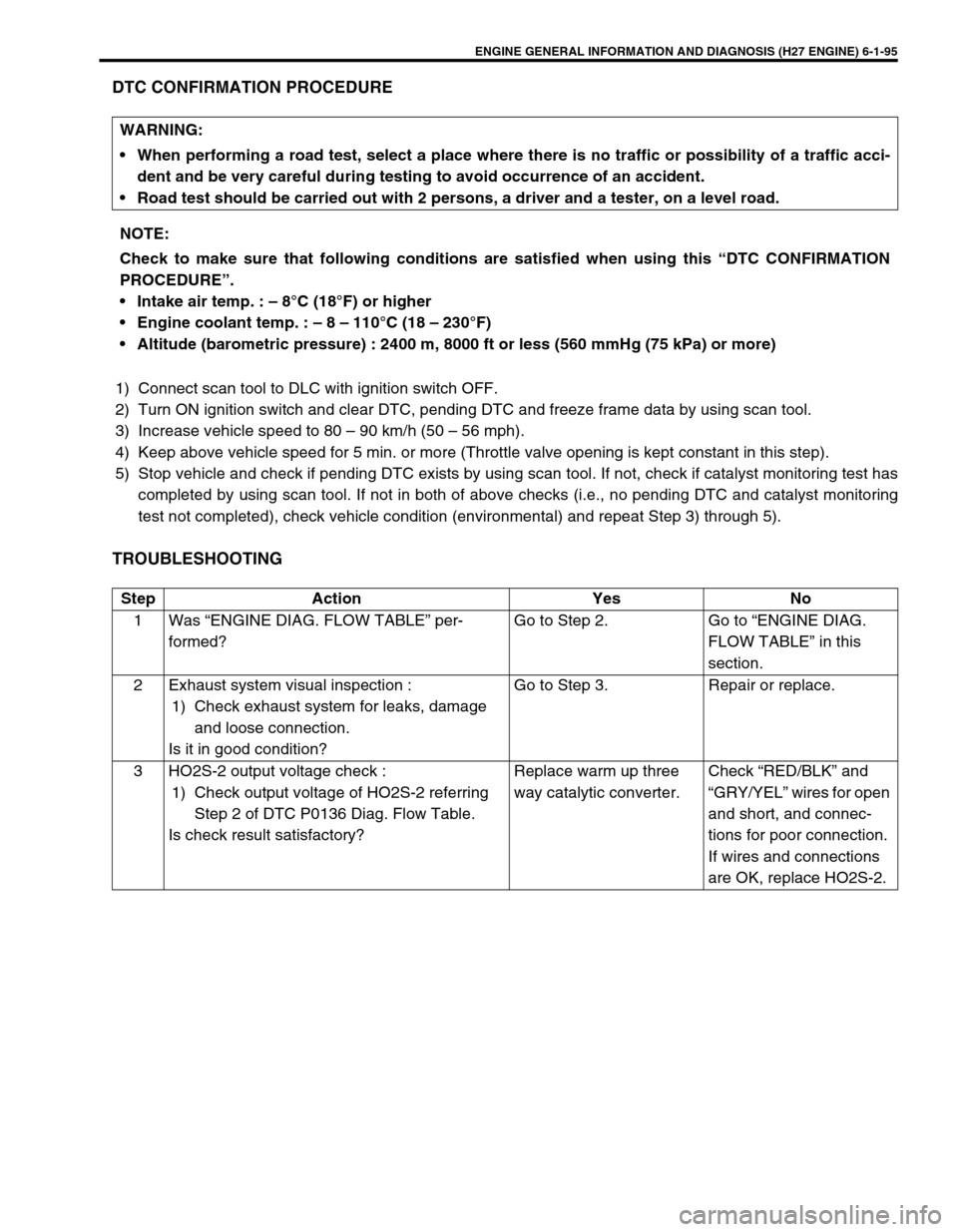
ENGINE GENERAL INFORMATION AND DIAGNOSIS (H27 ENGINE) 6-1-95
DTC CONFIRMATION PROCEDURE
1) Connect scan tool to DLC with ignition switch OFF.
2) Turn ON ignition switch and clear DTC, pending DTC and freeze frame data by using scan tool.
3) Increase vehicle speed to 80 – 90 km/h (50 – 56 mph).
4) Keep above vehicle speed for 5 min. or more (Throttle valve opening is kept constant in this step).
5) Stop vehicle and check if pending DTC exists by using scan tool. If not, check if catalyst monitoring test has
completed by using scan tool. If not in both of above checks (i.e., no pending DTC and catalyst monitoring
test not completed), check vehicle condition (environmental) and repeat Step 3) through 5).
TROUBLESHOOTING
WARNING:
When performing a road test, select a place where there is no traffic or possibility of a traffic acci-
dent and be very careful during testing to avoid occurrence of an accident.
Road test should be carried out with 2 persons, a driver and a tester, on a level road.
NOTE:
Check to make sure that following conditions are satisfied when using this “DTC CONFIRMATION
PROCEDURE”.
Intake air temp. : – 8°C (18°F) or higher
Engine coolant temp. : – 8 – 110°C (18 – 230°F)
Altitude (barometric pressure) : 2400 m, 8000 ft or less (560 mmHg (75 kPa) or more)
Step Action Yes No
1 Was “ENGINE DIAG. FLOW TABLE” per-
formed?Go to Step 2. Go to “ENGINE DIAG.
FLOW TABLE” in this
section.
2 Exhaust system visual inspection :
1) Check exhaust system for leaks, damage
and loose connection.
Is it in good condition?Go to Step 3. Repair or replace.
3 HO2S-2 output voltage check :
1) Check output voltage of HO2S-2 referring
Step 2 of DTC P0136 Diag. Flow Table.
Is check result satisfactory?Replace warm up three
way catalytic converter.Check “RED/BLK” and
“GRY/YEL” wires for open
and short, and connec-
tions for poor connection.
If wires and connections
are OK, replace HO2S-2.
Page 258 of 656
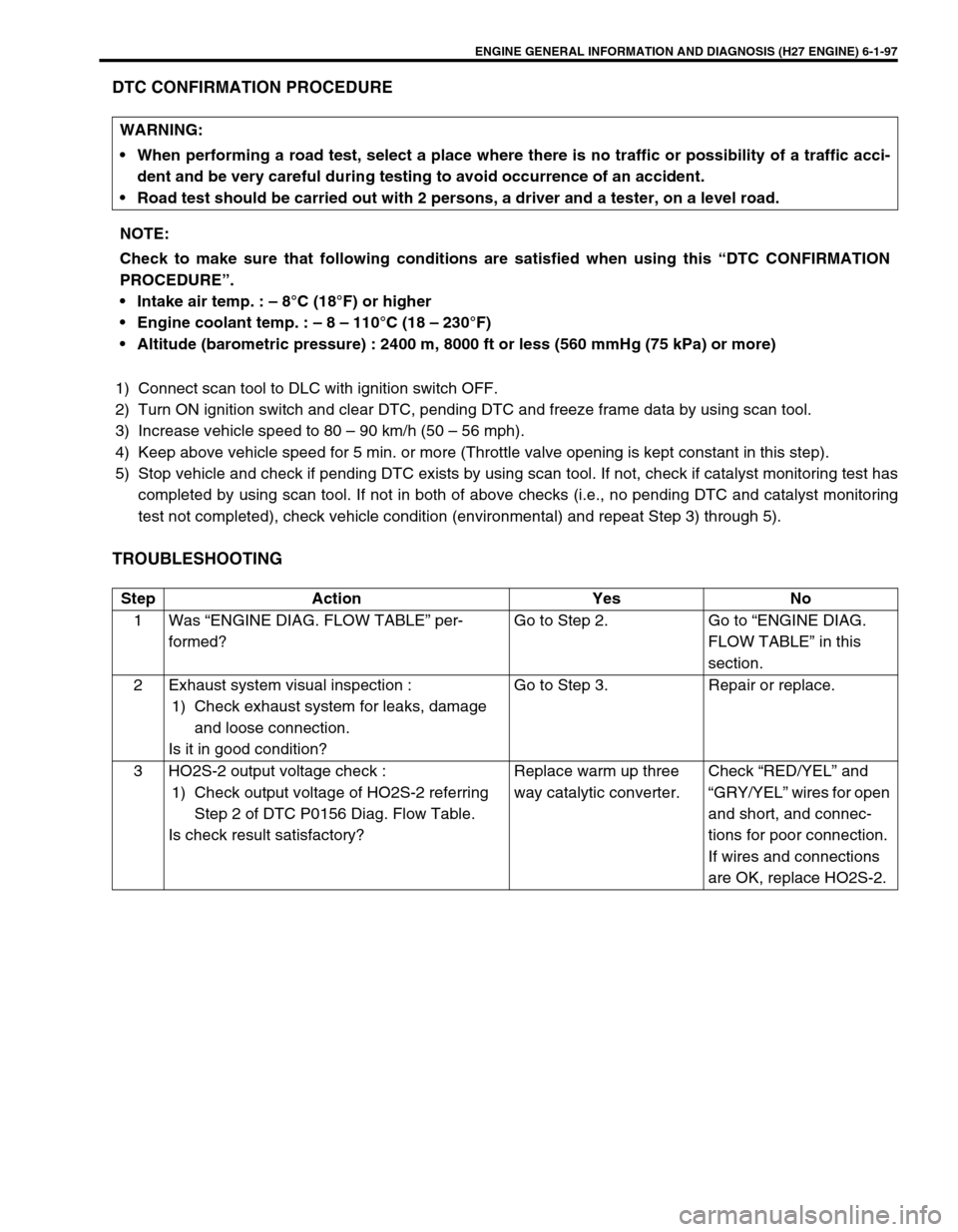
ENGINE GENERAL INFORMATION AND DIAGNOSIS (H27 ENGINE) 6-1-97
DTC CONFIRMATION PROCEDURE
1) Connect scan tool to DLC with ignition switch OFF.
2) Turn ON ignition switch and clear DTC, pending DTC and freeze frame data by using scan tool.
3) Increase vehicle speed to 80 – 90 km/h (50 – 56 mph).
4) Keep above vehicle speed for 5 min. or more (Throttle valve opening is kept constant in this step).
5) Stop vehicle and check if pending DTC exists by using scan tool. If not, check if catalyst monitoring test has
completed by using scan tool. If not in both of above checks (i.e., no pending DTC and catalyst monitoring
test not completed), check vehicle condition (environmental) and repeat Step 3) through 5).
TROUBLESHOOTING
WARNING:
When performing a road test, select a place where there is no traffic or possibility of a traffic acci-
dent and be very careful during testing to avoid occurrence of an accident.
Road test should be carried out with 2 persons, a driver and a tester, on a level road.
NOTE:
Check to make sure that following conditions are satisfied when using this “DTC CONFIRMATION
PROCEDURE”.
Intake air temp. : – 8°C (18°F) or higher
Engine coolant temp. : – 8 – 110°C (18 – 230°F)
Altitude (barometric pressure) : 2400 m, 8000 ft or less (560 mmHg (75 kPa) or more)
Step Action Yes No
1 Was “ENGINE DIAG. FLOW TABLE” per-
formed?Go to Step 2. Go to “ENGINE DIAG.
FLOW TABLE” in this
section.
2 Exhaust system visual inspection :
1) Check exhaust system for leaks, damage
and loose connection.
Is it in good condition?Go to Step 3. Repair or replace.
3 HO2S-2 output voltage check :
1) Check output voltage of HO2S-2 referring
Step 2 of DTC P0156 Diag. Flow Table.
Is check result satisfactory?Replace warm up three
way catalytic converter.Check “RED/YEL” and
“GRY/YEL” wires for open
and short, and connec-
tions for poor connection.
If wires and connections
are OK, replace HO2S-2.
Page 260 of 656
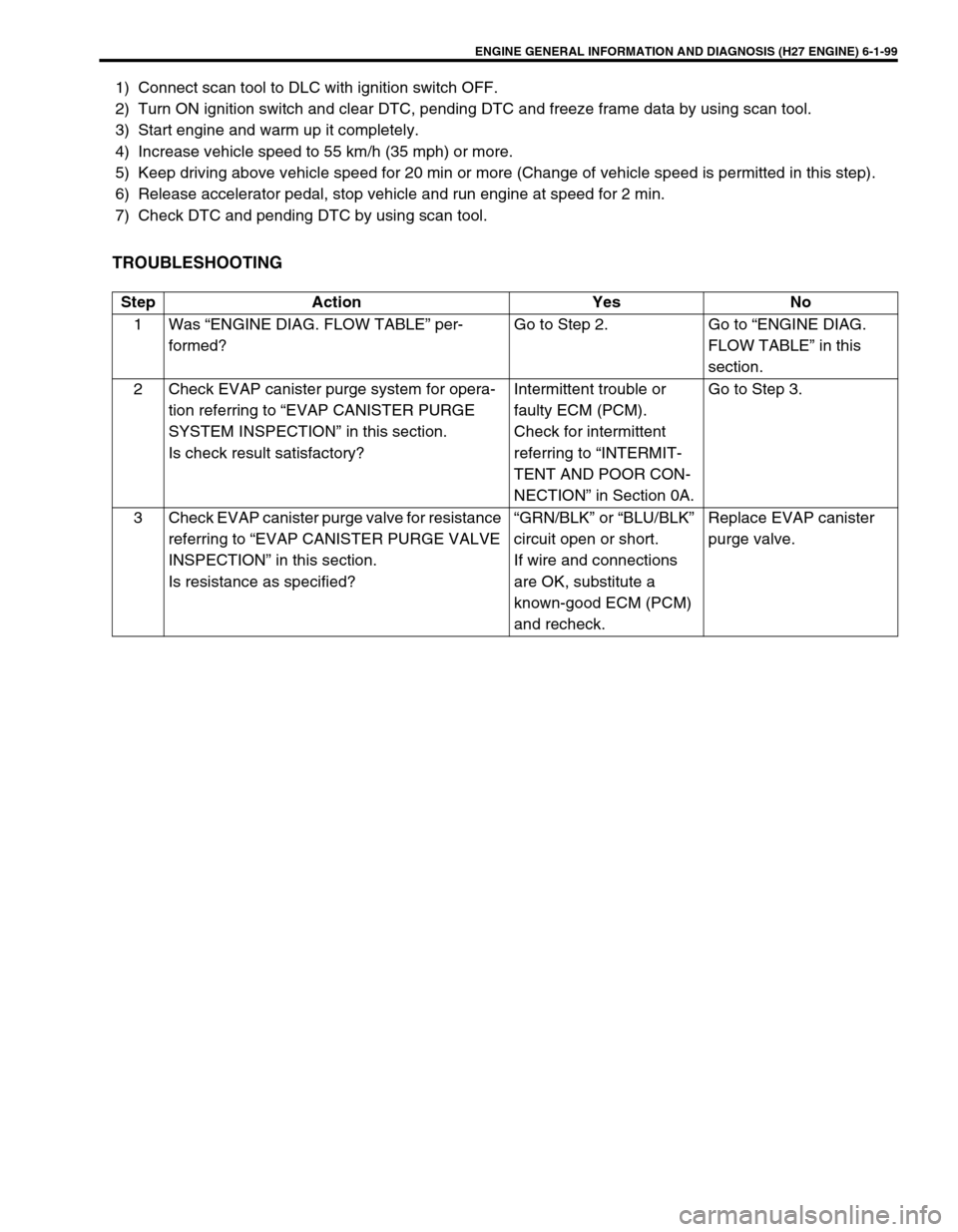
ENGINE GENERAL INFORMATION AND DIAGNOSIS (H27 ENGINE) 6-1-99
1) Connect scan tool to DLC with ignition switch OFF.
2) Turn ON ignition switch and clear DTC, pending DTC and freeze frame data by using scan tool.
3) Start engine and warm up it completely.
4) Increase vehicle speed to 55 km/h (35 mph) or more.
5) Keep driving above vehicle speed for 20 min or more (Change of vehicle speed is permitted in this step).
6) Release accelerator pedal, stop vehicle and run engine at speed for 2 min.
7) Check DTC and pending DTC by using scan tool.
TROUBLESHOOTING
Step Action Yes No
1 Was “ENGINE DIAG. FLOW TABLE” per-
formed?Go to Step 2. Go to “ENGINE DIAG.
FLOW TABLE” in this
section.
2 Check EVAP canister purge system for opera-
tion referring to “EVAP CANISTER PURGE
SYSTEM INSPECTION” in this section.
Is check result satisfactory?Intermittent trouble or
faulty ECM (PCM).
Check for intermittent
referring to “INTERMIT-
TENT AND POOR CON-
NECTION” in Section 0A.Go to Step 3.
3 Check EVAP canister purge valve for resistance
referring to “EVAP CANISTER PURGE VALVE
INSPECTION” in this section.
Is resistance as specified?“GRN/BLK” or “BLU/BLK”
circuit open or short.
If wire and connections
are OK, substitute a
known-good ECM (PCM)
and recheck.Replace EVAP canister
purge valve.
Page 271 of 656
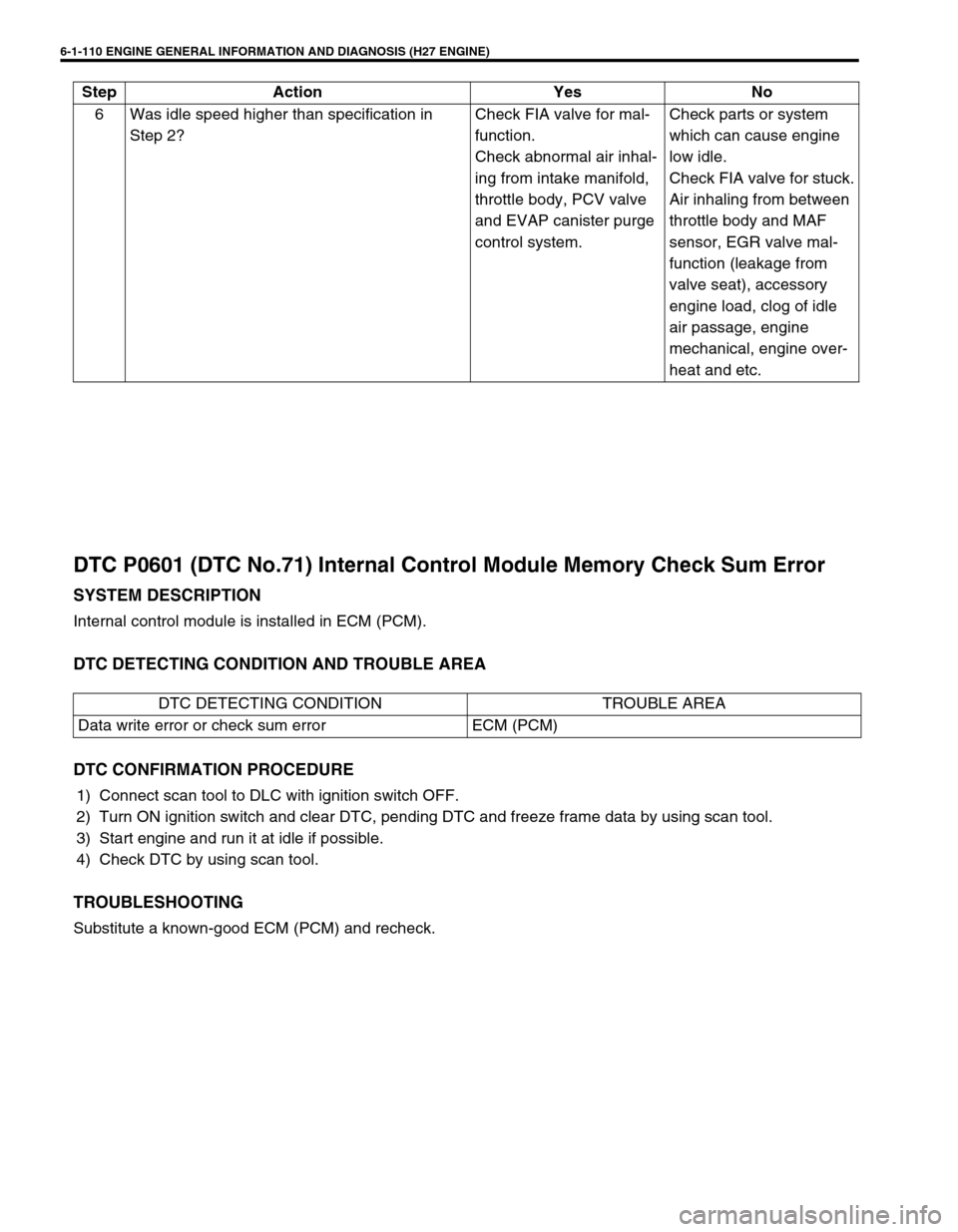
6-1-110 ENGINE GENERAL INFORMATION AND DIAGNOSIS (H27 ENGINE)
DTC P0601 (DTC No.71) Internal Control Module Memory Check Sum Error
SYSTEM DESCRIPTION
Internal control module is installed in ECM (PCM).
DTC DETECTING CONDITION AND TROUBLE AREA
DTC CONFIRMATION PROCEDURE
1) Connect scan tool to DLC with ignition switch OFF.
2) Turn ON ignition switch and clear DTC, pending DTC and freeze frame data by using scan tool.
3) Start engine and run it at idle if possible.
4) Check DTC by using scan tool.
TROUBLESHOOTING
Substitute a known-good ECM (PCM) and recheck.6 Was idle speed higher than specification in
Step 2?Check FIA valve for mal-
function.
Check abnormal air inhal-
ing from intake manifold,
throttle body, PCV valve
and EVAP canister purge
control system.Check parts or system
which can cause engine
low idle.
Check FIA valve for stuck.
Air inhaling from between
throttle body and MAF
sensor, EGR valve mal-
function (leakage from
valve seat), accessory
engine load, clog of idle
air passage, engine
mechanical, engine over-
heat and etc. Step Action Yes No
DTC DETECTING CONDITION TROUBLE AREA
Data write error or check sum error ECM (PCM)
Page 274 of 656
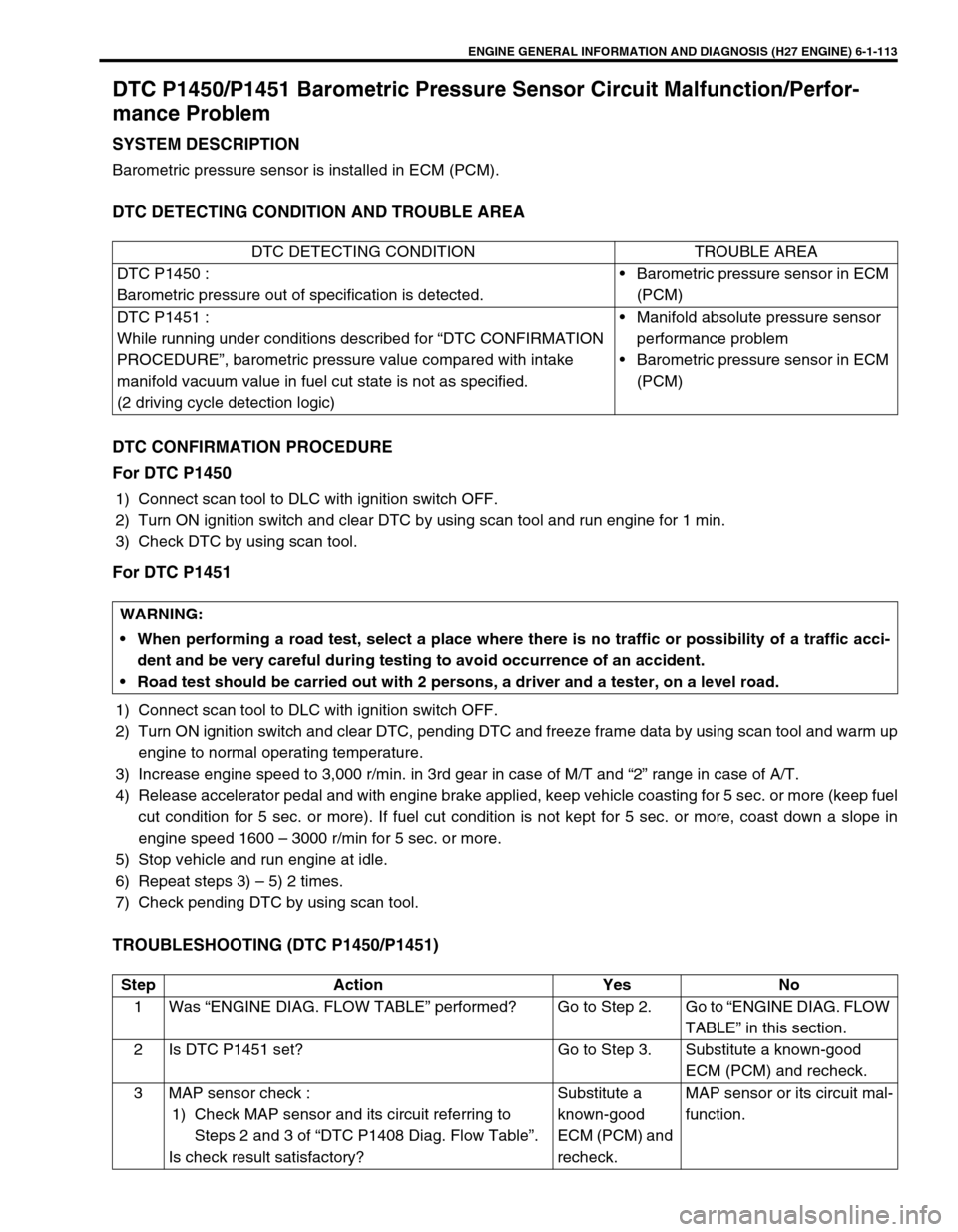
ENGINE GENERAL INFORMATION AND DIAGNOSIS (H27 ENGINE) 6-1-113
DTC P1450/P1451 Barometric Pressure Sensor Circuit Malfunction/Perfor-
mance Problem
SYSTEM DESCRIPTION
Barometric pressure sensor is installed in ECM (PCM).
DTC DETECTING CONDITION AND TROUBLE AREA
DTC CONFIRMATION PROCEDURE
For DTC P1450
1) Connect scan tool to DLC with ignition switch OFF.
2) Turn ON ignition switch and clear DTC by using scan tool and run engine for 1 min.
3) Check DTC by using scan tool.
For DTC P1451
1) Connect scan tool to DLC with ignition switch OFF.
2) Turn ON ignition switch and clear DTC, pending DTC and freeze frame data by using scan tool and warm up
engine to normal operating temperature.
3) Increase engine speed to 3,000 r/min. in 3rd gear in case of M/T and “2” range in case of A/T.
4) Release accelerator pedal and with engine brake applied, keep vehicle coasting for 5 sec. or more (keep fuel
cut condition for 5 sec. or more). If fuel cut condition is not kept for 5 sec. or more, coast down a slope in
engine speed 1600 – 3000 r/min for 5 sec. or more.
5) Stop vehicle and run engine at idle.
6) Repeat steps 3) – 5) 2 times.
7) Check pending DTC by using scan tool.
TROUBLESHOOTING (DTC P1450/P1451)
DTC DETECTING CONDITION TROUBLE AREA
DTC P1450 :
Barometric pressure out of specification is detected.•Barometric pressure sensor in ECM
(PCM)
DTC P1451 :
While running under conditions described for “DTC CONFIRMATION
PROCEDURE”, barometric pressure value compared with intake
manifold vacuum value in fuel cut state is not as specified.
(2 driving cycle detection logic)•Manifold absolute pressure sensor
performance problem
•Barometric pressure sensor in ECM
(PCM)
WARNING:
When performing a road test, select a place where there is no traffic or possibility of a traffic acci-
dent and be very careful during testing to avoid occurrence of an accident.
Road test should be carried out with 2 persons, a driver and a tester, on a level road.
Step Action Yes No
1Was “ENGINE DIAG. FLOW TABLE” performed? Go to Step 2. Go to “ENGINE DIAG. FLOW
TABLE” in this section.
2 Is DTC P1451 set? Go to Step 3. Substitute a known-good
ECM (PCM) and recheck.
3 MAP sensor check :
1) Check MAP sensor and its circuit referring to
Steps 2 and 3 of “DTC P1408 Diag. Flow Table”.
Is check result satisfactory?Substitute a
known-good
ECM (PCM) and
recheck.MAP sensor or its circuit mal-
function.
Page 285 of 656
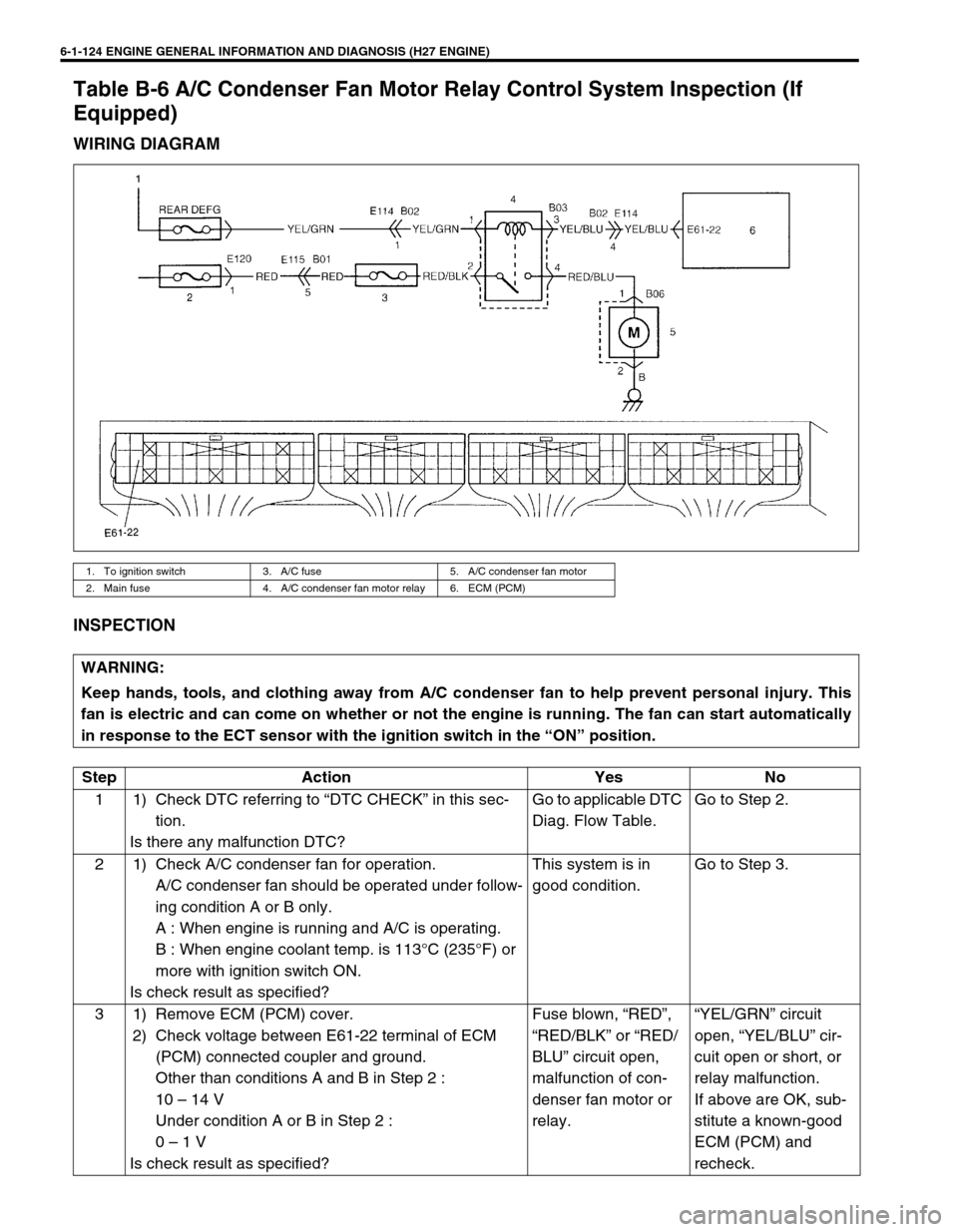
6-1-124 ENGINE GENERAL INFORMATION AND DIAGNOSIS (H27 ENGINE)
Table B-6 A/C Condenser Fan Motor Relay Control System Inspection (If
Equipped)
WIRING DIAGRAM
INSPECTION
1. To ignition switch 3. A/C fuse 5. A/C condenser fan motor
2. Main fuse 4. A/C condenser fan motor relay 6. ECM (PCM)
WARNING:
Keep hands, tools, and clothing away from A/C condenser fan to help prevent personal injury. This
fan is electric and can come on whether or not the engine is running. The fan can start automatically
in response to the ECT sensor with the ignition switch in the “ON” position.
Step Action Yes No
1 1) Check DTC referring to “DTC CHECK” in this sec-
tion.
Is there any malfunction DTC?Go to applicable DTC
Diag. Flow Table.Go to Step 2.
2 1) Check A/C condenser fan for operation.
A/C condenser fan should be operated under follow-
ing condition A or B only.
A : When engine is running and A/C is operating.
B : When engine coolant temp. is 113°C (235°F) or
more with ignition switch ON.
Is check result as specified?This system is in
good condition.Go to Step 3.
3 1) Remove ECM (PCM) cover.
2) Check voltage between E61-22 terminal of ECM
(PCM) connected coupler and ground.
Other than conditions A and B in Step 2 :
10 – 14 V
Under condition A or B in Step 2 :
0 – 1 V
Is check result as specified?Fuse blown, “RED”,
“RED/BLK” or “RED/
BLU” circuit open,
malfunction of con-
denser fan motor or
relay.“YEL/GRN” circuit
open, “YEL/BLU” cir-
cuit open or short, or
relay malfunction.
If above are OK, sub-
stitute a known-good
ECM (PCM) and
recheck.