diff SUZUKI GRAND VITARA 2001 2.G Manual PDF
[x] Cancel search | Manufacturer: SUZUKI, Model Year: 2001, Model line: GRAND VITARA, Model: SUZUKI GRAND VITARA 2001 2.GPages: 656, PDF Size: 14.31 MB
Page 575 of 656
10A-6 SEAT BELT
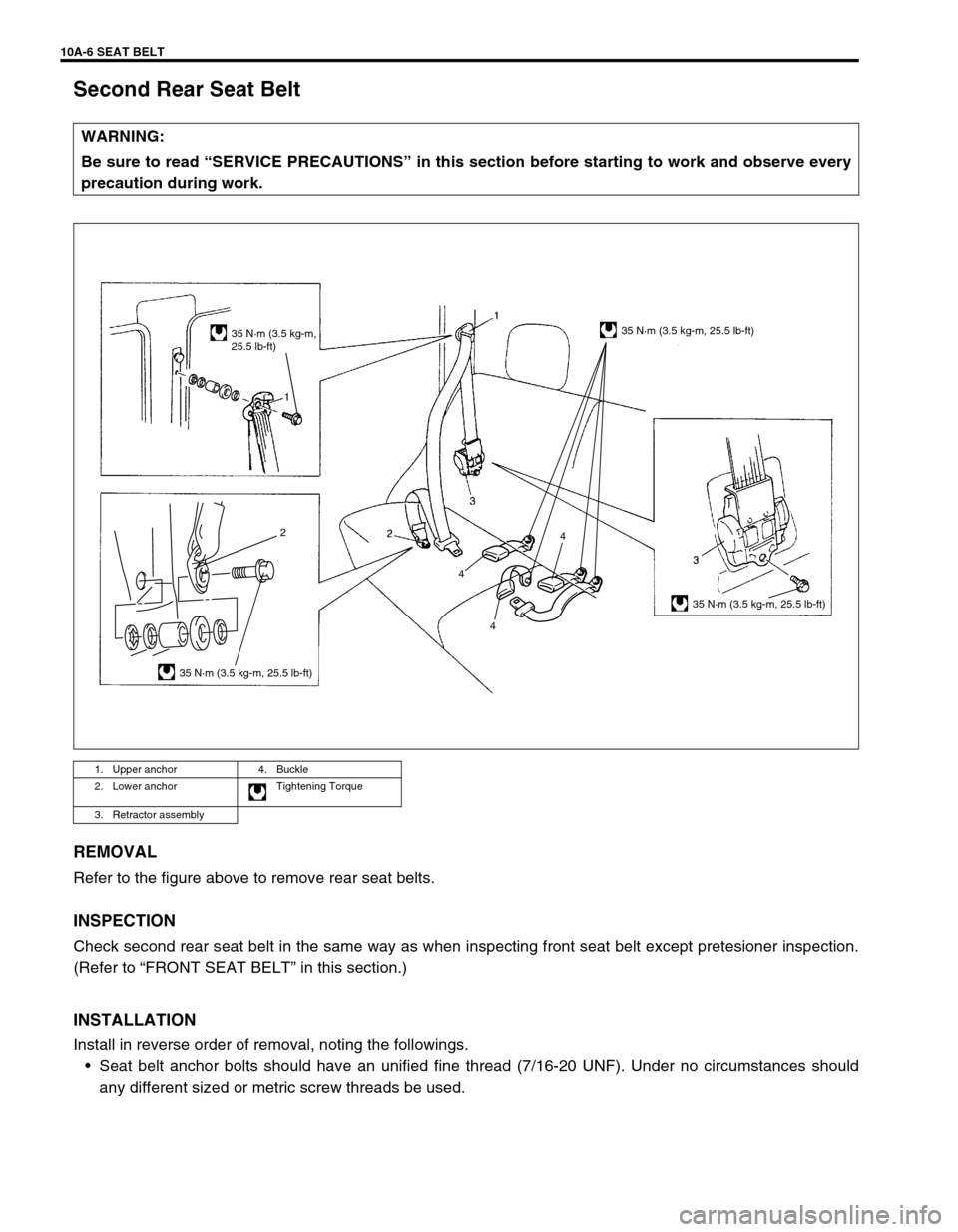
Second Rear Seat Belt
REMOVAL
Refer to the figure above to remove rear seat belts.
INSPECTION
Check second rear seat belt in the same way as when inspecting front seat belt except pretesioner inspection.
(Refer to “FRONT SEAT BELT” in this section.)
INSTALLATION
Install in reverse order of removal, noting the followings.
•Seat belt anchor bolts should have an unified fine thread (7/16-20 UNF). Under no circumstances should
any different sized or metric screw threads be used. WARNING:
Be sure to read “SERVICE PRECAUTIONS” in this section before starting to work and observe every
precaution during work.
1. Upper anchor 4. Buckle
2. Lower anchor Tightening Torque
3. Retractor assembly
2
35 N·m (3.5 kg-m, 25.5 lb-ft)
35 N·m (3.5 kg-m, 25.5 lb-ft)
35 N·m (3.5 kg-m, 25.5 lb-ft)
35 N·m (3.5 kg-m,
25.5 lb-ft)
4
4
4
Page 576 of 656
SEAT BELT 10A-7
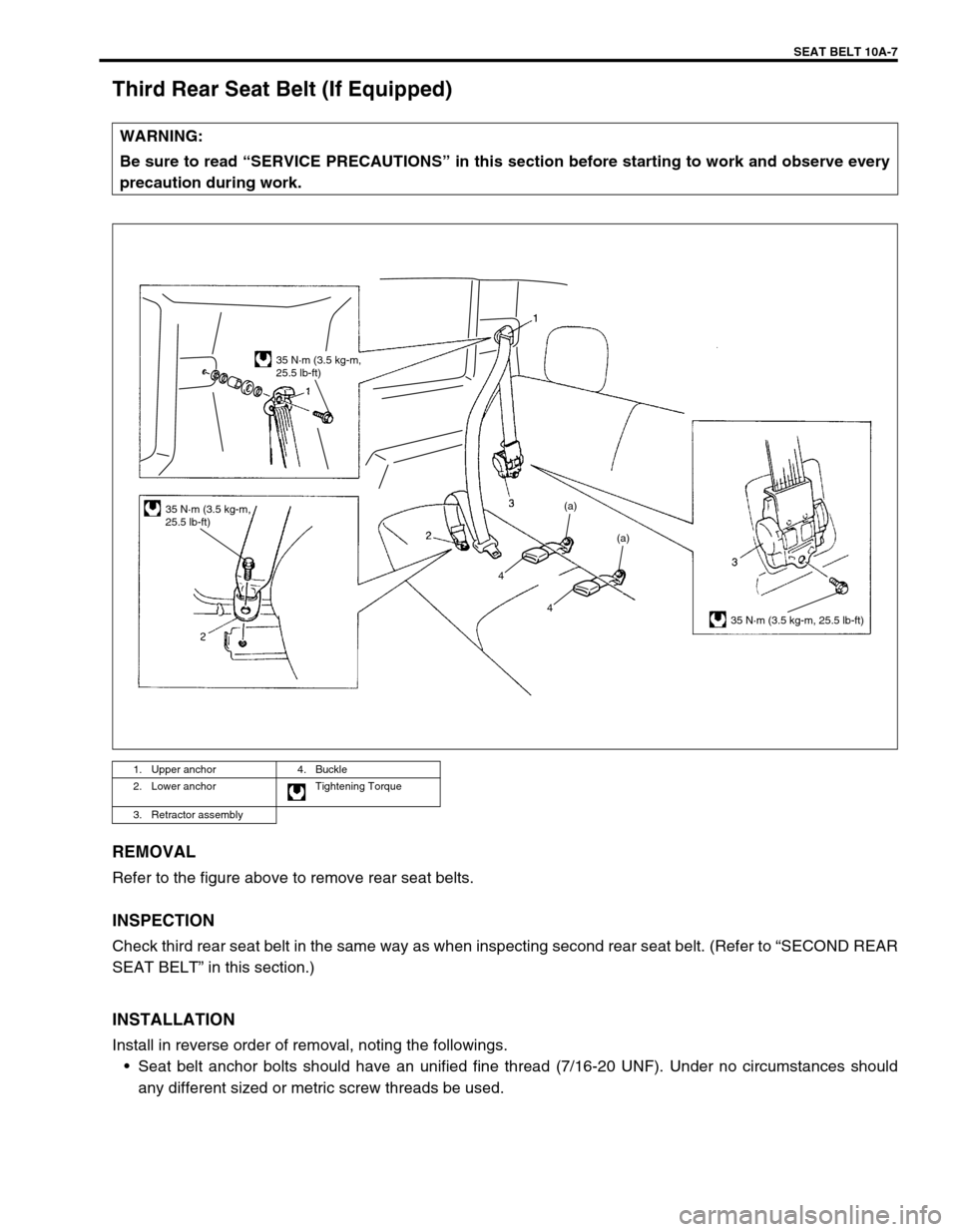
Third Rear Seat Belt (If Equipped)
REMOVAL
Refer to the figure above to remove rear seat belts.
INSPECTION
Check third rear seat belt in the same way as when inspecting second rear seat belt. (Refer to “SECOND REAR
SEAT BELT” in this section.)
INSTALLATION
Install in reverse order of removal, noting the followings.
•Seat belt anchor bolts should have an unified fine thread (7/16-20 UNF). Under no circumstances should
any different sized or metric screw threads be used. WARNING:
Be sure to read “SERVICE PRECAUTIONS” in this section before starting to work and observe every
precaution during work.
1. Upper anchor 4. Buckle
2. Lower anchor Tightening Torque
3. Retractor assembly
35 N·m (3.5 kg-m,
25.5 lb-ft)
35 N·m (3.5 kg-m,
25.5 lb-ft)
35 N·m (3.5 kg-m, 25.5 lb-ft)
4
4
(a)
(a)
Page 579 of 656

10B-2 AIR BAG SYSTEM
DTC B1031 – Power Source Voltage
High........................................................... 10B-33
DTC B1032 – Power Source Voltage
Low ........................................................... 10B-33
DTC B1035 – RH Forward Sensor Circuit
Open or Short to Ground .......................... 10B-36
DTC B1036 – RH Forward Sensor Circuit
Short Between Two Wires or Short to
Power Circuit............................................. 10B-36
DTC B1037 – LH Forward Sensor Circuit
Open or Short to Ground .......................... 10B-36
DTC B1038 – LH Forward Sensor Circuit
Short Between Two Wires or Short to
Power Circuit............................................. 10B-36
DTC B1041 – Driver Pretensioner Initiator
Circuit Resistance High............................. 10B-40
DTC B1042 – Driver Pretensioner Initiator
Circuit Resistance Low ............................. 10B-40
DTC B1043 – Driver Pretensioner Initiator
Circuit Short to Ground ............................. 10B-40
DTC B1044 – Driver Pretensioner Initiator
Circuit Short to Power Circuit .................... 10B-40
DTC B1045 – Passenger Pretensioner
Initiator Circuit Resistance High ................ 10B-40
DTC B1046 – Passenger Pretensioner
Initiator Circuit Resistance Low................. 10B-40
DTC B1047 – Passenger Pretensioner
Initiator Circuit Short to Ground ................ 10B-40
DTC B1048 – Passenger Pretensioner
Initiator Circuit Short to Power Circuit ....... 10B-40
DTC B1051 – Frontal Crash Detected
(System Activation Command Outputted). 10B-46DTC B1061 – “AIR BAG” Warning Lamp
Circuit Failure............................................ 10B-47
DTC B1071 – Internal SDM Fault ............. 10B-48
DTC B1013 – System Specifications
Different from SDM Specifications ............ 10B-48
On-Vehicle Service ..................................... 10B-49
Service Precautions .................................. 10B-49
Service and diagnosis ........................... 10B-49
Disabling air bag system ....................... 10B-50
Enabling air bag system........................ 10B-50
Handling and storage ............................ 10B-51
Repairs and Inspections Required after
an Accident ............................................... 10B-56
Accident with deployment/activation -
component replacement ....................... 10B-56
Accident with or without deployment/
activation - component inspections....... 10B-57
SDM .......................................................... 10B-60
Forward Sensor ........................................ 10B-62
Seat Belt Pretensioner .............................. 10B-64
Air Bag (Inflator) Module and Seat Belt
Pretensioner Disposal................................ 10B-65
Deployment/Activation Outside Vehicle .... 10B-66
Deployment/Activation Inside Vehicle....... 10B-72
Deployed Air Bag (Inflator) Module and
Activated Seat Belt Pretensioner
Disposal .................................................... 10B-76
Tightening Torque Specification............... 10B-77
Special Tool ................................................ 10B-77
Page 592 of 656
AIR BAG SYSTEM 10B-15
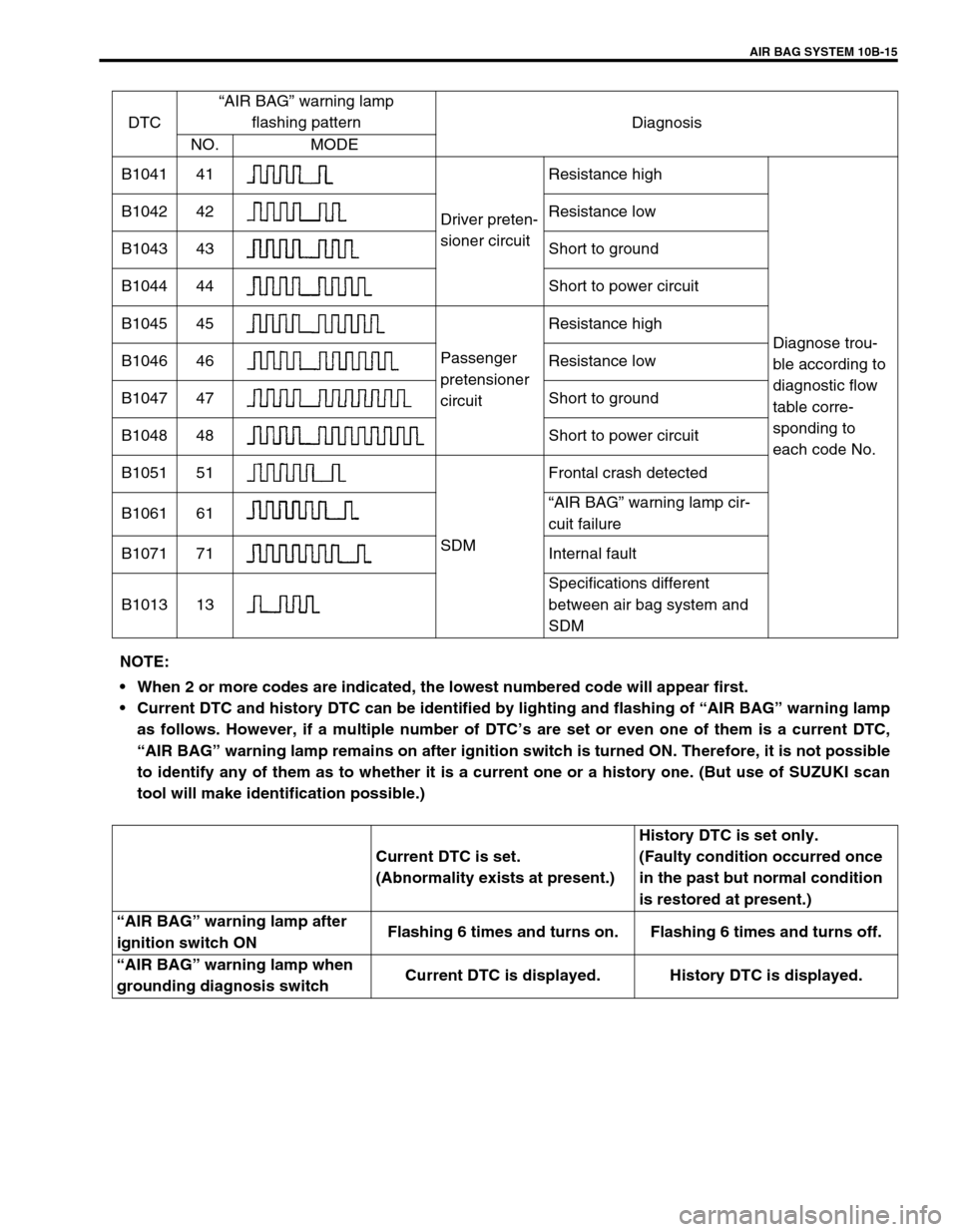
DTC“AIR BAG” warning lamp
flashing pattern
Diagnosis
NO. MODE
B1041 41
Driver preten-
sioner circuitResistance high
Diagnose trou-
ble according to
diagnostic flow
table corre-
sponding to
each code No. B1042 42 Resistance low
B1043 43 Short to ground
B1044 44 Short to power circuit
B1045 45
Passenger
pretensioner
circuitResistance high
B1046 46 Resistance low
B1047 47 Short to ground
B1048 48 Short to power circuit
B1051 51
SDMFrontal crash detected
B1061 61“AIR BAG” warning lamp cir-
cuit failure
B1071 71 Internal fault
B1013 13Specifications different
between air bag system and
SDM
NOTE:
When 2 or more codes are indicated, the lowest numbered code will appear first.
Current DTC and history DTC can be identified by lighting and flashing of “AIR BAG” warning lamp
as follows. However, if a multiple number of DTC’s are set or even one of them is a current DTC,
“AIR BAG” warning lamp remains on after ignition switch is turned ON. Therefore, it is not possible
to identify any of them as to whether it is a current one or a history one. (But use of SUZUKI scan
tool will make identification possible.)
Current DTC is set.
(Abnormality exists at present.)History DTC is set only.
(Faulty condition occurred once
in the past but normal condition
is restored at present.)
“AIR BAG” warning lamp after
ignition switch ONFlashing 6 times and turns on. Flashing 6 times and turns off.
“AIR BAG” warning lamp when
grounding diagnosis switchCurrent DTC is displayed. History DTC is displayed.
Page 625 of 656
10B-48 AIR BAG SYSTEM
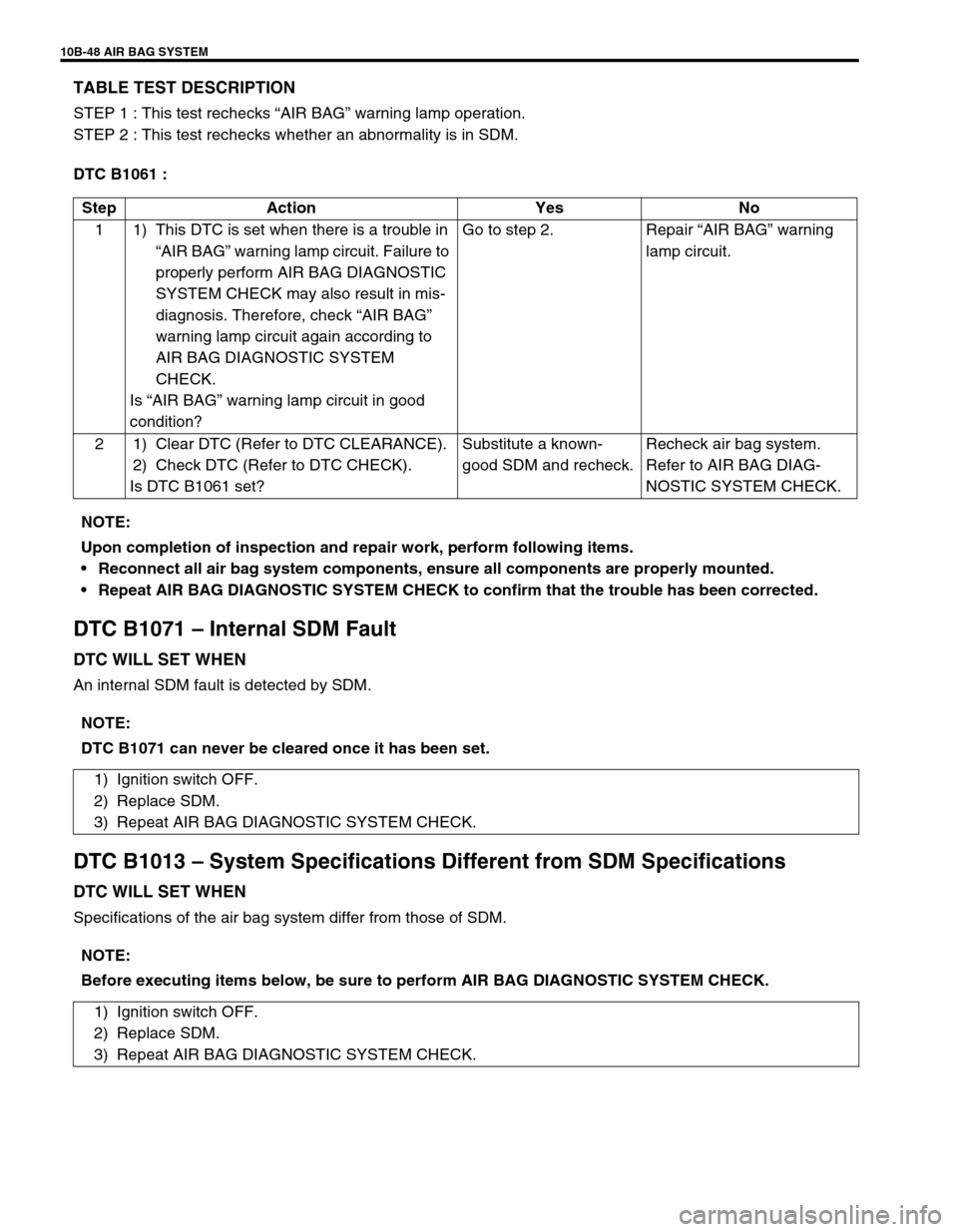
TABLE TEST DESCRIPTION
STEP 1 : This test rechecks “AIR BAG” warning lamp operation.
STEP 2 : This test rechecks whether an abnormality is in SDM.
DTC B1061 :
DTC B1071 – Internal SDM Fault
DTC WILL SET WHEN
An internal SDM fault is detected by SDM.
DTC B1013 – System Specifications Different from SDM Specifications
DTC WILL SET WHEN
Specifications of the air bag system differ from those of SDM.Step Action Yes No
1 1) This DTC is set when there is a trouble in
“AIR BAG” warning lamp circuit. Failure to
properly perform AIR BAG DIAGNOSTIC
SYSTEM CHECK may also result in mis-
diagnosis. Therefore, check “AIR BAG”
warning lamp circuit again according to
AIR BAG DIAGNOSTIC SYSTEM
CHECK.
Is “AIR BAG” warning lamp circuit in good
condition?Go to step 2. Repair “AIR BAG” warning
lamp circuit.
2 1) Clear DTC (Refer to DTC CLEARANCE).
2) Check DTC (Refer to DTC CHECK).
Is DTC B1061 set?Substitute a known-
good SDM and recheck.Recheck air bag system.
Refer to AIR BAG DIAG-
NOSTIC SYSTEM CHECK.
NOTE:
Upon completion of inspection and repair work, perform following items.
Reconnect all air bag system components, ensure all components are properly mounted.
Repeat AIR BAG DIAGNOSTIC SYSTEM CHECK to confirm that the trouble has been corrected.
NOTE:
DTC B1071 can never be cleared once it has been set.
1) Ignition switch OFF.
2) Replace SDM.
3) Repeat AIR BAG DIAGNOSTIC SYSTEM CHECK.
NOTE:
Before executing items below, be sure to perform AIR BAG DIAGNOSTIC SYSTEM CHECK.
1) Ignition switch OFF.
2) Replace SDM.
3) Repeat AIR BAG DIAGNOSTIC SYSTEM CHECK.
Page 632 of 656
AIR BAG SYSTEM 10B-55
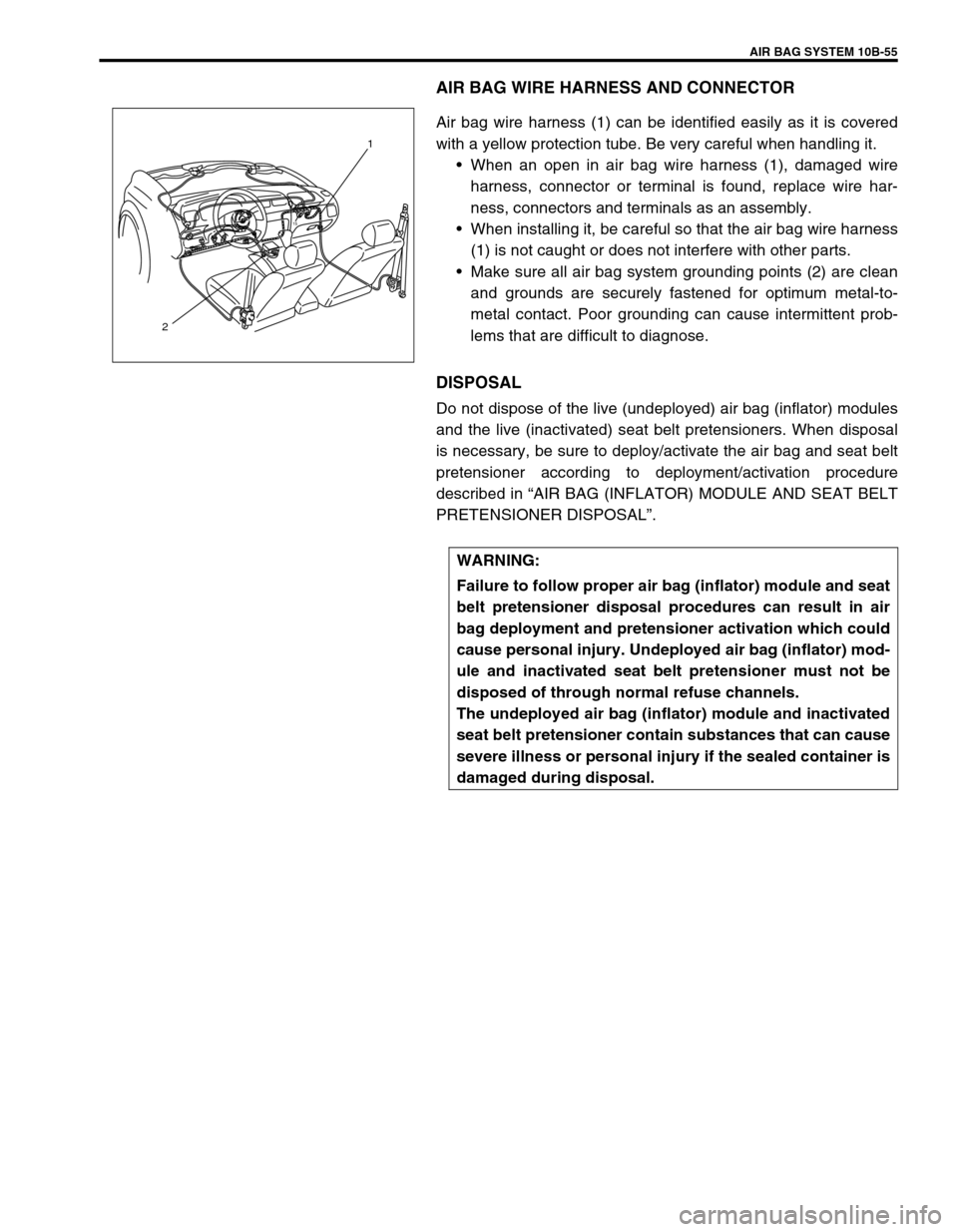
AIR BAG WIRE HARNESS AND CONNECTOR
Air bag wire harness (1) can be identified easily as it is covered
with a yellow protection tube. Be very careful when handling it.
•When an open in air bag wire harness (1), damaged wire
harness, connector or terminal is found, replace wire har-
ness, connectors and terminals as an assembly.
•When installing it, be careful so that the air bag wire harness
(1) is not caught or does not interfere with other parts.
•Make sure all air bag system grounding points (2) are clean
and grounds are securely fastened for optimum metal-to-
metal contact. Poor grounding can cause intermittent prob-
lems that are difficult to diagnose.
DISPOSAL
Do not dispose of the live (undeployed) air bag (inflator) modules
and the live (inactivated) seat belt pretensioners. When disposal
is necessary, be sure to deploy/activate the air bag and seat belt
pretensioner according to deployment/activation procedure
described in “AIR BAG (INFLATOR) MODULE AND SEAT BELT
PRETENSIONER DISPOSAL”.
15
21
WARNING:
Failure to follow proper air bag (inflator) module and seat
belt pretensioner disposal procedures can result in air
bag deployment and pretensioner activation which could
cause personal injury. Undeployed air bag (inflator) mod-
ule and inactivated seat belt pretensioner must not be
disposed of through normal refuse channels.
The undeployed air bag (inflator) module and inactivated
seat belt pretensioner contain substances that can cause
severe illness or personal injury if the sealed container is
damaged during disposal.