diff SUZUKI GRAND VITARA 2001 2.G Owner's Guide
[x] Cancel search | Manufacturer: SUZUKI, Model Year: 2001, Model line: GRAND VITARA, Model: SUZUKI GRAND VITARA 2001 2.GPages: 656, PDF Size: 14.31 MB
Page 379 of 656
6E2-46 ENGINE AND EMISSION CONTROL SYSTEM (SEQUENTIAL MULTIPORT FUEL INJECTION FOR H27 ENGINE)
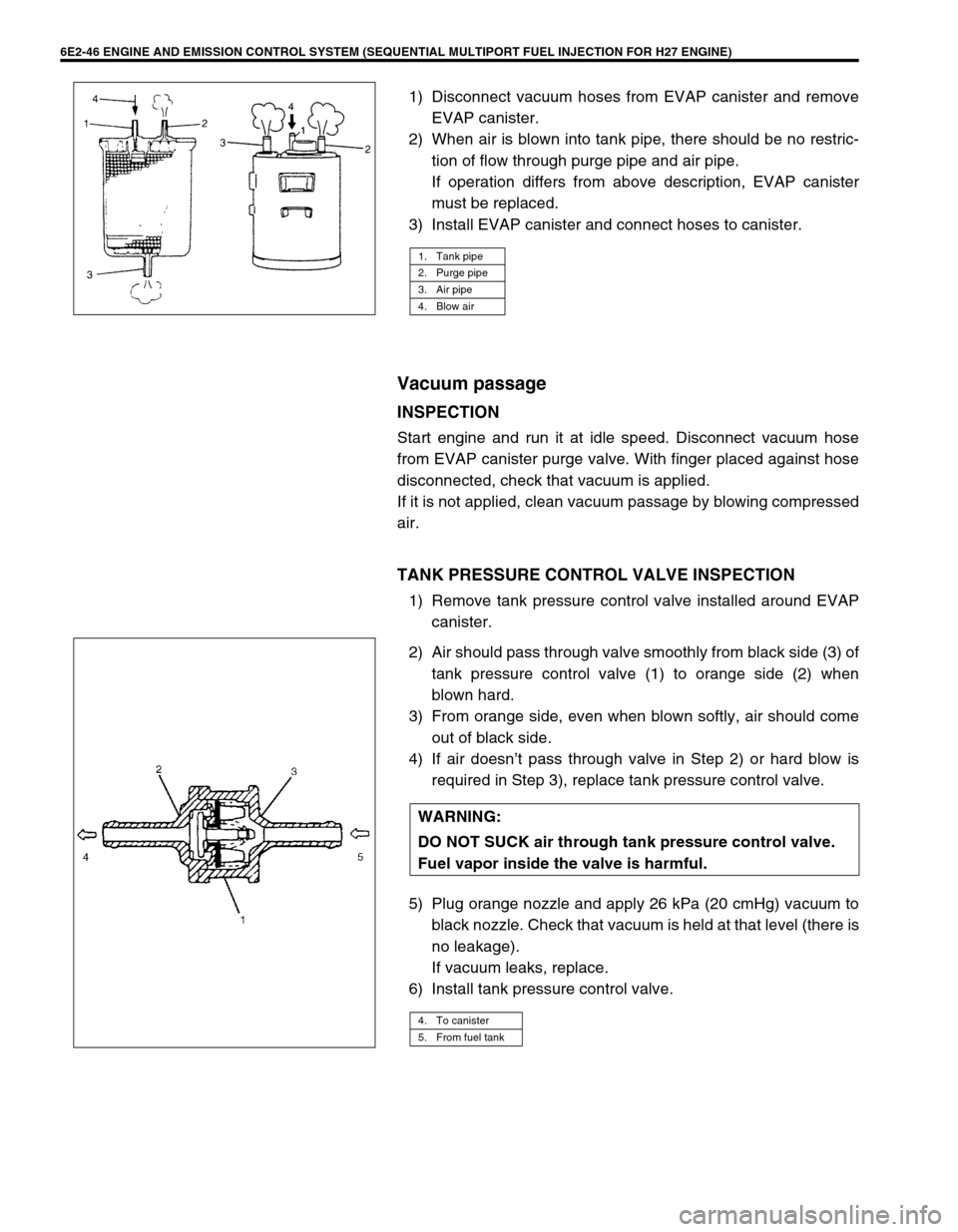
1) Disconnect vacuum hoses from EVAP canister and remove
EVAP canister.
2) When air is blown into tank pipe, there should be no restric-
tion of flow through purge pipe and air pipe.
If operation differs from above description, EVAP canister
must be replaced.
3) Install EVAP canister and connect hoses to canister.
Vacuum passage
INSPECTION
Start engine and run it at idle speed. Disconnect vacuum hose
from EVAP canister purge valve. With finger placed against hose
disconnected, check that vacuum is applied.
If it is not applied, clean vacuum passage by blowing compressed
air.
TANK PRESSURE CONTROL VALVE INSPECTION
1) Remove tank pressure control valve installed around EVAP
canister.
2) Air should pass through valve smoothly from black side (3) of
tank pressure control valve (1) to orange side (2) when
blown hard.
3) From orange side, even when blown softly, air should come
out of black side.
4) If air doesn’t pass through valve in Step 2) or hard blow is
required in Step 3), replace tank pressure control valve.
5) Plug orange nozzle and apply 26 kPa (20 cmHg) vacuum to
black nozzle. Check that vacuum is held at that level (there is
no leakage).
If vacuum leaks, replace.
6) Install tank pressure control valve.
1. Tank pipe
2. Purge pipe
3. Air pipe
4. Blow air
WARNING:
DO NOT SUCK air through tank pressure control valve.
Fuel vapor inside the valve is harmful.
4. To canister
5. From fuel tank
Page 412 of 656
AUTOMATIC TRANSMISSION (4 A/T) 7B1-3
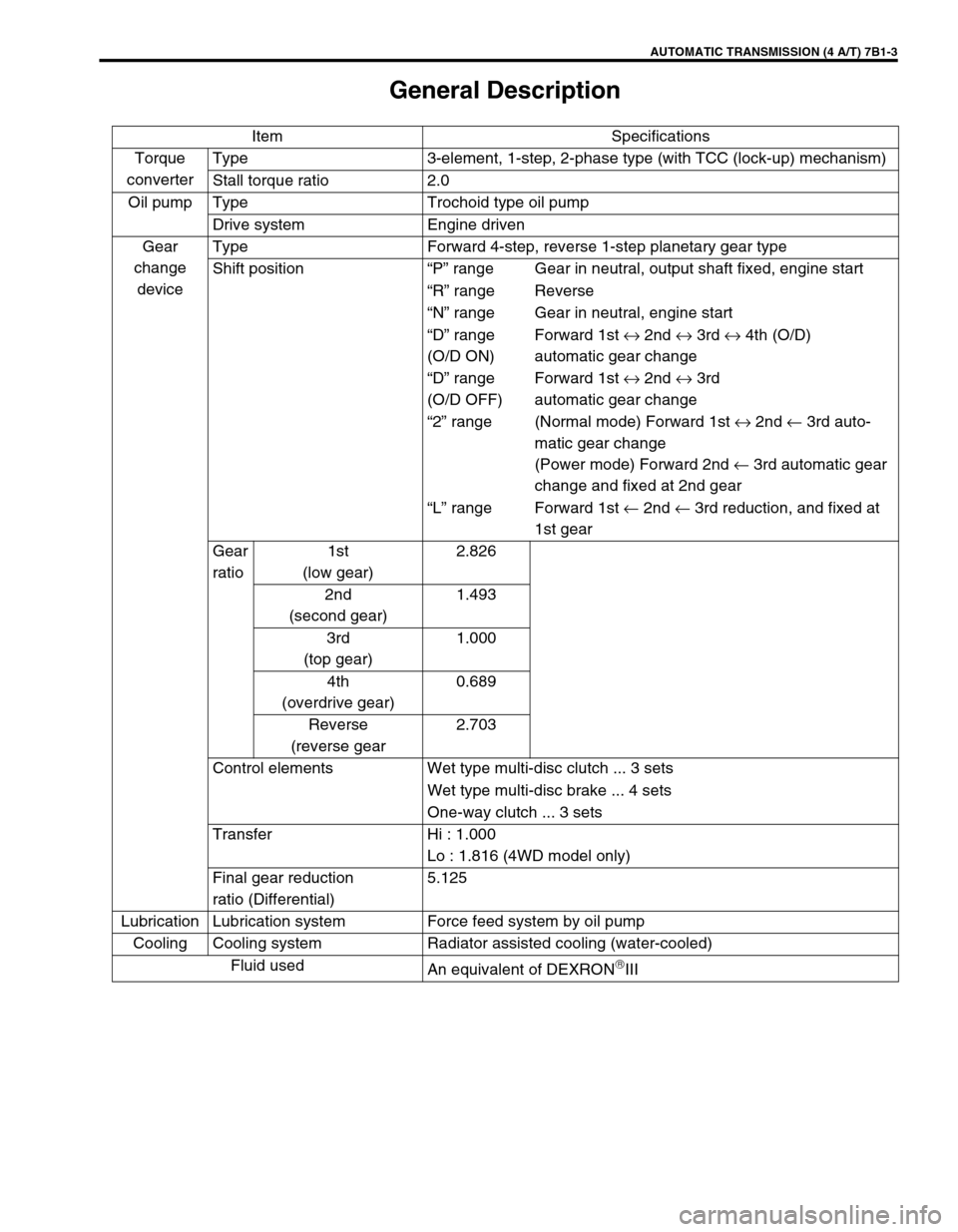
General Description
Item Specifications
Torque
converterType 3-element, 1-step, 2-phase type (with TCC (lock-up) mechanism)
Stall torque ratio 2.0
Oil pump Type Trochoid type oil pump
Drive system Engine driven
Gear
change
deviceType Forward 4-step, reverse 1-step planetary gear type
Shift position“P” range Gear in neutral, output shaft fixed, engine start
“R” range Reverse
“N” range Gear in neutral, engine start
“D” range
(O/D ON)Forward 1st ↔ 2nd ↔ 3rd ↔ 4th (O/D)
automatic gear change
“D” range
(O/D OFF)Forward 1st ↔ 2nd ↔ 3rd
automatic gear change
“2” range (Normal mode) Forward 1st ↔ 2nd ← 3rd auto-
matic gear change
(Power mode) Forward 2nd ← 3rd automatic gear
change and fixed at 2nd gear
“L” range Forward 1st ← 2nd ← 3rd reduction, and fixed at
1st gear
Gear
ratio1st
(low gear)2.826
2nd
(second gear)1.493
3rd
(top gear)1.000
4th
(overdrive gear)0.689
Reverse
(reverse gear2.703
Control elements Wet type multi-disc clutch ... 3 sets
Wet type multi-disc brake ... 4 sets
One-way clutch ... 3 sets
Transfer Hi : 1.000
Lo : 1.816 (4WD model only)
Final gear reduction
ratio (Differential)5.125
Lubrication Lubrication system Force feed system by oil pump
Cooling Cooling system Radiator assisted cooling (water-cooled)
Fluid used
An equivalent of DEXRON
III
Page 420 of 656
AUTOMATIC TRANSMISSION (4 A/T) 7B1-11
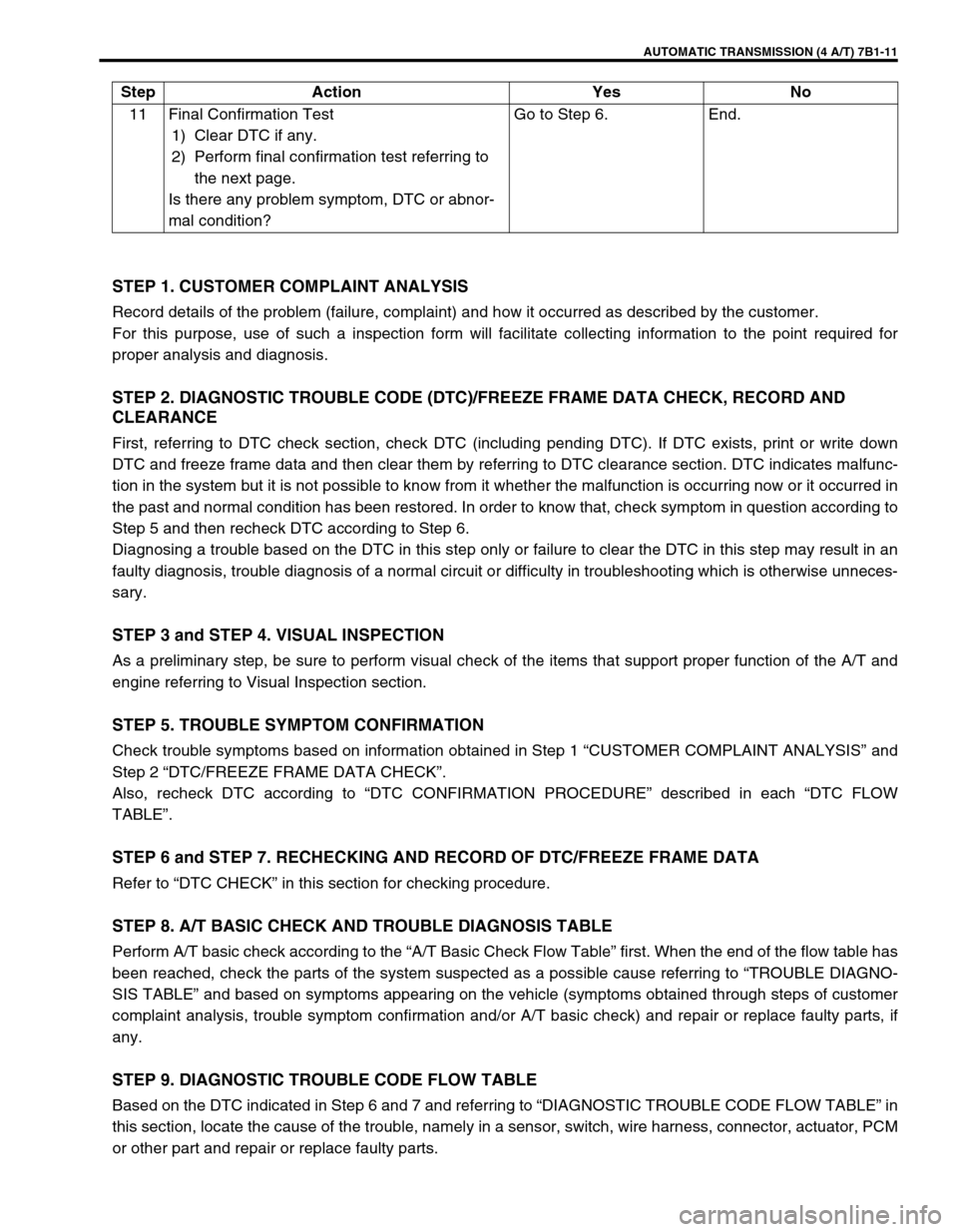
STEP 1. CUSTOMER COMPLAINT ANALYSIS
Record details of the problem (failure, complaint) and how it occurred as described by the customer.
For this purpose, use of such a inspection form will facilitate collecting information to the point required for
proper analysis and diagnosis.
STEP 2. DIAGNOSTIC TROUBLE CODE (DTC)/FREEZE FRAME DATA CHECK, RECORD AND
CLEARANCE
First, referring to DTC check section, check DTC (including pending DTC). If DTC exists, print or write down
DTC and freeze frame data and then clear them by referring to DTC clearance section. DTC indicates malfunc-
tion in the system but it is not possible to know from it whether the malfunction is occurring now or it occurred in
the past and normal condition has been restored. In order to know that, check symptom in question according to
Step 5 and then recheck DTC according to Step 6.
Diagnosing a trouble based on the DTC in this step only or failure to clear the DTC in this step may result in an
faulty diagnosis, trouble diagnosis of a normal circuit or difficulty in troubleshooting which is otherwise unneces-
sary.
STEP 3 and STEP 4. VISUAL INSPECTION
As a preliminary step, be sure to perform visual check of the items that support proper function of the A/T and
engine referring to Visual Inspection section.
STEP 5. TROUBLE SYMPTOM CONFIRMATION
Check trouble symptoms based on information obtained in Step 1 “CUSTOMER COMPLAINT ANALYSIS” and
Step 2 “DTC/FREEZE FRAME DATA CHECK”.
Also, recheck DTC according to “DTC CONFIRMATION PROCEDURE” described in each “DTC FLOW
TABLE”.
STEP 6 and STEP 7. RECHECKING AND RECORD OF DTC/FREEZE FRAME DATA
Refer to “DTC CHECK” in this section for checking procedure.
STEP 8. A/T BASIC CHECK AND TROUBLE DIAGNOSIS TABLE
Perform A/T basic check according to the “A/T Basic Check Flow Table” first. When the end of the flow table has
been reached, check the parts of the system suspected as a possible cause referring to “TROUBLE DIAGNO-
SIS TABLE” and based on symptoms appearing on the vehicle (symptoms obtained through steps of customer
complaint analysis, trouble symptom confirmation and/or A/T basic check) and repair or replace faulty parts, if
any.
STEP 9. DIAGNOSTIC TROUBLE CODE FLOW TABLE
Based on the DTC indicated in Step 6 and 7 and referring to “DIAGNOSTIC TROUBLE CODE FLOW TABLE” in
this section, locate the cause of the trouble, namely in a sensor, switch, wire harness, connector, actuator, PCM
or other part and repair or replace faulty parts.11 Final Confirmation Test
1) Clear DTC if any.
2) Perform final confirmation test referring to
the next page.
Is there any problem symptom, DTC or abnor-
mal condition?Go to Step 6. End. Step Action Yes No
Page 474 of 656
DIFFERENTIAL (FRONT) 7E-1
7E
SECTION 7E
DIFFERENTIAL (FRONT)
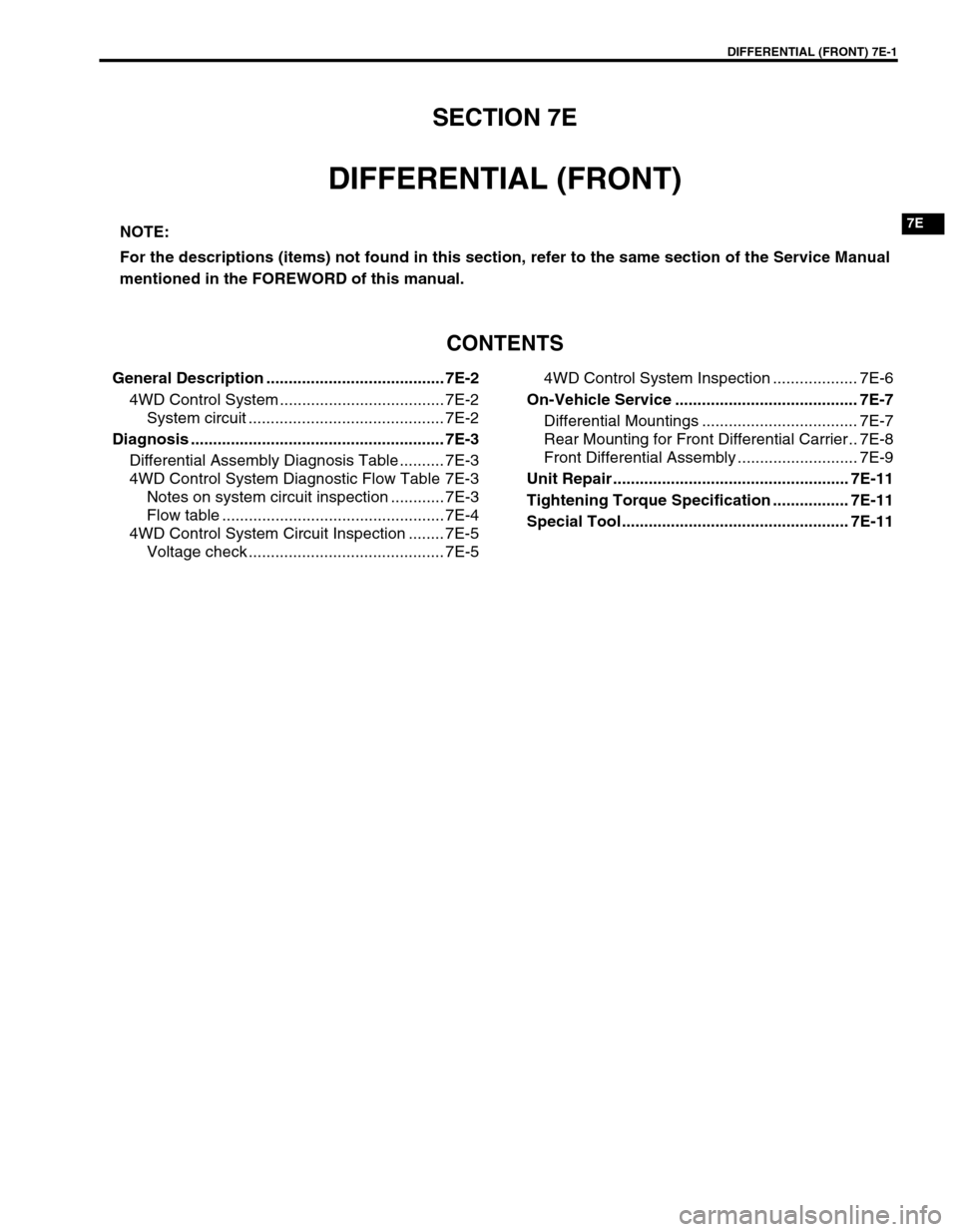
CONTENTS
General Description ........................................ 7E-2
4WD Control System ..................................... 7E-2
System circuit ............................................ 7E-2
Diagnosis ......................................................... 7E-3
Differential Assembly Diagnosis Table .......... 7E-3
4WD Control System Diagnostic Flow Table 7E-3
Notes on system circuit inspection ............ 7E-3
Flow table .................................................. 7E-4
4WD Control System Circuit Inspection ........ 7E-5
Voltage check ............................................ 7E-54WD Control System Inspection ................... 7E-6
On-Vehicle Service ......................................... 7E-7
Differential Mountings ................................... 7E-7
Rear Mounting for Front Differential Carrier.. 7E-8
Front Differential Assembly ........................... 7E-9
Unit Repair ..................................................... 7E-11
Tightening Torque Specification ................. 7E-11
Special Tool ................................................... 7E-11
NOTE:
For the descriptions (items) not found in this section, refer to the same section of the Service Manual
mentioned in the FOREWORD of this manual.
Page 475 of 656
7E-2 DIFFERENTIAL (FRONT)
General Description
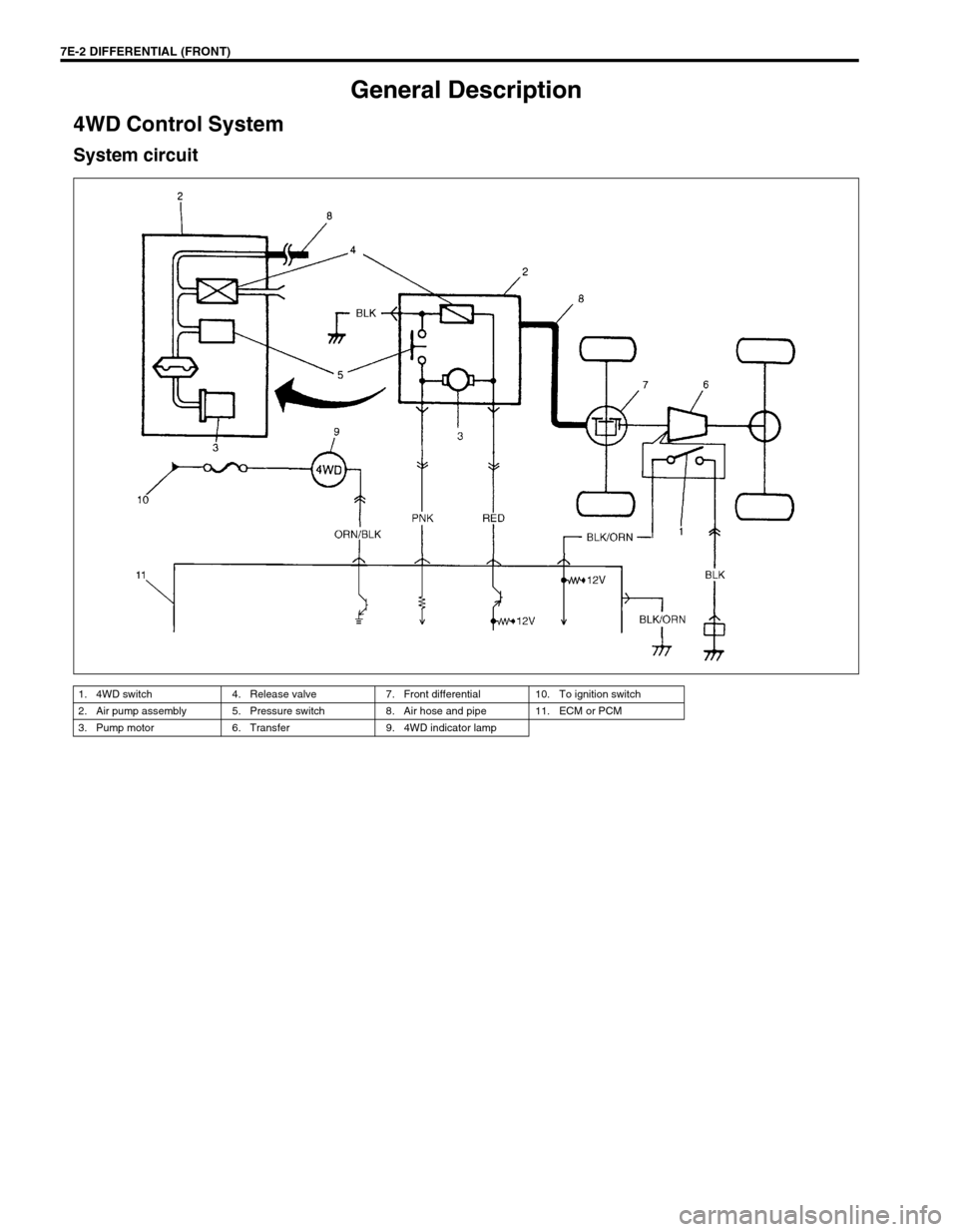
4WD Control System
System circuit
1. 4WD switch 4. Release valve 7. Front differential 10. To ignition switch
2. Air pump assembly 5. Pressure switch 8. Air hose and pipe 11. ECM or PCM
3. Pump motor 6. Transfer 9. 4WD indicator lamp
Page 476 of 656
DIFFERENTIAL (FRONT) 7E-3
Diagnosis
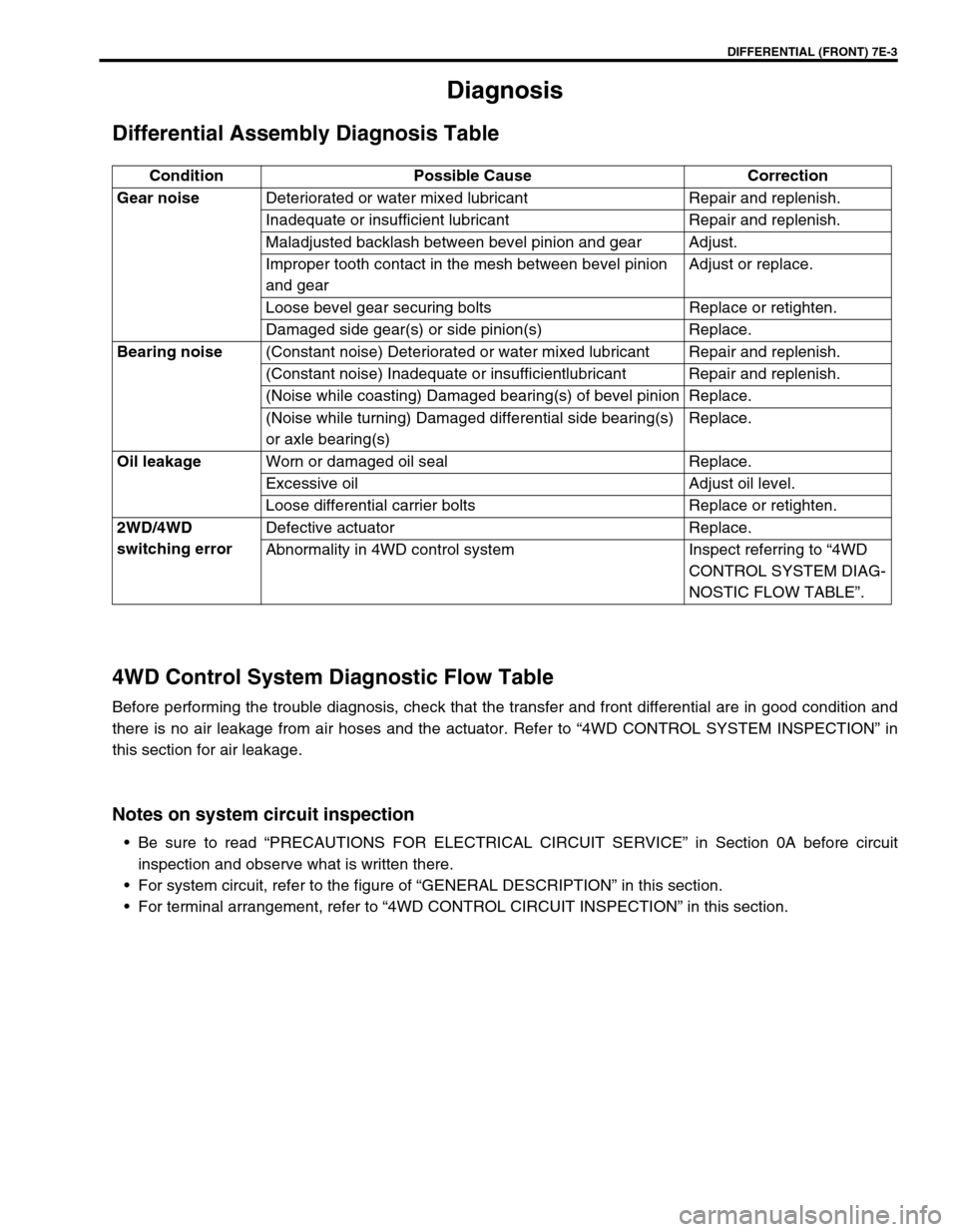
Differential Assembly Diagnosis Table
4WD Control System Diagnostic Flow Table
Before performing the trouble diagnosis, check that the transfer and front differential are in good condition and
there is no air leakage from air hoses and the actuator. Refer to “4WD CONTROL SYSTEM INSPECTION” in
this section for air leakage.
Notes on system circuit inspection
•Be sure to read “PRECAUTIONS FOR ELECTRICAL CIRCUIT SERVICE” in Section 0A before circuit
inspection and observe what is written there.
•For system circuit, refer to the figure of “GENERAL DESCRIPTION” in this section.
•For terminal arrangement, refer to “4WD CONTROL CIRCUIT INSPECTION” in this section. Condition Possible Cause Correction
Gear noiseDeteriorated or water mixed lubricant Repair and replenish.
Inadequate or insufficient lubricant Repair and replenish.
Maladjusted backlash between bevel pinion and gear Adjust.
Improper tooth contact in the mesh between bevel pinion
and gearAdjust or replace.
Loose bevel gear securing bolts Replace or retighten.
Damaged side gear(s) or side pinion(s) Replace.
Bearing noise(Constant noise) Deteriorated or water mixed lubricant Repair and replenish.
(Constant noise) Inadequate or insufficientlubricant Repair and replenish.
(Noise while coasting) Damaged bearing(s) of bevel pinion Replace.
(Noise while turning) Damaged differential side bearing(s)
or axle bearing(s)Replace.
Oil leakageWorn or damaged oil seal Replace.
Excessive oil Adjust oil level.
Loose differential carrier bolts Replace or retighten.
2WD/4WD
switching errorDefective actuator Replace.
Abnormality in 4WD control system Inspect referring to “4WD
CONTROL SYSTEM DIAG-
NOSTIC FLOW TABLE”.
Page 477 of 656
7E-4 DIFFERENTIAL (FRONT)
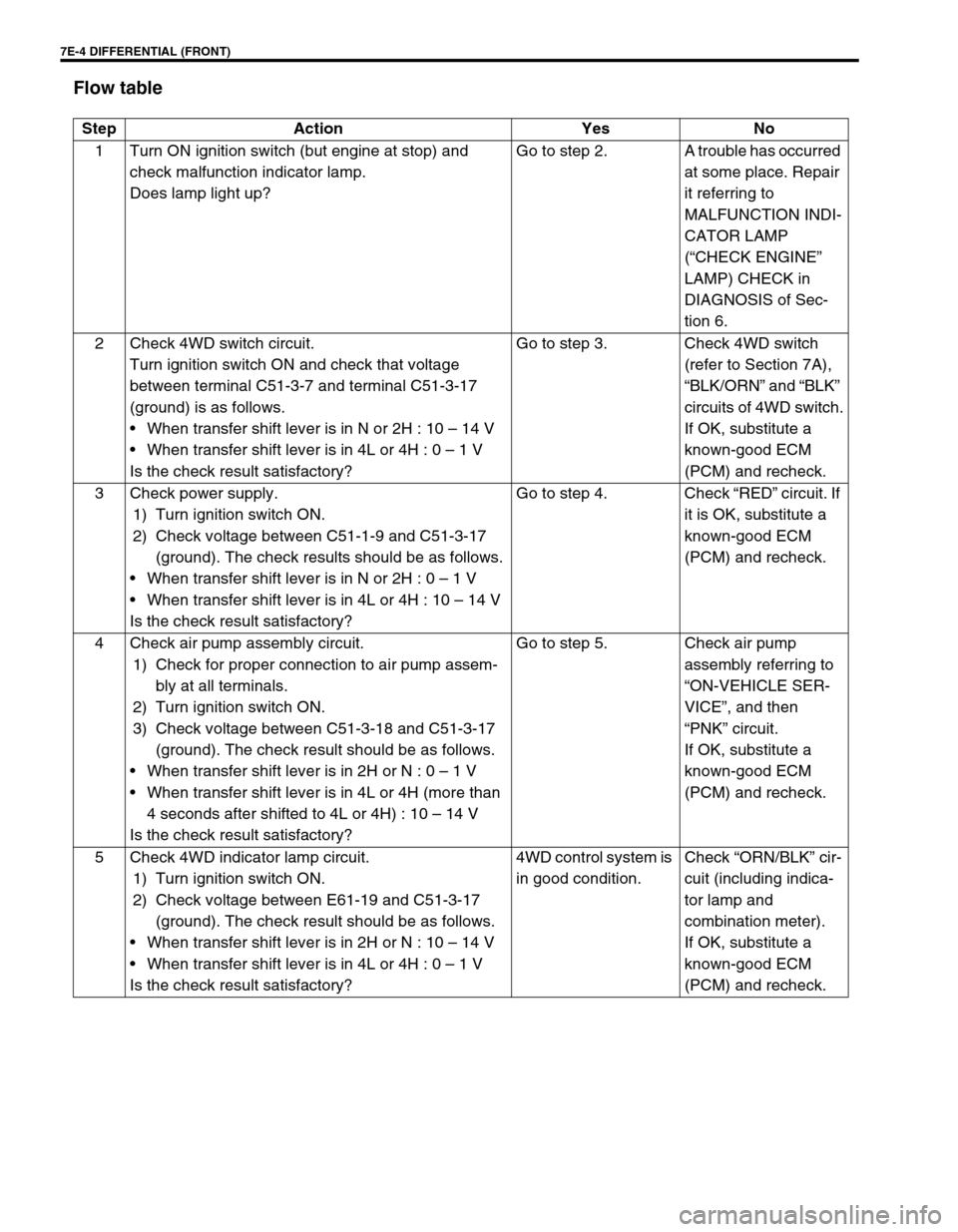
Flow table
Step Action Yes No
1 Turn ON ignition switch (but engine at stop) and
check malfunction indicator lamp.
Does lamp light up?Go to step 2. A trouble has occurred
at some place. Repair
it referring to
MALFUNCTION INDI-
CATOR LAMP
(“CHECK ENGINE”
LAMP) CHECK in
DIAGNOSIS of Sec-
tion 6.
2 Check 4WD switch circuit.
Turn ignition switch ON and check that voltage
between terminal C51-3-7 and terminal C51-3-17
(ground) is as follows.
When transfer shift lever is in N or 2H : 10 – 14 V
When transfer shift lever is in 4L or 4H : 0 – 1 V
Is the check result satisfactory?Go to step 3. Check 4WD switch
(refer to Section 7A),
“BLK/ORN” and “BLK”
circuits of 4WD switch.
If OK, substitute a
known-good ECM
(PCM) and recheck.
3 Check power supply.
1) Turn ignition switch ON.
2) Check voltage between C51-1-9 and C51-3-17
(ground). The check results should be as follows.
When transfer shift lever is in N or 2H : 0 – 1 V
When transfer shift lever is in 4L or 4H : 10 – 14 V
Is the check result satisfactory?Go to step 4. Check “RED” circuit. If
it is OK, substitute a
known-good ECM
(PCM) and recheck.
4 Check air pump assembly circuit.
1) Check for proper connection to air pump assem-
bly at all terminals.
2) Turn ignition switch ON.
3) Check voltage between C51-3-18 and C51-3-17
(ground). The check result should be as follows.
When transfer shift lever is in 2H or N : 0 – 1 V
When transfer shift lever is in 4L or 4H (more than
4 seconds after shifted to 4L or 4H) : 10 – 14 V
Is the check result satisfactory?Go to step 5. Check air pump
assembly referring to
“ON-VEHICLE SER-
VICE”, and then
“PNK” circuit.
If OK, substitute a
known-good ECM
(PCM) and recheck.
5 Check 4WD indicator lamp circuit.
1) Turn ignition switch ON.
2) Check voltage between E61-19 and C51-3-17
(ground). The check result should be as follows.
When transfer shift lever is in 2H or N : 10 – 14 V
When transfer shift lever is in 4L or 4H : 0 – 1 V
Is the check result satisfactory?4WD control system is
in good condition.Check “ORN/BLK” cir-
cuit (including indica-
tor lamp and
combination meter).
If OK, substitute a
known-good ECM
(PCM) and recheck.
Page 478 of 656
DIFFERENTIAL (FRONT) 7E-5
4WD Control System Circuit Inspection
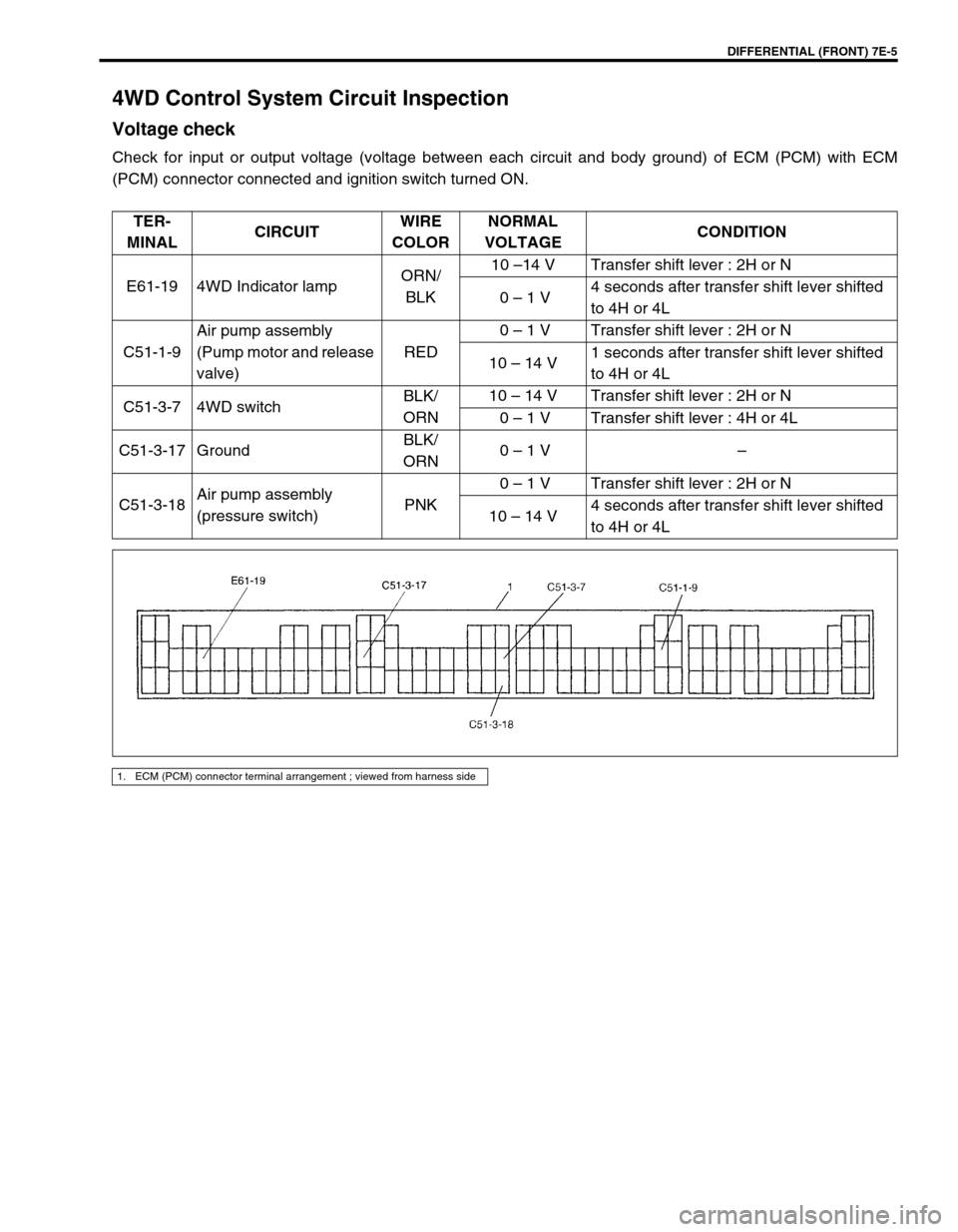
Voltage check
Check for input or output voltage (voltage between each circuit and body ground) of ECM (PCM) with ECM
(PCM) connector connected and ignition switch turned ON.
TER-
MINALCIRCUITWIRE
COLORNORMAL
VOLTAGECONDITION
E61-19 4WD Indicator lampORN/
BLK10 –14 V Transfer shift lever : 2H or N
0 – 1 V4 seconds after transfer shift lever shifted
to 4H or 4L
C51-1-9Air pump assembly
(Pump motor and release
valve)RED 0 – 1 V Transfer shift lever : 2H or N
10 – 14 V1 seconds after transfer shift lever shifted
to 4H or 4L
C51-3-7 4WD switchBLK/
ORN10 – 14 V Transfer shift lever : 2H or N
0 – 1 V Transfer shift lever : 4H or 4L
C51-3-17 GroundBLK/
ORN 0 – 1 V –
C51-3-18Air pump assembly
(pressure switch)PNK 0 – 1 V Transfer shift lever : 2H or N
10 – 14 V4 seconds after transfer shift lever shifted
to 4H or 4L
1. ECM (PCM) connector terminal arrangement ; viewed from harness side
Page 479 of 656
7E-6 DIFFERENTIAL (FRONT)
4WD Control System Inspection
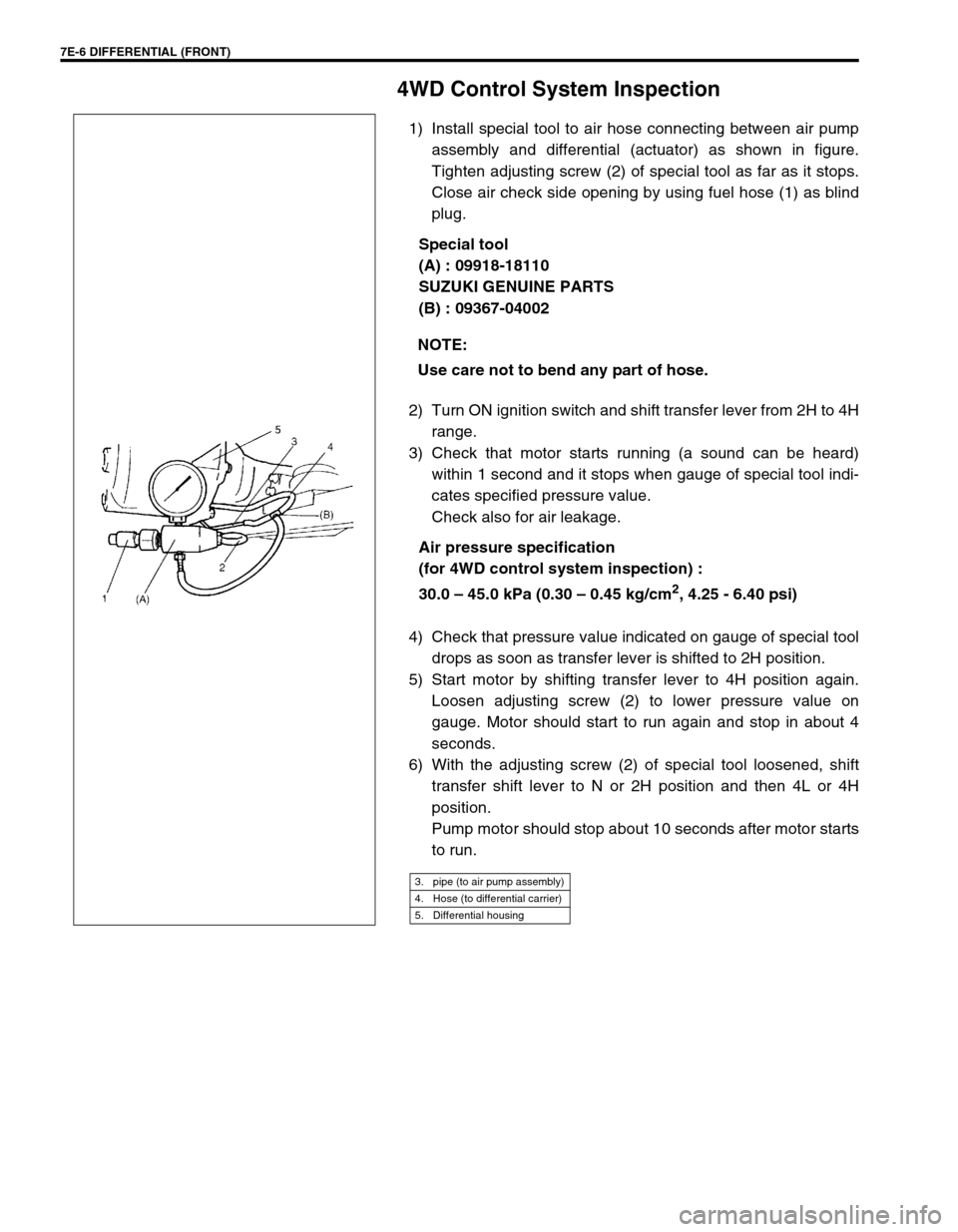
1) Install special tool to air hose connecting between air pump
assembly and differential (actuator) as shown in figure.
Tighten adjusting screw (2) of special tool as far as it stops.
Close air check side opening by using fuel hose (1) as blind
plug.
Special tool
(A) : 09918-18110
SUZUKI GENUINE PARTS
(B) : 09367-04002
2) Turn ON ignition switch and shift transfer lever from 2H to 4H
range.
3) Check that motor starts running (a sound can be heard)
within 1 second and it stops when gauge of special tool indi-
cates specified pressure value.
Check also for air leakage.
Air pressure specification
(for 4WD control system inspection) :
30.0 – 45.0 kPa (0.30 – 0.45 kg/cm
2, 4.25 - 6.40 psi)
4) Check that pressure value indicated on gauge of special tool
drops as soon as transfer lever is shifted to 2H position.
5) Start motor by shifting transfer lever to 4H position again.
Loosen adjusting screw (2) to lower pressure value on
gauge. Motor should start to run again and stop in about 4
seconds.
6) With the adjusting screw (2) of special tool loosened, shift
transfer shift lever to N or 2H position and then 4L or 4H
position.
Pump motor should stop about 10 seconds after motor starts
to run. NOTE:
Use care not to bend any part of hose.
3. pipe (to air pump assembly)
4. Hose (to differential carrier)
5. Differential housing
Page 480 of 656
DIFFERENTIAL (FRONT) 7E-7
On-Vehicle Service
Differential Mountings
REMOVAL AND INSTALLATION
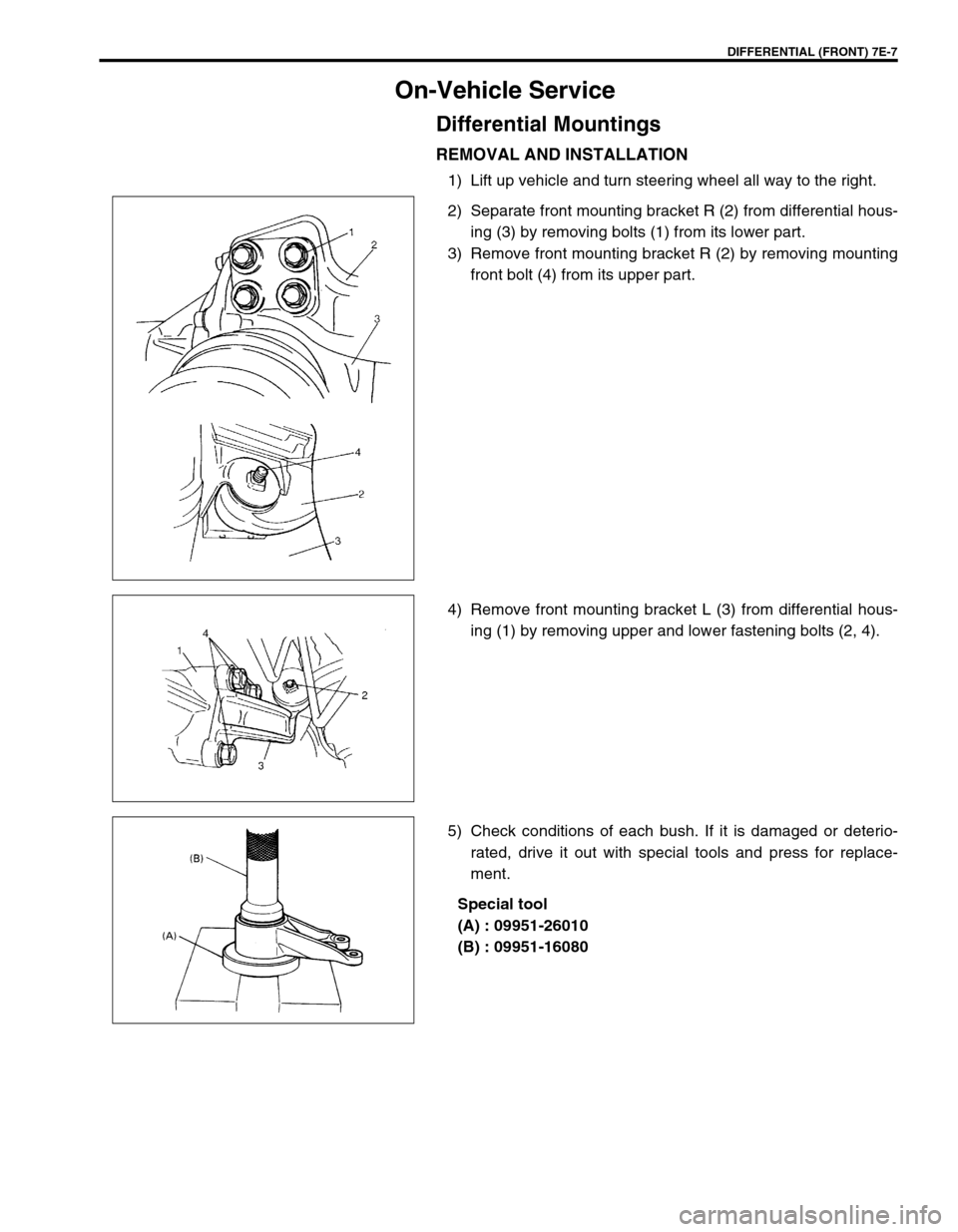
1) Lift up vehicle and turn steering wheel all way to the right.
2) Separate front mounting bracket R (2) from differential hous-
ing (3) by removing bolts (1) from its lower part.
3) Remove front mounting bracket R (2) by removing mounting
front bolt (4) from its upper part.
4) Remove front mounting bracket L (3) from differential hous-
ing (1) by removing upper and lower fastening bolts (2, 4).
5) Check conditions of each bush. If it is damaged or deterio-
rated, drive it out with special tools and press for replace-
ment.
Special tool
(A) : 09951-26010
(B) : 09951-16080