Pressure sensor SUZUKI GRAND VITARA 2001 2.G Owners Manual
[x] Cancel search | Manufacturer: SUZUKI, Model Year: 2001, Model line: GRAND VITARA, Model: SUZUKI GRAND VITARA 2001 2.GPages: 656, PDF Size: 14.31 MB
Page 30 of 656
![SUZUKI GRAND VITARA 2001 2.G Owners Manual AIR CONDITIONING (OPTIONAL) 1B-5
[A] : Dual A/C LH steering model 4. Condenser 11. Low pressure charge valve
[B] : Dual A/C RH steering model 5. Sight glass 12. Floor liquid pipe
[C] : Single A/C LH s](/img/20/7584/w960_7584-29.png "SUZUKI GRAND VITARA 2001 2.G Owners Manual AIR CONDITIONING (OPTIONAL) 1B-5
[A] : Dual A/C LH steering model 4. Condenser 11. Low pressure charge valve
[B] : Dual A/C RH steering model 5. Sight glass 12. Floor liquid pipe
[C] : Single A/C LH s")
AIR CONDITIONING (OPTIONAL) 1B-5
[A] : Dual A/C LH steering model 4. Condenser 11. Low pressure charge valve
[B] : Dual A/C RH steering model 5. Sight glass 12. Floor liquid pipe
[C] : Single A/C LH steering model 6. Refrigerant (dual) pressure sensor 13. Floor suction pipe
[D] : Single A/C RH steering model 7. Discharge pipe 14. Rear A/C unit
1. Front cooling unit 8. Liquid pipe 15. Rear A/C duct No.1
2. Heater unit 9. Suction pipe 16. Rear A/C duct No.2
3. Compressor 10. High pressure charge valve
[A]
[B]
[C][D]
10
7
9 3 4 6 5 1181
213
12 16
1514
1 2
13
12 16
1514
7
10
5
6
4
38
9 11
1 2
7
10
5
6
4
38
9 11
10
7
9 3 4 6 5 1181
2
Page 31 of 656
1B-6 AIR CONDITIONING (OPTIONAL)
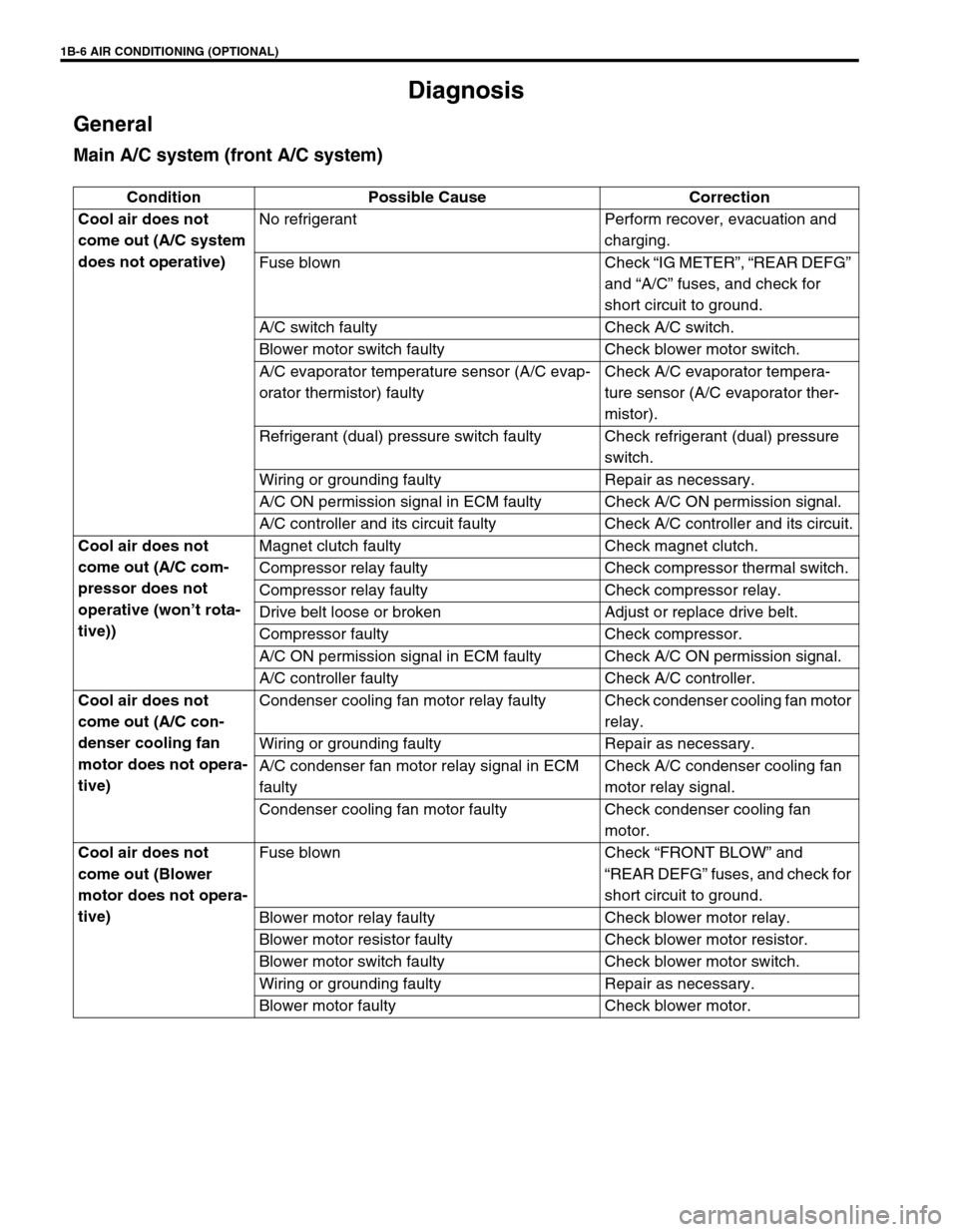
Diagnosis
General
Main A/C system (front A/C system)
Condition Possible Cause Correction
Cool air does not
come out (A/C system
does not operative)No refrigerant Perform recover, evacuation and
charging.
Fuse blown Check “IG METER”, “REAR DEFG”
and “A/C” fuses, and check for
short circuit to ground.
A/C switch faulty Check A/C switch.
Blower motor switch faulty Check blower motor switch.
A/C evaporator temperature sensor (A/C evap-
orator thermistor) faultyCheck A/C evaporator tempera-
ture sensor (A/C evaporator ther-
mistor).
Refrigerant (dual) pressure switch faulty Check refrigerant (dual) pressure
switch.
Wiring or grounding faulty Repair as necessary.
A/C ON permission signal in ECM faulty Check A/C ON permission signal.
A/C controller and its circuit faulty Check A/C controller and its circuit.
Cool air does not
come out (A/C com-
pressor does not
operative (won’t rota-
tive))Magnet clutch faulty Check magnet clutch.
Compressor relay faulty Check compressor thermal switch.
Compressor relay faulty Check compressor relay.
Drive belt loose or broken Adjust or replace drive belt.
Compressor faulty Check compressor.
A/C ON permission signal in ECM faulty Check A/C ON permission signal.
A/C controller faulty Check A/C controller.
Cool air does not
come out (A/C con-
denser cooling fan
motor does not opera-
tive)Condenser cooling fan motor relay faulty Check condenser cooling fan motor
relay.
Wiring or grounding faulty Repair as necessary.
A/C condenser fan motor relay signal in ECM
faultyCheck A/C condenser cooling fan
motor relay signal.
Condenser cooling fan motor faulty Check condenser cooling fan
motor.
Cool air does not
come out (Blower
motor does not opera-
tive)Fuse blown Check “FRONT BLOW” and
“REAR DEFG” fuses, and check for
short circuit to ground.
Blower motor relay faulty Check blower motor relay.
Blower motor resistor faulty Check blower motor resistor.
Blower motor switch faulty Check blower motor switch.
Wiring or grounding faulty Repair as necessary.
Blower motor faulty Check blower motor.
Page 39 of 656
1B-14 AIR CONDITIONING (OPTIONAL)
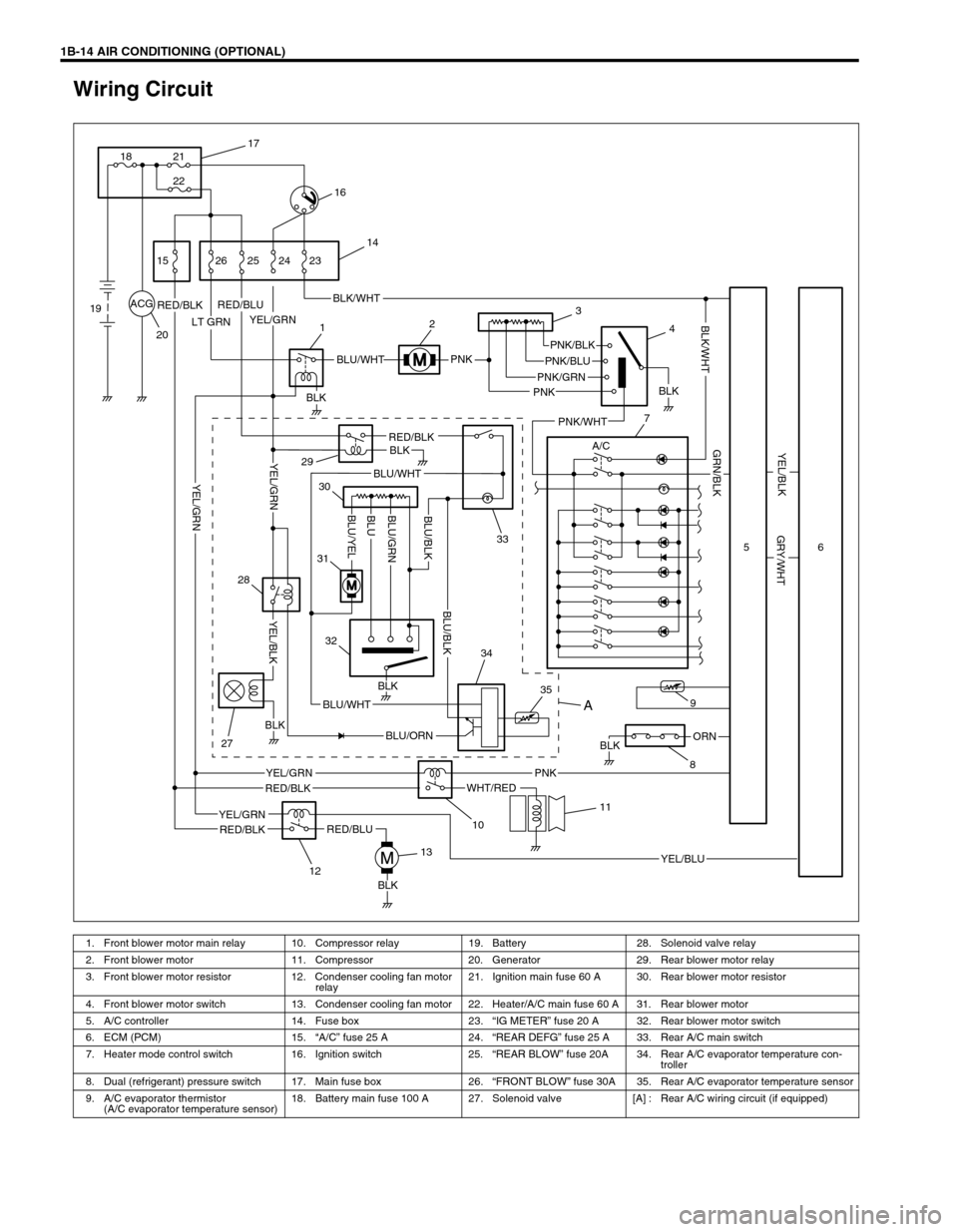
Wiring Circuit
ACG
LT GRN
PNK
PNK
BLKORN
BLK
YEL/GRNRED/BLKBLK/WHT
BLU/WHTPNK/BLK
PNK/GRN
RED/BLK
WHT/RED
YEL/GRN
YEL/BLU
A/C
RED/BLU
RED/BLU
RED/BLKBLK
BLU/ORN
BLU/WHT
BLU/WHT
PNK
PNK/BLU
BLK
PNK/WHT
YEL/BLK
GRY/WHT
GRN/BLK
BLK/WHT
RED/BLK
YEL/GRN
BLK
BLK
BLK
YEL/BLK
YEL/GRN
YEL/GRNBLU/GRN
BLU/YELBLUBLU/BLK
BLU/BLK
17
21
22 18
16
15
19
2026 25 24 23
14
12
29
3
4
7
33 30
31
32
28
27
1213
10
11
35 349
856
A
1. Front blower motor main relay 10. Compressor relay 19. Battery 28. Solenoid valve relay
2. Front blower motor 11. Compressor 20. Generator 29. Rear blower motor relay
3. Front blower motor resistor 12. Condenser cooling fan motor
relay21. Ignition main fuse 60 A 30. Rear blower motor resistor
4. Front blower motor switch 13. Condenser cooling fan motor 22. Heater/A/C main fuse 60 A 31. Rear blower motor
5. A/C controller 14. Fuse box 23.“IG METER” fuse 20 A 32. Rear blower motor switch
6. ECM (PCM) 15.“A/C” fuse 25 A 24.“REAR DEFG” fuse 25 A 33. Rear A/C main switch
7. Heater mode control switch 16. Ignition switch 25.“REAR BLOW” fuse 20A 34. Rear A/C evaporator temperature con-
troller
8. Dual (refrigerant) pressure switch 17. Main fuse box 26.“FRONT BLOW” fuse 30A 35. Rear A/C evaporator temperature sensor
9. A/C evaporator thermistor
(A/C evaporator temperature sensor)18. Battery main fuse 100 A 27. Solenoid valve [A] : Rear A/C wiring circuit (if equipped)
Page 41 of 656
1B-16 AIR CONDITIONING (OPTIONAL)
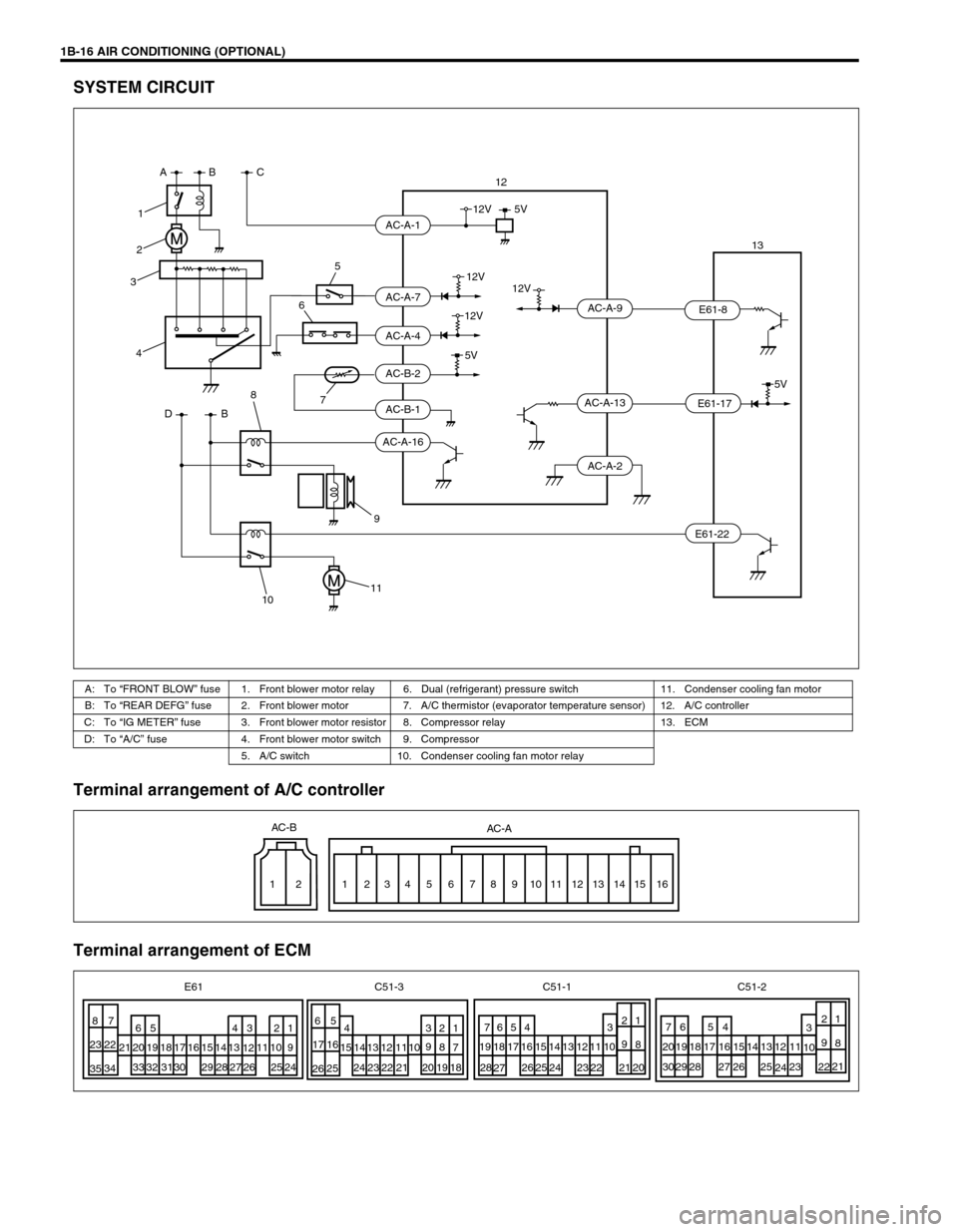
SYSTEM CIRCUIT
Terminal arrangement of A/C controller
Terminal arrangement of ECM
A: To “FRONT BLOW” fuse 1. Front blower motor relay 6. Dual (refrigerant) pressure switch 11. Condenser cooling fan motor
B: To “REAR DEFG” fuse 2. Front blower motor 7. A/C thermistor (evaporator temperature sensor) 12. A/C controller
C: To “IG METER” fuse 3. Front blower motor resistor 8. Compressor relay 13. ECM
D: To “A/C” fuse 4. Front blower motor switch 9. Compressor
5. A/C switch 10. Condenser cooling fan motor relay
5V
12V12V
12V5V
12V
5V
AC-A-1
AC-A-7
AC-A-4
AC-B-2
AC-B-1
AC-A-16AC-A-9
AC-A-2 AC-A-13
E61-8
E61-17
E61-22
A
DBBC
1
2
3
4
7 865
1011912
13
12 12
3
45 6 7 8 9 101112131415 16 AC-B
AC-A
87
22 23
34
3565
16 17
25
262
1
8 9
20
212
1
8 9
21
22 1 2 3 4 5 6
9
24 25 26 27 28 29 30 31 32 3310 11
12 13 14 15 16 17 18 19 20 211 2 3 4
7 8 9
10 11 12 13 14 15
18 19 20 21 22 23 243 4 5 6 7
10 11 12 13 14 15 16 17 18 19
22 23 24 25 26
27 283 4 5 6 7
10 11 12 13 14 15 16 19 18 2017
23
24 25 26 27 29 28 30 E61 C51-3 C51-1 C51-2
Page 42 of 656
AIR CONDITIONING (OPTIONAL) 1B-17
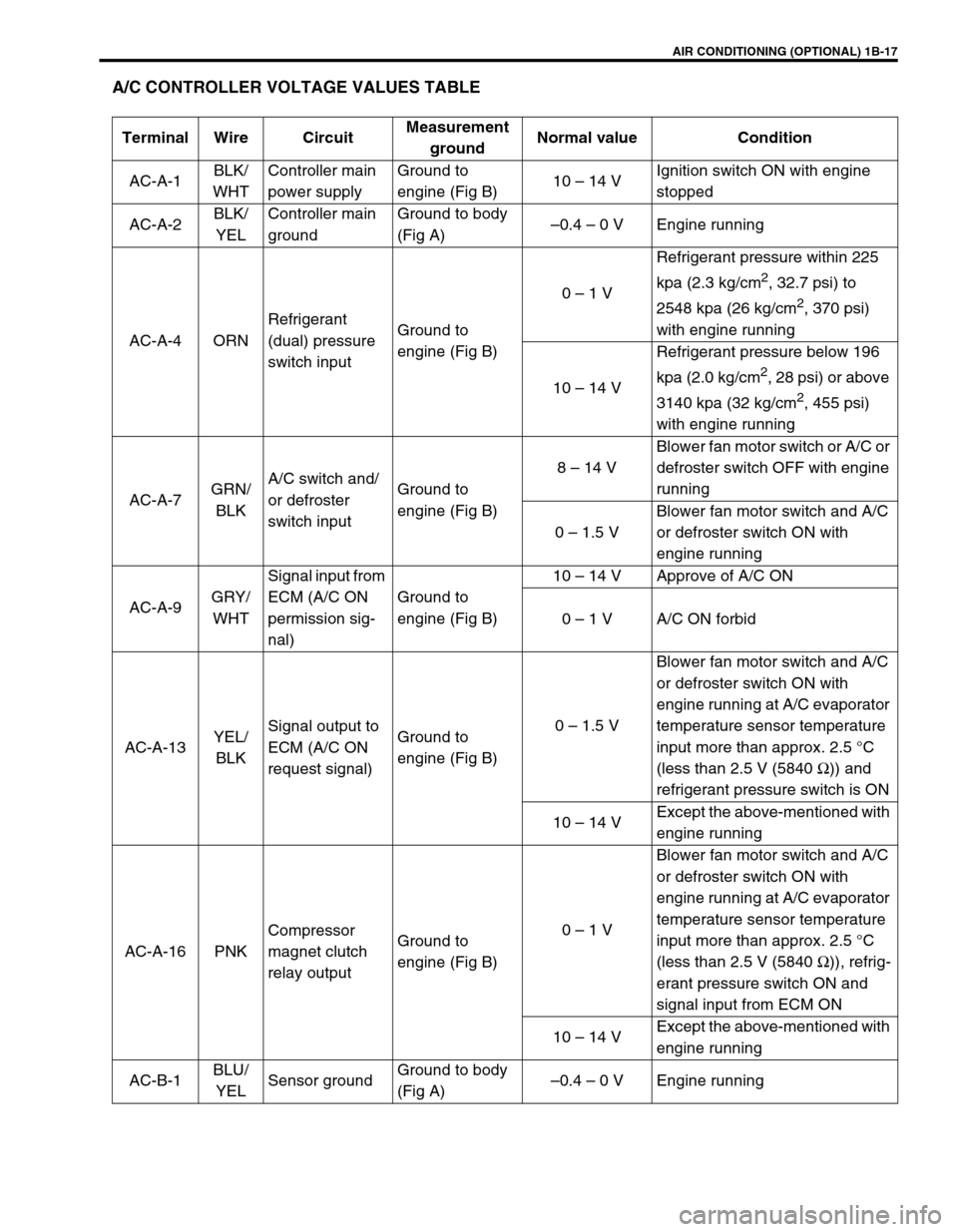
A/C CONTROLLER VOLTAGE VALUES TABLE
Terminal Wire CircuitMeasurement
groundNormal value Condition
AC-A-1BLK/
WHTController main
power supplyGround to
engine (Fig B)10 – 14 VIgnition switch ON with engine
stopped
AC-A-2BLK/
YELController main
groundGround to body
(Fig A)–0.4 – 0 V Engine running
AC-A-4 ORNRefrigerant
(dual) pressure
switch inputGround to
engine (Fig B)0 – 1 VRefrigerant pressure within 225
kpa (2.3 kg/cm
2, 32.7 psi) to
2548 kpa (26 kg/cm
2, 370 psi)
with engine running
10 – 14 VRefrigerant pressure below 196
kpa (2.0 kg/cm
2, 28 psi) or above
3140 kpa (32 kg/cm
2, 455 psi)
with engine running
AC-A-7GRN/
BLKA/C switch and/
or defroster
switch inputGround to
engine (Fig B)8 – 14 VBlower fan motor switch or A/C or
defroster switch OFF with engine
running
0 – 1.5 VBlower fan motor switch and A/C
or defroster switch ON with
engine running
AC-A-9GRY/
WHTSignal input from
ECM (A/C ON
permission sig-
nal)Ground to
engine (Fig B)10 – 14 V Approve of A/C ON
0 – 1 V A/C ON forbid
AC-A-13YEL/
BLKSignal output to
ECM (A/C ON
request signal)Ground to
engine (Fig B)0 – 1.5 VBlower fan motor switch and A/C
or defroster switch ON with
engine running at A/C evaporator
temperature sensor temperature
input more than approx. 2.5 °C
(less than 2.5 V (5840 Ω)) and
refrigerant pressure switch is ON
10 – 14 VExcept the above-mentioned with
engine running
AC-A-16 PNKCompressor
magnet clutch
relay outputGround to
engine (Fig B)0 – 1 VBlower fan motor switch and A/C
or defroster switch ON with
engine running at A/C evaporator
temperature sensor temperature
input more than approx. 2.5 °C
(less than 2.5 V (5840 Ω)), refrig-
erant pressure switch ON and
signal input from ECM ON
10 – 14 VExcept the above-mentioned with
engine running
AC-B-1BLU/
YELSensor groundGround to body
(Fig A)–0.4 – 0 V Engine running
Page 43 of 656
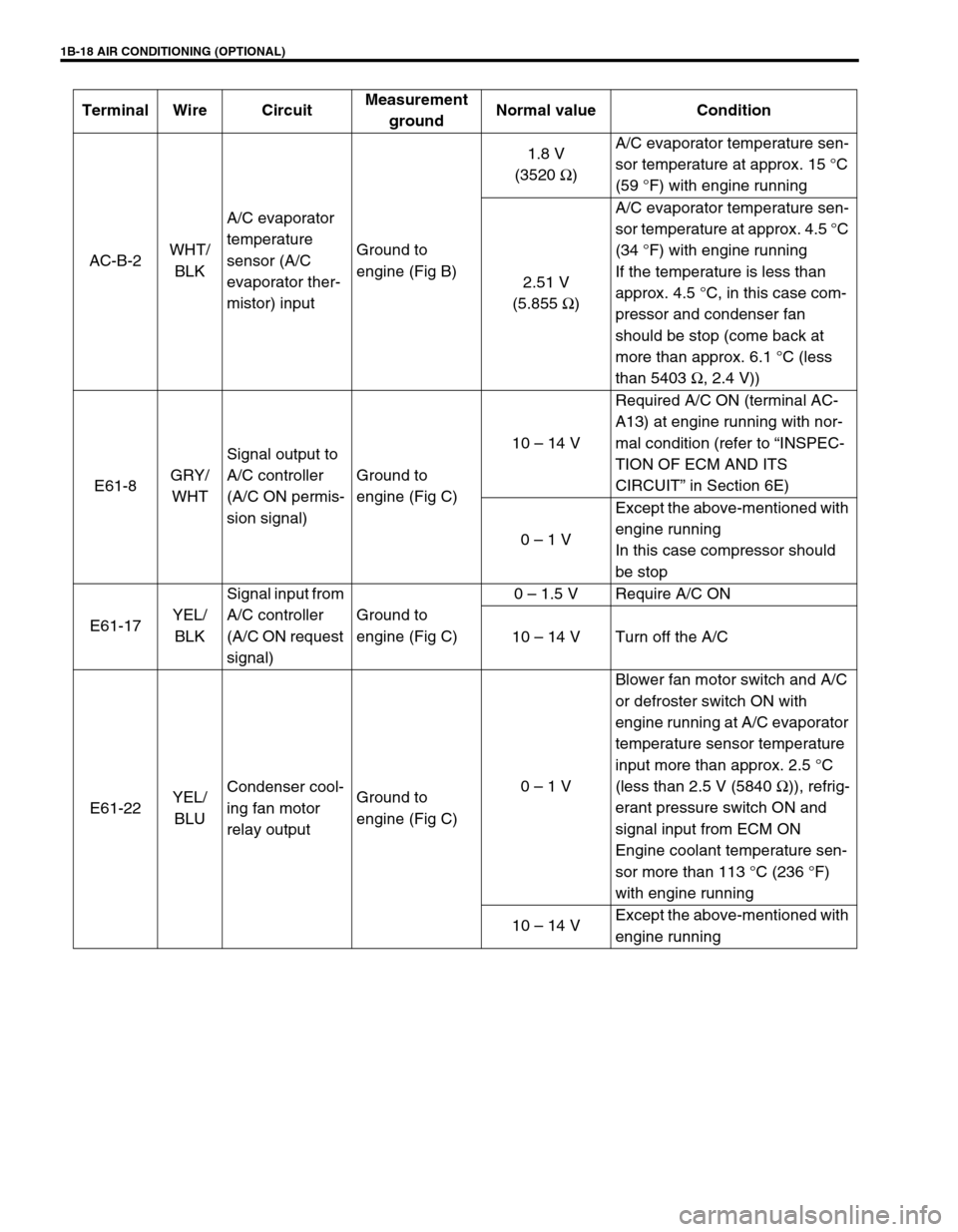
1B-18 AIR CONDITIONING (OPTIONAL)
Terminal Wire CircuitMeasurement
groundNormal value Condition
AC-B-2WHT/
BLKA/C evaporator
temperature
sensor (A/C
evaporator ther-
mistor) inputGround to
engine (Fig B)1.8 V
(3520 Ω)A/C evaporator temperature sen-
sor temperature at approx. 15 °C
(59 °F) with engine running
2.51 V
(5.855 Ω)A/C evaporator temperature sen-
sor temperature at approx. 4.5 °C
(34 °F) with engine running
If the temperature is less than
approx. 4.5 °C, in this case com-
pressor and condenser fan
should be stop (come back at
more than approx. 6.1 °C (less
than 5403 Ω, 2.4 V))
E61-8GRY/
WHTSignal output to
A/C controller
(A/C ON permis-
sion signal)Ground to
engine (Fig C)10 – 14 VRequired A/C ON (terminal AC-
A13) at engine running with nor-
mal condition (refer to “INSPEC-
TION OF ECM AND ITS
CIRCUIT” in Section 6E)
0 – 1 VExcept the above-mentioned with
engine running
In this case compressor should
be stop
E61-17YEL/
BLKSignal input from
A/C controller
(A/C ON request
signal)Ground to
engine (Fig C)0 – 1.5 V Require A/C ON
10 – 14 V Turn off the A/C
E61-22YEL/
BLUCondenser cool-
ing fan motor
relay outputGround to
engine (Fig C)0 – 1 VBlower fan motor switch and A/C
or defroster switch ON with
engine running at A/C evaporator
temperature sensor temperature
input more than approx. 2.5 °C
(less than 2.5 V (5840 Ω)), refrig-
erant pressure switch ON and
signal input from ECM ON
Engine coolant temperature sen-
sor more than 113 °C (236 °F)
with engine running
10 – 14 VExcept the above-mentioned with
engine running
Page 128 of 656
ANTILOCK BRAKE SYSTEM (ABS) 5E2-3
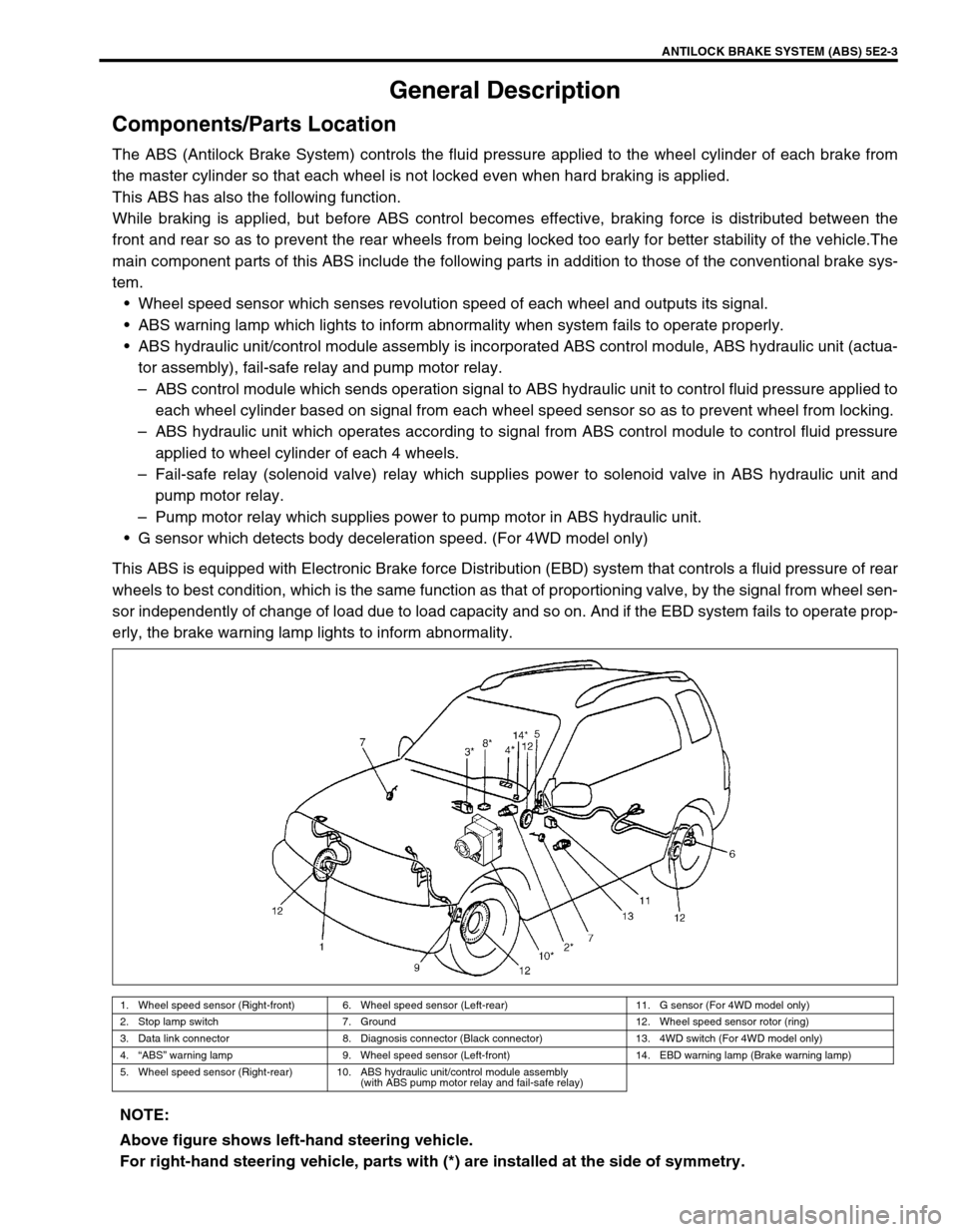
General Description
Components/Parts Location
The ABS (Antilock Brake System) controls the fluid pressure applied to the wheel cylinder of each brake from
the master cylinder so that each wheel is not locked even when hard braking is applied.
This ABS has also the following function.
While braking is applied, but before ABS control becomes effective, braking force is distributed between the
front and rear so as to prevent the rear wheels from being locked too early for better stability of the vehicle.The
main component parts of this ABS include the following parts in addition to those of the conventional brake sys-
tem.
Wheel speed sensor which senses revolution speed of each wheel and outputs its signal.
ABS warning lamp which lights to inform abnormality when system fails to operate properly.
ABS hydraulic unit/control module assembly is incorporated ABS control module, ABS hydraulic unit (actua-
tor assembly), fail-safe relay and pump motor relay.
–ABS control module which sends operation signal to ABS hydraulic unit to control fluid pressure applied to
each wheel cylinder based on signal from each wheel speed sensor so as to prevent wheel from locking.
–ABS hydraulic unit which operates according to signal from ABS control module to control fluid pressure
applied to wheel cylinder of each 4 wheels.
–Fail-safe relay (solenoid valve) relay which supplies power to solenoid valve in ABS hydraulic unit and
pump motor relay.
–Pump motor relay which supplies power to pump motor in ABS hydraulic unit.
G sensor which detects body deceleration speed. (For 4WD model only)
This ABS is equipped with Electronic Brake force Distribution (EBD) system that controls a fluid pressure of rear
wheels to best condition, which is the same function as that of proportioning valve, by the signal from wheel sen-
sor independently of change of load due to load capacity and so on. And if the EBD system fails to operate prop-
erly, the brake warning lamp lights to inform abnormality.
1. Wheel speed sensor (Right-front) 6. Wheel speed sensor (Left-rear) 11. G sensor (For 4WD model only)
2. Stop lamp switch 7. Ground 12. Wheel speed sensor rotor (ring)
3. Data link connector 8. Diagnosis connector (Black connector) 13. 4WD switch (For 4WD model only)
4.“ABS” warning lamp 9. Wheel speed sensor (Left-front) 14. EBD warning lamp (Brake warning lamp)
5. Wheel speed sensor (Right-rear) 10. ABS hydraulic unit/control module assembly
(with ABS pump motor relay and fail-safe relay)
NOTE:
Above figure shows left-hand steering vehicle.
For right-hand steering vehicle, parts with (*) are installed at the side of symmetry.
Page 162 of 656
ENGINE GENERAL INFORMATION AND DIAGNOSIS (H27 ENGINE) 6-1-1
6-1
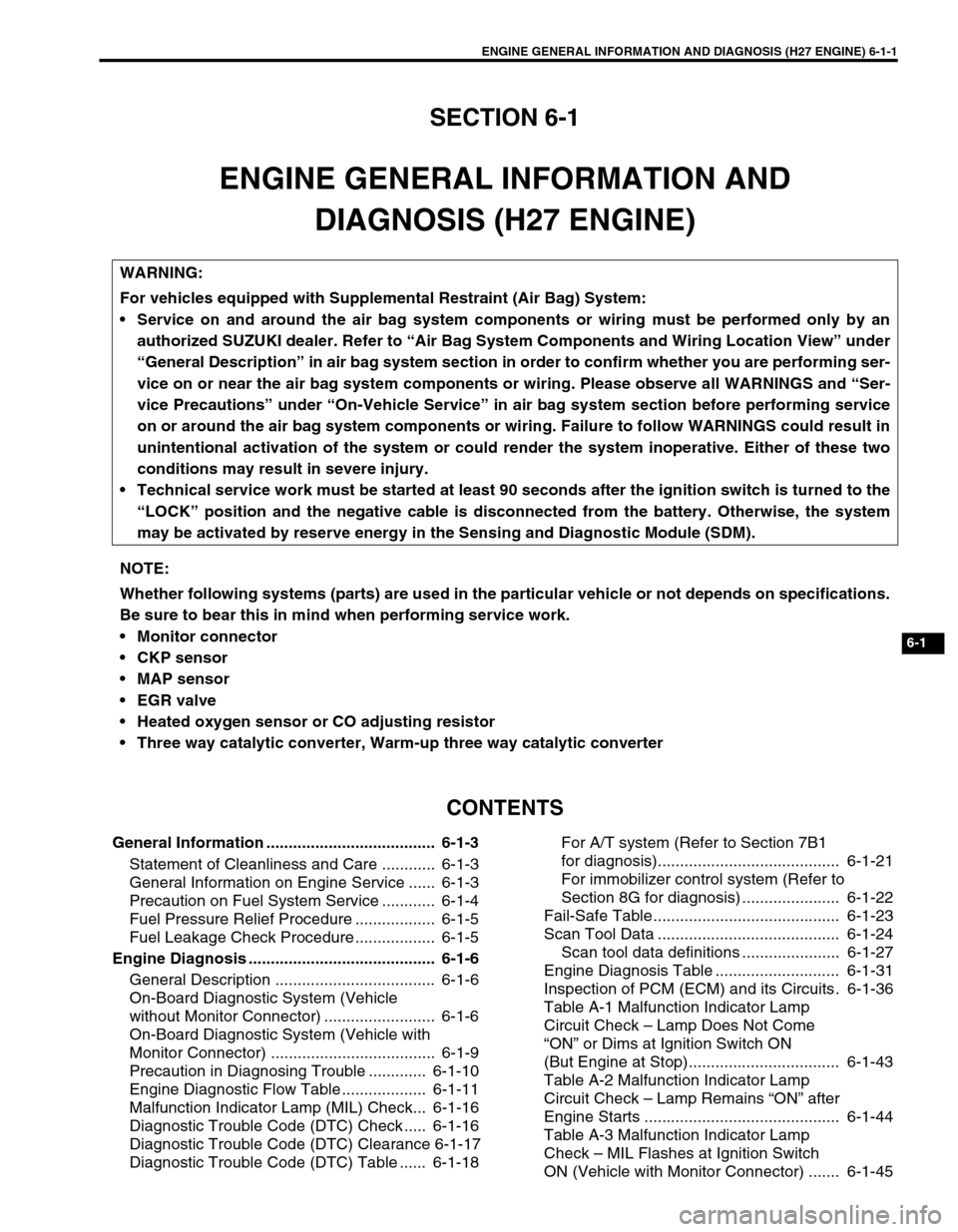
SECTION 6-1
ENGINE GENERAL INFORMATION AND
DIAGNOSIS (H27 ENGINE)
CONTENTS
General Information ...................................... 6-1-3
Statement of Cleanliness and Care ............ 6-1-3
General Information on Engine Service ...... 6-1-3
Precaution on Fuel System Service ............ 6-1-4
Fuel Pressure Relief Procedure .................. 6-1-5
Fuel Leakage Check Procedure .................. 6-1-5
Engine Diagnosis .......................................... 6-1-6
General Description .................................... 6-1-6
On-Board Diagnostic System (Vehicle
without Monitor Connector) ......................... 6-1-6
On-Board Diagnostic System (Vehicle with
Monitor Connector) ..................................... 6-1-9
Precaution in Diagnosing Trouble ............. 6-1-10
Engine Diagnostic Flow Table ................... 6-1-11
Malfunction Indicator Lamp (MIL) Check... 6-1-16
Diagnostic Trouble Code (DTC) Check ..... 6-1-16
Diagnostic Trouble Code (DTC) Clearance 6-1-17
Diagnostic Trouble Code (DTC) Table ...... 6-1-18For A/T system (Refer to Section 7B1
for diagnosis)......................................... 6-1-21
For immobilizer control system (Refer to
Section 8G for diagnosis) ...................... 6-1-22
Fail-Safe Table.......................................... 6-1-23
Scan Tool Data ......................................... 6-1-24
Scan tool data definitions ...................... 6-1-27
Engine Diagnosis Table ............................ 6-1-31
Inspection of PCM (ECM) and its Circuits. 6-1-36
Table A-1 Malfunction Indicator Lamp
Circuit Check – Lamp Does Not Come
“ON” or Dims at Ignition Switch ON
(But Engine at Stop).................................. 6-1-43
Table A-2 Malfunction Indicator Lamp
Circuit Check – Lamp Remains “ON” after
Engine Starts ............................................ 6-1-44
Table A-3 Malfunction Indicator Lamp
Check – MIL Flashes at Ignition Switch
ON (Vehicle with Monitor Connector) ....... 6-1-45 WARNING:
For vehicles equipped with Supplemental Restraint (Air Bag) System:
Service on and around the air bag system components or wiring must be performed only by an
authorized SUZUKI dealer. Refer to “Air Bag System Components and Wiring Location View” under
“General Description” in air bag system section in order to confirm whether you are performing ser-
vice on or near the air bag system components or wiring. Please observe all WARNINGS and “Ser-
vice Precautions” under “On-Vehicle Service” in air bag system section before performing service
on or around the air bag system components or wiring. Failure to follow WARNINGS could result in
unintentional activation of the system or could render the system inoperative. Either of these two
conditions may result in severe injury.
Technical service work must be started at least 90 seconds after the ignition switch is turned to the
“LOCK” position and the negative cable is disconnected from the battery. Otherwise, the system
may be activated by reserve energy in the Sensing and Diagnostic Module (SDM).
NOTE:
Whether following systems (parts) are used in the particular vehicle or not depends on specifications.
Be sure to bear this in mind when performing service work.
Monitor connector
CKP sensor
MAP sensor
EGR valve
Heated oxygen sensor or CO adjusting resistor
Three way catalytic converter, Warm-up three way catalytic converter
Page 163 of 656
6-1-2 ENGINE GENERAL INFORMATION AND DIAGNOSIS (H27 ENGINE)
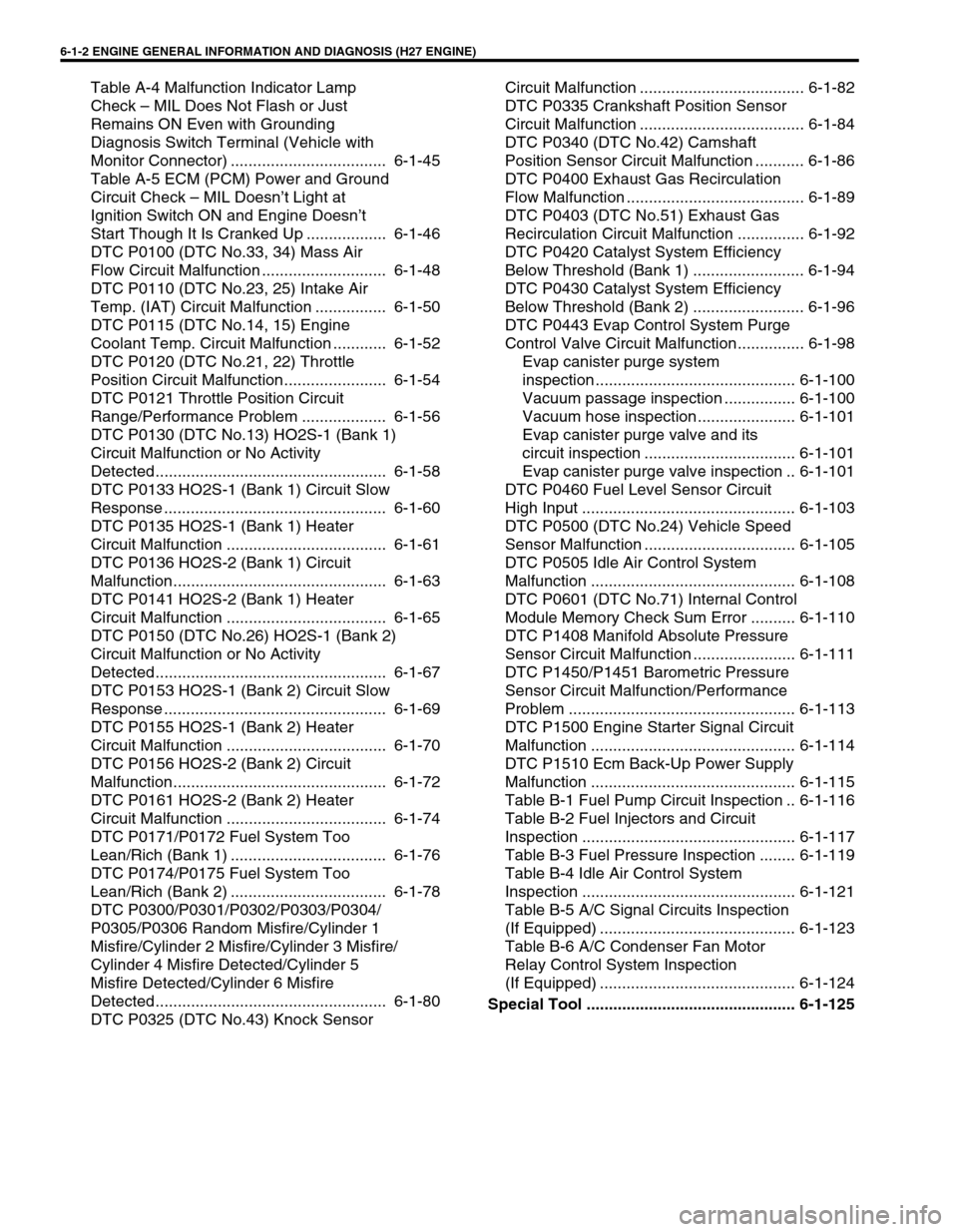
Table A-4 Malfunction Indicator Lamp
Check – MIL Does Not Flash or Just
Remains ON Even with Grounding
Diagnosis Switch Terminal (Vehicle with
Monitor Connector) ................................... 6-1-45
Table A-5 ECM (PCM) Power and Ground
Circuit Check – MIL Doesn’t Light at
Ignition Switch ON and Engine Doesn’t
Start Though It Is Cranked Up .................. 6-1-46
DTC P0100 (DTC No.33, 34) Mass Air
Flow Circuit Malfunction ............................ 6-1-48
DTC P0110 (DTC No.23, 25) Intake Air
Temp. (IAT) Circuit Malfunction ................ 6-1-50
DTC P0115 (DTC No.14, 15) Engine
Coolant Temp. Circuit Malfunction ............ 6-1-52
DTC P0120 (DTC No.21, 22) Throttle
Position Circuit Malfunction....................... 6-1-54
DTC P0121 Throttle Position Circuit
Range/Performance Problem ................... 6-1-56
DTC P0130 (DTC No.13) HO2S-1 (Bank 1)
Circuit Malfunction or No Activity
Detected.................................................... 6-1-58
DTC P0133 HO2S-1 (Bank 1) Circuit Slow
Response .................................................. 6-1-60
DTC P0135 HO2S-1 (Bank 1) Heater
Circuit Malfunction .................................... 6-1-61
DTC P0136 HO2S-2 (Bank 1) Circuit
Malfunction................................................ 6-1-63
DTC P0141 HO2S-2 (Bank 1) Heater
Circuit Malfunction .................................... 6-1-65
DTC P0150 (DTC No.26) HO2S-1 (Bank 2)
Circuit Malfunction or No Activity
Detected.................................................... 6-1-67
DTC P0153 HO2S-1 (Bank 2) Circuit Slow
Response .................................................. 6-1-69
DTC P0155 HO2S-1 (Bank 2) Heater
Circuit Malfunction .................................... 6-1-70
DTC P0156 HO2S-2 (Bank 2) Circuit
Malfunction................................................ 6-1-72
DTC P0161 HO2S-2 (Bank 2) Heater
Circuit Malfunction .................................... 6-1-74
DTC P0171/P0172 Fuel System Too
Lean/Rich (Bank 1) ................................... 6-1-76
DTC P0174/P0175 Fuel System Too
Lean/Rich (Bank 2) ................................... 6-1-78
DTC P0300/P0301/P0302/P0303/P0304/
P0305/P0306 Random Misfire/Cylinder 1
Misfire/Cylinder 2 Misfire/Cylinder 3 Misfire/
Cylinder 4 Misfire Detected/Cylinder 5
Misfire Detected/Cylinder 6 Misfire
Detected.................................................... 6-1-80
DTC P0325 (DTC No.43) Knock Sensor Circuit Malfunction ..................................... 6-1-82
DTC P0335 Crankshaft Position Sensor
Circuit Malfunction ..................................... 6-1-84
DTC P0340 (DTC No.42) Camshaft
Position Sensor Circuit Malfunction ........... 6-1-86
DTC P0400 Exhaust Gas Recirculation
Flow Malfunction ........................................ 6-1-89
DTC P0403 (DTC No.51) Exhaust Gas
Recirculation Circuit Malfunction ............... 6-1-92
DTC P0420 Catalyst System Efficiency
Below Threshold (Bank 1) ......................... 6-1-94
DTC P0430 Catalyst System Efficiency
Below Threshold (Bank 2) ......................... 6-1-96
DTC P0443 Evap Control System Purge
Control Valve Circuit Malfunction............... 6-1-98
Evap canister purge system
inspection ............................................. 6-1-100
Vacuum passage inspection ................ 6-1-100
Vacuum hose inspection ...................... 6-1-101
Evap canister purge valve and its
circuit inspection .................................. 6-1-101
Evap canister purge valve inspection .. 6-1-101
DTC P0460 Fuel Level Sensor Circuit
High Input ................................................ 6-1-103
DTC P0500 (DTC No.24) Vehicle Speed
Sensor Malfunction .................................. 6-1-105
DTC P0505 Idle Air Control System
Malfunction .............................................. 6-1-108
DTC P0601 (DTC No.71) Internal Control
Module Memory Check Sum Error .......... 6-1-110
DTC P1408 Manifold Absolute Pressure
Sensor Circuit Malfunction ....................... 6-1-111
DTC P1450/P1451 Barometric Pressure
Sensor Circuit Malfunction/Performance
Problem ................................................... 6-1-113
DTC P1500 Engine Starter Signal Circuit
Malfunction .............................................. 6-1-114
DTC P1510 Ecm Back-Up Power Supply
Malfunction .............................................. 6-1-115
Table B-1 Fuel Pump Circuit Inspection .. 6-1-116
Table B-2 Fuel Injectors and Circuit
Inspection ................................................ 6-1-117
Table B-3 Fuel Pressure Inspection ........ 6-1-119
Table B-4 Idle Air Control System
Inspection ................................................ 6-1-121
Table B-5 A/C Signal Circuits Inspection
(If Equipped) ............................................ 6-1-123
Table B-6 A/C Condenser Fan Motor
Relay Control System Inspection
(If Equipped) ............................................ 6-1-124
Special Tool ............................................... 6-1-125
Page 182 of 656
ENGINE GENERAL INFORMATION AND DIAGNOSIS (H27 ENGINE) 6-1-21
For A/T system (Refer to Section 7B1 for diagnosis)
P0505Idle air control system mal-
functionDifference between desired idle speed
and actual idle speed continues to
exceed specified value for longer than
specified time.2 driving
cyclesNot
applicable
P0601
(No.71)Internal control module mem-
ory check sum errorData write error (or check sum error)
when written into ECM1 driving
cycle1 driving
cycle
P1408Manifold absolute pressure
sensor circuit malfunctionManifold absolute pressure sensor
output voltage is higher or lower than
specified value (or sensor circuit
shorted to ground or open).2 driving
cyclesNot
applicable
P1450Barometric pressure sensor
circuit malfunctionBarometric pressure is lower or higher
than specification.1 driving
cycleNot
applicable
P1451Barometric pressure sensor
performance problemDifference between intake manifold
pressure and barometric pressure is
larger than specification.2 driving
cyclesNot
applicable
P1500Engine starter signal circuit
malfunctionEngine starts with no starter signal or
signal input during long period after
start.2 driving
cyclesNot
applicable
P1510ECM back-up power supply
malfunctionNo back-up power after starting
engine.1 driving
cycleNot
applicable DTC NO. DETECTED ITEMDETECTING CONDITION
(DTC will set when detecting : )MIL
(vehicle
without
monitor
connector)MIL
(vehicle
with
monitor
connector)
DTC NO. DETECTED ITEMDETECTING CONDITION
(DTC will set when detecting : )MIL
(vehicle
without
monitor
connector)MIL
(vehicle
with
monitor
connector)
P0705
(No.72)Transmission range switch cir-
cuit malfunctionMultiple signals inputted simulta-
neously or P, R, N, D, 2 or L range sig-
nal not inputted while running at
60km/h or more.2 driving
cyclesNot
applicable
P0715
(No.76)Input speed sensor circuit
malfunctionInput speed sensor signal is lower
than specification while running.2 driving
cyclesNot
applicable
P0720
(No.75)Output speed sensor circuit
malfunctionOutput speed sensor signal not input-
ted while VSS signal being inputted.2 driving
cyclesNot
applicable
P0741TCC (lock-up) solenoid perfor-
mance or stuck offActual TCC operation does not agree
with ON/OFF control from PCM to
TCC.2 driving
cyclesNot
applicable
P0743
(No.65)
(No.66)TCC (lock-up) solenoid electri-
calMonitor signal OFF is detected when
TCC control solenoid is ON or monitor
signal ON is detected when it is OFF.1 driving
cycleNot
applicable
P0751Shift solenoid A (#1) perfor-
mance or stuck offGear change control from PCM to A/T
does not agree with actual gear posi-
tion of A/T.2 driving
cyclesNot
applicable