warning SUZUKI GRAND VITARA 2008 3.G Inspection And Maintenance Manual
[x] Cancel search | Manufacturer: SUZUKI, Model Year: 2008, Model line: GRAND VITARA, Model: SUZUKI GRAND VITARA 2008 3.GPages: 48, PDF Size: 1.33 MB
Page 24 of 48

Downloaded from www.Manualslib.com manuals search engine INSPECTION AND MAINTENANCE
Fuel Filter (Diesel engine)
F9Q diesel
78K077
The fuel filter works as a water sedimentor
as well.
Drain water when the fuel filter warning
light comes on. To drain water: 1) Place a pan or ample rag under the fuel filter drain nozzle. 2) Loosen the drain knob. The water will be drained. 3) Tighten the drain knob when the water
changes to the diesel fuel. 4) Tighten the drain knob.
7-23
Brakes
Brake Fluid
64J154
Check the brake fluid level by looking at
the reservoir in the engine compartment.
Check that the fluid level is between the "MAX" and "MIN" lines. If the brake fluid level is near the "MIN" line, fill it up to the "MAX" line with SAE J1703 or DOT3 brake
fluid.
A WARNING
Failure to follow the guidelines below can result in personal injury or seri
ous damage to the brake system. . • If the brake fluid in the reservoir drops below a certain level, the
brake warning light on the instru
ment panel will come on (the
engine must be running with the
parking brake fully disengaged).
Should the light come on, immedi
ately ask your SUZUKI dealer to inspect the brake system. . • A rapid fluid loss indicates a leak In the brake system which should be
inspected by your SUZUKI dealer
immediately.
• Brake fluid can harm your eyes and
damage painted surfaces. Use cau
tion when refilling the reservoir. • Do not use any fluid other than SAE
J1703 or DOT3 brake fluid. Do not use reclaimed fluid or fluid that has
been stored in old or open contain
ers. It is essential that foreign particles and other liquids are kept out of the brake fluid reservoir.
Page 25 of 48

Downloaded from www.Manualslib.com manuals search engine A WARNING
Brake fluid is harmful or fatal if swallowed, and harmful if it comes in contact with skin or eyes. If swallowed,
do not induce vomiting. Immediately contact a poison control center or a
physician. If brake fluid gets in eyes
flush eyes with water and seek medi~ cal a~ention. ~ash thoroughly after
handling. Solution can be poisonous to animals. Keep out of the reach of
children and animals.
NOTE: With disc brakes, the fluid level can be
expected to gradually fall as the brake
pads wear.
Brake Pedal Check. if the ~rake pedal·stops at the regular height without "spongy" feeling when you depress it. If not, have the brake system inspected by your SUZUKI dealer. If you doubt the brake pedal for the regular
height, check it as follows:
. .
54G108
Pedal to wall minimum distance "a": 70 mm (2.8 in.)
With the engine running, measure the distance between the brake pedal and floor
wall when the pedal is depressed with
approximate~y. 300 ~ (30 kg, 66 Ibs) of force: .The ~Inlmum distance required is as spec!fled. SIn?e vour vehicle's brake system IS self-adJusting, there is no need for
pedal adjustment.
If the pedal to floor wall distance as measured above is less than the minimum dis~ance required, have your vehicle Inspected by your SUZUKI dealer.
NOTE: When measuring the distance between the i?rake pedal and floor wall, be sure not to mclude the floor mat or rubber on the floor
wall in your measurement.
INSPECTION AND MAINTENANCE
60G104S
A WARNING
If you experience any of the following
problems with your vehicle's brake
system, have the vehicle inspected
immediately
by your SUZUKI dealer. • Poor braking performance • Uneven braking (Brakes not work-
ing uniformly on all wheels.) • Excessive pedal travel • Brake dragging • Excessive noise • Pedal pulsation (Pedal pulsates
when depressed.) .
7-24
Page 27 of 48

Downloaded from www.Manualslib.com manuals search engine Tires
54G307
The front and rear tire pressure specifications for your vehicle are listed on the Tire Information Label. 80th the front and rear
tires should have the specified tire pressure.
Note that the value does not apply to the
compact spare tire, if equipped.
Tire Inspection Inspect your vehicle's tires at least once a
month by performing the following checks:
1) Measure the air pressure with a tire
gauge. Adjust the pressure if necessary. Remember to check the spare
tire, too.
A. WARNING
• Air pressures should be checked
when the tires are cold or you may
get inaccurate readings.
• Check the inflation pressure from time to time while inflating the tire gradually, until the specified pressure is obtained. • Never underinflate or overinflate the tires.
Underinflation can cause unusual
handling characteristics or can cause the rim to slip on the tire
bead, resulting in an accident or
damage to the tire or rim. Overinflation can cause the tire to burst, resulting in personal injury. Overinflation can also cause unusual handling characteristics
which may result in an accident.
INSPECTION AND MAINTENANCE
EXAMPLE
(1)
(2)
(1) Tread wear indicator (2) Indicator location mark
54G136
2) Check that the depth of the tread
groove is more than 1.6 mm (0.06 in.). To help you check this, the tires have molded-in tread wear indicators in the
grooves. When the indicators appear
on the tread surface, the remaining
depth of the tread is 1.6 mm (0.06 in.)
or less and the tire should be replaced. 3) Check for abnormal wear, cracks and
damage. Any tires with cracks or other
damage
should be replaced. If any tires
show abnormal wear, have them
inspected by your SUZUKI dealer.
7-26
Page 28 of 48

Downloaded from www.Manualslib.com manuals search engine INSPECTION AND MAINTENANCE
A WARNING
Hitting curbs and running over rocks
can damage tires and affect wheel
alignment.
Be sure to have tires and
wheel alignment checked periodically by your SUZUKI dealer.
4) Check for loose wheel nuts. 5) Check that there are no nails, stones or
other objects sticking into the tires.
A WARNING
• Your SUZUKI is equipped with tires
which are all the same type and
size. This is important to ensure
proper steering and handling of the
vehicle. Never mix tires of different
size
or type on the four wheels of
your vehicle. The size and type of
tires used should
be only those
approved by SUZUKI as standard or optional equipment for your
vehicle.
• Replacing the wheels and tires
equipped on your vehicle with certain combinations of aftermarket
wheels and tires can significantly
change the steering
and handling
characteristics of your vehicle. • Therefore, use only those wheel and tire combinations approved by SUZUKI as standard or optional
equipment for your vehicle.
7-27
CAUTION
Replacing the original tires with tires of a different size may result in false
speedometer or odometer readings.
Check with your
SUZUKI dealer
before purchasing replacement tires
that differ
in size from the original
tires.
Tire Rotation Vehicle equipped with 225nOR16 tires
have a spare wheel and tire that are the
same size as the wheels and tires on the
vehicle, and
can use a 5-tire rotation as
shown in the example below.
5-tire rotation
L: Left hand drive R: Right hand drive
65D445
A WARNING
Never perform a 5-tire rotation when
the type and size of the spare wheel and tire are not the same as the other
wheels and tires equipped on your
vehicle.
Vehicle equipped with 225/65R17 tires
have a spare wheel and tire that are a different size than the wheels and tires on the vehicle, and must use a 4-tire rotation as
shown in the example below.
4-tire rotation
Front
65D459
To avoid uneven wear of your tires and to
prolong their life, rotate the tires as illustrated. Tires should be rotated every 10000 km (6000 miles). After rotation, adjust front
and rear tire pressures to the specification
Page 29 of 48

Downloaded from www.Manualslib.com manuals search engine listed on your vehicle's Tire Information
Label.
A. WARNING
Vehicle equipped with 225/65R17 tires have a spare wheel and tire that
are a different size than the wheels and tires on the vehicle. The ·spare
wheel and tire on these vehicles are
intended for temporary emergency
use only. The wheel is painted yellow to remind you that the wheel and tire
are for temporary use only. Continuous use of this spare can result in tire
failure and loss of control. Always observe these precautions when using this spare: • Be aware that your vehicle will han
dle differently with this temporary
spare.
• Do not exceed 80 km/h (50 mph)
speed.
• Replace the temporary spare with a
standard tire and wheel as soon as possible.
• Do not operate your vehicle in "4H
LOCK" or "4L LOCK" with this temporary spare. • Do not use tire chains on the spare
tire. If you must use tire chains,
rearrange the wheels so standard
tires and wheels are fitted to the rear axle. (Continued)
A. WARNING
(Continued) • Replace the spare tire with a new
one as soon as the tread wear indicator appears. • When replacing the spare tire, use
a replacement tire with the exact
same size and construction.
INSPECTION AND MAINTENANCE
Battery
A. WARNING
• Batteries produce flammable hydrogen gas. Keep flames and
sparks away from the battery or an explosion may occur. Never smoke when working in the vicinity of the battery. • When checking or servicing the
battery, disconnect the negative cable. Be careful not to cause a short circuit by allowing metal objects to contact the battery posts and the vehicle at the same time. • To avoid harm to yourself or damage to your vehicle or battery, follow the jump starting instructions in the "EMERGENCY SERVICE" section of this manual if it is necessary to jump start your vehicle.
7-28
Page 30 of 48

Downloaded from www.Manualslib.com manuals search engine INSPECTION AND MAINTENANCE
EXAMPLE (traditional type)
~"'-"""'-UPPER
LOWER
54G118
For maintenance-free battery (cap-less type), you need not add water. For tradi
tional type battery, which has water filler caps, the level of the battery solution must
be kept between the "UPPER" and the "LOWER" level lines at all times. If the level is found to be below the "LOWER" level
line, add distilled water to the "UPPER"
level line. You should periodically check the
battery, battery terminals, and battery hold-down bracket for corrosion. Remove
corrosion using a stiff brush and ammonia
mixed with water, or baking soda mixed
with water. After removing corrosion, rinse
with
clean water.
If your vehicle is not going to be driven for
a month or longer, disconnect the cable from the negative terminal of the battery to help prevent discharge.
7-29
Replacement of the battery
EXAMPLE (3) (1)
(2)
To remove the battery: 1) Disconnect the negative cable (1). 2) Disconnect the positive cable (2). 3) Remove the retainer nuts (3) and
remove the retainer (4). 4) Remove the battery.
To install the battery: 1) Install the battery in the reverse order of removal. 2) Tighten the retainer nuts and battery cables securely.
NOTE:
When the battery is disconnected, some of the vehicle's function will be initialized and/ or deactivated.
These function are required to reset after the battery is reconnected.
A WARNING
Batteries contain toxic substances including sulfuric acid and lead. They could have potential negative consequences for the environment and
human health. Used battery must be disposed or recycled according to
the local law and must not be discarded with ordinary household waste. Make sure not to tip over the
battery when you remove it from the vehicle. Otherwise, sulfuric acid could run out and you might get
injury.
Page 35 of 48

Downloaded from www.Manualslib.com manuals search engine EXAMPLE
/
------
65D045
The individual fuse box is located under
the driver's side of the dashboard. The
amperage is shown on the each fuse.
EXAMPLE
(Xl
OK
60G111
A WARNING
If the main fuse or a primary fuse
blows, be sure to have your vehicle inspected by an authorized SUZUKI
dealer. Always use a genuine SUZUKI replacement. Never use a substitute
such as a wire even for a temporary
repair, or extensive electrical damage
and a fire can result.
INSPECTION AND MAINTENANCE
OK BLOWN
81A283
A WARNING
Always be sure to replace a blown fuse with a fuse of the correct amper
age. Never use a substitute such as
aluminum foil or wire to replace a bloWn fuse. If you replace a fuse and
the new one blows in a short period of time, you may have a major electrical problem. Have your vehicle
inspected immediately by your
SUZUKI dealer.
NOTE:
Make sure that the fuse box always carries
spare fuses.
7-34
Page 36 of 48

Downloaded from www.Manualslib.com manuals search engine INSPECTION AND MAINTENANCE
Headlight Aiming
Since special procedures are required, we
recommend you take your vehicle to your SUZUKI dealer for headlight alignment.
7-35
Head Light Washer Fluid
Check that there is washer fluid in the tank. Refill it if necessary.
CAUTION
• In winter season, be sure to remove snow or ice on the nozzle holder at
the front bumper before operating
head light washer. • To avoid the frozen damage to the nozzle of the head light washer, be sure to use the specific washer fluid.
Bulb Replacement
A WARNING
• Light bulbs can be hot enough to burn your finger right after being
turned off. This is true especially for halogen headlight bulbs.
Replace the bulbs after they
become cool enough. • The headlight bulbs are filled with pressurized halogen gas. They can
burst and injure you if they are hit or dropped. Handle them carefully.
CAUTION
The oils from your skin may cause a halogen bulb to overheat and burst when the lights are on. Grasp a new bulb with a clean cloth.
CAUTION
Frequent replacement of a bulb indicates the need for an inspection of the electrical system. This should be
carried out by your SUZUKI dealer.
Page 47 of 48
Downloaded from www.Manualslib.com manuals search engine Windshield Washer Fluid
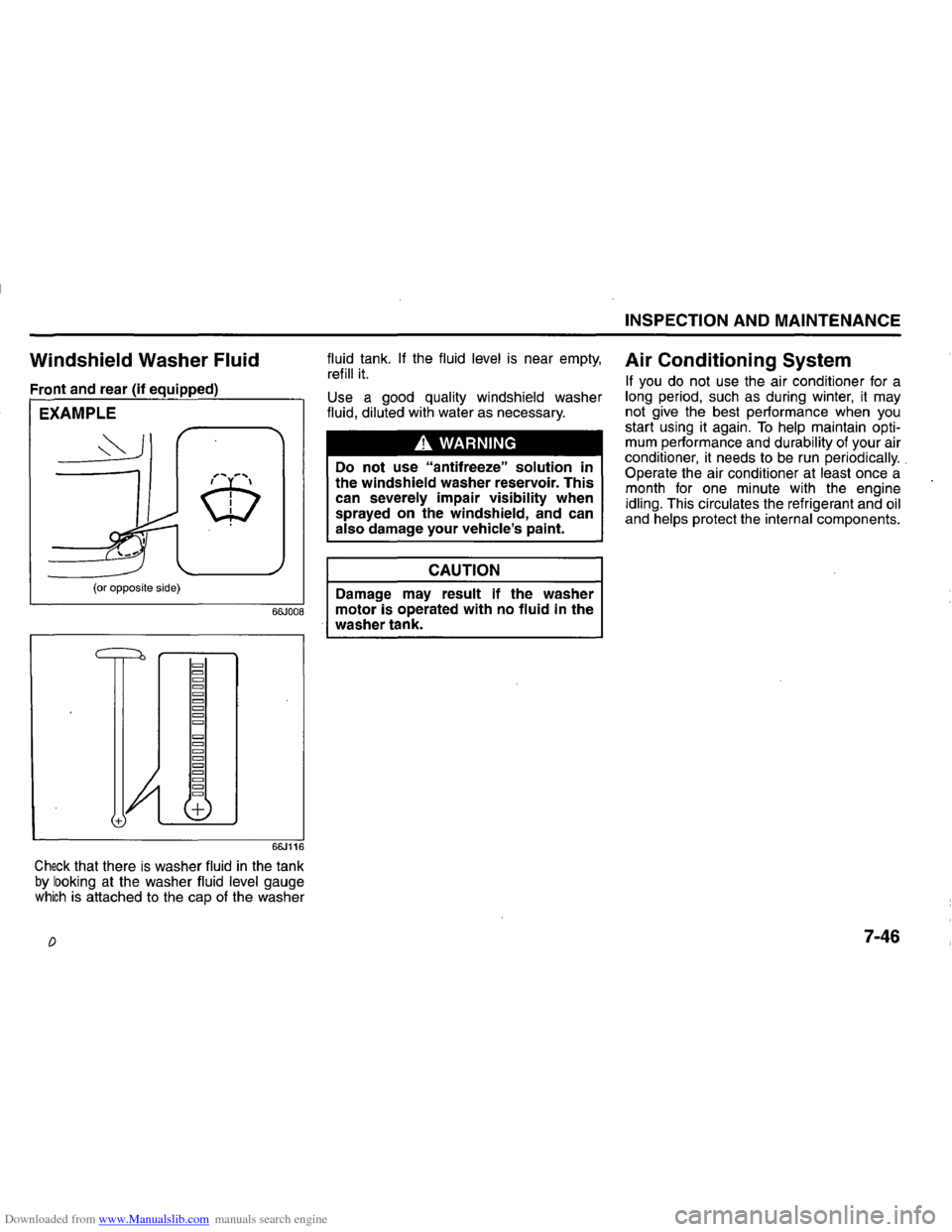
Front and rear (if equipped)
EXAMPLE
(or opposite side)
= = = = =
= =
= =
=
= = =
= = = = =
66JOOB
66J116
Check that there is washer fluid in the tank by looking at the washer fluid level gauge which is attached to the cap of the washer
D
fluid tank. If the fluid level is near empty, refill it.
Use a good quality windshield washer
fluid, diluted with water as necessary.
A WARNING
Do not use "antifreeze" solution in the windshield washer reservoir. This can severely impair visibility when
sprayed on the windshield, and can also damage your vehicle's paint.
CAUTION
Damage may result if the washer
motor is operated with no fluid in the
washer tank.
INSPECTION AND MAINTENANCE
Air Conditioning System
If you do not use the air conditioner for a long period, such as during winter, it may
not give the best performance when you start using it again. To help maintain opti
mum performance and durability of your air
conditioner, it needs to be run periodically .. Operate the air conditioner at least once a
month for one minute with the engine
idling. This circulates the refrigerant and oil and helps protect the internal components.
7-46