emergency SUZUKI GRAND VITARA 2012 User Guide
[x] Cancel search | Manufacturer: SUZUKI, Model Year: 2012, Model line: GRAND VITARA, Model: SUZUKI GRAND VITARA 2012Pages: 337, PDF Size: 6.21 MB
Page 140 of 337
3-39OPERATING YOUR VEHICLE
79K21-03E
The low tire pressure warning light can
come on due to normal causes such as
natural air leaks and pressure changes
caused by changes in temperature or
atmospheric pressure. Adjusting the air
pressure in the tires to the pressure shown
WARNING
The tire pressure monitoring system
is not a substitute for regular tire
pressure inspections. Check tire
inflation pressures monthly when
cold and set to the recommended
inflation pressure as specified on the
vehicle’s tire information placard and
in the owner’s manual. Refer to
“Tires” in the “INSPECTION AND
MAINTENANCE” section.
WARNING
If the low tire pressure warning light
does not come on when the ignition
is turned to the “ON” position, or
comes on and blinks while driving
there may be a problem with the tire
pressure monitoring system. Have
your vehicle inspected by an autho-
rized SUZUKI dealer. Even if the light
turns off after blinking, indicating
that the monitoring system has
recovered, make sure to have an
authorized SUZUKI dealer check the
system.
WARNING
The load rating of your tires is
reduced at lower inflation pressures.
If your tires become even moderately
under-inflated, the vehicle load may
exceed the load rating of the tires,
which can lead to tire failure. The low
tire pressure warning light will not
alert you of this condition. The warn-
ing light will only come on when one
or more of your tires become signifi-
cantly under-inflated. Check and
adjust your tire inflation pressure at
least once a month. Refer to “Tires”
in the “INSPECTION AND MAINTE-
NANCE” section.
WARNING
If the low tire pressure warning light
comes on and stays on, reduce your
speed and avoid abrupt steering and
braking. Stop in a safe place as soon
as possible and check your tires.
If you have a flat tire, replace it with
the spare tire. Refer to “Jacking
Instructions” in the “EMERGENCY
SERVICE” section. Refer to
“Replacing Tires and/or Wheels”
for instructions on how to restore
normal operation of the tire pres-
sure monitoring system after you
have had a flat tire.
If one or more of your tires is
under-inflated adjust the inflation
pressure in all of your tires to the
recommended inflation pressure as
soon as possible.
Be aware that driving on a signifi-
cantly under-inflated tire can cause
the tire to overheat and can lead to
tire failure, and may affect steering
control and brake effectiveness. This
could lead to an accident, resulting in
severe injury or death.
Page 236 of 337
5-83OTHER CONTROLS AND EQUIPMENT
79K21-03E
Frame HooksFront
78K052
Rear
78K149
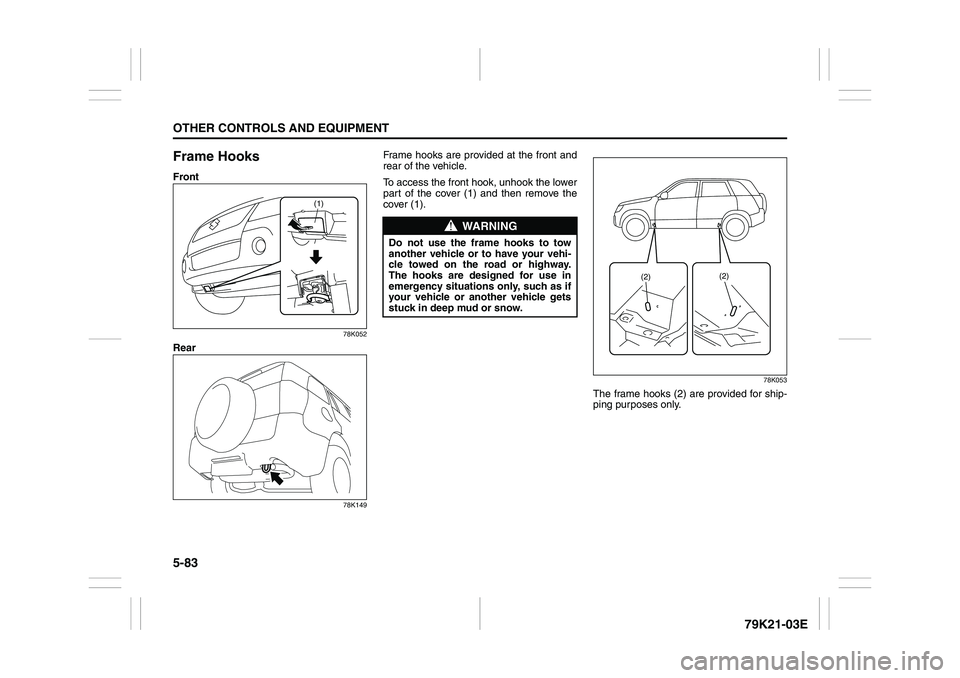
Frame hooks are provided at the front and
rear of the vehicle.
To access the front hook, unhook the lower
part of the cover (1) and then remove the
cover (1).
78K053
The frame hooks (2) are provided for ship-
ping purposes only.
(1)
WARNING
Do not use the frame hooks to tow
another vehicle or to have your vehi-
cle towed on the road or highway.
The hooks are designed for use in
emergency situations only, such as if
your vehicle or another vehicle gets
stuck in deep mud or snow.
(2)(2)
Page 243 of 337
6-6
VEHICLE LOADING AND TOWING
79K21-03E
60A186
WARNING
(Continued)
Avoid “riding” the brakes. “Riding”
the brakes could cause the brakes
to overheat, resulting in reduced
braking efficiency. Use engine
braking as much as possible.
Because of the added trailer
weight, your engine may overheat
on hot days when going up long or
steep hills. Pay attention to your
engine temperature gauge. If it indi-
cates overheating, pull off the road
and stop in a safe place. Refer to
the “If the Engine Overheats” in
“EMERGENCY SERVICE” section
for details on how to proceed.
WARNING
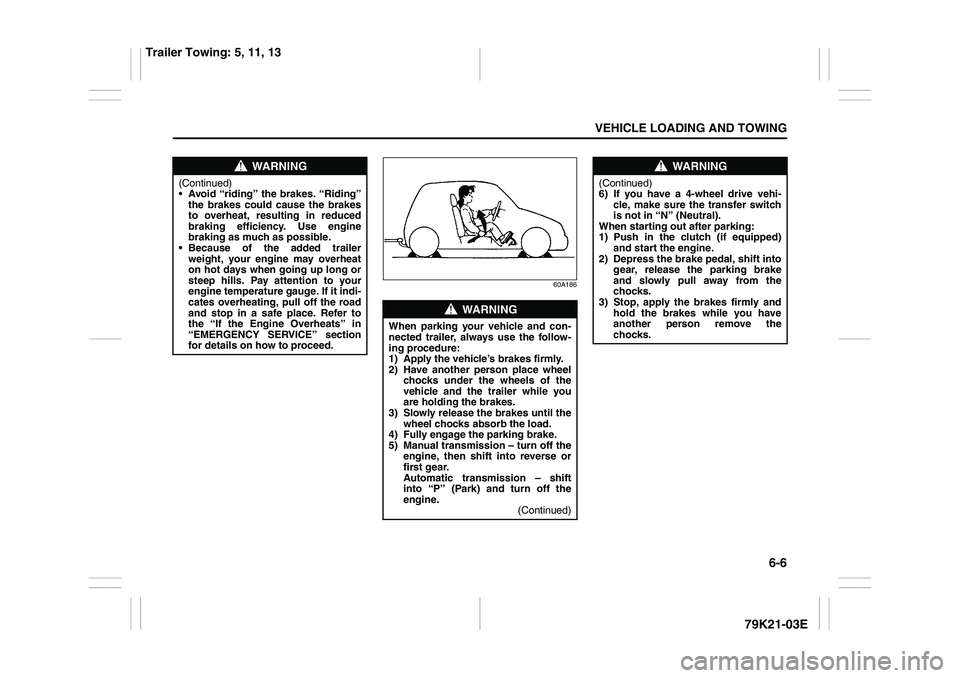
When parking your vehicle and con-
nected trailer, always use the follow-
ing procedure:
1) Apply the vehicle’s brakes firmly.
2) Have another person place wheel
chocks under the wheels of the
vehicle and the trailer while you
are holding the brakes.
3) Slowly release the brakes until the
wheel chocks absorb the load.
4) Fully engage the parking brake.
5) Manual transmission – turn off the
engine, then shift into reverse or
first gear.
Automatic transmission – shift
into “P” (Park) and turn off the
engine.
(Continued)
WARNING
(Continued)
6) If you have a 4-wheel drive vehi-
cle, make sure the transfer switch
is not in “N” (Neutral).
When starting out after parking:
1) Push in the clutch (if equipped)
and start the engine.
2) Depress the brake pedal, shift into
gear, release the parking brake
and slowly pull away from the
chocks.
3) Stop, apply the brakes firmly and
hold the brakes while you have
another person remove the
chocks.
Trailer Towing: 5, 11, 13
Page 280 of 337
7-31INSPECTION AND MAINTENANCE
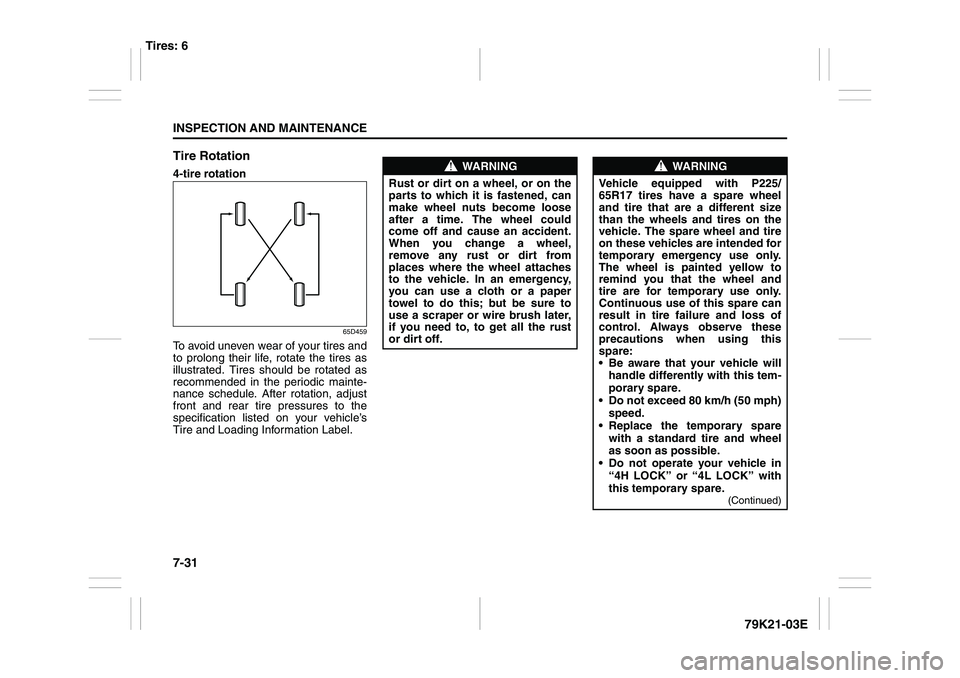
79K21-03E Tire Rotation
4-tire rotation
65D459
To avoid uneven wear of your tires and
to prolong their life, rotate the tires as
illustrated. Tires should be rotated as
recommended in the periodic mainte-
nance schedule. After rotation, adjust
front and rear tire pressures to the
specification listed on your vehicle’s
Tire and Loading Information Label.
WARNING
Rust or dirt on a wheel, or on the
parts to which it is fastened, can
make wheel nuts become loose
after a time. The wheel could
come off and cause an accident.
When you change a wheel,
remove any rust or dirt from
places where the wheel attaches
to the vehicle. In an emergency,
you can use a cloth or a paper
towel to do this; but be sure to
use a scraper or wire brush later,
if you need to, to get all the rust
or dirt off.
WARNING
Vehicle equipped with P225/
65R17 tires have a spare wheel
and tire that are a different size
than the wheels and tires on the
vehicle. The spare wheel and tire
on these vehicles are intended for
temporary emergency use only.
The wheel is painted yellow to
remind you that the wheel and
tire are for temporary use only.
Continuous use of this spare can
result in tire failure and loss of
control. Always observe these
precautions when using this
spare:
Be aware that your vehicle will
handle differently with this tem-
porary spare.
Do not exceed 80 km/h (50 mph)
speed.
Replace the temporary spare
with a standard tire and wheel
as soon as possible.
Do not operate your vehicle in
“4H LOCK” or “4L LOCK” with
this temporary spare.
(Continued)
Tires: 6
Page 285 of 337
7-36
INSPECTION AND MAINTENANCE
79K21-03E
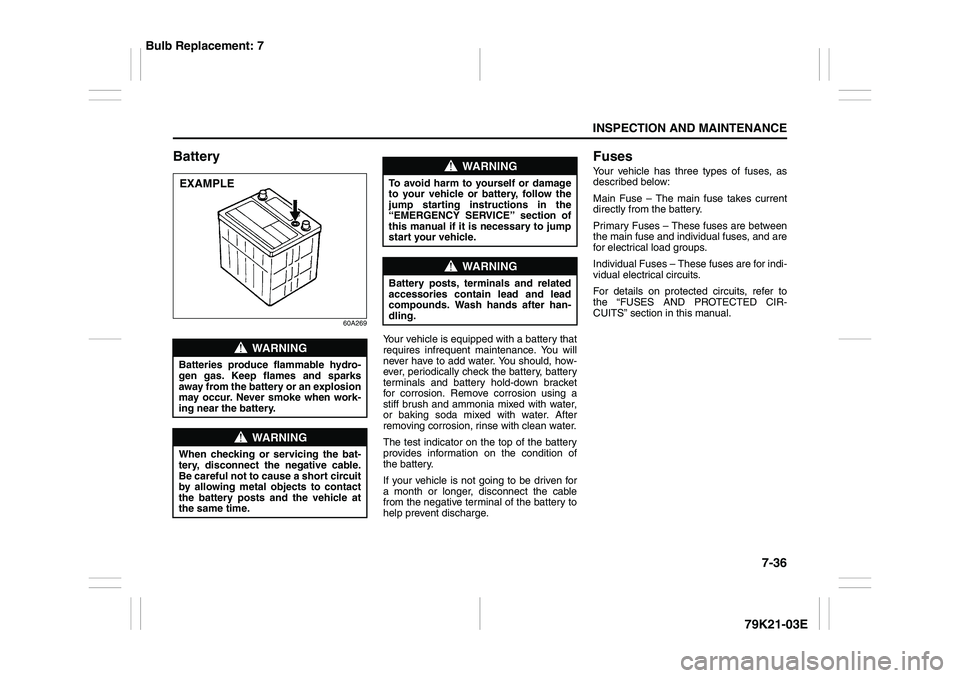
Battery
60A269
Your vehicle is equipped with a battery that
requires infrequent maintenance. You will
never have to add water. You should, how-
ever, periodically check the battery, battery
terminals and battery hold-down bracket
for corrosion. Remove corrosion using a
stiff brush and ammonia mixed with water,
or baking soda mixed with water. After
removing corrosion, rinse with clean water.
The test indicator on the top of the battery
provides information on the condition of
the battery.
If your vehicle is not going to be driven for
a month or longer, disconnect the cable
from the negative terminal of the battery to
help prevent discharge.
FusesYour vehicle has three types of fuses, as
described below:
Main Fuse – The main fuse takes current
directly from the battery.
Primary Fuses – These fuses are between
the main fuse and individual fuses, and are
for electrical load groups.
Individual Fuses – These fuses are for indi-
vidual electrical circuits.
For details on protected circuits, refer to
the “FUSES AND PROTECTED CIR-
CUITS” section in this manual.
WARNING
Batteries produce flammable hydro-
gen gas. Keep flames and sparks
away from the battery or an explosion
may occur. Never smoke when work-
ing near the battery.
WARNING
When checking or servicing the bat-
tery, disconnect the negative cable.
Be careful not to cause a short circuit
by allowing metal objects to contact
the battery posts and the vehicle at
the same time.EXAMPLE
WARNING
To avoid harm to yourself or damage
to your vehicle or battery, follow the
jump starting instructions in the
“EMERGENCY SERVICE” section of
this manual if it is necessary to jump
start your vehicle.
WARNING
Battery posts, terminals and related
accessories contain lead and lead
compounds. Wash hands after han-
dling.
Bulb Replacement: 7
Page 299 of 337
EMERGENCY SERVICE
8
79K21-03E
60G411
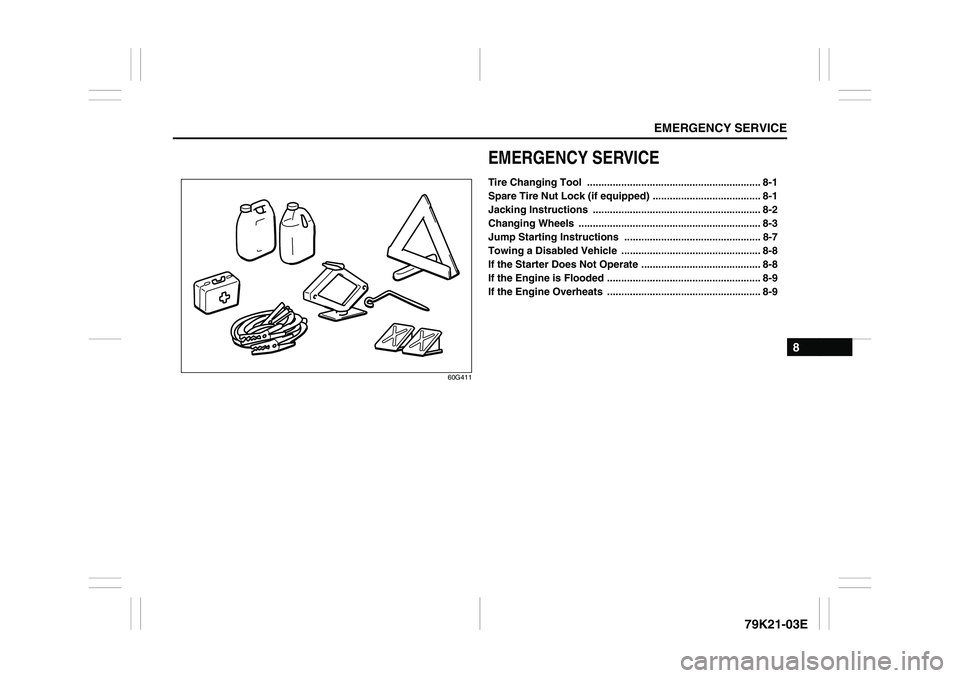
EMERGENCY SERVICETire Changing Tool ............................................................. 8-1
Spare Tire Nut Lock (if equipped) ...................................... 8-1
Jacking Instructions ........................................................... 8-2
Changing Wheels ................................................................ 8-3
Jump Starting Instructions ................................................ 8-7
Towing a Disabled Vehicle ................................................. 8-8
If the Starter Does Not Operate .......................................... 8-8
If the Engine is Flooded ...................................................... 8-9
If the Engine Overheats ...................................................... 8-9
Page 300 of 337
8-1EMERGENCY SERVICE
79K21-03E
Tire Changing Tool
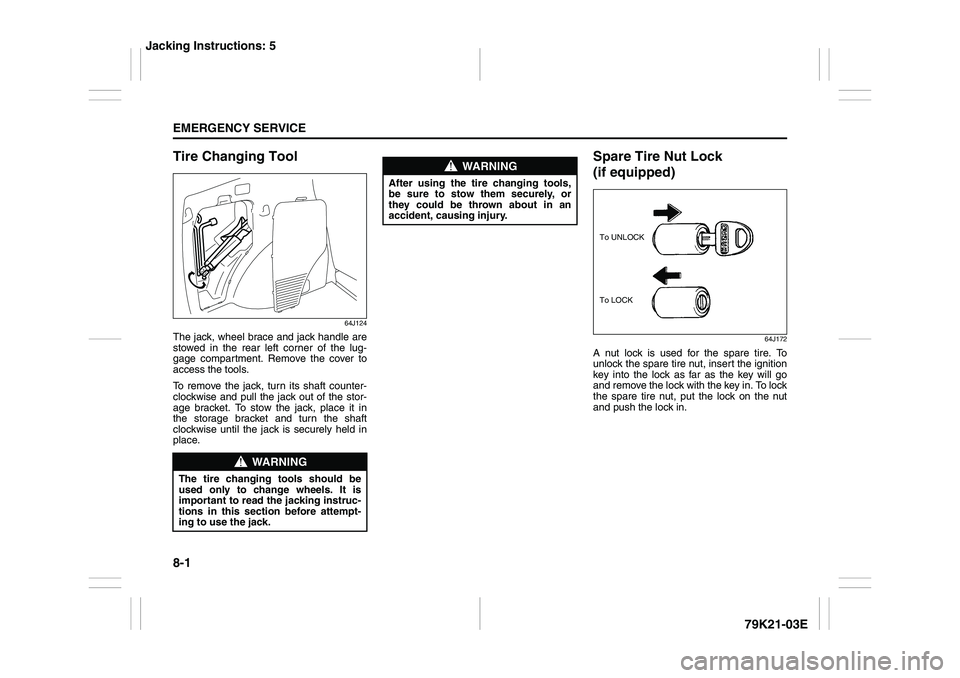
64J124
The jack, wheel brace and jack handle are
stowed in the rear left corner of the lug-
gage compartment. Remove the cover to
access the tools.
To remove the jack, turn its shaft counter-
clockwise and pull the jack out of the stor-
age bracket. To stow the jack, place it in
the storage bracket and turn the shaft
clockwise until the jack is securely held in
place.
Spare Tire Nut Lock
(if equipped)
64J172
A nut lock is used for the spare tire. To
unlock the spare tire nut, insert the ignition
key into the lock as far as the key will go
and remove the lock with the key in. To lock
the spare tire nut, put the lock on the nut
and push the lock in.
WARNING
The tire changing tools should be
used only to change wheels. It is
important to read the jacking instruc-
tions in this section before attempt-
ing to use the jack.
WARNING
After using the tire changing tools,
be sure to stow them securely, or
they could be thrown about in an
accident, causing injury.
To LOCK To UNLOCK
Jacking Instructions: 5
Page 301 of 337
8-2
EMERGENCY SERVICE
79K21-03E
Jacking Instructions
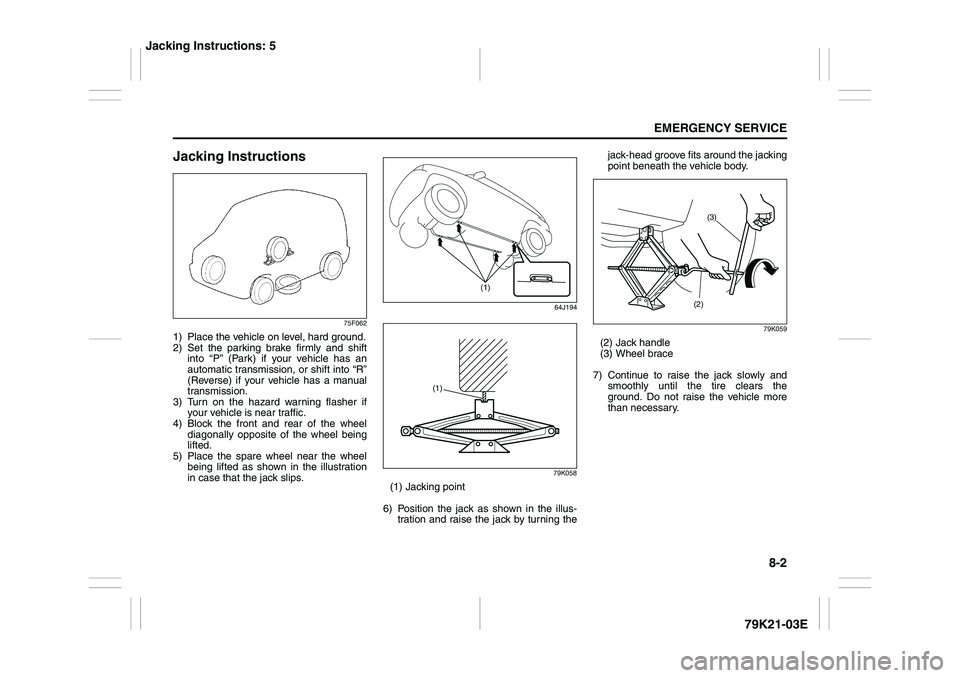
75F062
1) Place the vehicle on level, hard ground.
2) Set the parking brake firmly and shift
into “P” (Park) if your vehicle has an
automatic transmission, or shift into “R”
(Reverse) if your vehicle has a manual
transmission.
3) Turn on the hazard warning flasher if
your vehicle is near traffic.
4) Block the front and rear of the wheel
diagonally opposite of the wheel being
lifted.
5) Place the spare wheel near the wheel
being lifted as shown in the illustration
in case that the jack slips.
64J194
79K058
(1) Jacking point
6) Position the jack as shown in the illus-
tration and raise the jack by turning thejack-head groove fits around the jacking
point beneath the vehicle body.
79K059
(2) Jack handle
(3) Wheel brace
7) Continue to raise the jack slowly and
smoothly until the tire clears the
ground. Do not raise the vehicle more
than necessary.
(1)
(1)
(3)
(2)
Jacking Instructions: 5
Page 302 of 337
8-3EMERGENCY SERVICE
79K21-03E
Changing WheelsTo change a wheel, use the following pro-
cedure:
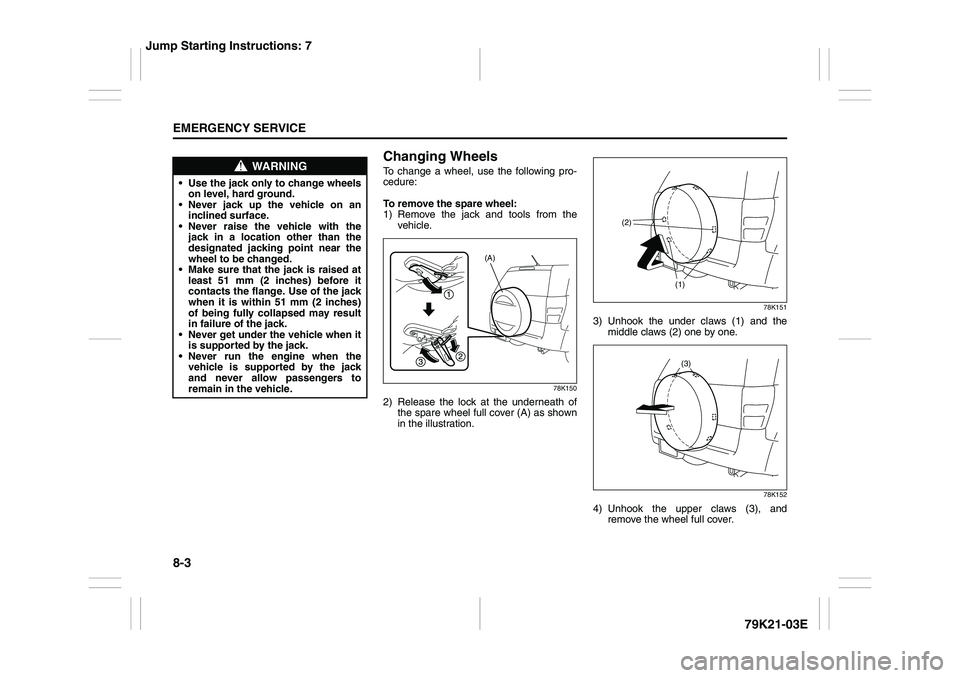
To remove the spare wheel:
1) Remove the jack and tools from the
vehicle.
78K150
2) Release the lock at the underneath of
the spare wheel full cover (A) as shown
in the illustration.
78K151
3) Unhook the under claws (1) and the
middle claws (2) one by one.
78K152
4) Unhook the upper claws (3), and
remove the wheel full cover.
WARNING
Use the jack only to change wheels
on level, hard ground.
Never jack up the vehicle on an
inclined surface.
Never raise the vehicle with the
jack in a location other than the
designated jacking point near the
wheel to be changed.
Make sure that the jack is raised at
least 51 mm (2 inches) before it
contacts the flange. Use of the jack
when it is within 51 mm (2 inches)
of being fully collapsed may result
in failure of the jack.
Never get under the vehicle when it
is supported by the jack.
Never run the engine when the
vehicle is supported by the jack
and never allow passengers to
remain in the vehicle.
(A)
(1) (2)(3)
Jump Starting Instructions: 7
Page 303 of 337
8-4
EMERGENCY SERVICE
79K21-03E
NOTE:
Remove the full wheel cover from the bot-
tom part to the upper part. Otherwise, the
claws may be broken.
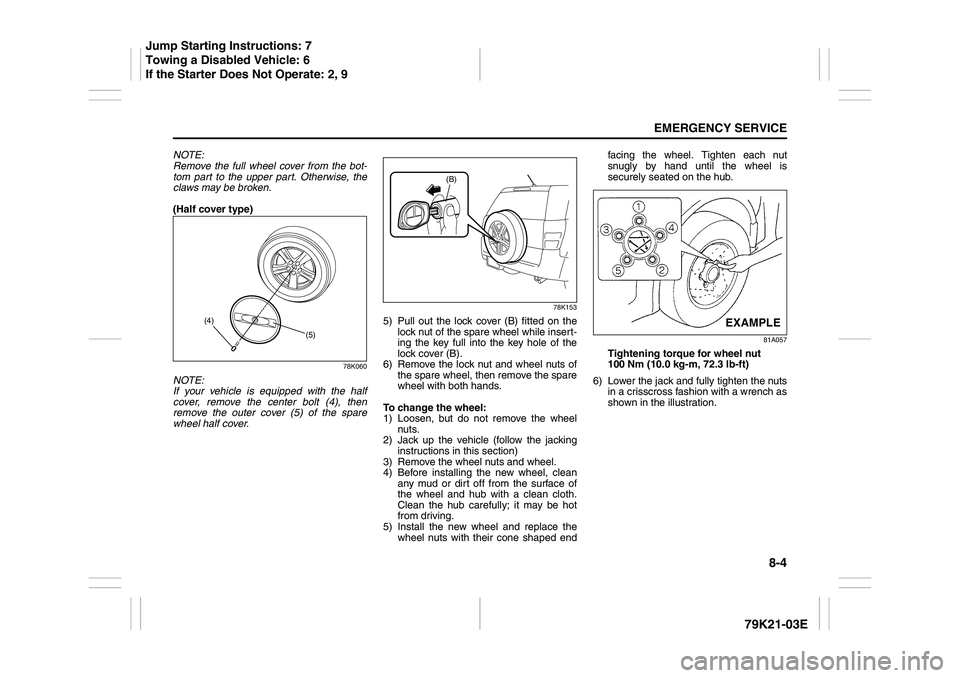
(Half cover type)
78K060
NOTE:
If your vehicle is equipped with the half
cover, remove the center bolt (4), then
remove the outer cover (5) of the spare
wheel half cover.
78K153
5) Pull out the lock cover (B) fitted on the
lock nut of the spare wheel while insert-
ing the key full into the key hole of the
lock cover (B).
6) Remove the lock nut and wheel nuts of
the spare wheel, then remove the spare
wheel with both hands.
To change the wheel:
1) Loosen, but do not remove the wheel
nuts.
2) Jack up the vehicle (follow the jacking
instructions in this section)
3) Remove the wheel nuts and wheel.
4) Before installing the new wheel, clean
any mud or dirt off from the surface of
the wheel and hub with a clean cloth.
Clean the hub carefully; it may be hot
from driving.
5) Install the new wheel and replace the
wheel nuts with their cone shaped endfacing the wheel. Tighten each nut
snugly by hand until the wheel is
securely seated on the hub.
81A057
Tightening torque for wheel nut
100 Nm (10.0 kg-m, 72.3 lb-ft)
6) Lower the jack and fully tighten the nuts
in a crisscross fashion with a wrench as
shown in the illustration.
(5) (4)
(B)
EXAMPLE
Jump Starting Instructions: 7
Towing a Disabled Vehicle: 6
If the Starter Does Not Operate: 2, 9