emergency SUZUKI GRAND VITARA 2012 Owner's Manual
[x] Cancel search | Manufacturer: SUZUKI, Model Year: 2012, Model line: GRAND VITARA, Model: SUZUKI GRAND VITARA 2012Pages: 337, PDF Size: 6.21 MB
Page 304 of 337
8-5EMERGENCY SERVICE
79K21-03E
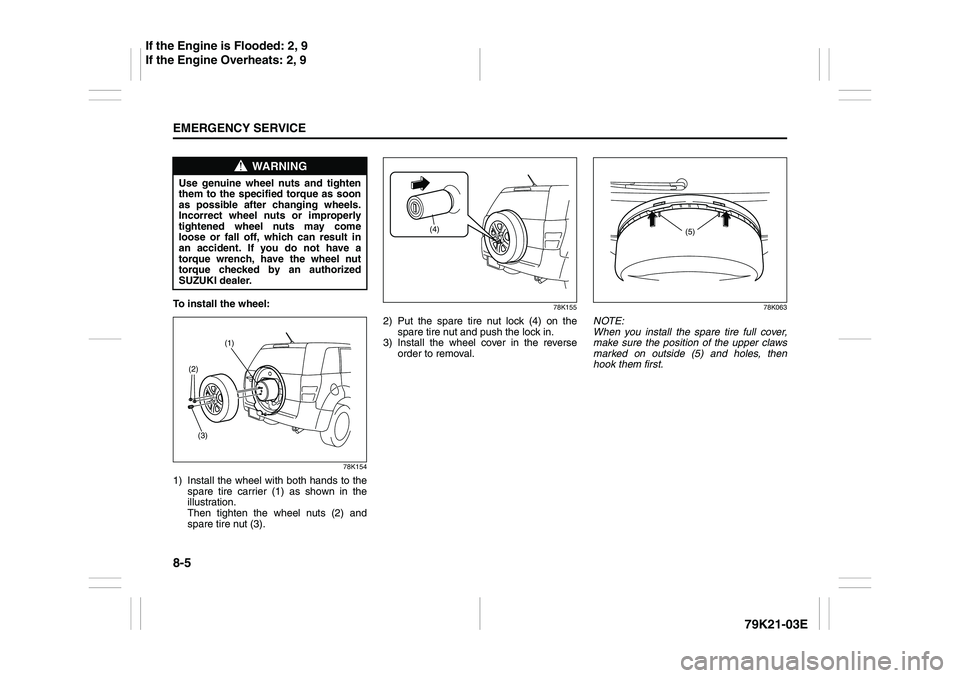
To install the wheel:
78K154
1) Install the wheel with both hands to the
spare tire carrier (1) as shown in the
illustration.
Then tighten the wheel nuts (2) and
spare tire nut (3).
78K155
2) Put the spare tire nut lock (4) on the
spare tire nut and push the lock in.
3) Install the wheel cover in the reverse
order to removal.
78K063
NOTE:
When you install the spare tire full cover,
make sure the position of the upper claws
marked on outside (5) and holes, then
hook them first.
WARNING
Use genuine wheel nuts and tighten
them to the specified torque as soon
as possible after changing wheels.
Incorrect wheel nuts or improperly
tightened wheel nuts may come
loose or fall off, which can result in
an accident. If you do not have a
torque wrench, have the wheel nut
torque checked by an authorized
SUZUKI dealer.
(1)
(2)
(3)
(4)
(5)
If the Engine is Flooded: 2, 9
If the Engine Overheats: 2, 9
Page 305 of 337
8-6
EMERGENCY SERVICE
79K21-03E
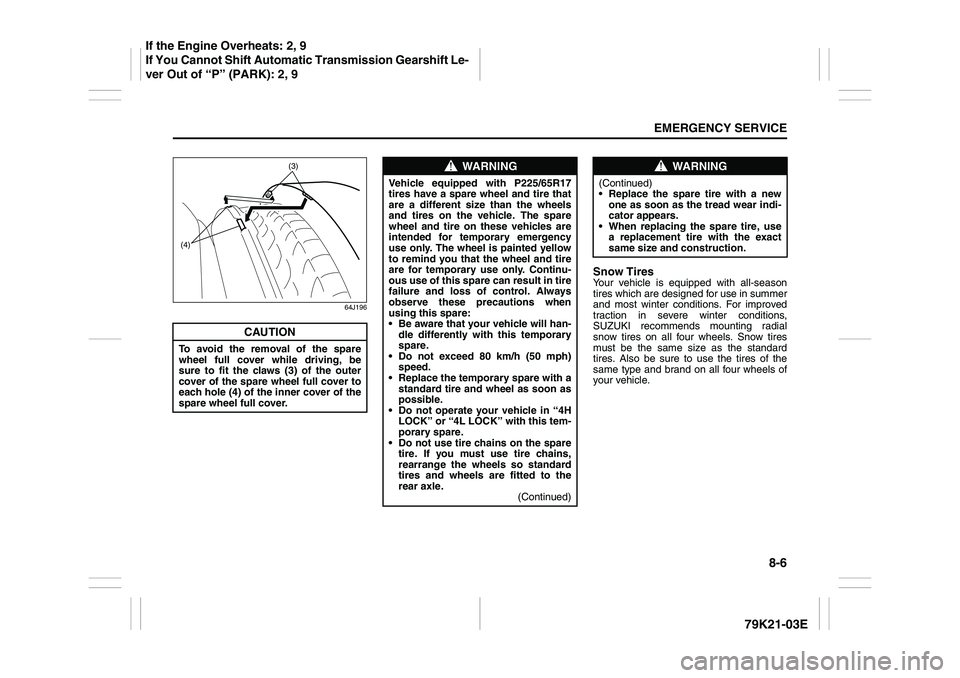
64J196
Snow TiresYour vehicle is equipped with all-season
tires which are designed for use in summer
and most winter conditions. For improved
traction in severe winter conditions,
SUZUKI recommends mounting radial
snow tires on all four wheels. Snow tires
must be the same size as the standard
tires. Also be sure to use the tires of the
same type and brand on all four wheels of
your vehicle.
CAUTION
To avoid the removal of the spare
wheel full cover while driving, be
sure to fit the claws (3) of the outer
cover of the spare wheel full cover to
each hole (4) of the inner cover of the
spare wheel full cover.
(3)
(4)
WARNING
Vehicle equipped with P225/65R17
tires have a spare wheel and tire that
are a different size than the wheels
and tires on the vehicle. The spare
wheel and tire on these vehicles are
intended for temporary emergency
use only. The wheel is painted yellow
to remind you that the wheel and tire
are for temporary use only. Continu-
ous use of this spare can result in tire
failure and loss of control. Always
observe these precautions when
using this spare:
Be aware that your vehicle will han-
dle differently with this temporary
spare.
Do not exceed 80 km/h (50 mph)
speed.
Replace the temporary spare with a
standard tire and wheel as soon as
possible.
Do not operate your vehicle in “4H
LOCK” or “4L LOCK” with this tem-
porary spare.
Do not use tire chains on the spare
tire. If you must use tire chains,
rearrange the wheels so standard
tires and wheels are fitted to the
rear axle.
(Continued)
WARNING
(Continued)
Replace the spare tire with a new
one as soon as the tread wear indi-
cator appears.
When replacing the spare tire, use
a replacement tire with the exact
same size and construction.
If the Engine Overheats: 2, 9
If You Cannot Shift Automatic Transmission Gearshift Le-
ver Out of “P” (PARK): 2, 9
Page 306 of 337
8-7EMERGENCY SERVICE
79K21-03E
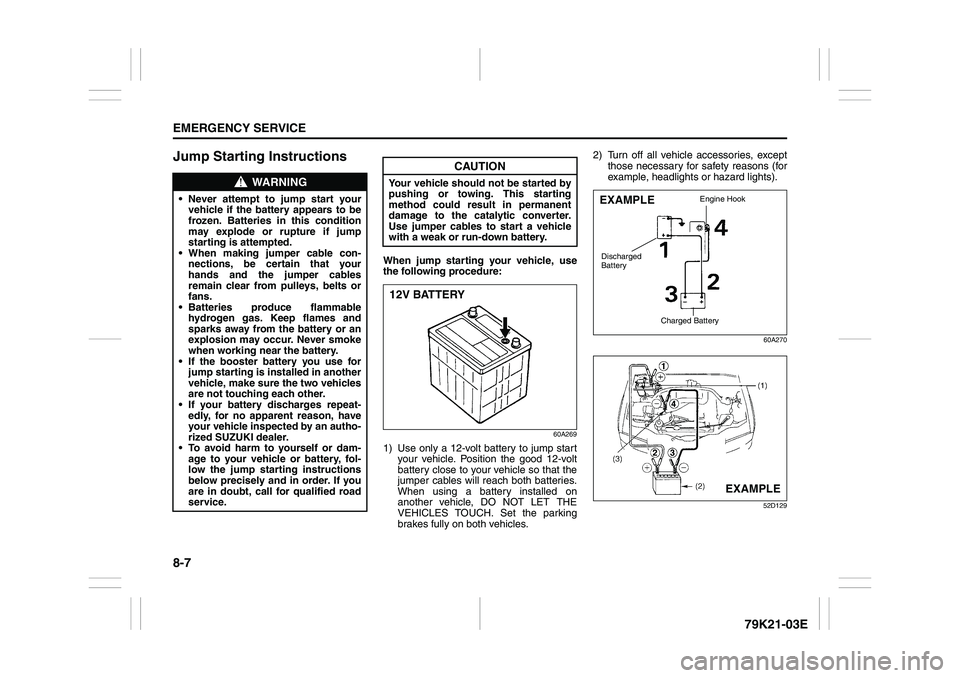
Jump Starting Instructions
When jump starting your vehicle, use
the following procedure:
60A269
1) Use only a 12-volt battery to jump start
your vehicle. Position the good 12-volt
battery close to your vehicle so that the
jumper cables will reach both batteries.
When using a battery installed on
another vehicle, DO NOT LET THE
VEHICLES TOUCH. Set the parking
brakes fully on both vehicles.2) Turn off all vehicle accessories, except
those necessary for safety reasons (for
example, headlights or hazard lights).
60A270
52D129
WARNING
Never attempt to jump start your
vehicle if the battery appears to be
frozen. Batteries in this condition
may explode or rupture if jump
starting is attempted.
When making jumper cable con-
nections, be certain that your
hands and the jumper cables
remain clear from pulleys, belts or
fans.
Batteries produce flammable
hydrogen gas. Keep flames and
sparks away from the battery or an
explosion may occur. Never smoke
when working near the battery.
If the booster battery you use for
jump starting is installed in another
vehicle, make sure the two vehicles
are not touching each other.
If your battery discharges repeat-
edly, for no apparent reason, have
your vehicle inspected by an autho-
rized SUZUKI dealer.
To avoid harm to yourself or dam-
age to your vehicle or battery, fol-
low the jump starting instructions
below precisely and in order. If you
are in doubt, call for qualified road
service.
CAUTION
Your vehicle should not be started by
pushing or towing. This starting
method could result in permanent
damage to the catalytic converter.
Use jumper cables to start a vehicle
with a weak or run-down battery.12V BATTERY
EXAMPLE
Engine Hook
Charged Battery
Discharged
Battery
EXAMPLE
Page 307 of 337
8-8
EMERGENCY SERVICE
79K21-03E
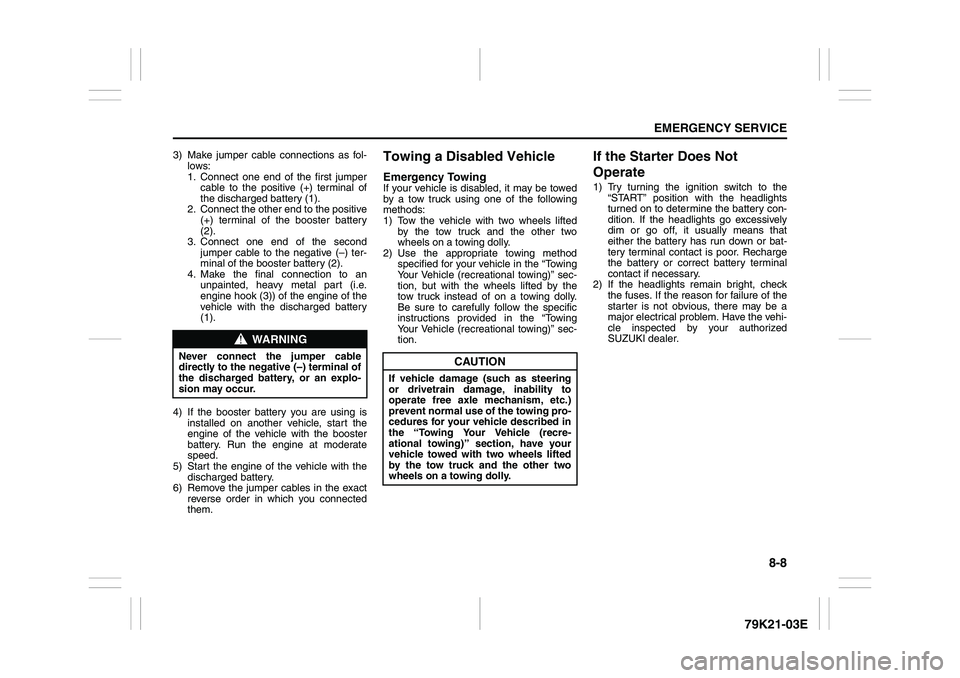
3) Make jumper cable connections as fol-
lows:
1. Connect one end of the first jumper
cable to the positive (+) terminal of
the discharged battery (1).
2. Connect the other end to the positive
(+) terminal of the booster battery
(2).
3. Connect one end of the second
jumper cable to the negative (–) ter-
minal of the booster battery (2).
4. Make the final connection to an
unpainted, heavy metal part (i.e.
engine hook (3)) of the engine of the
vehicle with the discharged battery
(1).
4) If the booster battery you are using is
installed on another vehicle, start the
engine of the vehicle with the booster
battery. Run the engine at moderate
speed.
5) Start the engine of the vehicle with the
discharged battery.
6) Remove the jumper cables in the exact
reverse order in which you connected
them.
Towing a Disabled VehicleEmergency TowingIf your vehicle is disabled, it may be towed
by a tow truck using one of the following
methods:
1) Tow the vehicle with two wheels lifted
by the tow truck and the other two
wheels on a towing dolly.
2) Use the appropriate towing method
specified for your vehicle in the “Towing
Your Vehicle (recreational towing)” sec-
tion, but with the wheels lifted by the
tow truck instead of on a towing dolly.
Be sure to carefully follow the specific
instructions provided in the “Towing
Your Vehicle (recreational towing)” sec-
tion.
If the Starter Does Not
Operate1) Try turning the ignition switch to the
“START” position with the headlights
turned on to determine the battery con-
dition. If the headlights go excessively
dim or go off, it usually means that
either the battery has run down or bat-
tery terminal contact is poor. Recharge
the battery or correct battery terminal
contact if necessary.
2) If the headlights remain bright, check
the fuses. If the reason for failure of the
starter is not obvious, there may be a
major electrical problem. Have the vehi-
cle inspected by your authorized
SUZUKI dealer.
WARNING
Never connect the jumper cable
directly to the negative (–) terminal of
the discharged battery, or an explo-
sion may occur.
CAUTION
If vehicle damage (such as steering
or drivetrain damage, inability to
operate free axle mechanism, etc.)
prevent normal use of the towing pro-
cedures for your vehicle described in
the “Towing Your Vehicle (recre-
ational towing)” section, have your
vehicle towed with two wheels lifted
by the tow truck and the other two
wheels on a towing dolly.
Page 308 of 337
8-9EMERGENCY SERVICE
79K21-03E
If the Engine is FloodedIf the engine is flooded with gasoline, it
may be hard to start. If this happens, press
the accelerator pedal all the way to the
floor and hold it there while cranking the
engine. (Do not operate the starter motor
for more than 15 seconds).
If the Engine OverheatsThe engine could overheat temporarily
under severe driving conditions. If the
engine coolant temperature gauge indi-
cates overheating during driving:
1) Turn off the air conditioner, if equipped.
2) Take the vehicle to a safe place and
park.
3) Let the engine run at normal idle speed
for a few minutes until the indicator is
within the normal, acceptable tempera-
ture range shown by the white band
between “H” and “C”.If the temperature indication does not
come down to within the normal, accept-
able range:
1) Turn off the engine and check that the
water pump belt and pulleys are not
damaged or slipping. If any abnormality
is found, correct it.
2) Check the coolant level in the reservoir.
If it is found to be lower than the “LOW”
line, look for leaks at the radiator, water
pump and radiator and heater hoses. If
you locate any leaks that may have
caused the overheating, do not run the
engine until these problems have been
corrected.
3) If you do not find a leak, carefully add
coolant to the reservoir and then the
radiator, if necessary. (Refer to “Engine
Coolant” in the “INSPECTION AND
MAINTENANCE” section.)
WARNING
If you see or hear escaping steam,
stop the vehicle in a safe place and
immediately turn off the engine to let
it cool. Do not open the hood when
steam is present. When the steam
can no longer be seen or heard, open
the hood to see if the coolant is still
boiling. If it is, you must wait until it
stops boiling before you proceed.
Also, be careful not to touch hot
engine parts (radiator, water hoses,
engine etc.).
Page 309 of 337
8-10
EMERGENCY SERVICE
79K21-03E
66J191
WARNING
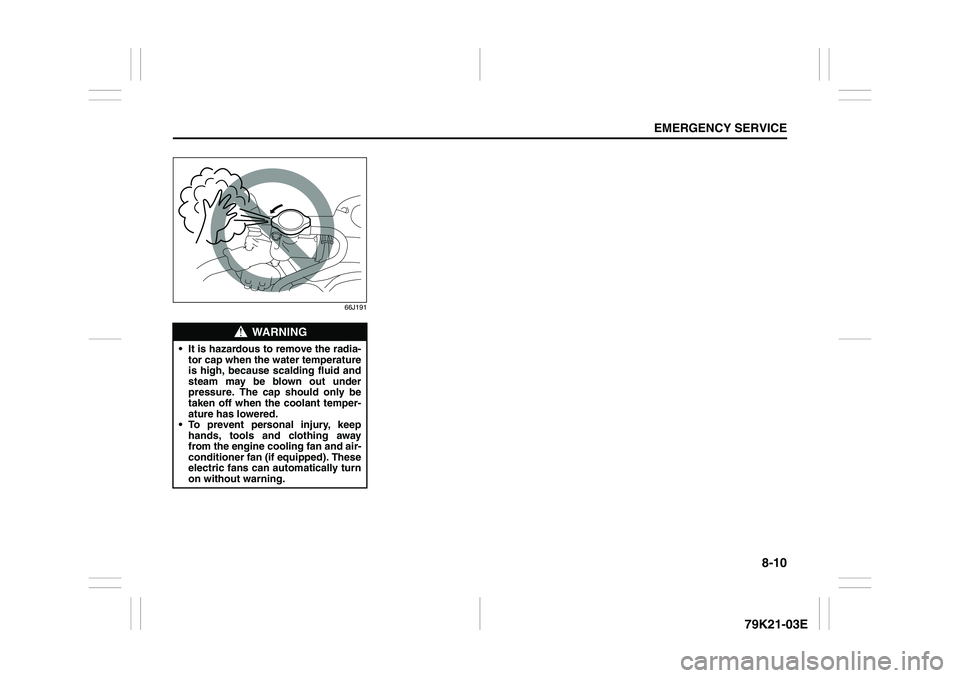
It is hazardous to remove the radia-
tor cap when the water temperature
is high, because scalding fluid and
steam may be blown out under
pressure. The cap should only be
taken off when the coolant temper-
ature has lowered.
To prevent personal injury, keep
hands, tools and clothing away
from the engine cooling fan and air-
conditioner fan (if equipped). These
electric fans can automatically turn
on without warning.
Page 310 of 337
8-11EMERGENCY SERVICE
79K21-03E
MEMO
Page 332 of 337
13-2INDEX
79K21-03E
Cup Holder and Storage Bin
...............................................5-72
DDaily Inspection Checklist
..................................................3-2
Daytime Running Light (D.R.L.) Indicator Light
...............2-63
Daytime Running Light (D.R.L.) System
............................2-78
Door Locks
...........................................................................2-1
Drive Belt
..............................................................................7-9
Driver’s Seat Belt Reminder Light
.....................................2-61
Driving Range
......................................................................2-68
EElectronic Stability Program (ESP®)
.................................3-31
Emergency Locking Retractor (ELR) .................................2-28
Emission Compliance Label (for U.S.A.)
...........................10-2
Engine Block Heater
............................................................3-10
Engine Coolant
....................................................................7-13
Engine Coolant Level Check
..............................................7-14
Engine Coolant Replacement .............................................7-15
Engine Hood
........................................................................5-63
Engine Oil and Filter
............................................................7-10
Engine Serial Number .........................................................10-1
Exhaust Gas Warning .........................................................3-1
FFloor Mats
............................................................................5-74
Fluid Level Check
................................................................7-20
Folding Rear Seats ..............................................................2-24
Frame Hooks
........................................................................5-83
Front Air Bags ......................................................................2-45
Front Fog Light Switch
.......................................................2-78
Front Passenger’s Seat Belt Reminder Light
...................2-55
Front Seat Back Pocket
......................................................5-73
Front Seat Heater
.................................................................2-21Front Seats
.......................................................................... 2-18
Fuel Consumption
.............................................................. 2-68
Fuel Filler Cap
..................................................................... 5-62
Fuel Gauge
.......................................................................... 2-65
Fuel Pump Labeling
............................................................ 1-1
Fuel Recommendation ....................................................... 1-1
Fuse under the Dash Board
............................................... 7-38
Fuses
.................................................................................... 7-36
FUSES AND PROTECTED CIRCUITS
................................ 11-1
GGasoline Containing MTBE
................................................ 1-1
Gasoline/Ethanol blends
.................................................... 1-1
Gasoline/Methanol blends ................................................. 1-1
Gear Oil
................................................................................ 7-17
Gear Oil Level Check
.......................................................... 7-19
Gear Oil Replacement ......................................................... 7-19
GLOSSARY OF TIRE TERMINOLOGY
............................... 7-32
Glove Box
............................................................................ 5-71
HHazard Warning Switch
...................................................... 2-79
Head Restraints
..........................................................2-20
, 2-23
Headlight Aiming
................................................................ 7-39
High Beam Indicator Light
................................................. 2-63
Hill descent control Indicator Light
................................... 2-60
Hill descent control System
............................................... 3-35
Hill hold control System
..................................................... 3-37
HomeLink®
.......................................................................... 5-80
Horn
...................................................................................... 2-82
IIdentification Numbers
....................................................... 10-1
If the Engine is Flooded ..................................................... 8-9