load SUZUKI GRAND VITARA 2016 Owner's Manual
[x] Cancel search | Manufacturer: SUZUKI, Model Year: 2016, Model line: GRAND VITARA, Model: SUZUKI GRAND VITARA 2016Pages: 482, PDF Size: 21 MB
Page 301 of 482
5-59
OTHER CONTROLS AND EQUIPMENT
54P00-01E
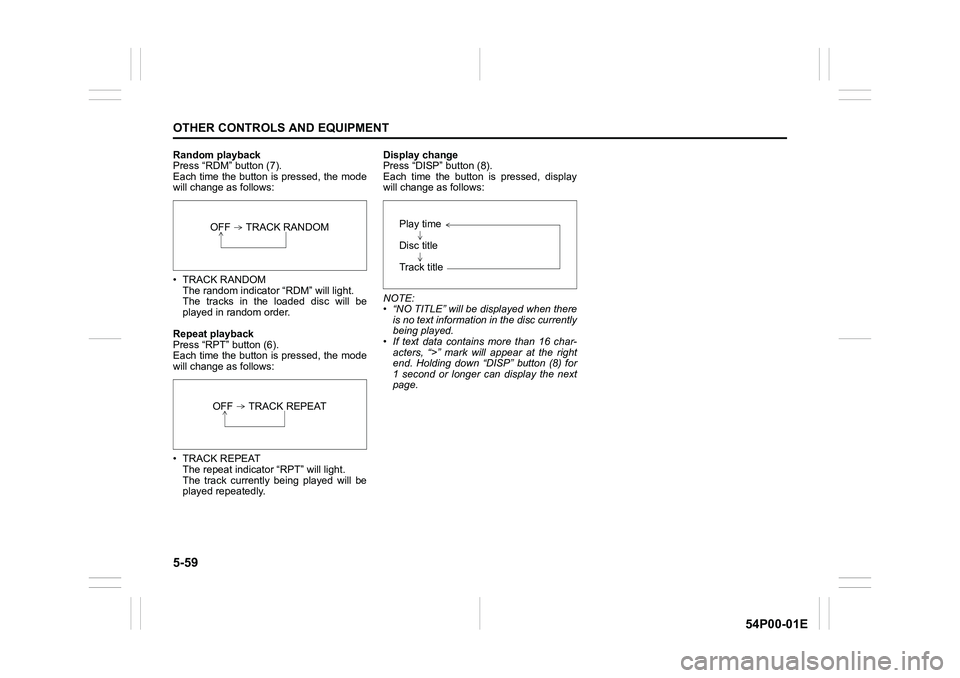
Random playback
Press “RDM” button (7).
Each time the button is pressed, the mode
will change as follows:
• TRACK RANDOM
The random indicator “RDM” will light.
The tracks in the loaded disc will be
played in random order.
Repeat playback
Press “RPT” button (6).
Each time the button is pressed, the mode
will change as follows:
• TRACK REPEAT
The repeat indicator “RPT” will light.
The track currently being played will be
played repeatedly.Display change
Press “DISP” button (8).
Each time the button is pressed, display
will change as follows:
NOTE:
• “NO TITLE” will be displayed when there
is no text information in the disc currently
being played.
• If text data contains more than 16 char-
acters, “>” mark will appear at the right
end. Holding down “DISP” button (8) for
1 second or longer can display the next
page.
OFF TRACK RANDOM
OFF TRACK REPEAT
Play time
Disc title
Track title
Page 303 of 482
5-61
OTHER CONTROLS AND EQUIPMENT
54P00-01E
Selecting a folder
Turn “TUNE/FLD PUSH SOUND” knob (1)
to select a folder.
Selecting a track
• Press UP button (2) to listen to the next
track.
• Press DOWN button (3) twice to listen to
the previous track.
When DOWN button (3) is pressed
once, the track currently being played
will start from the beginning again.
Fast forwarding/rewinding a track
• Hold down UP button (2) to fast forward
the track.
• Hold down DOWN button (3) to fast
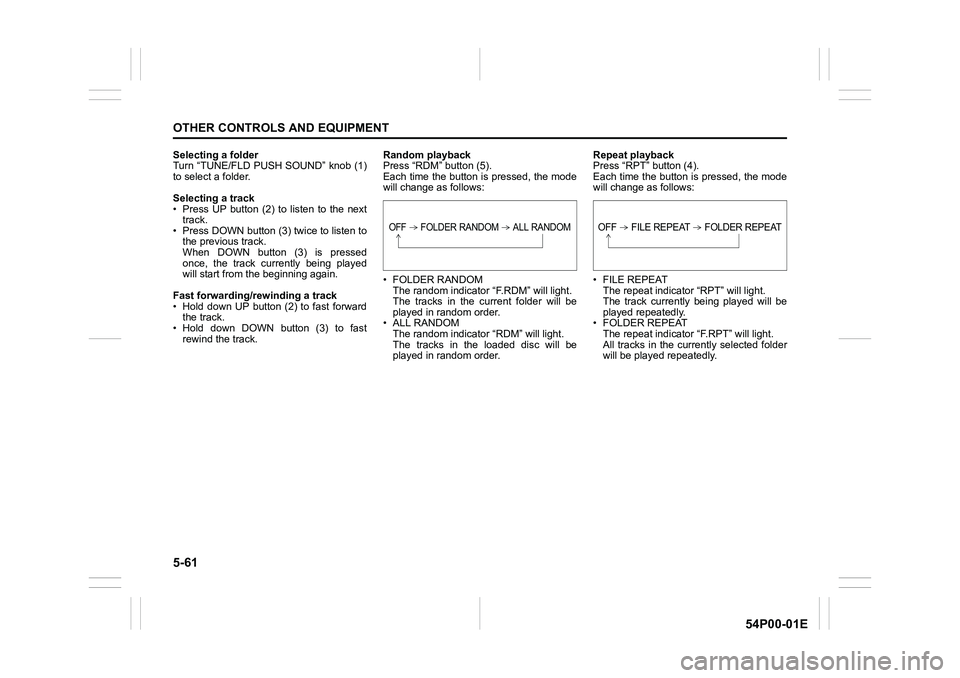
rewind the track.Random playback
Press “RDM” button (5).
Each time the button is pressed, the mode
will change as follows:
• FOLDER RANDOM
The random indicator “F.RDM” will light.
The tracks in the current folder will be
played in random order.
• ALL RANDOM
The random indicator “RDM” will light.
The tracks in the loaded disc will be
played in random order.Repeat playback
Press “RPT” button (4).
Each time the button is pressed, the mode
will change as follows:
• FILE REPEAT
The repeat indicator “RPT” will light.
The track currently being played will be
played repeatedly.
• FOLDER REPEAT
The repeat indicator “F.RPT” will light.
All tracks in the currently selected folder
will be played repeatedly.
OFF FOLDER RANDOM ALL RANDOMOFF FILE REPEAT FOLDER REPEAT
Page 332 of 482
VEHICLE LOADING AND TOWING
6
54P00-01E
54G215
VEHICLE LOADING AND TOWING
Vehicle loading .................................................................... 6-1
Trailer towing ....................................................................... 6-1
Page 333 of 482
6-1
VEHICLE LOADING AND TOWING
54P00-01E
Vehicle loading
Your vehicle was designed for specific
weight capacities. The weight capacities of
your vehicle are indicated by the Gross
Vehicle Weight Rating (GVWR) and the
Permissible maximum Axle Weight (PAW,
front and rear). The GVWR and PAW (front
and rear) are listed in “SPECIFICATIONS”
section.
GVWR – Maximum permissible overall
weight of the fully loaded vehicle (including
all the occupants, accessories and cargo
plus the trailer nose weight if towing a
trailer).
PAW (front and rear) – Maximum permissi-
ble weight on an individual axle.
Actual weight of the loaded vehicle and
actual loads at the front and rear axles can
only be determined by weighing the vehi-
cle. Compare these weights to the GVWR
and PAW (front and rear). If the gross vehi-
cle weight or the load on either axle
exceeds these ratings, you must remove
enough weight to bring the load down to
the rated capacity.
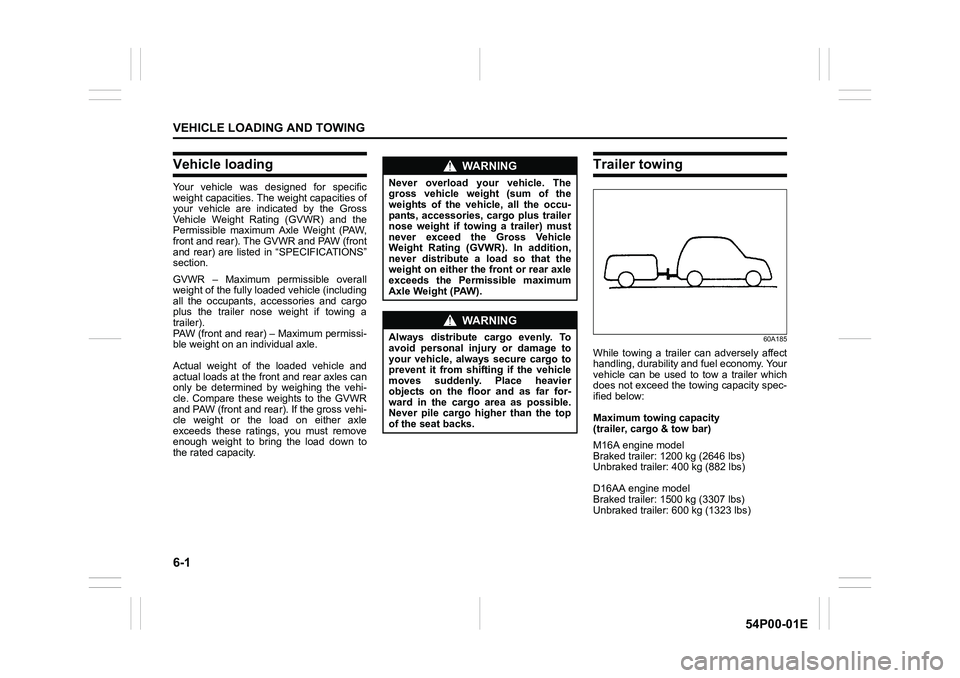
Trailer towing
60A185
While towing a trailer can adversely affect
handling, durability and fuel economy. Your
vehicle can be used to tow a trailer which
does not exceed the towing capacity spec-
ified below:
Maximum towing capacity
(trailer, cargo & tow bar)
M16A engine model
Braked trailer: 1200 kg (2646 lbs)
Unbraked trailer: 400 kg (882 lbs)
D16AA engine model
Braked trailer: 1500 kg (3307 lbs)
Unbraked trailer: 600 kg (1323 lbs)
WA R N I N G
Never overload your vehicle. The
gross vehicle weight (sum of the
weights of the vehicle, all the occu-
pants, accessories, cargo plus trailer
nose weight if towing a trailer) must
never exceed the Gross Vehicle
Weight Rating (GVWR). In addition,
never distribute a load so that the
weight on either the front or rear axle
exceeds the Permissible maximum
Axle Weight (PAW).
WA R N I N G
Always distribute cargo evenly. To
avoid personal injury or damage to
your vehicle, always secure cargo to
prevent it from shifting if the vehicle
moves suddenly. Place heavier
objects on the floor and as far for-
ward in the cargo area as possible.
Never pile cargo higher than the top
of the seat backs.
Page 334 of 482
6-2
VEHICLE LOADING AND TOWING
54P00-01E
NOTE:
If your vehicle has a parking sensor sys-
tem, set the system to the trailer mode via
the information display. When this mode is
set, the rear corner and rear center sen-
sors are inhibited from operating. Refer to
“Information display” in “BEFORE DRIV-
ING” section.
To w b a r s
Only use a tow bar that is designed to
attach to the chassis of your vehicle, and a
hitch that is designed to bolt to this tow bar.
We recommend that you use a genuine
SUZUKI tow bar (available as option), or
equivalent.
Safety chains
Always attach safety chains between your
vehicle and trailer. Cross safety chains
under the nose of the trailer so that the
nose will not drop to the road if the trailer
becomes separated from the tow bar. Fol-
low the manufacturer’s recommendation
for attaching safety chains. Always leave
just enough slack to permit full turning.
Never allow safety chains to drag on the
road.
Trailer lights
Check that your trailer is equipped with
lights which meet local requirements.
Always check for the proper operation of
all trailer lights before you start to tow.
Brakes
WA R N I N G
For vehicles equipped with the radar
brake support system, if your vehicle
is used to tow a trailer, press the
radar brake support OFF switch and
turn off the radar brake support sys-
tem. If not, unexpected accidents
related to the system being turned on
may occur.
NOTICE
Trailer towing puts additional stress
on the engine, drive train and brakes
of your vehicle. Never tow a trailer
during the first 960 km (600 miles) of
vehicle operation.
WA R N I N G
Never use a tow bar which attaches
to the axle or the bumper of your
vehicle.
WA R N I N G
Never attach safety chains to the
bumper of your vehicle. Secure con-
nections so that they cannot come
loose.
WA R N I N G
Never connect trailer lights directly
into your vehicle’s electrical system,
or electrical system damage may
occur.
WA R N I N G
If trailer brakes are used, follow all
instructions provided by the manu-
facturer. Never connect to the brake
system of your vehicle and never
take an electrical supply directly from
the wiring harness.
Page 335 of 482
6-3
VEHICLE LOADING AND TOWING
54P00-01E
Tires
Mirrors
Check if your vehicle’s mirrors meet local
requirements for mirrors used on towing
vehicles. If they do not, you must install the
required mirrors before you tow.
Vehicle/trailer loading
To load your vehicle and trailer properly,
you must know how to measure gross
trailer weight and trailer nose weight.
Gross trailer weight is the weight of the
trailer plus all the cargo in it. You can mea-
sure gross trailer weight by putting the fully
loaded trailer on a vehicle scale.
Nose weight is the downward force
exerted on the tow bar by the trailer cou-pler, with the trailer fully loaded and the
coupler at its normal towing height. This
weight can be measured using a bathroom
scale.
The weight of your loaded trailer (gross
trailer weight) should never exceed towing
capacity.
Distribute cargo in your trailer so that nose
weight is about 10% of gross trailer weight,
but does not exceed the maximum vertical
load on trailer hitch point. You should mea-
sure gross trailer weight and nose weight
before towing to check that your load is
properly distributed.
Additional trailer towing warnings
WA R N I N G
When towing a trailer, it is very
important for your vehicle and trailer
to have properly inflated tires. Your
vehicle’s tires should be inflated to
the pressures listed on your vehicles
tire information label. If laden pres-
sures are listed on the label, the tires
should be inflated to the laden pres-
sures. Inflate trailer tires according to
the specifications provided by the
trailer manufacturer.
WA R N I N G
Improper weight distribution of your
trailer may result in poor vehicle han-
dling and swaying of the trailer.
Always check that trailer nose weight
is about 10% of gross trailer weight,
but does not exceed the maximum
vertical load on trailer hitch point.
Also check that the cargo is properly
secured. Failure to observe this
requirement may result in an acci-
dent.
WA R N I N G
Never overload cargo on your trailer
or your vehicle. Gross trailer weight
must never exceed towing capacity.
Gross vehicle weight (sum of the
weights of the vehicle, all the occu-
pants, accessories including tow
bars and a trailer hitch, cargo and
trailer nose weight) must never
exceed the Gross Vehicle Weight Rat-
ing (GVWR) listed in “SPECIFICA-
TIONS” section.
WA R N I N G
Connect trailer lights and hook up
safety chains every time you tow.
NOTICE
Because towing a trailer puts addi-
tional stress on your vehicle, more
frequent maintenance will be
required than under normal driving
conditions. Follow the schedule in
“Maintenance recommended under
severe driving conditions”.
Page 336 of 482
6-4
VEHICLE LOADING AND TOWING
54P00-01E
WA R N I N G
Your vehicle should be handled in a
different way when towing a trailer.
For the safety of yourself and others,
observe the following precautions:
• Practice turning, stopping, and
reversing before you begin towing
a trailer in traffic. Do not tow a
trailer in traffic until you are confi-
dent that you can handle the vehi-
cle and trailer safely.
• Never exceed towing speed limits
or 80 km/h (50 mph), whichever is
lower.
• Never drive at a speed that causes
shaking or swaying of the trailer. If
you notice even the slightest sign
of shaking or swaying, slow down.
• When roads are wet, slippery or
rough, drive at a slower speed than
you would on dry or smooth roads.
Failure to slow down when road
conditions are bad can result in
loss of control.
• Always have someone guide you
when reversing.
(Continued)
WA R N I N G
(Continued)
• Allow adequate stopping distance.
Stopping distance is increased
when you tow a trailer. For each 16
km/h (10 mph) of speed, allow at
least one vehicle and trailer length
between you and the vehicle
ahead. Allow a greater stopping
distance if roads are wet or slip-
pery.
• If the trailer has over-run brakes,
apply the brakes gradually to avoid
snatching caused by the trailer
wheels locking.
• Slow down before corners and
maintain a steady speed while cor-
nering. Deceleration or accelera-
tion while cornering can result in
loss of control. Remember that a
larger than normal turning radius is
needed because the trailer wheels
will be closer than vehicle wheels
to the inside of the turn.
• Avoid sudden acceleration and
stopping of the vehicle. Do not
make quick maneuvers unless they
are necessary.
• Slow down in cross winds and be
prepared for gusts of wind from
large passing vehicles.
(Continued)
WA R N I N G
(Continued)
• Be careful when overtaking other
vehicles. Allow enough room for
your trailer before changing lanes,
and use turn signal lights properly
in advance.
• Slow down and shift into a lower
gear before you reach long or steep
downhill grades. It is hazardous to
attempt downshifting while you are
descending a hill.
• Do not step on the brake pedal
strongly. This could cause the
brakes to over-heat resulting in
reduced braking efficiency. Use
engine braking as much as possi-
ble.
• Because of the added trailer
weight, your engine may overheat
on hot days when going up long or
steep hills. Pay attention to your
engine temperature gauge. If it indi-
cates overheating, pull off the road
and stop the vehicle in a safe place.
Refer to “Engine trouble: Overheat-
ing” in “EMERGENCY SERVICE”
section.
Page 337 of 482
6-5
VEHICLE LOADING AND TOWING
54P00-01E
60A186
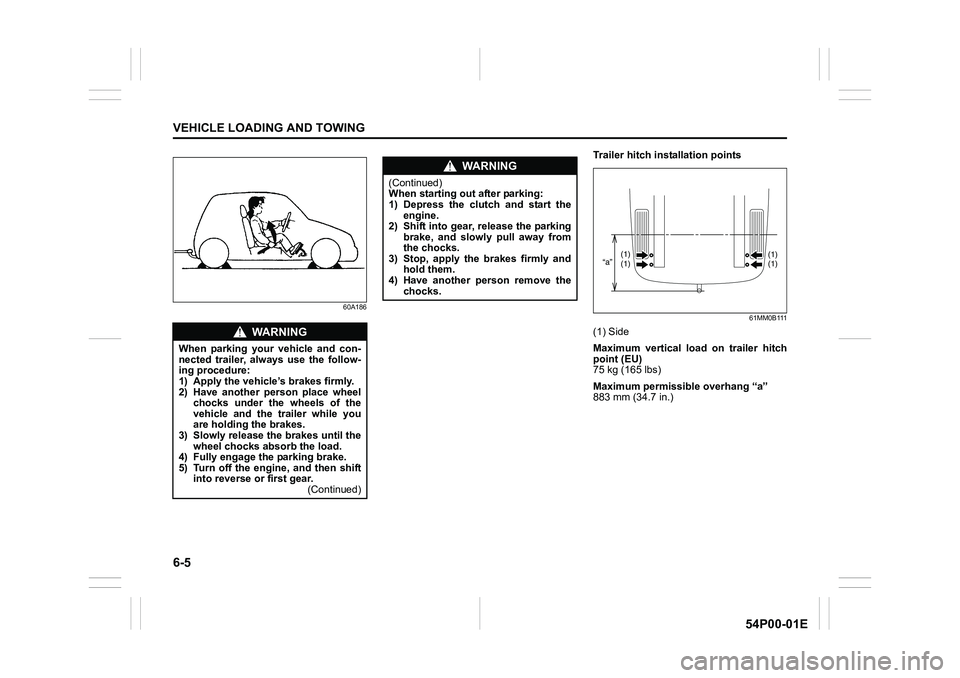
Trailer hitch installation points
61MM0B111
(1) Side
Maximum vertical load on trailer hitch
point (EU)
75 kg (165 lbs)
Maximum permissible overhang “a”
883 mm (34.7 in.)WA R N I N G
When parking your vehicle and con-
nected trailer, always use the follow-
ing procedure:
1) Apply the vehicle’s brakes firmly.
2) Have another person place wheel
chocks under the wheels of the
vehicle and the trailer while you
are holding the brakes.
3) Slowly release the brakes until the
wheel chocks absorb the load.
4) Fully engage the parking brake.
5) Turn off the engine, and then shift
into reverse or first gear.
(Continued)
WA R N I N G
(Continued)
When starting out after parking:
1) Depress the clutch and start the
engine.
2) Shift into gear, release the parking
brake, and slowly pull away from
the chocks.
3) Stop, apply the brakes firmly and
hold them.
4) Have another person remove the
chocks.
“a”(1)(1)(1) (1)
Page 379 of 482
7-41
INSPECTION AND MAINTENANCE
54P00-01E
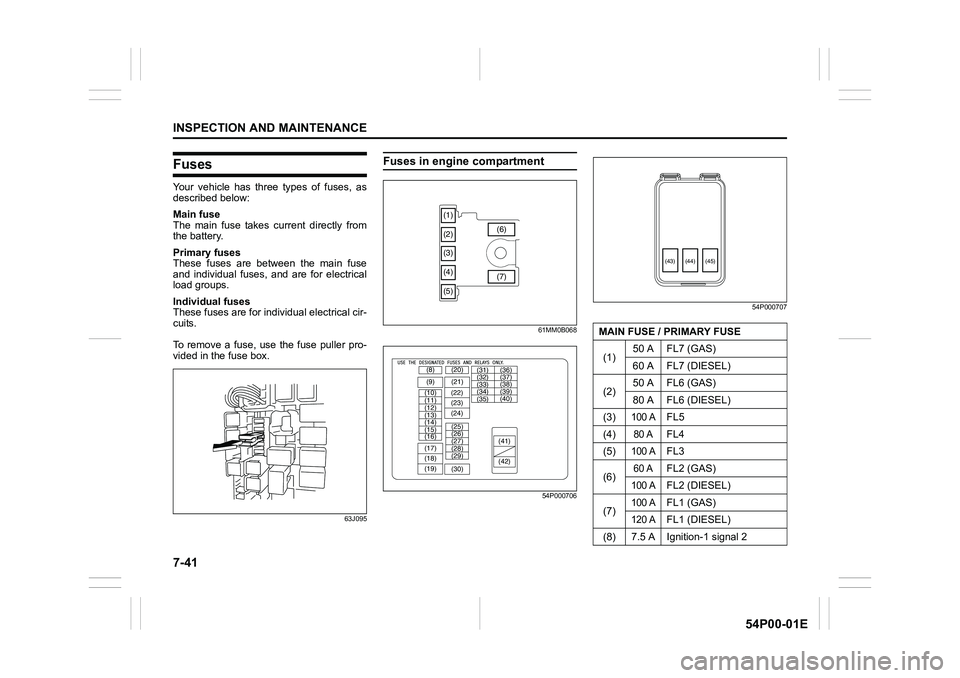
Fuses
Your vehicle has three types of fuses, as
described below:
Main fuse
The main fuse takes current directly from
the battery.
Primary fuses
These fuses are between the main fuse
and individual fuses, and are for electrical
load groups.
Individual fuses
These fuses are for individual electrical cir-
cuits.
To remove a fuse, use the fuse puller pro-
vided in the fuse box.
63J095
Fuses in engine compartment
61MM0B068
54P00070654P000707
(1)
(2)
(3)
(4)
(5)(6)
(7)
(8) (20)
(9)
(10)
(11)
(12)
(13)
(14)
(15)
(16)
(17)
(18)
(19)(21)
(22)
(23)
(24)
(25)
(26)(33)
(34)
(35)
(27)
(28)
(29)(36)
(30)(37) (31)
(32)
(38)
(39)
(40)
(41)
(42)
MAIN FUSE / PRIMARY FUSE
(1)50 A FL7 (GAS)
60 A FL7 (DIESEL)
(2)50 A FL6 (GAS)
80 A FL6 (DIESEL)
(3)
100 AFL5
(4)
80 AFL4
(5)
100 AFL3
(6)
60 AFL2 (GAS)
100 AFL2 (DIESEL)
(7)
100 AFL1 (GAS)
120 AFL1 (DIESEL)
(8) 7.5 A Ignition-1 signal 2
(43) (44) (45)
Page 380 of 482
7-42
INSPECTION AND MAINTENANCE
54P00-01E
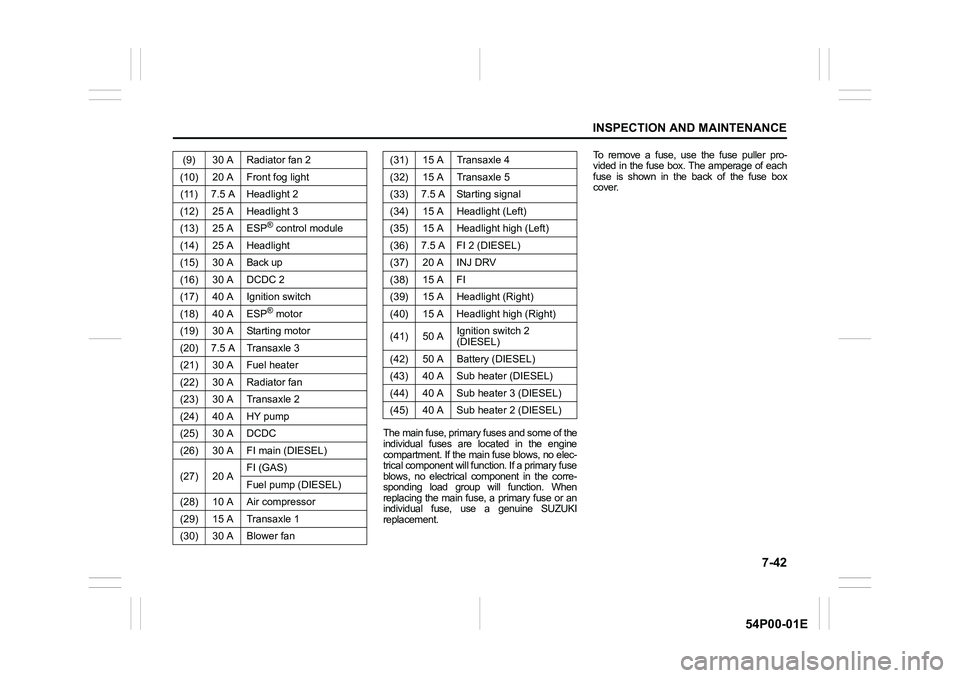
The main fuse, primary fuses and some of the
individual fuses are located in the engine
compartment. If the main fuse blows, no elec-
trical component will function. If a primary fuse
blows, no electrical component in the corre-
sponding load group will function. When
replacing the main fuse, a primary fuse or an
individual fuse, use a genuine SUZUKI
replacement.To remove a fuse, use the fuse puller pro-
vided in the fuse box. The amperage of each
fuse is shown in the back of the fuse box
cover. (9) 30 A Radiator fan 2
(10) 20 A Front fog light
(11) 7.5 A Headlight 2
(12) 25 A Headlight 3
(13) 25 A ESP
® control module
(14) 25 A Headlight
(15) 30 A Back up
(16) 30 A DCDC 2
(17) 40 A Ignition switch
(18) 40 A ESP
® motor
(19) 30 A Starting motor
(20) 7.5 A Transaxle 3
(21) 30 A Fuel heater
(22) 30 A Radiator fan
(23) 30 A Transaxle 2
(24) 40 A HY pump
(25) 30 A DCDC
(26) 30 A FI main (DIESEL)
(27) 20 AFI (GAS)
Fuel pump (DIESEL)
(28) 10 A Air compressor
(29) 15 A Transaxle 1
(30) 30 A Blower fan
(31) 15 A Transaxle 4
(32) 15 A Transaxle 5
(33) 7.5 A Starting signal
(34) 15 A Headlight (Left)
(35) 15 A Headlight high (Left)
(36) 7.5 A FI 2 (DIESEL)
(37) 20 A INJ DRV
(38) 15 A FI
(39) 15 A Headlight (Right)
(40) 15 A Headlight high (Right)
(41) 50 AIgnition switch 2
(DIESEL)
(42) 50 A Battery (DIESEL)
(43) 40 A Sub heater (DIESEL)
(44) 40 A Sub heater 3 (DIESEL)
(45) 40 A Sub heater 2 (DIESEL)