ESP SUZUKI GRAND VITARA 2017 User Guide
[x] Cancel search | Manufacturer: SUZUKI, Model Year: 2017, Model line: GRAND VITARA, Model: SUZUKI GRAND VITARA 2017Pages: 482, PDF Size: 21 MB
Page 68 of 482
2-46
BEFORE DRIVING
54P00-01E
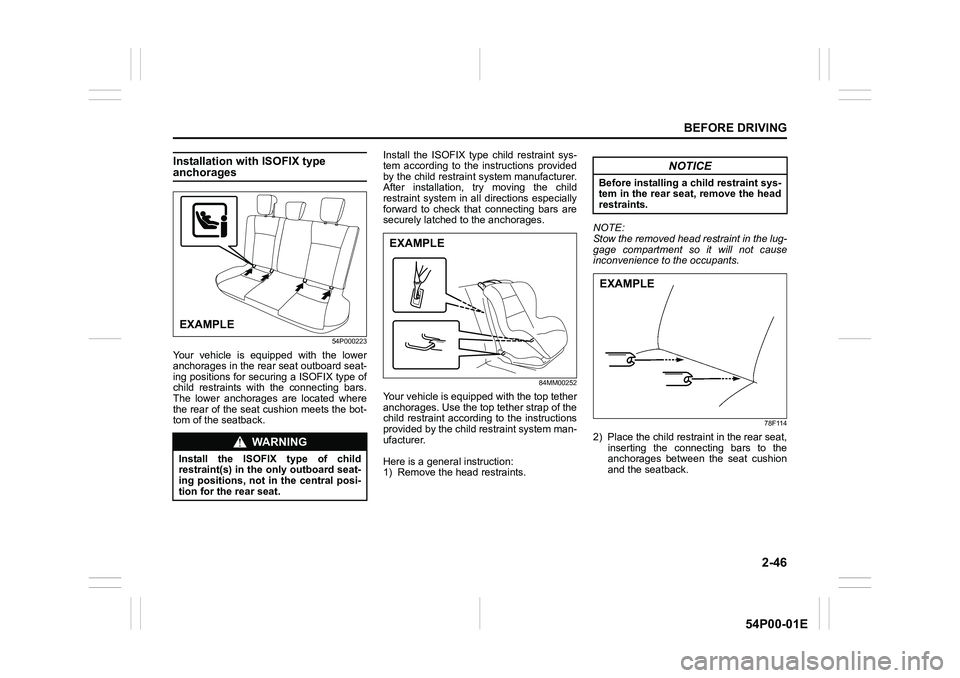
Installation with ISOFIX type anchorages
54P000223
Your vehicle is equipped with the lower
anchorages in the rear seat outboard seat-
ing positions for securing a ISOFIX type of
child restraints with the connecting bars.
The lower anchorages are located where
the rear of the seat cushion meets the bot-
tom of the seatback.Install the ISOFIX type child restraint sys-
tem according to the instructions provided
by the child restraint system manufacturer.
After installation, try moving the child
restraint system in all directions especially
forward to check that connecting bars are
securely latched to the anchorages.
84MM00252
Your vehicle is equipped with the top tether
anchorages. Use the top tether strap of the
child restraint according to the instructions
provided by the child restraint system man-
ufacturer.
Here is a general instruction:
1) Remove the head restraints.NOTE:
Stow the removed head restraint in the lug-
gage compartment so it will not cause
inconvenience to the occupants.
78F114
2) Place the child restraint in the rear seat,
inserting the connecting bars to the
anchorages between the seat cushion
and the seatback.WA R N I N G
Install the ISOFIX type of child
restraint(s) in the only outboard seat-
ing positions, not in the central posi-
tion for the rear seat.
EXAMPLE
EXAMPLE
NOTICE
Before installing a child restraint sys-
tem in the rear seat, remove the head
restraints.
EXAMPLE
Page 69 of 482
2-47
BEFORE DRIVING
54P00-01E
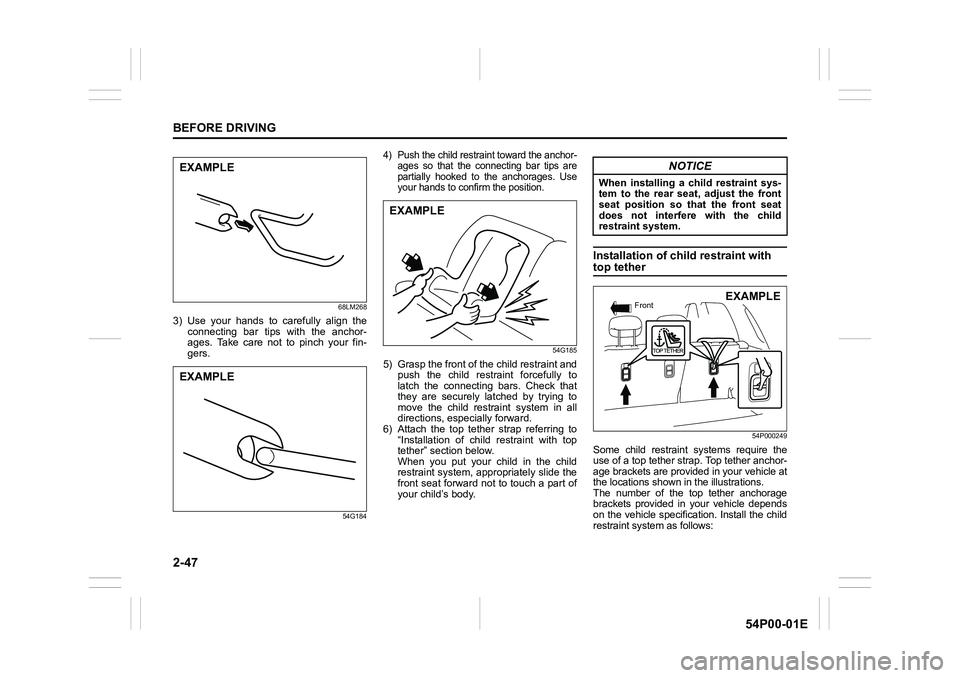
68LM268
3) Use your hands to carefully align the
connecting bar tips with the anchor-
ages. Take care not to pinch your fin-
gers.
54G184
4) Push the child restraint toward the anchor-
ages so that the connecting bar tips are
partially hooked to the anchorages. Use
your hands to confirm the position.
54G185
5) Grasp the front of the child restraint and
push the child restraint forcefully to
latch the connecting bars. Check that
they are securely latched by trying to
move the child restraint system in all
directions, especially forward.
6) Attach the top tether strap referring to
“Installation of child restraint with top
tether” section below.
When you put your child in the child
restraint system, appropriately slide the
front seat forward not to touch a part of
your child’s body.
Installation of child restraint with
top tether
54P000249
Some child restraint systems require the
use of a top tether strap. Top tether anchor-
age brackets are provided in your vehicle at
the locations shown in the illustrations.
The number of the top tether anchorage
brackets provided in your vehicle depends
on the vehicle specification. Install the child
restraint system as follows:
EXAMPLE
EXAMPLE
EXAMPLE
NOTICE
When installing a child restraint sys-
tem to the rear seat, adjust the front
seat position so that the front seat
does not interfere with the child
restraint system.
EXAMPLEFront
Page 70 of 482
2-48
BEFORE DRIVING
54P00-01E
1) Remove the luggage compartment cover.2) Secure the child restraint on the rear
seat using the procedure described
above for securing a restraint system
that does not require a top tether strap.
3) Hook the top tether strap to the top
tether anchorage bracket and tighten
the top tether strap according to the
instructions provided by the child
restraint system manufacturer. Attach
the top tether strap to the correspond-
ing top tether anchorage bracket
located directly behind the child
restraint. Do not attach the top tether
strap to the luggage restraint loops.
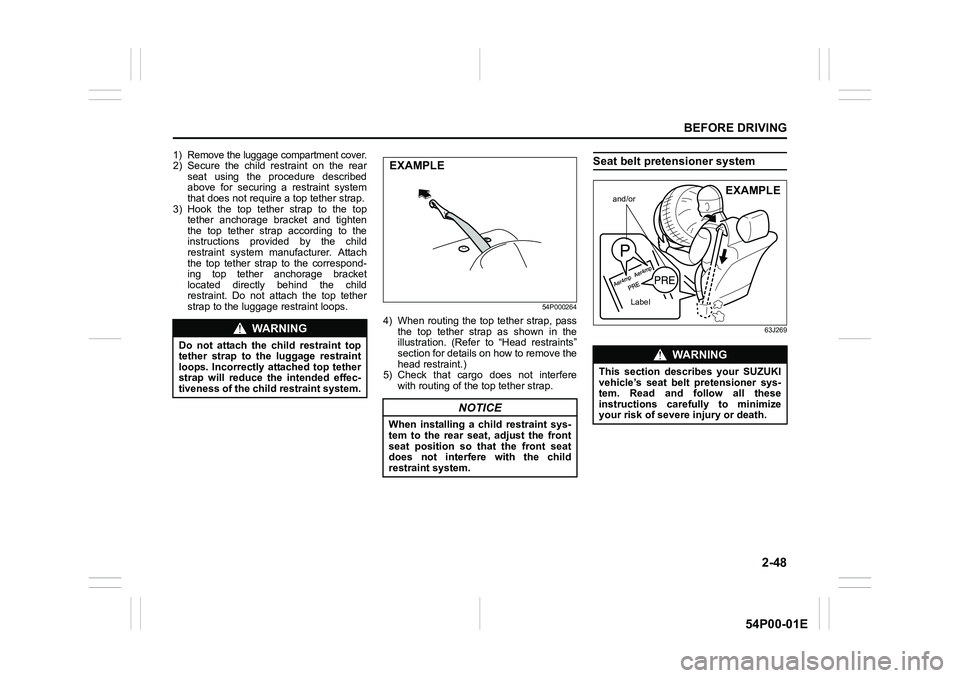
54P000264
4) When routing the top tether strap, pass
the top tether strap as shown in the
illustration. (Refer to “Head restraints”
section for details on how to remove the
head restraint.)
5) Check that cargo does not interfere
with routing of the top tether strap.
Seat belt pretensioner system
63J269WA R N I N G
Do not attach the child restraint top
tether strap to the luggage restraint
loops. Incorrectly attached top tether
strap will reduce the intended effec-
tiveness of the child restraint system.
NOTICE
When installing a child restraint sys-
tem to the rear seat, adjust the front
seat position so that the front seat
does not interfere with the child
restraint system.
EXAMPLE
WA R N I N G
This section describes your SUZUKI
vehicle’s seat belt pretensioner sys-
tem. Read and follow all these
instructions carefully to minimize
your risk of severe injury or death.
and/or
Label
EXAMPLE
Page 108 of 482
2-86
BEFORE DRIVING
54P00-01E
Warning and indicator
messageMaster warning
indicator lightSound Cause and remedy
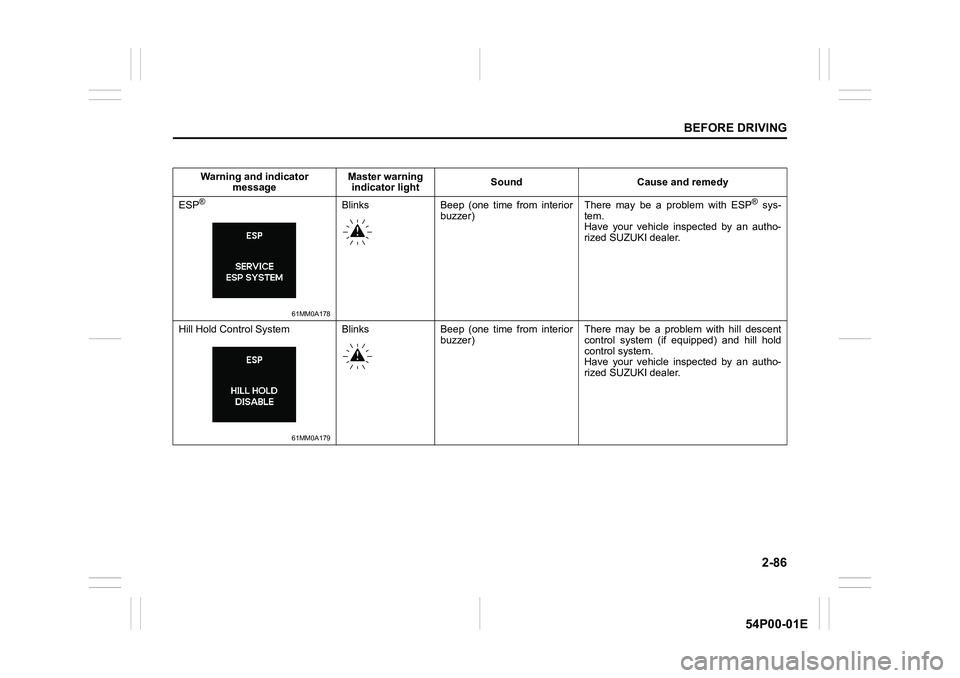
ESP
®
61MM0A178
Blinks Beep (one time from interior
buzzer) There may be a problem with ESP® sys-
tem.
Have your vehicle inspected by an autho-
rized SUZUKI dealer.
Hill Hold Control System
61MM0A179
Blinks Beep (one time from interior
buzzer) There may be a problem with hill descent
control system (if equipped) and hill hold
control system.
Have your vehicle inspected by an autho-
rized SUZUKI dealer.
Page 110 of 482
2-88
BEFORE DRIVING
54P00-01E
Warning and indicator lights
NOTE:
If warning and indicator lights blink or
come on, the corresponding messages
may be shown on the information display.
Low tire pressure warning light
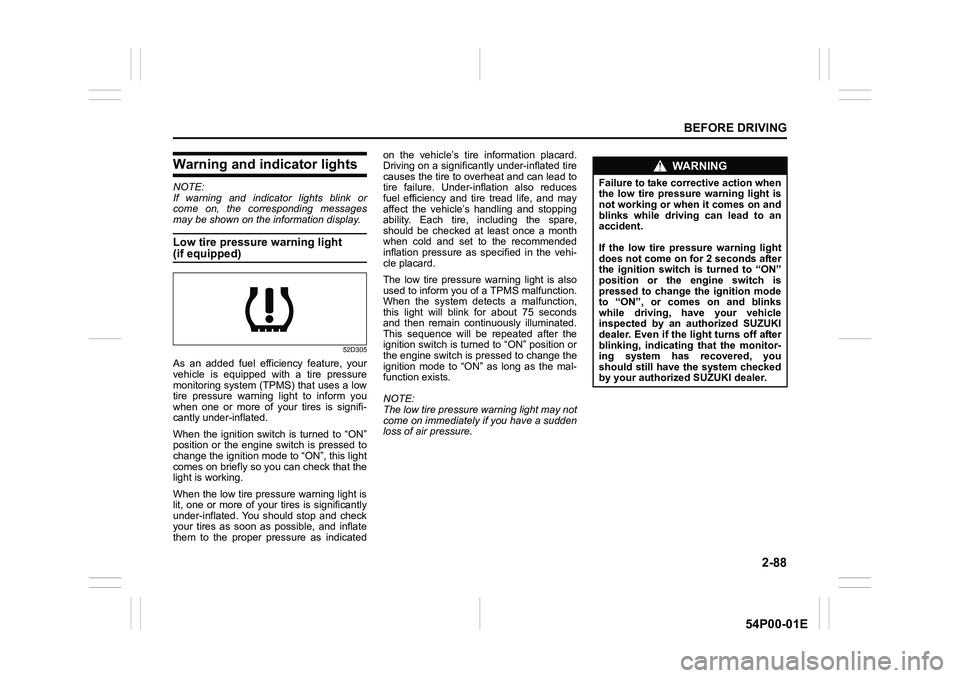
(if equipped)
52D305
As an added fuel efficiency feature, your
vehicle is equipped with a tire pressure
monitoring system (TPMS) that uses a low
tire pressure warning light to inform you
when one or more of your tires is signifi-
cantly under-inflated.
When the ignition switch is turned to “ON”
position or the engine switch is pressed to
change the ignition mode to “ON”, this light
comes on briefly so you can check that the
light is working.
When the low tire pressure warning light is
lit, one or more of your tires is significantly
under-inflated. You should stop and check
your tires as soon as possible, and inflate
them to the proper pressure as indicatedon the vehicle’s tire information placard.
Driving on a significantly under-inflated tire
causes the tire to overheat and can lead to
tire failure. Under-inflation also reduces
fuel efficiency and tire tread life, and may
affect the vehicle’s handling and stopping
ability. Each tire, including the spare,
should be checked at least once a month
when cold and set to the recommended
inflation pressure as specified in the vehi-
cle placard.
The low tire pressure warning light is also
used to inform you of a TPMS malfunction.
When the system detects a malfunction,
this light will blink for about 75 seconds
and then remain continuously illuminated.
This sequence will be repeated after the
ignition switch is turned to “ON” position or
the engine switch is pressed to change the
ignition mode to “ON” as long as the mal-
function exists.
NOTE:
The low tire pressure warning light may not
come on immediately if you have a sudden
loss of air pressure.
WA R N I N G
Failure to take corrective action when
the low tire pressure warning light is
not working or when it comes on and
blinks while driving can lead to an
accident.
If the low tire pressure warning light
does not come on for 2 seconds after
the ignition switch is turned to “ON”
position or the engine switch is
pressed to change the ignition mode
to “ON”, or comes on and blinks
while driving, have your vehicle
inspected by an authorized SUZUKI
dealer. Even if the light turns off after
blinking, indicating that the monitor-
ing system has recovered, you
should still have the system checked
by your authorized SUZUKI dealer.
Page 113 of 482
2-91
BEFORE DRIVING
54P00-01E
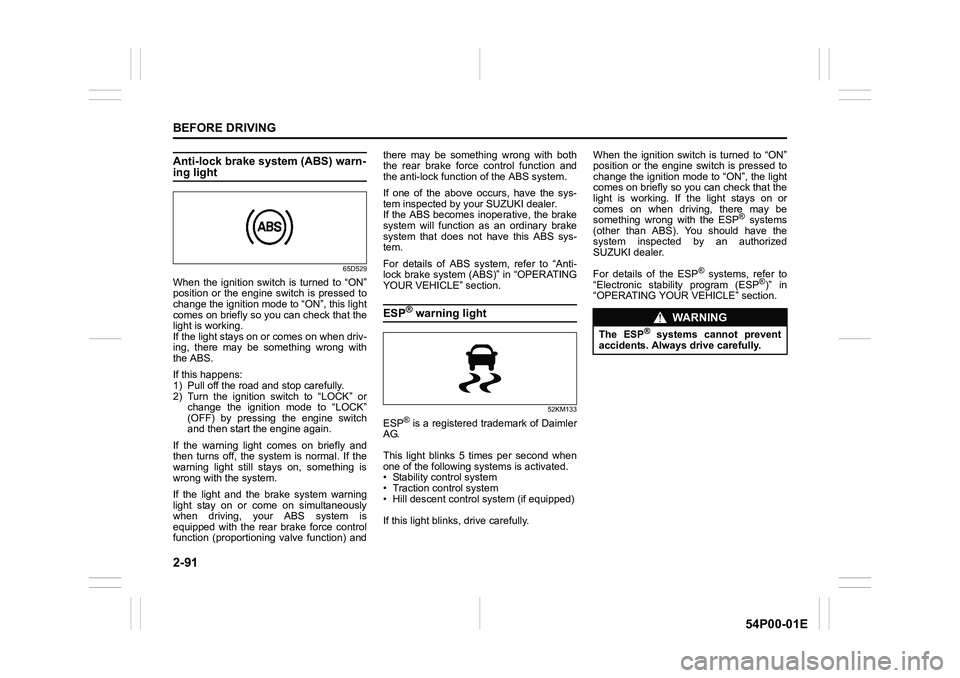
Anti-lock brake system (ABS) warn-ing light
65D529
When the ignition switch is turned to “ON”
position or the engine switch is pressed to
change the ignition mode to “ON”, this light
comes on briefly so you can check that the
light is working.
If the light stays on or comes on when driv-
ing, there may be something wrong with
the ABS.
If this happens:
1) Pull off the road and stop carefully.
2) Turn the ignition switch to “LOCK” or
change the ignition mode to “LOCK”
(OFF) by pressing the engine switch
and then start the engine again.
If the warning light comes on briefly and
then turns off, the system is normal. If the
warning light still stays on, something is
wrong with the system.
If the light and the brake system warning
light stay on or come on simultaneously
when driving, your ABS system is
equipped with the rear brake force control
function (proportioning valve function) andthere may be something wrong with both
the rear brake force control function and
the anti-lock function of the ABS system.
If one of the above occurs, have the sys-
tem inspected by your SUZUKI dealer.
If the ABS becomes inoperative, the brake
system will function as an ordinary brake
system that does not have this ABS sys-
tem.
For details of ABS system, refer to “Anti-
lock brake system (ABS)” in “OPERATING
YOUR VEHICLE” section.
ESP® warning light
52KM133
ESP® is a registered trademark of Daimler
AG.
This light blinks 5 times per second when
one of the following systems is activated.
• Stability control system
• Traction control system
• Hill descent control system (if equipped)
If this light blinks, drive carefully.When the ignition switch is turned to “ON”
position or the engine switch is pressed to
change the ignition mode to “ON”, the light
comes on briefly so you can check that the
light is working. If the light stays on or
comes on when driving, there may be
something wrong with the ESP
® systems
(other than ABS). You should have the
system inspected by an authorized
SUZUKI dealer.
For details of the ESP
® systems, refer to
“Electronic stability program (ESP®)” in
“OPERATING YOUR VEHICLE” section.
WA R N I N G
The ESP® systems cannot prevent
accidents. Always drive carefully.
Page 114 of 482
2-92
BEFORE DRIVING
54P00-01E
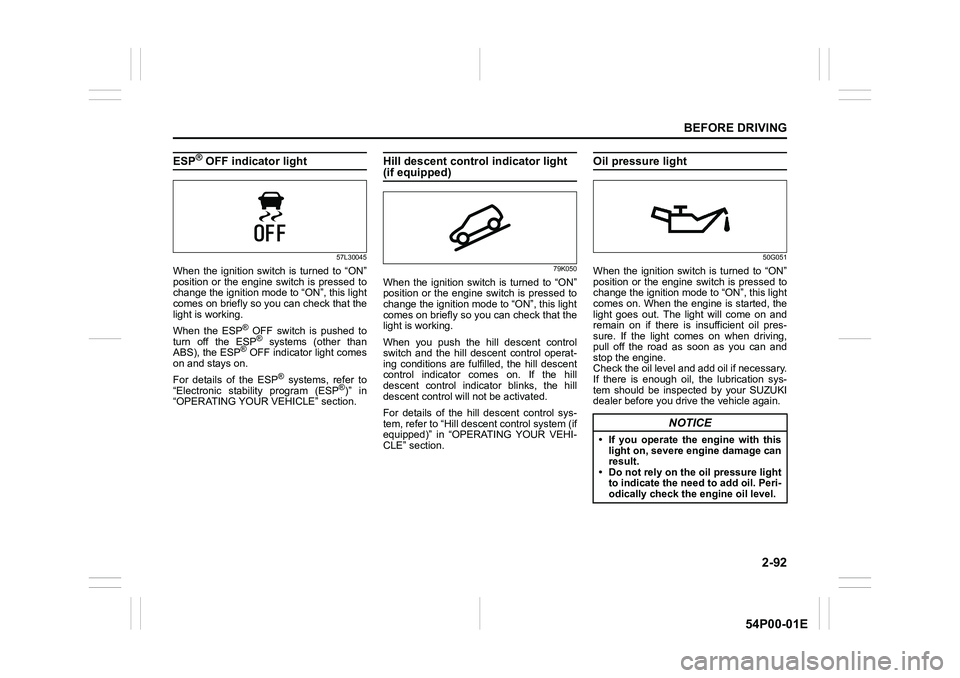
ESP® OFF indicator light
57L30045
When the ignition switch is turned to “ON”
position or the engine switch is pressed to
change the ignition mode to “ON”, this light
comes on briefly so you can check that the
light is working.
When the ESP
® OFF switch is pushed to
turn off the ESP® systems (other than
ABS), the ESP® OFF indicator light comes
on and stays on.
For details of the ESP
® systems, refer to
“Electronic stability program (ESP®)” in
“OPERATING YOUR VEHICLE” section.
Hill descent control indicator light (if equipped)
79K050
When the ignition switch is turned to “ON”
position or the engine switch is pressed to
change the ignition mode to “ON”, this light
comes on briefly so you can check that the
light is working.
When you push the hill descent control
switch and the hill descent control operat-
ing conditions are fulfilled, the hill descent
control indicator comes on. If the hill
descent control indicator blinks, the hill
descent control will not be activated.
For details of the hill descent control sys-
tem, refer to “Hill descent control system (if
equipped)” in “OPERATING YOUR VEHI-
CLE” section.
Oil pressure light
50G051
When the ignition switch is turned to “ON”
position or the engine switch is pressed to
change the ignition mode to “ON”, this light
comes on. When the engine is started, the
light goes out. The light will come on and
remain on if there is insufficient oil pres-
sure. If the light comes on when driving,
pull off the road as soon as you can and
stop the engine.
Check the oil level and add oil if necessary.
If there is enough oil, the lubrication sys-
tem should be inspected by your SUZUKI
dealer before you drive the vehicle again.
NOTICE
• If you operate the engine with this
light on, severe engine damage can
result.
• Do not rely on the oil pressure light
to indicate the need to add oil. Peri-
odically check the engine oil level.
Page 118 of 482
2-96
BEFORE DRIVING
54P00-01E
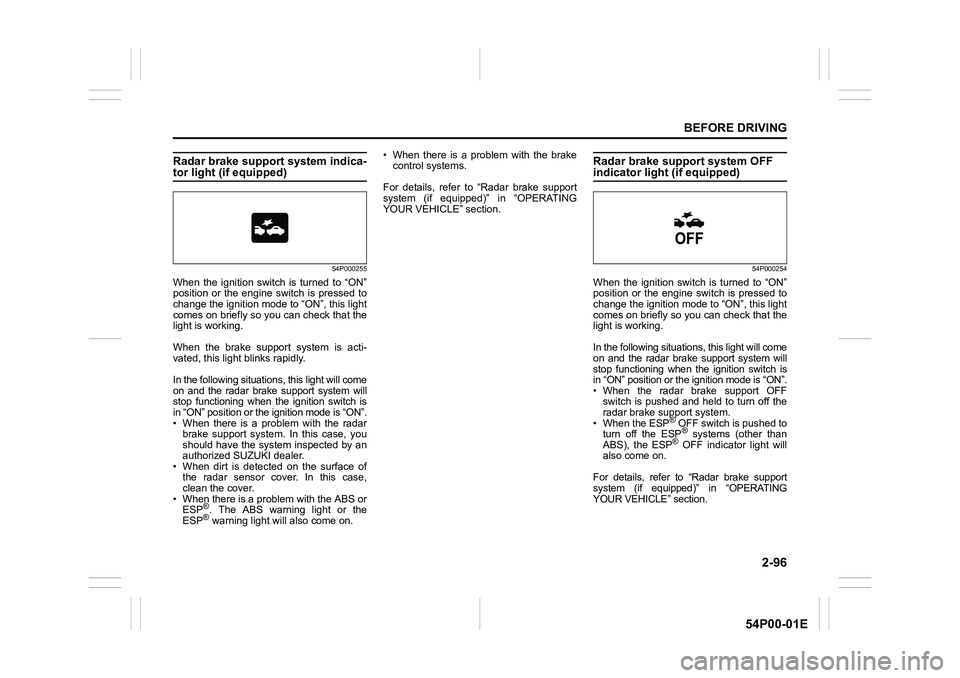
Radar brake support system indica-tor light (if equipped)
54P000255
When the ignition switch is turned to “ON”
position or the engine switch is pressed to
change the ignition mode to “ON”, this light
comes on briefly so you can check that the
light is working.
When the brake support system is acti-
vated, this light blinks rapidly.
In the following situations, this light will come
on and the radar brake support system will
stop functioning when the ignition switch is
in “ON” position or the ignition mode is “ON”.
• When there is a problem with the radar
brake support system. In this case, you
should have the system inspected by an
authorized SUZUKI dealer.
• When dirt is detected on the surface of
the radar sensor cover. In this case,
clean the cover.
• When there is a problem with the ABS or
ESP
®. The ABS warning light or the
ESP® warning light will also come on.• When there is a problem with the brake
control systems.
For details, refer to “Radar brake support
system (if equipped)” in “OPERATING
YOUR VEHICLE” section.
Radar brake support system OFF indicator light (if equipped)
54P000254
When the ignition switch is turned to “ON”
position or the engine switch is pressed to
change the ignition mode to “ON”, this light
comes on briefly so you can check that the
light is working.
In the following situations, this light will come
on and the radar brake support system will
stop functioning when the ignition switch is
in “ON” position or the ignition mode is “ON”.
• When the radar brake support OFF
switch is pushed and held to turn off the
radar brake support system.
• When the ESP
® OFF switch is pushed to
turn off the ESP® systems (other than
ABS), the ESP® OFF indicator light will
also come on.
For details, refer to “Radar brake support
system (if equipped)” in “OPERATING
YOUR VEHICLE” section.
Page 120 of 482
2-98
BEFORE DRIVING
54P00-01E
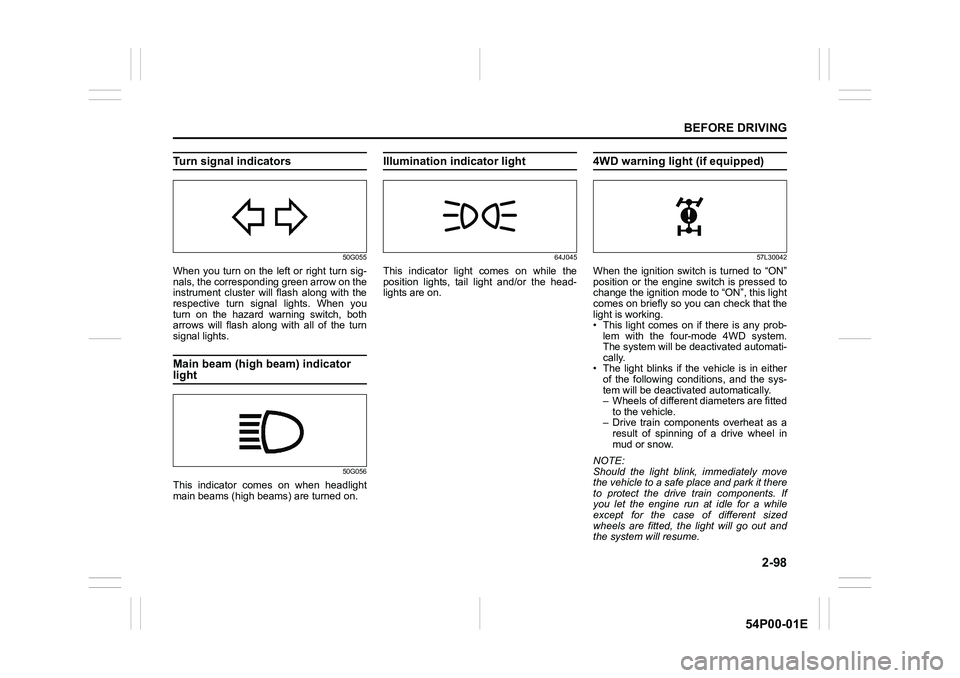
Turn signal indicators
50G055
When you turn on the left or right turn sig-
nals, the corresponding green arrow on the
instrument cluster will flash along with the
respective turn signal lights. When you
turn on the hazard warning switch, both
arrows will flash along with all of the turn
signal lights.
Main beam (high beam) indicator
light
50G056
This indicator comes on when headlight
main beams (high beams) are turned on.
Illumination indicator light
64J045
This indicator light comes on while the
position lights, tail light and/or the head-
lights are on.
4WD warning light (if equipped)
57L30042
When the ignition switch is turned to “ON”
position or the engine switch is pressed to
change the ignition mode to “ON”, this light
comes on briefly so you can check that the
light is working.
• This light comes on if there is any prob-
lem with the four-mode 4WD system.
The system will be deactivated automati-
cally.
• The light blinks if the vehicle is in either
of the following conditions, and the sys-
tem will be deactivated automatically.
– Wheels of different diameters are fitted
to the vehicle.
– Drive train components overheat as a
result of spinning of a drive wheel in
mud or snow.
NOTE:
Should the light blink, immediately move
the vehicle to a safe place and park it there
to protect the drive train components. If
you let the engine run at idle for a while
except for the case of different sized
wheels are fitted, the light will go out and
the system will resume.
Page 140 of 482
OPERATING YOUR VEHICLE
3
54P00-01E
60G408
OPERATING YOUR VEHICLE
Exhaust gas warning .......................................................... 3-1
Daily inspection checklist .................................................. 3-1
Engine oil consumption ..................................................... 3-2
Ignition switch
(vehicle without keyless push start system) .................... 3-3
Engine switch
(vehicle with keyless push start system) .......................... 3-5
Keyless push start system (if equipped) .......................... 3-6
Parking brake lever ............................................................. 3-10
Pedal ..................................................................................... 3-11
Starting engine
(vehicle without keyless push start system) .................... 3-12
Starting engine
(vehicle with keyless push start system) .......................... 3-14
Using transaxle ................................................................... 3-19
Gearshift indicator .............................................................. 3-21
Four-mode 4WD system (if equipped) .............................. 3-23
ENG A-STOP system
(engine auto stop start system) (if equipped) .................. 3-29
Adaptive cruise control system (if equipped) .................. 3-32
Cruise control (if equipped) ............................................... 3-42
Speed limiter (if equipped) ................................................. 3-45
Radar brake support system (if equipped) ....................... 3-47
Emergency stop signal (ESS) (if equipped) ...................... 3-63
Parking sensors (if equipped) ............................................ 3-64
Rearview camera (if equipped) .......................................... 3-71
Braking ................................................................................. 3-74
Electronic stability program (ESP®) ................................. 3-76
Tire pressure monitoring system (TPMS) (if equipped) .. 3-83