ECU SUZUKI GRAND VITARA 2022 User Guide
[x] Cancel search | Manufacturer: SUZUKI, Model Year: 2022, Model line: GRAND VITARA, Model: SUZUKI GRAND VITARA 2022Pages: 482, PDF Size: 21 MB
Page 61 of 482
2-39
BEFORE DRIVING
54P00-01E
65D608
65D609
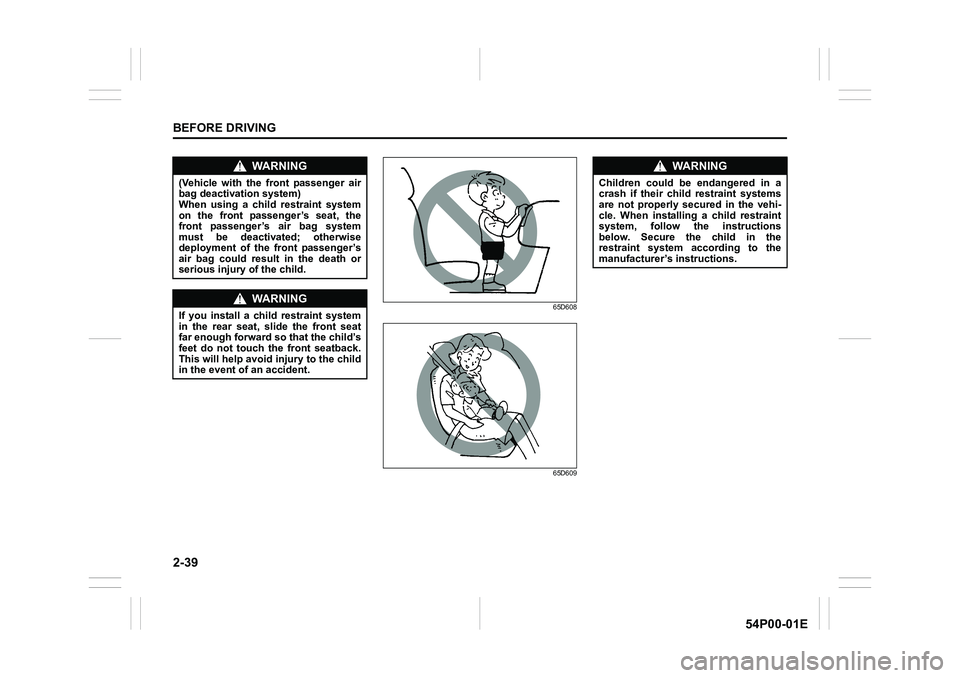
WA R N I N G
(Vehicle with the front passenger air
bag deactivation system)
When using a child restraint system
on the front passenger’s seat, the
front passenger’s air bag system
must be deactivated; otherwise
deployment of the front passenger’s
air bag could result in the death or
serious injury of the child.
WA R N I N G
If you install a child restraint system
in the rear seat, slide the front seat
far enough forward so that the child’s
feet do not touch the front seatback.
This will help avoid injury to the child
in the event of an accident.
WA R N I N G
Children could be endangered in a
crash if their child restraint systems
are not properly secured in the vehi-
cle. When installing a child restraint
system, follow the instructions
below. Secure the child in the
restraint system according to the
manufacturer’s instructions.
Page 67 of 482
2-45
BEFORE DRIVING
54P00-01E
Installation with lap-shoulder seat belts
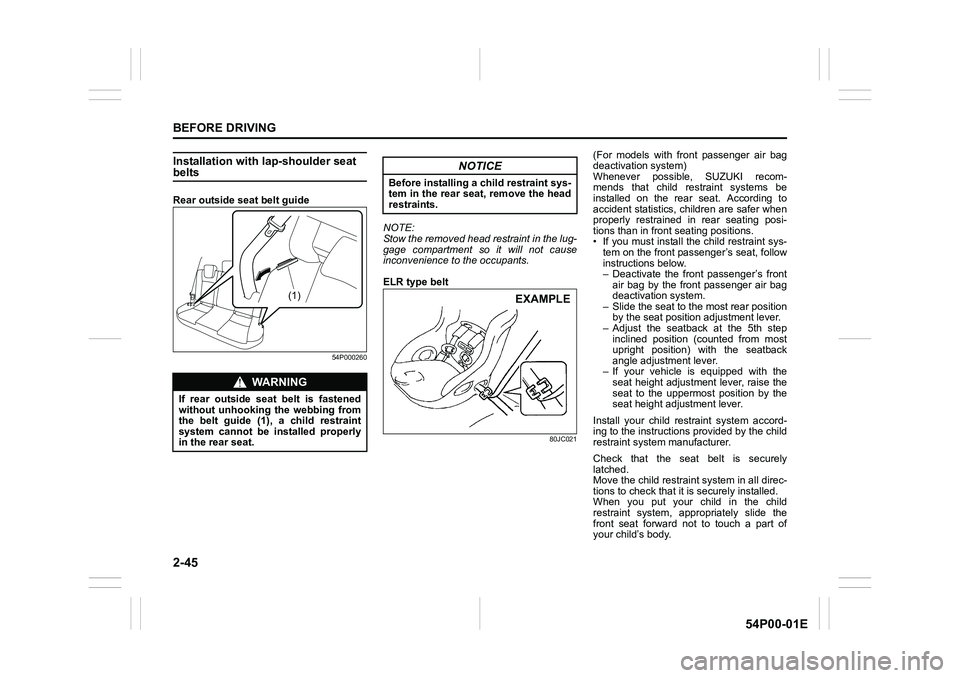
Rear outside seat belt guide
54P000260
NOTE:
Stow the removed head restraint in the lug-
gage compartment so it will not cause
inconvenience to the occupants.
ELR type belt
80JC021
(For models with front passenger air bag
deactivation system)
Whenever possible, SUZUKI recom-
mends that child restraint systems be
installed on the rear seat. According to
accident statistics, children are safer when
properly restrained in rear seating posi-
tions than in front seating positions.
• If you must install the child restraint sys-
tem on the front passenger’s seat, follow
instructions below.
– Deactivate the front passenger’s front
air bag by the front passenger air bag
deactivation system.
– Slide the seat to the most rear position
by the seat position adjustment lever.
– Adjust the seatback at the 5th step
inclined position (counted from most
upright position) with the seatback
angle adjustment lever.
– If your vehicle is equipped with the
seat height adjustment lever, raise the
seat to the uppermost position by the
seat height adjustment lever.
Install your child restraint system accord-
ing to the instructions provided by the child
restraint system manufacturer.
Check that the seat belt is securely
latched.
Move the child restraint system in all direc-
tions to check that it is securely installed.
When you put your child in the child
restraint system, appropriately slide the
front seat forward not to touch a part of
your child’s body.
WA R N I N G
If rear outside seat belt is fastened
without unhooking the webbing from
the belt guide (1), a child restraint
system cannot be installed properly
in the rear seat.
(1)
NOTICE
Before installing a child restraint sys-
tem in the rear seat, remove the head
restraints.
EXAMPLE
Page 68 of 482
2-46
BEFORE DRIVING
54P00-01E
Installation with ISOFIX type anchorages
54P000223
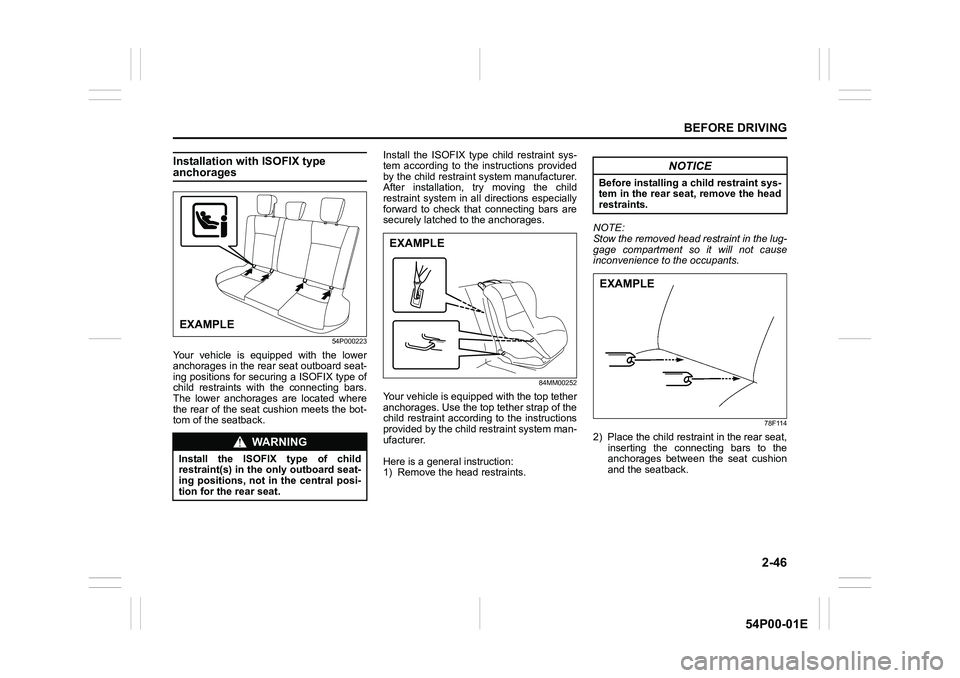
Your vehicle is equipped with the lower
anchorages in the rear seat outboard seat-
ing positions for securing a ISOFIX type of
child restraints with the connecting bars.
The lower anchorages are located where
the rear of the seat cushion meets the bot-
tom of the seatback.Install the ISOFIX type child restraint sys-
tem according to the instructions provided
by the child restraint system manufacturer.
After installation, try moving the child
restraint system in all directions especially
forward to check that connecting bars are
securely latched to the anchorages.
84MM00252
Your vehicle is equipped with the top tether
anchorages. Use the top tether strap of the
child restraint according to the instructions
provided by the child restraint system man-
ufacturer.
Here is a general instruction:
1) Remove the head restraints.NOTE:
Stow the removed head restraint in the lug-
gage compartment so it will not cause
inconvenience to the occupants.
78F114
2) Place the child restraint in the rear seat,
inserting the connecting bars to the
anchorages between the seat cushion
and the seatback.WA R N I N G
Install the ISOFIX type of child
restraint(s) in the only outboard seat-
ing positions, not in the central posi-
tion for the rear seat.
EXAMPLE
EXAMPLE
NOTICE
Before installing a child restraint sys-
tem in the rear seat, remove the head
restraints.
EXAMPLE
Page 69 of 482
2-47
BEFORE DRIVING
54P00-01E
68LM268
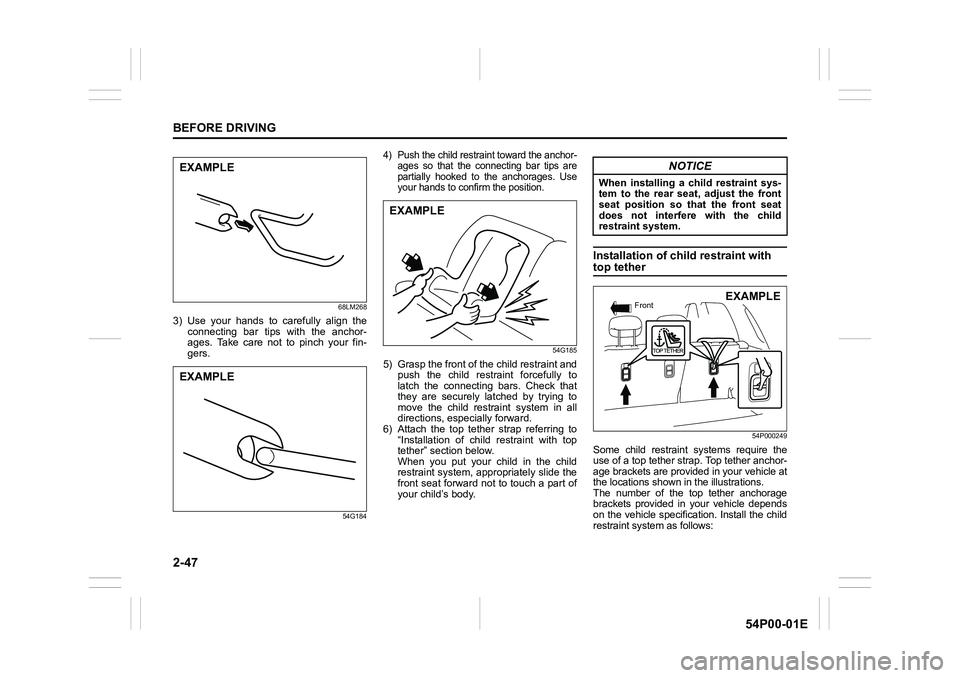
3) Use your hands to carefully align the
connecting bar tips with the anchor-
ages. Take care not to pinch your fin-
gers.
54G184
4) Push the child restraint toward the anchor-
ages so that the connecting bar tips are
partially hooked to the anchorages. Use
your hands to confirm the position.
54G185
5) Grasp the front of the child restraint and
push the child restraint forcefully to
latch the connecting bars. Check that
they are securely latched by trying to
move the child restraint system in all
directions, especially forward.
6) Attach the top tether strap referring to
“Installation of child restraint with top
tether” section below.
When you put your child in the child
restraint system, appropriately slide the
front seat forward not to touch a part of
your child’s body.
Installation of child restraint with
top tether
54P000249
Some child restraint systems require the
use of a top tether strap. Top tether anchor-
age brackets are provided in your vehicle at
the locations shown in the illustrations.
The number of the top tether anchorage
brackets provided in your vehicle depends
on the vehicle specification. Install the child
restraint system as follows:
EXAMPLE
EXAMPLE
EXAMPLE
NOTICE
When installing a child restraint sys-
tem to the rear seat, adjust the front
seat position so that the front seat
does not interfere with the child
restraint system.
EXAMPLEFront
Page 70 of 482
2-48
BEFORE DRIVING
54P00-01E
1) Remove the luggage compartment cover.2) Secure the child restraint on the rear
seat using the procedure described
above for securing a restraint system
that does not require a top tether strap.
3) Hook the top tether strap to the top
tether anchorage bracket and tighten
the top tether strap according to the
instructions provided by the child
restraint system manufacturer. Attach
the top tether strap to the correspond-
ing top tether anchorage bracket
located directly behind the child
restraint. Do not attach the top tether
strap to the luggage restraint loops.
54P000264
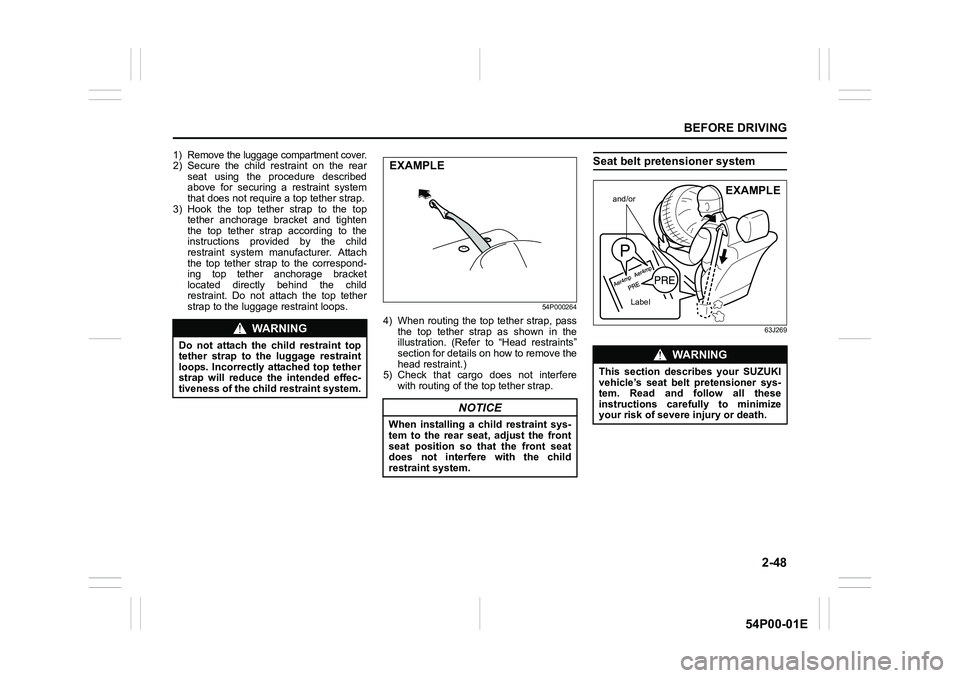
4) When routing the top tether strap, pass
the top tether strap as shown in the
illustration. (Refer to “Head restraints”
section for details on how to remove the
head restraint.)
5) Check that cargo does not interfere
with routing of the top tether strap.
Seat belt pretensioner system
63J269WA R N I N G
Do not attach the child restraint top
tether strap to the luggage restraint
loops. Incorrectly attached top tether
strap will reduce the intended effec-
tiveness of the child restraint system.
NOTICE
When installing a child restraint sys-
tem to the rear seat, adjust the front
seat position so that the front seat
does not interfere with the child
restraint system.
EXAMPLE
WA R N I N G
This section describes your SUZUKI
vehicle’s seat belt pretensioner sys-
tem. Read and follow all these
instructions carefully to minimize
your risk of severe injury or death.
and/or
Label
EXAMPLE
Page 75 of 482
2-53
BEFORE DRIVING
54P00-01E
Refer to “Seat belts and child restraint sys-
tems” section for details on securing your
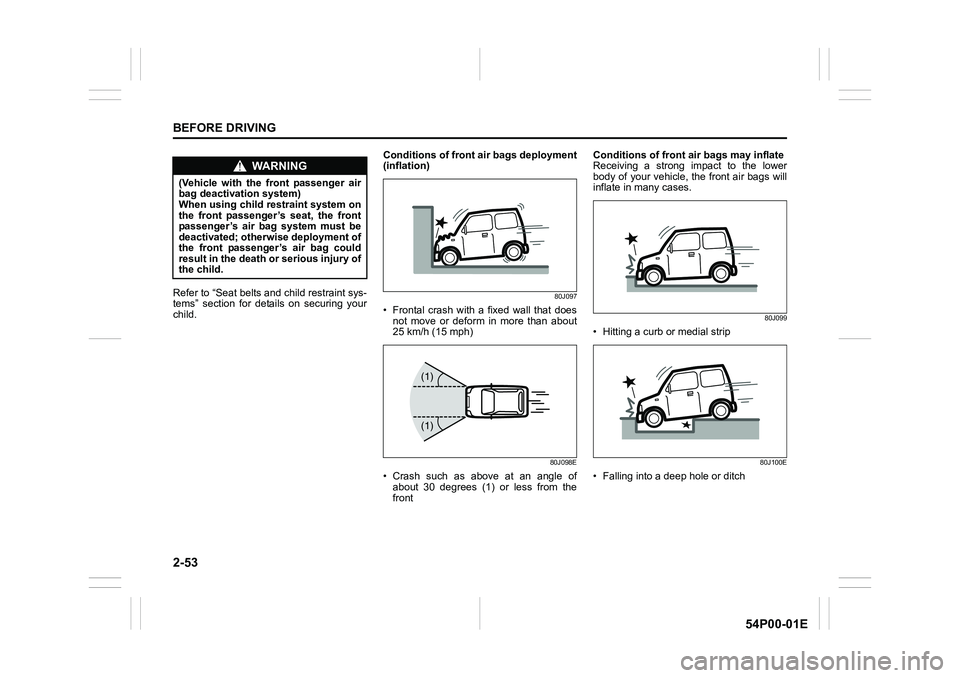
child.Conditions of front air bags deployment
(inflation)80J097
• Frontal crash with a fixed wall that does
not move or deform in more than about
25 km/h (15 mph)
80J098E
• Crash such as above at an angle of
about 30 degrees (1) or less from the
frontConditions of front air bags may inflate
Receiving a strong impact to the lower
body of your vehicle, the front air bags will
inflate in many cases.
80J099
• Hitting a curb or medial strip
80J100E
• Falling into a deep hole or ditch
WA R N I N G
(Vehicle with the front passenger air
bag deactivation system)
When using child restraint system on
the front passenger’s seat, the front
passenger’s air bag system must be
deactivated; otherwise deployment of
the front passenger’s air bag could
result in the death or serious injury of
the child.
(1)
(1)
Page 136 of 482
2-114
BEFORE DRIVING
54P00-01E
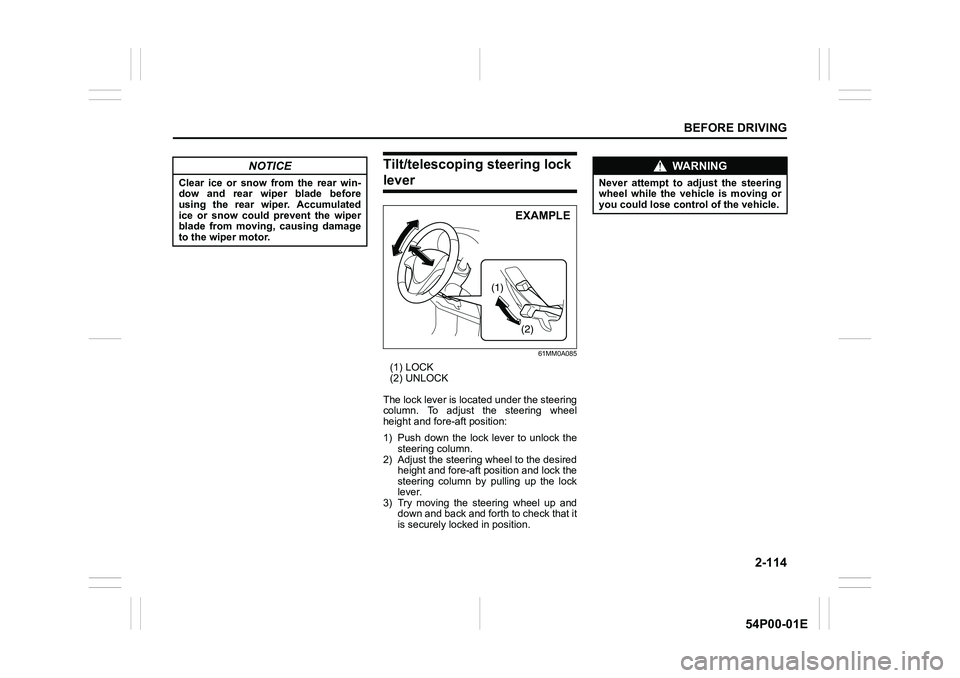
Tilt/telescoping steering lock
lever
61MM0A085
(1) LOCK
(2) UNLOCK
The lock lever is located under the steering
column. To adjust the steering wheel
height and fore-aft position:
1) Push down the lock lever to unlock the
steering column.
2) Adjust the steering wheel to the desired
height and fore-aft position and lock the
steering column by pulling up the lock
lever.
3) Try moving the steering wheel up and
down and back and forth to check that it
is securely locked in position.
NOTICE
Clear ice or snow from the rear win-
dow and rear wiper blade before
using the rear wiper. Accumulated
ice or snow could prevent the wiper
blade from moving, causing damage
to the wiper motor.
(1)
(2)
EXAMPLE
WA R N I N G
Never attempt to adjust the steering
wheel while the vehicle is moving or
you could lose control of the vehicle.
Page 142 of 482
3-2
OPERATING YOUR VEHICLE
54P00-01E
NOTE:
It is normal for water to drip from the air
conditioning system after use.
4) Check that the hood is fully closed and
latched.
5) Check the headlights, turn signal lights,
brake lights and horn for proper opera-
tion.
6) Adjust the seat and head restraint.
7) Check the brake pedal and the parking
brake lever.
8) Adjust the mirrors.
9) Check that you and all passengers
have properly fastened your seat belts.
10)Check that all warning lights come on
as the ignition switch is turned to “ON”
position or the engine switch is pressed
to change the ignition mode to “ON”.
11)Check all gauges.
12)Check that the brake system warning
light turns off when the parking brake is
released.
Once a week, or each time you fill your fuel
tank, perform the following under-hood
checks:
1) Engine oil level
2) Coolant level
3) Brake fluid level
4) Battery solution level
5) Windshield washer fluid level
6) Hood latch operation
Pull the hood release handle inside the
vehicle. Check that you cannot openthe hood all the way without releasing
the secondary latch. Close the hood
securely after checking for proper latch
operation. See the item “All latches,
hinges and locks” of “Chassis, body
and others” in “Maintenance schedule”
in “INSPECTION AND MAINTE-
NANCE” section for lubrication sched-
ule.
Once a month, or each time you fill your
fuel tank, check the tire pressure using a
tire pressure gauge. Also check the tire
pressure of the spare tire.Engine oil consumption
It is normal for the engine to consume
some engine oil during normal vehicle
operation.
The amount of engine oil consumption
depends on viscosity and quality of the oil
and your driving conditions.
More oil is consumed during high-speed
driving and when there is frequent acceler-
ation and deceleration. Under high loads,
your engine also will consume more oil.
A new engine also consumes more oil,
since its pistons, piston rings and cylinder
walls have not yet become conditioned.
New engines reach the normal level of oil
consumption only after approximately
5000 km (3000 miles) driving.
Oil consumption:
Max. 1.0 L per 1000 km
(1 Qt. per 600 miles)
When judging the amount of oil consump-
tion, note that the oil may become diluted
and it is difficult to judge the accurate oil
level.
As an example, if a vehicle is used for
repeated short trips, and consumes a nor-
mal amount of oil, the dipstick may not
show any drop in the oil level at all, even
after 1000 km (600 miles) or more of driv-
ing. This is because the oil gradually
becomes diluted with fuel or moisture,
WA R N I N G
Check that the hood is fully closed
and latched before driving. If it is not,
it can fly up unexpectedly during
driving, obstructing your view and
resulting in an accident.
Page 150 of 482
3-10
OPERATING YOUR VEHICLE
54P00-01E
NOTE:
• Even when the remote controller is in the
interior workable area, if it is in any of the
following conditions, you may not be
able to start the engine or select the igni-
tion modes, and the REMOTE CON-
TROLLER OUTSIDE warning may be
given.
–The remote controller’s battery is low.
–The remote controller is affected by
strong radio signals or noise.
–The remote controller is in contact with
or covered by a metallic object.
–The remote controller is in stowage
such as the glove box or a door
pocket.
–The remote controller is in the sun visor
pocket or on the floor.
• Even when the remote controller is out-
side the interior workable area, if it is in
any of the following conditions, you may
be able to start the engine or select the
ignition mode. The REMOTE CON-
TROLLER OUTSIDE warning may not
be given at that time.
–The remote controller is outside the
vehicle but very close to a door.
–The remote controller is on the instru-
ment panel.Parking brake lever
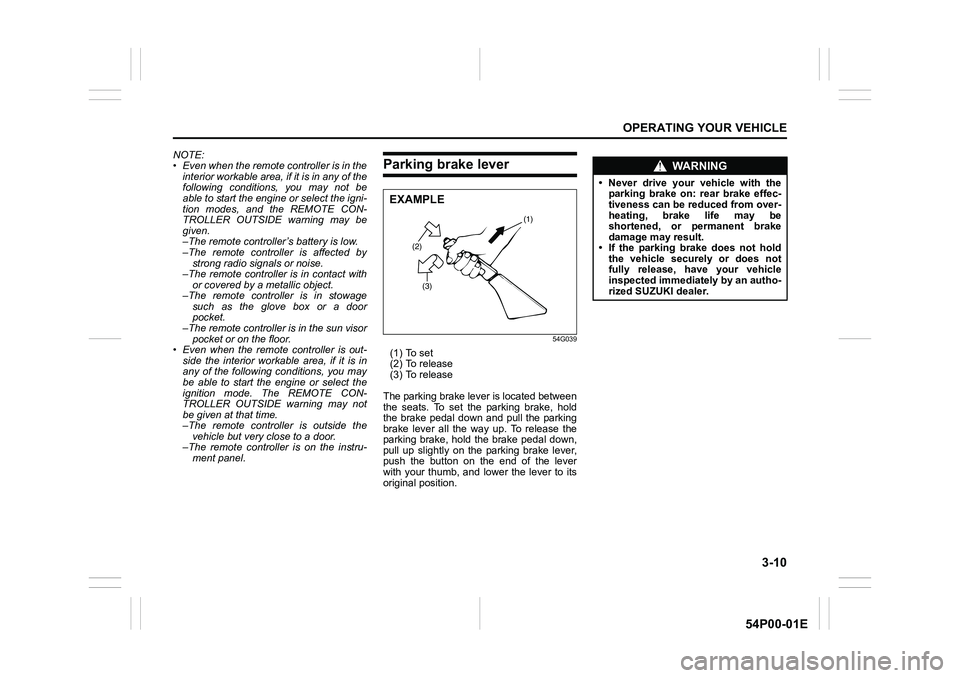
54G039
(1) To set
(2) To release
(3) To release
The parking brake lever is located between
the seats. To set the parking brake, hold
the brake pedal down and pull the parking
brake lever all the way up. To release the
parking brake, hold the brake pedal down,
pull up slightly on the parking brake lever,
push the button on the end of the lever
with your thumb, and lower the lever to its
original position.
(2)
(3)(1)
EXAMPLE
WA R N I N G
• Never drive your vehicle with the
parking brake on: rear brake effec-
tiveness can be reduced from over-
heating, brake life may be
shortened, or permanent brake
damage may result.
• If the parking brake does not hold
the vehicle securely or does not
fully release, have your vehicle
inspected immediately by an autho-
rized SUZUKI dealer.
Page 211 of 482
3-71
OPERATING YOUR VEHICLE
54P00-01E
Rearview camera
(if equipped)
When the gearshift lever is shifted to “R”
position while the ignition switch is in “ON”
position or the ignition mode is “ON”, the
rearview camera system automatically
shows the view behind the vehicle on the
display.
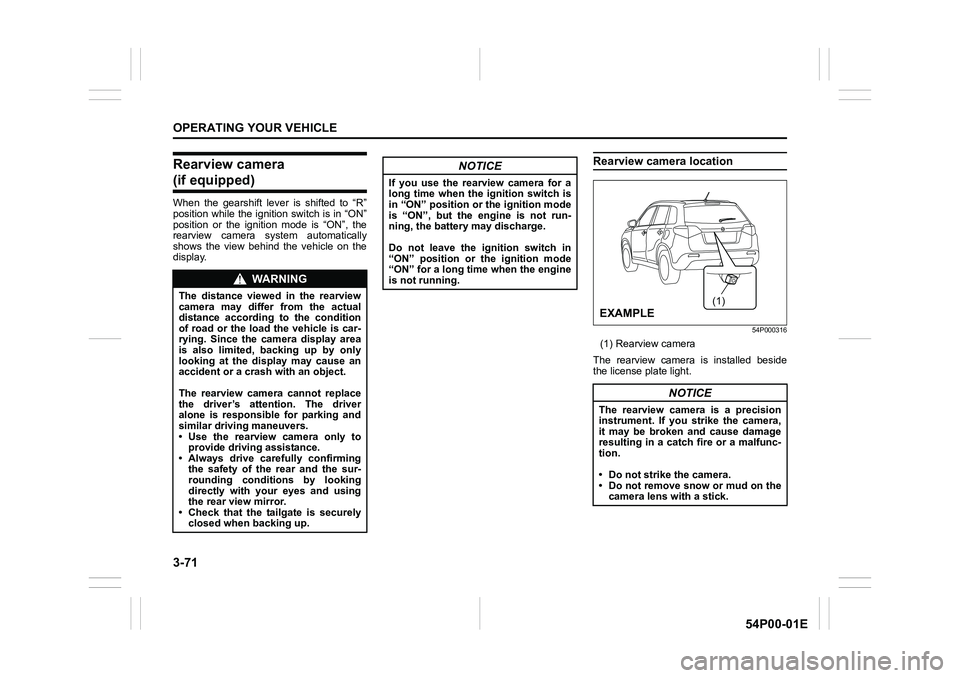
Rearview camera location
54P000316
(1) Rearview camera
The rearview camera is installed beside
the license plate light.
WA R N I N G
The distance viewed in the rearview
camera may differ from the actual
distance according to the condition
of road or the load the vehicle is car-
rying. Since the camera display area
is also limited, backing up by only
looking at the display may cause an
accident or a crash with an object.
The rearview camera cannot replace
the driver’s attention. The driver
alone is responsible for parking and
similar driving maneuvers.
• Use the rearview camera only to
provide driving assistance.
• Always drive carefully confirming
the safety of the rear and the sur-
rounding conditions by looking
directly with your eyes and using
the rear view mirror.
• Check that the tailgate is securely
closed when backing up.
NOTICE
If you use the rearview camera for a
long time when the ignition switch is
in “ON” position or the ignition mode
is “ON”, but the engine is not run-
ning, the battery may discharge.
Do not leave the ignition switch in
“ON” position or the ignition mode
“ON” for a long time when the engine
is not running.
NOTICE
The rearview camera is a precision
instrument. If you strike the camera,
it may be broken and cause damage
resulting in a catch fire or a malfunc-
tion.
• Do not strike the camera.
• Do not remove snow or mud on the
camera lens with a stick.
(1)
EXAMPLE