belt SUZUKI IGNIS 2017 User Guide
[x] Cancel search | Manufacturer: SUZUKI, Model Year: 2017, Model line: IGNIS, Model: SUZUKI IGNIS 2017Pages: 505, PDF Size: 8.36 MB
Page 59 of 505
2-36
BEFORE DRIVING
75RM4-01E
60A036
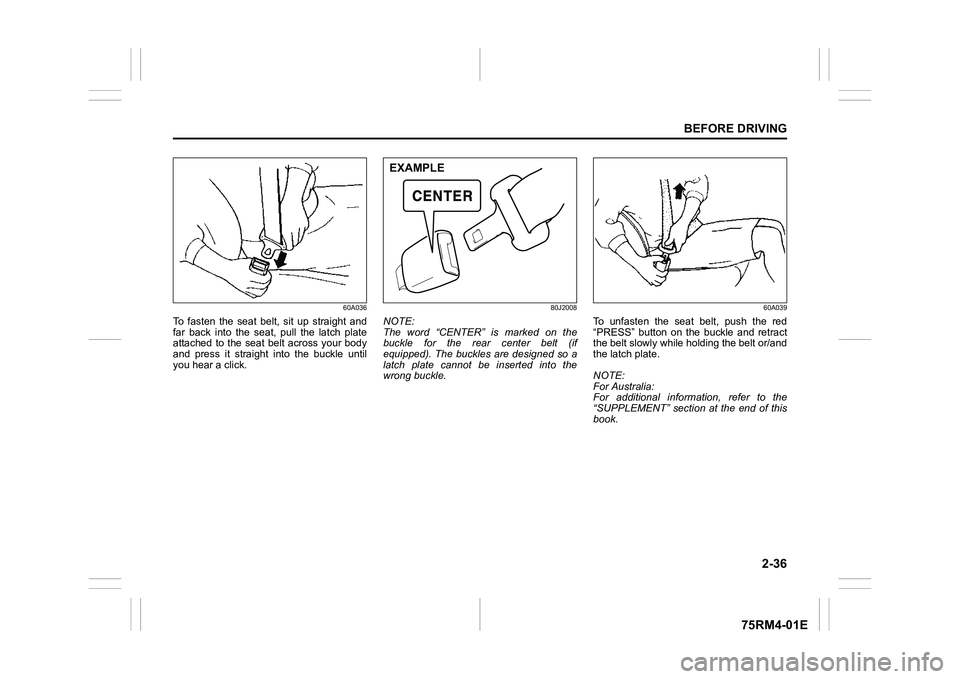
To fasten the seat belt, sit up straight and
far back into the seat, pull the latch plate
attached to the seat belt across your body
and press it straight into the buckle until
you hear a click.
80J2008
NOTE:
The word “CENTER” is marked on the
buckle for the rear center belt (if
equipped). The buckles are designed so a
latch plate cannot be inserted into the
wrong buckle.
60A039
To unfasten the seat belt, push the red
“PRESS” button on the buckle and retract
the belt slowly while holding the belt or/and
the latch plate.
NOTE:
For Australia:
For additional information, refer to the
“SUPPLEMENT” section at the end of this
book.
EXAMPLE
Page 60 of 505
2-37BEFORE DRIVING
75RM4-01E
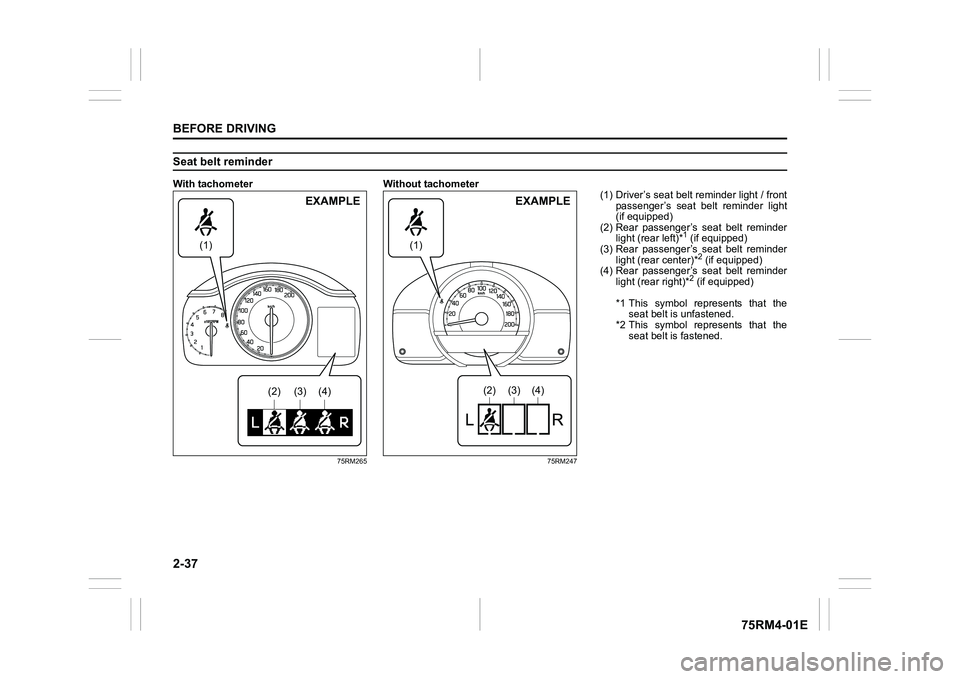
Seat belt reminderWith tachometer
75RM265
Without tachometer
75RM247
(1) Driver’s seat belt reminder light / frontpassenger’s seat belt reminder light
(if equipped)
(2) Rear passenger’s seat belt reminder light (rear left)*
1 (if equipped)
(3) Rear passenger’s seat belt reminder
light (rear center)*2 (if equipped)
(4) Rear passenger’s seat belt reminder light (rear right)*
2 (if equipped)
*1 This symbol represents that the seat belt is unfastened.
*2 This symbol represents that the seat belt is fastened.
(2) (3) (4)
(1)
EXAMPLE
(1)
(2)
(3)
(4)
EXAMPLE
Page 61 of 505
2-38
BEFORE DRIVING
75RM4-01E
When the driver and/or passenger(s)
do(does) not buckle his or her seat belt,
the seat belt reminder light will come on or
blink and a buzzer will sound as a
reminder to the driver and/or passenger(s)
to buckle his or her seat belt. For more
details, refer to the explanation below.
NOTE:
The driver’s seat belt reminder light / front
passenger’s seat belt reminder light is for
both the driver and front passenger. Driver’s seat belt reminder
If the driver’s seat belt remains unbuckled
when the ignition switch is turned to “ON”
position or the engine switch is pressed to
change the ignition mode to ON, the
reminder works as follows:
1) The seat belt reminder light will come
on.
2) After the vehicle’s speed has reached
about 15 km/h, the seat belt reminder
light will blink and a buzzer will sound
for about 95 seconds.
3) The reminder light will remain on until the driver’s seat belt is buckled.
If the driver has buckled his or her seat belt
and later unbuckles the seat belt, the
reminder system will be activated from
Step 1) or 2) according to the vehicle’s
speed. When the vehicle’s speed is less
than 15 km/h, the reminder will start from
Step 1). When the vehicle’s speed is more
than 15 km/h, the reminder will start from
Step 2).
The reminder will be automatically can-
celed when the driver’s seat belt is buckled
or the ignition switch is turned off, or the
engine switch is pressed to change the
ignition mode to LOCK (OFF). Front passenger’s seat belt reminder
(if equipped)
The front passenger’s seat belt reminder
will activate only when there is a passen-
ger sitting in the front seat. In some situa-
tions, however, such as when you place
heavy objects in the front seat, the seat
belt reminder can be activated as if a pas-
senger was present. The front passenger’s
seat belt reminder wo
rks in the same man-
ner as the driver’s seat belt reminder.
Rear passenger’s seat belt reminder
(if equipped)
If a rear seat belt is not fastened when the
engine is started, all the rear passenger’s
seat belt reminder lights will come on for
about 35 seconds and then go out.
Within this 35 seconds;
• For the instrument c luster with tachome-
ter, the corresponding reminder is high-
lighted. The reminder fades when the
seat belt is fastened.
• For the instrum ent cluster without
tachometer, the corresponding reminder
comes on with the frame. The reminder
goes off with leaving the frame when the
seat belt is fastened.
The rear passenger’s seat belt reminder
lights will also come on for about 35 sec-
onds in the following conditions.
• If a seat belt is unfastened when the vehicle speed is less than 15 km/h, the
corresponding light will come on.
WA R N I N G
It is absolutely essential that the
driver and passengers fasten their
seat belts at all times. Persons who
are not fastening seat belts have a
much greater risk of injury if an acci-
dent occurs. Make a regular habit of
buckling your seat belt before putting
the key in the ignition or pressing the
engine switch.
Page 62 of 505
2-39BEFORE DRIVING
75RM4-01E
• If a seat belt is unfastened when thevehicle speed is more than 15 km/h, the
corresponding light will come on and a
buzzer will sound.
The reminder will be automatically can-
celed when the rear seat belt is buckled or
the ignition switch is turned off, or the
engine switch is pressed to change the
ignition mode to LOCK (OFF).
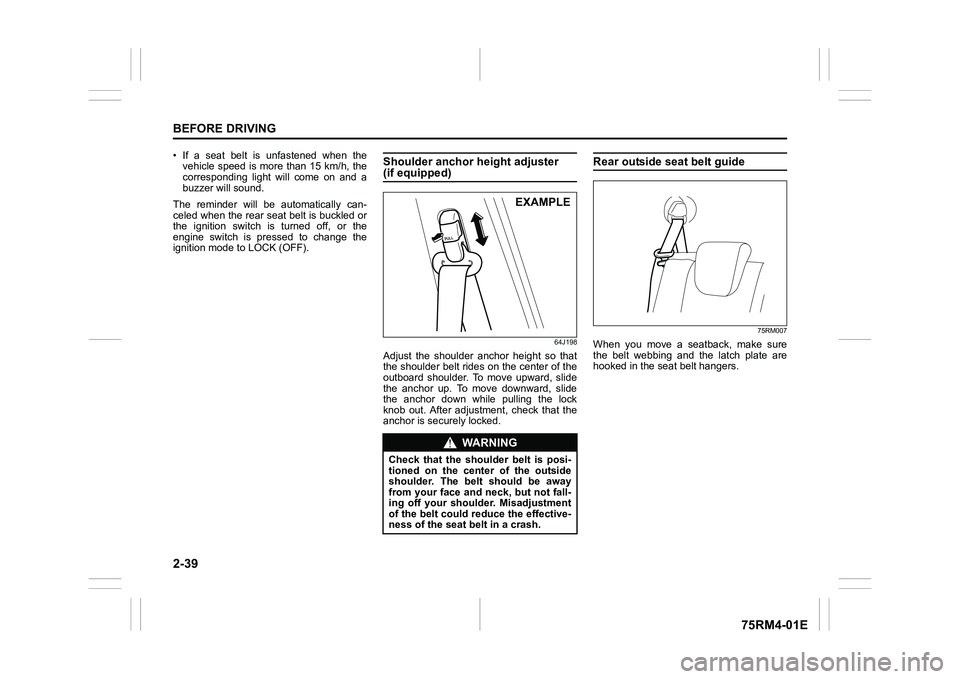
Shoulder anchor height adjuster (if equipped)
64J198
Adjust the shoulder anchor height so that
the shoulder belt rides on the center of the
outboard shoulder. To move upward, slide
the anchor up. To move downward, slide
the anchor down while pulling the lock
knob out. After adjustment, check that the
anchor is securely locked.
Rear outside seat belt guide
75RM007
When you move a seatback, make sure
the belt webbing and the latch plate are
hooked in the seat belt hangers.
WA R N I N G
Check that the shoulder belt is posi-
tioned on the cent er of the outside
shoulder. The belt should be away
from your face and neck, but not fall-
ing off your shoulder. Misadjustment
of the belt could reduce the effective-
ness of the seat belt in a crash.
EXAMPLE
Page 63 of 505
2-40
BEFORE DRIVING
75RM4-01E
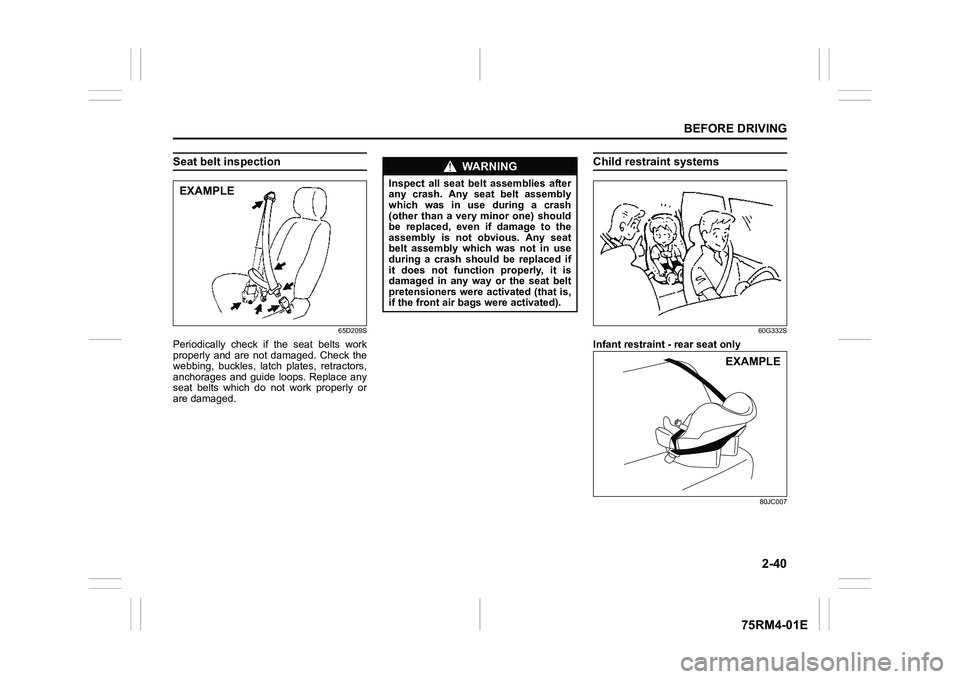
Seat belt inspection
65D209S
Periodically check if the seat belts work
properly and are not damaged. Check the
webbing, buckles, latch plates, retractors,
anchorages and guide loops. Replace any
seat belts which do not work properly or
are damaged.
Child restraint systems
60G332S
Infant restraint - rear seat only
80JC007
EXAMPLE
WA R N I N G
Inspect all seat belt assemblies after
any crash. Any seat belt assembly
which was in use during a crash
(other than a very minor one) should
be replaced, even if damage to the
assembly is not obvious. Any seat
belt assembly which was not in use
during a crash should be replaced if
it does not function properly, it is
damaged in any way or the seat belt
pretensioners were activated (that is,
if the front air bags were activated).
EXAMPLE
Page 64 of 505
2-41BEFORE DRIVING
75RM4-01E
Child restraint
80JC016
Booster seat
80JC008
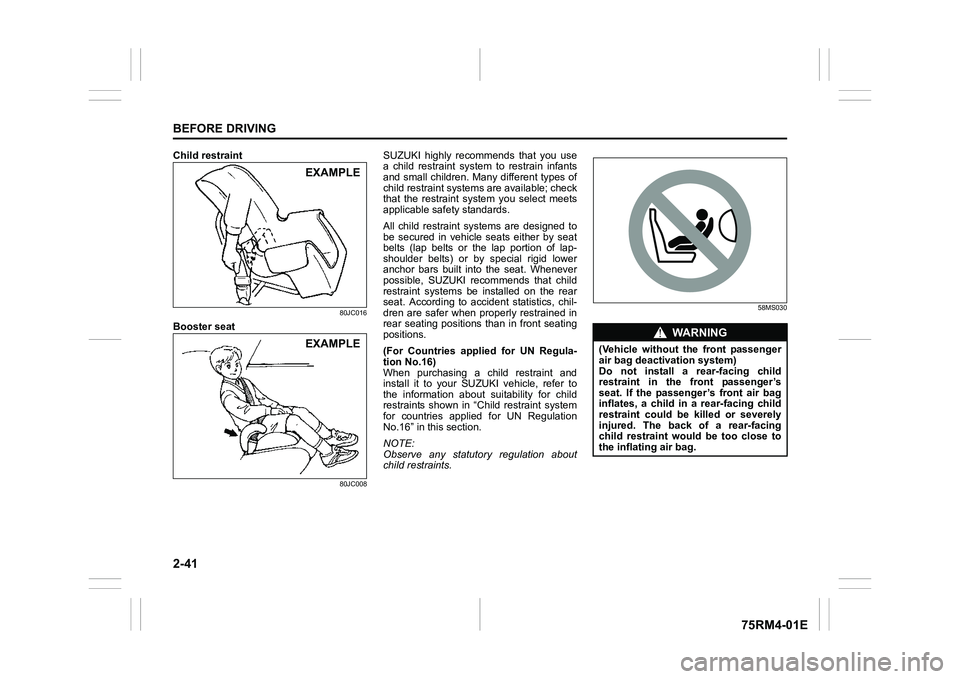
SUZUKI highly recommends that you use
a child restraint system to restrain infants
and small children. Many different types of
child restraint systems are available; check
that the restraint syst em you select meets
applicable safety standards.
All child restraint systems are designed to
be secured in vehicle seats either by seat
belts (lap belts or the lap portion of lap-
shoulder belts) or by special rigid lower
anchor bars built into the seat. Whenever
possible, SUZUKI recommends that child
restraint systems be installed on the rear
seat. According to accident statistics, chil-
dren are safer when properly restrained in
rear seating positions than in front seating
positions.
(For Countries applied for UN Regula-
tion No.16)
When purchasing a child restraint and
install it to your SUZUKI vehicle, refer to
the information about suitability for child
restraints shown in “Child restraint system
for countries applied for UN Regulation
No.16” in this section.
NOTE:
Observe any statutory regulation about
child restraints.
58MS030
EXAMPLEEXAMPLE
WA R N I N G
(Vehicle without the front passenger
air bag deactivation system)
Do not install a rear-facing child
restraint in the front passenger’s
seat. If the passenger’s front air bag
inflates, a child in a rear-facing child
restraint could be killed or severely
injured. The back of a rear-facing
child restraint would be too close to
the inflating air bag.
Page 66 of 505
2-43BEFORE DRIVING
75RM4-01E
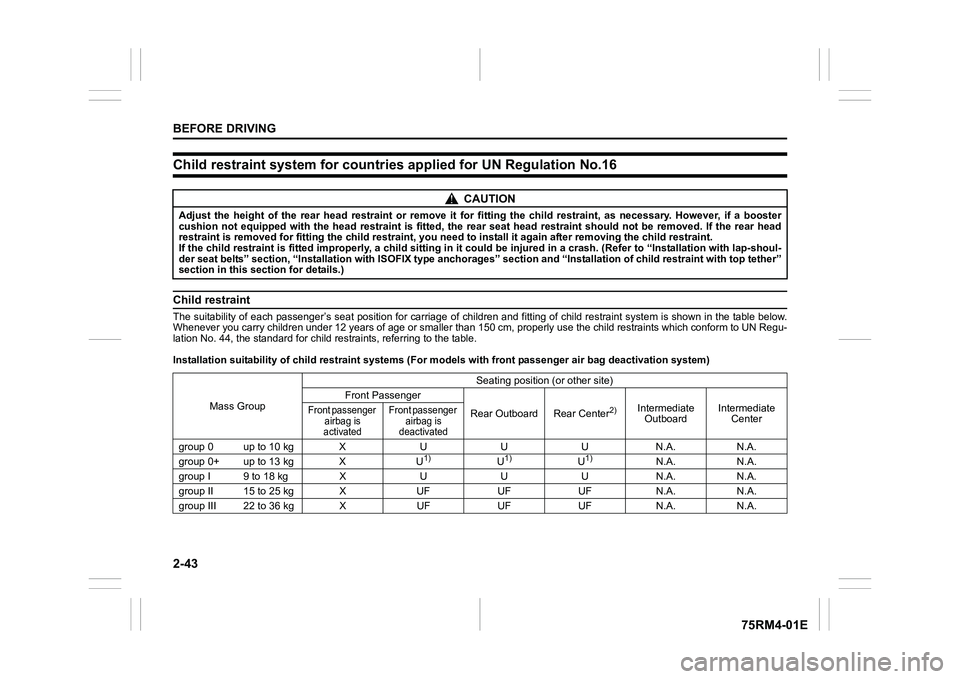
Child restraint system for countries applied for UN Regulation No.16Child restraintThe suitability of each passenger’s seat position for carriage of children and fitting of child restraint system is shown in t he table below.
Whenever you carry children under 12 years of age or smaller th an 150 cm, properly use the child restraints which conform to UN Regu-
lation No. 44, the standard for child restraints, referring to the table.
Installation suitability of chi ld restraint systems (For models with front passenger air bag deactivation system)
CAUTION
Adjust the height of the rear head restraint or remove it for f itting the child restraint, as necessary. However, if a booster
cushion not equipped with the head restraint is fitted, the rea r seat head restraint should not be removed. If the rear head
restraint is removed for fitting the child restraint, you need to install it again after removing the child restraint.
If the child restraint is fitted improperly, a child sitting in it could be injured in a crash. (Refer to “Installation with l ap-shoul-
der seat belts” section, “Instal lation with ISOFIX type anchora ges” section and “Installation of child restraint with top teth er”
section in this sect ion for details.)
Mass Group Seating position (or other site)
Front Passenger
Rear Outboard Rear Center
2)
Intermediate Outboard Intermediate
Center
Front passenger
airbag is
activated Front passenger
airbag is
deactivated
group 0 up to 10 kg X U U U N.A. N.A.
group 0+ up to 13 kg X U
1)
U1)
U1)
N.A. N.A.
group I 9 to 18 kg X U U U N.A. N.A.
group II 15 to 25 kg X UF UF UF N.A. N.A.
group III 22 to 36 kg X UF UF UF N.A. N.A.
Page 71 of 505
2-48
BEFORE DRIVING
75RM4-01E
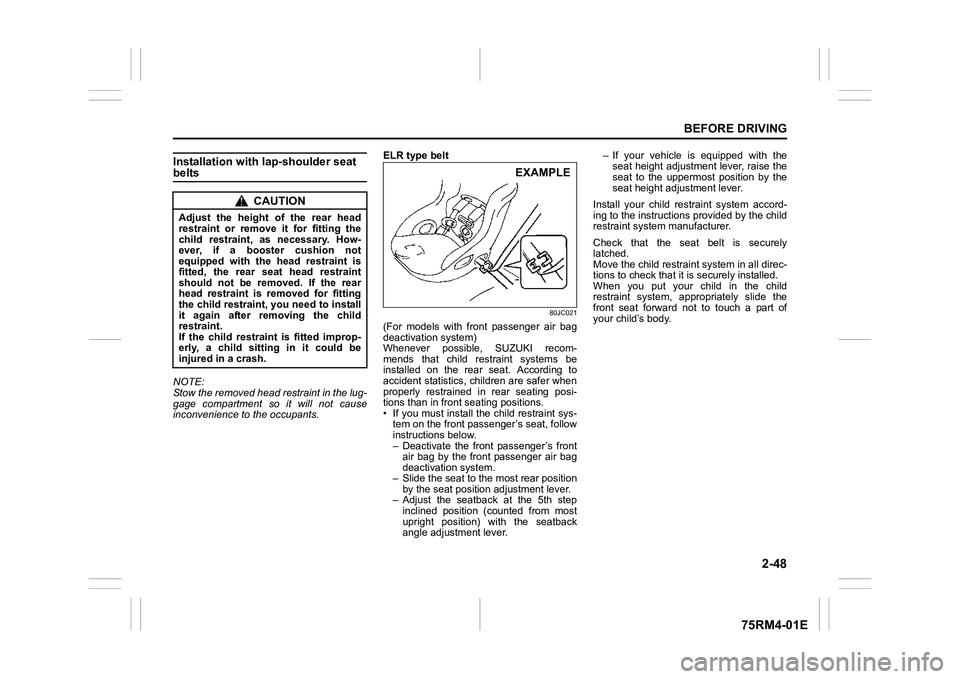
Installation with lap-shoulder seat beltsNOTE:
Stow the removed head restraint in the lug-
gage compartment so it will not cause
inconvenience to the occupants.ELR type belt
80JC021
(For models with front passenger air bag
deactivation system)
Whenever possible, SUZUKI recom-
mends that child restraint systems be
installed on the rear seat. According to
accident statistics, children are safer when
properly restrained in rear seating posi-
tions than in front seating positions.
• If you must install the child restraint sys-
tem on the front passe nger’s seat, follow
instructions below.
– Deactivate the front passenger’s front air bag by the front passenger air bag
deactivation system.
– Slide the seat to t he most rear position
by the seat position adjustment lever.
– Adjust the seatba ck at the 5th step
inclined position (counted from most
upright position) w ith the seatback
angle adjustment lever. – If your vehicle is equipped with the
seat height adjustment lever, raise the
seat to the uppermost position by the
seat height adjustment lever.
Install your child restraint system accord-
ing to the instructions provided by the child
restraint system manufacturer.
Check that the seat belt is securely
latched.
Move the child restraint system in all direc-
tions to check that it is securely installed.
When you put your child in the child
restraint system, appr opriately slide the
front seat forward not to touch a part of
your child’s body.
CAUTION
Adjust the height of the rear head
restraint or remove it for fitting the
child restraint, as necessary. How-
ever, if a booster cushion not
equipped with the head restraint is
fitted, the rear seat head restraint
should not be removed. If the rear
head restraint is removed for fitting
the child restraint, you need to install
it again after removing the child
restraint.
If the child restraint is fitted improp-
erly, a child sitting in it could be
injured in a crash.
EXAMPLE
Page 75 of 505
2-52
BEFORE DRIVING
75RM4-01E
Seat belt pretensioner system
63J269
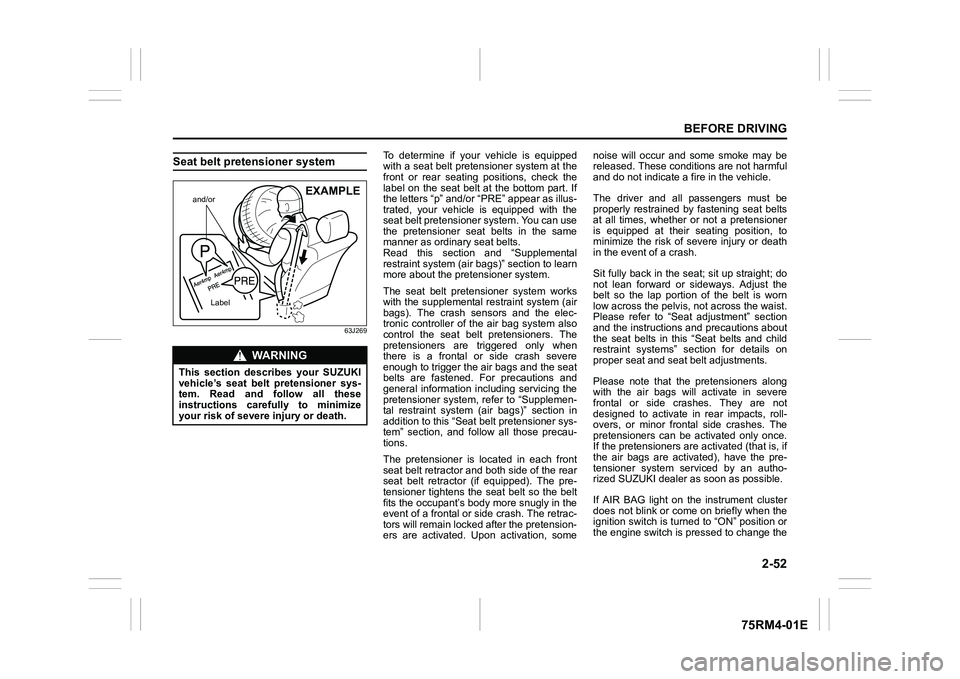
To determine if your vehicle is equipped
with a seat belt pretensioner system at the
front or rear seating positions, check the
label on the seat belt at the bottom part. If
the letters “p” and/or “PRE” appear as illus-
trated, your vehicle is equipped with the
seat belt pretensioner system. You can use
the pretensioner seat belts in the same
manner as ordinary seat belts.
Read this section and “Supplemental
restraint system (air bags)” section to learn
more about the pretensioner system.
The seat belt pretensioner system works
with the supplemental r estraint system (air
bags). The crash sensors and the elec-
tronic controller of t he air bag system also
control the seat belt pretensioners. The
pretensioners are triggered only when
there is a frontal or side crash severe
enough to trigger the air bags and the seat
belts are fastened. For precautions and
general information including servicing the
pretensioner system, refer to “Supplemen-
tal restraint system (air bags)” section in
addition to this “Seat belt pretensioner sys-
tem” section, and follow all those precau-
tions.
The pretensioner is located in each front
seat belt retractor and both side of the rear
seat belt retractor (if equipped). The pre-
tensioner tightens the seat belt so the belt
fits the occupant’s body more snugly in the
event of a frontal or side crash. The retrac-
tors will remain locked after the pretension-
ers are activated. Upon activation, some noise will occur and some smoke may be
released. These conditions are not harmful
and do not indicate a fire in the vehicle.
The driver and all passengers must be
properly restrained by fastening seat belts
at all times, whether or not a pretensioner
is equipped at their seating position, to
minimize the risk of severe injury or death
in the event o
f a crash.
Sit fully back in the seat; sit up straight; do
not lean forward or sideways. Adjust the
belt so the lap portion of the belt is worn
low across the pelvis , not across the waist.
Please refer to “Seat adjustment” section
and the instructions and precautions about
the seat belts in this “Seat belts and child
restraint systems” section for details on
proper seat and seat belt adjustments.
Please note that the pretensioners along
with the air bags will activate in severe
frontal or side crashes. They are not
designed to activate in rear impacts, roll-
overs, or minor frontal side crashes. The
pretensioners can be activated only once.
If the pretensioners are activated (that is, if
the air bags are activated), have the pre-
tensioner system serviced by an autho-
rized SUZUKI dealer as soon as possible.
If AIR BAG light on the instrument cluster
does not blink or come on briefly when the
ignition switch is turned to “ON” position or
the engine switch is pressed to change the
WA R N I N G
This section describes your SUZUKI
vehicle’s seat belt pretensioner sys-
tem. Read and follow all these
instructions carefully to minimize
your risk of severe injury or death.
and/or
Label
EXAMPLE
Page 77 of 505
2-54
BEFORE DRIVING
75RM4-01E
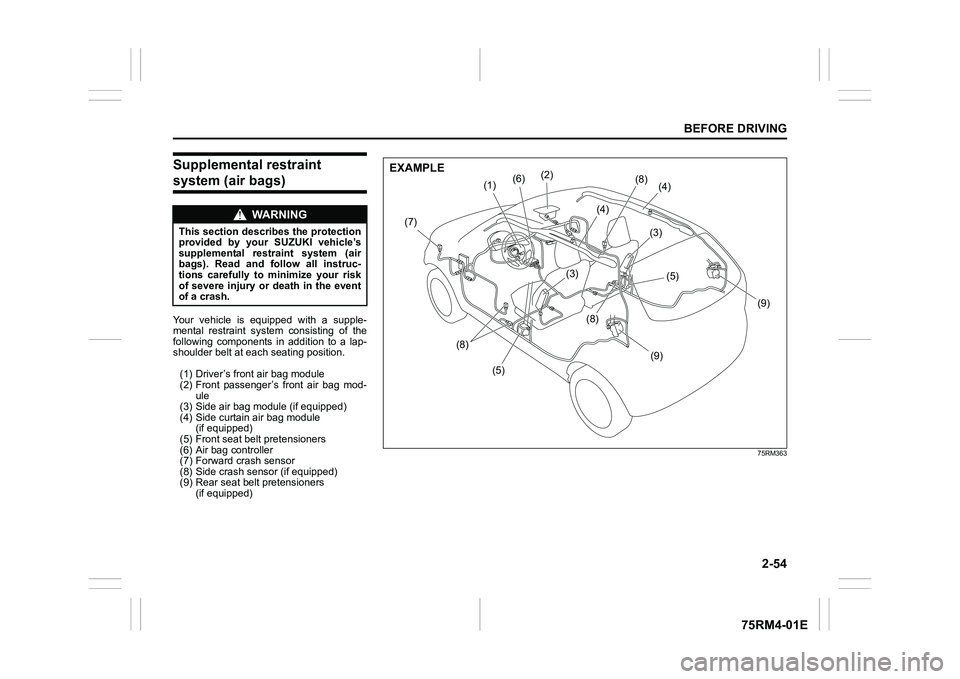
Supplemental restraint system (air bags) Your vehicle is equipped with a supple-
mental restraint system consisting of the
following components in addition to a lap-
shoulder belt at each seating position.
(1) Driver’s front air bag module
(2) Front passenger’s front air bag mod- ule
(3) Side air bag module (if equipped)
(4) Side curtain air bag module (if equipped)
(5) Front seat belt pretensioners
(6) Air bag controller
(7) Forward crash sensor
(8) Side crash sensor (if equipped)
(9) Rear seat belt pretensioners (if equipped)
WA R N I N G
This section describes the protection
provided by your SUZUKI vehicle’s
supplemental restraint system (air
bags). Read and follow all instruc-
tions carefully to minimize your risk
of severe injury or death in the event
of a crash.
75RM363
(5)
(8)
(7)
(6)
(1)
(2)
(4)
(9)
(9)
(8)
(5)
(3)
(3)
(4)
(8)
EXAMPLE