CAB SUZUKI IGNIS 2018 Owners Manual
[x] Cancel search | Manufacturer: SUZUKI, Model Year: 2018, Model line: IGNIS, Model: SUZUKI IGNIS 2018Pages: 505, PDF Size: 8.36 MB
Page 3 of 505
75RM4-01E
FOREWORDThis manual should be considered a per-
manent part of the vehicle and should
remain with the vehicle when resold or oth-
erwise transferred to a new owner or oper-
ator. Please read this manual carefully
before operating your new SUZUKI vehicle
and review the manual from time to time. It
contains important information on safety,
operation and maintenance.
All information in this manual is based
on the latest product information avail-
able at the time of publication. Due to
improvements or other changes, there
may be discrepancies between informa-
tion in this manual and your vehicle.
SUZUKI MOTOR CORPORATION
reserves the right to make production
changes at any time, without notice and
without incurring any obligation to
make the same or similar changes to
vehicles previously built or sold.
This vehicle may not comply with stan-
dards or regulations of other countries.
Before attempting to register this vehi-
cle in any other country, check all appli-
cable regulations and make anynecessary modifications. NOTE:
Please see the warning label named “Air
bag symbol meaning” in the “BEFORE
DRIVING” section for information on front
air bag protection.
NOTE:
(For Hong Kong models)
• “ENG A-STOP System” means Idling
Stop System.
• “SHVS (Smart Hybrid Vehicle by Suzuki)” means Mild Hybrid.
Page 7 of 505
75RM4-01E
(For EU countries)
Parties who can read out the technical data using specific diag nostic devices (the “Parties”);• Authorized distributors, dealers and repairers/service worksho ps of SUZUKI vehicles, and independent repairers/service workshops
• Manufacturer of SUZUKI vehicles ( e.g. SUZUKI MOTOR CORPORATION (“SUZUKI”), MAGYAR SUZUKI CORPORATION LTD.,
MARUTI SUZUKI INDIA LIMITED, SUZ UKI MOTOR (THAILAND) CO., LTD., THAI SUZUKI MOTOR CO., LTD.)
• Suppliers of SUZUKI vehicle part s, components and accessories (the “Suppliers”)Data usage (the “Data Usage”)SUZUKI and the Parties may use t he Recorded Data in the modules or memories for the purpose of;
• Diagnostic, service, repair and warranty processes
• Research and further vehicle developments
• Implementation of or investigat ion for field actions including recall and service campaign
• Quality improvements, etc.
After an error has been corrected, data related to such error a re basically deleted from error storage module or memory, while certain
data are overwritten or kept further.Conditions under which SUZUKI and the Parties can disclose or p rovide any of the Recorded Data to a third partySUZUKI and the Parties may disclose or provide any of the Recorded Data to a third party under any of the following conditions:
• A consent from the Vehicle owner/ user(s), or from lessee of the Vehicle (in case of lease) is obtained.
• It is officially requested by police, prosecutor, court, or other authorities.
• It is provided to a research in stitute for statistical study after processing in such a manner that owner/user(s) of the Vehi cle cannot be
identified.
• It is used by SUZUKI or the Part ies or their directors, officers or employees for the purpose s described in the Data Usage.
• It is used by SUZUKI or t he Parties in a lawsuit.
• Any other cases allowed by ap plicable laws and regulations.
If required, you may receive fur ther information from each of the Parties other than the Suppliers.
NOTE:
• The data cannot be used to detect the Vehicle’s movements.
• The data stored in data storage modules or memories differ according to the Vehicle’s grade or model.
• No conversation nor noise/sound will be recorded in any event.
• The data may not be recorded in some situations.
If these technical data are combined with other information (e. g. accident or witness report, damage on the Vehicle, etc.), there may be
cases that such data may i dentify a specific person.
Page 35 of 505
2-12
BEFORE DRIVING
75RM4-01E
If the remote controller is left in the vehicle
and you lock the driver’s door or front pas-
senger’s door as described below, the door
will be automatically unlocked.
• If you open the driver’s door and lock thedoor by turning the lock knob forward or
pushing the power door locking switch,
the driver’s door will be automatically
unlocked.
• If you open the front passenger’s door and lock the door by turning the lock
knob forward or pushing the power door
locking switch, the front passenger’s
door will be automat ically unlocked.
NOTE:
• The reminder will not operate when the remote controller is on the instrument
panel, in the glove box, in a storage
compartment, in the sun visor or on the
floor, etc.
• Check that the driver always carries the remote controller.
• Do not leave the remote controller in the vehicle when leaving the vehicle. Battery replacement
If the remote controller becomes unreli-
able, replace the battery.
To replace the battery of the remote con-
troller:
71LMT0201
1) Pull the key out from the remote con-
troller.
2) Insert a flat-bladed screwdriver covered with a soft cloth in the slot of the remote
controller and pry it open.
68LM210
(1) Lithium disc type battery:
CR2032 or equivalent 3) Replace the battery (1) so its + terminal
faces the bottom of the case as shown
in the illustration.
4) Close the remote controller firmly.
5) Check that the door locks can be oper- ated with the remote controller.
6) Dispose of the used battery properly according to applicable rules or regula-
tions. Do not dispose of lithium batter-
ies with ordinary household trash.
(1)
WA R N I N G
Swallowing a lithium battery may
cause serious internal injury. Do not
allow anyone to swallow a lithium
battery. Keep lithium batteries away
from children and pets. If swallowed,
contact a physici an immediately.
NOTICE
• The remote controller is a sensitive
electronic instrument. To avoid
damaging it, do not expose it to
dust or moisture or tamper with
internal parts.
• When replacing the battery by yourself, the re mote controller
could be damaged affected by
static electricity. Discharge the
static electricity built up in your
body by touching metal before
replacing th e battery.
Page 36 of 505
2-13BEFORE DRIVING
75RM4-01E
NOTE:
Used batteries must be disposed of prop-
erly according to applicable rules or regu-
lations and must not be disposed of with
ordinary household trash.
80JM133
(1) Crossed-out wheeled bin symbol
The crossed-out wheeled bin symbol (1)
indicates that a used battery should be col-
lected separately from ordinary household
trash.
By ensuring the used battery is disposed
of or recycled correctly, you will help pre-
vent potential negative consequences for
the environment and human health, which
could otherwise be caused by inappropri-
ate battery disposal. The recycling of
materials will help to conserve natural
resources. For more detailed information about disposing of or recycling the used
battery, consult your SUZUKI dealer.
Keyless entry system transmitter (Type B)
76MS011
(1) LOCK button
(2) UNLOCK button
There are two ways to lock or unlock all
doors (including the tailgate) simultane-
ously by operating the transmitter near the
vehicle.
(1)
(1)
(2)
Page 38 of 505
2-15BEFORE DRIVING
75RM4-01E
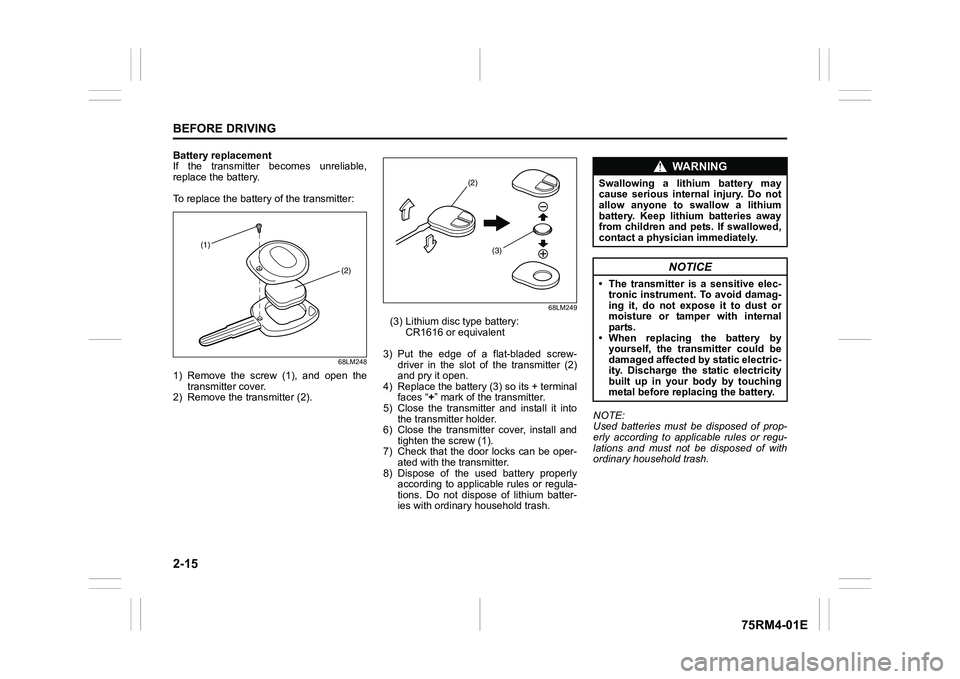
Battery replacement
If the transmitter becomes unreliable,
replace the battery.
To replace the battery of the transmitter:
68LM248
1) Remove the screw (1), and open thetransmitter cover.
2) Remove the transmitter (2).
68LM249
(3) Lithium disc type battery: CR1616 or equivalent
3) Put the edge of a flat-bladed screw- driver in the slot of the transmitter (2)
and pry it open.
4) Replace the battery (3) so its + terminal faces “ +” mark of the transmitter.
5) Close the transmitter and install it into the transmitter holder.
6) Close the transmitter cover, install and
tighten the screw (1).
7) Check that the door locks can be oper- ated with the transmitter.
8) Dispose of the used battery properly according to applicable rules or regula-
tions. Do not dispose of lithium batter-
ies with ordinary household trash. NOTE:
Used batteries must be disposed of prop-
erly according to applicable rules or regu-
lations and must not be disposed of with
ordinary household trash.
(1)
(2)
(2)
(3)
WA R N I N G
Swallowing a lithium battery may
cause serious internal injury. Do not
allow anyone to swallow a lithium
battery. Keep lithium batteries away
from children and pets. If swallowed,
contact a physici an immediately.
NOTICE
• The transmitter is a sensitive elec-
tronic instrument. To avoid damag-
ing it, do not expose it to dust or
moisture or tamper with internal
parts.
• When replacing the battery by yourself, the transmitter could be
damaged affected by static electric-
ity. Discharge the static electricity
built up in your body by touching
metal before repla cing the battery.
Page 57 of 505
2-34
BEFORE DRIVING
75RM4-01E
65D201 65D199
WA R N I N G
(Continued)
• Seat belts should never be wornwith the straps twisted and should
be adjusted as tightly as is com-
fortable to provide the protection
for which they have been designed.
A slack belt will provide less pro-
tection than a snug belt.
• Check that each seat belt buckle is inserted into the proper buckle
catch. It is possible to cross the
buckles in the rear seat. (Continued)
Across the pelvis
WA R N I N G
(Continued)
• Pregnant women should use seatbelts, although specific recommen-
dations about driving should be
made by the woman’s medical advi-
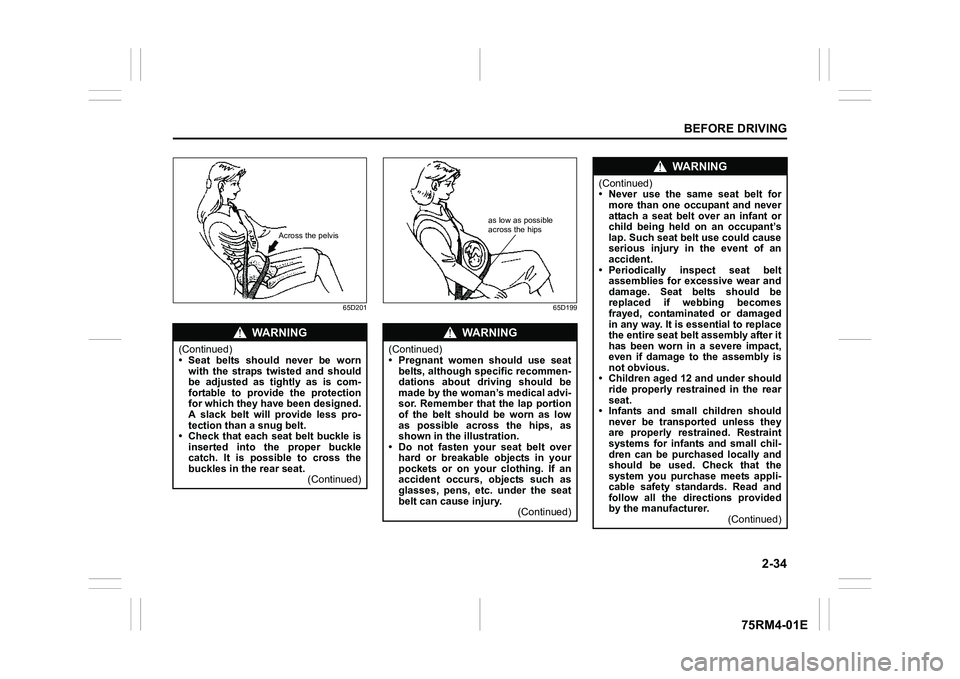
sor. Remember that the lap portion
of the belt should be worn as low
as possible across the hips, as
shown in the illustration.
• Do not fasten your seat belt over
hard or breakable objects in your
pockets or on your clothing. If an
accident occurs, objects such as
glasses, pens, etc. under the seat
belt can cause injury. (Continued)
as low as possible
across the hips
WA R N I N G
(Continued)
• Never use the same seat belt for
more than one occupant and never
attach a seat belt over an infant or
child being held on an occupant’s
lap. Such seat belt use could cause
serious injury in the event of an
accident.
• Periodically inspect seat belt assemblies for excessive wear and
damage. Seat belts should be
replaced if webbing becomes
frayed, contaminated or damaged
in any way. It is essential to replace
the entire seat belt assembly after it
has been worn in a severe impact,
even if damage to the assembly is
not obvious.
• Children aged 12 and under should
ride properly restrained in the rear
seat.
• Infants and small children should
never be transported unless they
are properly restrained. Restraint
systems for infants and small chil-
dren can be purchased locally and
should be used. Check that the
system you purchase meets appli-
cable safety standards. Read and
follow all the directions provided
by the manufacturer. (Continued)
Page 64 of 505
2-41BEFORE DRIVING
75RM4-01E
Child restraint
80JC016
Booster seat
80JC008
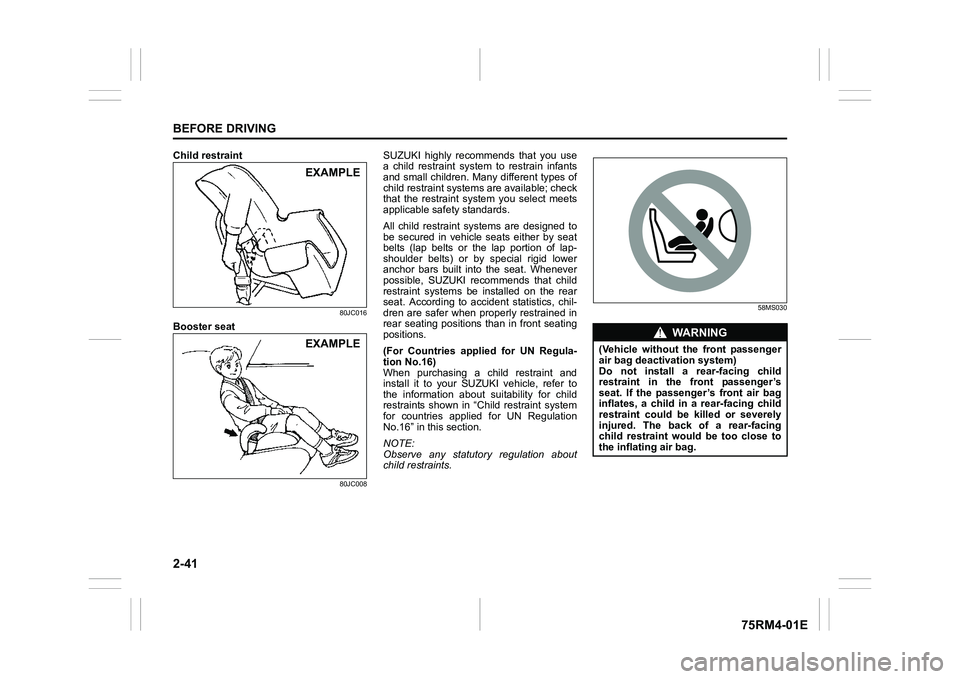
SUZUKI highly recommends that you use
a child restraint system to restrain infants
and small children. Many different types of
child restraint systems are available; check
that the restraint syst em you select meets
applicable safety standards.
All child restraint systems are designed to
be secured in vehicle seats either by seat
belts (lap belts or the lap portion of lap-
shoulder belts) or by special rigid lower
anchor bars built into the seat. Whenever
possible, SUZUKI recommends that child
restraint systems be installed on the rear
seat. According to accident statistics, chil-
dren are safer when properly restrained in
rear seating positions than in front seating
positions.
(For Countries applied for UN Regula-
tion No.16)
When purchasing a child restraint and
install it to your SUZUKI vehicle, refer to
the information about suitability for child
restraints shown in “Child restraint system
for countries applied for UN Regulation
No.16” in this section.
NOTE:
Observe any statutory regulation about
child restraints.
58MS030
EXAMPLEEXAMPLE
WA R N I N G
(Vehicle without the front passenger
air bag deactivation system)
Do not install a rear-facing child
restraint in the front passenger’s
seat. If the passenger’s front air bag
inflates, a child in a rear-facing child
restraint could be killed or severely
injured. The back of a rear-facing
child restraint would be too close to
the inflating air bag.
Page 104 of 505
2-81BEFORE DRIVING
75RM4-01E
NOTE:
For the theft deterrent alarm system of
other than Australia, Israel, Germany and
Taiwan models, refer to “Theft deterrent
alarm system” in this section.
Oil change
(Oil life monitoring system reset setting)
(if equipped)
The oil life monitoring system must be
reset after changing the engine oil and oil
filter.
IS A/C (ENG A-STOP system setting)
(if equipped)
• When using the automatic heating and air conditioning system (if equipped),
you can select one of the following
engine auto stop settings.
– Standard
– Economy
–Comfort
• When “Economy” is selected, engine
auto stop condition is eased, compared
with “Standard”. Engine auto stop condi-
tion will occur more f requently, the stop
time will be longer, leading to reduction
of fuel consumption.
• When “Comfort” is sel ected, engine auto
stop condition becomes severe, com-
pared with “Standard”. Engine auto stop
condition will occur less frequently, the
stop time will be shorter, leading to more
comfortable cabin condition by air condi-
tioner. TPMS
(Tire pressure monitoring system set-
ting) (if equipped)
• You can check the current tire inflation
pressure on the information display.
• You can set one of the initial values of
tire pressure below that are indicated on
the tire information label.
– Comfort Mode
– Load Mode
Refer to “Tire pressure monitoring system
(TPMS)” in the “OPERATING YOUR VEHI-
CLE” section for details.
Display item (if equipped)
(Idling stop setting)
You can switch whether the information
display shows the engine stopping time by
the ENG A-STOP system.
(Idling disp setting)
You can switch whether the information
display shows the Eco-driving display
when the ignition switch is turned to
“LOCK” position or the ignition mode is
changed to LOCK (OFF).
(Idling warn setting)
You can switch whether the information
display shows the warning and indicator
messages related on the ENG A-STOP
system.
(Regen disp setting)
You can choose that the deceleration
energy regenerating indicator light comes
on or does not come on. Default (initialization setting)
If you select “YES” and push the informa-
tion switch (2), all settings will be reinitial-
ized.
Page 170 of 505
3-17OPERATING YOUR VEHICLE
75RM4-01E
Returning ignition mode to LOCK (OFF)CVT – To ensure safety, the ignition mode
can be returned to LOCK (OFF) by press-
ing the engine switch only when the gear-
shift lever is placed in the “P” position
without pressing the knob button.
NOTE:
In the case of a CVT model, the ignition
mode cannot be returned to the LOCK
(OFF) position if the gearshift lever is in
any other position than “P”.
Certain problems like a fault in engine sys-
tem may prevent the engine switch from
going back to the LOCK (OFF) mode. If
this happens, have the vehicle inspected
by an authorized SUZUKI dealer after
doing the following:
• Lock the doors using the key to prevent
theft. (The request switches and the key-
less push start system remote controller
cannot be used to lock them.)
• Disconnect the negative cable from the lead-acid battery to prevent discharge. LOCK (OFF) mode reminder buzzer
If the driver’s door is opened without
returning the ignition mode to LOCK (OFF)
by pressing the engine switch, a buzzer
sounds to warn you of this state.
• If you open the driver’s door after press-
ing the engine switch to change the igni-
tion mode to ACC, the interior buzzer
beeps intermittently.
• The buzzer will stop sounding if you then push the engine switch twice, thus bringing
it back the ignition mode to LOCK (OFF).NOTE:
Whenever you leave the vehicle, check
that you have returned the ignition mode to
LOCK (OFF) using the engine switch and
then lock the doors. Without returning the
ignition mode to LOCK (OFF), you cannot
use a request switch or keyless push start
system remote controller to lock the doors.
Steering lock warning buzzer
If the steering lock fails to engage due to a
fault in the system when the ignition mode
is turned to LOCK (OFF) by pressing the
engine switch and any door (including the
tailgate) is opened or closed, the interior
buzzer will warn you of this condition with
repeated short beeps. If this happens,
have the vehicle inspected by an autho-
rized SUZUKI dealer.
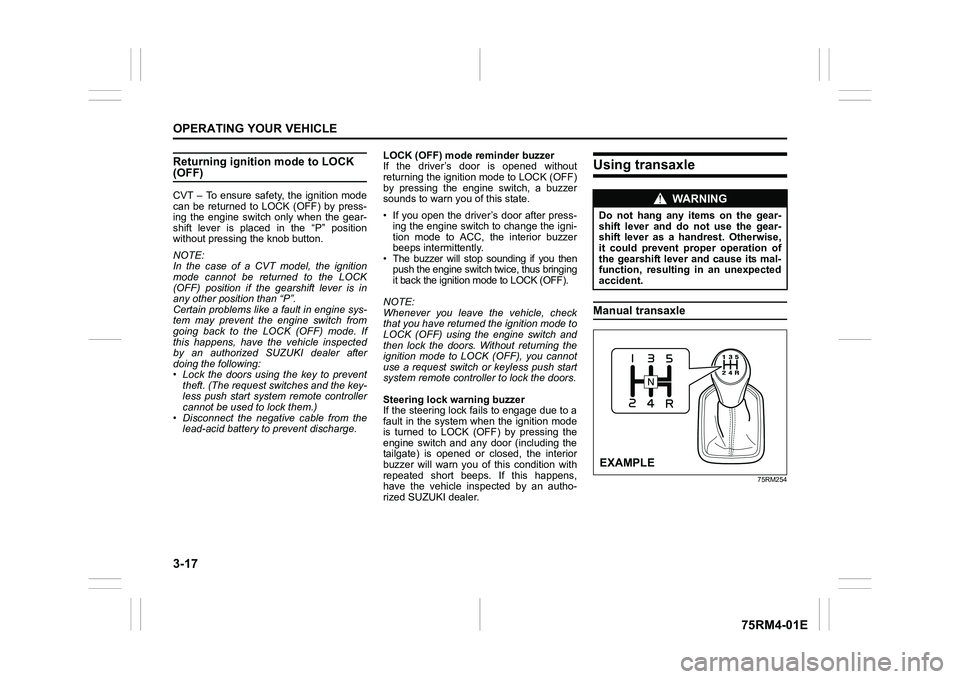
Using transaxleManual transaxle
75RM254
WA R N I N G
Do not hang any items on the gear-
shift lever and do not use the gear-
shift lever as a handrest. Otherwise,
it could prevent proper operation of
the gearshift lever and cause its mal-
function, resulting in an unexpected
accident.EXAMPLE
Page 190 of 505
3-37OPERATING YOUR VEHICLE
75RM4-01E
• The audio and other electrical compo-nent can be used during the automatic
engine stop, but the air conditioner will
switch to the fan mode.
• If the vehicle is equipped with the auto- matic heating and air conditioning sys-
tem, the fan speed will be limited during
the automatic engine stop (only in the
auto control mode) to keep the cabin air-
conditioned for a longer time.
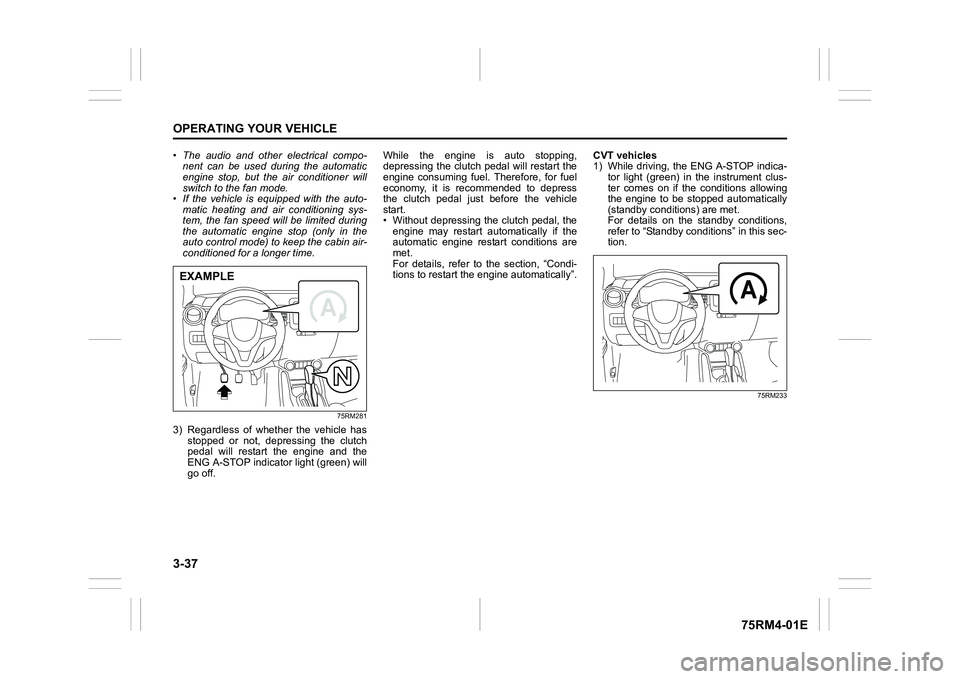
75RM281
3) Regardless of whether the vehicle has
stopped or not, depressing the clutch
pedal will restart the engine and the
ENG A-STOP indicator light (green) will
go off. While the engine is auto stopping,
depressing the clutch pedal will restart the
engine consuming fuel. Therefore, for fuel
economy, it is recommended to depress
the clutch pedal just before the vehicle
start.
• Without depressing the clutch pedal, the
engine may restart automatically if the
automatic engine restart conditions are
met.
For details, refer to the section, “Condi-
tions to restart the engine automatically”. CVT vehicles
1) While driving, the ENG A-STOP indica-
tor light (green) in the instrument clus-
ter comes on if the conditions allowing
the engine to be stopped automatically
(standby conditions) are met.
For details on the standby conditions,
refer to “Standby conditions” in this sec-
tion.
75RM233
EXAMPLE