Engine power SUZUKI IGNIS 2022 Owner's Manual
[x] Cancel search | Manufacturer: SUZUKI, Model Year: 2022, Model line: IGNIS, Model: SUZUKI IGNIS 2022Pages: 505, PDF Size: 8.36 MB
Page 378 of 505
7-29INSPECTION AND MAINTENANCE
75RM4-01E
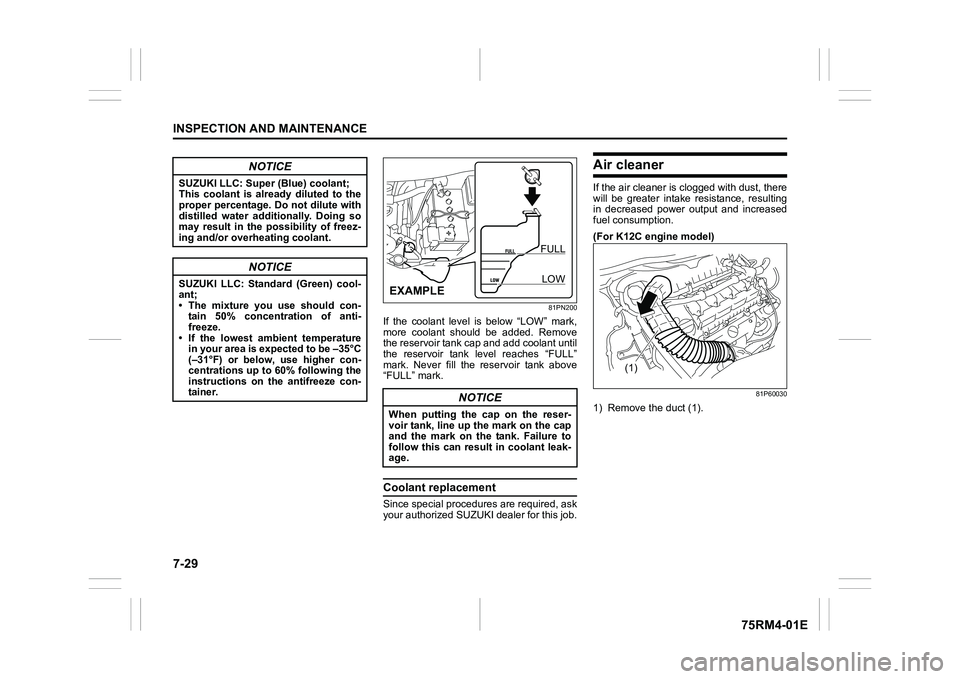
81PN200
If the coolant level is below “LOW” mark,
more coolant should be added. Remove
the reservoir tank cap and add coolant until
the reservoir tank level reaches “FULL”
mark. Never fill the reservoir tank above
“FULL” mark.Coolant replacementSince special procedures are required, ask
your authorized SUZUKI dealer for this job.
Air cleanerIf the air cleaner is clogged with dust, there
will be greater intake resistance, resulting
in decreased power output and increased
fuel consumption.
(For K12C engine model)
81P60030
1) Remove the duct (1).
NOTICE
SUZUKI LLC: Super (Blue) coolant;
This coolant is already diluted to the
proper percentage. Do not dilute with
distilled water additionally. Doing so
may result in the possibility of freez-
ing and/or overheating coolant.
NOTICE
SUZUKI LLC: Standard (Green) cool-
ant;
• The mixture you use should con-tain 50% concentration of anti-
freeze.
• If the lowest ambient temperature in your area is expected to be –35°C
(–31°F) or below, use higher con-
centrations up to 60% following the
instructions on the antifreeze con-
tainer.
NOTICE
When putting the cap on the reser-
voir tank, line up the mark on the cap
and the mark on the tank. Failure to
follow this can result in coolant leak-
age.
FULL
LOW
(ΟΝ03/(
(1)
Page 394 of 505
7-45INSPECTION AND MAINTENANCE
75RM4-01E
Lithium-ion battery (if equipped)This battery is installed only in models
equipped with the ENG A-STOP system
and is located under the front passenger’s
seat.
• The lithium-ion battery is maintenance-free. However, in order to avoid a flat
battery, drive the vehicle once a month
for at least 30 minutes to recharge the
battery.
• When replacing or disposing of the lith- ium-ion battery, consult your authorized
SUZUKI dealer.
FusesYour vehicle has three types of fuses, as
described below:
Main fuse
The main fuse takes current directly from
the lead-acid battery.
Primary fuses
These fuses are between the main fuse
and individual fuses, and are for electrical
load groups.
Individual fuses
These fuses are for indi vidual electrical cir-
cuits.
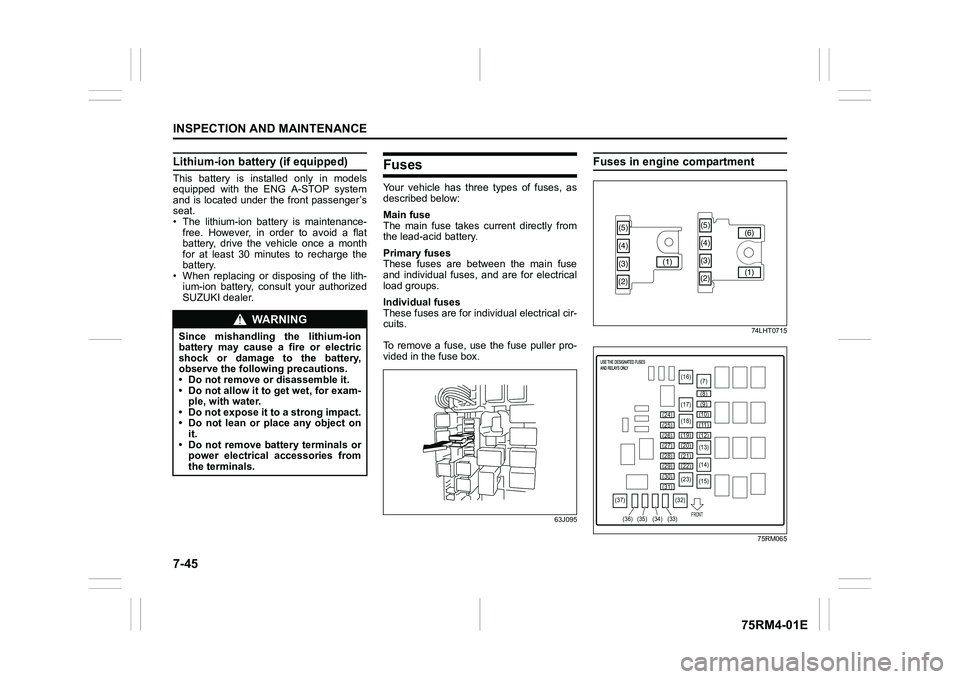
To remove a fuse, use the fuse puller pro-
vided in the fuse box.
63J095
Fuses in engine compartment
74LHT0715
75RM065
WA R N I N G
Since mishandling the lithium-ion
battery may cause a fire or electric
shock or damage to the battery,
observe the following precautions.
• Do not remove or disassemble it.
• Do not allow it to get wet, for exam- ple, with water.
• Do not expose it to a strong impact.
• Do not lean or place any object on it.
• Do not remove battery terminals or power electrical accessories from
the terminals.
(5)
(3)
(4)
(2) (1)(5)
(4)
(3)
(2) (1)
(6)
(7)
(16)
(17)
(18)
(19)
(20)
(21)
(22)
(23)
(25)
(24)
(26)
(29)
(27)
(28)
(30)
(31)
(32)
(37)
(33)
(34)
(35)
(36) (8)
(9)
(10)
(11)
(12)
(13)
(14)
(15)FRONT
Page 395 of 505
7-46
INSPECTION AND MAINTENANCE
75RM4-01E
*1: Models with ENG A-STOP
*2: CVT models with ENG A-STOP
*3: Auto Gear Shift models
*4: Models with Auto-on headlight system
*5: Models with front fog light The main fuse, primary fuses and some of
the individual fuses are located in the
engine compartment. If the main fuse
blows, no electrical component will func-
tion. If a primary fuse blows, no electrical
component in the corresponding load
group will function. When replacing the
main fuse, a primary fuse or an individual
fuse, use a genuine S
UZUKI replacement.
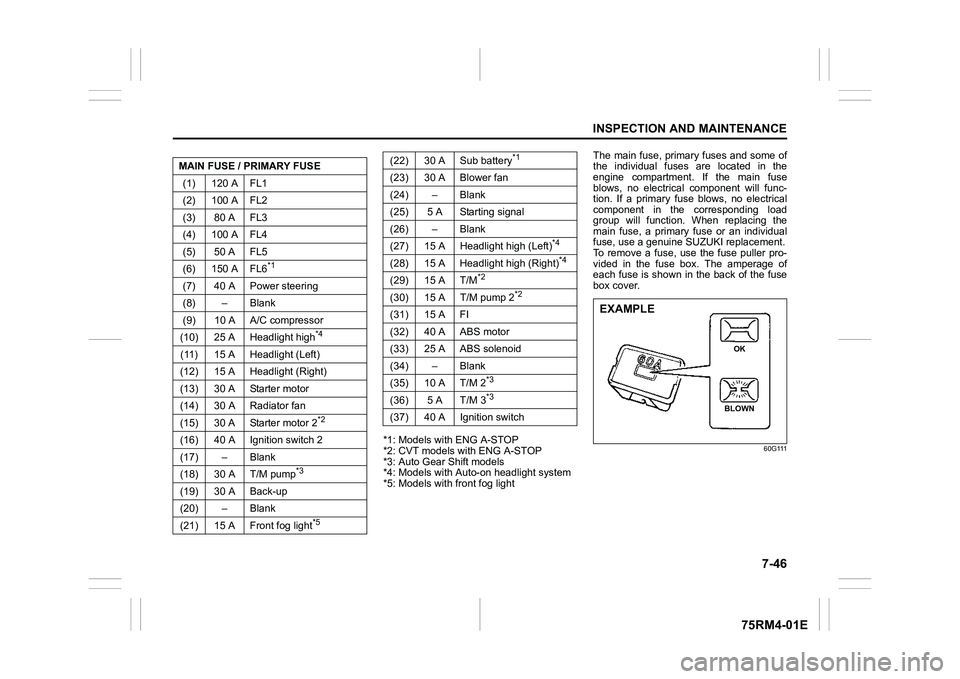
To remove a fuse, use the fuse puller pro-
vided in the fuse box. The amperage of
each fuse is shown in the back of the fuse
box cover.
60G111
MAIN FUSE / PRIMARY FUSE
(1) 120 A FL1
(2) 100 A FL2
(3) 80 A FL3
(4) 100 A FL4
(5) 50 A FL5
(6) 150 A FL6
*1
(7) 40 A Power steering
(8) – Blank
(9) 10 A A/C compressor
(10) 25 A Headlight high
*4
(11) 15 A Headlight (Left)
(12) 15 A Headlight (Right)
(13) 30 A Starter motor
(14) 30 A Radiator fan
(15) 30 A Starter motor 2
*2
(16) 40 A Ignition switch 2
(17) – Blank
(18) 30 A T/M pump
*3
(19) 30 A Back-up
(20) – Blank
(21) 15 A Front fog light
*5
(22) 30 A Sub battery
*1
(23) 30 A Blower fan
(24) – Blank
(25) 5 A Starting signal
(26) – Blank
(27) 15 A Headlight high (Left)
*4
(28) 15 A Headlight high (Right)
*4
(29) 15 A T/M
*2
(30) 15 A T/M pump 2
*2
(31) 15 A FI
(32) 40 A ABS motor
(33) 25 A ABS solenoid
(34) – Blank
(35) 10 A T/M 2
*3
(36) 5 A T/M 3
*3
(37) 40 A Ignition switch
EXAMPLE
BLOWN OK
Page 417 of 505
8-8
EMERGENCY SERVICE
75RM4-01E
81PN248
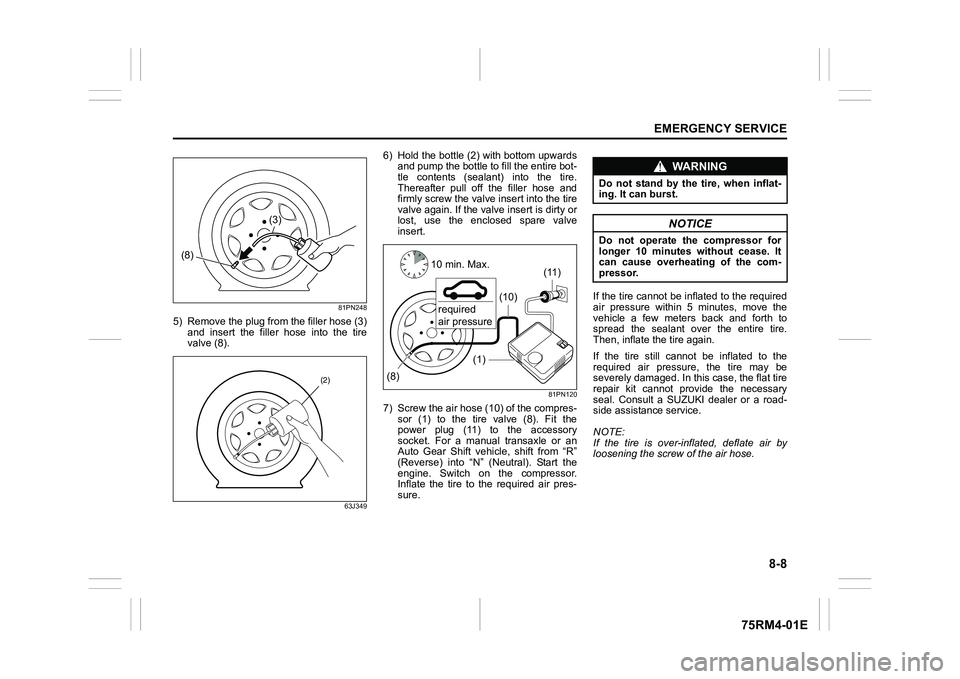
5) Remove the plug from the filler hose (3)and insert the filler hose into the tire
valve (8).
63J349
6) Hold the bottle (2) with bottom upwardsand pump the bottle to fill the entire bot-
tle contents (sealant) into the tire.
Thereafter pull off the filler hose and
firmly screw the valve insert into the tire
valve again. If the valve insert is dirty or
lost, use the enclosed spare valve
insert.
81PN120
7) Screw the air hose (10) of the compres- sor (1) to the tire valve (8). Fit the
power plug (11) to the accessory
socket. For a manual transaxle or an
Auto Gear Shift vehicle, shift from “R”
(Reverse) into “N” (Neutral). Start the
engine. Switch on the compressor.
Inflate the tire to the required air pres-
sure. If the tire cannot be inflated to the required
air pressure within 5 minutes, move the
vehicle a few meters back and forth to
spread the sealant over the entire tire.
Then, inflate the tire again.
If the tire still cannot be inflated to the
required air pressure, the tire may be
severely damaged. In this case, the flat tire
repair kit cannot provide the necessary
seal. Consult a SUZUKI dealer or a road-
side assistance service.
NOTE:
If the tire is over-inflated, deflate air by
loosening the screw of the air hose.
(3)
(8)
(2)
(1)
(8) (11)
(10)
10 min. Max.required
air pressure
WA R N I N G
Do not stand by the tire, when inflat-
ing. It can burst.
NOTICE
Do not operate the compressor for
longer 10 minutes without cease. It
can cause overheating of the com-
pressor.
Page 419 of 505
8-10
EMERGENCY SERVICE
75RM4-01E
Using compressor to inflate a tire1) Place the vehicle on level, hard ground.
Set the parking brake firmly and shift
into “P” (Park) if your vehicle has a
CVT, or shift into “R” (Reverse) if your
vehicle has a manual transaxle or Auto
Gear Shift.
2) Take out the compressor.
3) Unscrew the valve cap from the tire valve.
4) Connect the air ho se of the compressor
to the tire valve.
5) Connect the power plug of the com- pressor to the accessory socket. For a
manual transaxle or an Auto Gear Shift
vehicle, shift from “R” (Reverse) into “N”
(Neutral). Start the engine. Switch on
the compressor. Inflate the tire to the
required air pressure.
Jump-starting instructions
1) Use only a 12-volt lead-acid battery to
jump-start your vehicle. Position the
good 12-volt lead-acid battery close to
your vehicle so that the jump leads will
reach both batteries. When using a bat-
tery installed on another vehicle, check
that two vehicles do not touch each
other. Set the parking brakes fully on
both vehicles.
2) Turn off all vehicle accessories, except those necessary for safety reasons (for
example, headlights or hazard lights).
NOTICE
Do not operate the compressor for
longer than 10 minutes. It can cause
overheating of the compressor.
WA R N I N G
• Never attempt to jump-start your
vehicle if the lead-acid battery
appears to be frozen. Batteries in
this condition may explode.
• When making jump lead connec- tions, check that your hands and
the jump leads remain clear from
pulleys, belts or fans.
• Lead-acid batteries produce flam-
mable hydrogen gas. Keep flames
and sparks away from the battery
or an explosion may occur. Never
smoke when working near the bat-
tery.
• If the booster ba ttery you use for
jump-starting is installed in another
vehicle, check that the two vehicles
are not touching each other.
• If your lead-acid battery discharges repeatedly, for no apparent reason,
have your vehicle inspected by an
authorized SUZUKI dealer.
• To avoid harm to yourself or dam- age to your vehicle or battery, fol-
low the jump-starting instructions
below.
If you are in doubt, call for qualified
road service.
NOTICE
Your vehicle should not be started by
pushing or towing. This starting
method could result in permanent
damage to the catalytic converter.
Use jump leads to start a vehicle with
a weak or flat battery.
Page 450 of 505
13-2INDEX
75RM4-01E
Compact spare tire .............................................................. 7-41
Continuously variable transaxle (CVT) .......................... .... 3-19
Continuously variable transaxle (CVT) fluid .................... .7-32
Coolant level check ............................................ ................. 7-28
Coolant replacement ............................................ ............... 7-29
Corrosion prevention .......... .................................................. 9-1
Cruise control ................................................. ..................... 3-48
Cruise indicator light ......................................... ................ 2-115
Cup holder and storage area . ............................................... 5-8DDaily inspection checklist ..................................... ................ 3-1
Daytime running light .......................................... ................ 7-51
Daytime running light (D.R.L.) system.......................... ... 2-118
Dead lock system ............................................... ................... 2-4
Deceleration energy regeneratin g indicator light ........... 2-114
Depress brake pedal indicator .................................. ....... 2-115
Door locks ..................................................... ......................... 2-2
Drive belt ..................................................... ......................... 7-23
Drive mode indicator ........................................... ................ 2-78
Driver’s seat belt reminder light /
Front passenger’s seat belt remi nder light .....................2-106
Driving on hills ............................................... ........................ 4-3
Driving on slippery roads ...................................... ............... 4-4
Driving range.................................................. ............. 2-74, 2-94
Driving time ................................................... ....................... 2-74
Dual camera brake support ...................................... .......... 3-53
Dual camera brake support indicator light...................... 2-110
Dual camera brake support OFF indicator light ............. 2-110
Dual camera brake support OFF switch ........................... .3-61
Dual camera brake support warn ing light ....................... 2-116
EEco-Cool ....................................................... ........................ 3-48
Eco-driving display ............................................ .................. 2-79
Electric mirrors............................................... ...................... 2-24
Electric power steering ligh t ............................................. 2-109
Electric window controls ... .................................................. 2-20
Electronic stabi lity program (ESP
®) ................................... 3-78
Emergency locking retractor ( ELR) .................................... 2-35
Emergency stop signal (ESS) . ............................................ 3-71
Energy flow indicator.......................................... ........2-74, 3-46
ENG A-STOP indicator light ..................................... ......... 2-114
ENG A-STOP OFF light ........................................... ........... 2-114
ENG A-STOP OFF switch .......................................... .......... 3-45
ENG A-STOP system (e ngine auto stop start system) ..... 3-35
Engine coolant ................................................. .................... 7-28
Engine hood .................................................... ....................... 5-2
Engine oil and filter .......................................... .................... 7-23
Engine oil consumption ......................................... ............... 3-2
Engine serial number........................................... ................ 10-1
Engine switch .................................................. ....................... 3-5
Engine switch illumination ..................................... ............... 3-7
Engine trouble: Flooded engine ................................. ........ 8-13
Engine trouble: Overheating .................................... ........... 8-13
Engine trouble: Starter does not operate ....................... ... 8-13
ESP
® OFF indicator light ..........................................2 -105, 3-79
ESP® OFF switch .................................................... ............. 3-80
ESP® warning light ................................................. ..2-104, 3-79
Exhaust gas warning ............................................ ................. 3-1
FFlat tire repair kit .................................................................... 8-5
Floor mats ..................................................... ........................ 5-10