seat SUZUKI IGNIS 2022 Repair Manual
[x] Cancel search | Manufacturer: SUZUKI, Model Year: 2022, Model line: IGNIS, Model: SUZUKI IGNIS 2022Pages: 505, PDF Size: 8.36 MB
Page 394 of 505
7-45INSPECTION AND MAINTENANCE
75RM4-01E
Lithium-ion battery (if equipped)This battery is installed only in models
equipped with the ENG A-STOP system
and is located under the front passenger’s
seat.
• The lithium-ion battery is maintenance-free. However, in order to avoid a flat
battery, drive the vehicle once a month
for at least 30 minutes to recharge the
battery.
• When replacing or disposing of the lith- ium-ion battery, consult your authorized
SUZUKI dealer.
FusesYour vehicle has three types of fuses, as
described below:
Main fuse
The main fuse takes current directly from
the lead-acid battery.
Primary fuses
These fuses are between the main fuse
and individual fuses, and are for electrical
load groups.
Individual fuses
These fuses are for indi vidual electrical cir-
cuits.
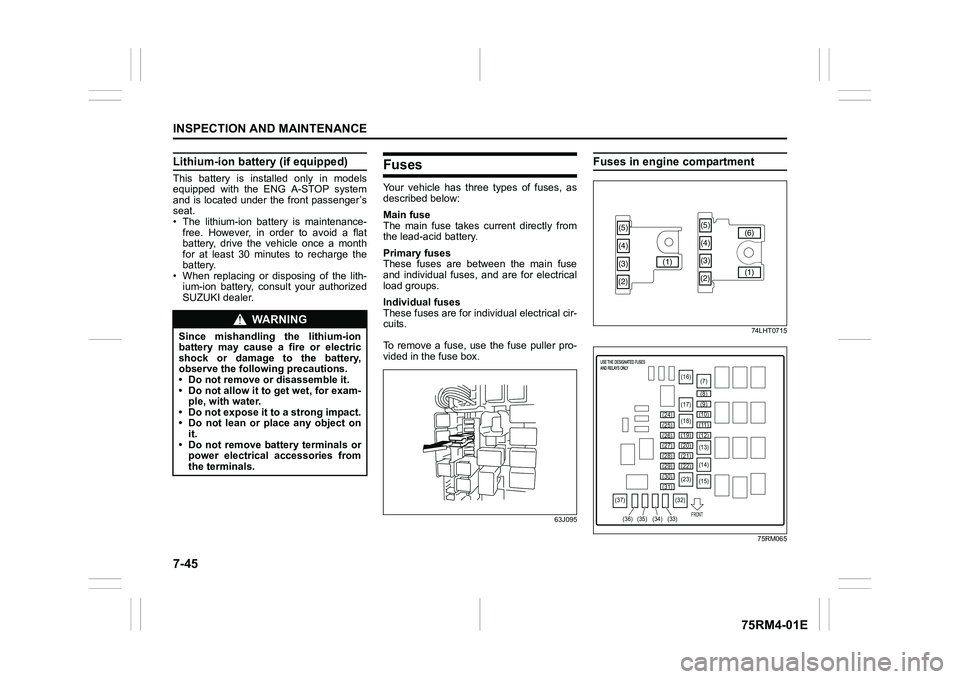
To remove a fuse, use the fuse puller pro-
vided in the fuse box.
63J095
Fuses in engine compartment
74LHT0715
75RM065
WA R N I N G
Since mishandling the lithium-ion
battery may cause a fire or electric
shock or damage to the battery,
observe the following precautions.
• Do not remove or disassemble it.
• Do not allow it to get wet, for exam- ple, with water.
• Do not expose it to a strong impact.
• Do not lean or place any object on it.
• Do not remove battery terminals or power electrical accessories from
the terminals.
(5)
(3)
(4)
(2) (1)(5)
(4)
(3)
(2) (1)
(6)
(7)
(16)
(17)
(18)
(19)
(20)
(21)
(22)
(23)
(25)
(24)
(26)
(29)
(27)
(28)
(30)
(31)
(32)
(37)
(33)
(34)
(35)
(36) (8)
(9)
(10)
(11)
(12)
(13)
(14)
(15)FRONT
Page 396 of 505
7-47INSPECTION AND MAINTENANCE
75RM4-01E
NOTE:
Check that the fuse box always carries
spare fuses.
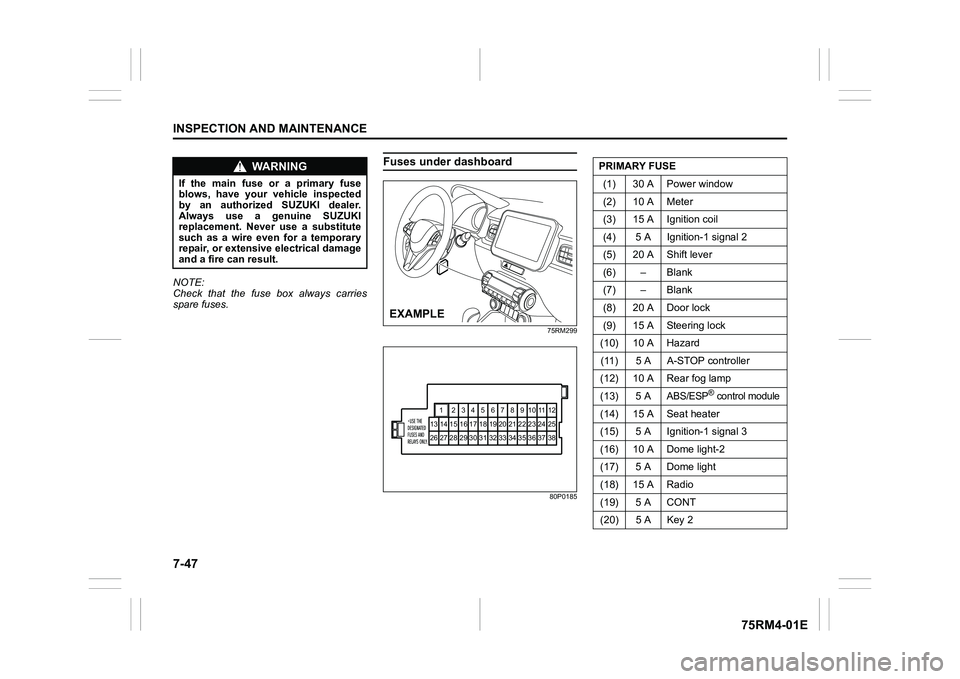
Fuses under dashboard
75RM299
80P0185
WA R N I N G
If the main fuse or a primary fuse
blows, have your vehicle inspected
by an authorized SUZUKI dealer.
Always use a genuine SUZUKI
replacement. Never use a substitute
such as a wire even for a temporary
repair, or extensive electrical damage
and a fire can result.
EXAMPLE
12 15
28
14
27
13
26 3
16
29 4
17
30 5
18
31 6
19
32 7
20
33 8
21
34 9
22
35 10
23
36 11
24
37 12
25
38
35,0Ν5Υа)86(
(1) 30 A Power window
(2) 10 A Meter
(3) 15 A Ignition coil
(4) 5 A Ignition-1 signal 2
(5) 20 A Shift lever
(6) – Blank
(7) – Blank
(8) 20 A Door lock
(9) 15 A Steering lock
(10) 10 A Hazard (11) 5 A A-STOP controller
(12) 10 A Rear fog lamp
(13) 5 A
ABS/ESP
® control module
(14) 15 A Seat heater
(15) 5 A Ignition-1 signal 3
(16) 10 A Dome light-2
(17) 5 A Dome light
(18) 15 A Radio
(19) 5 A CONT
(20) 5 A Key 2
Page 413 of 505
8-4
EMERGENCY SERVICE
75RM4-01E
NOTE:
For more details, contact an authorized
SUZUKI dealer.Changing wheelsTo change a wheel, use the following pro-
cedure:
1) Remove the jack (if equipped), toolsand spare wheel from the vehicle.
2) Loosen, but do not remove the wheel
nuts.
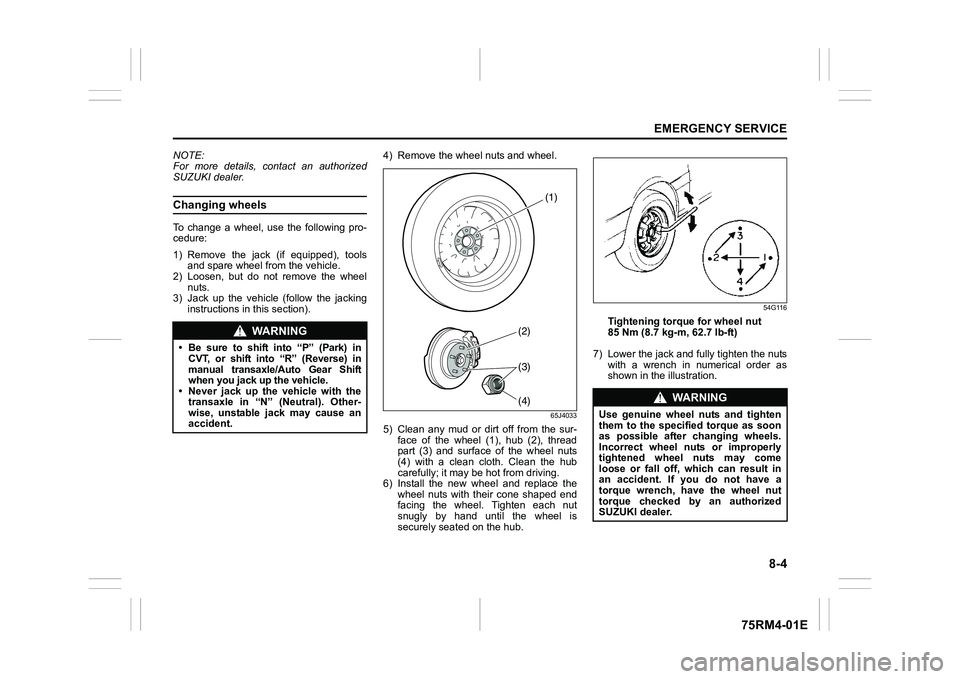
3) Jack up the vehicle (follow the jacking instructions in this section). 4) Remove the wheel nuts and wheel.
65J4033
5) Clean any mud or dirt off from the sur-
face of the wheel (1), hub (2), thread
part (3) and surface of the wheel nuts
(4) with a clean cloth. Clean the hub
carefully; it m ay be hot from driving.
6) Install the new wheel and replace the
wheel nuts with their cone shaped end
facing the wheel. Tighten each nut
snugly by hand until the wheel is
securely seated on the hub.
54G116
Tightening torque for wheel nut
85 Nm (8.7 kg-m, 62.7 lb-ft)
7) Lower the jack and fully tighten the nuts with a wrench in numerical order as
shown in the illustration.
WA R N I N G
• Be sure to shift into “P” (Park) inCVT, or shift into “R” (Reverse) in
manual transaxle/Auto Gear Shift
when you jack up the vehicle.• Never jack up the vehicle with the
transaxle in “N” (Neutral). Other-
wise, unstable jack may cause an
accident.
(2)(4)
(1)
(3)
WA R N I N G
Use genuine wheel nuts and tighten
them to the specified torque as soon
as possible after changing wheels.
Incorrect wheel nut s or improperly
tightened wheel nuts may come
loose or fall off, which can result in
an accident. If you do not have a
torque wrench, have the wheel nut
torque checked by an authorized
SUZUKI dealer.
Page 415 of 505
8-6
EMERGENCY SERVICE
75RM4-01E
IMPORTANT
The flat tire repair kit cannot be used in
the following cases. Consult a SUZUKI
dealer or a roadside assistance service.
• Cuts or piercing in the tire treadlarger than approx. 4 mm.
• Cuts in the tire side wall.
• Tire damage caused by driving with considerably reduced tire pressure or
even with deflated tire.
• The tire bead completely unseated outside of the rim.
• The rim damaged.
Small punctures in the tire tread,
caused by a nail or a screw, can be
sealed with the flat tire repair kit.
Do not remove nails or screws from the
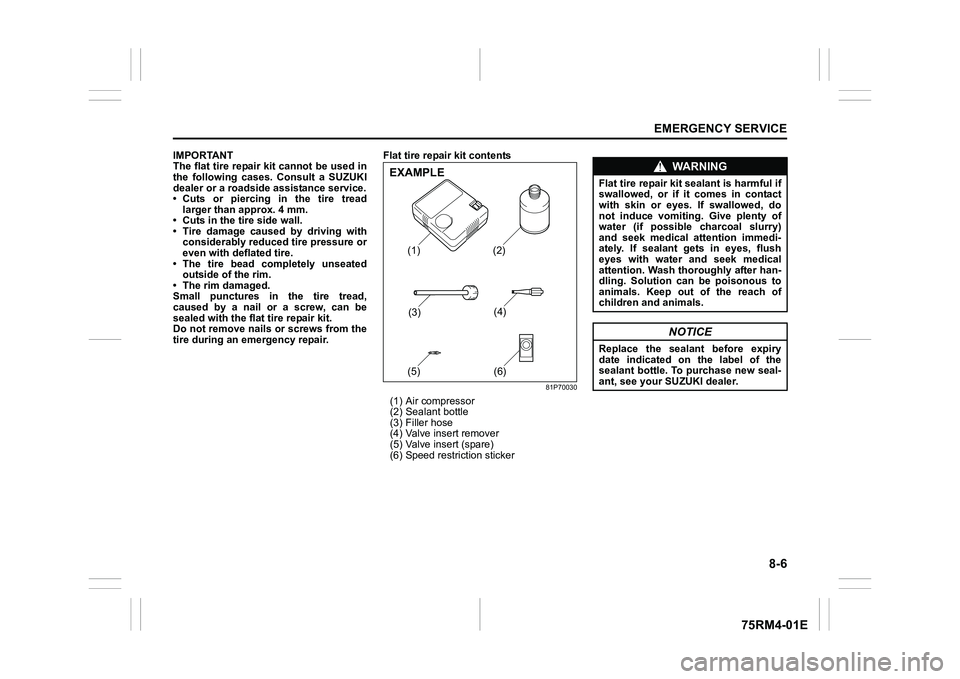
tire during an e mergency repair. Flat tire repair kit contents
81P70030
(1) Air compressor
(2) Sealant bottle
(3) Filler hose
(4) Valve insert remover
(5) Valve insert (spare)
(6) Speed restriction sticker
(1)(3)
(4)
(5)
(6)(2)
EXAMPLE
WA R N I N G
Flat tire repair kit sealant is harmful if
swallowed, or if it comes in contact
with skin or eyes. If swallowed, do
not induce vomiting. Give plenty of
water (if possible charcoal slurry)
and seek medical attention immedi-
ately. If sealant gets in eyes, flush
eyes with water and seek medical
attention. Wash thoroughly after han-
dling. Solution can be poisonous to
animals. Keep out of the reach of
children and animals.
NOTICE
Replace the sealant before expiry
date indicated on the label of the
sealant bottle. To purchase new seal-
ant, see your SUZUKI dealer.
Page 427 of 505
9-2
APPEARANCE CARE
75RM4-01E
are spilled or leaked, clean and dry the
area immediately.
Store your vehicle in a dry, well-venti-
lated area
Do not park your vehicle in a damp, poorly-
ventilated area. If you often wash your
vehicle in the garage and place it there in
wet condition, your garage may be damp.
The high humidity in the garage may
cause or accelerate corrosion. A wet vehi-
cle may corrode even in a heated garage if
the ventilation is poor.
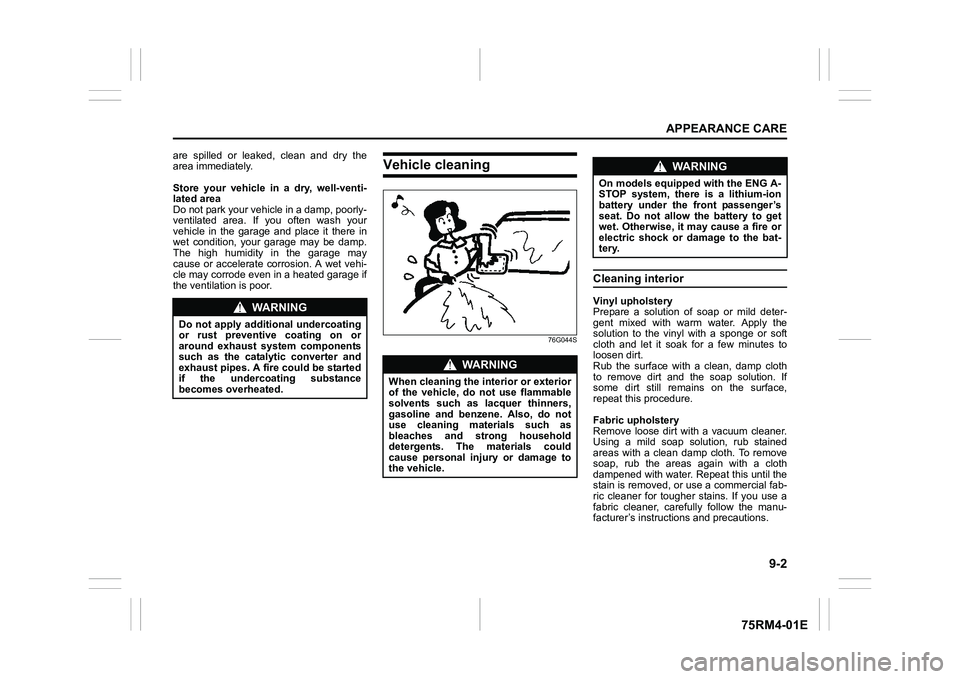
Vehicle cleaning
76G044S
Cleaning interiorVinyl upholstery
Prepare a solution of soap or mild deter-
gent mixed with warm water. Apply the
solution to the vinyl with a sponge or soft
cloth and let it soak for a few minutes to
loosen dirt.
Rub the surface with a clean, damp cloth
to remove dirt and the soap solution. If
some dirt still remains on the surface,
repeat this procedure.
Fabric upholstery
Remove loose dirt with a vacuum cleaner.
Using a mild soap solution, rub stained
areas with a clean damp cloth. To remove
soap, rub the areas again with a cloth
dampened with water. Repeat this until the
stain is removed, or use a commercial fab-
ric cleaner for tougher stains. If you use a
fabric cleaner, carefully follow the manu-
facturer’s instructions and precautions.
WA R N I N G
Do not apply additional undercoating
or rust preventive coating on or
around exhaust system components
such as the catalytic converter and
exhaust pipes. A fire could be started
if the undercoating substance
becomes overheated.
WA R N I N G
When cleaning the interior or exterior
of the vehicle, do not use flammable
solvents such as lacquer thinners,
gasoline and benzene. Also, do not
use cleaning materials such as
bleaches and strong household
detergents. The materials could
cause personal injury or damage to
the vehicle.
WA R N I N G
On models equipped with the ENG A-
STOP system, there is a lithium-ion
battery under the front passenger’s
seat. Do not allow the battery to get
wet. Otherwise, it may cause a fire or
electric shock or damage to the bat-
tery.
Page 428 of 505
9-3APPEARANCE CARE
75RM4-01E
Leather upholstery
Remove loose dirt with a vacuum cleaner.
Using a mild soap or saddle soap solution,
wipe dirt off with a clean damp soft cloth.
To remove soap, wipe the areas again with
a soft cloth dampened with water. Wipe the
areas dry with a soft dry cloth. Repeat this
until the dirt or stain is removed, or use a
commercial leather cleaner for tougher dirt
or stains. If you use a leather cleaner,
carefully follow the manufacturer’s instruc-
tions and precautions. Do not use solvent
type cleaners or abrasive cleaners.
NOTE:
• In order to keep leather upholstery look-ing good, it should be cleaned at least
twice a year.
• If leather upholstery becomes wet, immediately wipe it dry with tissue paper
or a soft cloth. Water may cause leather
to harden and shrink if it is not wiped off.
• When parking on sunny days, select a
shady place or use a sunshade. If
leather upholstery is exposed to direct
sunlight for a long time, it may discolor
and shrink.
• As is common with natural materials, leather is inherently irregular in grain and
cowhide has spots in its natural state.
These do not affect the performance of
the leather in any way. Seat belts
Clean seat belts with a mild soap and
water. Do not use bleach or dye on the
belts. They may weaken the fabric in the
belts.
Vinyl floor mats
Ordinary dirt can be removed from vinyl
with water or mild soap. Use a brush to
help loosen dirt. After the dirt is loosened,
rinse the mat thoroughly with water and
dry it in the shade.
Carpets
Remove dirt and soil as much as possible
with a vacuum cleaner. Using a mild soap
solution, rub stained areas with a clean
damp cloth. To remove soap, rub the areas
again with a cloth dampened with water.
Repeat this until the stain is removed, or
use a commercial carpet cleaner for
tougher stains. If you use a carpet cleaner,
carefully follow the manufacturer’s instruc-
tions and precautions.
Instrument panel and console
Remove loose dirt with a vacuum cleaner.
Gently wipe dirt off with a tightly squeezed
damp clean cloth. Repeat this until the dirt
is removed.
NOTICE
Do not use chemical products that
contain silicon to wipe electrical
components such as the air condi-
tioning system, audio, navigation
system, or other switches. These will
cause damage to the components.
NOTICE
• Liquid such as liquid aromatics,
soft drinks or juice may cause dis-
coloration, wrinkles, and cracking
to resin-based parts and textiles.
Immediately wipe it dry with tissue
paper or a soft cloth.
• Do not leave leather products with color, fur or vinyl products, etc. in
your vehicle for long periods. It
may cause discoloration or deterio-
ration of interior.
Page 440 of 505
12-1SUPPLEMENT
75RM4-01E
For AustraliaBuilt dateBuilt date is located on Vehicle Identifica-
tion plate.
“Built date” means – the calendar month
and the year in which the body shell and
power train sub-assemblies are conjoined
and the vehicle is driven or moved from the
production line.Temporary-use spare tire (compact spare tire)Temporary Spare Tires fitted to this vehicle
must have a maximum load rating of not
less than 775 kg, or a load index of “99”
and a speed category symbol of not less
than “M” (130 km/h).
Drive with caution when the Temporary-
Use Spare Unit is fitted. Reinstall standard
unit as soon as possible.
Child restraint
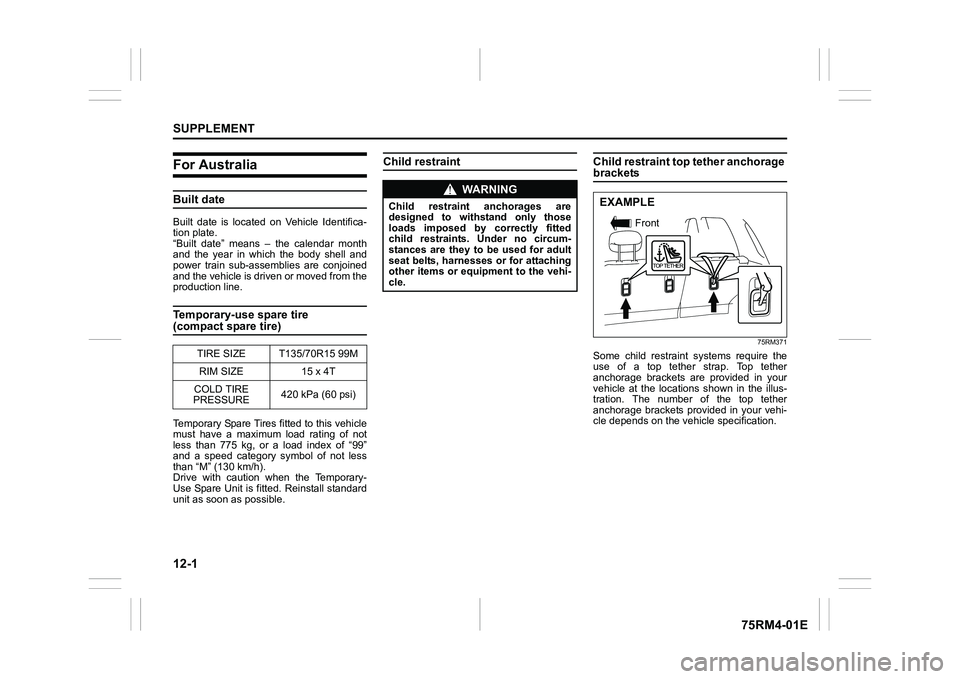
Child restraint top tether anchorage brackets
75RM371
Some child restraint systems require the
use of a top tether strap. Top tether
anchorage brackets are provided in your
vehicle at the locations shown in the illus-
tration. The number of the top tether
anchorage brackets provided in your vehi-
cle depends on the v ehicle specification.
TIRE SIZE T135/70R15 99M
RIM SIZE 15 x 4T
COLD TIRE
PRESSURE 420 kPa (60 psi)
WA R N I N G
Child restraint anchorages are
designed to withstand only those
loads imposed by correctly fitted
child restraints. Under no circum-
stances are they to be used for adult
seat belts, harnesses or for attaching
other items or equipment to the vehi-
cle.
EXAMPLE
Front
Page 441 of 505
12-2
SUPPLEMENT
75RM4-01E
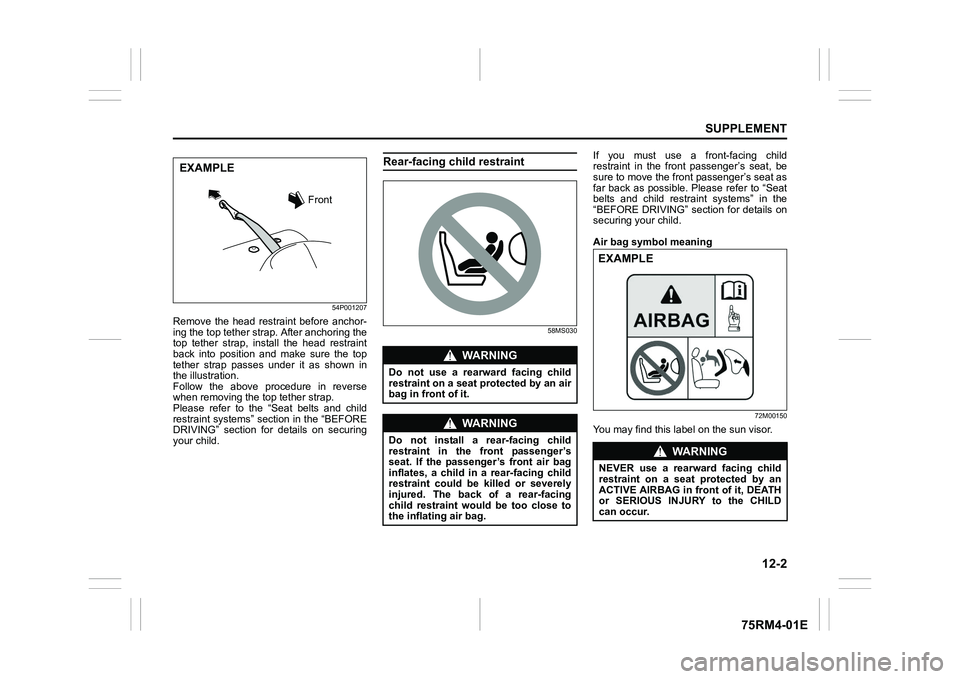
54P001207
Remove the head restraint before anchor-
ing the top tether strap. After anchoring the
top tether strap, install the head restraint
back into position and make sure the top
tether strap passes under it as shown in
the illustration.
Follow the above procedure in reverse
when removing the top tether strap.
Please refer to the “Seat belts and child
restraint systems” section in the “BEFORE
DRIVING” section for details on securing
your child.
Rear-facing child restraint
58MS030
If you must use a front-facing child
restraint in the front passenger’s seat, be
sure to move the front passenger’s seat as
far back as possible. Please refer to “Seat
belts and child restraint systems” in the
“BEFORE DRIVING” section for details on
securing your child.
Air bag symbol meaning
72M00150
You may find this label on the sun visor.
Front
EXAMPLE
WA R N I N G
Do not use a rearward facing child
restraint on a seat protected by an air
bag in front of it.
WA R N I N G
Do not install a rear-facing child
restraint in the front passenger’s
seat. If the passenger’s front air bag
inflates, a child in a rear-facing child
restraint could be killed or severely
injured. The back of a rear-facing
child restraint would be too close to
the inflating air bag.
WA R N I N G
NEVER use a rearward facing child
restraint on a seat protected by an
ACTIVE AIRBAG in front of it, DEATH
or SERIOUS INJURY to the CHILD
can occur.EXAMPLE
Page 442 of 505
12-3SUPPLEMENT
75RM4-01E
Seat belt warningFollow this warning as well as the instruc-
tion for seat belt in this book.In the case where a “Seat Belt Assembly”
incorporates an “ Automatic Length Adjust-
ing and Locking Retractor ” or an “Emer-
gency Locking Retractor ”.
For GCC countriesTechnical data
1.2L
Max power : 61kW/6000 rpm
Max torque : 113Nm/4200 rpm
Max speed : 170km/h (2WD M/T)
160km/h (2WD CVT)
WA R N I N G
Seat belts are designed to bear upon
the bony structure of the body, and
should be worn low across the front
of the pelvis or the pelvis, chest and
shoulders, as applicable; wearing the
lap section of the belt across the
abdominal area must be avoided.
• Seat belts should be adjusted as
firmly as possible, consistent with
comfort, to provide the protection
for which they have been designed.
A slack belt will greatly reduce the
protection afforded to the wearer.
• Care should be taken to avoid con-
tamination of the webbing with pol-
ishes, oils and chemicals, and
particularly battery acid. Cleaning
may safely be carried out using
mild soap and water. The belt
should be replaced if webbing
becomes frayed, contaminated or
damaged. (Continued)
WA R N I N G
(Continued)
• It is essential to replace the entire
assembly after it has been worn in
a severe impact even if damage to
the assembly is not obvious.
• Belts should not be worn with straps twisted.
• Each belt assembly must only be
used by one occupant; it is danger-
ous to put a belt around a child
being carried on the occupant’s
lap.
WA R N I N G
• No modifications or additionsshould be made by the user which
will either prevent the seat belt
adjusting devices from operating to
remove slack, or prevent the seat
belt assembly from being adjusted
to remove slack.
• Referring to the SEAT BELT instruction in this book, adjust the
seat belt so that the lap and sash
portions of the Seat Belt Assembly
fit as firmly as possible consistent
with comfort.
Page 446 of 505
12-7SUPPLEMENT
75RM4-01E
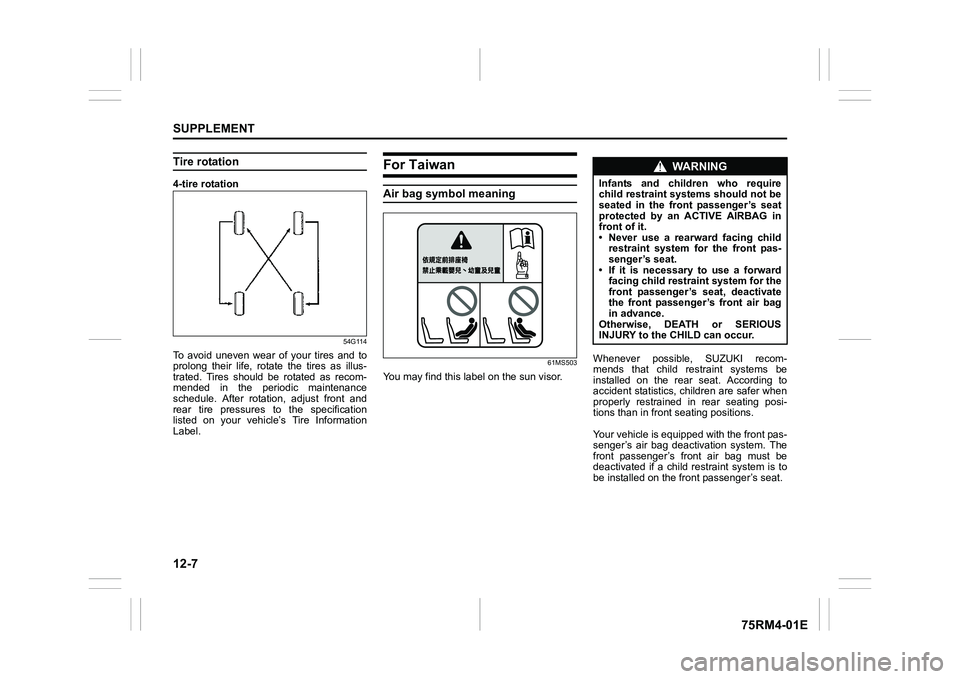
Tire rotation4-tire rotation
54G114
To avoid uneven wear of your tires and to
prolong their life, rotate the tires as illus-
trated. Tires should be rotated as recom-
mended in the periodic maintenance
schedule. After rotation, adjust front and
rear tire pressures to the specification
listed on your vehicle’s Tire Information
Label.
For TaiwanAir bag symbol meaning
61MS503
You may find this label on the sun visor.Whenever possible, SUZUKI recom-
mends that child restraint systems be
installed on the rear seat. According to
accident statistics, children are safer when
properly restrained in rear seating posi-
tions than in front seating positions.
Your vehicle is equipped with the front pas-
senger’s air bag deactivation system. The
front passenger’s front air bag must be
deactivated if a child restraint system is to
be installed on the fr
ont passenger’s seat.
WA R N I N G
Infants and children who require
child restraint systems should not be
seated in the front passenger’s seat
protected by an ACTIVE AIRBAG in
front of it.
• Never use a rearward facing child
restraint system for the front pas-
senger’s seat.
• If it is necessary to use a forward facing child restraint system for the
front passenger’s seat, deactivate
the front passenger’s front air bag
in advance.
Otherwise, DEATH or SERIOUS
INJURY to the CHILD can occur.