seat SUZUKI IGNIS 2022 Workshop Manual
[x] Cancel search | Manufacturer: SUZUKI, Model Year: 2022, Model line: IGNIS, Model: SUZUKI IGNIS 2022Pages: 505, PDF Size: 8.36 MB
Page 206 of 505
3-53OPERATING YOUR VEHICLE
75RM4-01E
Canceling speed limiter• To cancel the speed limiter, push “CAN-CEL” switch (2). The set indicator (5) will
go off.
• To resume the previously set speed, push up the “RES +/SET –” switch (3)
and turn on the set indicator (5).
To turn off the speed limiter system, push
“LIMIT” switch (1) and check that limit indi-
cator (4) is off.
Also, you can turn off the speed limiter by
turning off the engine.
NOTE:
If you turn off the speed limiter system, the
previously set speed in the memory is
cleared. Set your speed again.
Dual camera brake support (if equipped)Dual camera brake support is a system
that detects obstacles or partition lines in
front of your vehicle by the stereo camera,
attempts to avoid a crash by giving warn-
ing to the driver, and attempts to reduce
damage in the event of a crash. NOTE:
• While the system is working, if a vehicle
in front of you moves outside of the ste-
reo camera’s detection field or the vehi-
cle can no longer be detected, the
system may stop functioning.
• While the system is working, a braking sound may be heard even if you do not
depress the brake pedal, but this is nor-
mal.
WA R N I N G
• Dual camera brake support has lim-its and may not function properly
depending on the driving condi-
tions. Do not rely excessively on
the system and always drive in a
safe manner.
• For safety reasons, do not check the operation of the system by
yourself.
• Check that all passengers fasten their seat belts when the vehicle is
being operated.
When the system is activated, there
is a risk of serious injury from
being thrown.
Page 221 of 505
3-68
OPERATING YOUR VEHICLE
75RM4-01E
72M20405
• When your vehicle is weighed down byheavy items in the luggage compartment
or rear seat
• When the tires are not inflated to the rec- ommended tire inflation pressure or the
tires are worn
• With tire chains or non-specified sized
tires equipped
• When you have a temporarily repaired flat tire
• With a modified suspension equipped
• When passing through the entrance or exit of the tunnel and the brightness is
changed extremely
• When driving without lighting the head- lights at night or in tunnels
• When driving on a steep slope or sharp curves
• When the optical axis of the headlight is
deviated
• With modified headlights and/or front fog lights equipped
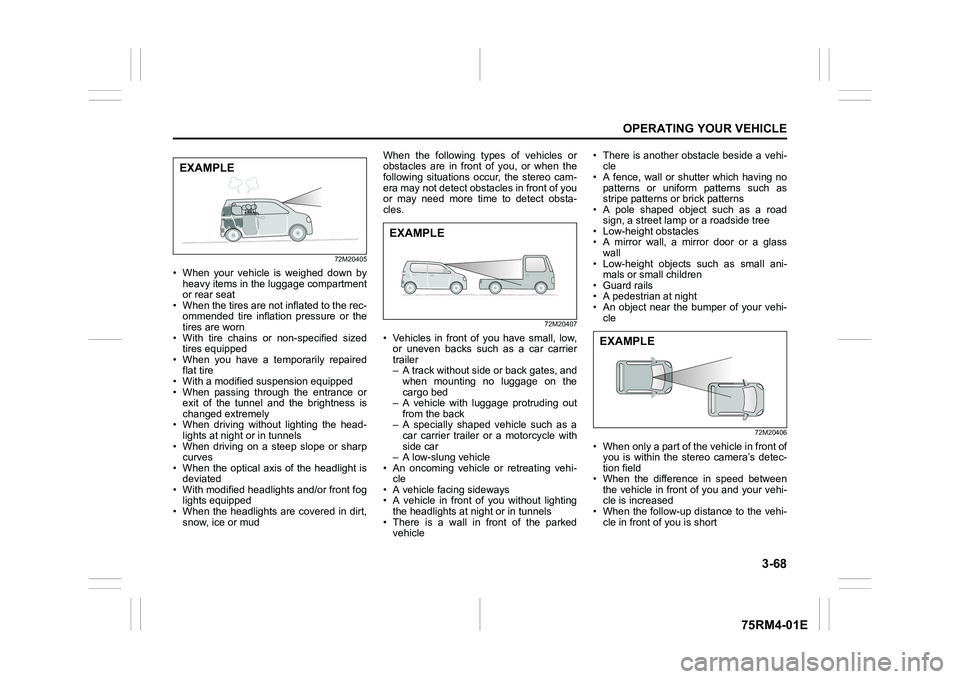
• When the headlights are covered in dirt, snow, ice or mud When the following types of vehicles or
obstacles are in front of you, or when the
following situations occur, the stereo cam-
era may not detect obstacles in front of you
or may need more time to detect obsta-
cles.
72M20407
• Vehicles in front of you have small, low,
or uneven backs such as a car carrier
trailer
– A track without side or back gates, andwhen mounting no luggage on the
cargo bed
– A vehicle with luggage protruding out
from the back
– A specially shaped vehicle such as a car carrier trailer or a motorcycle with
side car
– A low-slung vehicle
• An oncoming vehicle or retreating vehi-
cle
• A vehicle facing sideways
• A vehicle in front of you without lighting
the headlights at n ight or in tunnels
• There is a wall in front of the parked vehicle • There is another obstacle beside a vehi-
cle
• A fence, wall or shutter which having no
patterns or uniform patterns such as
stripe patterns or brick patterns
• A pole shaped object such as a road
sign, a street lamp or a roadside tree
• Low-height obstacles
• A mirror wall, a mirror door or a glass
wall
• Low-height objects such as small ani- mals or small children
• Guard rails
• A pedestrian at night
• An object near the bumper of your vehi- cle
72M20406
• When only a part of the vehicle in front ofyou is within the stereo camera’s detec-
tion field
• When the difference in speed between the vehicle in front of you and your vehi-
cle is increased
• When the follow-up distance to the vehi- cle in front of you is short
EXAMPLE
EXAMPLE
EXAMPLE
Page 248 of 505
4-1DRIVING TIPS
75RM4-01E
52D078S
Running-in
Catalytic converter
80G106
The purpose of the catalytic converter is to
minimize the amount of harmful pollutants
in your vehicle’s exhaust. Use of leaded
fuel in vehicles equipped with catalytic
converters is prohibited, because lead
deactivates the pollutant-reducing compo-
nents of the catalyst system.
The converter is designed to last the life of
the vehicle under normal usage and when
unleaded fuel is used. No special mainte-
nance is required on the converter. How-
ever, it is very important to keep the engine
properly tuned. Engine misfiring, which can
result from an improperly tuned engine,
may cause overheating of the catalytic
converter. This may result in permanent
WA R N I N G
• Fasten your seat belts at all times.Even though air bags are equipped
at the front seating positions, the
driver and all passengers should
be properly restrained at all times,
using the seat belts provided. Refer
to “Seat belts and child restraint
systems” section for instructions
on proper use of the seat belts.
• Never drive under the influence of
alcohol or other drugs. Alcohol and
drugs can seriously impair your
ability to drive safely, greatly
increasing the risk of injury to
yourself and others. You should
also avoid driving when you are
tired, sick, irritated or under stress.
NOTICE
The future performance and reliabil-
ity of the engine depends on the care
and restraint exercised during its
early life. It is especially important to
observe the following precautions
during the first 960 km (600 miles) of
vehicle operation.
•After starting, do not race theengine. Warm it up gradually.
• Avoid prolonged vehicle operation at a constant speed. Moving parts
will break in better if you vary your
speed.
• Start off from a stop slowly. Avoid full throttle starts.
• Avoid hard braking, especially during the first 320 km (200 miles)
of driving.
• Do not drive slowly with the trans- axle in a high gear.
• Drive the vehicle at moderate
engine speeds.
• Do not tow a trailer during the first 960 km (600 miles) of vehicle oper-
ation.
Page 256 of 505
5-1OTHER CONTROLS AND EQUIPMENT
75RM4-01E
Fuel filler cap
75RM169
75RM130
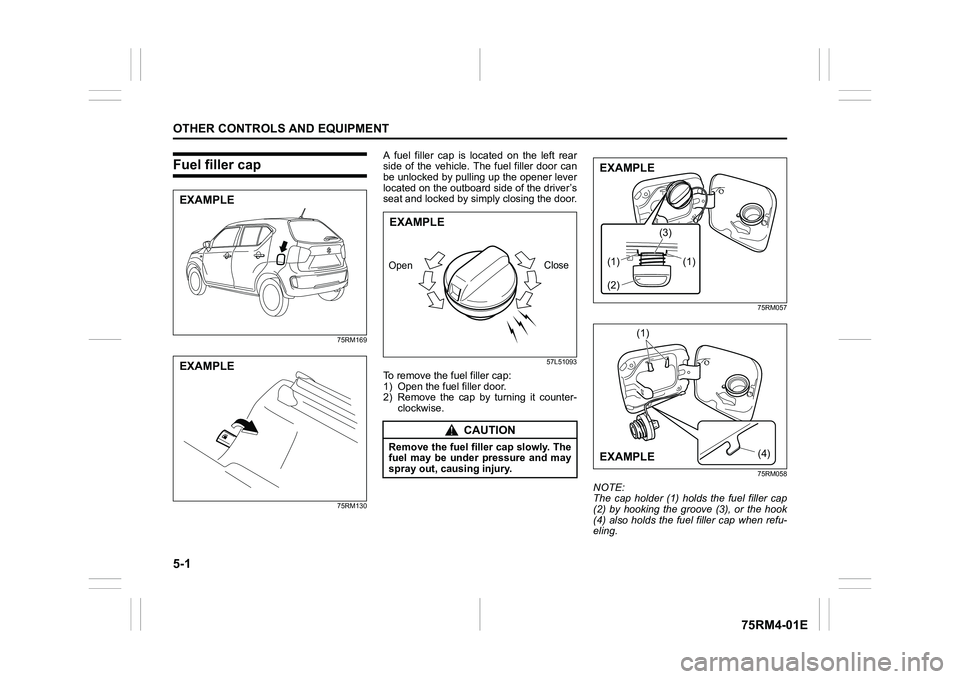
A fuel filler cap is located on the left rear
side of the vehicle. The fuel filler door can
be unlocked by pulling up the opener lever
located on the outboard side of the driver’s
seat and locked by simply closing the door.
57L51093
To remove the fuel filler cap:
1) Open the fuel filler door.
2) Remove the cap by turning it counter-
clockwise.
75RM057
75RM058
NOTE:
The cap holder (1) holds the fuel filler cap
(2) by hooking the groove (3), or the hook
(4) also holds the fuel filler cap when refu-
eling.
EXAMPLEEXAMPLE
CAUTION
Remove the fuel filler cap slowly. The
fuel may be under pressure and may
spray out, causing injury.Open CloseEXAMPLE
(1)(2)
(3)
(1)
(ΟΝ03/(
(4)
(1)
(ΟΝ03/(
Page 263 of 505
5-8
OTHER CONTROLS AND EQUIPMENT
75RM4-01E
75RM138
There is a recess in the glove box.
WA R N I N G
Never drive with the glove box lid
open. It could cause injury if an acci-
dent occurs.
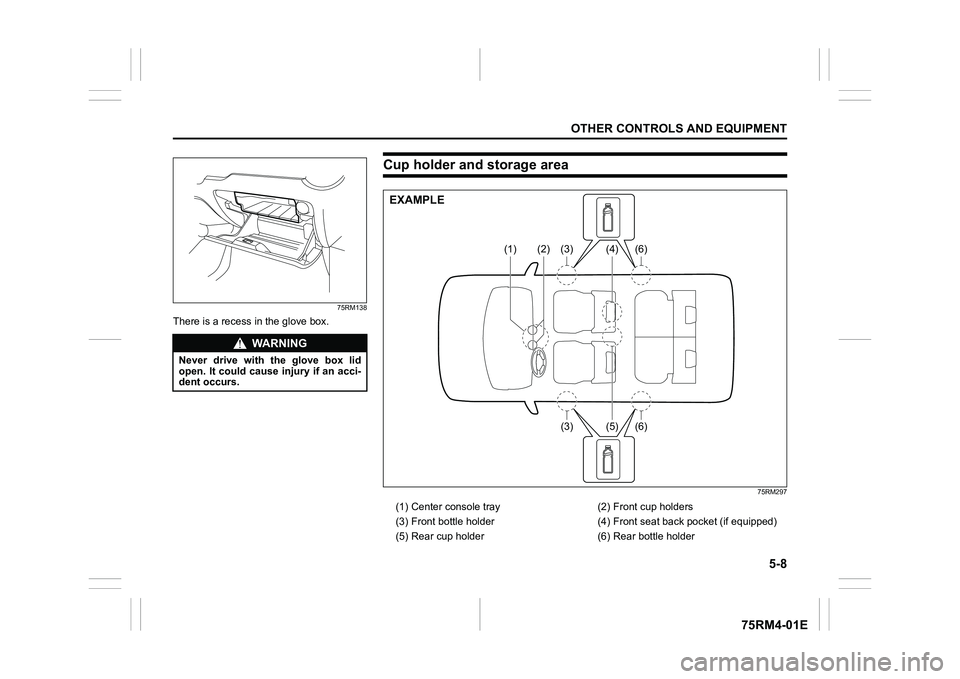
Cup holder and storage area
75RM297
(1) Center console tray (2) Front cup holders
(3) Front bottle holder (4) Front seat back pocket (if equipped)
(5) Rear cup holder (6) Rear bottle holder
(1) (2) (3)
(6)
(4)(6)
(5)
(3)
(4)(4)
EXAMPLE
Page 264 of 505
5-9OTHER CONTROLS AND EQUIPMENT
75RM4-01E
Center console tray (1)
Front cup holders (2) / Rear cup holder (5)Use the rear cup holder to put a cup with a
lid or a bottle with a cap. Also, you can put
small articles in the rear cup holder.
Front bottle holder (3) / Rear bottle holder (6)You should only place a bottle with a cap in
the holder.Front seat back pocket (4) (if equipped)
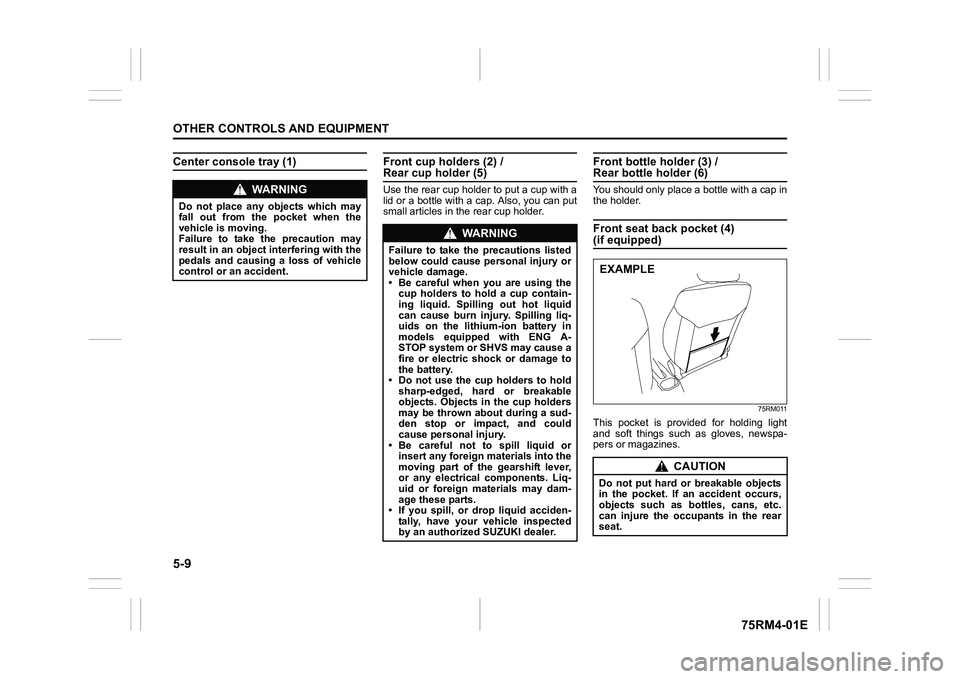
75RM011
This pocket is provided for holding light
and soft things such as gloves, newspa-
pers or magazines.
WA R N I N G
Do not place any objects which may
fall out from the pocket when the
vehicle is moving.
Failure to take the precaution may
result in an object interfering with the
pedals and causing a loss of vehicle
control or an accident.
WA R N I N G
Failure to take the precautions listed
below could cause personal injury or
vehicle damage.
• Be careful when you are using the
cup holders to hold a cup contain-
ing liquid. Spilling out hot liquid
can cause burn injury. Spilling liq-
uids on the lithium-ion battery in
models equipped with ENG A-
STOP system or SHVS may cause a
fire or electric shock or damage to
the battery.
• Do not use the cup holders to hold sharp-edged, hard or breakable
objects. Objects in the cup holders
may be thrown about during a sud-
den stop or impact, and could
cause personal injury.
• Be careful not to spill liquid or insert any foreign materials into the
moving part of the gearshift lever,
or any electrical components. Liq-
uid or foreign materials may dam-
age these parts.
• If you spill, or drop liquid acciden- tally, have your vehicle inspected
by an authorized SUZUKI dealer.
CAUTION
Do not put hard or breakable objects
in the pocket. If an accident occurs,
objects such as bottles, cans, etc.
can injure the occupants in the rear
seat.EXAMPLE
Page 342 of 505
6-1VEHICLE LOADING AND TOWING
75RM4-01E
Vehicle loadingYour vehicle was designed for specific
weight capacities. The weight capacities of
your vehicle are indicated by the Gross
Vehicle Weight Rating (GVWR) and the
Permissible maximum Axle Weight (PAW,
front and rear). The GVWR and PAW (front
and rear) are listed in the “SPECIFICA-
TIONS” section.
GVWR – Maximum permissible overall
weight of the fully loaded vehicle (including
all the occupants, accessories and cargo
plus the trailer nose weight if towing a
trailer).
PAW (front and rear) – Maximum permissi-
ble weight on an individual axle.
Actual weight of the loaded vehicle and
actual loads at the front and rear axles can
only be determined by weighing the vehi-
cle. Compare these weights to the GVWR
and PAW (front and rear). If the gross vehi-
cle weight or the load on either axle
exceeds these ratings, you must remove
enough weight to bring the load down to
the rated capacity.
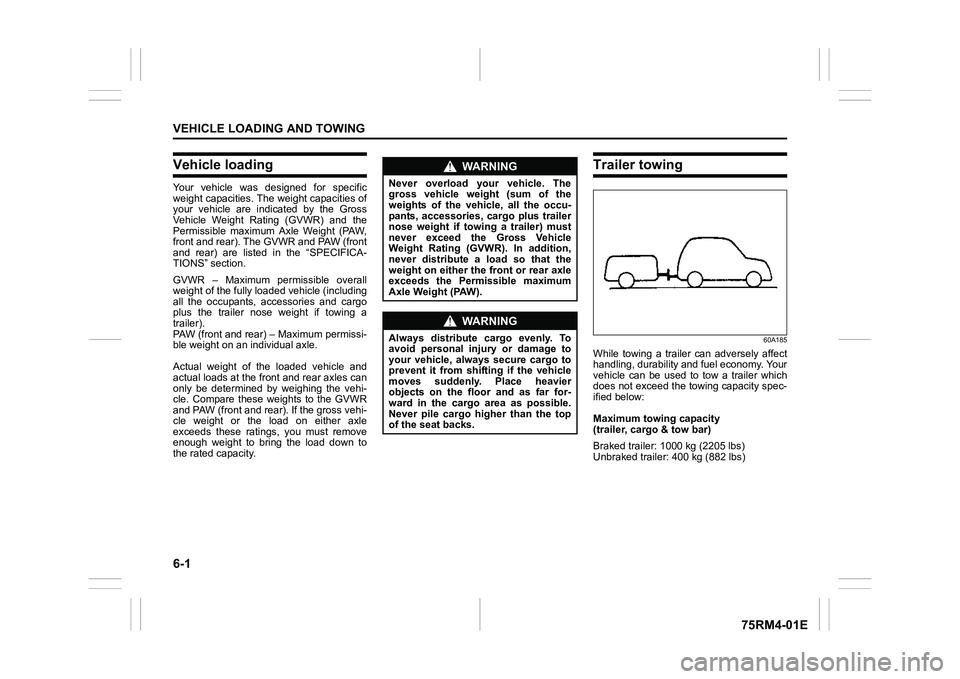
Trailer towing
60A185
While towing a trailer can adversely affect
handling, durability and fuel economy. Your
vehicle can be used to tow a trailer which
does not exceed the towing capacity spec-
ified below:
Maximum towing capacity
(trailer, cargo & tow bar)
Braked trailer: 1000 kg (2205 lbs)
Unbraked trailer: 400 kg (882 lbs)
WA R N I N G
Never overload your vehicle. The
gross vehicle weight (sum of the
weights of the vehicle, all the occu-
pants, accessories, cargo plus trailer
nose weight if towing a trailer) must
never exceed the Gross Vehicle
Weight Rating (GVWR). In addition,
never distribute a load so that the
weight on either the front or rear axle
exceeds the Permissible maximum
Axle Weight (PAW).
WA R N I N G
Always distribute cargo evenly. To
avoid personal injury or damage to
your vehicle, always secure cargo to
prevent it from shifting if the vehicle
moves suddenly. Place heavier
objects on the floor and as far for-
ward in the cargo area as possible.
Never pile cargo higher than the top
of the seat backs.
Page 350 of 505
7-1INSPECTION AND MAINTENANCE
75RM4-01E
60B128S
WA R N I N G
Take extreme care when working on
your vehicle to prevent accidental
injury. Carefully observe the follow-
ing precautions:
• To prevent damage or unintendedactivation of the air bag system or
seat belt pretensioner system, check
that the lead-acid battery is discon-
nected and the ignition switch has
been in “LOCK” position or the igni-
tion mode has been LOCK (OFF) for
at least 90 seconds before perform-
ing any electrical service work on
your SUZUKI vehicle. Do not touch
air bag system components, seat
belt pretensioner system compo-
nents or wires.
The wires are wrapped with yellow
tape or yellow tubing, and the cou-
plers are yellow for easy identifica-
tion.
• Do not leave the engine running in garages or other confined areas. (Continued)
WA R N I N G
(Continued)
• When the engine is running, keep
hands, clothing, tools, and other
objects away from the fan and drive
belt. Even though the fan may not
be moving, it can automatically
turn on without warning.
• When it is necessary to perform
service work with the engine run-
ning, check that the parking brake
is set fully and the transaxle is in
Neutral (for manual transaxle or
Auto Gear Shift vehicles) or Park
(for CVT vehicles).
• Do not touch ignition wires or other ignition system parts when starting
the engine or when the engine is
running, or you could receive an
electric shock.
•Be careful not to touch a hot engine, exhaust manifold and
pipes, muffler, radiator and water
hoses.
• Do not allow smoking, sparks, or flames around fuel or the battery.
Flammable fumes are present.
• Do not get under your vehicle if it is supported only with the portable
jack provided in your vehicle.
• Be careful not to cause accidental short circuits between the positive
and negative battery terminals. (Continued)
WA R N I N G
(Continued)
• Keep used oil, coolant, and other
fluids away from children and pets.
Dispose of used fluids properly;
never pour them on the ground,
into sewers, etc.
Page 375 of 505
7-26
INSPECTION AND MAINTENANCE
75RM4-01E
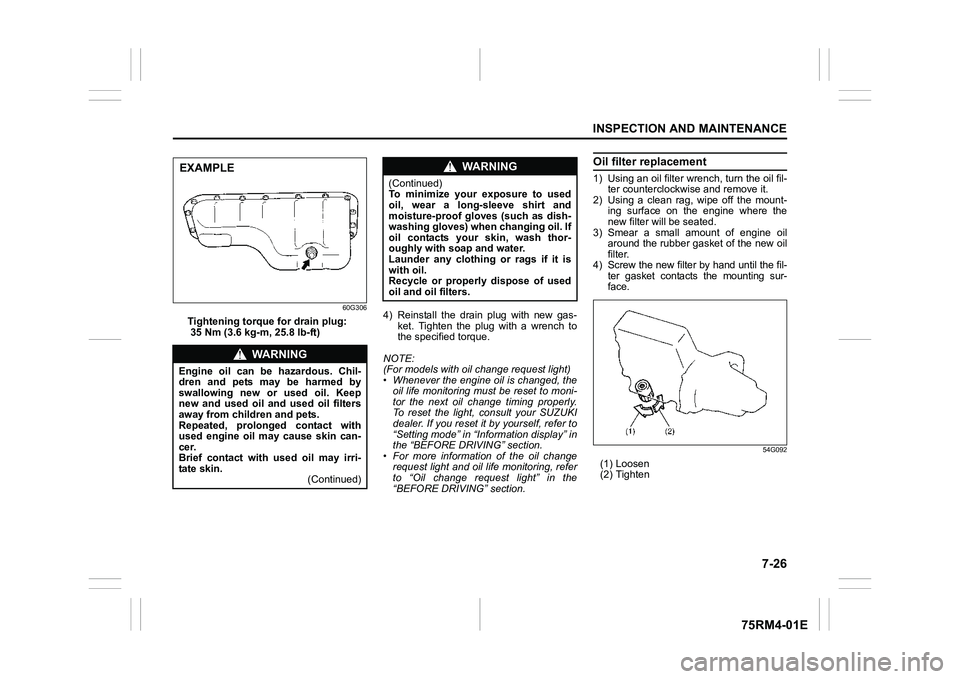
60G306
Tightening torque for drain plug:
35 Nm (3.6 kg-m, 25.8 lb-ft)4) Reinstall the drain plug with new gas-
ket. Tighten the plug with a wrench to
the specif ied torque.
NOTE:
(For models with oil change request light)
• Whenever the engine oil is changed, the oil life monitoring must be reset to moni-
tor the next oil change timing properly.
To reset the light, consult your SUZUKI
dealer. If you reset it by yourself, refer to
“Setting mode” in “Inf ormation display” in
the “BEFORE DRIVING” section.
• For more information of the oil change request light and oil life monitoring, refer
to “Oil change request light” in the
“BEFORE DRIVING” section.
Oil filter replacement1) Using an oil filter wr ench, turn the oil fil-
ter counterclockwise and remove it.
2) Using a clean rag, wipe off the mount- ing surface on the engine where the
new filter will be seated.
3) Smear a small amount of engine oil around the rubber gasket of the new oil
filter.
4) Screw the new filter by hand until the fil- ter gasket contacts the mounting sur-
face.
54G092
(1) Loosen
(2) Tighten
WA R N I N G
Engine oil can be hazardous. Chil-
dren and pets may be harmed by
swallowing new or used oil. Keep
new and used oil and used oil filters
away from children and pets.
Repeated, prolonged contact with
used engine oil may cause skin can-
cer.
Brief contact with used oil may irri-
tate skin. (Continued)EXAMPLE
WA R N I N G
(Continued)
To minimize your exposure to used
oil, wear a long-sleeve shirt and
moisture-proof gloves (such as dish-
washing gloves) when changing oil. If
oil contacts your skin, wash thor-
oughly with soap and water.
Launder any clothing or rags if it is
with oil.
Recycle or properly dispose of used
oil and oil filters.
Page 382 of 505
7-33INSPECTION AND MAINTENANCE
75RM4-01E
75F086
81PN159 75RM370
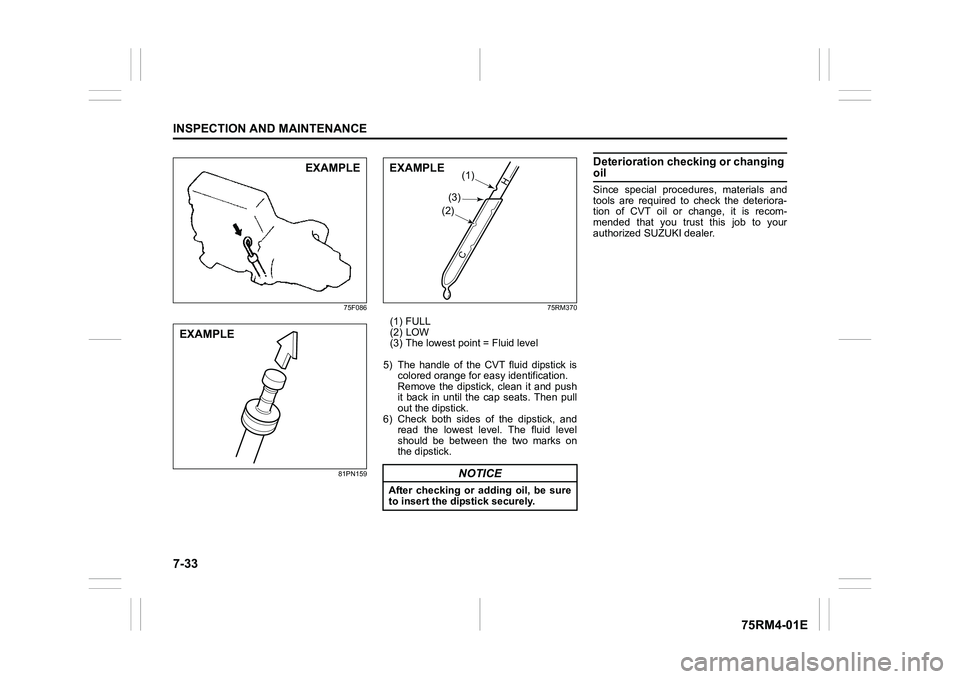
(1) FULL
(2) LOW
(3) The lowest point = Fluid level
5) The handle of the CVT fluid dipstick is colored orange for ea sy identification.
Remove the dipstick, clean it and push
it back in until the cap seats. Then pull
out the dipstick.
6) Check both sides of the dipstick, and read the lowest level. The fluid level
should be between the two marks on
the dipstick.
Deterioration checking or changing oilSince special procedures, materials and
tools are required to check the deteriora-
tion of CVT oil or change, it is recom-
mended that you trust this job to your
authorized SUZUKI dealer.
EXAMPLE
EXAMPLE
NOTICE
After checking or adding oil, be sure
to insert the di pstick securely.
(3)
(1)
(2)
C
H
(ΟΝ03/(