display SUZUKI JIMNY 2005 3.G Service User Guide
[x] Cancel search | Manufacturer: SUZUKI, Model Year: 2005, Model line: JIMNY, Model: SUZUKI JIMNY 2005 3.GPages: 687, PDF Size: 13.38 MB
Page 408 of 687

Downloaded from www.Manualslib.com manuals search engine ENGINE GENERAL INFORMATION AND DIAGNOSIS 6-51
DTC P0110 (DTC No.18) Intake Air Temp. (IAT) Circuit Malfunction
CIRCUIT DESCRIPTION
DTC CONFIRMATION PROCEDURE
1) Clear DTC, start engine and keep it at idle for 1 min.
2) Select “DTC” mode no scan tool and check DTC.
INSPECTION
DTC DETECTING CONDITION POSSIBLE CAUSE
Low intake air temperature (High voltage-High resistance)
High intake air temperature (Low voltage-Low resistance)“Lg/R” circuit open or shorted to power.
“B/Bl” circuit open
IAT sensor malfunction
ECM malfunction
NOTE:
When DTC P0105 (No.11), P0110 (No.18), P046, P0115 (No.19) and P0120 (No.13) are indicated
together, it is possible that “B/Bl” circuit is open.
Before inspecting, be sure to check that ambient temperature is higher than –40 °C (–40 °F).
Step Action Yes No
1Was “Engine Diag. Flow Table” performed? Go to Step 2. Go to “Engine Diag. Flow
Table”.
2 Check IAT Sensor and Its Circuit.
1) Connect scan tool to DLC with ignition
switch OFF. See Fig. 1.
2) Turn ignition switch ON.
3) Check intake air temp. displayed on scan
tool.
Is –40 °C (–40 °F) or 119 °C (246 °F) indicated?Go to Step 3. Intermittent trouble.
Check for intermittent
referring to “Intermittent
and Poor Connection” in
Section 0A.
Page 409 of 687
![SUZUKI JIMNY 2005 3.G Service User Guide Downloaded from www.Manualslib.com manuals search engine 6-52 ENGINE GENERAL INFORMATION AND DIAGNOSIS
[A] Fig. 1 for Step 2 / [B] Fig. 2 for Step 3 / [C] Fig. 3 for Step 63 Check Wire Harness.
1) Dis](/img/20/7588/w960_7588-408.png "SUZUKI JIMNY 2005 3.G Service User Guide Downloaded from www.Manualslib.com manuals search engine 6-52 ENGINE GENERAL INFORMATION AND DIAGNOSIS
[A] Fig. 1 for Step 2 / [B] Fig. 2 for Step 3 / [C] Fig. 3 for Step 63 Check Wire Harness.
1) Dis")
Downloaded from www.Manualslib.com manuals search engine 6-52 ENGINE GENERAL INFORMATION AND DIAGNOSIS
[A] Fig. 1 for Step 2 / [B] Fig. 2 for Step 3 / [C] Fig. 3 for Step 63 Check Wire Harness.
1) Disconnect IAT sensor connector with igni-
tion switch OFF.
2) Check for proper connection to IAT sensor
at “Lg/B” and “B/Bl” wire terminals.
See Fig. 2.
3) If OK, then with ignition switch ON.
Is voltage applied to “Lg/B” wire terminal about
4 – 6 V?Go to Step 5.“Lg/B” wire open or
shorted to power, or poor
E19-15 connection.
If wire and connection are
OK, substitute a known-
good ECM and recheck.
4 Does scan tool indicate –40 °C (–40 °F) at Step
2.Go to Step 6. Go to Step 5.
5 Check Wire Harness
1) Check intake air temp. displayed on scan
tool with ignition switch ON.
Is –40 °C (–40 °F) indicated?Replace IAT sensor.“Lg/B” wire shorted to
ground.
If wire is OK, substitute a
known-good ECM and
recheck.
6 Check Wire Harness.
1) Using service wire, connect IAT sensor con-
nector terminals.
2) Check intake air temp. displayed on scan
tool with ignition switch ON. See Fig. 3.
Is 119 °C (246 °F) indicated?Replace IAT sensor.“Lg/B” wire open or poor
E19-10 connection.
If wire and connection are
OK, substitute a known-
good ECM and recheck. Step Action Yes No
Page 411 of 687
![SUZUKI JIMNY 2005 3.G Service User Guide Downloaded from www.Manualslib.com manuals search engine 6-54 ENGINE GENERAL INFORMATION AND DIAGNOSIS
INSPECTION
[A] Fig. 1 for Step 2 / [B] Fig. 2 for Step 5 / [C] Fig. 3 for Step 6Step Action Yes N](/img/20/7588/w960_7588-410.png "SUZUKI JIMNY 2005 3.G Service User Guide Downloaded from www.Manualslib.com manuals search engine 6-54 ENGINE GENERAL INFORMATION AND DIAGNOSIS
INSPECTION
[A] Fig. 1 for Step 2 / [B] Fig. 2 for Step 5 / [C] Fig. 3 for Step 6Step Action Yes N")
Downloaded from www.Manualslib.com manuals search engine 6-54 ENGINE GENERAL INFORMATION AND DIAGNOSIS
INSPECTION
[A] Fig. 1 for Step 2 / [B] Fig. 2 for Step 5 / [C] Fig. 3 for Step 6Step Action Yes No
1Was “Engine Diag. Flow Table” performed? Go to Step 2. Go to “Engine Diag. Flow
Table”.
2 Check ECT Sensor and Its Circuit.
1) Connect scan tool with ignition switch OFF.
See Fig. 1.
2) Turn ignition switch ON.
3) Check engine coolant temp. displayed on
scan tool.
Is –40 °C (–40 °F) or 119 °C (246 °F) indicated?Go to Step 3. Intermittent trouble.
Check for intermittent
referring to “Intermittent
and Poor Connection” in
Section 0A.
3 Check Wire Harness.
1) Disconnect ECT sensor connector.
2) Check engine coolant temp. displayed on
scan tool.
Is –40 °C (–40 °F) indicated?Replace ECT sensor.“G/B” wire shorted to
ground.
If wire is OK, substitute a
known-good ECM and
recheck.
4 Does scan tool indicate –40 °C (–40 °F) at Step
2.Go to Step 6. Go to Step 5.
5 Check Wire Harness.
1) Disconnect ECT sensor connector with igni-
tion switch OFF.
2) Check for proper connection to ECT sensor
at “B/Bl” and “G/B” wire terminals.
See Fig. 2.
3) If OK, then with ignition switch ON.
Is voltage applied to “B/Bl” wire terminal about
4 – 6 V?Go to Step 4.“G/B” wire open or
shorted to power, or poor
E19-14 connection.
If wire and connection are
OK, substitute a known-
good ECM and recheck.
6 Check Wire Harness.
1) Using service wire, connect ECT sensor
connector terminals. See Fig. 3.
2) Turn ignition switch ON and check engine
coolant temp. displayed on scan tool.
Is 119 °C (246 °F) indicated?Replace ECT sensor.“B/Bl” wire open or poor
E19-10 connection.
If wire and connection are
OK, substitute a known-
good ECM and recheck.
Page 413 of 687
![SUZUKI JIMNY 2005 3.G Service User Guide Downloaded from www.Manualslib.com manuals search engine 6-56 ENGINE GENERAL INFORMATION AND DIAGNOSIS
INSPECTION
[A] Fig. 1 for Step 2 / [B] Fig. 2 for Step 3 / [C] Fig. 3 for Step 4Step Action Yes N](/img/20/7588/w960_7588-412.png "SUZUKI JIMNY 2005 3.G Service User Guide Downloaded from www.Manualslib.com manuals search engine 6-56 ENGINE GENERAL INFORMATION AND DIAGNOSIS
INSPECTION
[A] Fig. 1 for Step 2 / [B] Fig. 2 for Step 3 / [C] Fig. 3 for Step 4Step Action Yes N")
Downloaded from www.Manualslib.com manuals search engine 6-56 ENGINE GENERAL INFORMATION AND DIAGNOSIS
INSPECTION
[A] Fig. 1 for Step 2 / [B] Fig. 2 for Step 3 / [C] Fig. 3 for Step 4Step Action Yes No
1Was “Engine Diag. Flow Table” performed? Go to Step 2. Go to “Engine Diag. Flow
Table”.
2 Check TP Sensor and Its Circuit.
1) Connect scan tool to DLC with ignition
switch OFF and then turn ignition switch ON.
See Fig. 1.
2) Check throttle valve opening percentage dis-
played on scan tool.
Is it displayed 0% or 100%?Go to Step 3. Intermittent trouble.
Check for intermittent
referring to “Intermittent
and Poor Connection” in
Section 0A.
3 Check Wire Harness.
1) Disconnect connector from TP sensor with
ignition switch OFF.
2) Check for proper connection to TP sensor at
“Lg/R”, “Lg” and “B/Bl” wire terminal.
3) If OK, then with ignition switch ON, check
voltage at each of “Lg/R” and “Lg” wire ter-
minals and body ground. See Fig. 2.
Is voltage about 4 – 6 V at each terminal?Go to Step 4.“Lg/R” wire open, “Lg/R”
wire shorted to ground cir-
cuit or power circuit or
“B/Bl” wire, “Lg” wire open
or shorted to ground cir-
cuit or poor E19-22 or
E19-16 connection.
If wire and connection are
OK, substitute a known-
good ECM and recheck.
4 Check TP Sensor.
1) Check resistance between terminals of TP
sensor. See Fig. 3.
TP sensor resistance
Between 1 and 3 : 4.0 – 6.0 k
Ω
ΩΩ Ω
Between 2 and 3 : Varying according to
throttle valve opening (0.02 – 6.0 k
Ω
ΩΩ Ω)
Are measured values within specifications?“B/Bl” wire open or poor
E19-10 connection.
If wire and connection are
OK, substitute a known-
good ECM and recheck.Replace TP sensor.
Page 422 of 687

Downloaded from www.Manualslib.com manuals search engine ENGINE GENERAL INFORMATION AND DIAGNOSIS 6-65
6) Repeat above steps 5) 4 times.
7) Increase vehicle speed to about 50 mph (80 km/h) in 3rd gear or 2 range.
8) Release accelerator pedal and with engine brake applied, keep vehicle coasting (fuel cut condition) for
10sec. or more.
9) Stop vehicle (don’t turn ignition switch OFF) and run engine at idle for 2 min. After this step 9), if “Oxygen
Sensor Monitoring TEST COMPLETED” is displayed in “READINESS TESTS” mode and DTC is not dis-
played in “DTC” mode, confirmation test is completed.
If “TEST NOT COMPLTD” is still being displayed, proceed to next step 10).
10) Drive vehicle under usual driving condition for 10 min. (or vehicle is at a stop and run engine at idle for 10
min. or longer)
11) Stop vehicle (don’t turn ignition switch OFF). Confirm test results according to “Test Result Confirmation
Flow Table” in “DTC CONFIRMATION PROCEDURE” of DTC P0420.
INSPECTION
*Usual driving : Driving at 30 – 40 mph, 50 – 60 km/h including short stop according to traffic signal. (under driving condition other than high-load, high-engine
speed, rapid accelerating and decelerating)
Step Action Yes No
1Was “Engine Diag. Flow Table” performed? Go to Step 2. Go to “Engine Diag. Flow
Table”.
2 Check exhaust system for leakage, loose con-
nection and damage.
Is it good condition?Go to Step 3. Repair or replace.
3 Check HO2S-2 and Its Circuit.
Was HO2S-2 output voltage indicated on scan
tool in step 3) of DTC confirmation test less
than 1.275 V?Go to Step 4.“B/Bl” or “W” circuit open
or HO2S-2 malfunction.
4 Check Short Term Fuel Trim.
Did short term fuel trim very within –20 – + 20%
range in step 3) of DTC confirmation test?Check “W” and “B/Bl” wire
for open and short, and
connection for poor con-
nection. If wire and con-
nection are OK, replace
HO2S-2.Check fuel system. Go to
DTC P0171 / P0172 Diag.
Flow Table.
Page 443 of 687

Downloaded from www.Manualslib.com manuals search engine 6-86 ENGINE GENERAL INFORMATION AND DIAGNOSIS
2) Start engine and warm it up to normal operating temperature (70 – 110 °C, 158 – 230 °F) and run it at idle
for 5 min.
3) Increase vehicle speed to 50 – 55 mph, 80 – 88 km/h in 5th gear or in “D” range.
4) Hold throttle valve at that opening position for 2 min. or longer.
5) Increase engine speed to 4000 r/min. in 3rd gear or in “2” range.
6) Release accelerator pedal and with engine brake applied, keep vehicle coasting (fuel cut condition) till
engine speed reaches 1500 r/min.
7) Stop vehicle (don’t turn ignition switch OFF) and confirm test results according to following “Test Result Con-
firmation Flow Table.”
Test Result Confirmation Flow Table
INSPECTION
Step Action Yes No
1 Check DTC in “DTC” mode and pending DTC in
“ON BOARD TEST”.
Is DTC or pending DTC displayed?Proceed to applicable
DTC flow table.Go to Step 2.
2 Set scan tool to “READINESS TESTS” mode
and check if testing has been completed.
Is test completed?No DTC is detected.
(Confirmation test is com-
pleted)Repeat DTC confirmation
procedure.
Step Action Yes No
1Was “Engine Diag. Flow Table” performed? Go to Step 2. Go to “Engine Diag. Flow
Table”.
2 1) Turn ignition switch ON.
2) Does EGR stepper motor operation for 0.6
second after ignition switch OFF?Go to Step 3. Go to Step 6.
3 With ignition switch at OFF, check voltage
between E19-28, 17, 29, 18 terminals of ECM
and body ground. See Fig. 2.
Is voltage about 0 V?Go to Step 4. Go to Step 8.
Page 446 of 687
Downloaded from www.Manualslib.com manuals search engine ENGINE GENERAL INFORMATION AND DIAGNOSIS 6-89
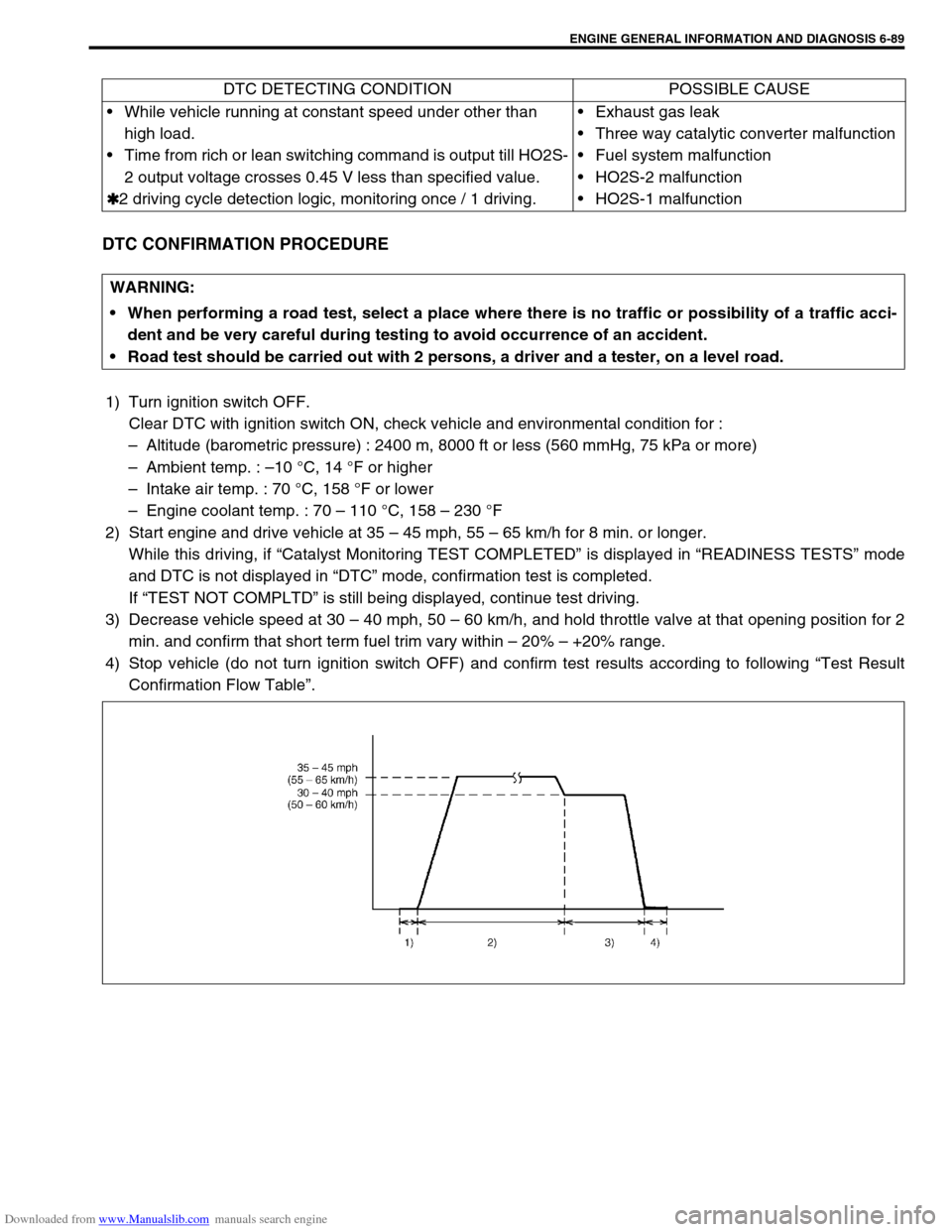
DTC CONFIRMATION PROCEDURE
1) Turn ignition switch OFF.
Clear DTC with ignition switch ON, check vehicle and environmental condition for :
–Altitude (barometric pressure) : 2400 m, 8000 ft or less (560 mmHg, 75 kPa or more)
–Ambient temp. : –10 °C, 14 °F or higher
–Intake air temp. : 70 °C, 158 °F or lower
–Engine coolant temp. : 70 – 110 °C, 158 – 230 °F
2) Start engine and drive vehicle at 35 – 45 mph, 55 – 65 km/h for 8 min. or longer.
While this driving, if “Catalyst Monitoring TEST COMPLETED” is displayed in “READINESS TESTS” mode
and DTC is not displayed in “DTC” mode, confirmation test is completed.
If “TEST NOT COMPLTD” is still being displayed, continue test driving.
3) Decrease vehicle speed at 30 – 40 mph, 50 – 60 km/h, and hold throttle valve at that opening position for 2
min. and confirm that short term fuel trim vary within – 20% – +20% range.
4) Stop vehicle (do not turn ignition switch OFF) and confirm test results according to following “Test Result
Confirmation Flow Table”. DTC DETECTING CONDITION POSSIBLE CAUSE
While vehicle running at constant speed under other than
high load.
Time from rich or lean switching command is output till HO2S-
2 output voltage crosses 0.45 V less than specified value.
✱
✱✱ ✱2 driving cycle detection logic, monitoring once / 1 driving.Exhaust gas leak
Three way catalytic converter malfunction
Fuel system malfunction
HO2S-2 malfunction
HO2S-1 malfunction
WARNING:
When performing a road test, select a place where there is no traffic or possibility of a traffic acci-
dent and be very careful during testing to avoid occurrence of an accident.
Road test should be carried out with 2 persons, a driver and a tester, on a level road.
Page 447 of 687

Downloaded from www.Manualslib.com manuals search engine 6-90 ENGINE GENERAL INFORMATION AND DIAGNOSIS
Test Result Confirmation Flow Table
INSPECTION
Step Action Yes No
1 Check DTC in “DTC” mode and pending DTC in
“ON BOARD TEST” or “PENDING DTC” mode.
Is DTC or pending DTC displayed?Proceed to applicable
DTC Diag. Flow Table.Go to Step 2.
2 Set scan tool to “READINESS TESTS” mode
and check if testing has been completed.
Is test completed?No DTC is detected (con-
firmation test is com-
pleted).Repeat DTC confirmation
procedure.
Step Action Yes No
1Was “Engine Diag. Flow Table” performed? Go to Step 2. Go to “Engine Diag. Flow
Table”.
2 Check Short Term Fuel Trim.
Did short term fuel trim vary within –20 % –
+20 % range in step 3) of DTC confirmation
test?Go to Step 3. Check fuel system.
Go to DTC P0171/P0172
Diag. Flow Table.
3 Check HO2S-2 for Output Voltage.
Perform steps 1) through 9) of DTC confirma-
tion procedure for DTC P0136 (HO2S-2 mal-
function) and check output voltage of HO2S-2
then.
Is over 0.6 V and below 0.3 V indicated?Replace three way cata-
lytic converter.Check “W” and “B/Bl”
wires for open and short,
and connections for poor
connection.
If wires and connections
are OK, replace HO2S-2.
Page 451 of 687
Downloaded from www.Manualslib.com manuals search engine 6-94 ENGINE GENERAL INFORMATION AND DIAGNOSIS
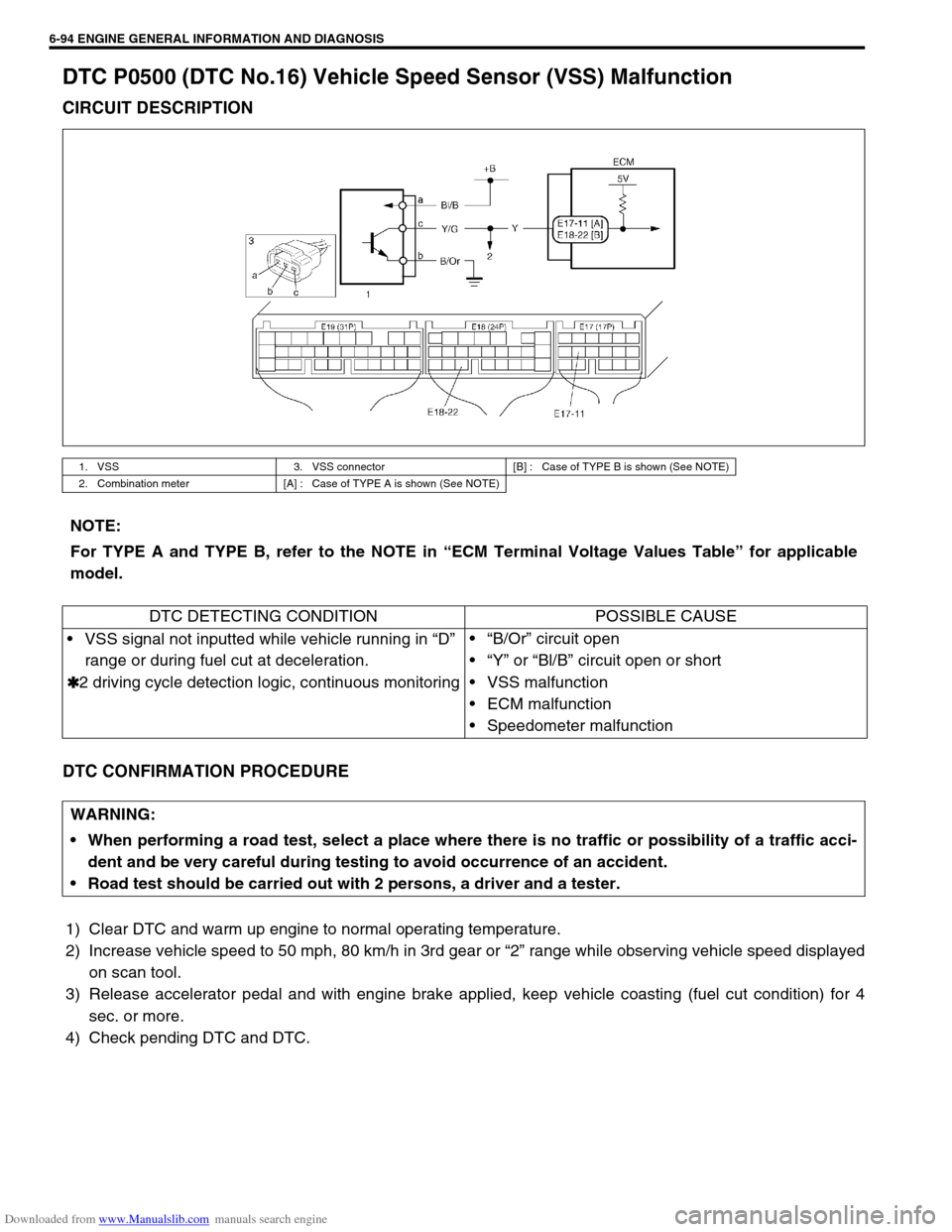
DTC P0500 (DTC No.16) Vehicle Speed Sensor (VSS) Malfunction
CIRCUIT DESCRIPTION
DTC CONFIRMATION PROCEDURE
1) Clear DTC and warm up engine to normal operating temperature.
2) Increase vehicle speed to 50 mph, 80 km/h in 3rd gear or “2” range while observing vehicle speed displayed
on scan tool.
3) Release accelerator pedal and with engine brake applied, keep vehicle coasting (fuel cut condition) for 4
sec. or more.
4) Check pending DTC and DTC.
1. VSS 3. VSS connector [B] : Case of TYPE B is shown (See NOTE)
2. Combination meter [A] : Case of TYPE A is shown (See NOTE)
NOTE:
For TYPE A and TYPE B, refer to the NOTE in “ECM Terminal Voltage Values Table” for applicable
model.
DTC DETECTING CONDITION POSSIBLE CAUSE
VSS signal not inputted while vehicle running in “D”
range or during fuel cut at deceleration.
✱
✱✱ ✱2 driving cycle detection logic, continuous monitoring“B/Or” circuit open
“Y” or “Bl/B” circuit open or short
VSS malfunction
ECM malfunction
Speedometer malfunction
WARNING:
When performing a road test, select a place where there is no traffic or possibility of a traffic acci-
dent and be very careful during testing to avoid occurrence of an accident.
Road test should be carried out with 2 persons, a driver and a tester.
Page 452 of 687
![SUZUKI JIMNY 2005 3.G Service User Guide Downloaded from www.Manualslib.com manuals search engine ENGINE GENERAL INFORMATION AND DIAGNOSIS 6-95
INSPECTION
[A] Fig. 1 for Step 5 / [B] Fig. 2 for Step 4 and Step 6Step Action Yes No
1Was “Eng](/img/20/7588/w960_7588-451.png "SUZUKI JIMNY 2005 3.G Service User Guide Downloaded from www.Manualslib.com manuals search engine ENGINE GENERAL INFORMATION AND DIAGNOSIS 6-95
INSPECTION
[A] Fig. 1 for Step 5 / [B] Fig. 2 for Step 4 and Step 6Step Action Yes No
1Was “Eng")
Downloaded from www.Manualslib.com manuals search engine ENGINE GENERAL INFORMATION AND DIAGNOSIS 6-95
INSPECTION
[A] Fig. 1 for Step 5 / [B] Fig. 2 for Step 4 and Step 6Step Action Yes No
1Was “Engine Diag. Flow Table” performed? Go to Step 2. Go to “Engine Diag. Flow
Table”.
2 Does speedometer indicate vehicle speed? Go to Step 3. Go to Step 5.
3 Check Vehicle Speed Signal.
Is vehicle speed displayed on scan tool in step
2) and 3) of DTC confirmation procedure?Intermittent trouble or
faulty ECM.
Check for intermittent
referring to “Intermittent
and Poor Connection” in
Section 0A.Go to Step 4.
4 1) Turn ignition switch to OFF position.
2) Disconnect combination meter connec-
tors.Refer to Section 8.
3) Turn ignition switch to ON position, without
running engine.
4) Measure voltage from terminal “c” of VSS
connector to ground. See Fig.2.
Is voltage within 4 – 5 V?Faulty speedometer.“Y” or “Y/G” wire open or
short.
Poor connection of ECM
connector terminal.
If OK, substitute a known-
good ECM and recheck.
5 1) With ignition switch at OFF position, discon-
nect VSS connector.
2) Turn ignition switch to ON position, without
running engine.
3) Measure voltage from terminal “a” to “b” of
VSS connector. See Fig.1.
Is voltage within 10 – 14 V?Go to Step 6.“Bl/B” or “B/Or” wire open
or short.
6 1) Measure voltage from terminal “c” of VSS
connector to ground. See Fig.2.
Is voltage more than 4 V?Go to Step 7.“Y” or “Y/G” wire open or
short.
Poor connection of ECM
connector terminal.
If OK, substitute a known-
good ECM and recheck.
7 1) Remove VSS.
2) Visually inspect VSS sensor signal rotor for
damage.
Was any damage found?Faulty VSS signal rotor. Poor connection of VSS
connector terminal.
If OK, substitute a known-
good VSS and recheck.