crank SUZUKI JIMNY 2005 3.G Service Owner's Manual
[x] Cancel search | Manufacturer: SUZUKI, Model Year: 2005, Model line: JIMNY, Model: SUZUKI JIMNY 2005 3.GPages: 687, PDF Size: 13.38 MB
Page 379 of 687
![SUZUKI JIMNY 2005 3.G Service Owners Manual Downloaded from www.Manualslib.com manuals search engine 6-22 ENGINE GENERAL INFORMATION AND DIAGNOSIS
[A] Fig. 1 for Step 5 / [B] Fig. 2 for Step 7 / [C] Fig. 3 for Step 810 Check fuel supply as foll](/img/20/7588/w960_7588-378.png "SUZUKI JIMNY 2005 3.G Service Owners Manual Downloaded from www.Manualslib.com manuals search engine 6-22 ENGINE GENERAL INFORMATION AND DIAGNOSIS
[A] Fig. 1 for Step 5 / [B] Fig. 2 for Step 7 / [C] Fig. 3 for Step 810 Check fuel supply as foll")
Downloaded from www.Manualslib.com manuals search engine 6-22 ENGINE GENERAL INFORMATION AND DIAGNOSIS
[A] Fig. 1 for Step 5 / [B] Fig. 2 for Step 7 / [C] Fig. 3 for Step 810 Check fuel supply as follows :
1) Check to make sure that enough fuel is filled
in fuel tank.
2) Turn ON ignition switch for 2 seconds and
then OFF. See Fig. 5.
Is fuel return pressure (returning sounds) felt
from fuel feed hose (1) when ignition switch is
turned ON?Go to Step 12. Go to Step 11.
11 Check fuel pump for operating.
1) Was fuel pump operating sound heard from
fuel filler for about 2 seconds after ignition
switch ON and stop?Go to “Diag. Flow Table
B-3”.Go to “Diag. Flow Table
B-2”.
12 Check ignition spark as follows :
1) Disconnect injector couplers.
2) Remove spark plugs and connect them to
high tension cords.
3) Ground spark plugs.
4) Crank engine and check if each spark plug
sparks.
Is it in good condition?Go to Step 13. Go to “Ignition Spark Test”
in Section 6F.
13 Check fuel injector for operation as follows :
1) Install spark plugs and connect injector con-
nectors.
2) Using sound scope (2), check operating
sound of each injector (3) when cranking
engine. See Fig. 6.
Was injector operating sound heard from all
injectors?Go to “Engine Diagnosis
Table”.Go to “Diag. Flow Table
B-1”. Step Action Yes No
[B] : When not using SUZUKI scan tool :
[C] : When using SUZUKI scan tool
Page 380 of 687
![SUZUKI JIMNY 2005 3.G Service Owners Manual Downloaded from www.Manualslib.com manuals search engine ENGINE GENERAL INFORMATION AND DIAGNOSIS 6-23
[D] Fig. 4 for Step 7 or 8 / [E] Fig. 5 for Step 10 / [F] Fig. 6 for Step 13
Engine diagnosis tab](/img/20/7588/w960_7588-379.png "SUZUKI JIMNY 2005 3.G Service Owners Manual Downloaded from www.Manualslib.com manuals search engine ENGINE GENERAL INFORMATION AND DIAGNOSIS 6-23
[D] Fig. 4 for Step 7 or 8 / [E] Fig. 5 for Step 10 / [F] Fig. 6 for Step 13
Engine diagnosis tab")
Downloaded from www.Manualslib.com manuals search engine ENGINE GENERAL INFORMATION AND DIAGNOSIS 6-23
[D] Fig. 4 for Step 7 or 8 / [E] Fig. 5 for Step 10 / [F] Fig. 6 for Step 13
Engine diagnosis table
Perform troubleshooting referring to following table when ECM has no DTC and no abnormality found in visual
inspection and engine basic inspection previously.
Condition Possible Cause Reference Item
Hard Starting
(Engine cranks OK)Faulty ignition coil Ignition coil assembly in Section 6F.
Faulty CMP sensing rotor or CKP sensing
rotorCMP sensing rotor or CKP sensing
rotor inspection in Section 6E.
Faulty idle air control system Diagnostic Flow Table B-4
Faulty ECT sensor, TP sensor, CKP sen-
sor, CMP sensor or MAP sensorECT sensor, TP sensor, CKP sensor,
CMP sensor or MAP sensor in Sec-
tion 6E.
Fuel pressure out of specification Diagnostic Flow Table B-3
Faulty fuel injector Diagnostic Flow Table B-1
Faulty ECM Inspection of ECM and its circuit in
this section.
Malfunctioning PCV system PCV system in Section 6E.
Low compression Compression check in Section 6A1.
Improper valve lash Valve lash in Section 6A1.
Improper valve timing Timing chain and chain tensioner in
Section 6A1.
Compression leak from valve seat Valves and cylinder head in Section
6A1.
Sticky valve stem Valves and cylinder head in Section
6A1.
Weak or damaged valve springs Valves and cylinder head in Section
6A1.
Compression leak at cylinder head gasket Valves and cylinder head in Section
6A1.
Sticking or damaged piston ring Pistons, piston rings, connecting rods
and cylinders in Section 6A1.
Worn piston, ring or cylinder Pistons, piston rings, connecting rods
and cylinders in Section 6A1.
Page 383 of 687

Downloaded from www.Manualslib.com manuals search engine 6-26 ENGINE GENERAL INFORMATION AND DIAGNOSIS
Excessive engine oil
consumptionSticky piston ring Pistons, piston rings, connecting rods
and cylinders in Section 6A1.
Worn piston and cylinder Pistons, piston rings, connecting rods
and cylinders in Section 6A1.
Worn piston ring groove and ring Pistons, piston rings, connecting rods
and cylinders in Section 6A1.
Improper location of piston ring gap Pistons, piston rings, connecting rods
and cylinders in Section 6A1.
Worn or damaged valve stem seal Valves and cylinder head in Section
6A1.
Worn valve stem Valves and cylinder head in Section
6A1.
Low oil pressure
Improper oil viscosity ITEM1-3 Engine oil and oil filter
change in Section 0B.
Malfunctioning oil pressure switch Oil pressure switch in Section 8.
Clogged oil strainer Oil pan and oil pump strainer in Sec-
tion 6A1.
Functional deterioration of oil pump Oil pump in Section 6A1.
Worn oil pump relief valve Oil pump in Section 6A1.
Excessive clearance in various sliding
partsRefer to Section 6A1.
Engine noise
See NOTE below.Improper valve lash Valve lash in Section 6A1.
Worn valve stem and guide Valves and cylinder head in Section
6A1.
Weak or broken valve spring Valve springs in Section 6A1.
Warped or bent valve Valves and cylinder head in Section
6A1.
Loose camshaft housing bolts Camshaft in Section 6A1.
Worn piston, ring and cylinder bore Pistons and cylinders in Section 6A1.
Worn crankpin bearing Crankpin and connecting rod bearing
in Section 6A1.
Worn crankpin Crankpin and connecting rod bearing
in Section 6A1.
Loose connecting rod nuts Connecting rod in Section 6A1.
Low oil pressure Previously outlined.
Worn crankshaft journal bearing Main bearings, Crankshaft and cylin-
der block in Section 6A1.
Worn crankshaft journal Main bearings, Crankshaft and cylin-
der block in Section 6A1.
Loose lower crankcase (bearing cap) bolts Main bearings, Crankshaft and cylin-
der block in Section 6A1.
Excessive crankshaft thrust play Main bearings, Crankshaft and cylin-
der block in Section 6A1. Condition Possible Cause Reference Item
NOTE:
Before checking the mechanical noise, make sure that :
Ignition timing is properly adjusted.
Specified spark plug is used.
Specified fuel is used.
Page 387 of 687

Downloaded from www.Manualslib.com manuals search engine 6-30 ENGINE GENERAL INFORMATION AND DIAGNOSIS
Scan tool data definitions
FUEL SYSTEM (FUEL SYSTEM STATUS)
Air / fuel ratio feedback loop status displayed as either open or closed loop. Open indicates that ECM ignores
feedback from the exhaust oxygen sensor.
Closed indicates final injection duration is corrected for oxygen sensor feedback.
CALC LOAD (CALCULATED LOAD VALUE, %)
Engine load displayed as a percentage of maximum possible load. Value is calculated mathematically using the
formula : actual (current) intake air volume ÷ maximum possible intake air volume x 100%.
COOLANT TEMP. (ENGINE COOLANT TEMPERATURE, °C, °F)
It is detected by engine coolant temp. sensor
SHORT FT B1 (SHORT TERM FUEL TRIM, %)
Short term fuel trim value represents short term corrections to the air / fuel mixture computation. A value of 0
indicates no correction, a value greater than 0 means an enrichment correction, and a value less than 0 implies
an enleanment correction.
LONG FT B1 (LONG TERM FUEL TRIM, %)
Long term fuel trim Value represents long term corrections to the air / fuel mixture computation. A value of 0 indi-
cates no correction, a value greater than 0 means an enrichment correction, and a value less than 0 implies an
enleanment correction.
MAP (INTAKE MANIFOLD ABSOLUTE PRESSURE, kPa, inHg)
It is detected by manifold absolute pressure sensor and used (among other things) to compute engine load.
ENGINE SPEED (rpm)
It is computed by reference pulses from crankshaft position sensor.
VEHICLE SPEED (km/h, MPH)
It is computed based on pulse signals from vehicle speed sensor.
IGNITION ADVANCE (IGNITION TIMING ADVANCE FOR NO.1 CYLINDER, °)
Ignition timing of NO.1 cylinder is commanded by ECM. The actual ignition timing should be checked by using
the timing light.
INTAKE AIR TEMP. (°C, °F)
It is detected by intake air temp. sensor and used to determine the amount of air passing into the intake manifold
as air density varies with temperature.
MAF (MASS AIR FLOW RATE, gm/s, lb/min)
It represents total mass of air entering intake manifold which is computed based on signals from MAP sensor,
IAT sensor, TP sensor, etc.BRAKE SWIgnition switch
ONBrake pedal is depressing ON
Brake pedal is releasing OFF
BLOWER FANIgnition switch
ONBlower fan switch ON ON
Blower fan switch OFF OFF
A/C MAG CLUTCHIgnition switch
ONA/C operating ON
A/C not operating OFF SCAN TOOL DATA CONDITION REFERENCE VALUES
Page 391 of 687

Downloaded from www.Manualslib.com manuals search engine 6-34 ENGINE GENERAL INFORMATION AND DIAGNOSIS
ECM TERMINAL VOLTAGE VALUES TABLE
For TYPE A (See NOTE)
NOTE:
Type A is other than follows.
Type B is left hand steering vehicle equipped with fasten seat belt light and EGR valve or right hand
steering vehicle equipped with fasten seat belt light and immobilizer control system.
TERMINAL
NO.CIRCUIT NORMAL
VOLTAGECONDITION
E191Ground––
2Ground––
3Ground––
4 EVAP canister purge valve 10 – 14 V Ignition switch ON
5Power steering pressure switch
(if equipped)0 – 1.3 VWhile engine running at idle speed, turn
steering wheel to right or left as far as it
stops
10 – 14 V Ignition switch ON
6 Idle air control valve 0 – 13 VAt specified idle speed after engine
warmed up
7 Heater of HO2S-1 10 – 14 V Ignition switch ON
8 Fuel injector NO.4 10 – 14 V Ignition switch ON
9 Fuel injector NO.1 10 – 14 V Ignition switch ON
10 Sensor ground––
11 Camshaft position sensor0 – 0.8 V and
4 – 6 VIgnition switch ON
12–– –
13Heater oxygen sensor-1 Refer to DTC P0130 diag. flow table
CO adjusting resistor (w/o HO2S) 0 – 5 V Ignition switch ON position
14
Engine coolant temp. sensor 0.55 - 0.95 VIgnition switch ON
Engine coolant temp. : 80 °C (176 °F)
15
Intake air temp. sensor 2.0 – 2.7 VIgnition switch ON
Intake air temp. : 20 °C (68 °F)
16 Throttle opening signal0.2 – 1.0 VIgnition switch ON position and throttle
valve at idle position
2.8 – 4.8 VIgnition switch ON position and throttle
valve fully open
17EGR valve (stepper motor coil 3, if
equipped)10 – 14 VIgnition switch ON position leaving engine
OFF
18EGR valve (stepper motor coil 1, if
equipped)10 – 14 VIgnition switch ON position leaving engine
OFF
19 Ignition coil #2––
20 Ignition coil #1––
21 Fuel injector NO.2 10 – 14 V Ignition switch ON
22 Power source for sensors 4.75 – 5.25 V Ignition switch ON
23 Crankshaft position sensor0 – 0.8 or
4 – 5 VIgnition switch ON position
24–– –
25 Knock sensor About 2.5 VAt specified idle speed after engine
warmed up
Page 393 of 687

Downloaded from www.Manualslib.com manuals search engine 6-36 ENGINE GENERAL INFORMATION AND DIAGNOSIS
For TYPE A (See NOTE)
E1918EGR valve (stepper motor coil 1, if
equipped)10 – 14 VIgnition switch ON position leaving engine
OFF
19 Ignition coil #2––
20 Ignition coil #1––
21 Fuel injector NO.2 10 – 14 V Ignition switch ON
22 Power source for sensors 4.75 – 5.25 V Ignition switch ON
23 Crankshaft position sensor0 – 0.8 or
4 – 5 VIgnition switch ON position
24–– –
25 Knock sensor About 2.5 VAt specified idle speed after engine
warmed up
26 Manifold absolute pressure sensor 3.3 – 4.0 VIgnition switch ON
Barometric pressure : 100 kPa
(760 mmHg)
27–– –
28EGR valve (stepper motor coil 4, if
equipped)10 – 14 VIgnition switch ON position leaving engine
OFF
29EGR valve (stepper motor coil 2, if
equipped)10 – 14 VIgnition switch ON position leaving engine
OFF
30–– –
31 Fuel injector NO.3 10 – 14 V Ignition switch ON TERMINAL
NO.CIRCUIT NORMAL
VOLTAGECONDITION
NOTE:
See NOTE in “ECM TERMINAL VOLTAGE VALUES TABLE” for applicable model.
TERMINAL
NO.CIRCUIT NORMAL
VOLTAGECONDITION
E181 A/C compressor clutch 0 V Ignition switch ON
2 Malfunction indicator lamp10 – 14 V Engine running
0 – 1.0 V Ignition switch ON leaving engine OFF
3 Data link connector 10 – 14 V Ignition switch ON
4 Heater of HO2S-2 (if equipped) 10 – 14 V Ignition switch ON
5 Power source 10 – 14 V Ignition switch ON
6 Power source 10 – 14 V Ignition switch ON
7 Power source for buck-up 10 – 14 V Ignition switch ON and OFF
8Immobilizer indicator lamp
(with immobilizer indicator lamp)10 – 14 V Engine running
0 – 1.0 V Ignition switch ON leaving engine OFF
Duty output terminal (without
immobilizer indicator lamp)0 – 1.0 V Ignition switch ON
9–– –
10 Main relay10 – 14 V Ignition switch OFF
0.4 – 1.5 V Ignition switch ON
11 Tachometer––
12 Data link connector 4 – 5 V Ignition switch ON
13 Heated oxygen sensor-2 Refer to DTC P0130 diag. flow table
Page 395 of 687

Downloaded from www.Manualslib.com manuals search engine 6-38 ENGINE GENERAL INFORMATION AND DIAGNOSIS
For TYPE A (See NOTE)
E189 Ignition switch 10 – 14 V Ignition switch ON
10 Main relay10 – 14 V Ignition switch OFF
0.4 – 1.5 V Ignition switch ON
11 Ignition switch 10 – 14 V Ignition switch ON
12 Rear defogger switch (if equipped)10 – 14 VIgnition switch ON and rear defogger
switch ON
0 – 1.3 VIgnition switch ON and rear defogger
switch OFF
13–– –
14Diag. Switch terminal (without
immobilizer indicator lamp)4 – 5 V Ignition switch ON
15Test switch terminal (without immo-
bilizer indicator lamp)4 – 5 V Ignition switch ON
16 A/C (input) signal10 – 14 VIgnition switch ON
A/C switch OFF
0 – 2 VIgnition switch ON
A/C switch ON
17 Lighting switch10 – 14 V Lighting switch ON
0 – 1.3 V Lighting switch OFF
18A/C condenser fan motor relay
(if equipped)0 – 1.0 V A/C is operating
10 – 14 V A/C is not operating
19 Fuel pump relay0 – 1 V For 2 seconds after ignition switch ON
10 – 14 V After the above time
20 Engine start signal 6 – 14 V While engine cranking
21 Stop lamp switch0 VIgnition switch ON
Stop lamp switch OFF
10 – 14 VIgnition switch ON
Stop lamp switch ON
22 Vehicle speed sensordeflect
between
0 – 1.6 and
4 – 14 VIgnition switch ON and rear right wheel
turned slowly with rear left wheel locked
23–– –
24–– – TERMINAL
NO.CIRCUIT NORMAL
VOLTAGECONDITION
NOTE:
See NOTE in “ECM TERMINAL VOLTAGE VALUES TABLE” for applicable model.
TERMINAL
NO.CIRCUIT NORMAL
VOLTAGECONDITION
E171–– –
2 R-range signal (A/T)10 – 14 VIgnition switch ON and shift select switch
in R range
0 – 1.3 VIgnition switch ON and shift select switch
in other than R range
3 Blank––
Page 396 of 687

Downloaded from www.Manualslib.com manuals search engine ENGINE GENERAL INFORMATION AND DIAGNOSIS 6-39
For TYPE B (See NOTE)
E174Blank––
5 Overdrive cut signal (A/T)0 – 1.0 VIgnition switch ON and ECT less than
60 °C
10 – 14 VIgnition switch ON and ECT more than
60 °C
6 D-range idle up signal (A/T)10 – 14 VIgnition switch ON and shift select switch
in other than P and N range
0 – 1.6 VIgnition switch ON and shift select switch
in P and N range
7 Stop lamp switch0 VIgnition switch ON
Stop lamp switch OFF
10 – 14 VIgnition switch ON
Stop lamp switch ON
8–– –
9 Ignition switch 10 – 14 V Ignition switch ON
10–– –
11 Vehicle speed sensordeflect
between
0 – 1.6 and
4 – 14 VIgnition switch ON and rear right wheel
turned slowly with rear left wheel locked
12 ABS signal (if equipped) 10 – 14 V Ignition switch ON
13 Engine start signal 6 – 14 V While engine cranking
14–– –
15–– –
16 Rear defogger switch (if equipped)10 – 14 V Ignition switch ON and rear defogger
switch ON
0 – 1.3 V Ignition switch ON and rear defogger
switch OFF
17 A/T failure signal (with immobilizer
indicator lamp) (A/T)–– TERMINAL
NO.CIRCUIT NORMAL
VOLTAGECONDITION
NOTE:
See NOTE in “ECM TERMINAL VOLTAGE VALUES TABLE” for applicable model.
TERMINAL
NO.CIRCUIT NORMAL
VOLTAGECONDITION
E171 A/C evaporator temp. sensor 2.0 – 2.3 VIgnition switch ON
A/C evaporator temp. sensor at 25 °C
(77 °F)
2 R-range signal (A/T)10 – 14 VIgnition switch ON and shift select switch
in R range
0 – 1.3 VIgnition switch ON and shift select switch
in other than R range
3Blank––
4Blank––
Page 401 of 687

Downloaded from www.Manualslib.com manuals search engine 6-44 ENGINE GENERAL INFORMATION AND DIAGNOSIS
Table A-2 Malfunction Indicator Lamp Circuit Check - Lamp Remains “ON”
after Engine Starts
WIRING DIAGRAM / CIRCUIT DESCRIPTION
Refer to table A-1.
INSPECTION
2 ECM Power and Ground Circuit Check
Does engine start?Go to Step 3. Go to “Table A-5 ECM
Power and Ground Circuit
Check”.
If engine is not cranked,
go to “Diagnosis” in Sec-
tion 8G.
3 MIL Circuit Check
1) Turn ignition switch OFF and disconnect
connectors from ECM.
2) Check for proper connection to ECM at ter-
minal E18-2 (Case of TYPE A) (See NOTE)
or E17-9 (Case of TYPE B) (See NOTE).
3) If OK, then using service wire, ground termi-
nal E18-2 (Case of TYPE A) (See NOTE) or
E17-9 (Case of TYPE B) (See NOTE) in
connector disconnected.
Does MIL turn on at ignition switch ON?Substitute a known-good
ECM and recheck.Bulb burned out, “V/Y”
wire circuit open or “P”
wire shorted to ground. Step Action Yes No
Step Action Yes No
1 Diagnostic Trouble Code (DTC) check
1) Check DTC referring to DTC CHECK sec-
tion.
Is there any DTC(s)?Go to Step 2 of “Engine
Diag. Flow Table”.Go to Step 2.
2DTC check
1) Start engine and recheck DTC while engine
running.
Is there any DTC(s)?Go to Step 3.
3 MIL Circuit check
1) Turn OFF ignition switch.
2) Disconnect connectors from ECM.
Does MIL turn ON at ignition switch ON?“V/Y” wire circuit shorted
to ground.Substitute a known-good
ECM and recheck.
Page 403 of 687
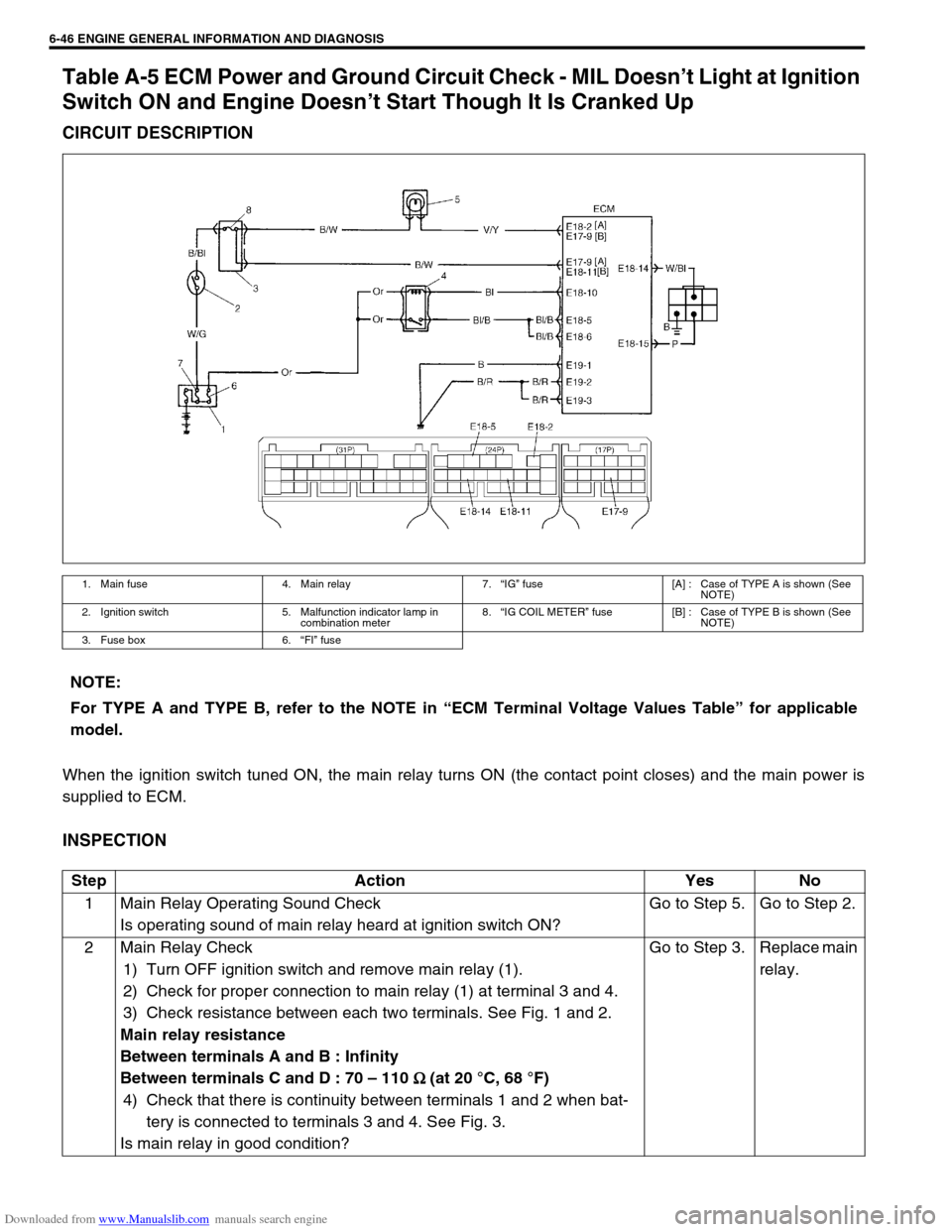
Downloaded from www.Manualslib.com manuals search engine 6-46 ENGINE GENERAL INFORMATION AND DIAGNOSIS
Table A-5 ECM Power and Ground Circuit Check - MIL Doesn’t Light at Ignition
Switch ON and Engine Doesn’t Start Though It Is Cranked Up
CIRCUIT DESCRIPTION
When the ignition switch tuned ON, the main relay turns ON (the contact point closes) and the main power is
supplied to ECM.
INSPECTION
1. Main fuse 4. Main relay 7.“IG” fuse [A] : Case of TYPE A is shown (See
NOTE)
2. Ignition switch 5. Malfunction indicator lamp in
combination meter8.“IG COIL METER” fuse [B] : Case of TYPE B is shown (See
NOTE)
3. Fuse box 6.“FI” fuse
NOTE:
For TYPE A and TYPE B, refer to the NOTE in “ECM Terminal Voltage Values Table” for applicable
model.
Step Action Yes No
1 Main Relay Operating Sound Check
Is operating sound of main relay heard at ignition switch ON?Go to Step 5. Go to Step 2.
2 Main Relay Check
1) Turn OFF ignition switch and remove main relay (1).
2) Check for proper connection to main relay (1) at terminal 3 and 4.
3) Check resistance between each two terminals. See Fig. 1 and 2.
Main relay resistance
Between terminals A and B : Infinity
Between terminals C and D : 70 – 110
Ω
Ω Ω Ω (at 20 °C, 68 °F)
4) Check that there is continuity between terminals 1 and 2 when bat-
tery is connected to terminals 3 and 4. See Fig. 3.
Is main relay in good condition?Go to Step 3. Replace main
relay.