drive SUZUKI JIMNY 2019 Owners Manual
[x] Cancel search | Manufacturer: SUZUKI, Model Year: 2019, Model line: JIMNY, Model: SUZUKI JIMNY 2019Pages: 421, PDF Size: 6.35 MB
Page 355 of 421

A CAUTION
Hitting curbs and running over rocks can damage tyres and affect wheel alignment. Have tyres and wheel alignment checked periodically by a SUZUKI dealer.
4) Check for loose wheel nuts. 5) Check that there are no nails, stones or other objects sticking into the tyres.
A WARNING
• Your SUZUKI vehicle is equipped with tyres which are all the same type and size. This is important to ensure proper steering and handling of the vehicle. Never mix tyres of different size or type on the four wheels of your vehicle. The size and type of tyres used should be only those approved by SUZUKI as standard or optional equipment for your vehicle. Replacing the wheels and tyres equipped on your vehicle with certain combinations of aftermarket wheels and tyres can significantly change the steering and handling characteristics of your vehicle. Therefore, use only those wheel and tyre combinations approved by SUZUKI as standard or optional equipment for your vehicle.
NOTICE
Replacing the original tyres with tyres of a different size may result in false speedometer or odometer readings. Check with a SUZUKI dealer before purchasing replacement tyres that differ in size from the original tyres. Replacing a tyre with one of a different size, or using different brands among the four tyres can result in damage to the drive train.
INSPECTION AND MAINTENANCE
Tyre rotation
5-tyre rotation
L A
65D445
L: Left hand drive R: Right hand drive
NOTE: If your vehicle is equipped with the tyre pressure monitoring system, the spare tyre TPMS sensor must be recognized when you include the spare tyre during a tyre rotation. For details, refer to "Replacing Tyres and/or Wheels" in "Tyre Pressure Monitoring System (TPMS)" in the "OPERATING YOUR VEHICLE" section.
6-38
Page 358 of 421
INSPECTION AND MAINTENANCE
Battery
A WARNING
• Batteries produce flammable hydrogen gas. Keep flames and sparks away from the battery or an explosion may occur. Never smoke when working near the battery. • When checking or servicing the battery, disconnect the negative cable. Be careful not to cause a short circuit by allowing metal objects to contact the battery posts and the vehicle at the same time. To avoid harm to yourself or damage to your vehicle or battery, follow the jump-starting instructions in "EMERGENCY SERVICE" section if it is necessary to jump-start your vehicle. • Diluted sulfuric acid spilled from battery can cause blindness or severe burns. Use proper eye protection and gloves. Flush eyes or bodi,: with ample water and get medical care immediately if suffered. Keep batteries out of reach of children.
6-41
~~,,_!s:./--(1)
~"1.L(2)
76MS006
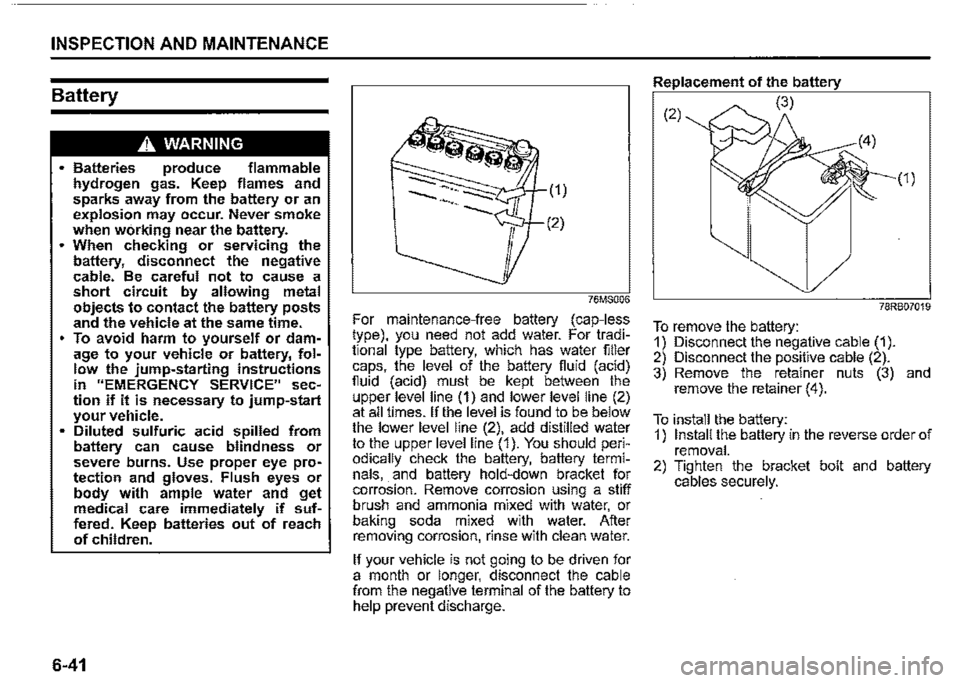
For maintenance-free battery (cap-less type), you need not add water. For traditional type battery, which has water filler caps, the level of the battery fluid (acid) fluid (acid) must be kept between the upper level line (1) and lower level line (2) at all times. If the level is found to be below the lower level line (2), add distilled water to the upper level line (1 ). You should periodically check the battery, battery terminals, . and battery hold-down bracket for corrosion. Remove corrosion using a stiff brush and ammonia mixed with water or baking soda mixed with water. After removing corrosion, rinse with clean water.
If your vehicle is not going to be driven for a month or longer, disconnect the cable from the negative terminal of the battery to help prevent discharge.
Replacement of the battery
(2) (3)
(1)
78RB07019
To remove the battery: 1) Disconnect the negative cable (1). 2) Disconnect the positive cable (2). 3) Remove the retainer nuts (3) and remove the retainer (4).
To install the battery: 1) Install the battery in the reverse order of removal. 2) Tighten the bracket bolt and battery cables securely.
Page 367 of 421

Front fog light (if equipped)
1) Start the engine. Turn the steering
wheel to the opposite side of the b~6 light to be replaced to repla_ce the easily. Then turn off the engine.
2) Remove the clips (1) and screw (2) at
the bottom of bumper. d For removing the clip, use a _flat-blade screwdriver as shown in the ,11ustrat1on.
78RB07033
3) Open the end of the cover inside the fender.
52R70140
4) Disconnect the coupler (3) ~Y1t~~~~:~ the lock release. Turn the u . (4) counterclockwise and remove ,t.
INSPECTION AND MAINTENANCE
Daytime running light (if equipped)
Models without front fog light
78RB07034
6-50
Page 370 of 421
INSPECTION AND MAINTENANCE
76MH0A126
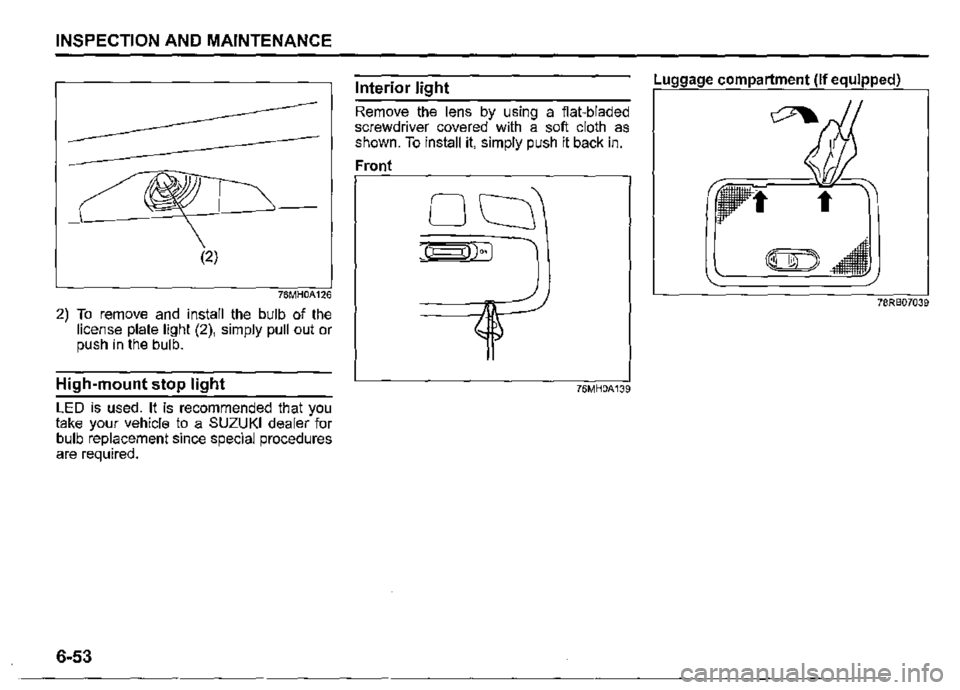
2) To remove and install the bulb of the license plate light (2), simply pull out or push in the bulb.
High-mount stop light
LED is used. It is recommended that you take your vehicle to a SUZUKI dealer for bulb replacement since special procedures are required.
6-53
Interior light
Remove the lens by using a flat-bladed screwdriver covered with a soft cloth as shown. To install it, simply push it back in.
Front
76MH0A139
Luggage compartment (if equipped)
78RB07039
Page 384 of 421

EMERGENCY SERVICE
A safety chain should always be used when you tow your vehicle.
NOTICE
Do not tow your vehicle with the rear wheels directly on the ground (and the transmission in neutral). If you do, the transmission will be damaged fatally.
7-7
--------·--··---------------
A WARNING
For vehicles equipped with the dual sensor brake support, if your vehicle is towed with the engine on, press dual sensor brake support OFF switch and turn off the dual sensor brake support. If not, accidents related to the system being turned on may occur.
NOTICE
Observe the following instructions when towing your vehicle. To help avoid damage to your vehicle during towing, proper equipment and towing procedures must be used. • Using the frame hook, tow your vehicle on paved roads for short distances at low speed.
Before towing
78RB08008
If you tow your vehicle with the front wheels on the ground, shift the transmission into Neutral and make sure the 4WD indicator on the instrument cluster comes on when you use the transfer lever to shift into 4-wheel drive high range position ("4H") and goes off when you use the transfer lever to shift into 2-wheel high drive position ("2H") with the engine running. If the 4WD indicator does not come on or it does not go off, that means, the airlocking hubs cannot be locked or unlocked, the vehicle must be towed with the front wheels lifted and the rear wheels on a dolly.
Page 385 of 421

Towing a Disabled Vehicle
If your vehicle is disabled, and if the steering and drive train are in good condition (and the engine can be started for 4WD vehicles), the vehicle can be towed according to the instructions in this section. Your vehicle may also be towed by a tow truck with the front or rear wheels lifted, according to the instructions below.
Front wheels lifted (all models)
54G279
Front wheels lifted Your vehicle may be towed by a tow truck with the front wheels lifted and a dolly under the rear wheels.
EMERGENCY SERVICE
7-8
Page 390 of 421
APPEARANCE CARE
Corrosion prevention
It is_ important to take good care of your vehicle to protect it from corrosion. Listed below are instructions for how to maintain your vehicle to prevent corrosion. Please read and follow these instructions carefully.
Important information about corro
sion
Common causes of corrosion 1) Accumulation of road salt, dirt moisture or chemicals in hard-to-reach areas of the vehicle underbody or frame. 2) Chipping, scratches and any damage to treated or painted metal surfaces resulting from minor accidents or abrasion by stones and gravel.
Environmental conditions which accelerate corrosion 1) Road salt, dust control chemicals, sea breeze or industrial pollution will all accelerate the corrosion of metal. 2) High humidity will increase the rate of corrosion particularly when the temperature range is just above the freezing point. 3) Moisture in certain areas of a vehicle for an extended period of lime may promote corrosion even though other body sections may be completely dry.
8-1
4) High temperatures will cause an accelerated rate of corrosion to parts of the vehicle which are not well-ventilated to permit quick drying.
This information illustrates the necessity of keeping your vehicle (particularly the ~nderbody) as clean and dry as possible. It Is equally important to repair any damage to the paint or protective coatings as soon as possible.
How to help prevent corrosion
Wash your vehicle frequently The_ best way to preserve the finish on your vehicle and to help avoid corrosion is to keep it clean with frequent washing. Wash your vehicle at least once during the winter and once immediately after the winter. K<:ep your vehicle, particularly the underside, as clean and dry as possible. If you frequently drive on salted roads your vehicle should be washed at least once a month during the winter. If you live near the ocean, your vehicle should be washed at least once a month throughout the year.
For washing instructions, refer to "Vehicle cleaning" section.
Remove foreign material deposits Foreign materials such as salts chemicals road oil or tar, tree sap, bird droppings and industnal fall-out may damage the finish of your vehicle if it is left on painted surfaces. Remove these types of deposits as quickly as possible. If these deposits are difficult to wash off, an additional cleaner may be required. Check that any cleaner you use is not harmful to painted surfaces and is specifically intended for your purposes. Follow the manufacturer's directions when using these special cleaners.
Repair finish damage Carefully examine your vehicle for damage to the painted surfaces. Should you find any chip~ or scratches in the paint, touch them up 1mmed1ately to prevent corrosion from starting. If the chips or scratches have gone through to the bare metal have a qualified body shop make the rep~ir.
Keep passenger and luggage compartments clean Moisture, dirt or mud can accumulate under the floor mats and may cause corrosion. Occasionally, check under these mats to ensure that this area is clean and dry. More fr~quent checks are necessary if the vehicle Is used for off-road driving or in wet weather. Certain cargos such as chemicals, fertilizers, cleaners, salts, etc. are extremely corrosive by nature. These products should be transported in sealed containers. If they
Page 391 of 421

are spilled or leaked, clean and dry the
area immediately.
Park your vehicle in a dry, well-venti
lated area Do not park your vehicle in a damp, poorlyventilated area. If you often wash your vehicle in the garage and place it there in wet condition, your garage may be damp. The high humidity in the garage may cause or accelerate corrosion. A wet vehicle may corrode even in a heated garage if the ventilation is poor.
Use mud and gravel shields The use of mud and gravel shields will help protect your vehicle, especially if you frequently drive on gravel or salted roads. Full-size shields, which extend as close to the road as is practical, are the best. The fittings for such shields should also be corrosion resistant. Please check with your SUZUKI dealer for information on these
shields.
A WARNING
Do not apply additional undercoating or rust preventive coating on or around exhaust system components such as the catalytic converter and exhaust pipes. A fire could be started if the undercoating substance
becomes overheated.
APPEARANCE CARE
Vehicle cleaning
A WARNING
When cleaning the interior or exterior of the vehicle, do not use flammable solvents such as lacquer thinners, gasoline and benzene. Also, do not use cleaning materials such as bleaches and strong household detergents. The materials could cause personal injury or damage to
the vehicle.
8-2
Page 399 of 421

Fuel recommendation
78RB0901R
To avoid damaging catalytic converter, you must use unleaded gasoline with an octane number (RON) of 91 or higher (or 95 or higher if a "RON 95" label is attached on the fuel filler lid), which complies with the European standard EN228. Do not use gasoline with additives containing metal.This is identified by a label attached on fuel lid that states: "UNLEADED FUEL ONLY", "NUR UNVERBLEITES BENZIN", "ENDAST BLYFRI BENSIN" or "SOLO GASOLINA SIN PLOMO".
Gasoline-ethanol blends Blends of unleaded gasoline and ethanol (grain alcohol), also known as gasohol, are commercially available in certain areas. Blends of this type may be used in your vehicle if they are no more than 10% ethanol. Check that this gasoline-ethanol blend has octane ratings no lower than those recommended for the gasoline.
Use the recommended gasoline which conforms to the following labels.
NOTE: If you are not satisfied with the driveability or fuel economy of your vehicle when you use a gasoline-alcohol blend, you should switch back to unleaded gasoline containing no alcohol.
Gasoline containing MTBE (where legally available) Unleaded gasoline containing MTB_E (methyl tertiary butyl ether) may be used in your vehicle if the MTBE content 1s not greater than 15%. This oxygenated fuel does not contain alcohol.
SPECIFICATION
NOTICE
The fuel tank has an air space to allow for fuel expansion in hot weather. If you continue to add fuel after the filler nozzle has automati-cally shut off or an initial blowback occurs, the air chamber will become full. Exposure to heat when fully fuelled in this manner will result in leakage due to fuel expansion. To prevent such fuel leakage, stop filling after the filler nozzle has automati-cally shut off, or when initial vent blowback occurs, if using an alterna-tive non-automatic system.
NOTICE
Be careful not to spill fuel containing alcohol while refueling. If fuel is spilled on the vehicle body, wipe it up immediately. Fuels containing alco-hol can cause paint damage, which is not covered under the New Vehicle Limited Warranty.
NOTE: For the fuel recommendation of Chile, Panama and Argentina models, refer to "For Chile, Panama and Argentina" in the "SUPPLEMENT" section.
9-2
Page 403 of 421

SPECIFICATION
ITEM: Wheels and tyres
Tyre size, front and rear 195/80R15 955•1
Rim size with steel wheels 15X5 1/2JJ
with aluminum wheels 15X5 1/2J
Tyre pressures For the specified tyre pressure, see the tyre information label located
on the driver's door lock pillar.
Recommended snow chain (for Europe) Radial thickness: 20 mm, axial thickness: 20mm
Recommended snow tyre 195/80R15.2
•1 If you cannot prepare tyres with the specified load index rate and speed symbol, prepare tyres with higher load index rate and speed
symbol. •2 If you prepare snow tyres; • Check that they are tyres of the same size, structure and load capacity as the originally installed tyres.
• Mount the snow tyres on all four wheels. • Understand that the maximum permissible speed of snow tyres is generally less than the originally installed tyres.
Consult a SUZUKI dealer or supplier for further information.
9-6