pressure SUZUKI JIMNY 2020 User Guide
[x] Cancel search | Manufacturer: SUZUKI, Model Year: 2020, Model line: JIMNY, Model: SUZUKI JIMNY 2020Pages: 421, PDF Size: 6.35 MB
Page 188 of 421

OPERATING YOUR VEHICLE
Other than the described above, the dual sensor cannot be detected the vehicle in front of you or light source, and there is a case where high beam assist may not activate properly. Refer to "Situations where the dual sensor may not activate properly" in this section for details.
Under the following situations, switch high beam or low beam manually, When switching back and forth between the high beams (main beams) and low beams frequently When there is a problem using the high beams (main beams) When it is considered disturbing to other drivers or pedestrians
There is a case where high beams (main beams) is switched to low beams by the fog lights of the vehicle in front of you.
Street lights, traffic signals, and illumination of billboards or signs may cause the high beams (main beams) to switch to the low beams, or low beam to remain on.
3-37
Dual sensor brake support OFF switch
You can turn off the dual sensor brake support system. In the following situations, push and hold the dual sensor brake support OFF switch as unexpected dangers may be possible if ii is activated. -When the vehicle is placed upon atester such as when undergoing a vehicle inspection -When the vehicle is put up on a lift, and the tyres are idling -When the vehicle is being towed -When the vehicle is being carried on a car carrier -When the vehicle is being operated on a race track -When there is vinyl curtains or pendulous branches in front of the vehicle -When driving in the field covered with grown grass -When using an automatic car washer -When the vehicle is placed upon a car elevator or placed in a mechanical parking lot -With a spare tyre or snow chains equipped -When you have a temporarily repaired flat tyre -When you have an accident or breakdown -When the automatic brake system is activated frequently
-When tyres are not inflated to the recommended tyre pressure -With worn tyres equipped -With non-specified sized tyres or wheels equipped -With a modified suspension equipped -When attaching an item which inter-feres with the visibility of the dual sensor -When the vehicle is being weighed down by heavy items -When the vehicle is used to tow a trailer
78RB03010
Page 193 of 421

81M40380
When raindrop, water or dirt on the windshield is not wiped up enough While using the windshield washer When a wiper blade other than SUZUKI genuine parts, including short type wiper
blade is used When the tyres are not inflated to the recommended tyre inflation pressure or when the tyres except the assignment size are equipped,
72M20405
When your vehicle is weighed down by heavy items in the luggage compartment or rear seat
When the headlights are covered in dirt, snow, ice or mud When the optical axis of the headlight is deviated When the brightness changes extremely (for example, passing the entrance or exit of tunnel), When the vehicle is swaying on the rough roads (for example, unevenness roads or stone pavement roads) and the visibility of the monocular camera is unstable, There may be a case to display the traffic sign irrelevant to the vehicle, the traffic sign that is not existed around the vehicle under the following situations. -When the traffic sign is existed on the branched road, the junction or the adjacent lane near the road that the vehicle is moving, -When there are similar things to the color and the object of the traffic sign (for example, the similar traffic sign, the signboard or the structures) -When the vehicle that the decal or sticker like the traffic sign is pasted on is existed in front of your vehicle, or when you overtake such a vehicle, -When the traffic sign is in front of the vehicle on the roundabout,
OPERATING YOUR VEHICLE
NOTE: The traffic sign may be continued to display on the information display under the following situations. Drive safely according to the actual traffic rules. -When you drive in the area where the different speed limit is established even though there is no speed limit sign, -When you drive in the area where the end of traffic regulation is indicated by the lane on the road even though there is no traffic sign to indicate the end of the traffic regulation,
Situations where the dual sensor cannot be detected accurately by the positions or conditions of the traffic signs The detection of traffic sign may be done with delay or there may be a possibility to occur no detection or inaccurate detection of the traffic sign including the supplemental mark under the following situations. When the traffic sign is dirt and hidden by the leaves of the tree or the vehicle in front of your vehicle and then it is hard to recognize the traffic sign, When the circumstance of the traffic sign is complicated and it is hard to recognize the traffic sign, When the traffic sign is far from the vehicle, When the traffic sign is bended or
deformed, When the color of the traffic sign is
faded,
3-42
Page 201 of 421

72M20405
When your vehicle is weighed down by heavy items in the luggage compartment or rear seat When wheel alignment is deviated When the tyres are not infiated to the recommended tyre pressure or the tyres are worn With snow chains or non-specified sized tyres equipped When you have a temporarily repaired fiat tyre With a modified suspension equipped When passing through the entrance or exit of the tunnel and the brightness is changed extremely When driving without lighting the headlights at night or in tunnels When driving on the following roads -On sharp curves or extremely rough surfaces -On a steep slope -On seam of the road When vehicle is swaying When the optical axis of the headlight is deviated
With modified headlights and/or front fog lights equipped When the headlights are covered in dirt, snow, ice or mud
When the following types of a vehicle are in front of you, or when the following situations occur, the dual sensor may not detect a vehicle in front of you or may need more time to detect a vehicle. ·
72M20407
Vehicles in front of you have small, low, or uneven backs as shown below: -A track without side or back gates, and when mounting no luggage on the cargo bed -A vehicle with luggage protruding out from the back -A specially shaped vehicle such as a car carrier trailer or a motorcycle with side car -A low-slung vehicle When ground clearance of vehicle in front of you is extremely high. When a vehicle is oncoming or retreating vehicle
OPERATING YOUR VEHICLE
When a vehicle facing sideways When a vehicle in front of you without turning on the tail lights at night or in tunnels When a vehicle in front of you refiects sunlight strongly When there is a wall in front of the parked vehicle When there is another obstacle beside a vehicle
D
72M20406
When only a part of the vehicle in front of you is within the dual sensor detection field When the difference of speed between the vehicle in front of you and your vehicle is increased When the distance to the vehicle in front of you is short When the vehicle in front of you is difficult to refiect the laser beam When driving on a curve For a while after escaping from a curve When the vehicle in front of you turns, accelerates or decelerates suddenly When a vehicle in front of you jumps out
3-50
Page 204 of 421

OPERATING YOUR VEHICLE
Braking
60G165S
The distance needed to bring any vehicle to a halt increases with the speed of the vehicle. The braking distance needed, for example, at 60 km/h (37 mph) will be approximately 4 times greater than the braking distance needed at 30 km/h (19 mph). Start to depress the brake pedal when there is plenty of distance between your vehicle and the stopping point, and slow down gradually.
3-53
A WARNING
If water gets into the brake devices, brake performance may become poor and unpredictable. After driving through water or washing the underside of the vehicle, test the brakes while driving at a slow speed to see if they have maintained their normal effectiveness. If the brakes are less effective than normal, dry them by repeatedly applying the brakes while driving slowly until the brakes have regained their normal effectiveness.
Power-assisted brakes
Your vehicle has power-assisted brakes. If power assistance is lost due to a stalled engine or other failures, the system is still fully operational on reserve power and you can bring the vehicle to a complete stop by pressing the brake pedal once and holding it down. The reserve power is partly used up when you depress the brake pedal and reduces each time the pedal is pressed. Apply smooth and even pressure to the pedal. Do not pump the pedal.
A WARNING
Even without reserve power in the brake system, you can still stop the vehicle by pressing the brake pedal harder than normally required. However, the stopping distance may be
longer.
Brake assist system
When you slam the brakes on, the brake assist system determines it to be an emergency stop and provides more powerful braking for a driver who cannot hold down the brake pedal firmly.
Page 205 of 421
Anti-lock brake system (ABS)
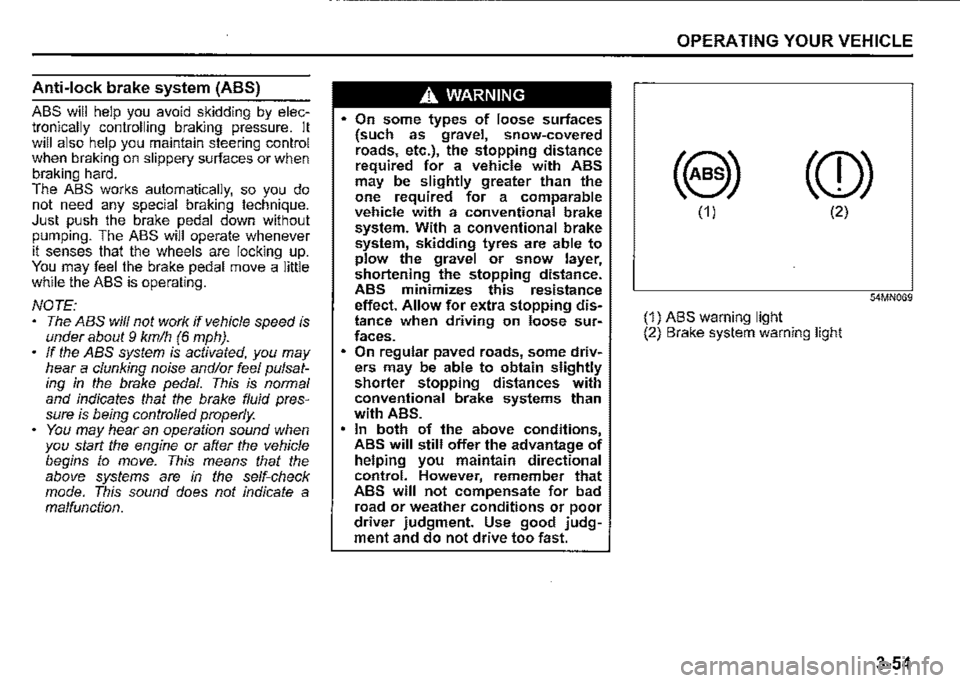
ABS will help you avoid skidding by electronically controlling braking pressure. It will also help you maintain steering control when braking on slippery surfaces or when braking hard. The ABS works automatically, so you do not need any special braking technique. Just push the brake pedal down without pumping. The ABS will operate whenever it senses that the wheels are locking up. You may feel the brake pedal move a little while the ABS is operating.
NOTE: The ABS will not work if vehicle speed is under about 9 km/h (6 mph). ff the ABS system is activated, you may hear a clunking noise and/or feel pulsating in the brake pedal. This is normal and indicates that the brake fluid pressure is being controlled properly. You may hear an operation sound when you start the engine or after the vehicle begins to move. This means that the above systems are in the self-check mode. This sound does not indicate a malfunction.
A WARNING
On some types of loose surfaces (such as gravel, snow-covered roads, etc.), the stopping distance required for a vehicle with ABS may be slightly greater than the one required for a comparable vehicle with a conventional brake system. With a conventional brake system, skidding tyres are able to plow the gravel or snow layer, shortening the stopping distance. ABS minimizes this resistance effect. Allow for extra stopping distance when driving on loose surfaces. On regular paved roads, some drivers may be able to obtain slightly shorter stopping distances with conventional brake systems than with ABS. In both of the above conditions, ABS will still offer the advantage of helping you maintain directional control. However, remember that ABS will not compensate for bad road or weather conditions or poor driver judgment. Use good judgment and do not drive too fast.
OPERATING YOUR VEHICLE
(8) (CD)
(1) (2)
54MN069
(1) ABS warning light (2) Brake system warning light
3-54
Page 206 of 421
OPERATING YOUR VEHICLE
A WARNING
If the ABS warning light (1) on the instrument cluster comes on and stays on while driving, there may be a problem with the ABS system. Ask a SUZUKI dealer to inspect the ABS system immediately. If the ABS system becomes inoperative, the brake system will function as an ordinary brake system that has no ABS. If the ABS warning light (1) and the brake system warning light (2) on the instrument cluster simultaneously stay on or come on while driving, both anti-lock function and rear brake force control function (proportioning valve function) of the ABS system may have failed. If so, the rear wheels may easily skid or the vehicle can even spin in the worst case when braking on a slippery road or when hard braking even on a dry paved road. Ask a SUZUKI dealer to inspect the ABS system immediately. Drive carefully, avoiding hard braking as much as possible.
3-55
How ABS works
A computer continuously monitors wheel speed. The computer compares the changes in wheel speed when braking. If the wheels slow suddenly. indicating a skidding situation, the computer will change braking pressure several times each second to prevent the wheels from locking. When you start your vehicle or when you accelerate after a hard stop. you may hear a momentary motor or clicking noise as the system resets or checks itself.
A WARNING
The ABS may not work properly if tyres or wheels other than those specified in the owner's manual are used. This is because the ABS works by comparing changes in wheel speed. When replacing tyres or wheels, use only the size and type specified in this owner's manual.
Electronic stability program
(ESP®)
ESP® is a registered trademark of Daimler
AG.
The Electronic Stability Program (ESP®) helps to control the vehicle during cornering if front wheels or rear wheels skid. It also assists you in maintaining traction while accelerating on loose or slippery road surfaces. It does this by regulating the engine's output, and by_ . selective!¥ applying the brakes. In add1t1on, ESP helps to avoid skidding by controlling braking pressure.
A WARNING
The ESP® cannot enhance the vehicle's driving stability in all situations and does not control your vehicle's entire braking system. The ESP® cannot prevent accidents, including those resulting from excessive speed in turns, or hydroplaning. Only safe and attentive drive can prevent accidents. The capabilities of an ESP®
equipped vehicle must never be used as a substitute for careful driving.
Page 207 of 421
The ESP® has the following three systems:
Stability control system
The vehicle stability control system helps provide integrated control of systems such as anti-lock brakes, traction control, engine control, etc. This system automatically controls the brakes and engine to help prevent the vehicle from skidding when cornering on a slippery road surface or when turning the steering wheel abruptly.
Traction control system
The traction control system automatically helps prevent the spinning of wheels when the vehicle is started or accelerated on slippery road surfaces. The system operates only if it senses that some of the wheels are spinning or beginning to lose traction. When this happens, the system operates the front or rear brakes and reduces engine power to l1m1t wheel spin.
NOTE: You may hear an operation sound when you start the engine or after the vehicle begins to move. This means that the above systems are in the self-check mode. This sound does not indicate a malfunction.
Anti-lock brake system (ABS)
ABS will help you avoid skidding by electronically controlling braking pressure. It will also help you maintain steering control when braking on slippery surfaces or when braking hard. The ABS works automatically, so you do not have to use any special braking technique. Just push the brak_e pedal down without pumping. The ABS will operate whenever it senses that wheels are locking up. You may feel the brake pedal pulsate while the ABS is operating. (For more information on ABS, see "Braking" in this section.)
NOTE: The ABS will not work if vehicle speed is under about 9 km/h (6 mph).
A WARNING
The ESP® may not work properly if tyres or wheels other than those specified in the owner's manual are used. When replacing tyres or wheels, use only the size and type specified in this owner's manual. • The ESP® may not work properly if ·tyres are not inflated to the recom
mended ~re pressure. The ESP" may not work properly if tyres are fitted with snow chains. (Continued)
OPERATING YOUR VEHICLE
A WARNING
(Continued) • The ESP® may not work properly if the tyres are excessively worn. Replace tyres when the tread wear indicators in the grooves appear on the tread surface. • The ESP® is not a substitute for winter tyres or snow chains on a snowMcovered road.
A WARNING
• The ESP® may not work properly if engine related parts such as the muffler are not equivalent to standard equipment or are extremely deteriorated. Do not modify the vehicle's suspension since the ESP® may not work properly.
NOTE: • If the Espi!) system is activated, you may hear a clunking noise and/or feel pulsating in the brake pedal. This is. normal and indicates that the brake flwd pressure is being controlled properly. You may hear an operation sound when you start the engine or after the vehicle begins to move. This means that the above systems are in the self-check mode. This sound does not indicate a malfunction.
3-56
Page 214 of 421
OPERATING YOUR VEHICLE
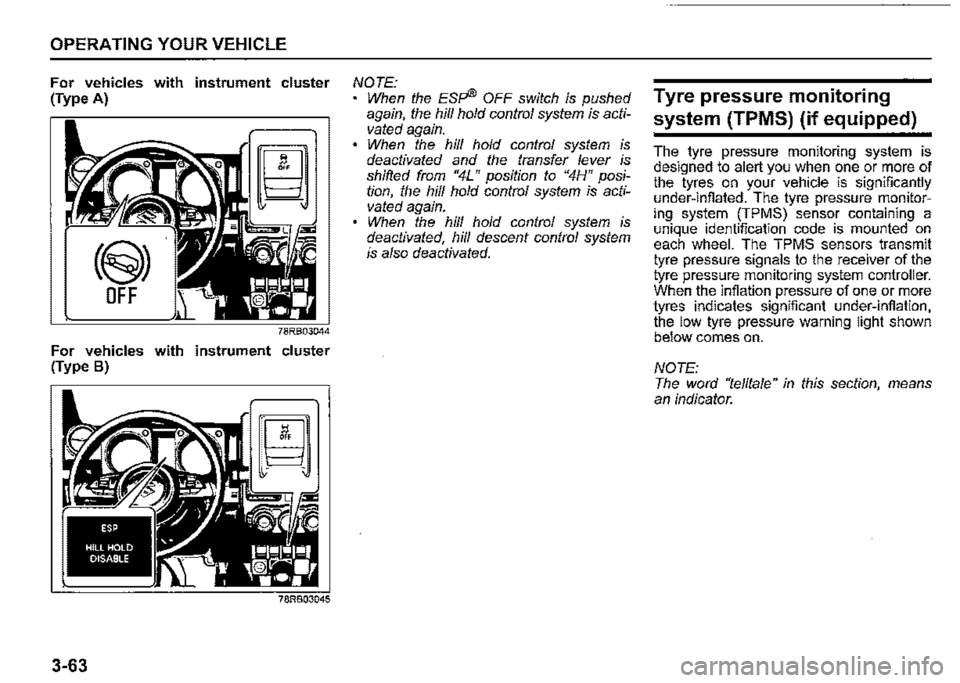
For vehicles with instrument cluster (Type A)
For vehicles with instrument cluster (Type B)
78RB03045
3-63
NOTE: • When the ESffe OFF switch is pushed again, the hill hold control system is activated again. When the hill hold control system is deactivated and the transfer lever is shifted from "4L" position to "4H" position, the hill hold control system is activated again. When the hill hold control system is deactivated, hill descent control system is also deactivated.
Tyre pressure monitoring
system (TPMS) (if equipped)
The tyre pressure monitoring system is designed to alert you when one or more of the tyres on your vehicle is significantly under-inflated. The tyre pressure monitoring system (TPMS) senso_r containing a unique identification code 1s mounted on each wheel. The TPMS sensors transmit tyre pressure signals to the receiver of the tyre pressure monitoring system controller. When the inflation pressure of one or more tyres indicates significant under-inflation, the low tyre pressure warning light shown below comes on.
NOTE: The word "telltale" in this section, means an indicator.
Page 215 of 421
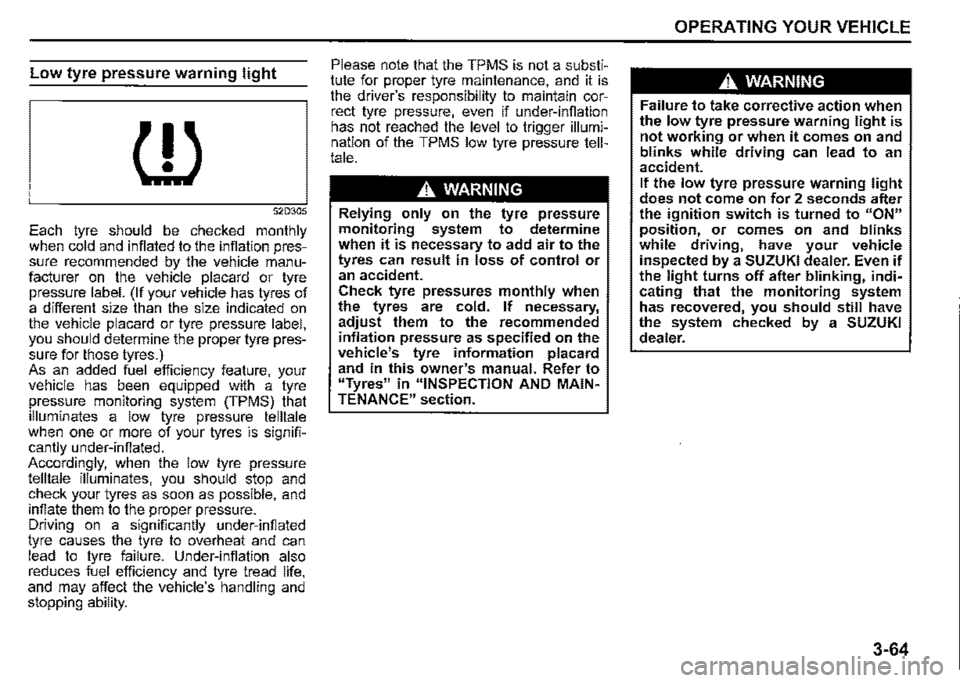
Low tyre pressure warning light
(!)
52D305
Each tyre should be checked monthly when cold and infiated to the infiation pressure recommended by the vehicle manufacturer on the vehicle placard or tyre pressure label. (If your vehicle has tyres of a different size than the size indicated on the vehicle placard or tyre pressure label, you should determine the proper tyre pressure for those tyres.) As an added fuel efficiency feature, your vehicle has been equipped with a tyre pressure monitoring system (TPMS) that illuminates a low tyre pressure telltale when one or more of your tyres is significantly under-infiated. Accordingly, when the low tyre pressure telltale illuminates, you should stop and check your tyres as soon as possible, and infiate them to the proper pressure. Driving on a significantly under-infiated tyre causes the tyre to overheat and can lead to tyre failure. Under-infiation also reduces fuel efficiency and tyre tread life, and may affect the vehicle's handling and stopping ability.
Please note that the TPMS is not a substitute for proper tyre maintenance, and it is the driver's responsibility to maintain correct tyre pressure, even if under-infiation has not reached the level to trigger illumination of the TPMS low tyre pressure telltale.
A WARNING
Relying only on the tyre pressure monitoring system to determine when it is necessary to add air to the tyres can result in loss of control or an accident. Check tyre pressures monthly when the tyres are cold. If necessary, adjust them to the recommended inflation pressure as specified on the vehicle's tyre information placard and in this owner's manual. Refer to "Tyres" in "INSPECTION AND MAINTENANCE" section.
OPERATING YOUR VEHICLE
A WARNING
Failure to take corrective action when the low tyre pressure warning light is not working or when it comes on and blinks while driving can lead to an accident. If the low tyre pressure warning light does not come on for 2 seconds after the ignition switch is turned to "ON" position, or comes on and blinks while driving, have your vehicle inspected by a SUZUKI dealer. Even if the light turns off after blinking, indicating that the monitoring system has recovered, you should still have the system checked by a SUZUKI dealer.
3-64
Page 216 of 421
OPERATING YOUR VEHICLE
A WARNING
The load-carrying capacity of your tyres is reduced at lower inflation pressures. If your tyres are even moderately under-inflated, the load on the tyres may exceed the load-carrying capacity of the tyres, which could lead to tyre failure. The low tyre pressure warning light will not alert you to this condition, because it only comes on when one or more of your tyres becomes significantly underinflated.
Check and adjust your tyre pressure at least once a month. Refer to "Tyres" in "INSPECTION AND MAINTENANCE" section.
3-65
A WARNING
Continuing to drive with the low tyre pressure warning light on can lead to an accident, resulting in severe injury or death. If the low tyre pressure warning light comes on and stays on, reduce your speed and avoid abrupt steering and braking. Be aware that driving on a significantly under-inflated tyre can cause the tyre to overheat and can lead to tyre failure, and may affect steering control and brake effectiveness. Stop in a safe place as soon as possible and check your tyres. If you have a flat tyre, replace it with the spare tyre (if equipped). Refer to "Jacking instructions" in "EMERGENCY SERVICE" section for the tyre replacement method. Also refer to "Replacing tyres and/ or wheels" for instructions on how to restore normal operation of the TPMS after you have had a flat tyre. • If one or more of your tyres is under-inflated, adjust the inflation pressure in all of your tyres to the recommended inflation pressure as soon as possible.
The low tyre pressure warning light can come on due to normal causes such as natural air leakage and pressure changes caused by changes in temperature or atmospheric pressure. Adjusting the air pressure in the tyres to the pressure shown on the tyre information placard should cause the low tyre pressure warning light to turn off.
To make the low tyre pressure warning light go off, adjust the tyre pressures when the tyres are cold, and drive the vehicle for about 10 minutes. When the adjusted tyre pressure is recognized, the low tyre pressure warning light will go off and the information display shows the current tyre pressure (if you select the TPMS monitor (if equipped)).