heating SUZUKI JIMNY 2020 Owner's Manual
[x] Cancel search | Manufacturer: SUZUKI, Model Year: 2020, Model line: JIMNY, Model: SUZUKI JIMNY 2020Pages: 421, PDF Size: 6.35 MB
Page 328 of 421
INSPECTION AND MAINTENANCE
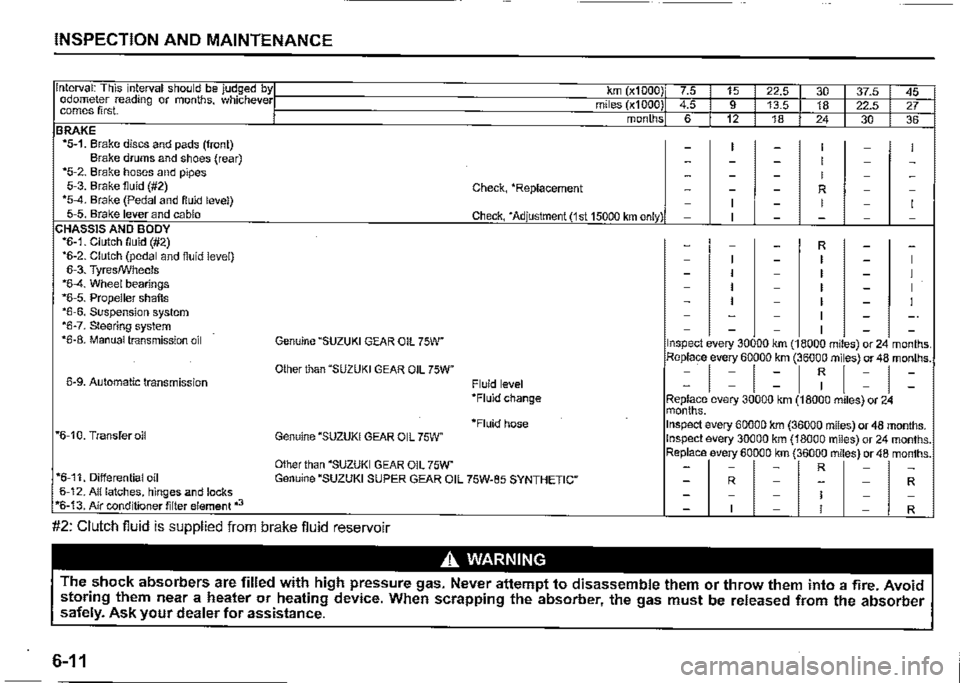
Interval: This interval should be judged by1l--------------------=cic-c+T.C~~,'-,--+----,i'--+ odometer reading or months, whicheverI km (x1000) 7.5 I 15 I 22.5 I 30 I 37.5 45 miles (x1000) 4.5 I 9 I 13.5 I 18 I 22.5 27 comes first. 11-------------------~='---'c=cc=l-";c--+----.,,-+ months 6 I 12 I 18 I 24 I 30 36 BRAKE *5-1. Brake discs and pads (front) Brake drums and shoes (rear) *5-2. Brake hoses and pipes 5-3. Brake fluid (#2) *5-4. Brake (Pedal and fluid level) 5-5. Brake lever and cable CHASSIS AND BODY "6-1. Clutch fluid (#2) *6-2. Clutch (pedal and fluid level) 6-3. Tyres/Wheels *6-4. Wheel bearings *6-5. Propeller shafts *6-6. Suspension system *6-7. Steering system *6-8. Manual transmission oil
6-9. Automatic transmission
*6-10. Transfer oil
*6-11. Differential oil 6-12. All latches, hinges and locks *6-13. Air conditioner filter element •3
Genuine "SUZUKI GEAR OIL 75W"
Other than "SUZUKI GEAR OIL 75W"
Genuine "SUZUKI GEAR OIL 75W"
Other than "SUZUKI GEAR OIL 75W"
Check, *Replacement
Check, *Adjustment (1st 15000 km only)
Flu!d level *Fluid change
*Fluid hose
Genuine "SUZUKI SUPER GEAR OIL 75W-85 SYNTHETIC"
#2: Clutch fiuid is supplied from brake fiuid reservoir
A WARNING
-I -I -I ---I -----I -----R ---I -I -I -I ----
---R ---I -I -I -I -I -I -I -I -I -I -I -I ---I --· ---I --Inspect every 30000 km (18000 miles) or 24 months. Replace every 60000 km (36000 miles) or 48 months.
= I = I = I 7 I = I = Replace every 30000 km (18000 miles) or 24 months. Inspect every 60000 km (36000 miles) or 48 months. Inspect every 30000 km (18000 miles) or 24 months. Replace every 60000 km (36000 m!les) or 48 months. ---R --R R
R
The shock absorbers are filled with high pressure gas. Never attempt to disassemble them or throw them into a fire. Avoid storing them near a heater or heating device. When scrapping the absorber, the gas must be released from the absorber safely. Ask your dealer for assistance.
6-11
Page 333 of 421
INSPECTION AND MAINTENANCE
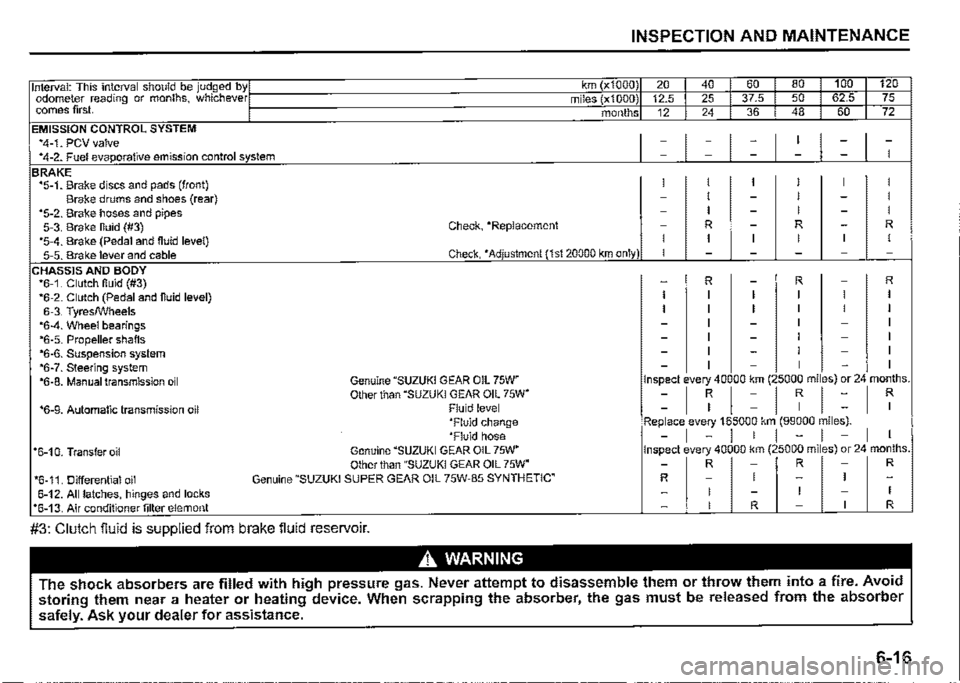
Interval: This interval should be judged bylf---------------------a"'-<"~ccfl---c~+--,;;;.-+~ odometer reading or months, whichever1 km (x1000)I 20 I 40 I 60 I 80 I 100 I 120 miles (x1000)I 12.5 I 25 I 37.5 I 50 I 62.5 I 75 comes first. If-----------------------"='-"'-'-=-;?l----'-~+---:a,;-+~ months! 12 24 I 36 I 48 I 60 I 72
EMISSION CONTROL SYSTEM •4-1. PCV valve •4-2. Fuel evaporative emission control system BRAKE *5-1. Brake discs and pads (front) Brake drums and shoes (rear) *5-2. Brake hoses and pipes 5-3. Brake fluid (#3) *5-4. Brake (Pedal and fluid level) 5-5. Brake lever and cable CHASSIS AND BODY *6-1. Clutch fluid (#3) *6-2. Clutch (Pedal and fluid level) 6-3. Tyres/Wheels *6-4. Wheel bearings •6-5. Propeller shafts *6-6. Suspension system *6-7. Steering system *6-8. Manual transmission oil
*6-9. Automatic transmission oil
*6-10. Transfer oil
*6-11. Differential oil 6-12. All latches, hinges and locks *6-13. Air conditioner filter element
Check, *Replacement
Check, *Adjustment (1st 20000 km only)
Genuine "SUZUKI GEAR OIL 75W" Other than "SUZUKI GEAR OIL 75W" Fluid level *Fluid change *Fluid hose Genuine "SUZUKI GEAR OIL 75W" Other than "SUZUKI GEAR OIL 75W" Genuine "SUZUKI SUPER GEAR OIL 75W-85 SYNTHETIC"
#3: Clutch fluid is supplied from brake fluid reservoir.
A WARNING
I
-I -I -I I I -I ------I
I I I I I I -I -I -I -I -I -I -R -R -R I I I I I I I -----
-R -R -R I I I I I I I I I I I I
-I -I -I -I -I -I -I -I -I -I -I -I Inspect every 40000 km (25000 miles) or 24 months.
= I 7 I = I 7 I = I 7 Replace every 165000 km (99000 miles). -I -I I I -I -I I Inspect every 40000 km (25000 miles) or 24 months. -R -R -R R
R I R
The shock absorbers are filled with high pressure gas. Never attempt to disassemble them or throw them into a fire. Avoid storing them near a heater or heating device. When scrapping the absorber, the gas must be released from the absorber
safely. Ask your dealer for assistance.
6-16
Page 338 of 421
INSPECTION AND MAINTENANCE
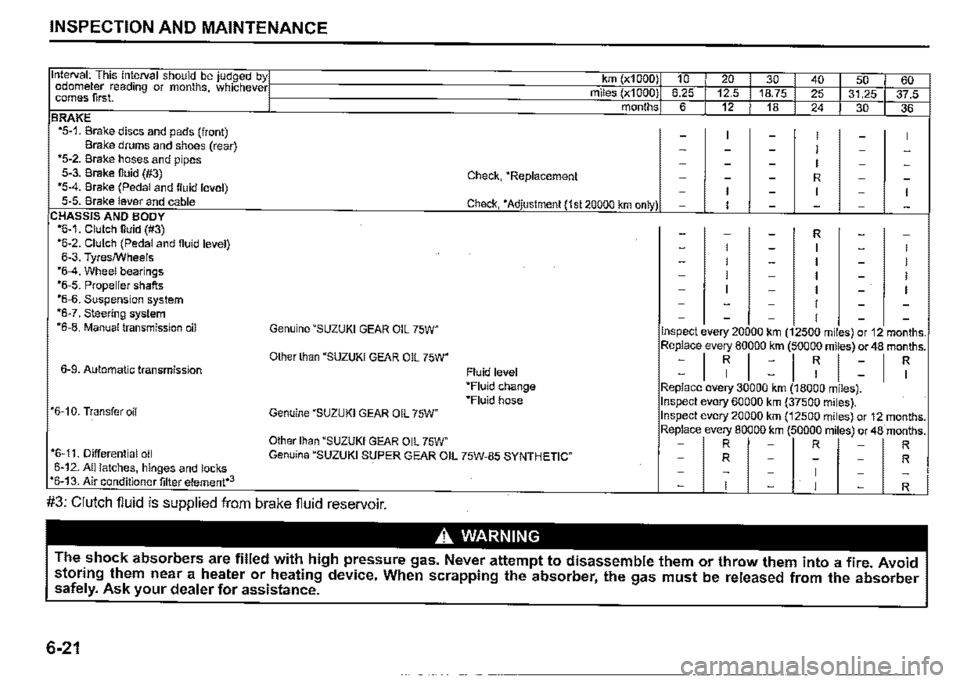
Interval: This interval should be judged byl, -----------------------=~"-f""'~----a'ica-l--i;ee+ odometer reading or months, whicheveq,r ___________________ =='='c~:,f-"'ii"-+-:;;;'----!-km (x100D) 10 I 20 I 30 I 40 I 50 I 60 miles (x1000) 6.25 I 12.5 I 18.75 I 25 I 31,25 I 37.5 comes first. I
BRAKE *5-1. Brake discs and pads (front) Brake drums and shoes (rear) *5-2. Brake hoses and pipes 5-3. Brake fluid (#3)
months
Check, *Replacement *5-4. Brake (Pedal and fluid level) 5-5. Brake lever and cable Check, *Adjustment (1st 20000 km only) CHASSIS ANO BODY *6-1. Clutch fluid (#3) *6-2. Clutch (Pedal and fluid level) 6-3. Tyres/Wheels *6-4. Wheel bearings *6-5. Propeller shafts *6-6. Suspension system *6-7. Steering system *6-8. Manual transmission oil
6-9. Automatic transmission
*6-10. Transfer oil
*6-11. Differential all 6-12. All latches, hinges and locks *6-13. Air conditioner filter elemenr·3
Genuine "SUZUKI GEAR OIL 75W"
Other than "SUZUKI GEAR OIL 75W"
Genuine "SUZUKI GEAR OIL 75W"
Other than "SUZUKI GEAR OIL 75W"
Fluid level *Fluid change *Fluid hose
Genuine "SUZUKI SUPER GEAR OIL 75W-85 SYNTHETIC"
#3: Clutch fiuid is supplied from brake fiuid reservoir.
A WARNING
6 I 12 I 18 I 24 I 30 I 36
-I -I -I ---I -----I -----R ---I -I -I -I ----
---R ---I -I -I -I -I -I -I -I -I -I -I -I ---I -----I --Inspect every 20000 km (12500 miles) or 12 months. Replace every 80000 km (50000 miles) or 48 months.
= I ~ I = I ~ I = I ~ Replace every 30000 km (18000 miles). Inspect every 60000 km (37500 miles). Inspect every 20000 km (12500 miles) or 12 months. Replace every 80000 km (50000 miles) or 48. months. -R -R -R -R ---R
R
The shock absorbers are filled with high pressure gas. Never attempt to disassemble them or throw them into a fire. Avoid storing them near a heater or heating device. When scrapping the absorber, the gas must be released from the absorber safely. Ask your dealer for assistance.
6-21
Page 340 of 421
INSPECTION AND MAINTENANCE
Drive belt
A WARNING
When the engine is running, keep hands, hair, clothing, tools, etc. away from the moving fan and drive belts.
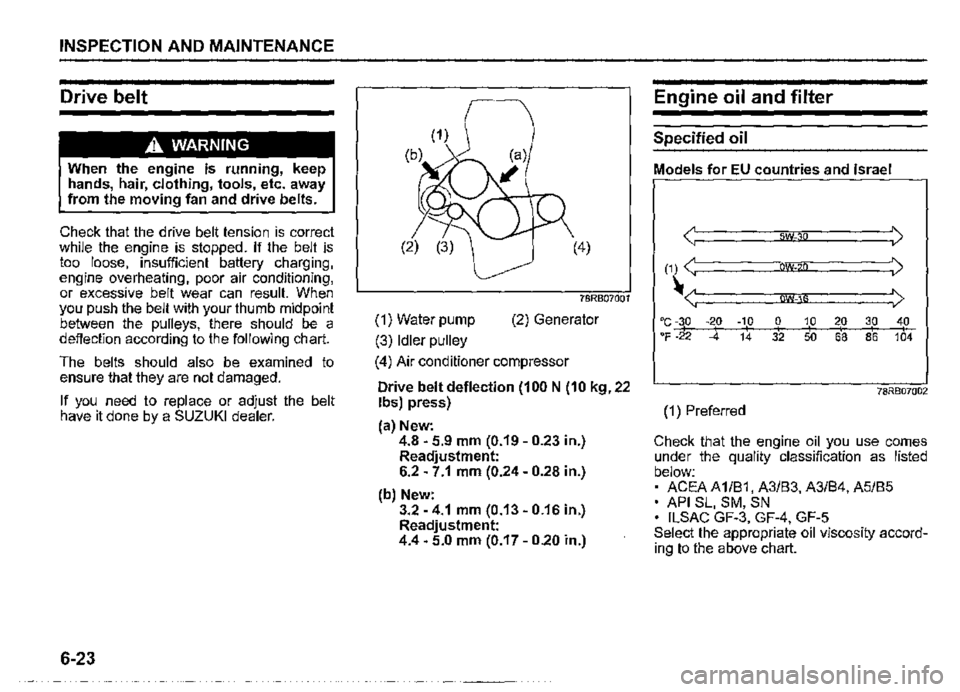
Check that the drive belt tension is correct while the engine is stopped. If the belt is too loose, insufficient battery charging, engine overheating, poor air conditioning, or excessive belt wear can result. When you push the belt with your thumb midpoint between the pulleys, there should be a deflection according to the following chart.
The belts should also be examined to ensure that they are not damaged.
If you need to replace or adjust the belt have it done by a SUZUKI dealer.
6-23
(2) (4)
78RB07001
(1) Water pump (2) Generator
(3) Idler pulley
(4) Air conditioner compressor
Drive belt deflection (100 N (10 kg, 22 lbs) press)
(a) New: 4.8 -5.9 mm (0.19 -0.23 in.) Readjustment: 6.2 -7 .1 mm (0.24 -0.28 in.)
(b) New: 3.2 -4.1 mm (0.13 -0.16 in.) Readjustment: 4.4 -5.0 mm (0.17 -0.20 in.)
Engine oil and filter
Specified oil
Models for EU countries and Israel
< l:!W-JQ >
(1) < 0W-20 >
~< OW-16 > °C-30 -20 -10 0 10 20 30 40 °F -22 -4 14 32 50 68 86 104
78RB07002
( 1) Preferred
Check that the engine oil you use comes under the quality classification as listed below: • ACEA A1/81, A3/83, A3/84, AS/85 • API SL, SM, SN • ILSAC GF-3, GF-4, GF-5 Select the appropriate oil viscosity according to the above chart.
Page 345 of 421
Refill with oil and oil leakage check
1) Pour oil through the filler hole and install the filler cap. For the approximate capacity of the oil, refer to "Recommended fuel / lubricants and capacities (approx.)" in "SPECIFICATIONS" section. 2) Start the engine and carefully check the oil filter and the drain plug for leakage. Run the engine at various speeds for at least 5 minutes. 3) Stop the engine and wait about 5 minutes. Check the oil level again and add oil if necessary. Check for leakage again.
NOTICE
When replacing the oil filter, it is recommended that you use a genuine SUZUKI replacement filter. If you use an aftermarket filter, check that it is of equivalent quality and follow the manufacturer's instructions. • Oil leakage from the periphery of the oil filter or drain plug indicate incorrect installation or gasket damage. If you find any leakage or are not sure that the filter has been properly tightened, have the vehicle inspected by a SUZUKI dealer.
Engine coolant
Selection of coolant
NOTICE
SUZUKI LLC: Super (Blue) coolant; This coolant is already diluted to the proper percentage. Do not dilute with distilled water additionally. Doing so may result in the possibility of freezing and/or overheating coolant.
To maintain optimum performance and durability of your engine, use SUZUKI genuine coolant or equivalent.
NOTE: If you use the engine coolant other than the SUZUKI LLC: Super (Blue) for replacement, follow the schedule of SUZUKI LLC: Standard (Green). To see the detail of the maintenance schedule, refer to "Periodic maintenance schedule" in this section.
This type of coolant is the best for cooling system for the following reasons: • The coolant helps maintain proper engine temperature. It gives proper protection against freezing and boiling. It gives proper protection against corrosion and rust.
INSPECTION AND MAINTENANCE
Failure to use the proper coolant can damage your cooling system. Your SUZUKI dealer can help you select the proper coolant.
NOTICE
To avoid damaging your cooling system: Always use a high quality ethylene glycol base non-silicate type coolant diluted with distilled water at the correct mixture concentration. Check that the proper mix is 50/50 coolant to distilled water and in no case higher than 70/30. Concentrations greater than 70/30 coolant to distilled water will cause overheating conditions. Do not use straight coolant nor plain water (except "SUZUKI LLC: Super {Blue)"). . • Do not add extra inhibitors or additives. They may not be compatible with your cooling system. Do not mix different types of base coolants. Doing so may result in accelerated seal wear and/or the possibility of severe overheating and extensive engine/automatic transmission damage.
6-28
Page 346 of 421
INSPECTION AND MAINTENANCE
NOTE: SUZUKI highly recommends the use of ECSTAR brand coolant. ECSTAR has been specially formulated for your SUZUKI product and contributes to the desired vehicle performance and ideal driving experience.
Coolant level check
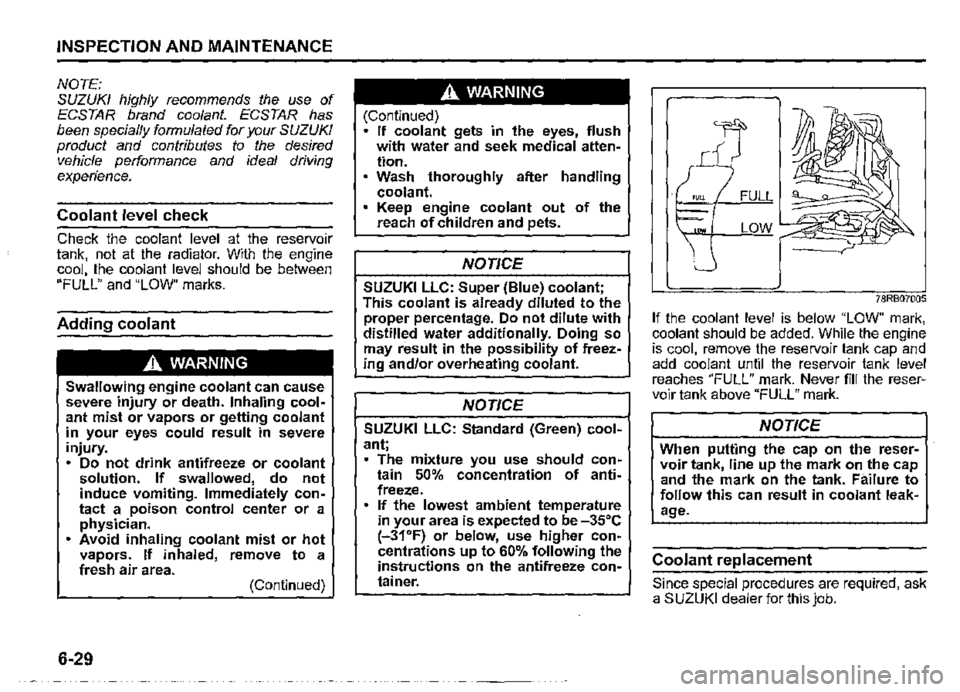
Check the coolant level at the reservoir tank, not at the radiator. With the engine cool, the coolant level should be between "FULL" and "LOW" marks.
Adding coolant
,A WARNING
Swallowing engine coolant can cause severe injury or death. Inhaling coolant mist or vapors or getting coolant in your eyes could result in severe injury. • Do not drink antifreeze or coolant solution. If swallowed, do not induce vomiting. Immediately contact a poison control center or a physician. • Avoid inhaling coolant mist or hot vapors. If inhaled, remove to a fresh air area. (Continued)
6-29
,A WARNING
(Continued) • If coolant gets in the eyes, flush with water and seek medical attention. Wash thoroughly after handling coolant. Keep engine coolant out of the reach of children and pets.
NOTICE
SUZUKI LLC: Super (Blue) coolant; This coolant is already diluted to the proper percentage. Do not dilute with distilled water additionally. Doing so may result in the possibility of freezing and/or overheating coolant.
NOTICE
SUZUKI LLC: Standard (Green) coolant; • The mixture you use should contain 50% concentration of antifreeze. If the lowest ambient temperature in your area is expected lo be -35°C (-31'F) or below, use higher concentrations up to 60% following the instructions on the antifreeze container.
78RB07005
If the coolant level is below "LOW" mark, coolant should be added. While the engine is cool, remove the reservoir tank cap and add coolant until the reservoir tank level reaches "FULL" mark. Never fill the reservoir tank above "FULL" mark.
NOTICE
When putting the cap on the reservoir tank, line up the mark on the cap and the mark on the tank. Failure to follow this can result in coolant leakage.
Coolant replacement
Since special procedures are required, ask a SUZUKI dealer for this job.
Page 377 of 421
EMERGENCY SERVICE
EMERGENCY SERVICE
Tyre changing tool .............................................................. 7-1
CJ~
Jacking instructions ........................................................... 7-1
Jump-starting instructions ................................................. 7-5
Towing your vehicle (recreational towing) ....................... 7-6
Engine trouble: Starter does not operate ......................... 7-10
Engine trouble: Does not start ........................................... 7-10
Engine trouble: Overheating .............................................. 7-10
·. ~ -
60G411
Page 387 of 421
Engine trouble: Starter does
not operate
1) Try turning the ignition switch to "START" position with the headlights turned on to determine the lead-acid battery condition. If the headlights go excessively dim or go off, it usually means that either the lead-acid battery is discharged or the battery terminal contact is poor. Recharge the lead-acid battery or correct battery terminal contact as necessary. 2) If the headlights remain bright, check the fuses. If the reason for failure of the starter is not obvious, there may be a major electrical problem. Have the vehicle inspected by a SUZUKI dealer.
Engine trouble: Does not start
Make sure that your vehicle has enough · fuel and battery. If the engine does not start under very cold condition, press the accelerator pedal all the way to the fioor and hold it while cranking the engine. Refer to "Starting engine" in operating your vehicle section. If the engine still does not start have your vehicle inspected at a SUZUKI dealer. Do not operate the starter motor for more than 12 seconds.
EMERGENCY SERVICE
Engine trouble: Overheating
The engine could overheat temporarily under severe driving conditions. If the high engine coolant temperature warning light comes on as overheating or the engine coolant temperature gauge indicates overheating during driving:
1) Turn off the air conditioner. 2) Take the vehicle to a safe place and park. 3) Run the engine at a normal idle speed for a few minutes until the high engine coolant temperature warning light goes off or the indicator is within the normal, acceptable temperature range between "H" and "C".
A WARNING
If you see or hear escaping steam, stop the vehicle in a safe place and immediately turn off the engine to cool it. Do not open the hood when steam is present. When the steam can no longer be seen or heard, open the hood to see if the coolant is still boiling. If it is, you must wait until it stops boiling before you proceed.
7-10
Page 388 of 421
EMERGENCY SERVICE
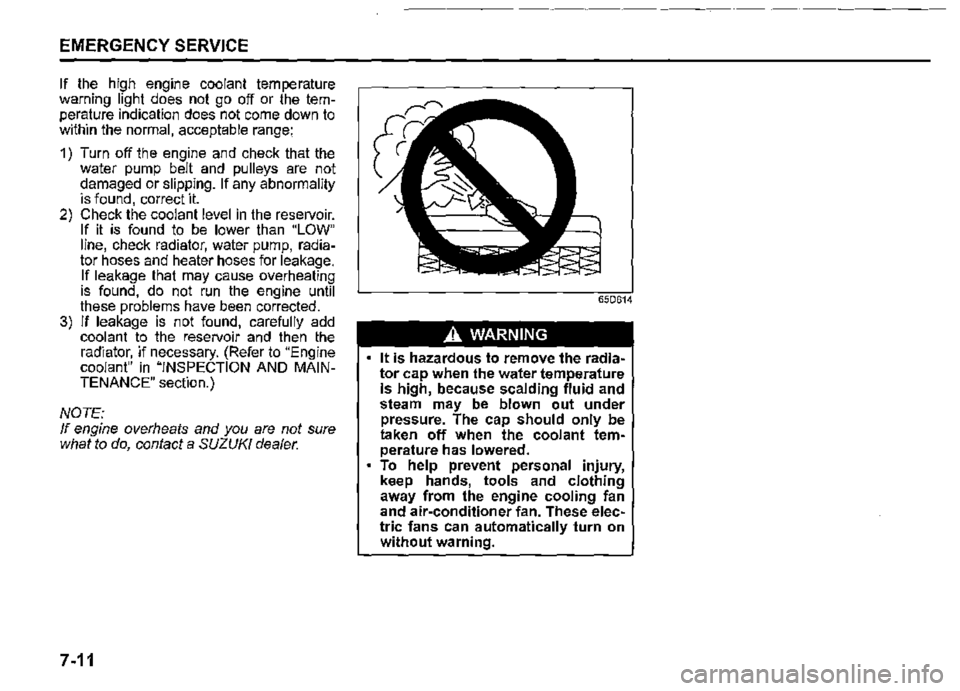
If the high engine coolant temperature warning light does not go off or the temperature indication does not come down to within the normal, acceptable range:
1) Turn off the engine and check that the water pump belt and pulleys are not damaged or slipping. If any abnormality is found, correct it. 2) Check the coolant level in the reservoir. If it is found to be lower than "LOW" line, check radiator, water pump, radiator hoses and heater hoses for leakage. If leakage that may cause overheating is found, do not run the engine until these problems have been corrected. 3) If leakage is not found, carefully add coolant to the reservoir and then the radiator, if necessary. (Refer to "Engine coolant" in "INSPECTION AND MAINTENANCE" section.)
NOTE: If engine overheats and you are not sure what to do, contact a SUZUKI dealer.
7-11
650614
A WARNING
• It is hazardous to remove the radiator cap when the water temperature is high, because scalding fluid and steam may be blown out under pressure. The cap should only be taken off when the coolant temperature has lowered. To help prevent personal injury, keep hands, tools and clothing away from the engine cooling fan and air-conditioner fan. These electric fans can automatically turn on without warning.
Page 411 of 421

INDEX
INDEX Brake system warning light ................................................ 2-41
Brakes ................................................................................... 6-33 Symbols Braking .................................................................................. 3-53 "SOS" button ..................................................................... 10-12 Brightness control ...................................................... 2-17. 2-26
A Built date ............................................................................... 10-1
Accelerator pedal ................................................................... 3-7 Bulb replacement ................................................................. 6-47
Accessory socket .................................................................. 5-6 C Adding coolant. .................................................................... 6-29 Catalytic converter ................................................................. 4-9 Adjusting headlight pattern ................................................ 2-60 Central door locking system ................................................. 2-3
Air cleaner ............................................................................ 6-30 Changing engine oil and filter ............................................. 6-26 Air conditioning system ...................................................... 6-58 Changing wheels .................................................................... 7-4 AIRBAG light ............................................................... 1-36. 2-45 Charging light ....................................................................... 2-44
Anti-lock brake system (ABS) ................................... 3-54. 3-56 Chassis serial number ........................................................... 9-1 Anti-lock brake system (ABS) warning light.. ................... 2-42 Child restraint ....................................................................... 10-1 Anti-theft feature .................................................................. 5-76 Child restraint system for countries applied Assist grips ............................................................................ 5-8 for UN Regulation No.16 ............................................. 1-20. 10-7 Automatic headlight leveling system warning light.. ....... 2-50 Child restraint systems ....................................................... 1-18
Automatic heating and air conditioning system Clock ............................................................................ 2-19. 2-29 (climate control) ................................................................... 5-23 Clutch pedal ................................................................... 3-7. 6-33 Automatic light operation ................................................... 2-56 Coolant level check .............................................................. 6-29 Automatic transmission ...................................................... 3-1 O Coolant replacement... ......................................................... 6-29 Average fuel consumption ......................................... 2-20. 2-30 Corrosion prevention ............................................................. 8-1 Average speed ..................................................................... 2-30 Cup holder ............................................................................ 5-11
8 Cup holder and storage area .............................................. 5-1 O
Battery .................................................................................. 6-41 D
Battery replacement .............................................................. 2-7
Bluetooth® audio ................................................................. 5-71
Bluetooth® hands-free ......................................................... 5-62
Daily inspection check list ..................................................... 3-1
Daytime running light .......................................................... 6-50
Daytime running light (D.R.L.) system ............................... 2-58 Brake assist system ............................................................ 3-53 Door locks ............................................................................... 2-2
Brake fluid ............................................................................ 6-33 Drive belt ............................................................................... 6-23 Brake pedal ................................................................... 3-7. 6-34
11-1