heating SUZUKI JIMNY 2020 User Guide
[x] Cancel search | Manufacturer: SUZUKI, Model Year: 2020, Model line: JIMNY, Model: SUZUKI JIMNY 2020Pages: 421, PDF Size: 6.35 MB
Page 232 of 421
DRIVING TIPS
Catalytic converter
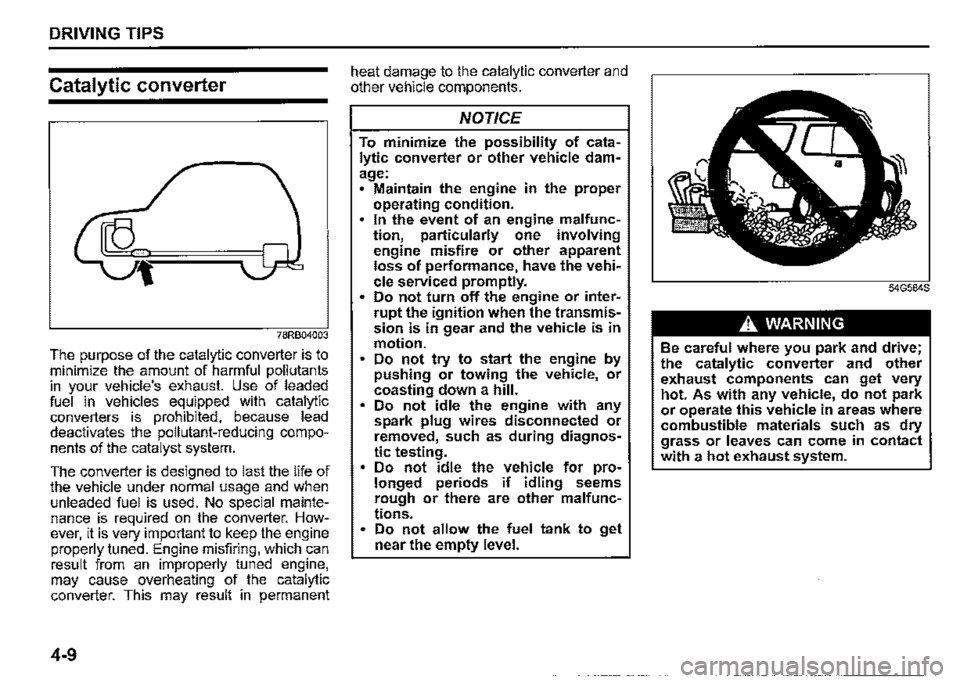
78RB04003
The purpose of the catalytic converter is to minimize the amount of harmful pollutants in your vehicle's exhaust. Use of lead".d fuel in vehicles equipped with catalytic converters is prohibited, because lead deactivates the pollutant-reducing components of the catalyst system.
The converter is designed to last the life of the vehicle under normal usage and when unleaded fuel is used. No special maintenance is required on the converter. However, it is very important to keep the engine properly tuned. Engine misfiring, which can result from an improperly tuned engine, may cause overheating of the catalytic converter. This may result in permanent
4-9
heat damage to the catalytic converter and other vehicle components.
NOTICE
To mm,m,ze the possibility of catalytic converter or other vehicle damage: • Maintain the engine in the proper operating condition. In the event of an engine malfunction, particularly one involving engine misfire or other apparent loss of performance, have the vehicle serviced promptly. • Do not turn off the engine or inter
rupt the ignition when the t(ans~i~sion is in gear and the vehicle 1s m motion. Do not try to start the engine by pushing or towing the vehicle, or coasting down a hill. Do not idle the engine with any spark plug wires disconnected or removed, such as during diagnostic testing. • Do not idle the vehicle for prolonged periods if idling seems rough or there are other malfunctions. Do not allow the fuel tank to get near the empty level.
A. WARNING
Be careful where you park and drive; the catalytic converter and other exhaust components can get very hot. As with any vehicle, do not park or operate this vehicle in areas where combustible materials such as dry grass or leaves can come in contact with a hot exhaust system.
Page 235 of 421
OTHER CONTROLS AND EQUIPMENT
OTHER CONTROLS AND EQUIPMENT
Fuel filler cap ....................................................................... 5-1
Engine hood ........................................................................ 5-2
Sun visor .............................................................................. 5-4
Interior light ......................................................................... 5-5
Accessory socket ................................................................ 5-6
USB socket (if equipped) .................................................... 5-7
Assist grips .......................................................................... 5-8 -
Ride-in assist grip ............................................................... 5-8
Glove box ............................................................................. 5-9
Cup holder and storage area ............................................. 5-10
Footrest (if equipped) ......................................................... 5-13
I
Luggage compartment carpet ............................................ 5-13
Frame hooks ........................................................................ 5-14
Heating and air conditioning system ................................ 5-16
Manual heating and air conditioning system ................... 5-17
60G407 Automatic heating and air conditioning system
(climate control) .................................................................. 5-23
Radio antenna ..................................................................... 5-30
Installation of radio frequency transmitters ..................... 5-30
Audio system (Type A/ Type B / Type C) (if equipped) ... 5-31
Page 251 of 421

Heating and air conditioning
system
There are two types of heating and air conditioning systems as follows:
• Manual heating and air conditioning system • Automatic heating and air conditioning
system (climate control)
OTHER CONTROLS AND EQUIPMENT
Air outlet
(1)
••••
EXAMPLE
78RB05025
1. Windshield defroster outlet 2. Side defroster outlet 3. Side outlet 4. Center outlet 5. Floor outlet
5-16
Page 252 of 421

OTHER CONTROLS AND EQUIPMENT
Center outlet
Move the knob (1 . 78Rsoso2, to adjust the direct~~rt1fally or horizontally, o airflow as desired.
5-17
Side outlet
When open ai 1aRsoso26
the air flow ~ele~t~~;i:iti~~t regardless of
A CAUTION
Prolonged exposur the heater or air e to. ~ot air from result in low t cond,tioner could vehicle occu ::;iperatu(e burns. All
dren, the eld~rly tsth part,c~larly chil
needs, individual's wft1e d w,1Jh special an~ sleeping ind' 'd e ,cate skin, ~amtain sufficient ~~• uals1 should air outlets to ,stance from the
exposure to hot ar~fvent prolonged ow.
Manual heating and .
cond"t" · air • ionmg system
Description of controls
Temperature sel t 78RBoso2s Th' . ec or (1) is is used to adjust the t emperature
Blowersp d · Thi . ee selector (2) s is used to turn select blower speed. on the blower and to
Page 255 of 421
DEFROST (g)
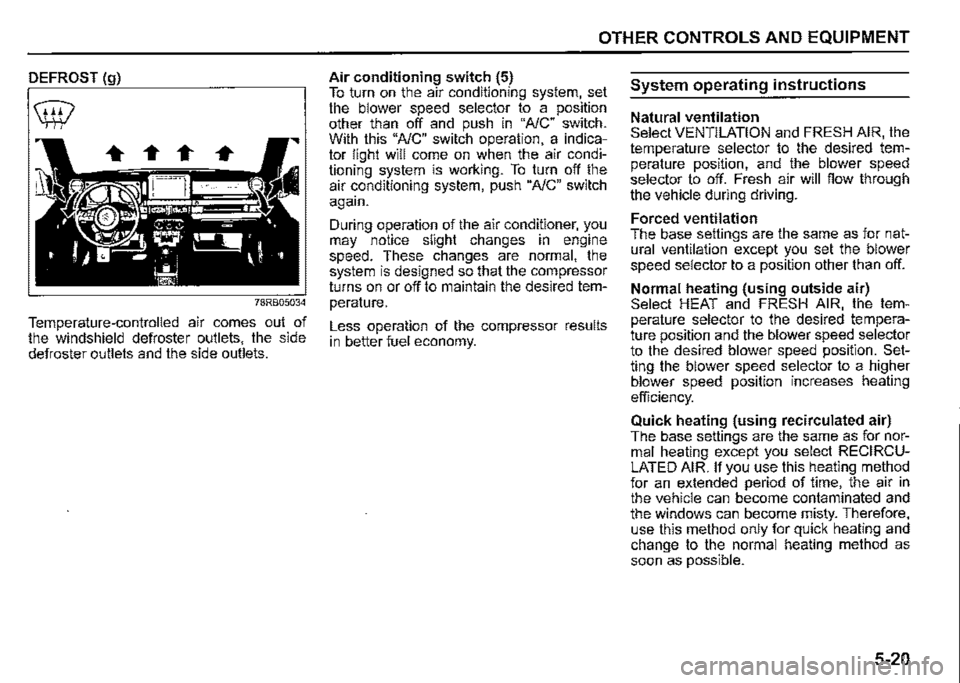
78RB05034
Temperature-controlled air comes out of the windshield defroster outlets, the side defroster outlets and the side outlets.
OTHER CONTROLS AND EQUIPMENT
Air conditioning switch (5) To turn on the air conditioning system, set the blower speed selector to a position other than off and push in "NC" switch. With this "NC" switch operation, a indicator light will come on when the air conditioning system is working. To turn off the air conditioning system, push "NC" switch again.
During operation of the air conditioner, you may notice slight changes in engine speed. These changes are normal, the system is designed so that the compressor turns on or off to maintain the desired temperature.
Less operation of the compressor results in better fuel economy.
System operating instructions
Natural ventilation Select VENTILATION and FRESH AIR, the temperature selector to the desired temperature position, and the blower speed selector to off. Fresh air will flow through the vehicle during driving.
Forced ventilation The base settings are the same as for natural ventilation except you set the blower speed selector to a position other than off.
Normal heating (using outside air) Select HEAT and FRESH AIR, the temperature selector to the desired temperature position and the blower speed selector to the desired blower speed position. Setting the blower speed selector to a higher blower speed position increases heating
efficiency.
Quick heating (using recirculated air) The base settings are the same as for normal heating except you select RECIRCULATED AIR. If you use this heating method for an extended period of time, the air in the vehicle can become contaminated and the windows can become misty. Therefore, use this method only for quick heating and change to the normal heating method as soon as possible.
5-20
Page 256 of 421
OTHER CONTROLS AND EQUIPMENT
Head cooled/Feet warmed heating Select BI-LEVEL and FRESH AIR, the temperature selector to the desired temperature position, and the blower speed selector to the desired blower speed position. Unless the temperature selector is in the fully cold position or fully hot position, the air that comes out of the center and side outlets will be cooler than the air that comes out of the floor outlets.
Normal cooling Set the air flow selector to VENTILATION, the temperature selector to the desired temperature position and the blower speed selector to the desired blower speed position, and turn on "NG" switch. Setting the blower speed selector to a higher blower speed position increases cooling efficiency.
You can switch the air intake selector to either FRESH AIR or RECIRCULATED AIR as you desire. Choosing RECIRCULATED AIR increases cooling efficiency.
Quick cooling (using recirculated air) The base settings are the same as for normal cooling except you select RECIRCULATED AIR and the highest blower speed.
NOTE: If you select RECIRCULATED AIR for an extended period of time, the air in the vehicle can become contaminated and the windows tend to get misted. Therefore, you should select FRESH AIR whenever possible.
5-21
If your vehicle has been left in the sun with the windows closed, it will cool faster if you open the windows briefly while you operate the air conditioner with the air intake selector at FRESH AIR and the blower at high speed.
Dehumidifying Set the air flow selector to a desired air flow selector position, the temperature selector to the desired temperature position and the blower speed selector to the desired blower speed position. Also select FRESH AIR and turn on "NG" switch.
NOTE: Because the air conditioner dehumidifies the air, turning it on will help keep the windows clear, even when blowing heated air using DEFROST or HEAT & DEFROST functions.
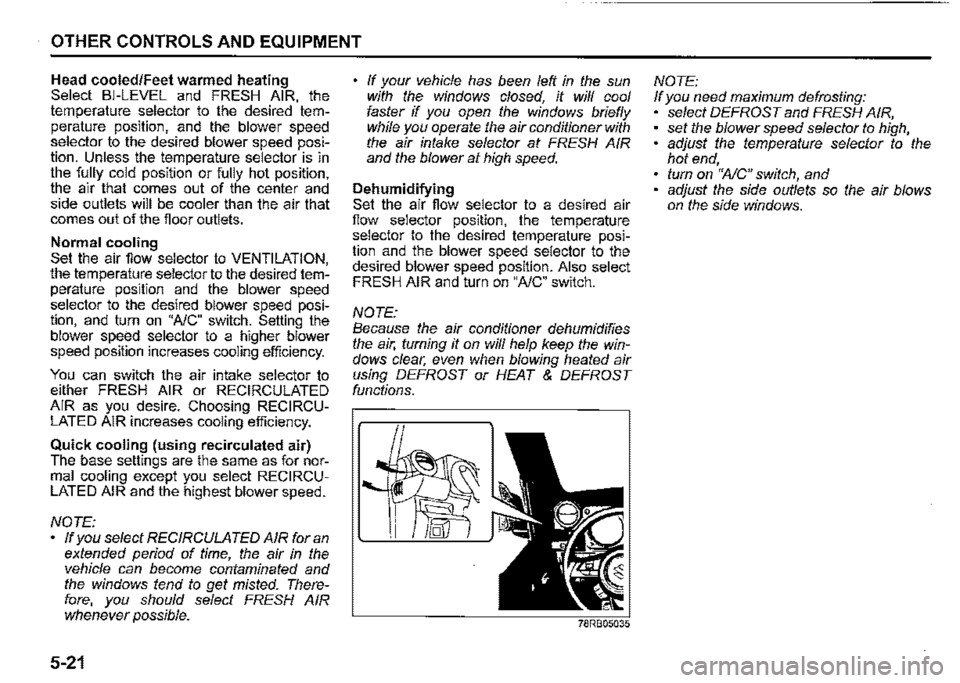
NOTE: If you need maximum defrosting: select DEFROST and FRESH AIR, set the blower speed selector to high, adjust the temperature selector to the hot end, turn on 'WC" switch, and adjust the side outlets so the air blows on the side windows.
Page 258 of 421

OTHER CONTROLS AND EQUIPMENT
Automatic heating and air conditioning system
{climate control)
Description of controls
(5) (4) (9) (7) (8)
MODE OFF
'm' 0 fR
(2) (3) (6) (1)
5-23
78RB05036
(1) Temperature selector (2) Blower speed selector (3) Air intake selector (4) Airfiow selector (5) Defrost switch (6) Air conditioning switch (7) "OFF" switch (8) "AUTO" switch (9) Display
Page 263 of 421
System operating instructions
Automatic operation
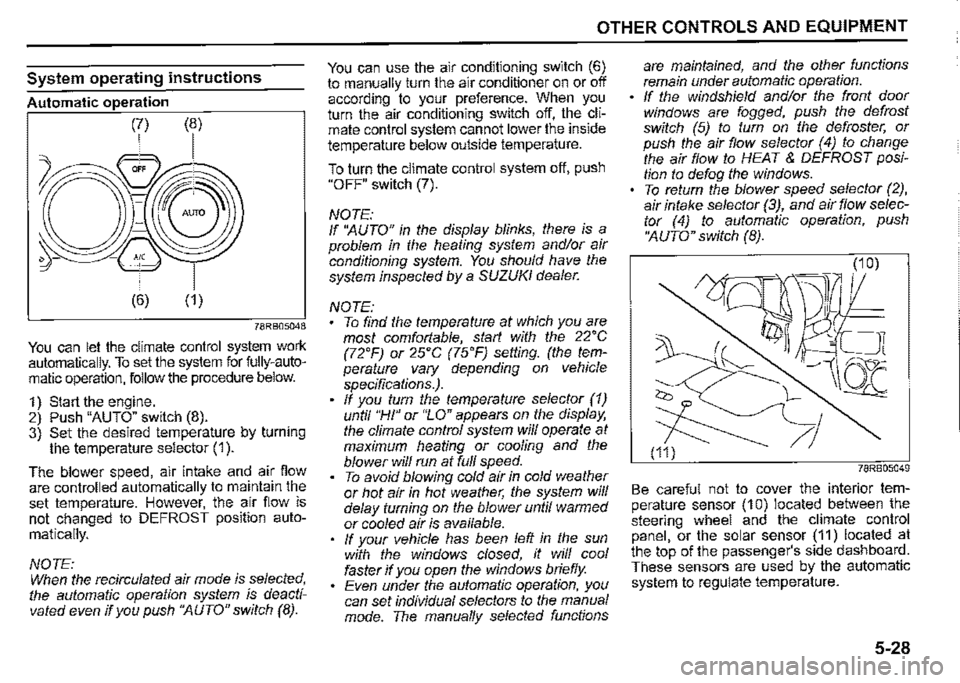
78RB05048
You can let the climate control system work automatically. To set the system for fully-automatic operation, follow the procedure below.
1) Start the engine. 2) Push "AUTO" switch (8). 3) Set the desired temperature by turning the temperature selector (1 ).
The blower speed, air intake and air flow are controlled automatically to maintain the set temperature. However, the air flow is not changed to DEFROST position auto
matically.
NOTE: When the recirculated air mode is selected, the automatic operation system is deactivated even if you push ''AUTO" switch (8).
OTHER CONTROLS AND EQUIPMENT
You can use the air conditioning switch (6) to manually turn the air conditioner on or off according to your preference. When you turn the air conditioning switch off, the climate control system cannot lower the inside temperature below outside temperature.
To turn the climate control system off, push "OFF" switch (7).
NOTE: If ''AUTO" in the display blinks, there is a problem in the heating system and/or air conditioning system. You should have the system inspected by a SUZUKI dealer.
NOTE: To find the temperature at which you are most comfortable, start with the 22'C (72'F) or 25'C (75'F) setting. (the temperature vary depending on vehicle specifications.). If you turn the temperature selector (1) until "HI" or "LO" appears on the display, the climate control system will operate at maximum heating or cooling and the blower will run at full speed. To avoid blowing cold air in cold weather or hot air in hot weather, the system will delay turning on the blower until warmed or cooled air is available. If your vehicle has been left in the sun with the windows closed, it will cool faster if you open the windows briefly. Even under the automatic operation, you can set individual selectors to the manual mode. The manually selected functions
are maintained, and the other functions remain under automatic operation. If the windshield and/or the front door windows are fogged, push the defrost switch (5) to turn on the defroster, or push the air flow selector (4) to change the air flow to HEAT & DEFROST position to defog the windows. To return the blower speed selector (2), air intake selector (3), and air flow selector (4) to automatic operation, push ''AUTO" switch (8).
78RB05049
Be careful not to cover the interior temperature sensor (10) located between the steering wheel and the climate control panel, or the solar sensor (11) located at the top of the passenger's side dashboard. These sensors are used by the automatic system to regulate temperature.
5-28
Page 290 of 421
OTHER CONTROLS AND EQUIPMENT
Listening to files stored in a USB device
Type A ---------r,
(1)
(7)(5)(6)
TypeB -._----------,..,,_
,,, lb 1_ --~'
(7)(5)(6)
5-55
(3) (4)
(2)
(3)
(4) (1),rc=-'
(2)
(7)(5)(6)
(3) (4)
(2)
78RB05063
Display
(A) (B) I I
I
USB F001-002
I Mf'3 0: ,13
<6) (c)
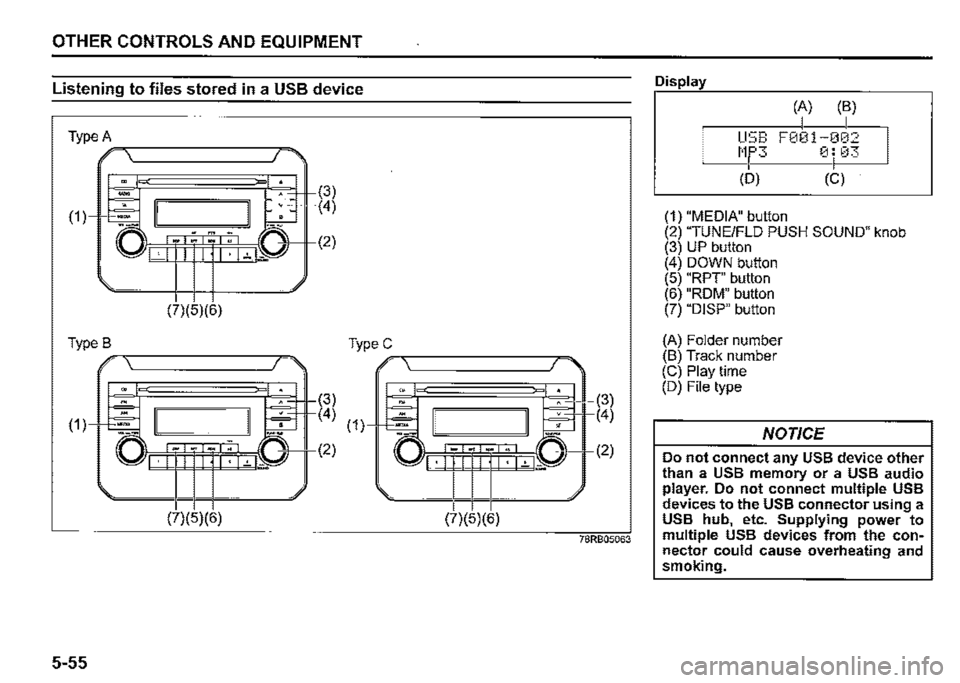
(1) "MEDIA" button (2) 'TUNE/FLO PUSH SOUND" knob (3) UP button (4) DOWN button (5) "RPT' button (6) "RDM" button (7) "DISP" button
{A) Folder number (B) Track number (C) Play time (D) File type
NOTICE
Do not connect any USB device other than a USB memory or a USB audio player. Do not connect multiple USB devices to the USB connector using a USB hub, etc. Supplying power to multiple USB devices from the connector could cause overheating and smoking.
Page 323 of 421
INSPECTION AND MAINTENANCE
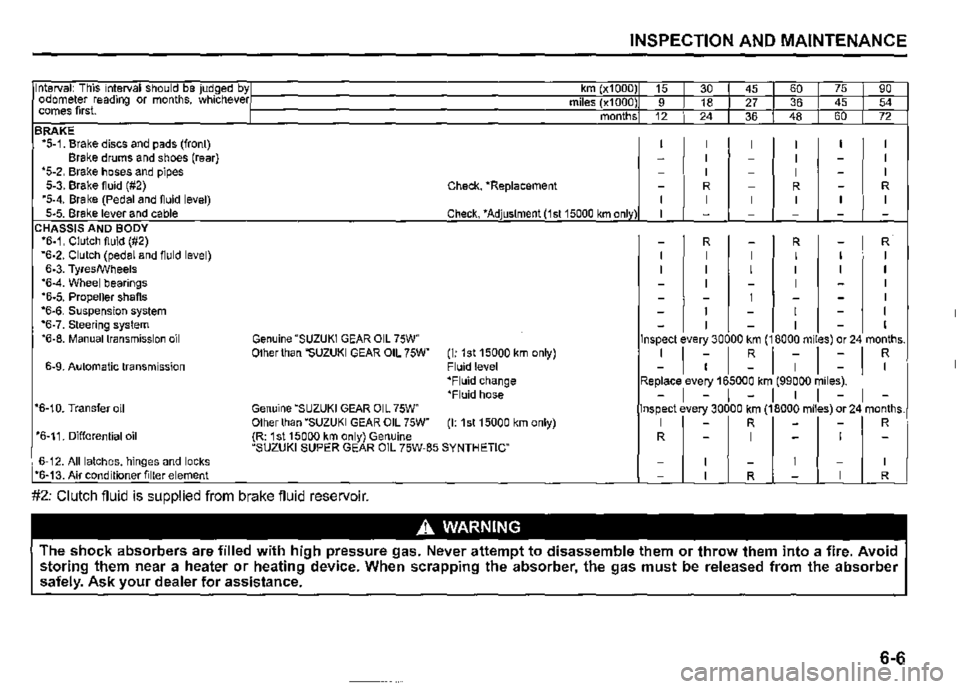
Interval: This interval should be judged byI km (x1000)I 15 I 30 I 45 I 60 I 75 90 odometer reading or months, whichever, miles (x1000)I 9 I 18 I 27 I 36 I 45 54 comes first. 1 monthsI 12 I 24 I 36 I 48 I 60 I 72 BRAKE *5-1. Brake discs and pads (front) I I I I I I Brake drums and shoes (rear) -I -I -I *5-2. Brake hoses and pipes -I -I -I 5-3. Brake fluid (#2) Check, *Replacement -R -R -R *5-4. Brake (Pedal and fluid level) I I I I I I 5-5. Brake lever and cable Check, *Adjustment (1st 15000 km only) I -----CHASSIS AND BODY *6-1. Clutch fluid (#2) -R -R -R *6-2. Clutch (pedal and fluid level) I I I I I I 6-3. Tyres/Wheels I I I I I I *6-4. Wheel bearings -I -I -I *6-5. Propeller shafts --I --I *6-6. Suspension system -I -I -I "6-7. Steering system -I -I -I *6-8. Manual transmission oil Genuine "SUZUKI GEAR OIL 75W" Inspect every 30000 km (18000 miles) or 24 months. Other than "SUZUKI GEAR OIL 75W" (1: 1st 15000 km only) I
I -I
R
I
-
I
-
I
R 6-9. Automatic transmission Fluid level -I -I -I *Fluid change Replace every 165000 km (99000 miles). *Fluid hose -I -I -I I I -I -*6-10. Transfer oil Genuine "SUZUKI GEAR OIL 75W" Inspect every 30000 km (18000 miles) or 24 months. Other than "SUZUKI GEAR OIL 75W" (I: 1st 15000 km only) I -R --R *6-11. Differential oil (R: 1 st 15000 km only) Genuine "SUZUKI SUPER GEAR OIL 75W-85 SYNTHETIC" R -I -I -
6-12. All latches, hinges and locks -I -I -I *6-13. Air conditioner filter element -I R -I R
#2: Clutch fluid is supplied from brake fluid reservoir.
A WARNING
The shock absorbers are filled with high pressure gas. Never attempt to disassemble them or throw them into a fire. Avoid storing them near a heater or heating device. When scrapping the absorber, the gas must be released from the absorber safely. Ask your dealer for assistance.
6-6