towing SUZUKI JIMNY 2022 User Guide
[x] Cancel search | Manufacturer: SUZUKI, Model Year: 2022, Model line: JIMNY, Model: SUZUKI JIMNY 2022Pages: 421, PDF Size: 6.35 MB
Page 249 of 421

Frame hooks
It is not recommended that you use the frame hooks for towing another vehicle. They were originally designed to tow your vehicle in emergency situation. If your vehicle needs to be towed in an emergency, refer to "Towing your vehicle (recreational vehicle)" in "EMERGENCY SERVICE" section.
A WARNING
Observe the following instructions when using frame hooks. The frame hook or vehicle body may break and cause serious injury or damage: • Do not use the frame hooks for towing another vehicle. Avoid pulling the vehicle to get out of severe snowy, muddy or sandy conditions, sudden starts or erratic driving maneuvers which could cause excessive stress on the frame hook.
In such case, we recommend that you contact a professional service.
OTHER CONTROLS AND EQUIPMENT
Front
78RB05023
NOTICE
When you use the frame hook (1), avoid the driving that gives significant physical shock on hook. Such operation can damage the hook, or the vehicle body. Do not sudden accelerate.
78RB05054
The hook (A) is provided for trailer/train/ sea shipping purposes only.
NOTICE
Do not use the hook (A) in emergency situation. If you use this hook (A), the hook or the vehicle may be damaged.
5-14
Page 325 of 421
INSPECTION AND MAINTENANCE
Maintenance recommended under severe driving conditions (except for EU countries and Israel)
Follow this schedule if your vehicle is mainly operated under one or more of the following conditions: • When most trips are less than 6 km (4 miles). • When most trips are less than 16 km (10 miles) and outside temperature remains below freezing. Idling and/or low-speed operation in stop-and-go traffic. Operating in extremely cold weather and/or on salted roads. Operating in rough and/or muddy areas. Operating in dusty areas. Repeated high speed drive or high engine revolutions. Towing a trailer, if admitted. Schedule should also be followed if the vehicle is used for delivery service, police, taxi or other commercial applications.
NdTE: For the Maintenance Recommended under Severe Driving Conditions of Russian models, refer to "For Russia" in the "SUPPLEMENT" section.
6-8
Page 335 of 421
INSPECTION AND MAINTENANCE
Maintenance recommended under severe driving conditions (for EU countries and Israel)
Follow this schedule if your vehicle is mainly operated under one or more of the following conditions:
• When most trips are less than 6 km (4 miles). When most trips are less than 16 km (1 O miles) and outside temperature remains below freezing.
Idling and/or low-speed operation in stop-and-go traffic. Operating in extremely cold weather and/or on salted roads. Operating in rough and/or muddy areas. Operating in dusty areas. Repeated high speed drive or high engine revolutions. Towing a trailer, if admitted. Schedule should also be followed if the vehicle is used for delivery service, police, taxi or other commercial applications.
6-18
Page 377 of 421
EMERGENCY SERVICE
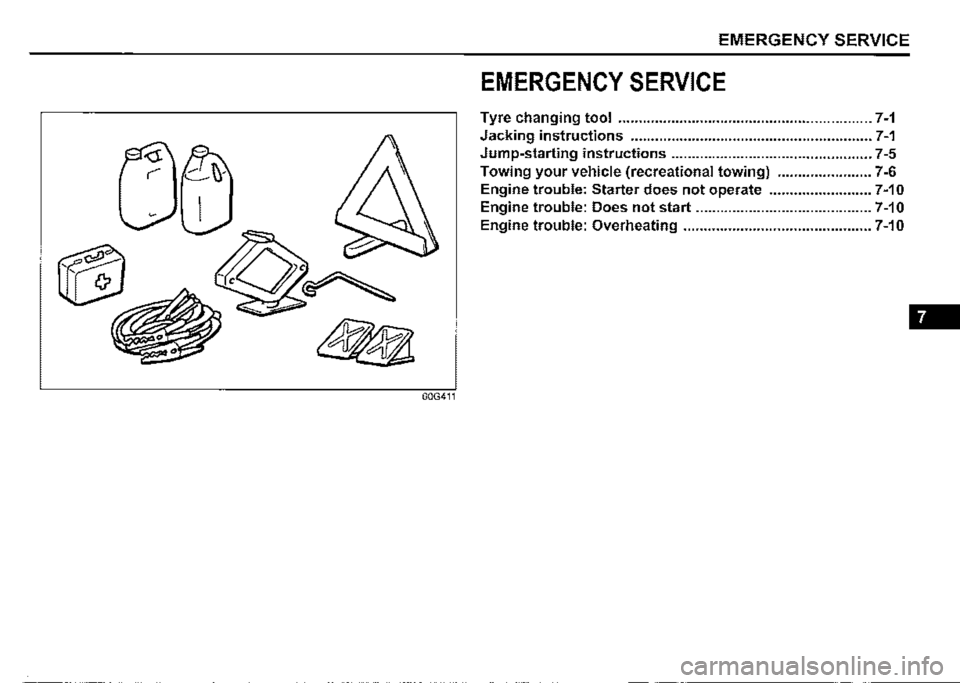
EMERGENCY SERVICE
Tyre changing tool .............................................................. 7-1
CJ~
Jacking instructions ........................................................... 7-1
Jump-starting instructions ................................................. 7-5
Towing your vehicle (recreational towing) ....................... 7-6
Engine trouble: Starter does not operate ......................... 7-10
Engine trouble: Does not start ........................................... 7-10
Engine trouble: Overheating .............................................. 7-10
·. ~ -
60G411
Page 382 of 421
EMERGENCY SERVICE
A. WARNING
Use genuine wheel nuts and tighten them to the specified torque as soon as possible after changing wheels. Incorrect wheel nuts or improperly tightened wheel nuts may come loose or fall off, which can result in an accident. If you do not have a torque wrench, have the wheel nut torque checked by a SUZUKI dealer.
7-5
Jump-starting instructions
A. WARNING
Never attempt to jump-start your vehicle if the lead-acid battery appears to be frozen. Batteries in this condition may explode. When making jump lead connections, check that your hands and the jump leads remain clear from pulleys, belts or fans. Lead-acid batteries produce flammable hydrogen gas. Keep flames and sparks away from the battery or an explosion may occur. Never smoke when working near the battery. If the booster battery you use for jump-starting is installed in another vehicle, check that the two vehicles are not touching each other. If your lead-acid battery discharges repeatedly, for no apparent reason, have your vehicle inspected by a SUZUKI dealer. • To avoid harm to yourself or damage to your vehicle or battery, follow the jump-starting instructions below. If you are in doubt, call for qualified road service.
NOTICE
Your vehicle should not be started by pushing or towing. This starting method could result in permanent damage to the catalytic converter. Use jump leads to start a vehicle with a weak or flat battery.
1) Use only a 12-volt lead-acid battery to jump-start your vehicle. Position the good 12-volt lead-acid battery close to your vehicle so that the jump leads will reach both batteries. When using a battery installed on another vehicle, check that two vehicles do not touch each other. Set the parking brakes fully on both vehicles. 2) Turn off all vehicle accessories, except those necessary for safety reasons (for example, headlights or hazard lights).
Page 383 of 421
78R808004
3) Connect jump leads as follows:
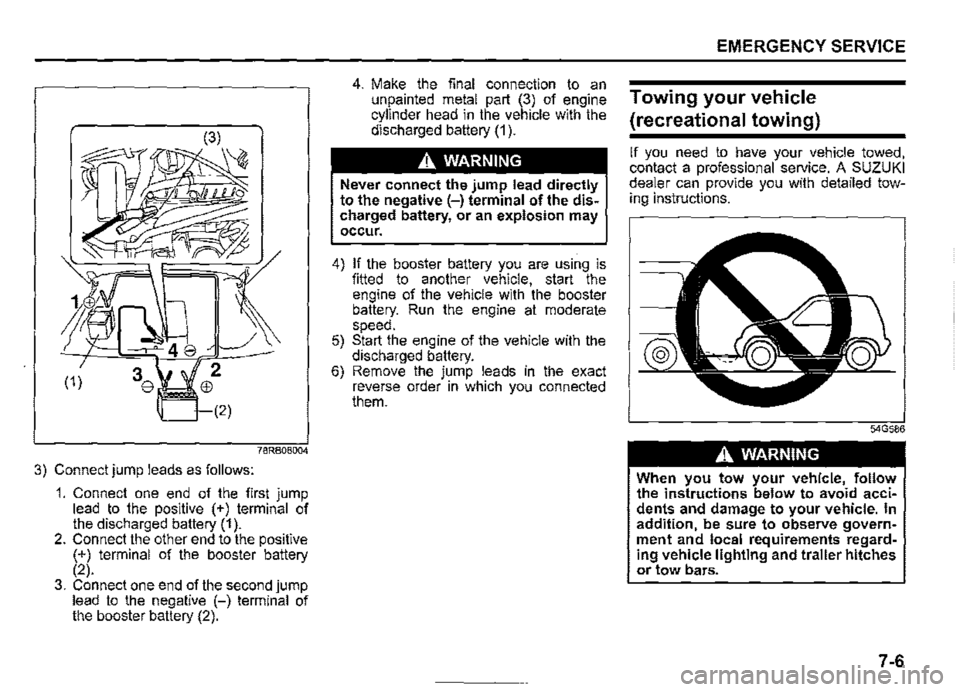
1. Connect one end of the first jump lead to the positive (+) terminal of the discharged battery (1 ). 2. Connect the other end to the positive (+) terminal of the booster battery (2). 3. Connect one end of the second jump lead to the negative (-) terminal of the booster battery (2).
4. Make the final connection to an unpainted metal part (3) of engine cylinder head in the vehicle with the discharged battery (1 ).
A WARNING
Never connect the jump lead directly to the negative (-) terminal of the discharged battery, or an explosion may occur.
4) If the booster battery you are using is fitted to another vehicle, start the engine of the vehicle with the booster battery. Run the engine at moderate speed. 5) Start the engine of the vehicle with the discharged battery. 6) Remove the jump leads in the exact reverse order in which you connected them.
EMERGENCY SERVICE
Towing your vehicle
(recreational towing)
If you need to have your vehicle towed, contact a professional service. A SUZUKI dealer can provide you with detailed towing instructions.
A WARNING
When you tow your vehicle, follow the instructions below to avoid accidents and damage to your vehicle. In addition, be sure to observe government and local requirements regarding vehicle lighting and trailer hitches or tow bars.
7-6
Page 384 of 421

EMERGENCY SERVICE
A safety chain should always be used when you tow your vehicle.
NOTICE
Do not tow your vehicle with the rear wheels directly on the ground (and the transmission in neutral). If you do, the transmission will be damaged fatally.
7-7
--------·--··---------------
A WARNING
For vehicles equipped with the dual sensor brake support, if your vehicle is towed with the engine on, press dual sensor brake support OFF switch and turn off the dual sensor brake support. If not, accidents related to the system being turned on may occur.
NOTICE
Observe the following instructions when towing your vehicle. To help avoid damage to your vehicle during towing, proper equipment and towing procedures must be used. • Using the frame hook, tow your vehicle on paved roads for short distances at low speed.
Before towing
78RB08008
If you tow your vehicle with the front wheels on the ground, shift the transmission into Neutral and make sure the 4WD indicator on the instrument cluster comes on when you use the transfer lever to shift into 4-wheel drive high range position ("4H") and goes off when you use the transfer lever to shift into 2-wheel high drive position ("2H") with the engine running. If the 4WD indicator does not come on or it does not go off, that means, the airlocking hubs cannot be locked or unlocked, the vehicle must be towed with the front wheels lifted and the rear wheels on a dolly.
Page 385 of 421

Towing a Disabled Vehicle
If your vehicle is disabled, and if the steering and drive train are in good condition (and the engine can be started for 4WD vehicles), the vehicle can be towed according to the instructions in this section. Your vehicle may also be towed by a tow truck with the front or rear wheels lifted, according to the instructions below.
Front wheels lifted (all models)
54G279
Front wheels lifted Your vehicle may be towed by a tow truck with the front wheels lifted and a dolly under the rear wheels.
EMERGENCY SERVICE
7-8
Page 386 of 421

EMERGENCY SERVICE
Rear wheels lifted (all models)
"ON"__.. "ACC"
UNLOCKED
78RB08006
7-9
Rear wheels lifted Your vehicle may be towed by a tow truck with the rear wheels lifted and the front wheels on the ground. Towing speed should not exceed 90 km/h (55 mph).
For this type of towing: 1) Shift the manual transmission to Neutral or the automatic transmission to "P" position and start the. engine. 2) Shift the transfer lever to 2WD position ("2H"). 3) Make sure the 4WD indicator on the instrument cluster is turned off.
NOTICE
If the air-locking hubs cannot be unlocked, tow the vehicle with the rear wheels lifted and a dolly under the front wheels.
4) Turn the ignition key to the "ACC" position to stop the engine and to unlock the steering wheel.
NOTICE
The steering column lock is not strong enough to withstand shocks transmitted from the front wheels during towing.
5) Make sure the front wheels are facing straight forward and secure the steering wheel with a steering wheel clamping device designed for towing service.
Page 415 of 421
INDEX
Seat belt warning ................................................................. 10-3 Transfer lever ....................................................................... 3-16
Seat belts and child restraint systems ................................ 1-7 Transfer oil.. .......................................................................... 6-31
Seat position adjustment lever ............................................. 1-3 Trip meter ..................................................................... 2-20, 2-32
Seatback angle adjustment lever ......................................... 1-3 Turn signal control lever ..................................................... 2-66
Selection of coolant. ............................................................ 6-28 Turn signal indicators .......................................................... 2-52
Selector position/ Gearshift indicator ............................... 2-19 Turn signal operation .......................................................... 2-66
Setting mode ........................................................................ 2-23 Tyre changing tool ................................................................. 7-1
Side airbags and side curtain airbags ............................... 1-41 Tyre inspection ..................................................................... 6-37
Side door locks ...................................................................... 2-2 Tyre pressure monitoring system (TPMS) ......................... 3-63
Side turn signal light ........................................................... 6-49 Tyre rotation ......................................................................... 6-38
Spark plugs .......................................................................... 6-30 Tyres ...................................................................................... 6-36
Specified oil .......................................................................... 6-23 u Speed limiter ........................................................................ 3-25 USB socket ............................................................................. 5-7 Speedometer ............................................................... 2-16, 2-26 Using transmission ................................................................ 3-8 Stability control system ...................................................... 3-56 V Starting engine ....................................................................... 3-7
Steering wheel ..................................................................... 6-36 Vehicle cleaning ..................................................................... 8-2
Vehicle identification ............................................................. 9-1 Sun visor ................................................................................ 5-4
Supplemental restraint system (airbags) .......................... 1-35
SUZUKI SAFETY SUPPORT ................................................ 3-27
T
Tachometer ................................................................. 2-16, 2-26
Tailgate ................................................................................... 2-3
Theft deterrent alarm system ............................................... 2-8
Vehicle swaying warning ..................................................... 3-34
w
Warning and indicator lights ............................................... 2-39
Warning and indicator messages ....................................... 2-35
Washing .................................................................................. 8-4
Waxing .................................................................................... 8-6
Windows ............................................................................... 2-10 Theft deterrent light ............................................................. 2-10 Windshield washer ............................................................... 2-68 Thermometer ............................................................... 2-19, 2-29 Windshield washer fluid ...................................................... 6-57 Tilt steering lock lever. ........................................................ 2-70
Towing your vehicle (recreational towing) .......................... 7-6
Traction control system ...................................................... 3-56
Traffic sign recognition ....................................................... 3-39
Trailer towing ....................................................................... 2-72
Windshield wiper and washer lever ................................... 2-67
Windshield wipers ................................................................ 2-68
Wiper and washer operation ............................................... 2-68
Wiper blades ......................................................................... 6-54
11-5