Instrument SUZUKI JIMNY 2022 Owner's Manual
[x] Cancel search | Manufacturer: SUZUKI, Model Year: 2022, Model line: JIMNY, Model: SUZUKI JIMNY 2022Pages: 421, PDF Size: 6.35 MB
Page 196 of 421

OPERATING YOUR VEHICLE
Laser explanatory label
Max overage power: 45 mW Pulse duration: 33 ns Wavelength: 905 nm
IEC 60825-1 :2007 Complies with FDA performance standards for laser products except for deviations pursuant to Laser Notice No. 50, dated Ju!y 26'", 2001
52RM30510
Laser emission data Maximum average power: 45 mW Pulse duration: 33 ns Wave length: 905 nm Divergence (horizontal x vertical): 28' x 12'
NOTE: The detection of the vehicle and an obstacle in front of you, partition lines ·on the road by the dual sensor is limited within the visual range. It also takes several seconds to detect and activate the alert after an object is appeared in the visual range of the dual sensor.
3-45
Laser classification label
INVISIBLE LASER RADIATION DO NOT VIEW DIRECTLY WITH OPTICAL INSTRUMENTS (MAGNIFIERS) CLASS 1M LASER PRODUCT
52RM30520
A WARNING
Do not stick a sticker or a film (including transparent thing) on the front of dual sensor of the outside windshield as shown in the below illustration.
78RB03013
(1) (2) Prohibited area
The prohibited area (1) and (2) are shown as below. (1) From top edge of windshield to dual sensor approximately 10 cm (3.9 inch) below of the bottom end of dual sensor (2) Approximately 20 cm (7.8 inch) from the center of dual sensor to right and left approximately 10 cm (3.9 inch)
A WARNING
Do not stick a sticker or a film (including transparent thing) below the dual sensor camera inside the windshield shown as following illustration.
Page 203 of 421
Emergency stop signal (ESS) (if equipped)
ESS stands for Emergency Stop Signal.
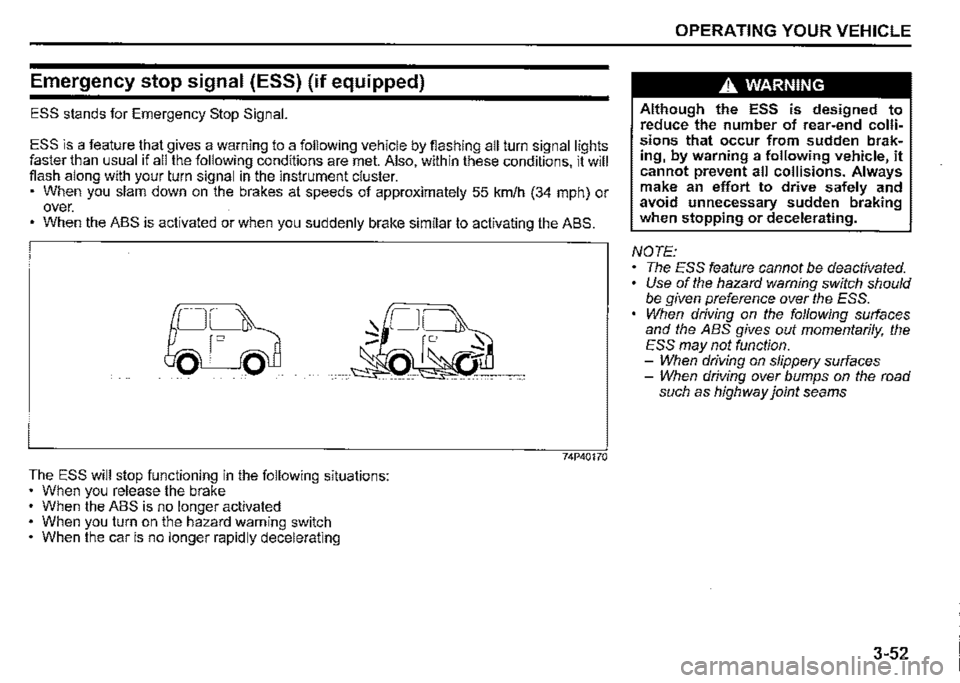
ESS is a feature t_hat gives a warning to a following vehicle by fiashing all turn signal lights faster than usual 1f all the following conditions are met. Also, within these conditions, it will fiash along with your turn signal in the instrument cluster. • When you slam down on the brakes at speeds of approximately 55 km/h (34 mph) or over. • When the ABS is activated or when you suddenly brake similar to activating the ABS.
The ESS will stop functioning in the following situations: • When you release the brake When the ABS is no longer activated When you turn on the hazard warning switch When the car is no longer rapidly decelerating
0
74P40170
OPERATING YOUR VEHICLE
A WARNING
Although the ESS is designed to reduce the number of rear-end collisions that occur from sudden braking, by warning a following vehicle, it cannot prevent all collisions. Always make an effort to drive safely and avoid unnecessary sudden braking when stopping or decelerating.
NOTE: The ESS feature cannot be deactivated. • Use of the hazard warning switch should be given preference over the ESS. When driving on the following surfaces and the ABS gives out momentarily, the ESS may not function. -When driving on slippery surfaces -When driving over bumps on the road such as highway joint seams
3-52
Page 206 of 421
OPERATING YOUR VEHICLE
A WARNING
If the ABS warning light (1) on the instrument cluster comes on and stays on while driving, there may be a problem with the ABS system. Ask a SUZUKI dealer to inspect the ABS system immediately. If the ABS system becomes inoperative, the brake system will function as an ordinary brake system that has no ABS. If the ABS warning light (1) and the brake system warning light (2) on the instrument cluster simultaneously stay on or come on while driving, both anti-lock function and rear brake force control function (proportioning valve function) of the ABS system may have failed. If so, the rear wheels may easily skid or the vehicle can even spin in the worst case when braking on a slippery road or when hard braking even on a dry paved road. Ask a SUZUKI dealer to inspect the ABS system immediately. Drive carefully, avoiding hard braking as much as possible.
3-55
How ABS works
A computer continuously monitors wheel speed. The computer compares the changes in wheel speed when braking. If the wheels slow suddenly. indicating a skidding situation, the computer will change braking pressure several times each second to prevent the wheels from locking. When you start your vehicle or when you accelerate after a hard stop. you may hear a momentary motor or clicking noise as the system resets or checks itself.
A WARNING
The ABS may not work properly if tyres or wheels other than those specified in the owner's manual are used. This is because the ABS works by comparing changes in wheel speed. When replacing tyres or wheels, use only the size and type specified in this owner's manual.
Electronic stability program
(ESP®)
ESP® is a registered trademark of Daimler
AG.
The Electronic Stability Program (ESP®) helps to control the vehicle during cornering if front wheels or rear wheels skid. It also assists you in maintaining traction while accelerating on loose or slippery road surfaces. It does this by regulating the engine's output, and by_ . selective!¥ applying the brakes. In add1t1on, ESP helps to avoid skidding by controlling braking pressure.
A WARNING
The ESP® cannot enhance the vehicle's driving stability in all situations and does not control your vehicle's entire braking system. The ESP® cannot prevent accidents, including those resulting from excessive speed in turns, or hydroplaning. Only safe and attentive drive can prevent accidents. The capabilities of an ESP®
equipped vehicle must never be used as a substitute for careful driving.
Page 209 of 421
ESP® OFF switch
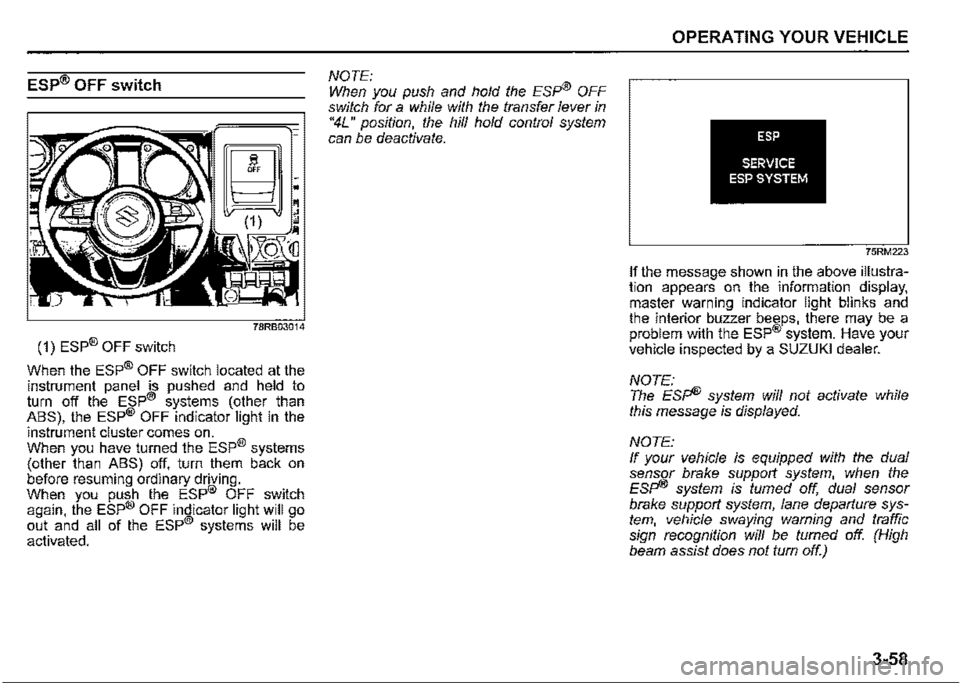
(1) ESP® OFF switch
When the ESP® OFF switch located at the instrument panel is pushed and held to turn off the ESP® systems (other than ABS), the ESP® OFF indicator light in the
instrument cluster comes on. When you have turned the ESP® systems (other than ABS) off, turn them back on before resuming ordinary driving. When you push the ESP® OFF switch again, the ESP® OFF indicator light will go out and all of the ESP® systems will be activated.
NOTE: When you push and hold the Esp® OFF switch for a while with the transfer lever in "4L" position, the hill hold control system can be deactivate.
OPERATING YOUR VEHICLE
ESP
SERVICE ESP SYSTEM
75RM223
If the message shown in the above illustration appears on the information display, master warning indicator light blinks and the interior buzzer beeps, there may be a problem with the ESP® system. Have your vehicle inspected by a SUZUKI dealer.
NOTE: The Esp® system will not activate while this message is displayed.
NOTE: If your vehicle is equipped with the dual sensor brake support system, when the Esp® system is turned off, dual sensor brake support system, lane departure system, vehicle swaying warning and traffic sign recognition will be fumed off. (High beam assist does not turn off.)
3-58
Page 210 of 421
OPERATING YOUR VEHICLE
ABS warning light/ brake system
warning light
See "Braking" in this section.
Hill descent control system
The hill descent control system is designed to reduce the driver's workload when going down steep, rough and/or slippery hills where the vehicle cannot decelerate enough by engine braking alone. The hill descent control system helps to control vehicle speed by automatically engaging the vehicle's brakes, as needed, so you can concentrate on steering the vehicle.
.A. WARNING
Do not rely excessively on the hill descent control system. The hill descent control system may not control the vehicle speed on a hill under all load or road conditions. Always be prepa!ed to control vehicle speed by applying the brakes. Failure to pay attention and control vehicle speed using the brakes when necessary may result in loss of control or an accident.
3-59
Hill descent control switch
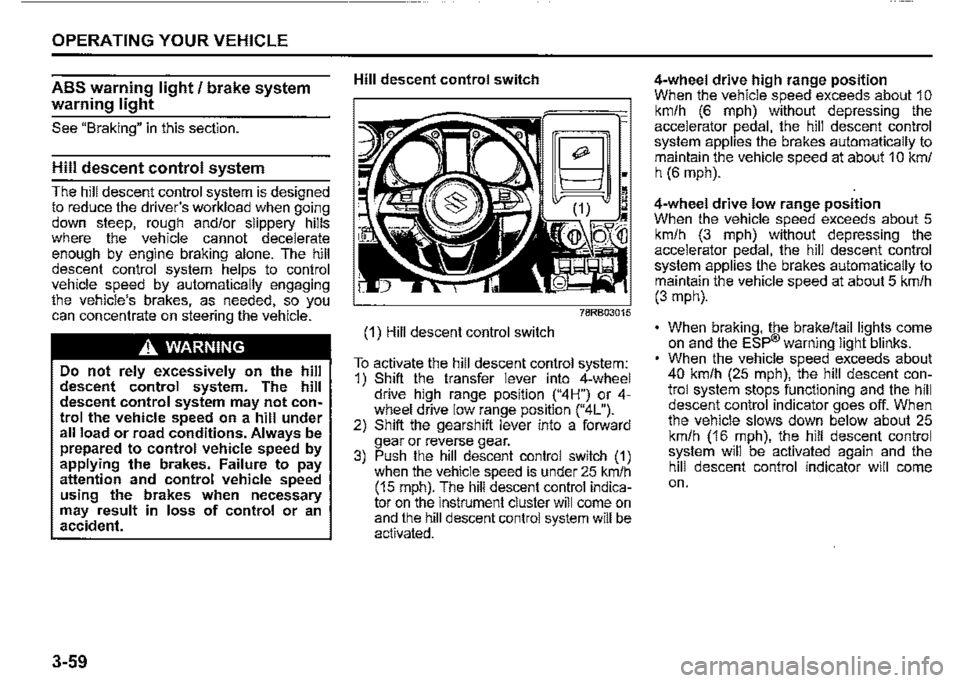
(1) Hill descent control switch
~;
~~~:~M
To activate the hill descent control system: 1) Shift the transfer lever into 4-wheel drive hiQh range position ("4H") or 4-wh!"el drive low '.ange position ("4L"). 2) Shift the gearsh1ft lever into a forward gear or reverse gear. 3) Push the hill descent control switch (1) when the vehicle speed is under 25 km/h (15 mph). The hill descent control indicator on the instrument cluster will come on and the hill descent control system will be activated.
4-wheel drive high range position When the vehicle speed exceeds about 1 o km/h (6 mph) without depressing the accelerator pedal, the hill descent control system applies the brakes automatically to maintain the vehicle speed at about 1 O km/ h (6 mph).
4-wheel drive low range position When the vehicle speed exceeds about 5 km/h (3 mph) without depressing the accelerator pedal, the hill descent control system applies the brakes automatically to maintain the vehicle speed at about 5 km/h (3 mph).
• When braking, the brake/tail lights come on and the ESP® warning light blinks. When the vehicle speed exceeds about 40 km/h (25 mph), the hill descent control system stops functioning and the hill descent control indicator goes off. When the vehicle slows down below about 25 km/h (16 mph), the hill descent control system will be activated again and the hill descent control indicator will come on.
Page 213 of 421
A WARNING
(Continued) After you release your foot from the brake pedal, accelerate the vehicle to move up immediately. If you release your foot from the brake pedal over 2 seconds, the hill hold control system will be canceled. If so, the vehicle may roll downward, which can result in an accident depending on the degree of slope. And, the engine may stall and the power assist for the steering and brakes will not work so steering and braking will be much harder than usual which can result in an accident or vehicle damage. If you drive on the steep slope, the gravel, the sclnow-covered road, or the muddy r I'd and the hill hold control system is activated, there may be a possibility that the wheels will be locked and then the vehicle may lose the control.
The hill hold control system activates for a maximum of about 2 seconds if your foot is moved from the brake pedal when the following conditions are all met.
1) The gearshift lever is in a forward gear or reverse gear. 2) The parking brake is released. 3) The vehicle is on an upward incline.
NOTE: When the hill hold control system is activated, the following conditions may be found, but this is not a malfunction. You may hear a sound from the engine room. As brake pedal becomes heavy, it may be difficult for you to depress it.
ESP
HILL HOLD DISABLE
75RM224
If the message shown in the above illustration appears on the information display, master warning indicator light blinks and the interior buzzer beeps, there may be a problem with the hill descent control system and the hill hold control system. Have your vehicle inspected by a SUZUKI dealer.
NOTE: The hill hold control system will not activate while this message is displayed.
OPERATING YOUR VEHICLE
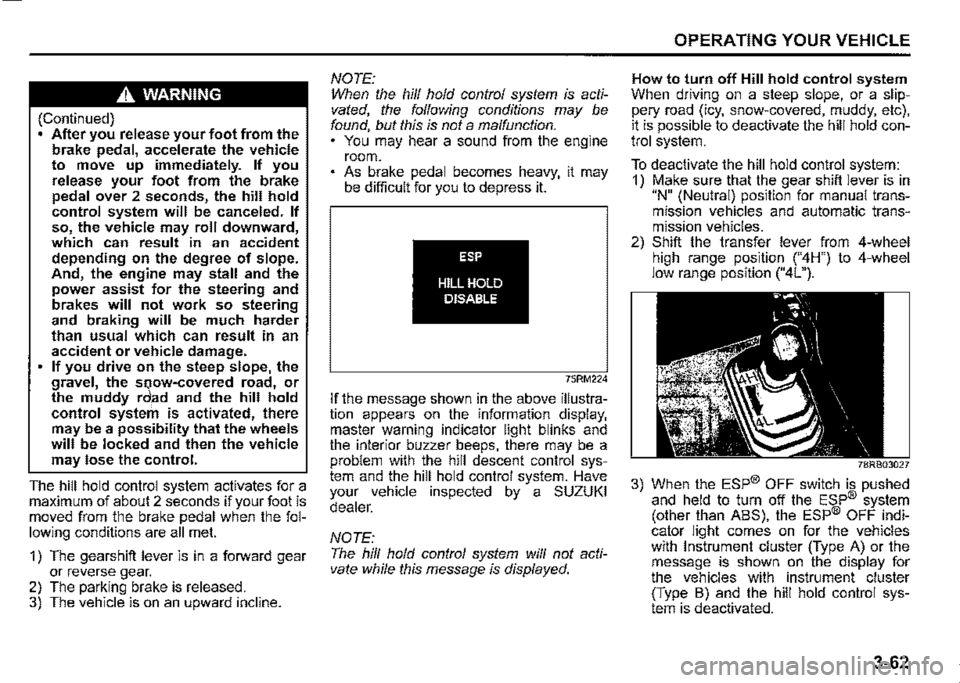
How to turn off Hill hold control system When driving on a steep slope, or a slippery road (icy, snow-covered, muddy, etc), it is possible to deactivate the hill hold control system.
To deactivate the hill hold control system: 1) Make sure that the gear shift lever is in "N" (Neutral) position for manual transmission vehicles and automatic transmission vehicles. 2) Shift the transfer lever from 4-wheel high range position ("4H") to 4-wheel low range position ("4L").
78RB03027
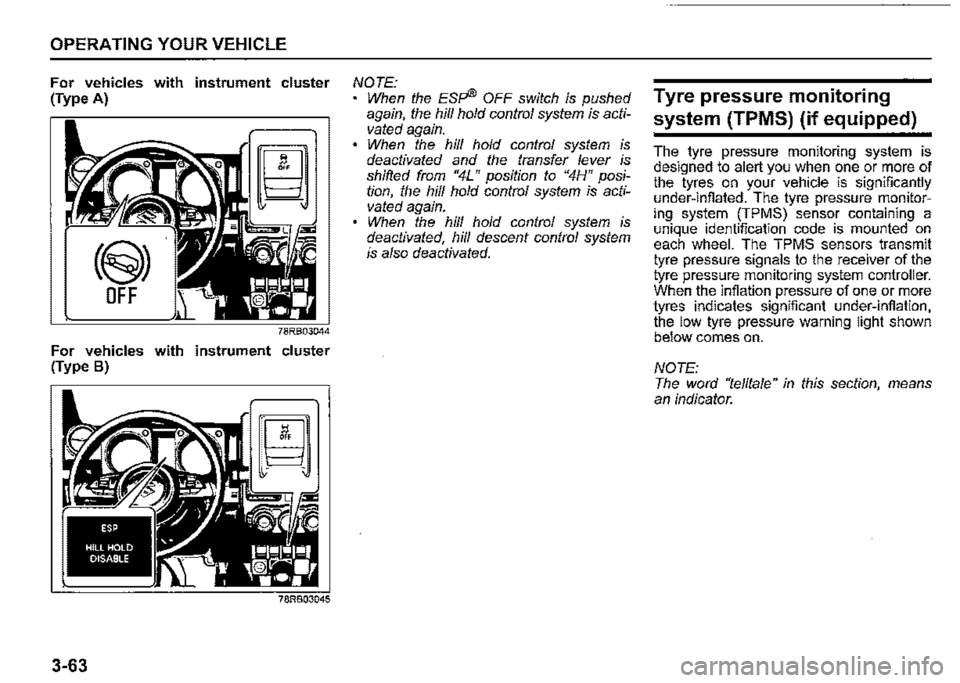
3) When the ESP® OFF switch is pushed and held to turn off the ESP® system (other than ABS), the ESP® OFF indicator light comes on for the vehicles with Instrument cluster (Type A) or the message is shown on the display for the vehicles with instrument cluster (Type B) and the hill hold control system is deactivated.
3-62
Page 214 of 421
OPERATING YOUR VEHICLE
For vehicles with instrument cluster (Type A)
For vehicles with instrument cluster (Type B)
78RB03045
3-63
NOTE: • When the ESffe OFF switch is pushed again, the hill hold control system is activated again. When the hill hold control system is deactivated and the transfer lever is shifted from "4L" position to "4H" position, the hill hold control system is activated again. When the hill hold control system is deactivated, hill descent control system is also deactivated.
Tyre pressure monitoring
system (TPMS) (if equipped)
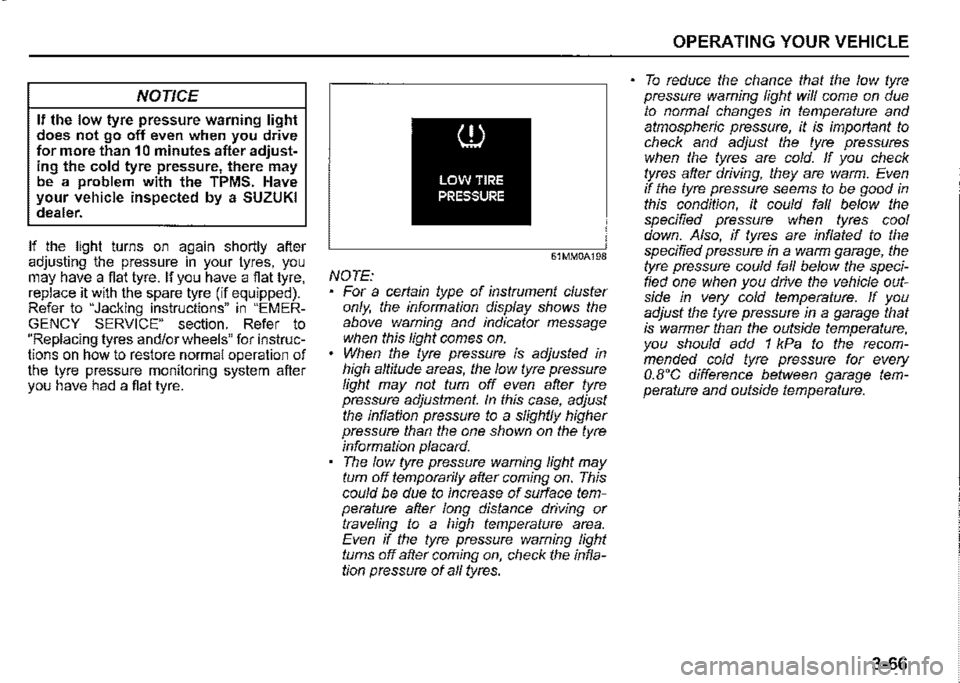
The tyre pressure monitoring system is designed to alert you when one or more of the tyres on your vehicle is significantly under-inflated. The tyre pressure monitoring system (TPMS) senso_r containing a unique identification code 1s mounted on each wheel. The TPMS sensors transmit tyre pressure signals to the receiver of the tyre pressure monitoring system controller. When the inflation pressure of one or more tyres indicates significant under-inflation, the low tyre pressure warning light shown below comes on.
NOTE: The word "telltale" in this section, means an indicator.
Page 217 of 421
NOTICE
If the low tyre pressure warning light does not go off even when you drive for more than 10 minutes after adjusting the cold tyre pressure, there may be a problem with the TPMS. Have your vehicle inspected by a SUZUKI dealer.
If the light turns on again shortly after adjusting the pressure in your tyres. you may have a flat tyre. If you have a flat tyre, replace it with the spare tyre (if equipped). Refer to "Jacking instructions" in "EMERGENCY SERVICE"" section. Refer to "Replacing tyres and/or wheels" for instructions on how to restore normal operation of the tyre pressure monitoring system after you have had a flat tyre.
61MM0A198
NOTE: For a certain type of instrument cluster only, the information display shows the above warning and indicator message when this light comes on. When the tyre pressure is adjusted in high altitude areas, the low tyre pressure light may not turn off even after tyre pressure adjustment. In this case, adjust the inflation pressure to a slightly higher pressure than the one shown on the tyre informaUon placard. The low tyre pressure warning light may turn off temporarily after coming on. This could be due to increase of surface temperature after long distance driving or traveling to a high temperature area. Even if the tyre pressure warning light turns off after coming on, check the inflation pressure of all tyres.
OPERATING YOUR VEHICLE
To reduce the chance that the low tyre pressure warning light will come on due to normal changes in temperature and atmospheric pressure, it is important to check and adjust the tyre pressures when the tyres are cold. If you check tyres after driving, they are warm. Even if the tyre pressure seems to be good in this condition, it could fall below the specified pressure when tyres cool down. Also, if tyres are inflated to the specified pressure in a warm garage, the tyre pressure could fall below the specified one when you drive the vehicle outside in very cold temperature. If you adjust the tyre pressure in a garage that is warmer than the outside temperature, you should add 1 kPa to the recommended cold tyre pressure for every O.B'C difference between garage temperature and outside temperature.
3-66
Page 218 of 421
OPERATING YOUR VEHICLE
TPMS malfunction indicator
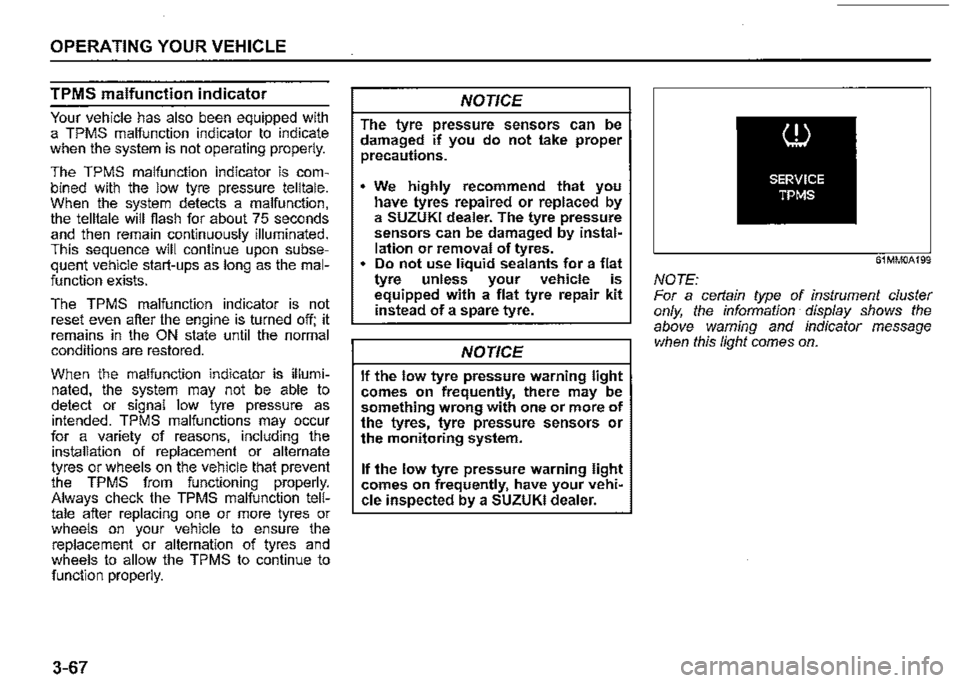
Your vehicle has also been equipped with a TPMS malfunction indicator to indicate when the system is not operating properly.
The TPMS malfunction indicator is combined with the low tyre pressure telltale. When the system detects a malfunction, the telltale will flash for about 75 seconds and then remain continuously illuminated. This sequence will continue upon subsequent vehicle start-ups as long as the malfunction exists.
The TPMS malfunction indicator is not reset even after the engine is turned off; it remains in the ON state until the normal conditions are restored.
When the malfunction indicator is illuminated, the system may not be able to detect or signal low tyre pressure as intended. TPMS malfunctions may occur for a variety of reasons, including the installation of replacement or alternate tyres or wheels on the vehicle that prevent the TPMS from functioning properly. Always check the TPMS malfunction telltale after replacing one or more tyres or wheels on your vehicle to ensure the replacement or alternation of tyres and wheels to allow the TPMS to continue to function properly.
3-67
NOTICE
The tyre pressure sensors can be damaged if you do not take proper precautions.
We highly recommend that you have tyres repaired or replaced by a SUZUKI dealer. The tyre pressure sensors can be damaged by installation or removal of tyres. • Do not use liquid sealants for a flat tyre unless your vehicle is equipped with a flat tyre repair kit instead of a spare tyre.
NOTICE
If the low tyre pressure warning light comes on frequently, there may be something wrong with one or more of the tyres, tyre pressure sensors or the monitoring system.
If the low tyre pressure warning light comes on frequently, have your vehi~ cle inspected by a SUZUKI dealer.
61MM0A199
NOTE: For a cerlain type of instrument cluster only, the information display shows the above warning and indicator message when this light comes on.
Page 219 of 421

TPMS limitations
The tyre pressure monitoring system may not function properly under certain circumstances. In the following situations, the low tyre pressure warning light may come on and remain on or may blink. When you replace a flat tyre with the spare tyre. When you include a spare tyre during a tyre rotation. When the TPMS sensor is damaged during a tyre replacement or liquid sealants are used to repair a flat tyre. When the electronic signal of TPMS sensor is disturbed in one of the following ways: -Electric devices or facilities using similar radio wave frequencies are nearby. -A metallic film that may cause radio wave interference is attached on the window. -A lot of snow or ice covers the vehicle, in particular, around the wheels or wheel housings. -Snow tyres that are not installed with genuine TPMS sensors or snow chains are used.
When you use non-genuine SUZUKI wheels or tyres. When the pressure of any tyre is too high. When there is a problem with the receiver of the TPMS controller.
TPMS setting (For instrument cluster -Type A)
You can set one of the initial value of tyre pressure below that is indicated on the tyre information label. -Comfort Mode -Load Mode
For details on how to set the mode, refer to "Setting mode" in "BEFORE DRIVING" section.
A WARNING
If the loading weight has changed, adjust the tyre pressure according to the tyre information label and set the initial value via the information display. If the loading weight, tyre pressure and initial value do not match, the tyre pressure monitoring system will not function properly.
OPERATING YOUR VEHICLE
TPMS setting (For instrument clus
ter• Type B)
• You can check the current tyre pressure on the information display. • You can set one of the initial value of tyre pressure below that is indicated on the tyre information label. -Comfort Mode
-Load Mode
A WARNING
If the loading weight has changed, adjust the tyre pressure according to the tyre information label and set the initial value via the information display. If the loading weight, tyre pressure and initial value do not nJatch, the tyre pressure monitoring system will not function properly.
3-68