full SUZUKI JIMNY 2022 Owners Manual
[x] Cancel search | Manufacturer: SUZUKI, Model Year: 2022, Model line: JIMNY, Model: SUZUKI JIMNY 2022Pages: 421, PDF Size: 6.35 MB
Page 3 of 421
FOREWORD
This manual should be considered as a permanent part of the vehicle and should remain with the vehicle when resold or otherwise transferred to a new owner or operator. Please read this manual carefully before operating your new SUZUKI vehicle and review the manual from time to time. It contains important information on safety, operation and maintenance.
SUZUKI MOTOR CORPORATION
All information in this manual is based on the latest product information available at the time of publication. Due to improvements or other changes1 there may be discrepancies between information in this manual and your vehicle. SUZUKI MOTOR CORPORATION reserves the right to make production changes at any time, without notice and without incurring any obligation to make the same or similar changes to vehicles previously built or sold.
This vehicle may not comply with standards or regulations of other countries. Before attempting to register this vehicle in any other country, check all applicable regulations and make any necessary modifications.
NOTE: Please see the warning label named "Airbag symbol meaning" in "BEFORE DRIVING" section for information on front airbag
protection.
IMPORTANT
A WARNING/ A CAUTION/NOTICE/ NOTE Please read this manual and follow its instructions carefully. To emphasize special information, the symbol A and the words WARNING, CAUTION, NOTICE and NOTE have special meanings. Pay particular attention to messages highlighted by these signal words:
A WARNING
Indicates a potential hazard that could result in death or serious injury.
A CAUTION
Indicates a potential hazard that could result in minor or moderate
injury.
NOTICE
Indicates a potential hazard that could result in vehicle damage.
NOTE: Indicates special information to make maintenance easier or instructions clearer.
Page 5 of 421
INTRODUCTION
Thank you for choosing SUZUKI product and welcome to our growing family. Your choice was a wise one; SUZUKI products have great
value that will give you driving pleasure for years.
This owner's manual was prepared to give you a safe, enjoyable, and trouble-free experience with your SUZUKI vehicle. In this manual, you will learn about the vehicle's operation, its safety features and maintenance requirements. Please read the manual carefully before operating your vehicle. Afterwards, keep this manual in the glove box for further reference.
Should you resell the vehicle, please leave this manual with it for the next owner.
In addition to the owner's manual, the other booklets provided with your SUZUKI vehicle explain the vehicle's warranties. We recom
mend you read them as well to familiarize yourself with this important information.
When planning the regular scheduled maintenance of your SUZUKI vehicle, we recommend you visit your local SUZUKI dealer. Their factory-trained technicians will provide the best possible service and use only genuine SUZUKI parts and accessories or their equiva
lents.
NOTE: "SUZUKI dealer'' means an Authorized Suzuki Dealer and an Authorized Suzuki Service Workshop. • The illustrations in this manual represent a typical variation, which may differ from your vehicle.
SUZUKI MOTOR CORPORATION
Page 27 of 421
Rear
t
~~
• II ,
78RB02010
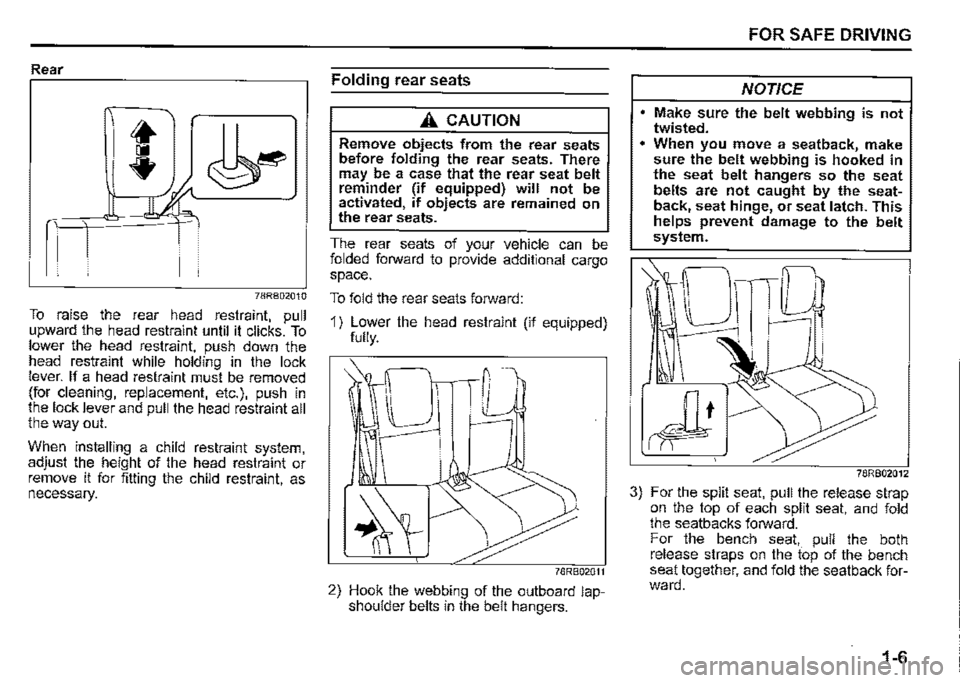
To raise the rear head restraint, pull upward the head restraint until it clicks. To lower the head restraint, push down the head restraint while holding in the lock lever. If a head restraint must be removed (for cleaning, replacement, etc.), push in the lock lever and pull the head restraint all the way out.
When installing a child restraint system, adjust the height of the head restraint or remove it for fitting the child restraint, as necessary.
Folding rear seats
A CAUTION
Remove objects from the rear seats before folding the rear seats. There may be a case that the rear seat belt reminder (if equipped) will not be activated, if objects are remained on the rear seats.
The rear seats of your vehicle can be folded forward to provide additional cargo space.
To fold the rear seats forward:
1) Lower the head restraint (if equipped) fully.
2) Hook the webbing of the outboard lapshoulder belts in the belt hangers.
FOR SAFE DRIVING
NOTICE
Make sure the belt webbing is not twisted. • When you move a seatback, make sure the belt webbing is hooked in the seat belt hangers so the seat belts are not caught by the seatback, seat hinge, or seat latch. This helps prevent damage to the belt system.
78RB02012
3) For the split seat, pull the release strap on the top of each split seat, and fold the seatbacks forward. For the bench seat, pull the both release straps on the fop of the bench seat together, and fold the seatback forward.
1-6
Page 28 of 421
FOR SAFE DRIVING
A. WARNING
If you need to carry cargo in the passenger compartment with the rear seatback folded forward, secure the cargo or it may be thrown about, causing injury. Never pile cargo higher than the seatbacks.
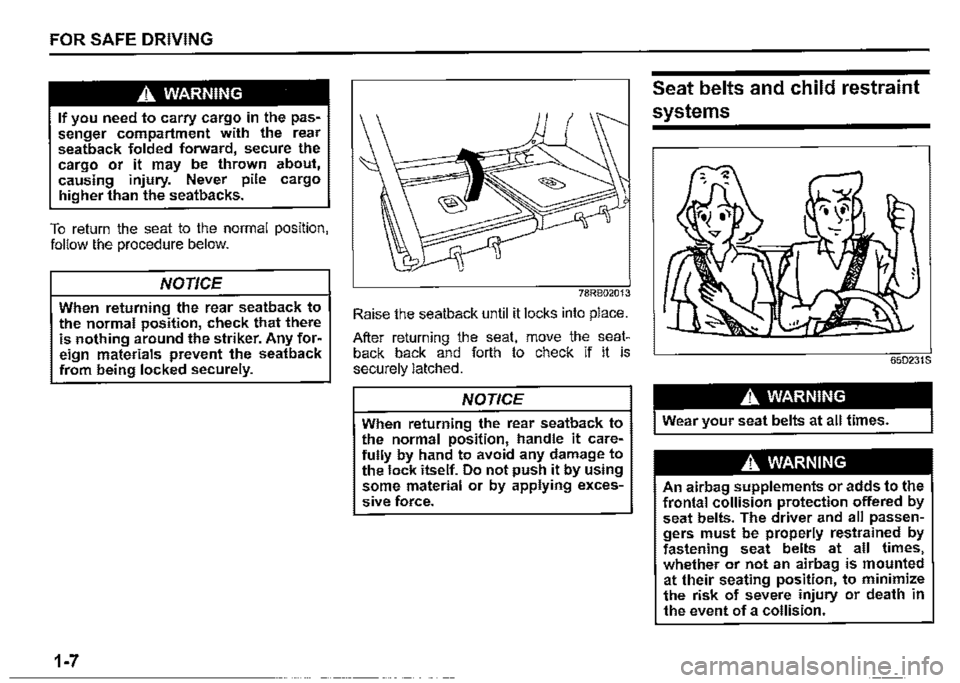
To return the seat to the normal position,
follow the procedure below.
NOTICE
When returning the rear seatback to the normal position, check that there is nothing around the striker. Any foreign materials prevent the seatback from being locked securely.
1-7
78RB02013
Raise the seatback until it locks into place.
After returning the seat, move the seatback back and forth to check if it is securely latched.
NOTICE
When returning the rear seatback to the normal position, handle it carefully by hand to avoid any damage to the lock itself. Do not push it by using some material or by applying exces
sive force.
Seat belts and child restraint
systems
650231S
A. WARNING
An airbag supplements or adds to the frontal collision protection offered by seat belts. The driver and all passengers must be properly restrained by fastening seat belts at all times, whether or not an airbag is mounted at their seating position, to minimize the risk of severe injury or death in the event of a collision.
Page 31 of 421
Lap-shoulder belt
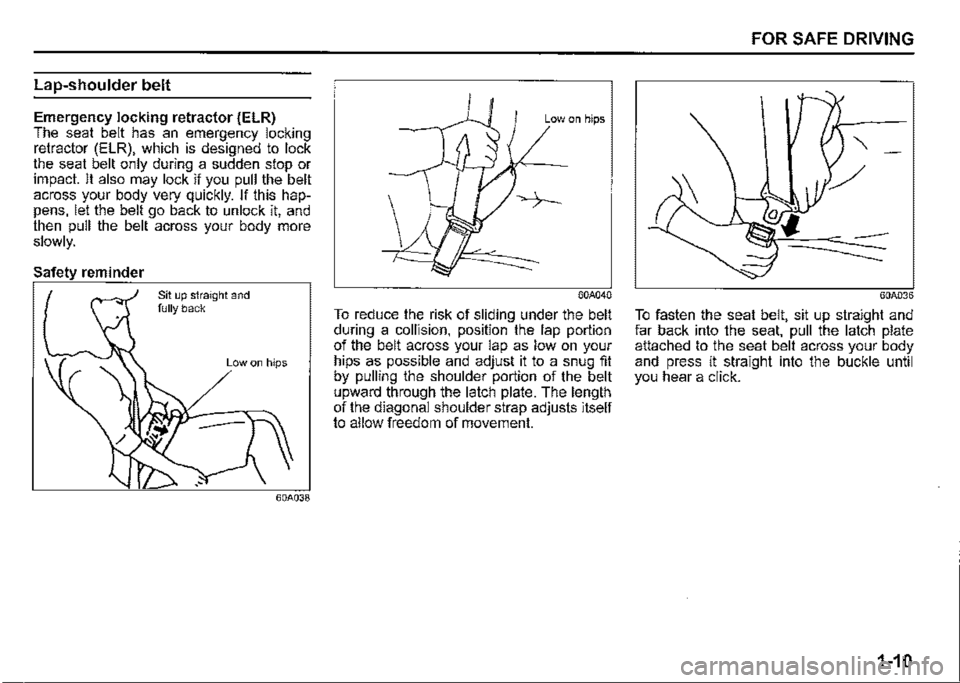
Emergency locking retractor {ELR) The seat belt has an emergency locking retractor {ELR), which is designed to lock the seat belt only during a sudden stop or impact. It also may lock if you pull the belt across your body very quickly. If this happens, let the belt go back to unlock it, and then pull the belt across your body more slowly.
Sit up straight and fully back
Low on hips
60A038
60A040
To reduce the risk of sliding under the belt during a collision, position the lap portion of the belt across your lap as low on your hips as possible and adjust it to a snug fit by pulling the shoulder portion of the belt upward through the latch plate. The length of the diagonal shoulder strap adjusts itself to allow freedom of movement.
FOR SAFE DRIVING
60A036
To fasten the seat belt, sit up straight and far back into the seat, pull the latch plate attached to the seat belt across your body and press it straight into the buckle until you hear a click.
1-10
Page 41 of 421
Child restraint system for
countries applied for UN
Regulation No.16
.A. CAUTION
Adjust the height of the head restraint or remove it for fitting the child restraint, as necessary. However, if a booster cushion not equipped with the head restraint is fitted, the head restraint should not be removed. If the head restraint is removed for fitting the child restraint, you need to install it again after removing the child restraint. If the child restraint is fitted improperly, a child sitting in it could be injured in a collision. (Refer to "Installation with lap-shoulder seat belts" section, 11lnstallation with ISOFIX type anchorages" section and "Installation of child restraint with top tether11 section in this section for details.)
Child restraint
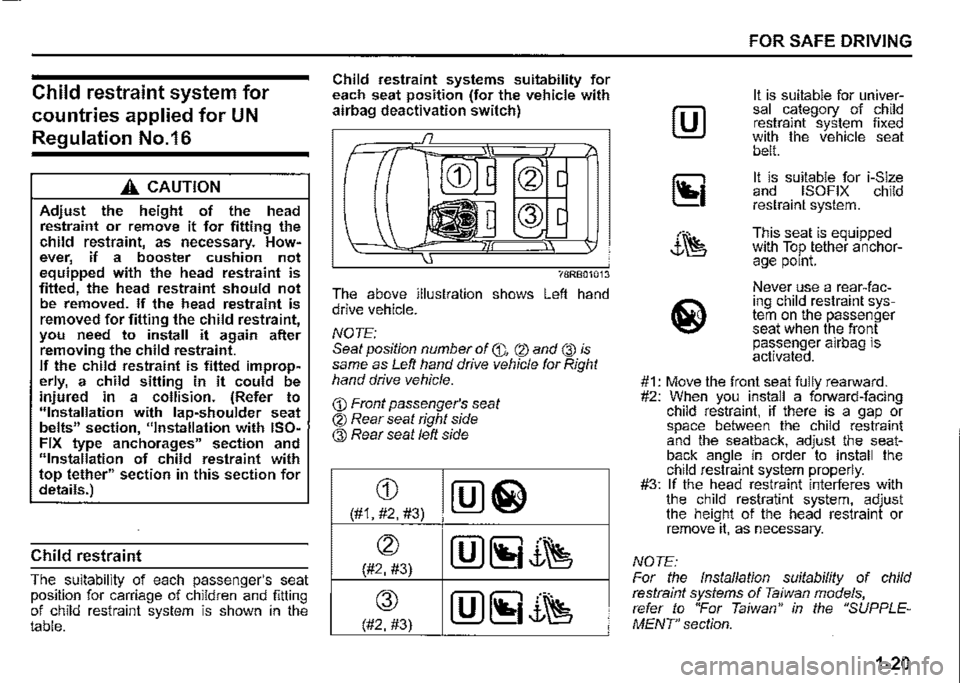
The suitability of each passenger's seat position for carriage of children and fitting of child restraint system is shown in the table.
Child restraint systems suitability for each seat position (for the vehicle with airbag deactivation switch)
The above illustration shows Left hand drive vehicle.
NOTE: Seat position number of G), @ and @ is same as Left hand drive vehicle for Right hand drive vehicle.
G) Front passenger's seat @ Rear seat right side @ Rear seat left side
G) (ID@ (#1. #2. #3)
(2) (ID~J,~ (#2, #3)
® (ID~J,~ (#2. #3)
FOR SAFE DRIVING
It is suitable for universal category of child restraint system fixed with the vehicle seat belt.
It is suitable for i-Size and ISOFIX child restraint system.
This seat is equipped with Top tether anchorage point.
Never use a rear-facing child restraint system on the passenger seat when the front passenger airbag is activated.
#1: Move the front seat fully rearward. #2: When you install a forward-facing child restraint, if there is a gap or space between the child restraint and the seatback, adjust the seatback angle in order to install the child restraint system properly. #3: If the head restraint interferes with the child restratint system, adjust the height of the head restraint or remove it, as necessary.
NOTE: For the Installation suitability of child restraint systems of Taiwan models, refer to "For Taiwan" in the "SUPPLEMENT" section.
1-20
Page 43 of 421
FOR SAFE DRIVING
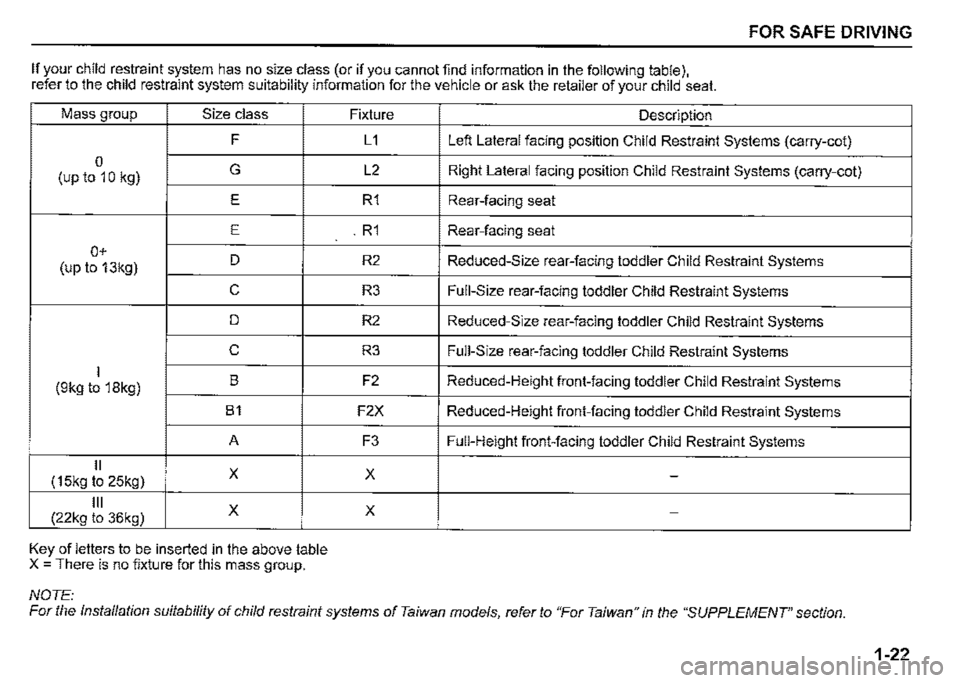
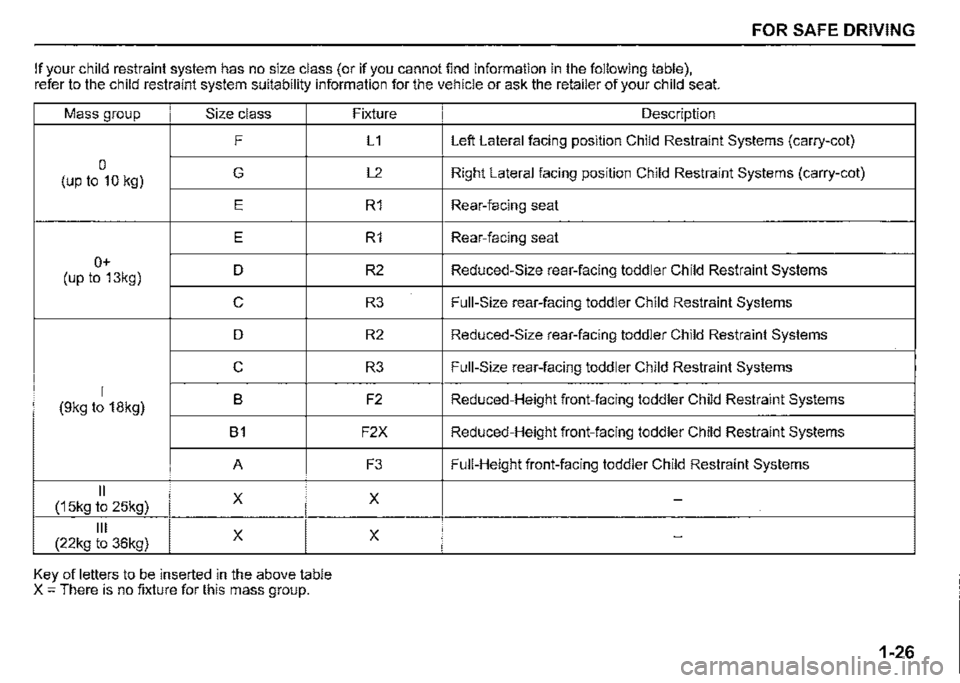
If your child restraint system has no size class (or if you cannot find information in the following table), refer to the child restraint system suitability information for the vehicle or ask the retailer of your child seat.
Mass group Size class
F
0 G (up to 10 kg)
E
E
O+ D (up to 13kg)
C
D
C
I 8 (9kg to 18kg)
81
A
II X (15kg to 25kg)
Ill X (22kg to 36kg)
Key of letters to be inserted in the above table X = There is no fixture for this mass group.
NOTE:
Fixture Description
L1 Left Lateral facing position Child Restraint Systems (carry-cot)
L2 Right Lateral facing position Child Restraint Systems (carry-cot)
R1 Rear-facing seat
. R1 Rear-facing seat
R2 Reduced-Size rear-facing toddler Child Restraint Systems
R3 Full-Size rear-facing toddler Child Restraint Systems
R2 Reduced-Size rear-facing toddler Child Restraint Systems
R3 Full-Size rear-facing toddler Child Restraint Systems
F2 Reduced-Height front-facing toddler Child Restraint Systems
F2X Reduced-Height front-facing toddler Child Restraint Systems
F3 Full-Height front-facing toddler Child Restraint Systems
X -
X -
For the Installation suitability of child restraint systems of Taiwan models, refer to "For Taiwan" in the "SUPPLEMENT" section.
1-22
Page 45 of 421
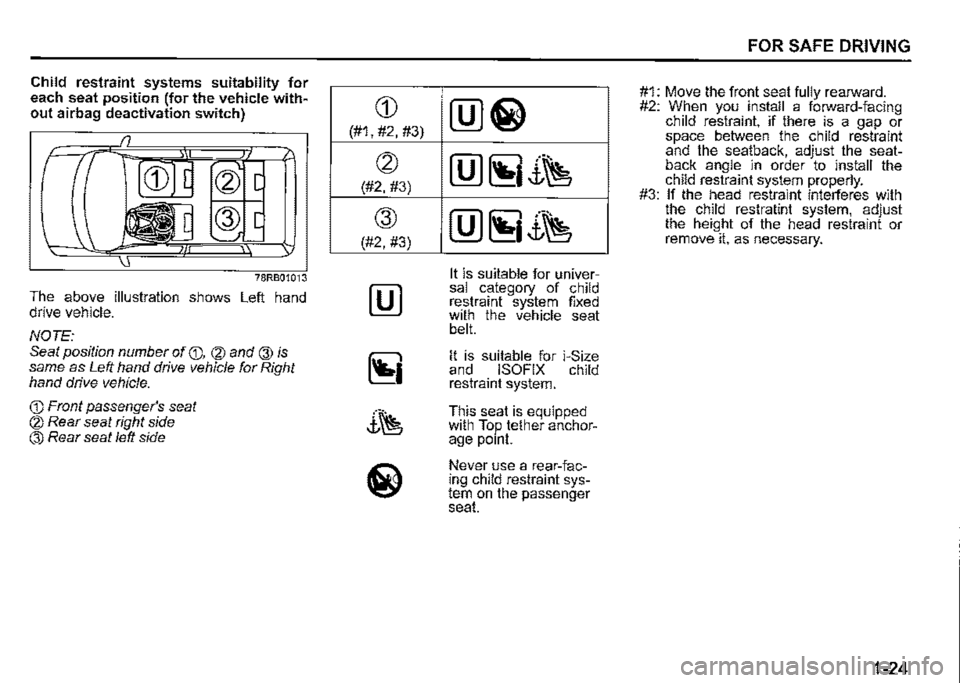
Child restraint systems suitability for each seat position (for the vehicle without airbag deactivation switch)
The above illustration shows Left hand drive vehicle.
NOTE: Seat position number of G), @ and @ is same as Left hand drive vehicle for Right hand drive vehicle.
G) Front passenger's seat @ Rear seat right side @ Rear seat left side
G)
(#1, #2, #3)
~
(#2, #3)
@
(#2, #3)
(gJ
(g)@
[g)~l~
[g)~l~
It is suitable for universal category of child restraint system fixed with the vehicle seat belt.
It is suitable for i-Size and ISOFIX child restraint system.
This seat is equipped with Top tether anchorage point.
Never use a rear-facing child restraint system on the passenger seat.
FOR SAFE DRIVING
#1: Move the front seat fully rearward. #2: When you install a forward-facing child restraint, if there is a gap or space between the child restraint and the seatback, adjust the seatback angle in order to install the child restraint system properly. #3: If the head restraint interferes with the child restratint system, adjust the height of the head restraint or remove it, as necessary.
1-24
Page 47 of 421
FOR SAFE DRIVING
If your child restraint system has no size class (or if you cannot find information in the following table), refer to the child restraint system suitability information for the vehicle or ask the retailer of your child seat.
Mass group Size class
F
0 G (upto 10kg)
E
E
O+ D (up to 13kg)
C
D
C
I B (9kg to 18kg)
B1
A
II X (15kg to 25kg)
Ill X (22kg to 36kg)
Key of letters to be inserted in the above table X; There is no fixture for this mass group.
Fixture Description
L1 Left Lateral facing position Child Restraint Systems (carry-cot)
L2 Right Lateral facing position Child Restraint Systems (carry-cot)
R1 Rear-facing seat
R1 Rear-facing seat
R2 Reduced-Size rear-facing toddler Child Restraint Systems
R3 Full-Size rear-facing toddler Child Restraint Systems
R2 Reduced-Size rear-facing toddler Child Restraint Systems
R3 Full-Size rear-facing toddler Child Restraint Systems
F2 Reduced-Height front-facing toddler Child Restraint Systems
F2X Reduced-Height front-facing toddler Child Restraint Systems
F3 Full-Height front-facing toddler Child Restraint Systems
X -
X -
1-26
Page 52 of 421
FOR SAFE DRIVING
68LM268
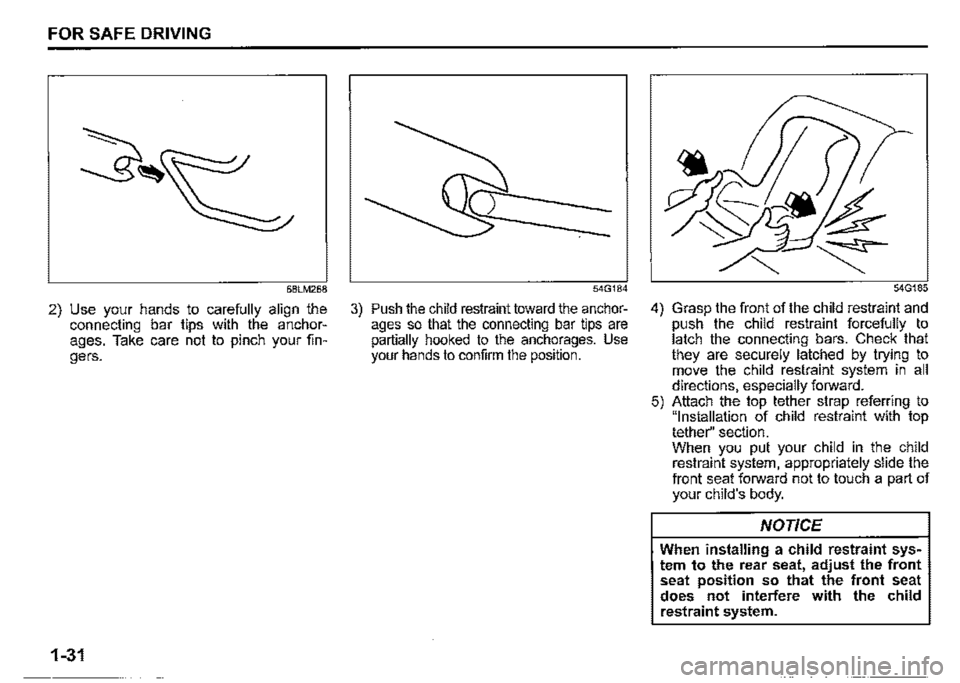
2) Use your hands to carefully align the connecting bar tips with the anchorages. Take care not to pinch your fingers.
1-31
54G184
3) Push the child restraint toward the anchorages so that the connecting bar tips are partially hooked to the anchorages. Use your hands to confirm the position.
54G185
4) Grasp the front of the child restraint and push the child restraint forcefully to latch the connecting bars. Check that they are securely latched by trying to move the child restraint system in all directions, especially forward. 5) Attach the top tether strap referring to "Installation of child restraint with top tether" section. When you put your child in the child restraint system, appropriately slide the front seat forward not to touch a part of your child's body.
NOTICE
When installing a child restraint system to the rear seat, adjust the front seat position so that the front seat does not interfere with the child restraint system.