remote start SUZUKI KIZASHI 2010 1.G Owner's Manual
[x] Cancel search | Manufacturer: SUZUKI, Model Year: 2010, Model line: KIZASHI, Model: SUZUKI KIZASHI 2010 1.GPages: 388, PDF Size: 4.94 MB
Page 139 of 388
3-8
OPERATING YOUR VEHICLE
57L20-03E
You should turn off such loads as theheadlights and air conditioning system to
facilitate starting of the engine.
Even if you fail to start the engine, the
starter motor will stop turning automati-
cally after a short time. After the starter
motor has stopped or if there is some
problem with the system, the starter
motor will rotate only while the engine
switch is being pressed.Stopping the engine Depress the engine switch to stop theengine after the vehicle stopped com-
pletely.
In case of emergency, you can stop the engine by depressing the engine switch
more than 3 seconds while the vehicle in
motion.
NOTE:
Except in emergency, do not stop the
engine while the vehicle in motion.
The steering and braking operation will
require more effort s when the engine
stopped.
Refer to “Braking” in the “OPERATING
YOUR VEHICLE” section.
Starting a Cold EngineWith your foot off the accelerator pedal,
crank the engine by pressing the engine
switch to change the ignition mode to
“START”.
After pressing the engine switch to change
the ignition mode to “START”, the starter
cranks the engine for about 12 seconds
before it can start the engine. If the engine
fails to start at the first attempt, wait about
15 seconds, then try again while keeping
the engine switch pressed while pressing
down the accelerator pedal to 1/3 of its
travel. Release the accelerator pedal when
the engine starts.
If the engine still does not start, try holding
the accelerator pedal all the way to the
floor while cranking. Th is should clear the
engine if it is flooded.
If you are unable to start the engine using
this procedure, consult your SUZUKI
dealer.
Starting a Warm EngineUse the same procedure as for “Starting a
Cold Engine”.If the master warning light flashes
and the engine cannot be startedYour keyless start system remote controller
may not be sensed as being within the
“interior workable area”. Try again after
making sure that you have the remote con-
troller with you. If the engine still cannot be
started, the battery of the remote controller
may be discharged. You must then use the
following method to be able to start the
engine.
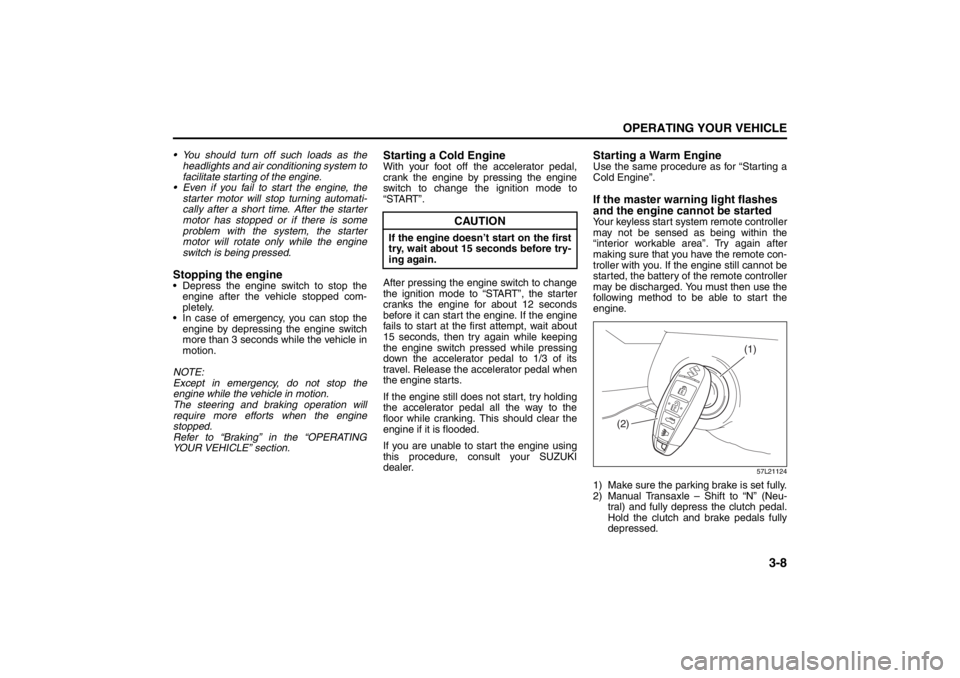
57L21124
1) Make sure the parking brake is set fully.
2) Manual Transaxle – Shift to “N” (Neu- tral) and fully depress the clutch pedal.
Hold the clutch and brake pedals fully
depressed.
CAUTION
If the engine doesn’ t start on the first
try, wait about 15 seconds before try-
ing again.
(1)
(2)
Cruise Control: 7, 8
Remote Audio Controls:
Horn: 6
Page 140 of 388

3-9OPERATING YOUR VEHICLE
57L20-03E
CVT – If the gearshift lever is not in the
“P” (Park) position, shift it to “P”. Hold
the brake pedal fully depressed.
3) The PUSH START SWITCH. message
will appear on the information display in
the instrument cluster. Press the engine
switch (1).
4) Within about 10 seconds of flashing of the master warning light in the instru-
ment cluster, touch the engine switch
with the lock switch end of the remote
controller (2) for about 2 seconds.
NOTE:
If you still cannot start the engine after several attempts using the above
method, there may be a problem else-
where, such as a low battery. Contact
your SUZUKI dealer for inspection.
The immobilizer/keyless start system warning light will light for about 5 sec-
onds while the master warning light is
flashing. In addition, the information dis-
play will show a certain message during
this time. Refer to “Information Display”
in the “Before Driving” section for details.
You may customize the system to cause the interior buzzer to sound once for the
“remote controller ou t of sensing range”
warning. Please contact an authorized
SUZUKI dealer for the customization.
If the battery of the remote controller is about to be completely discharged, a
message warning this will appear on the
information display when the ignition
mode is changed to “ON” by pressing the engine switch. For details on replac-
ing the battery, refer to the “Keyless Start
System Remote Controller” section in
the “Before Driving” chapter.
Returning the ignition mode to
“LOCK” (OFF)CVT
– To ensure safety, the ignition mode
can be returned to “LOCK” (OFF) by
pressing the engine switch only when the
gearshift lever is placed in the “P” position.
NOTE:
Messages may appear on the informa- tion display in the instrument cluster
when you attempt to return the ignition
mode to “LOCK” (OFF) by pressing the
engine switch. Refer to “Information dis-
play” in the “Before Driving” section for
details.
In the case of a CVT model, the engine cannot be returned to the “LOCK” (OFF)
position if the gearshift lever is in any
other position than “P”.
Certain problems like a fault in engine
system may prevent the engine switch
from going back to the “LOCK” (OFF)
mode. If this happens, have the vehicle
inspected by an autohorized SUZUKI
dealer after doing the following:
– Lock the doors using the key to pre-
vent theft. (The request switches and
the keyless start system remote con-
troller cannot be used to lock them.) – Disconnect the negative cable from
the battery to prevent discharge.
“LOCK” (OFF) mode reminder buzzer
If the driver’s door is opened without
returning the ignition mode to “LOCK”
(OFF) by pressing the engine switch, a
buzzer sounds to warn you of this state.
If you open the driver’s door after press- ing the engine switch to change the igni-
tion mode to “ACC”, the interior buzzer
beeps intermittently.
The buzzer will stop sounding if you then push the engine switch twice, thus bring-
ing it back the ignition mode to “LOCK”
(OFF).
NOTE:
Whenever you leave the vehicle, make
sure you have returned the ignition mode
to “LOCK” (OFF) using the engine switch
and then lock the doors. Without returning
the ignition mode to “LOCK” (OFF), you
cannot use a request switch or keyless
start system remote controller to lock the
doors.
Page 169 of 388
3-38
OPERATING YOUR VEHICLE
57L20-03E
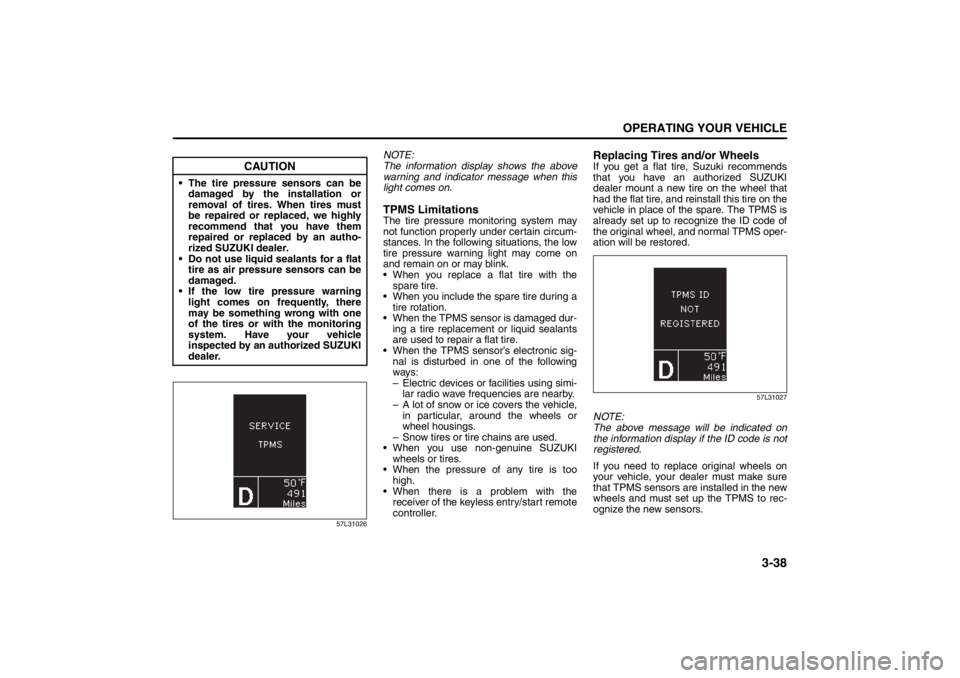
57L31026
NOTE:
The information display shows the above
warning and indicator message when this
light comes on.TPMS LimitationsThe tire pressure monitoring system may
not function properly under certain circum-
stances. In the following situations, the low
tire pressure warning light may come on
and remain on or may blink.
When you replace a flat tire with the
spare tire.
When you include the spare tire during a
tire rotation.
When the TPMS sensor is damaged dur-
ing a tire replacement or liquid sealants
are used to repair a flat tire.
When the TPMS sensor’s electronic sig-
nal is disturbed in one of the following
ways:
– Electric devices or facilities using simi-
lar radio wave frequencies are nearby.
– A lot of snow or ice covers the vehicle,
in particular, around the wheels or
wheel housings.
– Snow tires or tire chains are used.
When you use non-genuine SUZUKI
wheels or tires.
When the pressure of any tire is too
high.
When there is a problem with the
receiver of the keyless entry/start remote
controller.
Replacing Tires and/or WheelsIf you get a flat tire, Suzuki recommends
that you have an authorized SUZUKI
dealer mount a new tire on the wheel that
had the flat tire, and reinstall this tire on the
vehicle in place of the spare. The TPMS is
already set up to recognize the ID code of
the original wheel, and normal TPMS oper-
ation will be restored.
57L31027
NOTE:
The above message will be indicated on
the information display if the ID code is not
registered.
If you need to replace original wheels on
your vehicle, your dealer must make sure
that TPMS sensors are installed in the new
wheels and must set up the TPMS to rec-
ognize the new sensors.
CAUTION
The tire pressure sensors can be
damaged by the installation or
removal of tires. When tires must
be repaired or replaced, we highly
recommend that you have them
repaired or replaced by an autho-
rized SUZUKI dealer.
Do not use liquid sealants for a flat
tire as air pressure sensors can be
damaged.
If the low tire pressure warning
light comes on frequently, there
may be something wrong with one
of the tires or with the monitoring
system. Have your vehicle
inspected by an authorized SUZUKI
dealer.
Page 252 of 388
5-73OTHER CONTROLS AND EQUIPMENT
57L20-03E
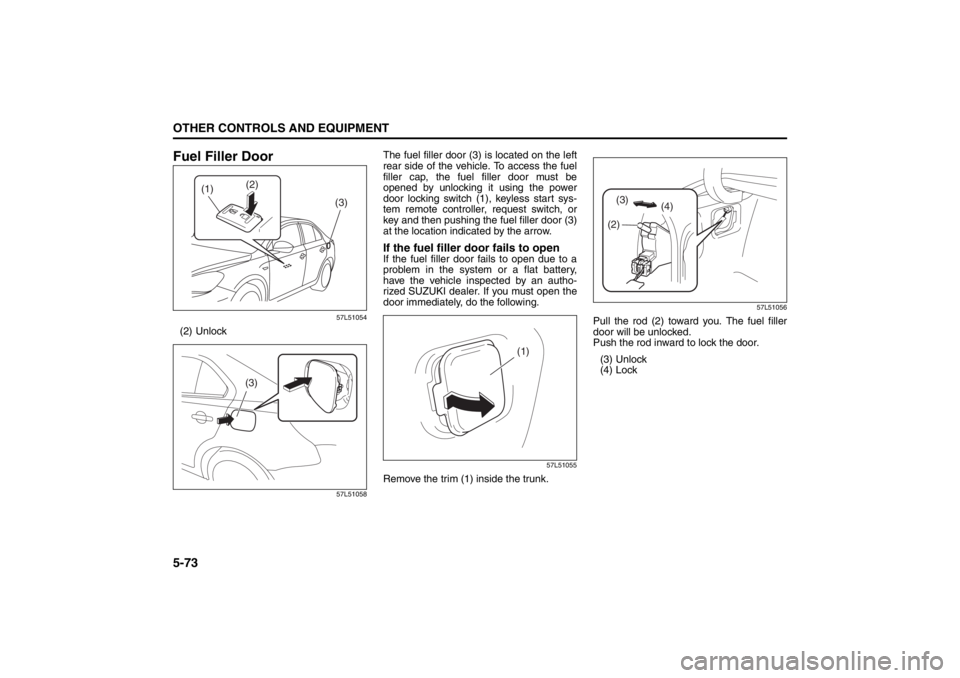
Fuel Filler Door
57L51054
(2) Unlock
57L51058
The fuel filler door (3) is located on the left
rear side of the vehicle. To access the fuel
filler cap, the fuel filler door must be
opened by unlocking it using the power
door locking switch (1), keyless start sys-
tem remote controller, request switch, or
key and then pushing the fuel filler door (3)
at the location indicated by the arrow.If the fuel filler door fails to openIf the fuel filler door fails to open due to a
problem in the system or a flat battery,
have the vehicle inspected by an autho-
rized SUZUKI dealer. If you must open the
door immediately, do the following.
57L51055
Remove the trim (1) inside the trunk.
57L51056
Pull the rod (2) toward you. The fuel filler
door will be unlocked.
Push the rod inward to lock the door.
(3) Unlock
(4) Lock
(1)
(3) (2)
(3)
(1)
(2)(3)
(4)
Page 264 of 388
5-85OTHER CONTROLS AND EQUIPMENT
57L20-03E
65D612
Be sure to close the sunroof when you
leave the vehicle unattended.
Periodically inspect the guide rail for dirt
and clean it if any dirt has accumulated.
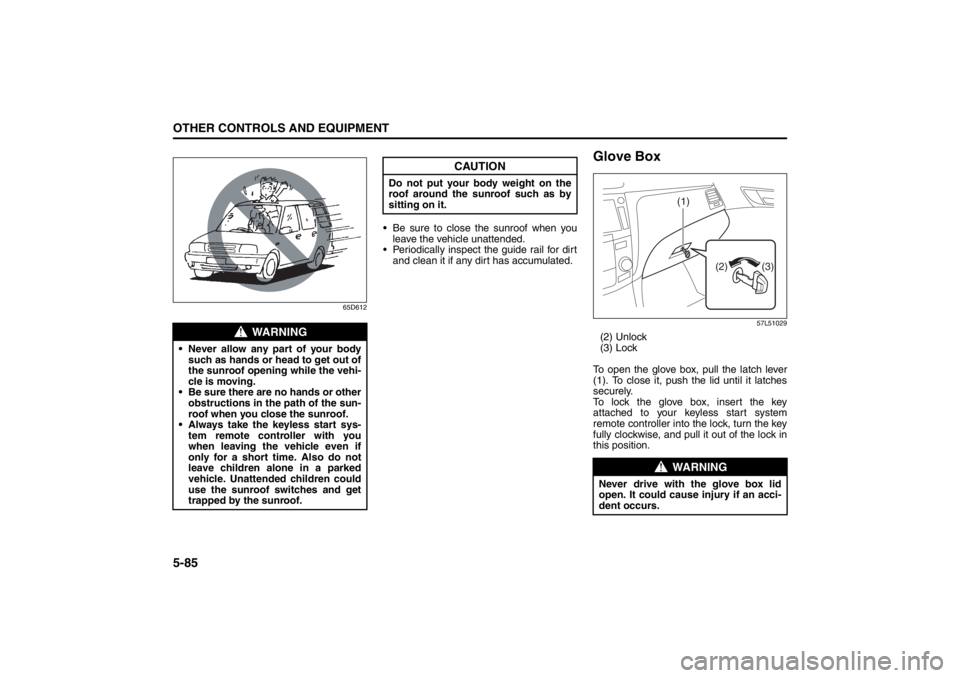
Glove Box
57L51029
(2) Unlock
(3) Lock
To open the glove box, pull the latch lever
(1). To close it, push the lid until it latches
securely.
To lock the glove box, insert the key
attached to your keyless start system
remote controller into the lock, turn the key
fully clockwise, and pull it out of the lock in
this position.
WARNING
Never allow any part of your body
such as hands or head to get out of
the sunroof opening while the vehi-
cle is moving.
Be sure there are no hands or other
obstructions in the path of the sun-
roof when you close the sunroof.
Always take the keyless start sys-
tem remote controller with you
when leaving the vehicle even if
only for a short time. Also do not
leave children alone in a parked
vehicle. Unattended children could
use the sunroof switches and get
trapped by the sunroof.
CAUTION
Do not put your body weight on the
roof around the sunroof such as by
sitting on it.
WARNING
Never drive with the glove box lid
open. It could cause injury if an acci-
dent occurs.
(1)
(3) (2)
Page 350 of 388
8-7EMERGENCY SERVICE
57L20-03E
4. Make the final connection to an
unpainted, heavy metal part (i.e.
engine hook (3)) of the engine of the
vehicle with the discharged battery
(1).
4) If the booster battery you are using is
installed on another vehicle, start the
engine of the vehicle with the booster
battery. Run the engine at moderate
speed.
5) Start the engine of the vehicle with the
discharged battery.
6) Remove the jumper cables in the exact
reverse order in which you connected
them.
Towing a Disabled VehicleEmergency TowingIf your vehicle is disabled, it may be towed
by a tow truck using one of the following
methods:
1) Tow the vehicle with two wheels lifted
by the tow truck and the other two
wheels on a towing dolly.
2) Use the appropriate towing method
specified for your vehicle in the “Towing
Your Vehicle (recreational towing)” sec-
tion, but with the wheels lifted by the
tow truck instead of on a towing dolly.
Be sure to carefully follow the specific
instructions provided in the “Towing
Your Vehicle (recreational towing)” sec-
tion.
If the Starter Does Not
Operate1) While bringing the remote controller
with you, place the gearshift lever in the
“P” position and depress the brake
pedal.
2) Try pressing the engine switch to
change the ignition mode to “START”
with the headlights turned on to deter-
mine the battery condition. If the head-
lights go excessively dim or go off, it
usually means that either the battery
has run down or battery terminal con-
tact is poor. Recharge the battery or
correct battery terminal contact if nec-
essary.
3) If the headlights remain bright, check
the fuses. If the reason for failure of the
starter is not obvious, there may be a
major electrical problem. Have the vehi-
cle inspected by your authorized
SUZUKI dealer.
WARNING
Never connect the jumper cable
directly to the negative (–) terminal of
the discharged battery, or an explo-
sion may occur.
CAUTION
If vehicle damage (such as steering
or drivetrain damage, etc.) prevents
normal use of the towing procedures
for your vehicle described in the
“Towing Your Vehicle (recreational
towing)” section, have your vehicle
towed with two wheels lifted by the
tow truck and the other two wheels
on a towing dolly.
Page 383 of 388

13-3
INDEX57L20-03E
Head Restraints .......................................................... 2-27, 2-29
Headlight Aiming ................................................................. 7-44
Heated Rear Window and Heated Outside Rearview
Mirrors (if equipped) Switch ............................................. 2-111
High Beam Indicator Light .................................................. 2-75
Highway Driving..................................................................... 4-3
Hill Hold Control System..................................................... 3-34
HomeLink
®........................................................................... 5-93
Horn .................................................................................... 2-111
How the ABS Works ............................................................ 3-30
IIdentification Numbers ........................................................ 10-1
If the Engine is Flooded ........................................................ 8-8
If the Engine Overheats......................................................... 8-8
If the Starter Does Not Operate ............................................ 8-7
If You Cannot Shift CVT Gearshift Lever Out of
“P” (PARK) ............. .............................................................. 3-18
If Your Vehicle Gets Stuck .................................................... 4-4
Illumination Indicator Light................................................. 2-75
Immobilizer System ........................................................ 2-2 , 3-4
Immobilizer/Keyless Start System Warning Light ............ 2-76
Improving Fuel Economy ............... ....................................... 4-2
Information Display ............................................................. 2-80
Inside Rearview Mirror ........................................................ 2-20
Installation of Child Restraint with Top Strap ................... 2-52
Installation with Lap-Shoulder Seat Belts
(child restraint with no top strap)....................................... 2-46
Installation with the LATCH System .................................. 2-49
Instantaneous fuel consumption ....................................... 2-82
Instrument Cluster ............................................................... 2-68
intelligent All Wheel Drive (i-AWD) Indicator Light .......... 2-76 Interior Light Switch ............................................................ 5-78
Interior Workable Area for Engine Starting, Power
Supply Mode Selection
and “Remote Controller
Outside” Warning................................................................... 3-6
Internal Trunk Release........................................................... 2-6
JJacking Instructions .............................................................. 8-2
Jump Starting Instructions ................................................... 8-6KKeyless Push Start System ................................................... 3-4
Keyless Start System Remote Controller ............................ 2-6
Keys......................................................................................... 2-1LLap-Shoulder Belt ................................................................ 2-36
Lidded Instrument Panel Box ............................................. 5-87
Light Reminder Buzzer ...................................................... 2-104
Lighting Control Lever....................................................... 2-100
Lighting Operation ............................................................. 2-100
Locking Rear Seatback........................................................ 2-34
Low Fuel Warning Light ...................................................... 2-74
Low Tire Pressure Warning Light .............................. 2-69 , 3-35
Luggage Under-box ............................................................. 5-92MMaintenance Recommended under Severe Driving
Conditions ..................................................................... 7-7 , 7-11
Maintenance Schedule ................. ......................................... 7-2
Malfunction Indicator Light ................................................. 2-74
Manual Transaxle ................................................................. 3-13
Master Warning Indicator Light .......................................... 2-77
Mirrors ................................................................................... 2-20