lock SUZUKI KIZASHI 2010 1.G Manual Online
[x] Cancel search | Manufacturer: SUZUKI, Model Year: 2010, Model line: KIZASHI, Model: SUZUKI KIZASHI 2010 1.GPages: 388, PDF Size: 4.94 MB
Page 257 of 388
5-78
OTHER CONTROLS AND EQUIPMENT
57L20-03E
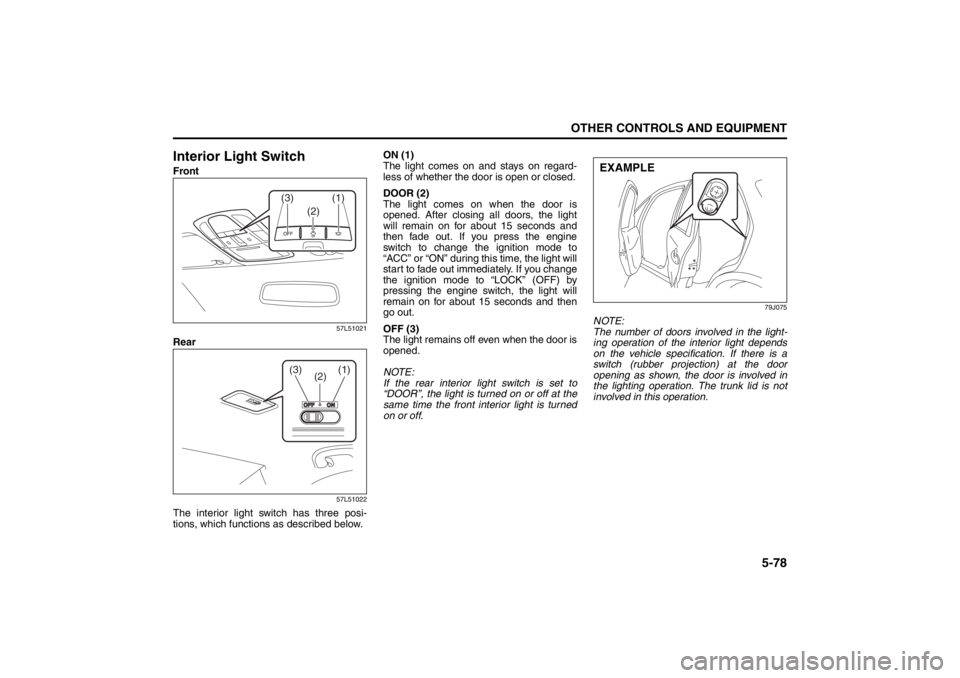
Interior Light SwitchFront
57L51021
Rear
57L51022
The interior light switch has three posi-
tions, which functions as described below.ON (1)
The light comes on and stays on regard-
less of whether the door is open or closed.
DOOR (2)
The light comes on when the door is
opened. After closing all doors, the light
will remain on for about 15 seconds and
then fade out. If you press the engine
switch to change the ignition mode to
“ACC” or “ON” during this time, the light will
start to fade out immediately. If you change
the ignition mode to “LOCK” (OFF) by
pressing the engine switch, the light will
remain on for about 15 seconds and then
go out.
OFF (3)
The light remains off even when the door is
opened.
NOTE:
If the rear interior light switch is set to
“DOOR”, the light is turned on or off at the
same time the front interior light is turned
on or off.
79J075
NOTE:
The number of doors involved in the light-
ing operation of the interior light depends
on the vehicle specification. If there is a
switch (rubber projection) at the door
opening as shown, the door is involved in
the lighting operation. The trunk lid is not
involved in this operation.
(2)(1) (3)
(1) (3)
(2)
EXAMPLE
Page 264 of 388
5-85OTHER CONTROLS AND EQUIPMENT
57L20-03E
65D612
Be sure to close the sunroof when you
leave the vehicle unattended.
Periodically inspect the guide rail for dirt
and clean it if any dirt has accumulated.
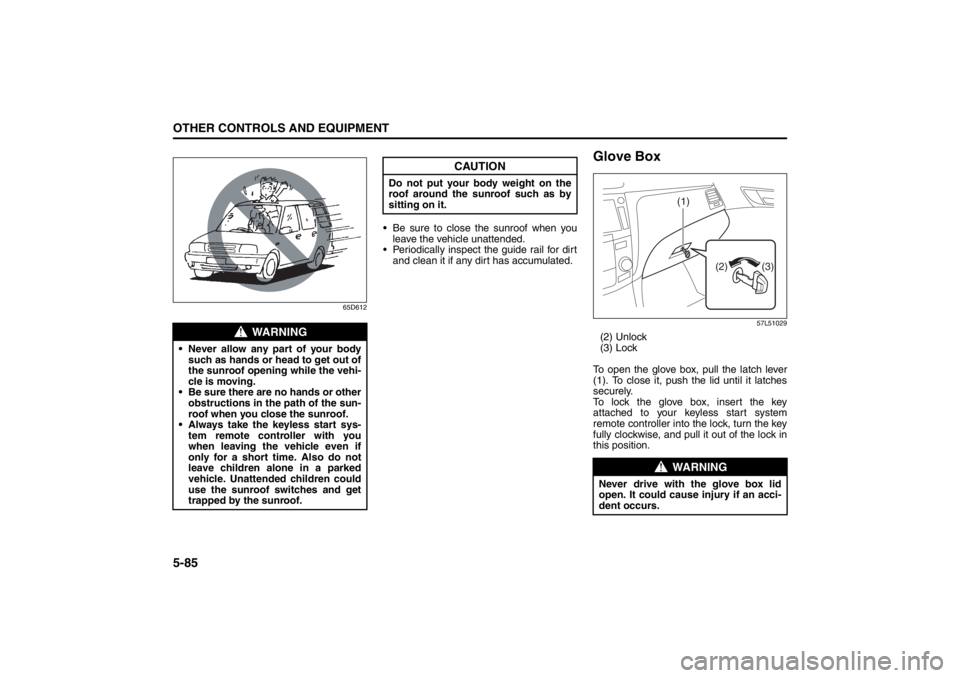
Glove Box
57L51029
(2) Unlock
(3) Lock
To open the glove box, pull the latch lever
(1). To close it, push the lid until it latches
securely.
To lock the glove box, insert the key
attached to your keyless start system
remote controller into the lock, turn the key
fully clockwise, and pull it out of the lock in
this position.
WARNING
Never allow any part of your body
such as hands or head to get out of
the sunroof opening while the vehi-
cle is moving.
Be sure there are no hands or other
obstructions in the path of the sun-
roof when you close the sunroof.
Always take the keyless start sys-
tem remote controller with you
when leaving the vehicle even if
only for a short time. Also do not
leave children alone in a parked
vehicle. Unattended children could
use the sunroof switches and get
trapped by the sunroof.
CAUTION
Do not put your body weight on the
roof around the sunroof such as by
sitting on it.
WARNING
Never drive with the glove box lid
open. It could cause injury if an acci-
dent occurs.
(1)
(3) (2)
Page 270 of 388
5-91OTHER CONTROLS AND EQUIPMENT
57L20-03E
NOTE:
There is a lid (1) behind the armrest stow-
age in the seatback.
When carrying a long cargo, the lid (1)
can be opened by folding it forward while
keeping the lever (2) pressed down.
When closing the lid (1), raise and push
it into position.
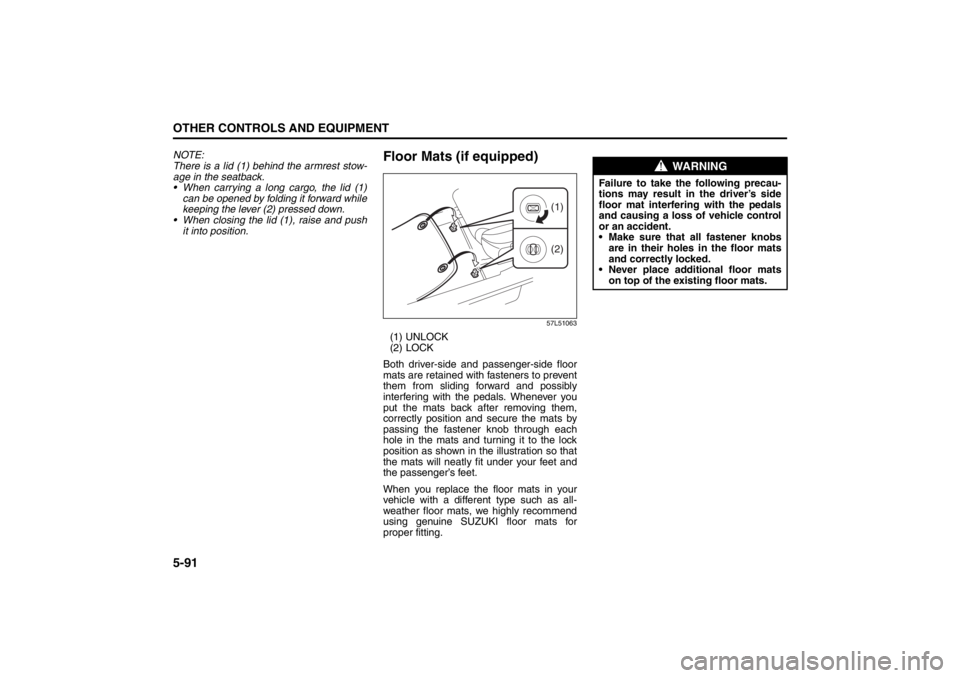
Floor Mats (if equipped)
57L51063
(1) UNLOCK
(2) LOCK
Both driver-side and passenger-side floor
mats are retained with fasteners to prevent
them from sliding forward and possibly
interfering with the pedals. Whenever you
put the mats back after removing them,
correctly position and secure the mats by
passing the fastener knob through each
hole in the mats and turning it to the lock
position as shown in the illustration so that
the mats will neatly fit under your feet and
the passenger’s feet.
When you replace the floor mats in your
vehicle with a different type such as all-
weather floor mats, we highly recommend
using genuine SUZUKI floor mats for
proper fitting.
(1)
(2)
WARNING
Failure to take the following precau-
tions may result in the driver’s side
floor mat interfering with the pedals
and causing a loss of vehicle control
or an accident.
Make sure that all fastener knobs
are in their holes in the floor mats
and correctly locked.
Never place additional floor mats
on top of the existing floor mats.
Page 272 of 388
5-93OTHER CONTROLS AND EQUIPMENT
57L20-03E
The gross weight of the roof rack plus
cargo must not exceed the loading
capacity (50 kg (110 lbs)). Also, do not
let the gross vehicle weight (fully loaded
vehicle including driver, passengers,
cargo, roof load and trailer tongue
weight) exceed the Gross Vehicle
Weight Rating (GVWR) listed in the
driver’s door lock pillar.
Mount and secure the cargo onto the
roof rack properly according to the
instructions provided. Be sure to stow
the heaviest items at the bottom and dis-
tribute the cargo as evenly as possible.
Do not carry items so large that they
hang over the bumpers or the sides of
the vehicle, or block your view.
Secure the front and rear ends of long
items – such as wood panels, surfboards
and so forth – to both the front and rear
of the vehicle. You should protect the
painted surfaces of the vehicle from
scuffing caused by tie-down ropes.
Check periodically to make sure the roof
rack is securely installed and free from
damage.
For vehicles with roof rack anchors,
make sure the anchors are covered with
the caps when not in use.
HomeLink
® (if equipped)
66J092
HomeLink
®: HomeLink
® is a registered
trademark of Johnson Controls Technology
Company.
The HomeLink
® Wireless Control System
provides a convenient way to replace up to
three hand-held radio-frequency (RF)
transmitters used to activate devices such
as gate operators, garage door openers,
entry door locks, security systems, even
home lighting. Additional HomeLink
® infor-
mation can be found on the Internet at
www.homelink.com
or by calling 1-800-
355-3515.
Before programming HomeLink
® to a
garage door opener or gate operator, make
sure that people and objects are out of the
way of the device to prevent potential harm
or damage. When programming a garage
door opener, it is advised to park outside of
the garage. Do not use HomeLink® with
any garage door opener that lacks safety
stop and reverse features as required by
U.S. federal safety standards (this includes
WARNING
Abrupt maneuvers or failure to
properly secure cargo can allow the
cargo to fly off the vehicle and hit
others, causing personal injury or
property damage.
Mount cargo securely and avoid
abrupt maneuvers such as “jack-
rabbit” starts, sharp turns, fast cor-
nering and sudden braking. Check
periodically to make sure that
cargo is securely fastened.
Large, bulky, long, or flat items can
affect vehicle aerodynamics or be
caught by the wind, and can reduce
vehicle control resulting in an acci-
dent and personal injury. Drive cau-
tiously at a safely reduced speed
when carrying this type of cargo.
Page 275 of 388
5-96
OTHER CONTROLS AND EQUIPMENT
57L20-03E
Using HomeLink
®
To operate, simply press and release the
programmed HomeLink
® button. Activation
will now occur for the trained device (i.e.
garage door opener, gate operator, secu-
rity system, entry door lock, home/office
lighting, etc.). For convenience, the hand-
held transmitter of the device may also be
used at any time. In the event that there
are still programming difficulties or ques-
tions, contact HomeLink
® at
www.homelink.com
or 1-800-355-3515.
Erasing HomeLink
® Buttons
To erase programming from the three but-
tons (individual buttons cannot be erased
but can be “reprogrammed” as outlined
below), follow the step noted:
Press and hold the two outer HomeLink
®
buttons until the indicator light begins to
flash-after 20 seconds. Release both but-
tons. Do not hold for longer that 30 sec-
onds. HomeLink
® is now in the train (or
learning) mode and can be programmed at
any time beginning with “Programming
HomeLink
®” – step 2).
Reprogramming a Single
HomeLink
® Button
To program a device to HomeLink
® using a
HomeLink
® button previously trained, fol-
low these steps:
1) Press and hold the desired HomeLink
®
button. DO NOT release the button.
2) The indicator light will begin to flash
after 20 seconds. Without releasing the
HomeLink
® button, proceed with “Pro-
gramming HomeLink
®” – step 2).
For questions or comments, contact
HomeLink
® at www.homelink.com
or 1-
800-355-3515.
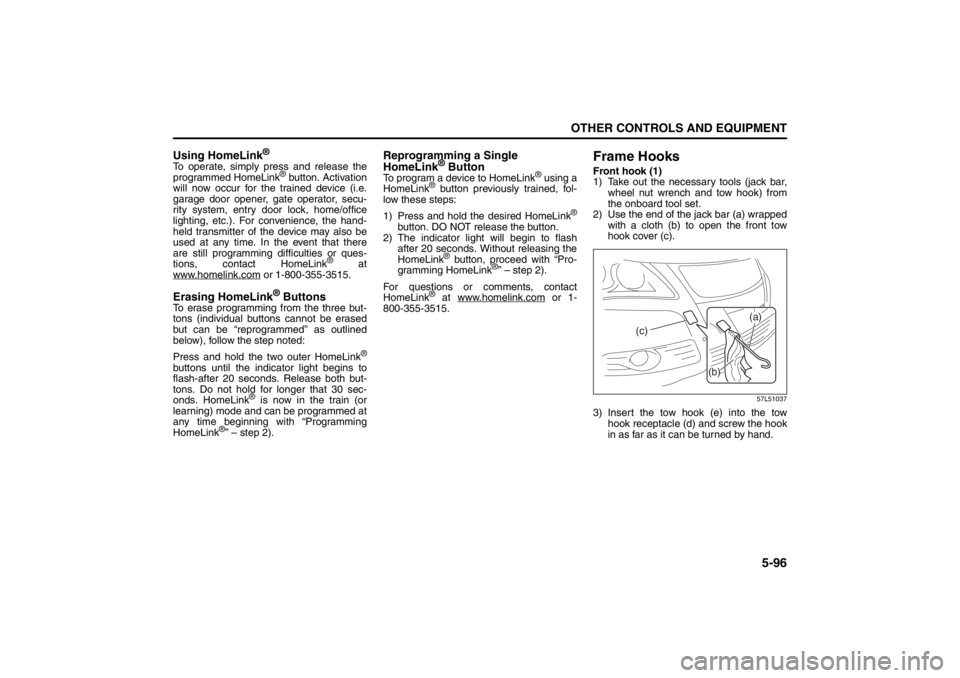
Frame HooksFront hook (1)
1) Take out the necessary tools (jack bar,
wheel nut wrench and tow hook) from
the onboard tool set.
2) Use the end of the jack bar (a) wrapped
with a cloth (b) to open the front tow
hook cover (c).
57L51037
3) Insert the tow hook (e) into the tow
hook receptacle (d) and screw the hook
in as far as it can be turned by hand.
(c)
(a)
(b)
Page 282 of 388
6-3VEHICLE LOADING AND TOWING
57L20-03E
80J2052
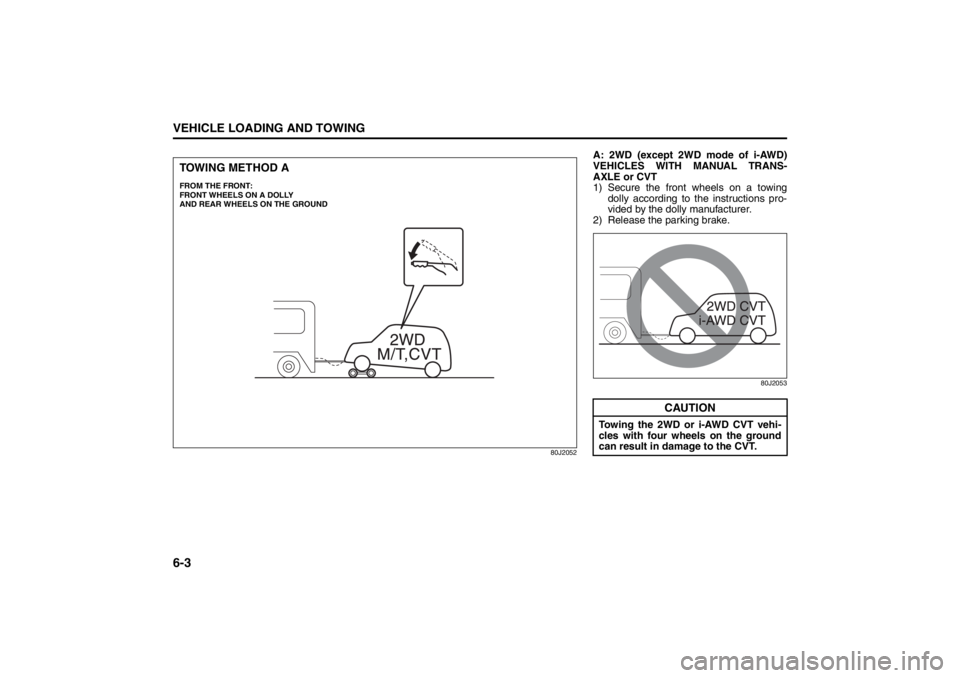
TOWING METHOD AFROM THE FRONT:
FRONT WHEELS ON A DOLLY
AND REAR WHEELS ON THE GROUND
A: 2WD (except 2WD mode of i-AWD)
VEHICLES WITH MANUAL TRANS-
AXLE or CVT
1) Secure the front wheels on a towing
dolly according to the instructions pro-
vided by the dolly manufacturer.
2) Release the parking brake.
80J2053
CAUTION
Towing the 2WD or i-AWD CVT vehi-
cles with four wheels on the ground
can result in damage to the CVT.
Engine Block Heater: 1
Page 283 of 388
6-4
VEHICLE LOADING AND TOWING
57L20-03E
57L61002
ACC OFF
N
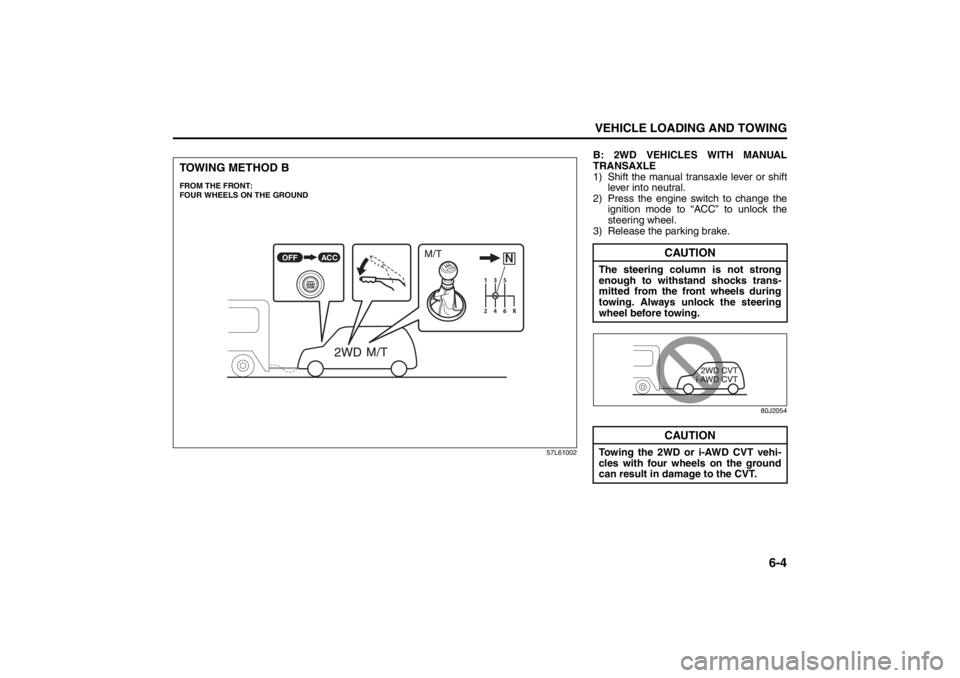
TOWING METHOD BFROM THE FRONT:
FOUR WHEELS ON THE GROUND
B: 2WD VEHICLES WITH MANUAL
TRANSAXLE
1) Shift the manual transaxle lever or shift
lever into neutral.
2) Press the engine switch to change the
ignition mode to “ACC” to unlock the
steering wheel.
3) Release the parking brake.
80J2054
CAUTION
The steering column is not strong
enough to withstand shocks trans-
mitted from the front wheels during
towing. Always unlock the steering
wheel before towing.
CAUTION
Towing the 2WD or i-AWD CVT vehi-
cles with four wheels on the ground
can result in damage to the CVT.
Using the Transaxle: 10
Page 286 of 388
7-1INSPECTION AND MAINTENANCE
57L20-03E
60A187S
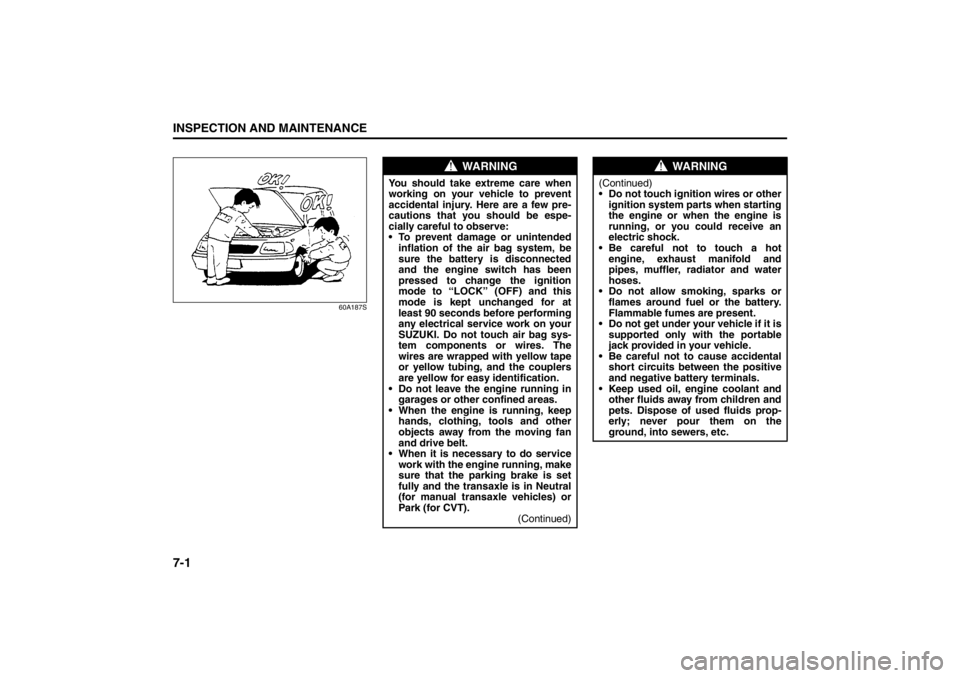
WARNING
You should take extreme care when
working on your vehicle to prevent
accidental injury. Here are a few pre-
cautions that you should be espe-
cially careful to observe:
To prevent damage or unintended
inflation of the air bag system, be
sure the battery is disconnected
and the engine switch has been
pressed to change the ignition
mode to “LOCK” (OFF) and this
mode is kept unchanged for at
least 90 seconds before performing
any electrical service work on your
SUZUKI. Do not touch air bag sys-
tem components or wires. The
wires are wrapped with yellow tape
or yellow tubing, and the couplers
are yellow for easy identification.
Do not leave the engine running in
garages or other confined areas.
When the engine is running, keep
hands, clothing, tools and other
objects away from the moving fan
and drive belt.
When it is necessary to do service
work with the engine running, make
sure that the parking brake is set
fully and the transaxle is in Neutral
(for manual transaxle vehicles) or
Park (for CVT).
(Continued)
WARNING
(Continued)
Do not touch ignition wires or other
ignition system parts when starting
the engine or when the engine is
running, or you could receive an
electric shock.
Be careful not to touch a hot
engine, exhaust manifold and
pipes, muffler, radiator and water
hoses.
Do not allow smoking, sparks or
flames around fuel or the battery.
Flammable fumes are present.
Do not get under your vehicle if it is
supported only with the portable
jack provided in your vehicle.
Be careful not to cause accidental
short circuits between the positive
and negative battery terminals.
Keep used oil, engine coolant and
other fluids away from children and
pets. Dispose of used fluids prop-
erly; never pour them on the
ground, into sewers, etc.
Highway Driving: NO
Driving on Hills: NO
Page 290 of 388
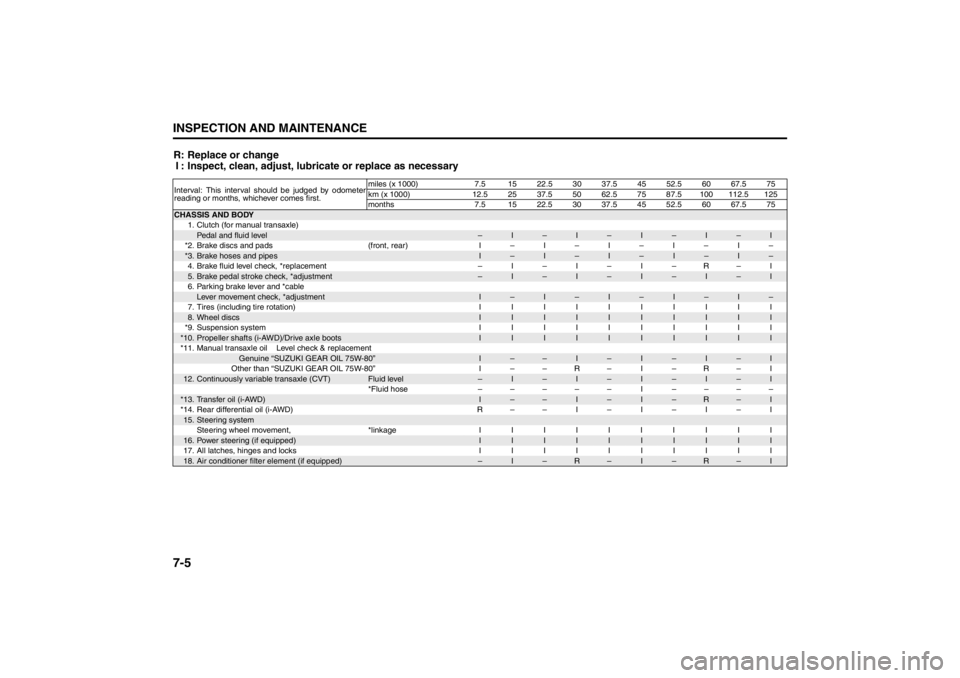
7-5INSPECTION AND MAINTENANCE
57L20-03E
R: Replace or changeI : Inspect, clean, adjust, lubr icate or replace as necessaryInterval: This interval should be judged by odometer
reading or months, whichever comes first. miles (x 1000) 7.5 15 22.5 30 37.5 45 52.5 60 67.5 75
km (x 1000) 12.5 25 37.5 50 62.5 75 87.5 100 112.5 125
months 7.5 15 22.5 30 37.5 45 52.5 60 67.5 75CHASSIS AND BODY
1. Clutch (for manual transaxle)
Pedal and fluid level
–
I
–
I
–
I
–
I
–
I
*2. Brake discs and pads (front, rear) I – I – I – I – I –
*3.
Brake hoses and pipes
I
–
I
–
I
–
I
–
I
–
4. Brake fluid level check, *replacement – I – I – I – R – I
5.Brake pedal stroke check, *adjustment
–
I
–
I
–
I
–
I
–
I
6. Parking brake lever and *cable
Lever movement check, *adjustment
I
–
I
–
I
–
I
–
I
–
7.Tires (including tire rotation) IIIIIIIIII
8.Wheel discs
I
I
I
I
I
I
I
I
I
I
*9. Suspension system I I I I I I I I I I
*10.
Propeller shafts (i-AWD)/Drive axle boots
I
I
I
I
I
I
I
I
I
I
*11. Manual transaxle oil Level check & replacement
Genuine “SUZUKI GEAR OIL 75W-80”
I
–
–
I
–
I
–
I
–
I
Other than “SUZUKI GEAR OIL 75W-80” I – – R – I – R – I
12.
Continuously variable transaxle (CVT)
Fluid level
–
I
–
I
–
I
–
I
–
I
*Fluid hose ––––– I ––––
*13.
Transfer oil (i-AWD)
I
–
–
I
–
I
–
R
–
I
*14. Rear differential oil (i-AWD) R – – I – I – I – I
15.
Steering systemSteering wheel movement, *linkage I I I I I I I I I I
16.
Power steering (if equipped)
I
I
I
I
I
I
I
I
I
I
17. All latches, hinges and locks I I I I I I I I I I
18.
Air conditioner filter element (if equipped)
–
I
–
R
–
I
–
R
–
I
Page 291 of 388
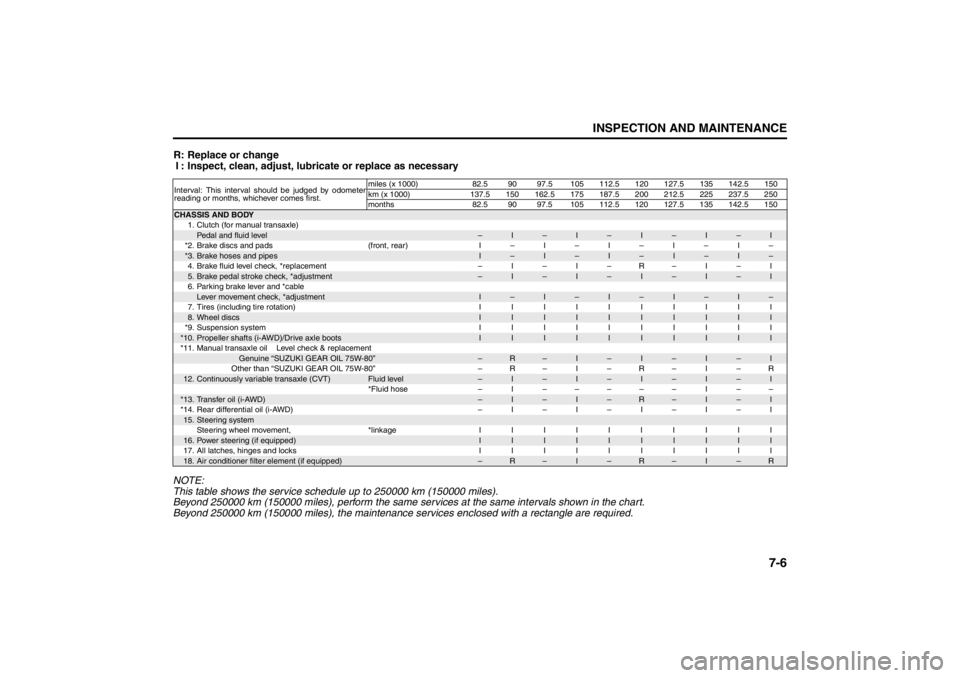
7-6
INSPECTION AND MAINTENANCE
57L20-03E
R: Replace or changeI : Inspect, clean, adjust, lubr icate or replace as necessary
NOTE:
This table shows the service schedule up to 250000 km (150000 miles).
Beyond 250000 km (150000 miles), perform the same services at the same intervals shown in the chart.
Beyond 250000 km (150000 miles), the maintenance se rvices enclosed with a rectangle are required.Interval: This interval should be judged by odometer
reading or months, whichever comes first.miles (x 1000) 82.5 90 97.5 105 112.5 120 127.5 135 142.5 150
km (x 1000) 137.5 150 162.5 175 187.5 200 212.5 225 237.5 250
months 82.5 90 97.5 105 112.5 120 127.5 135 142.5 150CHASSIS AND BODY
1. Clutch (for manual transaxle)
Pedal and fluid level
–
I
–
I
–
I
–
I
–
I
*2. Brake discs and pads (front, rear) I – I – I – I – I –
*3.
Brake hoses and pipes
I
–
I
–
I
–
I
–
I
–
4. Brake fluid level check, *replacement – I – I – R – I – I
5.Brake pedal stroke check, *adjustment
–
I
–
I
–
I
–
I
–
I
6. Parking brake lever and *cable
Lever movement check, *adjustment
I
–
I
–
I
–
I
–
I
–
7.Tires (including tire rotation) IIIIIIIIII
8.Wheel discs
I
I
I
I
I
I
I
I
I
I
*9. Suspension system I I I I I I I I I I
*10.
Propeller shafts (i-AWD)/Drive axle boots
I
I
I
I
I
I
I
I
I
I
*11. Manual transaxle oil Level check & replacement
Genuine “SUZUKI GEAR OIL 75W-80”
–
R
–
I
–
I
–
I
–
I
Other than “SUZUKI GEAR OIL 75W-80” – R – I – R – I – R
12.
Continuously variable transaxle (CVT)
Fluid level
–
I
–
I
–
I
–
I
–
I
*Fluid hose – I ––––– I ––
*13.
Transfer oil (i-AWD)
–
I
–
I
–
R
–
I
–
I
*14. Rear differential oil (i-AWD) – I – I – I – I – I
15.
Steering systemSteering wheel movement, *linkage I I I I I I I I I I
16.
Power steering (if equipped)
I
I
I
I
I
I
I
I
I
I
17. All latches, hinges and locks I I I I I I I I I I
18.
Air conditioner filter element (if equipped)
–
R
–
I
–
R
–
I
–
R