air condition SUZUKI MARUTI 2005 1.G User Guide
[x] Cancel search | Manufacturer: SUZUKI, Model Year: 2005, Model line: MARUTI, Model: SUZUKI MARUTI 2005 1.GPages: 136, PDF Size: 2.93 MB
Page 75 of 136
Downloaded from www.Manualslib.com manuals search engine 7583KHeating and Air Conditioning
SystemThe type of heating and air conditioning
system is:
Manual Heating and Air Conditioning
SystemAir OutletOTHER CONTROLS AND EQUIPMENT
7-1
83K-05-001
EXAMPLE
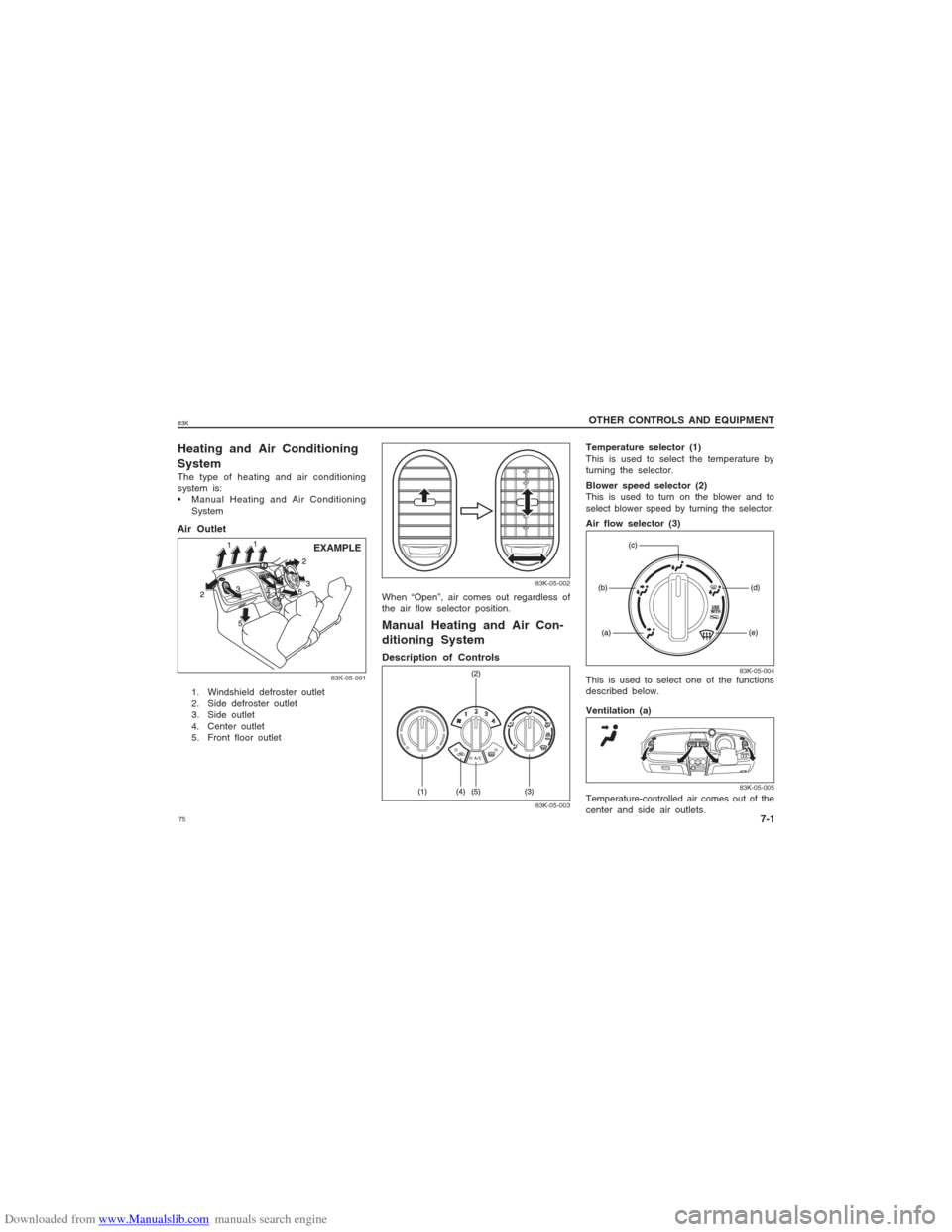
1. Windshield defroster outlet
2. Side defroster outlet
3. Side outlet
4. Center outlet
5. Front floor outlet
83K-05-002
When “Open”, air comes out regardless of
the air flow selector position.Manual Heating and Air Con-
ditioning SystemDescription of Controls
83K-05-003
Temperature selector (1)
This is used to select the temperature by
turning the selector.
Blower speed selector (2)
This is used to turn on the blower and to
select blower speed by turning the selector.
Air flow selector (3)
This is used to select one of the functions
described below.
Ventilation (a)
83K-05-005
Temperature-controlled air comes out of the
center and side air outlets.
83K-05-004
Page 76 of 136
Downloaded from www.Manualslib.com manuals search engine 7683K
OTHER CONTROLS AND EQUIPMENT
7-2Bi-level (b)
83K-05-007
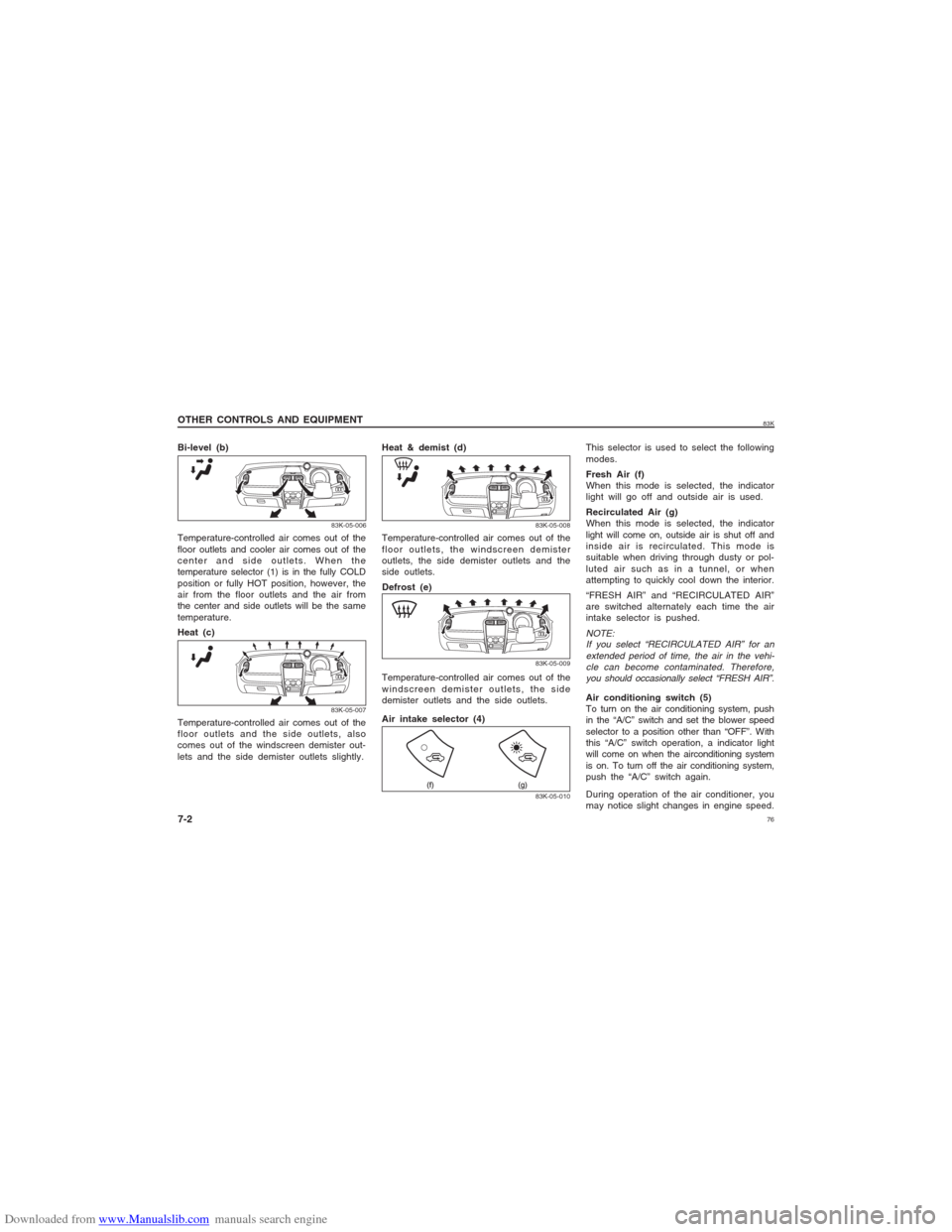
Temperature-controlled air comes out of the
floor outlets and the side outlets, also
comes out of the windscreen demister out-
lets and the side demister outlets slightly.Heat & demist (d)
83K-05-006
Temperature-controlled air comes out of the
floor outlets and cooler air comes out of the
center and side outlets. When the
temperature selector (1) is in the fully COLD
position or fully HOT position, however, the
air from the floor outlets and the air from
the center and side outlets will be the same
temperature.
Heat (c)Temperature-controlled air comes out of the
floor outlets, the windscreen demister
outlets, the side demister outlets and the
side outlets.
Defrost (e)
Air intake selector (4)
83K-05-008
Temperature-controlled air comes out of the
windscreen demister outlets, the side
demister outlets and the side outlets.
83K-05-00983K-05-010
This selector is used to select the following
modes.
Fresh Air (f)
When this mode is selected, the indicator
light will go off and outside air is used.
Recirculated Air (g)
When this mode is selected, the indicator
light will come on, outside air is shut off and
inside air is recirculated. This mode is
suitable when driving through dusty or pol-
luted air such as in a tunnel, or when
attempting to quickly cool down the interior.
“FRESH AIR” and “RECIRCULATED AIR”
are switched alternately each time the air
intake selector is pushed.NOTE:
If you select “RECIRCULATED AIR” for an
extended period of time, the air in the vehi-
cle can become contaminated. Therefore,
you should occasionally select “FRESH AIR”.Air conditioning switch (5)
To turn on the air conditioning system, push
in the “A/C” switch and set the blower speed
selector to a position other than “OFF”. With
this “A/C” switch operation, a indicator light
will come on when the airconditioning system
is on. To turn off the air conditioning system,
push the “A/C” switch again.
During operation of the air conditioner, you
may notice slight changes in engine speed.
Page 77 of 136
Downloaded from www.Manualslib.com manuals search engine 7783K
OTHER CONTROLS AND EQUIPMENT
7-3
These changes are normal, the system is
designed so that the compressor turns on
or off to maintain the desired temperature.
Less operation of the compressor results in
better fuel economy.System Operating InstructionsNatural ventilation
Select “VENTILATION” and “FRESH AIR”,
the temperature selector to the desired
temperature position, and the blower speed
selector to “OFF”. Fresh air will flow through
the vehicle during driving.
Forced ventilation
The control settings are the same as for
natural ventilation except you set the blower
speed selector to a position other than “OFF”.
Normal heating (using outside air)
Select “HEAT” and “FRESH AIR”, the tem-
perature selector to the desired temperature
position and the blower speed selector to
the desired blower speed position. Setting
the blower speed selector to a higher blower
speed position increases heating efficiency.
Quick heating (using recirculated air)
The control settings are the same as for
normal heating except you select “RECIR-
CULATED AIR”. If you use this heating
method for an extended period of time, the
air in the vehicle can become contaminatedand the windows can become misty.
Therefore, use this method only for quick
heating and change to the normal heating
method as soon as possible.
Cool face / Warm feet
Select “BI-LEVEL” and “FRESH AIR”, the
temperature selector to the desired tem-
perature position, and the blower speed
selector to the desired blower speed posi-
tion. Unless the temperature selector is in
the fully COLD position or fully HOT posi-
tion, the air that comes out of the center
and side outlets will be cooler than the air
that comes out of the floor outlets.
Normal cooling
Turn on the “A/C” switch, set the air flow
selector to “VENTILATION”, the temperature
selector to the desired temperature position
and the blower speed selector to the
desired blower speed position. Setting the
blower speed selector to a higher blower
speed position increases cooling efficiency.
You can switch the air intake selector to
either “FRESH AIR” or “RECIRCULATED
AIR” as you desire. Choosing “RECIRCU-
LATED AIR” increases cooling efficiency.
Quick cooling (using recirculated air)
The control settings are the same as for
normal cooling except you select “RECIR-
CULATED AIR” and the highest blower speed.
NOTE:
If your vehicle has been left in the sun
with the windows closed, it will cool
faster if you open the windows briefly
while you operate the air conditioner with
the air intake selector at “FRESH AIR”
and the blower at high speed.Dehumidifying
Turn on the “A/C” switch, set the air flow
selector to the desired air flow selector
position, and select “FRESH AIR”, the tem-
perature selector to the desired temperature
position, and the blower speed selector to
the desired blower speed position.
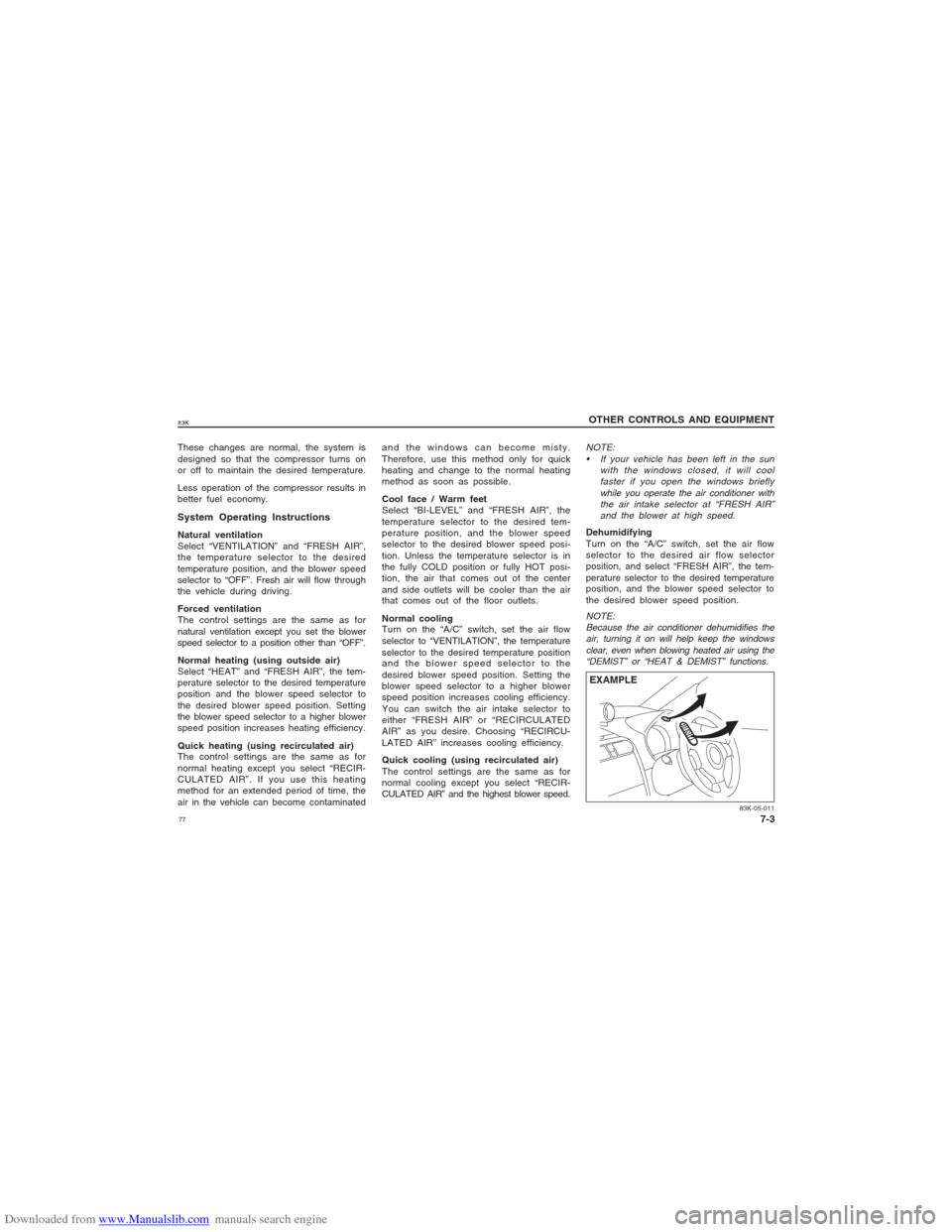
83K-05-011
NOTE:
Because the air conditioner dehumidifies the
air, turning it on will help keep the windows
clear, even when blowing heated air using the
“DEMIST” or “HEAT & DEMIST” functions.EXAMPLE
Page 78 of 136
Downloaded from www.Manualslib.com manuals search engine 7883K
OTHER CONTROLS AND EQUIPMENT
7-4Using the wrong refrigerant may
damage your air conditioning system.
Use R-134a only. Do not mix or replace
the R-134a with other refrigerants.
CAUTION
NOTE:
If you need maximum demisting:
set the air flow selector to “DEMIST”,
set the blower speed selector to HIGH,
adjust the temperature selector to the
HOT end,
turn on the “A/C” switch, and
adjust the side outlets so the air blows
on the side windows.MaintenanceIf you do not use the air conditioner for a
long period, such as during winter, it may
not give the best performance when you
start using it again. To help maintain opti-
mum performance and durability of your air
conditioner, it needs to be run periodically.
Operate the air conditioner at least once a
month for one minute with the engine idling.
This circulates the refrigerant and oil and
helps protect the internal components.NOTE:
Your vehicle uses the air conditioning
refrigerant HFC-134a, commonly called “R-
134a”. Only R-134a should be used in your
vehicle.
Audio System (if equipped)Refer supplementary manual for audio
system (if equipped), provided along with
the vehicle.Radio Antenna
83K-05-013
To avoid damage to the radio antenna:
Remove the antenna when using an
automatic car wash.
Remove the antenna when the
antenna hits anything such as a low
ceiling in a parking garage or
putting a car cover over your car.
CAUTION
Remote Audio Controls
(if equipped)
83K-05-014
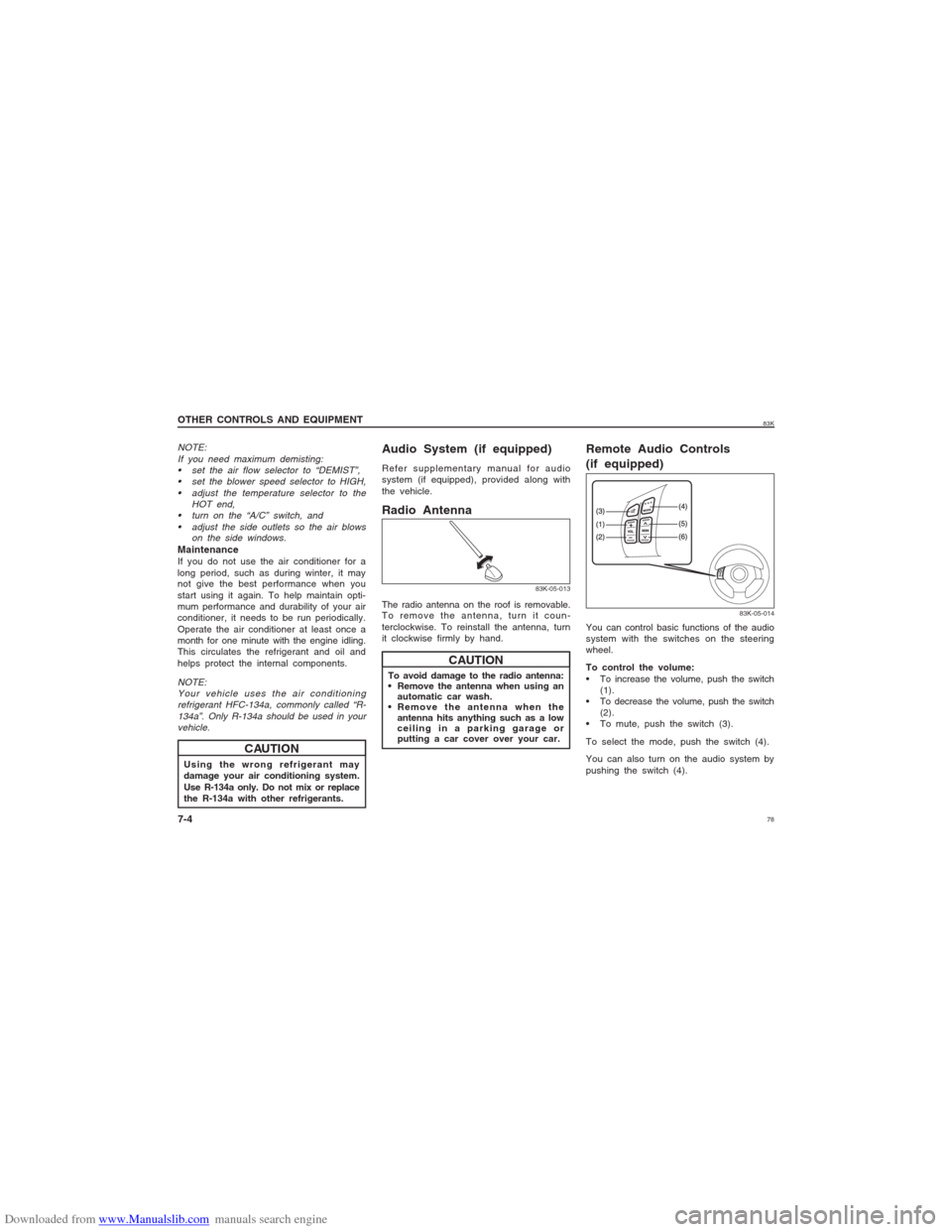
You can control basic functions of the audio
system with the switches on the steering
wheel.
To control the volume:
To increase the volume, push the switch
(1).
To decrease the volume, push the switch
(2).
To mute, push the switch (3).
To select the mode, push the switch (4).
You can also turn on the audio system by
pushing the switch (4). The radio antenna on the roof is removable.
To remove the antenna, turn it coun-
terclockwise. To reinstall the antenna, turn
it clockwise firmly by hand.
Page 89 of 136
Downloaded from www.Manualslib.com manuals search engine 8983KINSPECTION AND MAINTENANCE
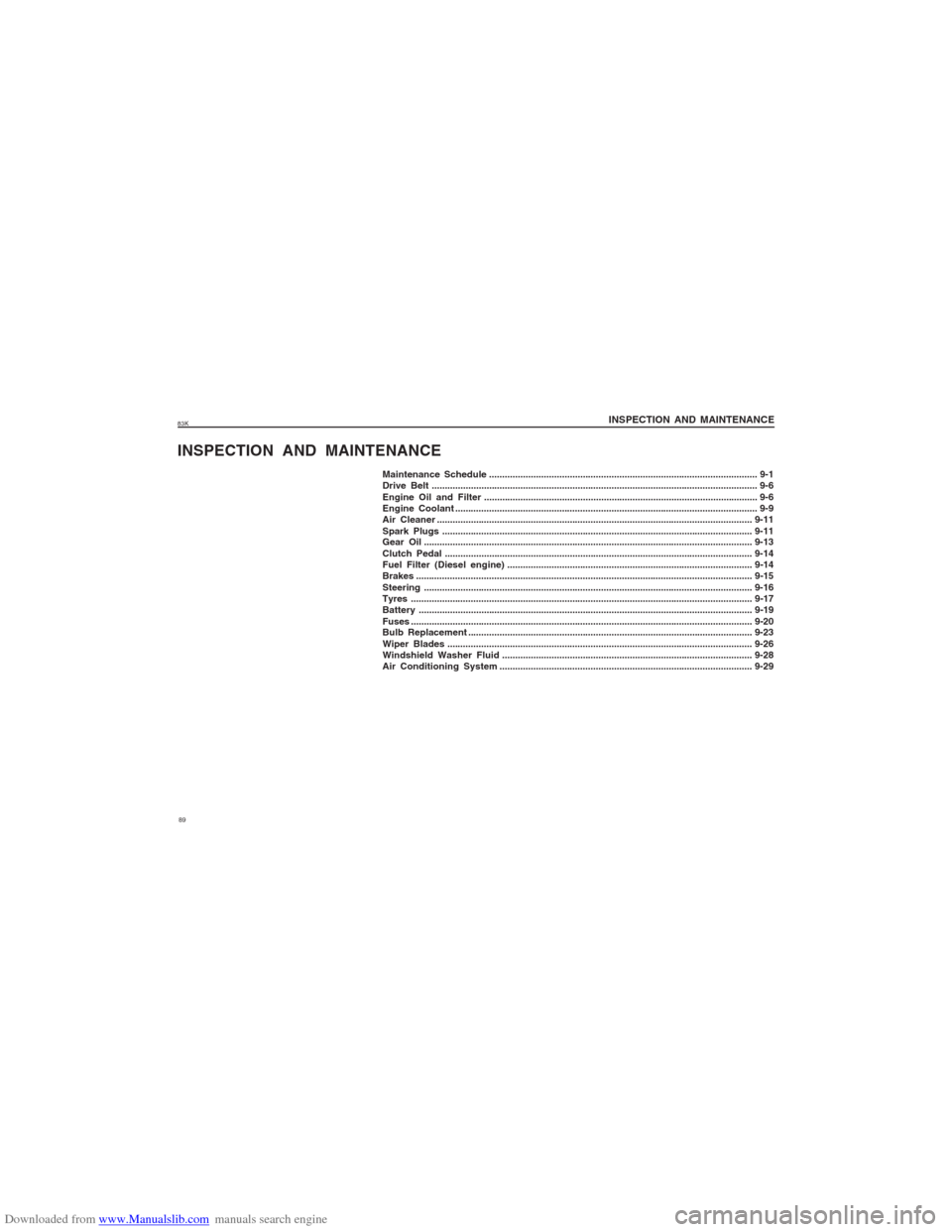
Maintenance Schedule ....................................................................................................... 9-1
Drive Belt ............................................................................................................................. 9-6
Engine Oil and Filter......................................................................................................... 9-6
Engine Coolant.................................................................................................................... 9-9
Air Cleaner ......................................................................................................................... 9-11
Spark Plugs....................................................................................................................... 9-11
Gear Oil.............................................................................................................................. 9-13
Clutch Pedal...................................................................................................................... 9-14
Fuel Filter (Diesel engine) .............................................................................................. 9-14
Brakes ................................................................................................................................. 9-15
Steering.............................................................................................................................. 9-16
Tyres ................................................................................................................................... 9-17
Battery................................................................................................................................ 9-19
Fuses ................................................................................................................................... 9-20
Bulb Replacement............................................................................................................. 9-23
Wiper Blades..................................................................................................................... 9-26
Windshield Washer Fluid................................................................................................9-28
Air Conditioning System.................................................................................................9-29
INSPECTION AND MAINTENANCE
Page 92 of 136
Downloaded from www.Manualslib.com manuals search engine 9283K
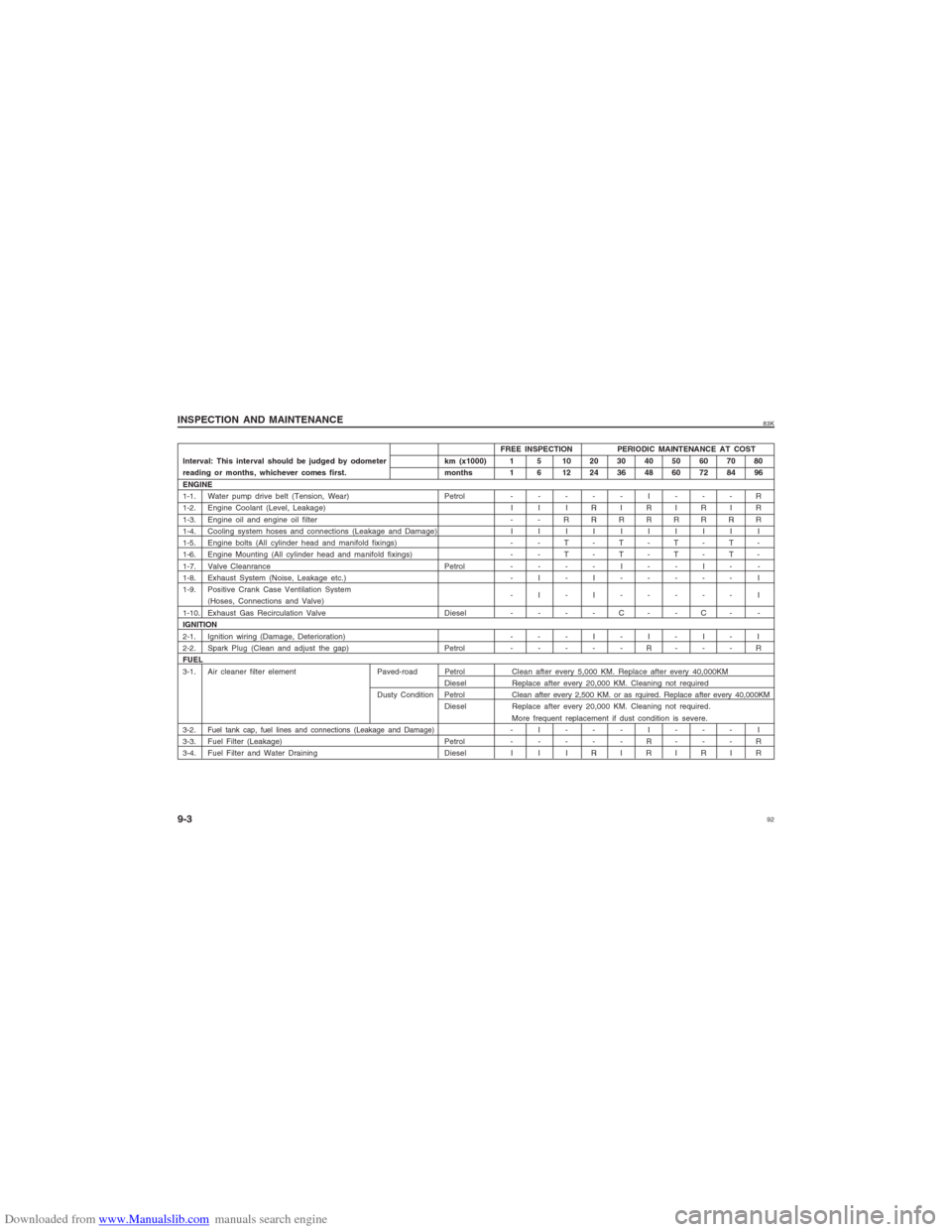
FREE INSPECTION PERIODIC MAINTENANCE AT COST
Interval: This interval should be judged by odometer km (x1000) 1 5 10 20 30 40 50 60 70 80
reading or months, whichever comes first.months 1 6 12 24 36 48 60 72 84 96
ENGINE
1-1. Water pump drive belt (Tension, Wear) Petrol-----I---R
1-2.Engine Coolant (Level, Leakage) I I I R I R I R I R
1-3. Engine oil and engine oil filter - - R RRRRRRR
1-4.Cooling system hoses and connections (Leakage and Damage)IIIIIIIIII
1-5.Engine bolts (All cylinder head and manifold fixings) - - T - T - T - T -
1-6.Engine Mounting (All cylinder head and manifold fixings) - - T - T - T - T -
1-7. Valve Cleanrance Petrol----I--I--
1-8.Exhaust System (Noise, Leakage etc.) - I - I-----I
1-9. Positive Crank Case Ventilation System
(Hoses, Connections and Valve)-I-I-----I
1-10.Exhaust Gas Recirculation Valve Diesel----C--C--
IGNITION
2-1.Ignition wiring (Damage, Deterioration) - - - I - I - I - I
2-2. Spark Plug (Clean and adjust the gap) Petrol-----R---R
FUEL
3-1. Air cleaner filter element Paved-road Petrol Clean after every 5,000 KM. Replace after every 40,000KM
Diesel Replace after every 20,000 KM. Cleaning not required
Dusty Condition Petrol Clean after every 2,500 KM. or as rquired. Replace after every 40,000KM
Diesel Replace after every 20,000 KM. Cleaning not required.
More frequent replacement if dust condition is severe.
3-2.
Fuel tank cap, fuel lines and connections (Leakage and Damage)
-I---I---I
3-3. Fuel Filter (Leakage) Petrol-----R---R
3-4. Fuel Filter and Water Draining Diesel I I I R I R I R I R
INSPECTION AND MAINTENANCE
9-3
Page 94 of 136
Downloaded from www.Manualslib.com manuals search engine 9483K
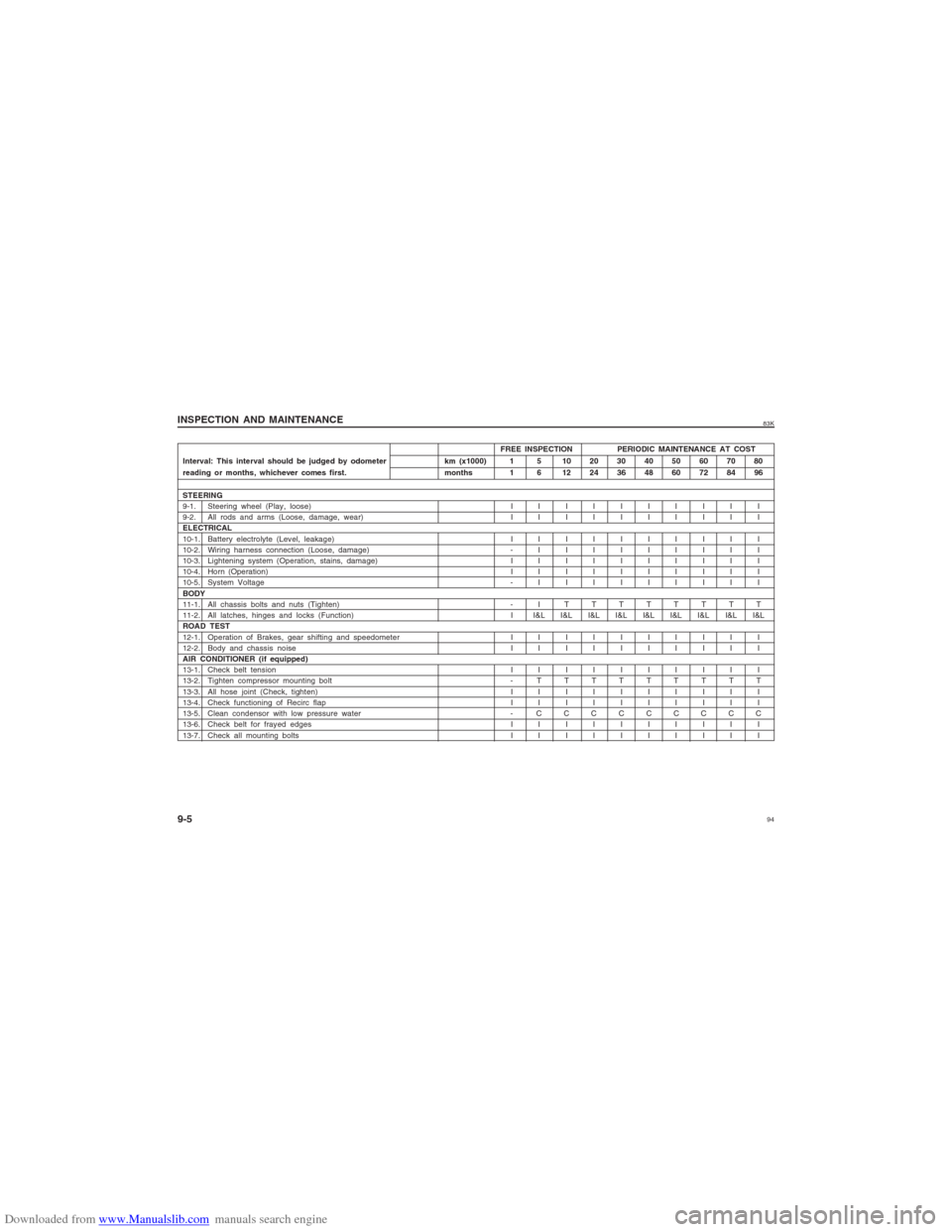
FREE INSPECTION PERIODIC MAINTENANCE AT COST
Interval: This interval should be judged by odometer km (x1000) 1 5 10 20 30 40 50 60 70 80
reading or months, whichever comes first.months 1 6 12 24 36 48 60 72 84 96
STEERING
9-1.Steering wheel (Play, loose)IIIIIIIIII
9-2. All rods and arms (Loose, damage, wear)IIIIIIIIII
ELECTRICAL
10-1.Battery electrolyte (Level, leakage)IIIIIIIIII
10-2. Wiring harness connection (Loose, damage) -IIIIIIIII
10-3. Lightening system (Operation, stains, damage)IIIIIIIIII
10-4.Horn (Operation)IIIIIIIIII
10-5.System Voltage -IIIIIIIII
BODY
11-1.All chassis bolts and nuts (Tighten) - ITTTTTTTT
11-2. All latches, hinges and locks (Function) I I&L I&L I&L I&L I&L I&L I&L I&L I&L
ROAD TEST
12-1.Operation of Brakes, gear shifting and speedometerIIIIIIIIII
12-2.Body and chassis noiseIIIIIIIIII
AIR CONDITIONER (if equipped)
13-1. Check belt tensionIIIIIIIIII
13-2.Tighten compressor mounting bolt -TTTTTTTTT
13-3. All hose joint (Check, tighten)IIIIIIIIII
13-4.Check functioning of Recirc flapIIIIIIIIII
13-5. Clean condensor with low pressure water - C C CCCCCCC
13-6. Check belt for frayed edgesIIIIIIIIII
13-7.Check all mounting boltsIIIIIIIIII
INSPECTION AND MAINTENANCE
9-5
Page 95 of 136
Downloaded from www.Manualslib.com manuals search engine 9583KDrive Belt
w ww w
w WARNING
When the engine is running, keep
hands, hair, clothing, tools, etc. away
from the moving fan and drive belts.
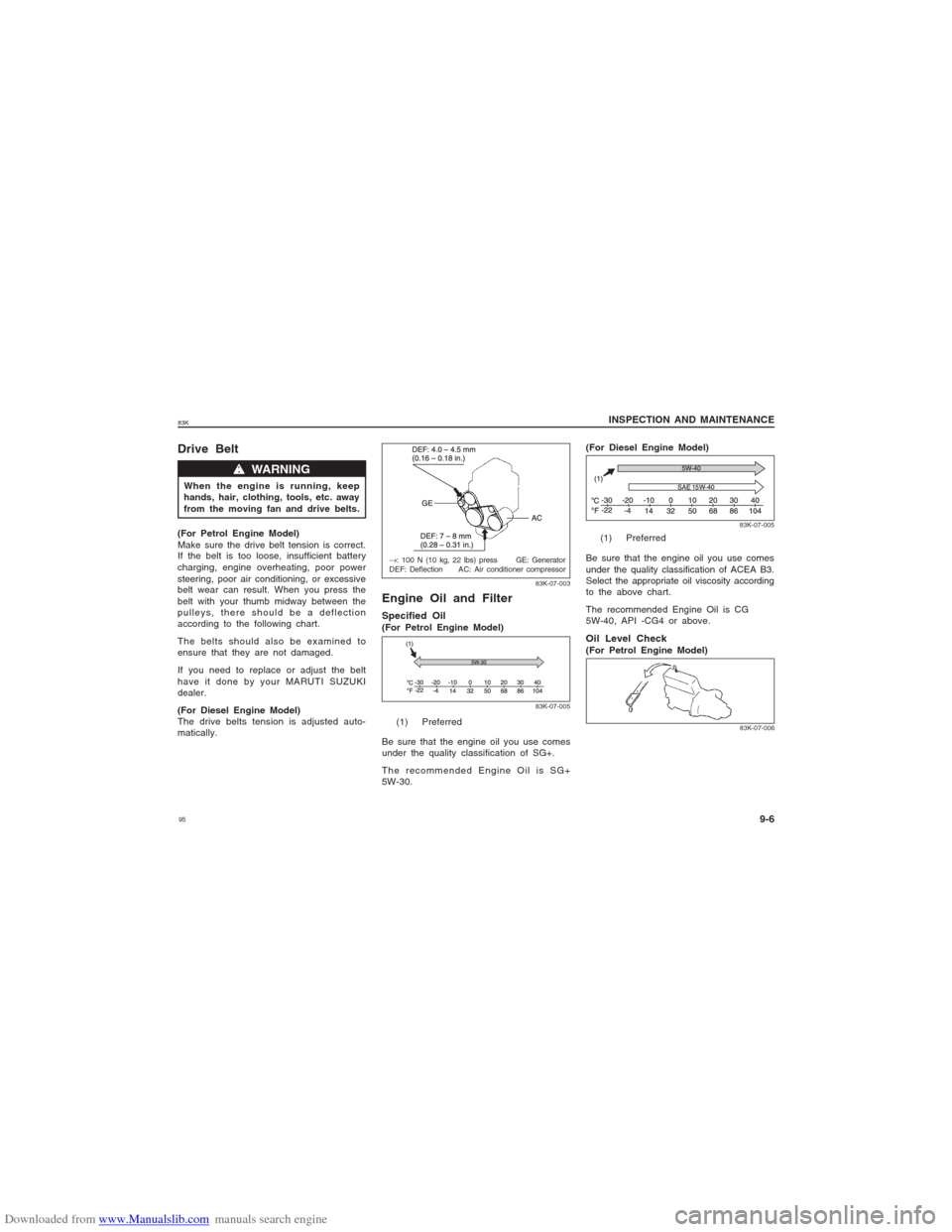
(For Petrol Engine Model)
Make sure the drive belt tension is correct.
If the belt is too loose, insufficient battery
charging, engine overheating, poor power
steering, poor air conditioning, or excessive
belt wear can result. When you press the
belt with your thumb midway between the
pulleys, there should be a deflection
according to the following chart.
The belts should also be examined to
ensure that they are not damaged.
If you need to replace or adjust the belt
have it done by your MARUTI SUZUKI
dealer.
(For Diesel Engine Model)
The drive belts tension is adjusted auto-
matically.
Engine Oil and FilterSpecified Oil(For Petrol Engine Model)
(1) Preferred→: 100 N (10 kg, 22 lbs) press GE: Generator
DEF: Deflection AC: Air conditioner compressor
INSPECTION AND MAINTENANCE
9-6
83K-07-003
(For Diesel Engine Model)
83K-07-005
Be sure that the engine oil you use comes
under the quality classification of ACEA B3.
Select the appropriate oil viscosity according
to the above chart.
The recommended Engine Oil is CG
5W-40, API -CG4 or above.Oil Level Check(For Petrol Engine Model)
83K-07-006
(1) Preferred
83K-07-005
Be sure that the engine oil you use comes
under the quality classification of SG+.
The recommended Engine Oil is SG+
5W-30.
Page 120 of 136
Downloaded from www.Manualslib.com manuals search engine 12083K
INSPECTION AND MAINTENANCE
9-31
w ww w
w WARNING
Do not use “antifreeze” solution in the
windshield washer reservoir. This can
severely impair visibility when sprayed
on the windshield, and can also
damage your vehicle’s paint.
CAUTION
Damage may result if the washer
motor is operated with no fluid in the
washer tank.Air Conditioning SystemIf you do not use the air conditioner for a
long period, such as during winter, it may
not give the best performance when you
start using it again. To help maintain opti-
mum performance and durability of your air
conditioner, it needs to be run periodically.
Operate the air conditioner at least once a
month for one minute with the engine idling.
This circulates the refrigerant and oil and
helps protect the internal components. Check that there is washer fluid in the tank.
Refill it if necessary. Use a good quality
windshield washer fluid, diluted with water
as necessary.
Page 126 of 136
Downloaded from www.Manualslib.com manuals search engine 12683K
EMERGENCY SERVICE
10-5
w ww w
w WARNING
If you see or hear escaping steam,
stop the vehicle in a safe place and
immediately turn off the engine to let
it cool. Do not open the hood when
steam is present. When the steam can
no longer be seen or heard, open the
hood to see if the coolant is still
boiling. If it is, you must wait until it
stops boiling before you proceed.If the Engine is FloodedIf the engine is flooded with Petrol, it may
be hard to start. If this happens, press the
accelerator pedal all the way to the floor
and hold it there while cranking the engine.
(Do not operate the starter motor for more
than 15 seconds).If the Engine OverheatsThe engine could overheat temporarily under
severe driving conditions. If the high engine
coolant temperature warning light comes on
as indication of overheating during driving:
1) Turn off the air conditioner, if equipped.
2) Take the vehicle to a safe place and park.
3) Let the engine run at the normal idle speed
for a few minutes until the high engine
coolant temperature warning light goes off.water pump belt and pulleys are not
damaged or slipping. If any abnormality
is found, contact your Maruti Suzuki
authorized workshop / service station.
2) Check the coolant level in the reservoir.
If it is found to be lower than the “LOW”
line, look for leaks at the radiator, water
pump, and radiator and heater hoses. If
you locate any leaks that may have
caused the overheating, do not run the
engine until these problems have been
corrected and contact your Maruti Suzuki
authorized workshop / service station.
3) If you do not find a leak, carefully add
coolant to the reservoir and then the
radiator, if necessary. (Refer to “Engine
Coolant” in the “INSPECTION AND
MAINTENANCE” section.)
83K-08-011
If the high engine coolant temperature
warning light does not go off:
1) Turn off the engine and check that the
83K-08-012
For Petrol
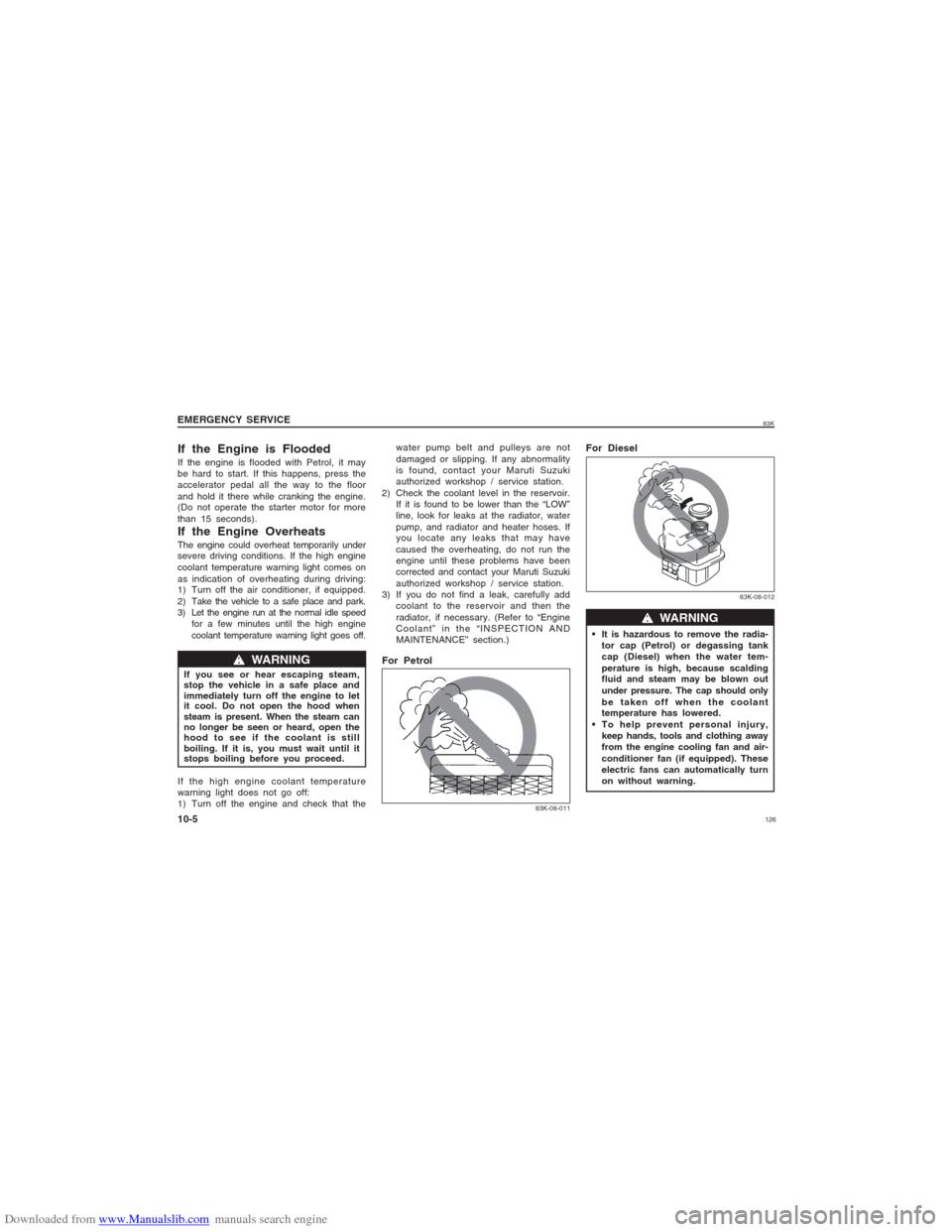
w ww w
w WARNING
It is hazardous to remove the radia-
tor cap (Petrol) or degassing tank
cap (Diesel) when the water tem-
perature is high, because scalding
fluid and steam may be blown out
under pressure. The cap should only
be taken off when the coolant
temperature has lowered.
To help prevent personal injury,
keep hands, tools and clothing away
from the engine cooling fan and air-
conditioner fan (if equipped). These
electric fans can automatically turn
on without warning.For Diesel