change time SUZUKI MARUTI 2005 1.G User Guide
[x] Cancel search | Manufacturer: SUZUKI, Model Year: 2005, Model line: MARUTI, Model: SUZUKI MARUTI 2005 1.GPages: 136, PDF Size: 2.93 MB
Page 65 of 136
Downloaded from www.Manualslib.com manuals search engine 6583K
OPERATING YOUR VEHICLE
5-10
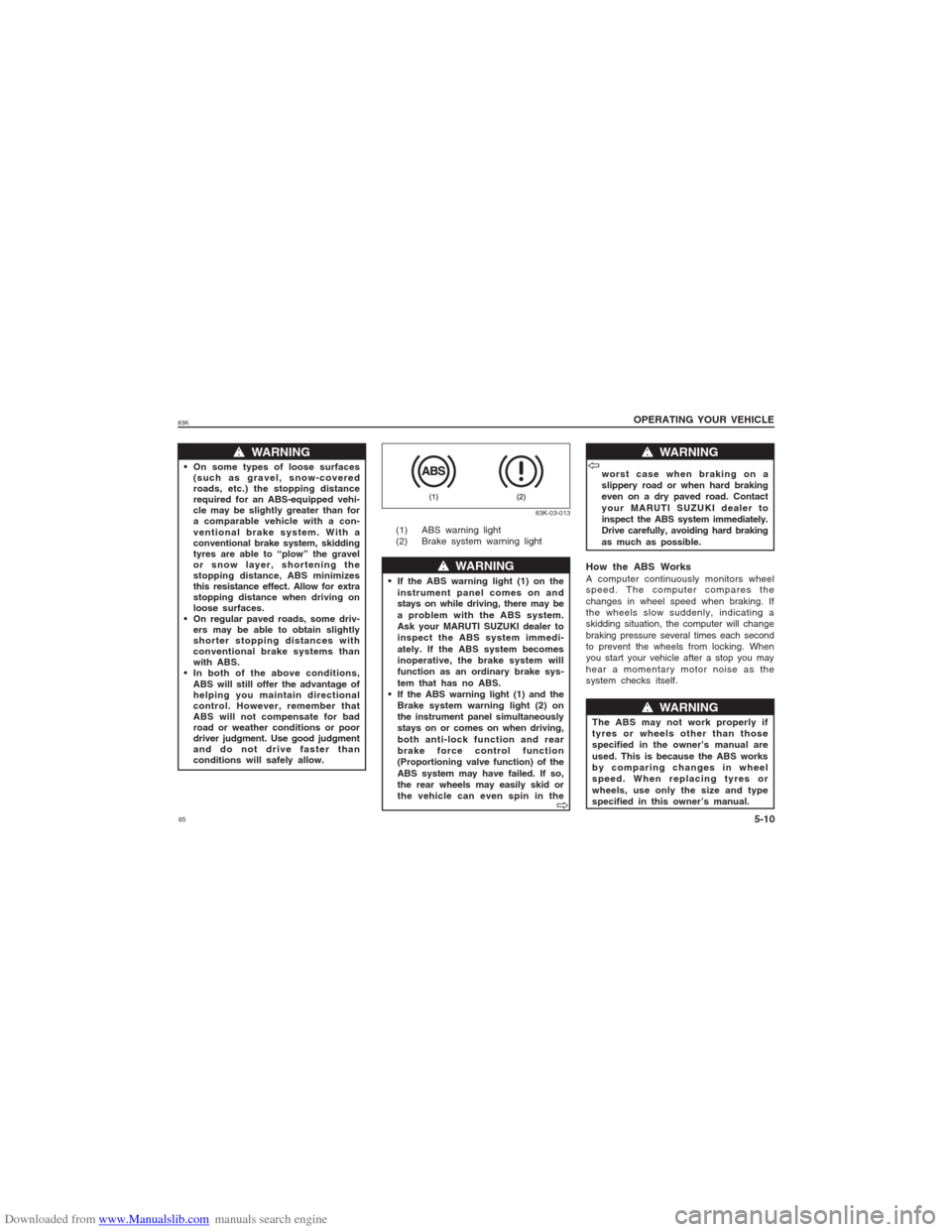
(1) ABS warning light
(2) Brake system warning light
w ww w
w WARNING
If the ABS warning light (1) on the
instrument panel comes on and
stays on while driving, there may be
a problem with the ABS system.
Ask your MARUTI SUZUKI dealer to
inspect the ABS system immedi-
ately. If the ABS system becomes
inoperative, the brake system will
function as an ordinary brake sys-
tem that has no ABS.
If the ABS warning light (1) and the
Brake system warning light (2) on
the instrument panel simultaneously
stays on or comes on when driving,
both anti-lock function and rear
brake force control function
(Proportioning valve function) of the
ABS system may have failed. If so,
the rear wheels may easily skid or
the vehicle can even spin in the
83K-03-013
V VV V
V
w ww w
w WARNING
V VV V
V
w ww w
w WARNING
The ABS may not work properly if
tyres or wheels other than those
specified in the owner’s manual are
used. This is because the ABS works
by comparing changes in wheel
speed. When replacing tyres or
wheels, use only the size and type
specified in this owner’s manual.worst case when braking on a
slippery road or when hard braking
even on a dry paved road. Contact
your MARUTI SUZUKI dealer to
inspect the ABS system immediately.
Drive carefully, avoiding hard braking
as much as possible.How the ABS WorksA computer continuously monitors wheel
speed. The computer compares the
changes in wheel speed when braking. If
the wheels slow suddenly, indicating a
skidding situation, the computer will change
braking pressure several times each second
to prevent the wheels from locking. When
you start your vehicle after a stop you may
hear a momentary motor noise as the
system checks itself.
w ww w
w WARNING
On some types of loose surfaces
(such as gravel, snow-covered
roads, etc.) the stopping distance
required for an ABS-equipped vehi-
cle may be slightly greater than for
a comparable vehicle with a con-
ventional brake system. With a
conventional brake system, skidding
tyres are able to “plow” the gravel
or snow layer, shortening the
stopping distance, ABS minimizes
this resistance effect. Allow for extra
stopping distance when driving on
loose surfaces.
On regular paved roads, some driv-
ers may be able to obtain slightly
shorter stopping distances with
conventional brake systems than
with ABS.
In both of the above conditions,
ABS will still offer the advantage of
helping you maintain directional
control. However, remember that
ABS will not compensate for bad
road or weather conditions or poor
driver judgment. Use good judgment
and do not drive faster than
conditions will safely allow.
Page 76 of 136
Downloaded from www.Manualslib.com manuals search engine 7683K
OTHER CONTROLS AND EQUIPMENT
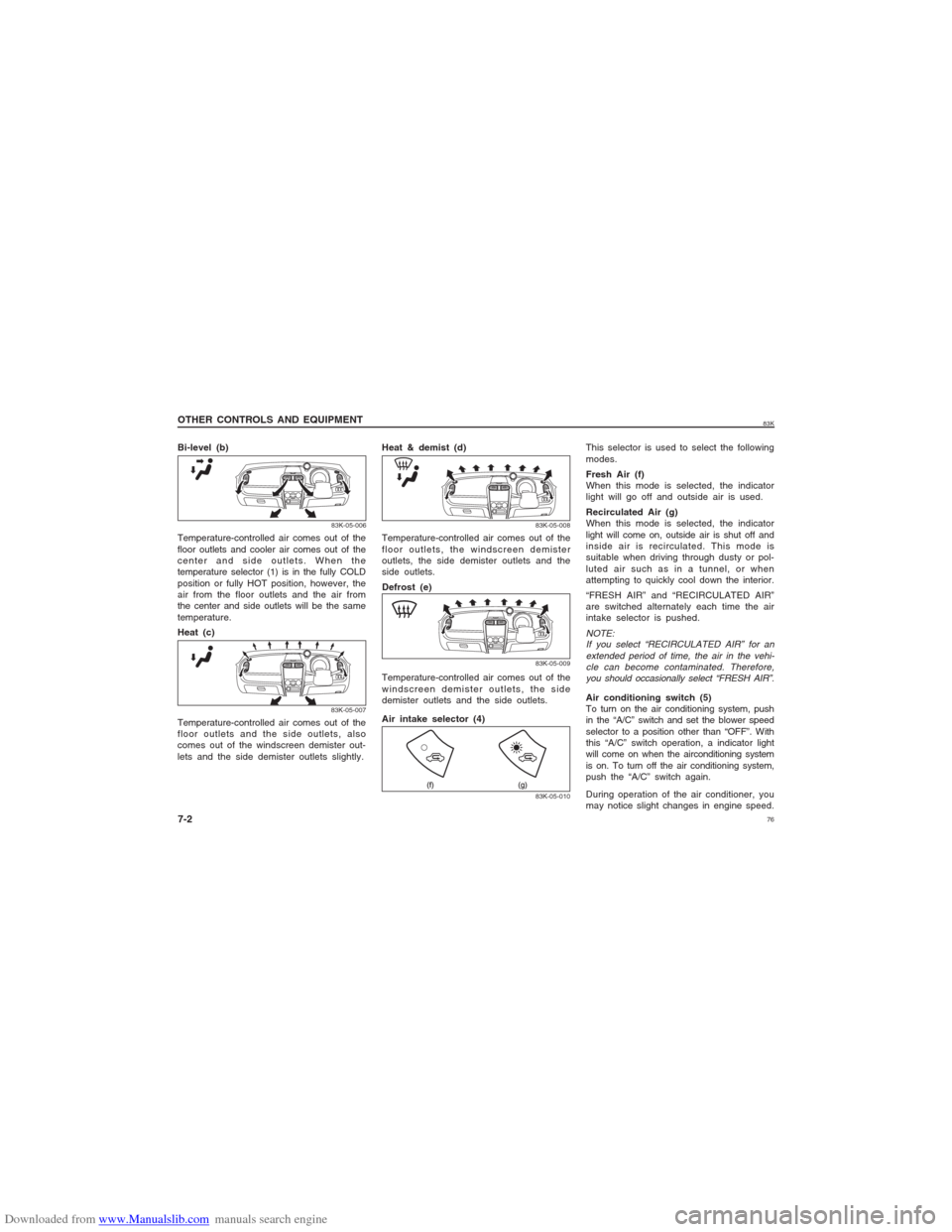
7-2Bi-level (b)
83K-05-007
Temperature-controlled air comes out of the
floor outlets and the side outlets, also
comes out of the windscreen demister out-
lets and the side demister outlets slightly.Heat & demist (d)
83K-05-006
Temperature-controlled air comes out of the
floor outlets and cooler air comes out of the
center and side outlets. When the
temperature selector (1) is in the fully COLD
position or fully HOT position, however, the
air from the floor outlets and the air from
the center and side outlets will be the same
temperature.
Heat (c)Temperature-controlled air comes out of the
floor outlets, the windscreen demister
outlets, the side demister outlets and the
side outlets.
Defrost (e)
Air intake selector (4)
83K-05-008
Temperature-controlled air comes out of the
windscreen demister outlets, the side
demister outlets and the side outlets.
83K-05-00983K-05-010
This selector is used to select the following
modes.
Fresh Air (f)
When this mode is selected, the indicator
light will go off and outside air is used.
Recirculated Air (g)
When this mode is selected, the indicator
light will come on, outside air is shut off and
inside air is recirculated. This mode is
suitable when driving through dusty or pol-
luted air such as in a tunnel, or when
attempting to quickly cool down the interior.
“FRESH AIR” and “RECIRCULATED AIR”
are switched alternately each time the air
intake selector is pushed.NOTE:
If you select “RECIRCULATED AIR” for an
extended period of time, the air in the vehi-
cle can become contaminated. Therefore,
you should occasionally select “FRESH AIR”.Air conditioning switch (5)
To turn on the air conditioning system, push
in the “A/C” switch and set the blower speed
selector to a position other than “OFF”. With
this “A/C” switch operation, a indicator light
will come on when the airconditioning system
is on. To turn off the air conditioning system,
push the “A/C” switch again.
During operation of the air conditioner, you
may notice slight changes in engine speed.
Page 77 of 136
Downloaded from www.Manualslib.com manuals search engine 7783K
OTHER CONTROLS AND EQUIPMENT
7-3
These changes are normal, the system is
designed so that the compressor turns on
or off to maintain the desired temperature.
Less operation of the compressor results in
better fuel economy.System Operating InstructionsNatural ventilation
Select “VENTILATION” and “FRESH AIR”,
the temperature selector to the desired
temperature position, and the blower speed
selector to “OFF”. Fresh air will flow through
the vehicle during driving.
Forced ventilation
The control settings are the same as for
natural ventilation except you set the blower
speed selector to a position other than “OFF”.
Normal heating (using outside air)
Select “HEAT” and “FRESH AIR”, the tem-
perature selector to the desired temperature
position and the blower speed selector to
the desired blower speed position. Setting
the blower speed selector to a higher blower
speed position increases heating efficiency.
Quick heating (using recirculated air)
The control settings are the same as for
normal heating except you select “RECIR-
CULATED AIR”. If you use this heating
method for an extended period of time, the
air in the vehicle can become contaminatedand the windows can become misty.
Therefore, use this method only for quick
heating and change to the normal heating
method as soon as possible.
Cool face / Warm feet
Select “BI-LEVEL” and “FRESH AIR”, the
temperature selector to the desired tem-
perature position, and the blower speed
selector to the desired blower speed posi-
tion. Unless the temperature selector is in
the fully COLD position or fully HOT posi-
tion, the air that comes out of the center
and side outlets will be cooler than the air
that comes out of the floor outlets.
Normal cooling
Turn on the “A/C” switch, set the air flow
selector to “VENTILATION”, the temperature
selector to the desired temperature position
and the blower speed selector to the
desired blower speed position. Setting the
blower speed selector to a higher blower
speed position increases cooling efficiency.
You can switch the air intake selector to
either “FRESH AIR” or “RECIRCULATED
AIR” as you desire. Choosing “RECIRCU-
LATED AIR” increases cooling efficiency.
Quick cooling (using recirculated air)
The control settings are the same as for
normal cooling except you select “RECIR-
CULATED AIR” and the highest blower speed.
NOTE:
If your vehicle has been left in the sun
with the windows closed, it will cool
faster if you open the windows briefly
while you operate the air conditioner with
the air intake selector at “FRESH AIR”
and the blower at high speed.Dehumidifying
Turn on the “A/C” switch, set the air flow
selector to the desired air flow selector
position, and select “FRESH AIR”, the tem-
perature selector to the desired temperature
position, and the blower speed selector to
the desired blower speed position.
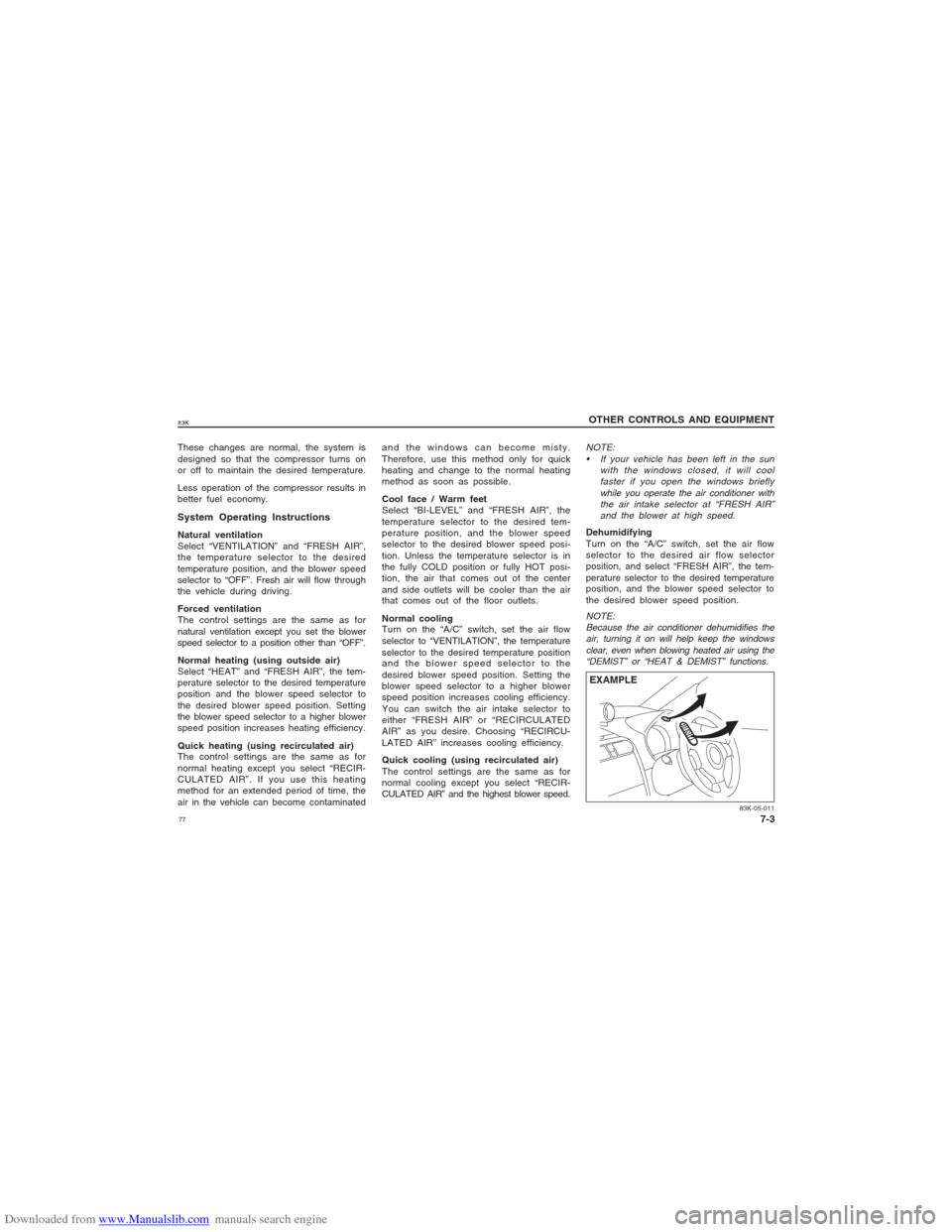
83K-05-011
NOTE:
Because the air conditioner dehumidifies the
air, turning it on will help keep the windows
clear, even when blowing heated air using the
“DEMIST” or “HEAT & DEMIST” functions.EXAMPLE
Page 103 of 136
Downloaded from www.Manualslib.com manuals search engine 10383K
INSPECTION AND MAINTENANCE
9-14 Gear Oil Change
Since special procedures, materials and
tools are required, it is recommended that
you trust this job to your MARUTI SUZUKI
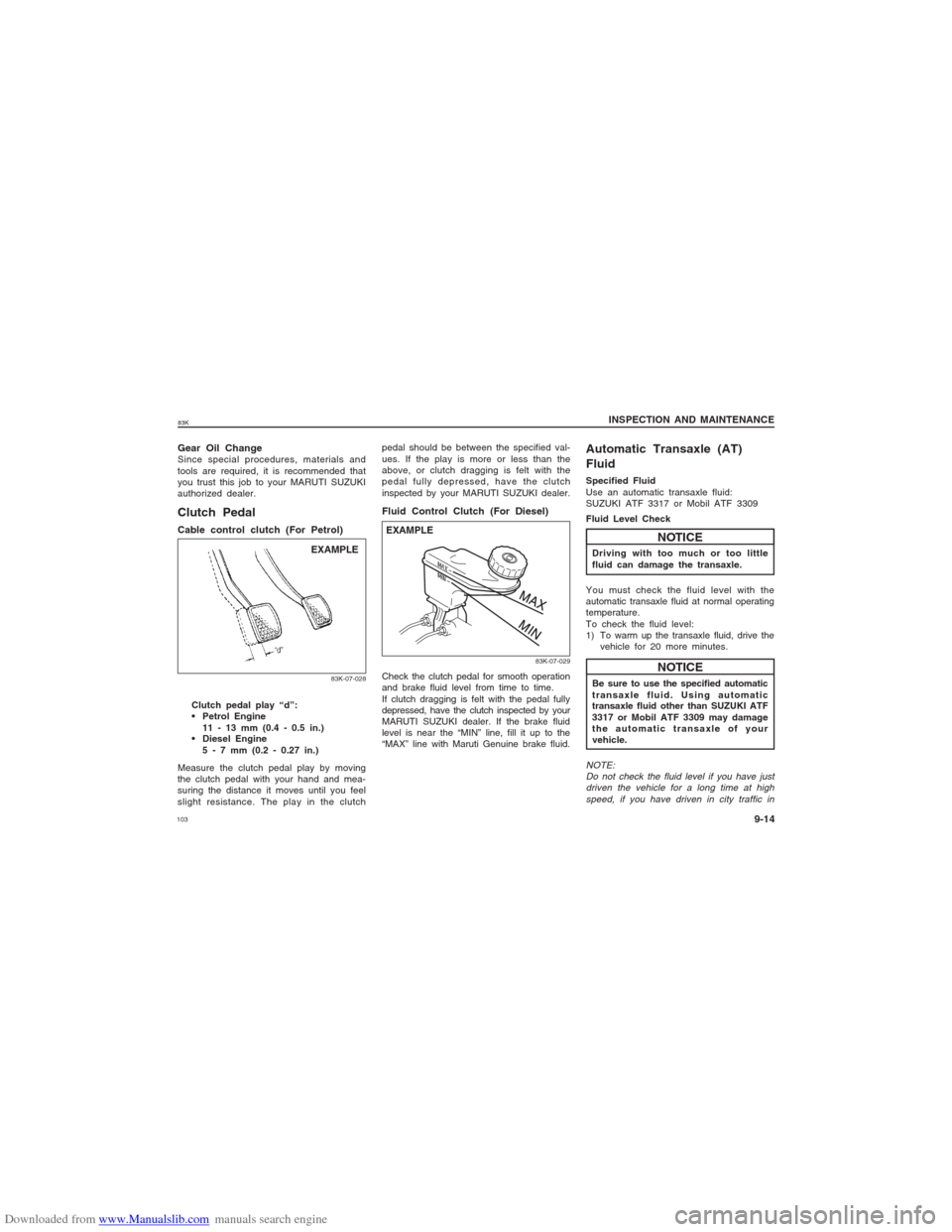
authorized dealer.Clutch PedalCable control clutch (For Petrol)
83K-07-028
Clutch pedal play “d”:
Petrol Engine
11 - 13 mm (0.4 - 0.5 in.)
Diesel Engine
5 - 7 mm (0.2 - 0.27 in.)
Measure the clutch pedal play by moving
the clutch pedal with your hand and mea-
suring the distance it moves until you feel
slight resistance. The play in the clutchpedal should be between the specified val-
ues. If the play is more or less than the
above, or clutch dragging is felt with the
pedal fully depressed, have the clutch
inspected by your MARUTI SUZUKI dealer.
Fluid Control Clutch (For Diesel)Check the clutch pedal for smooth operation
and brake fluid level from time to time.
If clutch dragging is felt with the pedal fully
depressed, have the clutch inspected by your
MARUTI SUZUKI dealer. If the brake fluid
level is near the “MIN” line, fill it up to the
“MAX” line with Maruti Genuine brake fluid.
83K-07-029
EXAMPLE
EXAMPLE
Automatic Transaxle (AT)
FluidSpecified Fluid
Use an automatic transaxle fluid:
SUZUKI ATF 3317 or Mobil ATF 3309
Fluid Level Check
NOTICE
Driving with too much or too little
fluid can damage the transaxle.
You must check the fluid level with the
automatic transaxle fluid at normal operating
temperature.
To check the fluid level:
1) To warm up the transaxle fluid, drive the
vehicle for 20 more minutes.
NOTICE
Be sure to use the specified automatic
transaxle fluid. Using automatic
transaxle fluid other than SUZUKI ATF
3317 or Mobil ATF 3309 may damage
the automatic transaxle of your
vehicle.NOTE:
Do not check the fluid level if you have just
driven the vehicle for a long time at high
speed, if you have driven in city traffic in