check engine SUZUKI MARUTI 2005 1.G User Guide
[x] Cancel search | Manufacturer: SUZUKI, Model Year: 2005, Model line: MARUTI, Model: SUZUKI MARUTI 2005 1.GPages: 136, PDF Size: 2.93 MB
Page 56 of 136
Downloaded from www.Manualslib.com manuals search engine 5683K
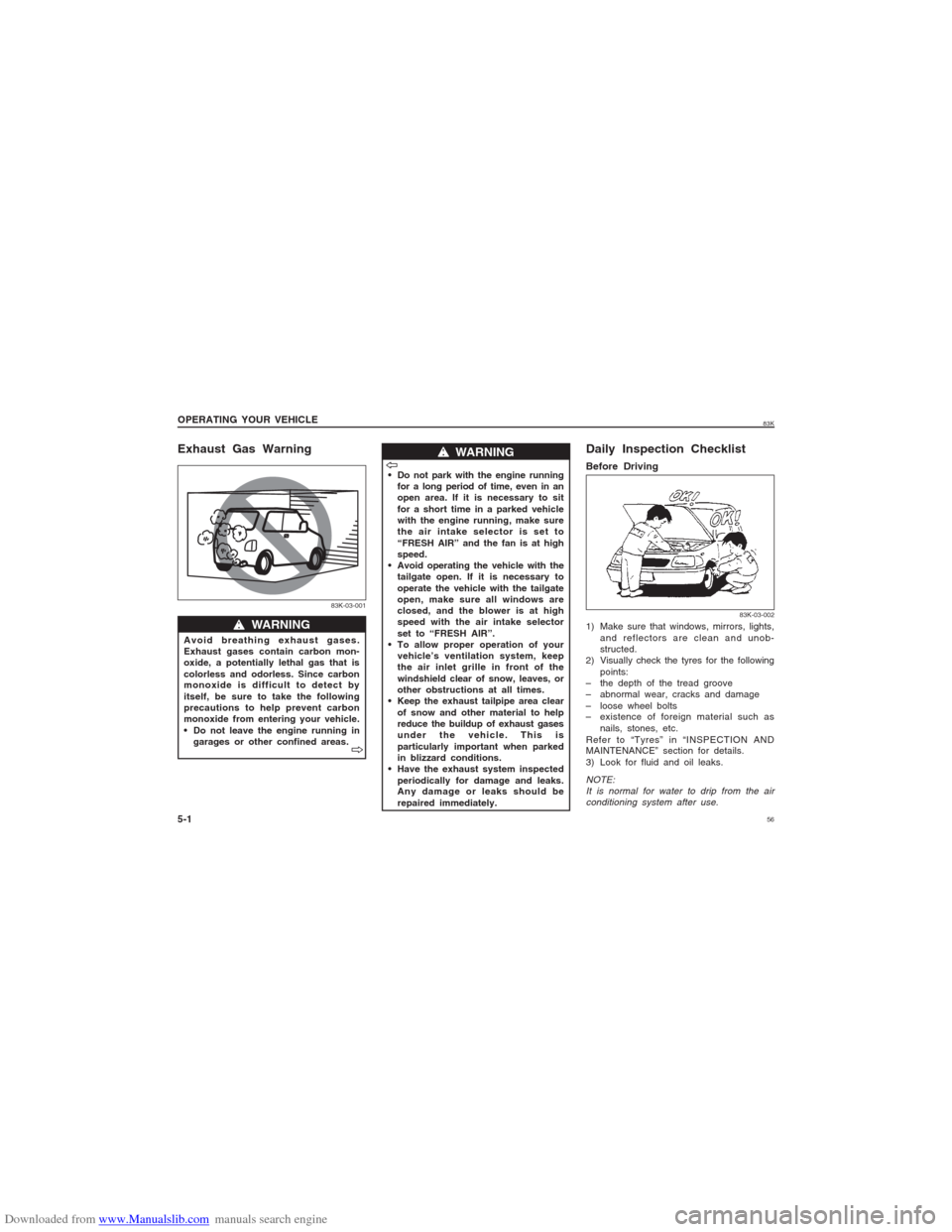
Exhaust Gas Warning
83K-03-001
w ww w
w WARNING
Avoid breathing exhaust gases.
Exhaust gases contain carbon mon-
oxide, a potentially lethal gas that is
colorless and odorless. Since carbon
monoxide is difficult to detect by
itself, be sure to take the following
precautions to help prevent carbon
monoxide from entering your vehicle.
Do not leave the engine running in
garages or other confined areas.
w ww w
w WARNING
Do not park with the engine running
for a long period of time, even in an
open area. If it is necessary to sit
for a short time in a parked vehicle
with the engine running, make sure
the air intake selector is set to
“FRESH AIR” and the fan is at high
speed.
Avoid operating the vehicle with the
tailgate open. If it is necessary to
operate the vehicle with the tailgate
open, make sure all windows are
closed, and the blower is at high
speed with the air intake selector
set to “FRESH AIR”.
To allow proper operation of your
vehicle’s ventilation system, keep
the air inlet grille in front of the
windshield clear of snow, leaves, or
other obstructions at all times.
Keep the exhaust tailpipe area clear
of snow and other material to help
reduce the buildup of exhaust gases
under the vehicle. This is
particularly important when parked
in blizzard conditions.
Have the exhaust system inspected
periodically for damage and leaks.
Any damage or leaks should be
repaired immediately.
Daily Inspection ChecklistBefore Driving1) Make sure that windows, mirrors, lights,
and reflectors are clean and unob-
structed.
2) Visually check the tyres for the following
points:
– the depth of the tread groove
– abnormal wear, cracks and damage
– loose wheel bolts
– existence of foreign material such as
nails, stones, etc.
Refer to “Tyres” in “INSPECTION AND
MAINTENANCE” section for details.
3) Look for fluid and oil leaks.NOTE:
It is normal for water to drip from the air
conditioning system after use.
83K-03-002
OPERATING YOUR VEHICLE
5-1
V VV V
V
V VV V
V
Page 57 of 136
Downloaded from www.Manualslib.com manuals search engine 5783K4) Make sure the bonnet is fully closed and
latched.
5) Check the headlights, turn signal lights,
brake lights and horn for proper opera-
tion.
6) Adjust the seat and adjustable head
restraint (if equipped).
7) Check the brake pedal and the parking
brake lever.
8) Adjust the mirrors.
9) Make sure that you and all passengers
have properly fastened your seat belts.
10)Make sure that all warning lights come
on as the key is turned to the “ON” or
“START” position.
11)Check all gauges.
12)Make sure that the BRAKE SYSTEM
WARNING light turns off when the
parking brake is released.
Once a week, or each time you fill your fuel
tank, perform the following under-hood
checks:
1) Engine oil level
2) Coolant level
3) Brake fluid level
4) Windshield washer fluid level
5) Battery solution level
6) Bonnet latch operation
Pull the Bonnet release handle inside the
vehicle. Make sure that you cannot open
the Bonnet all the way without releasingthe secondary latch. Be sure to close
the Bonnet securely after checking for
proper latch operation. See “All latches,
hinges & locks” of “CHASSIS AND
BODY” in the “Periodic Maintenance
Schedule” in the “INSPECTION AND
MAINTENANCE” section for lubrication
schedule.
w ww w
w WARNING
Make sure the bonnet is fully closed
and latched before driving. If it is not,
it can fly up unexpectedly during
driving, obstructing your view and
resulting in an accident.
Once a month, or each time you fill your
fuel tank, check the tyre pressure using a
tyre pressure gauge. Also check the tyre
pressure of the spare tyre.since its pistons, piston rings and cylinder
walls have not yet become conditioned. New
engines reach the normal level of oil
consumption only after approximately 5000
km (3000 miles) driving.
When judging the amount of oil consump-
tion, note that the oil may become diluted
and make it difficult to accurately judge the
true oil level.
As an example, if a vehicle is used for
repeated short trips, and consumes a nor-
mal amount of oil, the dipstick may not
show any drop in the oil level at all, even
after 1000 km (600 miles) or more of driv-
ing. This is because the oil is gradually
becoming diluted with fuel or moisture,
making it appear that the oil level has not
changed.
You should also be aware that the diluting
ingredients evaporate out when the vehicle
is subsequently driven at high speeds, such
as on an expressway, making it appear that
oil is excessively consumed after high-speed
driving.
OPERATING YOUR VEHICLE
5-2
Engine Oil ConsumptionIt is normal for the engine to consume some
engine oil during normal vehicle operation.
The amount of engine oil consumed
depends on the viscosity of the oil, the
quality of the oil and the conditions the
vehicle is driven under.
More oil is consumed during high-speed
driving and when there is frequent acceler-
ation and deceleration. Under high loads,
your engine also will consume more oil.
A new engine also consumes more oil,
83K-03-003
Ignition SwitchEXAMPLE
Page 58 of 136
Downloaded from www.Manualslib.com manuals search engine 5883K
w ww w
w WARNING
To avoid possible injury, do not oper-
ate controls by reaching through the
steering wheel.
83K-03-004
EXAMPLE OPERATING YOUR VEHICLE
5-3The ignition switch has the following four
positions:LOCKThis is the normal parking position. It is the
only position in which the key can be
removed.
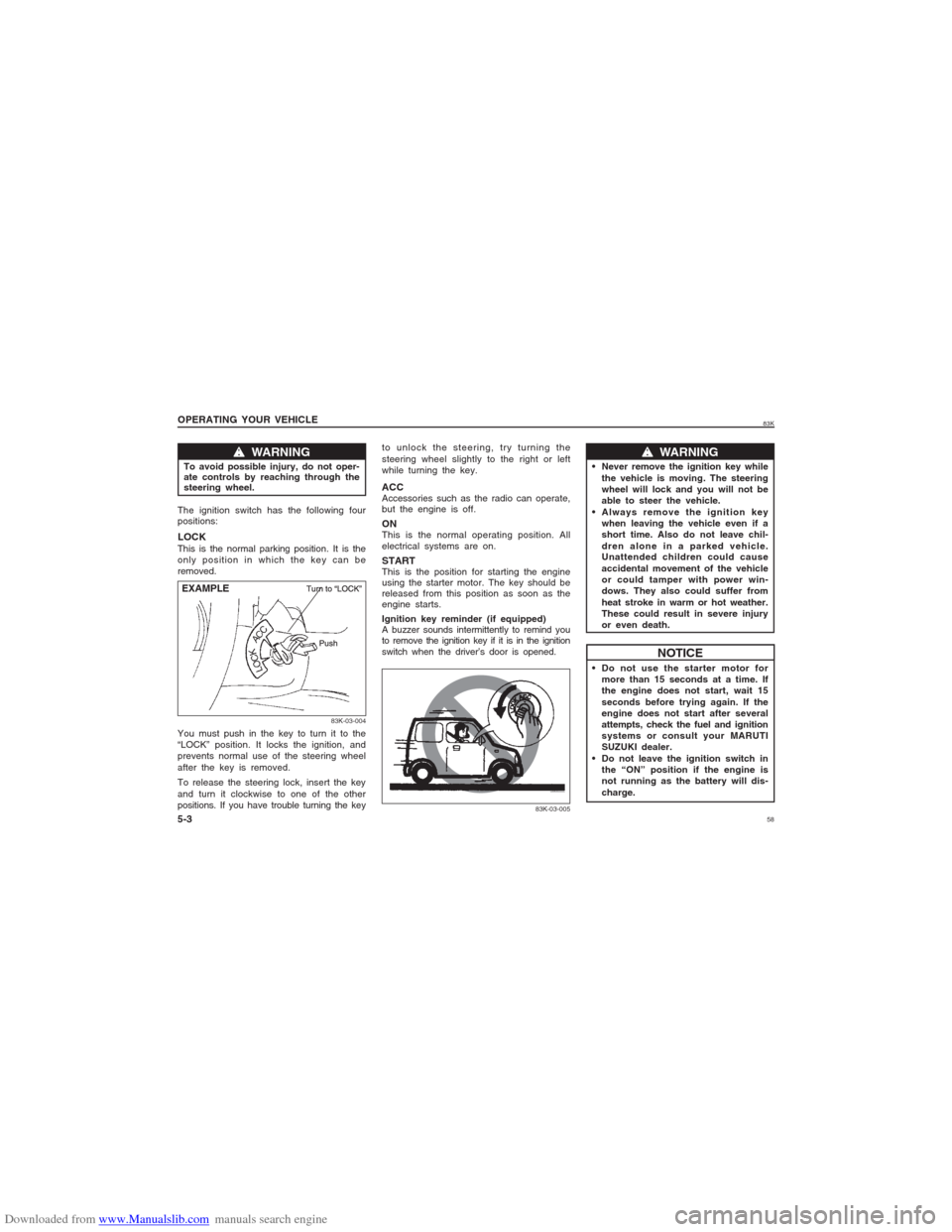
You must push in the key to turn it to the
“LOCK” position. It locks the ignition, and
prevents normal use of the steering wheel
after the key is removed.
To release the steering lock, insert the key
and turn it clockwise to one of the other
positions. If you have trouble turning the keyto unlock the steering, try turning the
steering wheel slightly to the right or left
while turning the key.
ACCAccessories such as the radio can operate,
but the engine is off.ONThis is the normal operating position. All
electrical systems are on.STARTThis is the position for starting the engine
using the starter motor. The key should be
released from this position as soon as the
engine starts.
Ignition key reminder (if equipped)
A buzzer sounds intermittently to remind you
to remove the ignition key if it is in the ignition
switch when the driver’s door is opened.
w ww w
w WARNING
Never remove the ignition key while
the vehicle is moving. The steering
wheel will lock and you will not be
able to steer the vehicle.
Always remove the ignition key
when leaving the vehicle even if a
short time. Also do not leave chil-
dren alone in a parked vehicle.
Unattended children could cause
accidental movement of the vehicle
or could tamper with power win-
dows. They also could suffer from
heat stroke in warm or hot weather.
These could result in severe injury
or even death.
NOTICE
Do not use the starter motor for
more than 15 seconds at a time. If
the engine does not start, wait 15
seconds before trying again. If the
engine does not start after several
attempts, check the fuel and ignition
systems or consult your MARUTI
SUZUKI dealer.
Do not leave the ignition switch in
the “ON” position if the engine is
not running as the battery will dis-
charge.
83K-03-005
Page 60 of 136
Downloaded from www.Manualslib.com manuals search engine 6083K
OPERATING YOUR VEHICLE
5-5 Brake Pedal (2)Your SUZUKI vehicle is equipped with front
disc brakes and rear drum brakes.
Depressing the brake pedal applies both
sets of brakes.
You may hear occasional brake squeal
when you apply the brakes. This is a
normal condition caused by environmental
factors such as cold, wet, snow, etc.
w ww w
w WARNING
If brake squeal is excessive and
occurs each time the brakes are
applied, you should have the brakes
checked by your SUZUKI dealer.
w ww w
w WARNING
Do not “ride” the brakes by applying
them continuously or resting your foot
on the pedal. This will result in
overheating of the brakes which could
cause unpredictable braking action,
longer stopping distances, or
permanent brake damage.Accelerator Pedal (3)This pedal controls the speed of the engine.
Depressing the accelerator pedal increases
power output and speed.
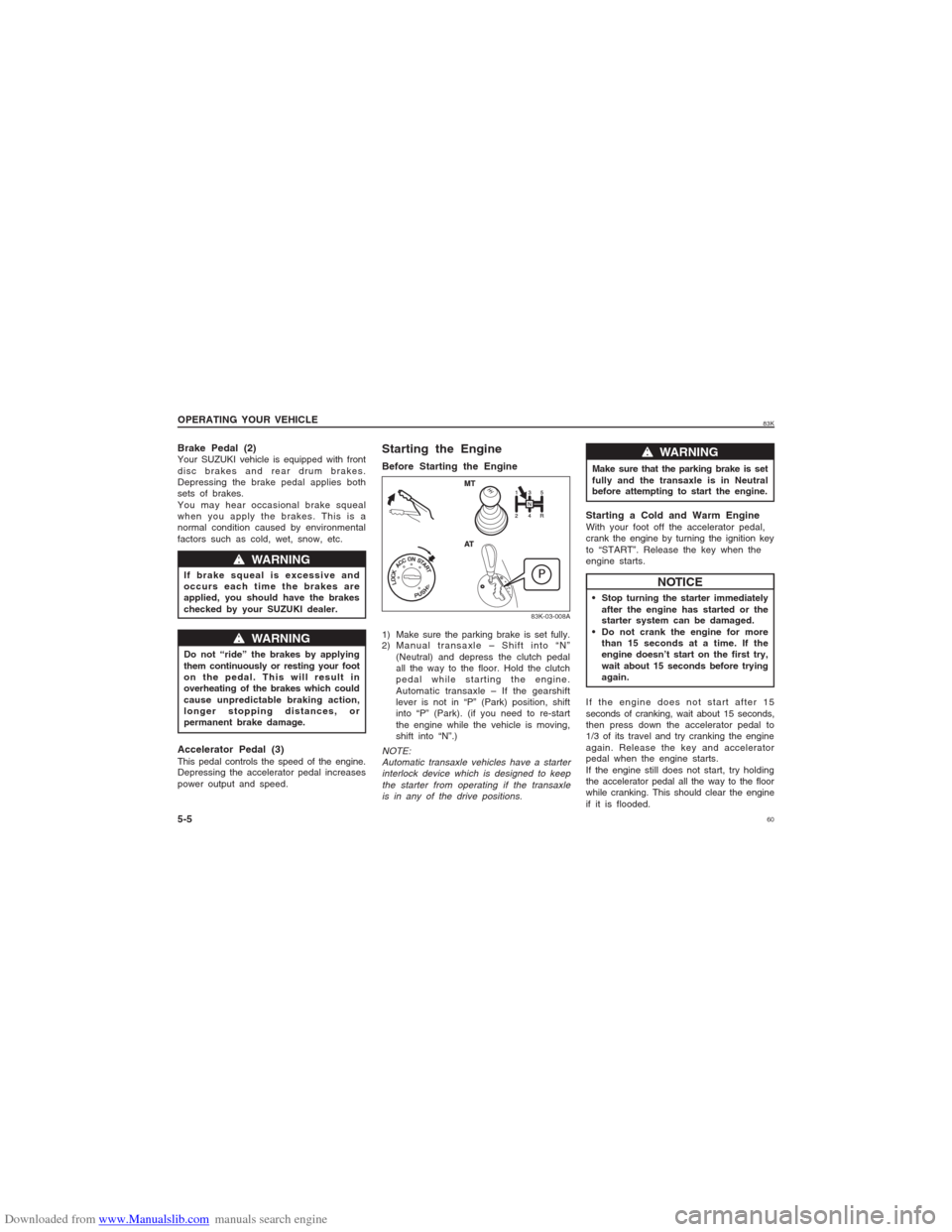
Starting the EngineBefore Starting the Engine
83K-03-008A
1) Make sure the parking brake is set fully.
2) Manual transaxle – Shift into “N”
(Neutral) and depress the clutch pedal
all the way to the floor. Hold the clutch
pedal while starting the engine.
Automatic transaxle – If the gearshift
lever is not in “P” (Park) position, shift
into “P” (Park). (if you need to re-start
the engine while the vehicle is moving,
shift into “N”.)NOTE:
Automatic transaxle vehicles have a starter
interlock device which is designed to keep
the starter from operating if the transaxle
is in any of the drive positions.
Make sure that the parking brake is set
fully and the transaxle is in Neutral
before attempting to start the engine.
w ww w
w WARNING
Starting a Cold and Warm EngineWith your foot off the accelerator pedal,
crank the engine by turning the ignition key
to “START”. Release the key when the
engine starts.
NOTICE
Stop turning the starter immediately
after the engine has started or the
starter system can be damaged.
Do not crank the engine for more
than 15 seconds at a time. If the
engine doesn’t start on the first try,
wait about 15 seconds before trying
again.
If the engine does not start after 15
seconds of cranking, wait about 15 seconds,
then press down the accelerator pedal to
1/3 of its travel and try cranking the engine
again. Release the key and accelerator
pedal when the engine starts.
If the engine still does not start, try holding
the accelerator pedal all the way to the floor
while cranking. This should clear the engine
if it is flooded.
Page 65 of 136
Downloaded from www.Manualslib.com manuals search engine 6583K
OPERATING YOUR VEHICLE
5-10
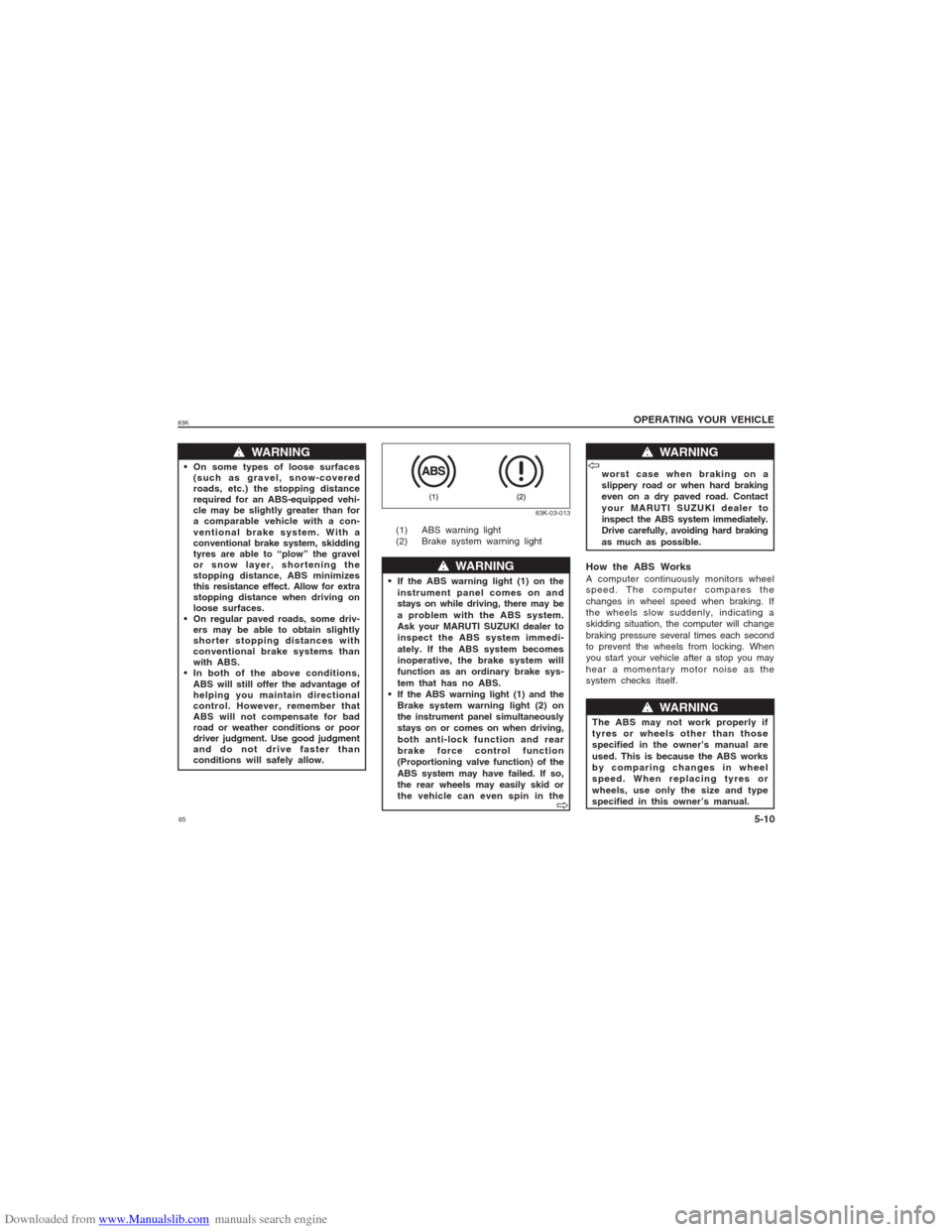
(1) ABS warning light
(2) Brake system warning light
w ww w
w WARNING
If the ABS warning light (1) on the
instrument panel comes on and
stays on while driving, there may be
a problem with the ABS system.
Ask your MARUTI SUZUKI dealer to
inspect the ABS system immedi-
ately. If the ABS system becomes
inoperative, the brake system will
function as an ordinary brake sys-
tem that has no ABS.
If the ABS warning light (1) and the
Brake system warning light (2) on
the instrument panel simultaneously
stays on or comes on when driving,
both anti-lock function and rear
brake force control function
(Proportioning valve function) of the
ABS system may have failed. If so,
the rear wheels may easily skid or
the vehicle can even spin in the
83K-03-013
V VV V
V
w ww w
w WARNING
V VV V
V
w ww w
w WARNING
The ABS may not work properly if
tyres or wheels other than those
specified in the owner’s manual are
used. This is because the ABS works
by comparing changes in wheel
speed. When replacing tyres or
wheels, use only the size and type
specified in this owner’s manual.worst case when braking on a
slippery road or when hard braking
even on a dry paved road. Contact
your MARUTI SUZUKI dealer to
inspect the ABS system immediately.
Drive carefully, avoiding hard braking
as much as possible.How the ABS WorksA computer continuously monitors wheel
speed. The computer compares the
changes in wheel speed when braking. If
the wheels slow suddenly, indicating a
skidding situation, the computer will change
braking pressure several times each second
to prevent the wheels from locking. When
you start your vehicle after a stop you may
hear a momentary motor noise as the
system checks itself.
w ww w
w WARNING
On some types of loose surfaces
(such as gravel, snow-covered
roads, etc.) the stopping distance
required for an ABS-equipped vehi-
cle may be slightly greater than for
a comparable vehicle with a con-
ventional brake system. With a
conventional brake system, skidding
tyres are able to “plow” the gravel
or snow layer, shortening the
stopping distance, ABS minimizes
this resistance effect. Allow for extra
stopping distance when driving on
loose surfaces.
On regular paved roads, some driv-
ers may be able to obtain slightly
shorter stopping distances with
conventional brake systems than
with ABS.
In both of the above conditions,
ABS will still offer the advantage of
helping you maintain directional
control. However, remember that
ABS will not compensate for bad
road or weather conditions or poor
driver judgment. Use good judgment
and do not drive faster than
conditions will safely allow.
Page 72 of 136
Downloaded from www.Manualslib.com manuals search engine 7283K
DRIVING TIPS
6-6
83K-04-010
4. Before entering a corner, decelerate to
a safe speed. Don’t apply brakes during
cornering, or a cornering skid may occur.
5. When overtaking other vehicles, watch
out for the oncoming vehicle and
carefully confirm the safety.
6. Don’t attempt zigzag driving which will
hinder your control over the vehicle and
cause an accident.
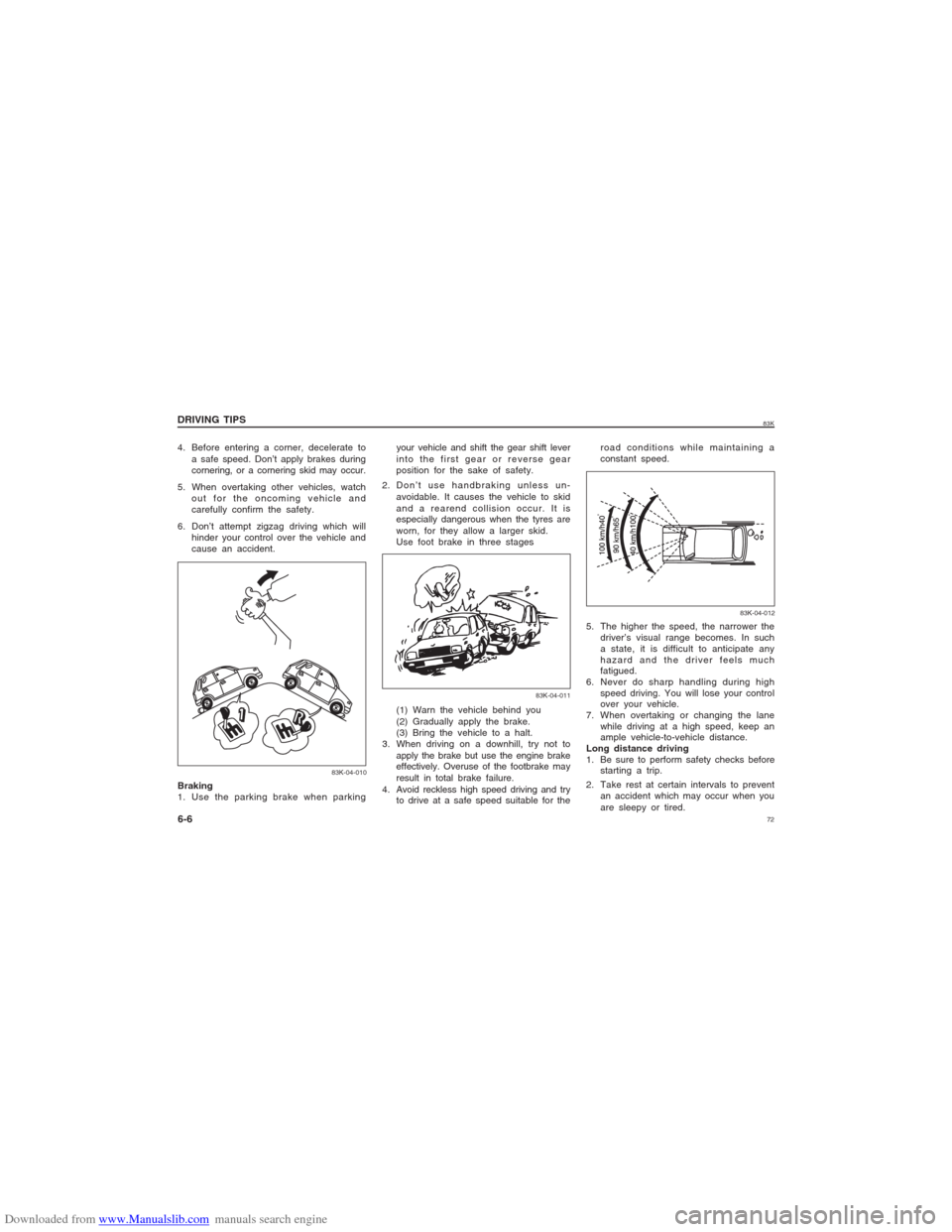
Braking
1. Use the parking brake when parking(1) Warn the vehicle behind you
(2) Gradually apply the brake.
(3) Bring the vehicle to a halt.
3. When driving on a downhill, try not to
apply the brake but use the engine brake
effectively. Overuse of the footbrake may
result in total brake failure.
4. Avoid reckless high speed driving and try
to drive at a safe speed suitable for theroad conditions while maintaining a
constant speed.
83K-04-012
83K-04-011
your vehicle and shift the gear shift lever
into the first gear or reverse gear
position for the sake of safety.
2. Don’t use handbraking unless un-
avoidable. It causes the vehicle to skid
and a rearend collision occur. It is
especially dangerous when the tyres are
worn, for they allow a larger skid.
Use foot brake in three stages
5. The higher the speed, the narrower the
driver’s visual range becomes. In such
a state, it is difficult to anticipate any
hazard and the driver feels much
fatigued.
6. Never do sharp handling during high
speed driving. You will lose your control
over your vehicle.
7. When overtaking or changing the lane
while driving at a high speed, keep an
ample vehicle-to-vehicle distance.
Long distance driving
1. Be sure to perform safety checks before
starting a trip.
2. Take rest at certain intervals to prevent
an accident which may occur when you
are sleepy or tired.
Page 94 of 136
Downloaded from www.Manualslib.com manuals search engine 9483K
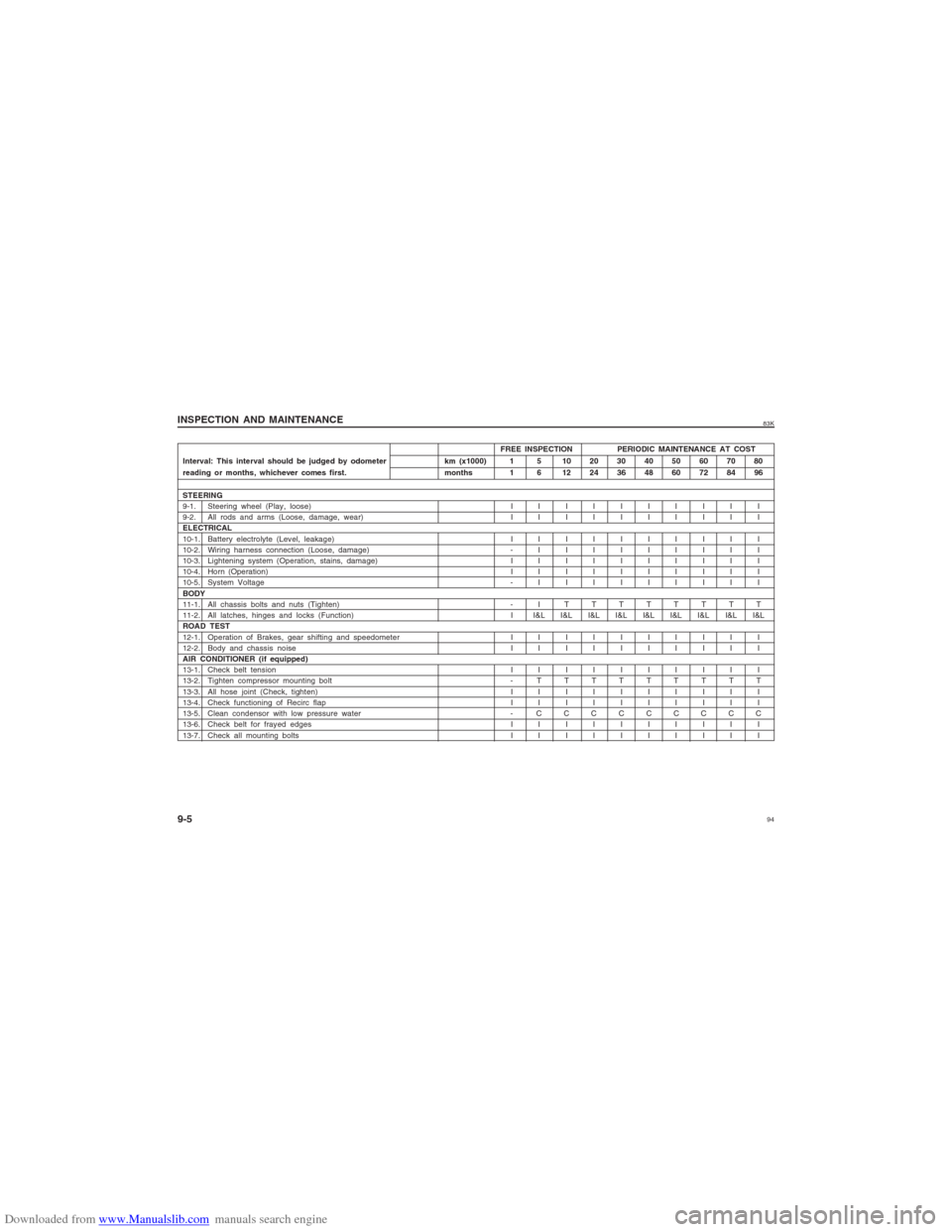
FREE INSPECTION PERIODIC MAINTENANCE AT COST
Interval: This interval should be judged by odometer km (x1000) 1 5 10 20 30 40 50 60 70 80
reading or months, whichever comes first.months 1 6 12 24 36 48 60 72 84 96
STEERING
9-1.Steering wheel (Play, loose)IIIIIIIIII
9-2. All rods and arms (Loose, damage, wear)IIIIIIIIII
ELECTRICAL
10-1.Battery electrolyte (Level, leakage)IIIIIIIIII
10-2. Wiring harness connection (Loose, damage) -IIIIIIIII
10-3. Lightening system (Operation, stains, damage)IIIIIIIIII
10-4.Horn (Operation)IIIIIIIIII
10-5.System Voltage -IIIIIIIII
BODY
11-1.All chassis bolts and nuts (Tighten) - ITTTTTTTT
11-2. All latches, hinges and locks (Function) I I&L I&L I&L I&L I&L I&L I&L I&L I&L
ROAD TEST
12-1.Operation of Brakes, gear shifting and speedometerIIIIIIIIII
12-2.Body and chassis noiseIIIIIIIIII
AIR CONDITIONER (if equipped)
13-1. Check belt tensionIIIIIIIIII
13-2.Tighten compressor mounting bolt -TTTTTTTTT
13-3. All hose joint (Check, tighten)IIIIIIIIII
13-4.Check functioning of Recirc flapIIIIIIIIII
13-5. Clean condensor with low pressure water - C C CCCCCCC
13-6. Check belt for frayed edgesIIIIIIIIII
13-7.Check all mounting boltsIIIIIIIIII
INSPECTION AND MAINTENANCE
9-5
Page 95 of 136
Downloaded from www.Manualslib.com manuals search engine 9583KDrive Belt
w ww w
w WARNING
When the engine is running, keep
hands, hair, clothing, tools, etc. away
from the moving fan and drive belts.
(For Petrol Engine Model)
Make sure the drive belt tension is correct.
If the belt is too loose, insufficient battery
charging, engine overheating, poor power
steering, poor air conditioning, or excessive
belt wear can result. When you press the
belt with your thumb midway between the
pulleys, there should be a deflection
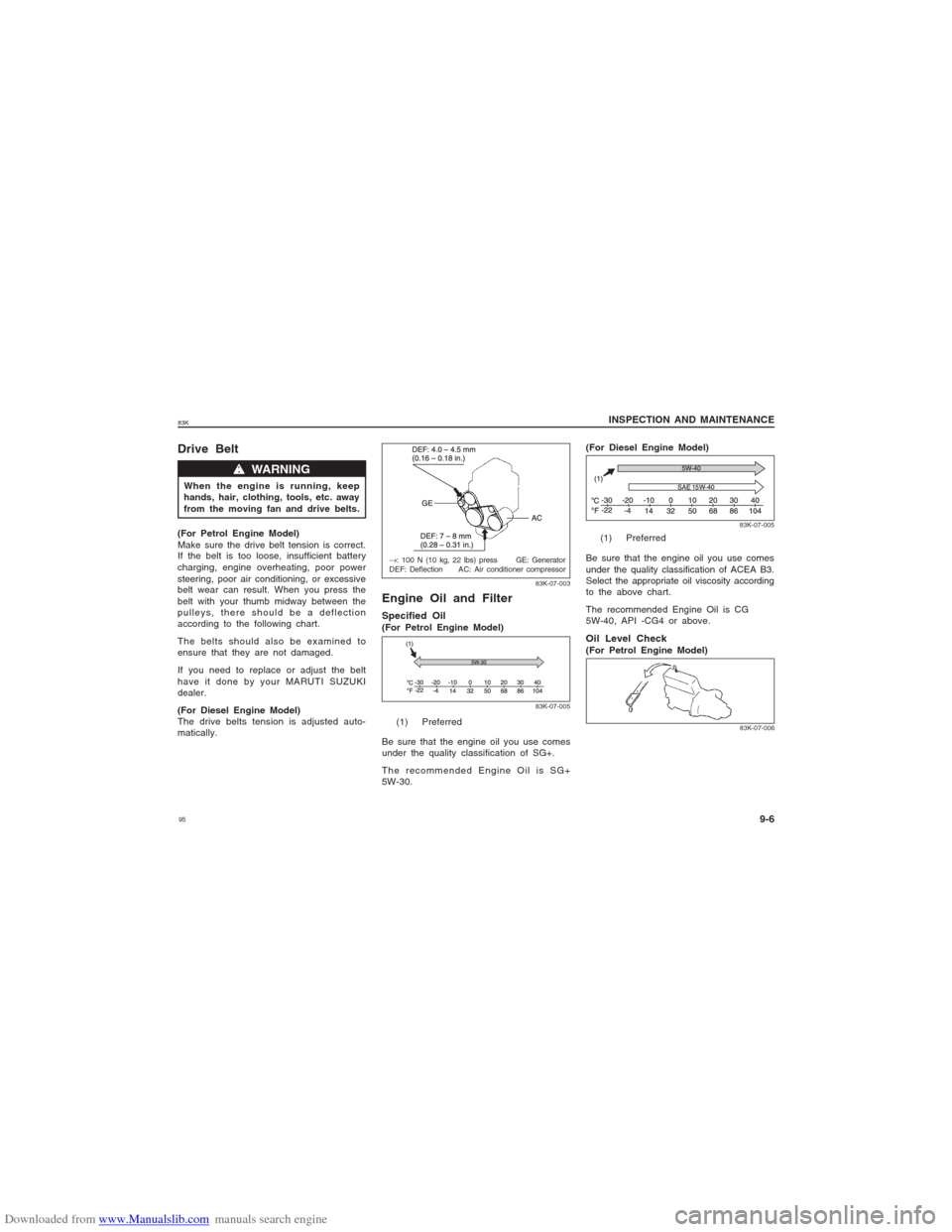
according to the following chart.
The belts should also be examined to
ensure that they are not damaged.
If you need to replace or adjust the belt
have it done by your MARUTI SUZUKI
dealer.
(For Diesel Engine Model)
The drive belts tension is adjusted auto-
matically.
Engine Oil and FilterSpecified Oil(For Petrol Engine Model)
(1) Preferred→: 100 N (10 kg, 22 lbs) press GE: Generator
DEF: Deflection AC: Air conditioner compressor
INSPECTION AND MAINTENANCE
9-6
83K-07-003
(For Diesel Engine Model)
83K-07-005
Be sure that the engine oil you use comes
under the quality classification of ACEA B3.
Select the appropriate oil viscosity according
to the above chart.
The recommended Engine Oil is CG
5W-40, API -CG4 or above.Oil Level Check(For Petrol Engine Model)
83K-07-006
(1) Preferred
83K-07-005
Be sure that the engine oil you use comes
under the quality classification of SG+.
The recommended Engine Oil is SG+
5W-30.
Page 96 of 136
Downloaded from www.Manualslib.com manuals search engine 9683K
INSPECTION AND MAINTENANCE
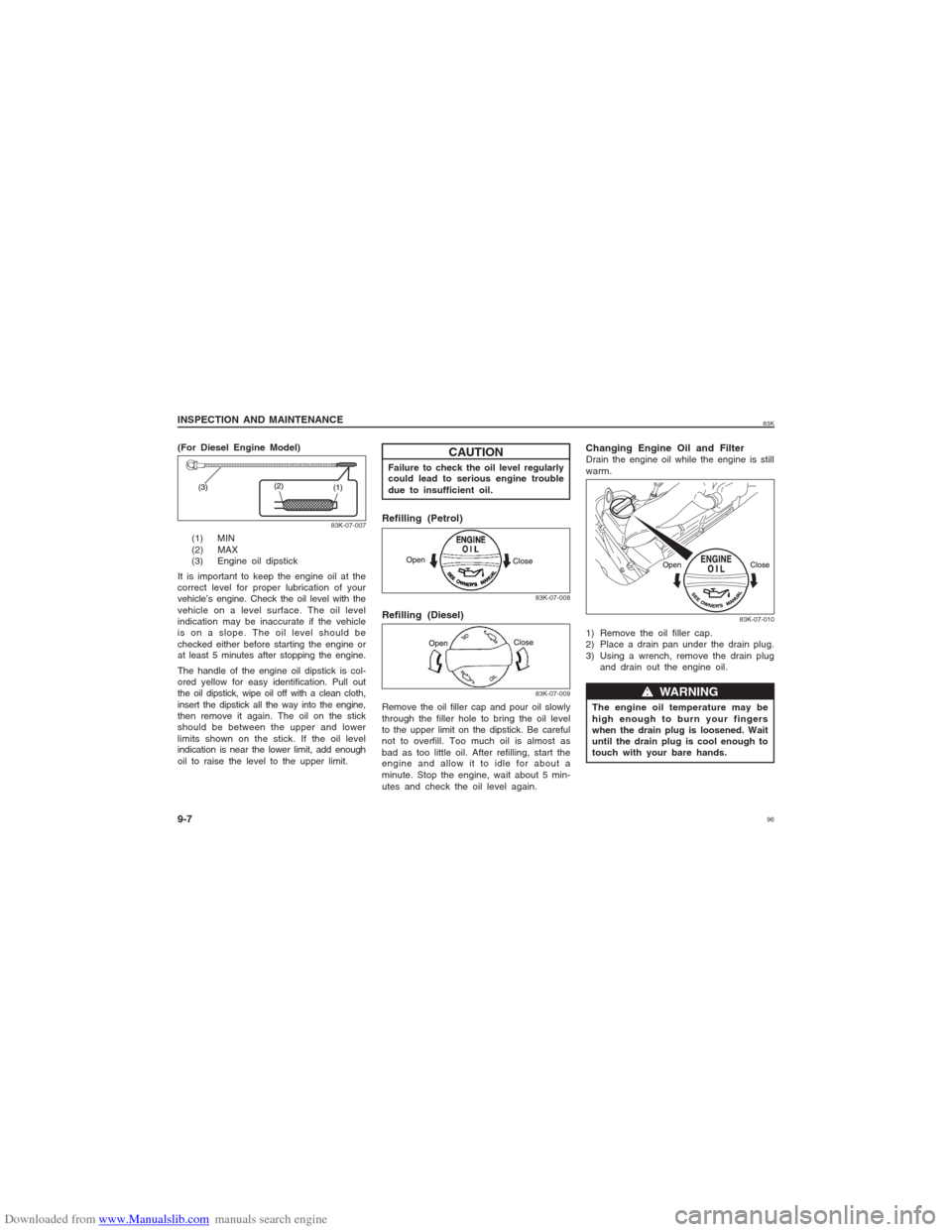
9-7(For Diesel Engine Model)
83K-07-007
CAUTION
Failure to check the oil level regularly
could lead to serious engine trouble
due to insufficient oil.
(1) MIN
(2) MAX
(3) Engine oil dipstick
It is important to keep the engine oil at the
correct level for proper lubrication of your
vehicle’s engine. Check the oil level with the
vehicle on a level surface. The oil level
indication may be inaccurate if the vehicle
is on a slope. The oil level should be
checked either before starting the engine or
at least 5 minutes after stopping the engine.
The handle of the engine oil dipstick is col-
ored yellow for easy identification. Pull out
the oil dipstick, wipe oil off with a clean cloth,
insert the dipstick all the way into the engine,
then remove it again. The oil on the stick
should be between the upper and lower
limits shown on the stick. If the oil level
indication is near the lower limit, add enough
oil to raise the level to the upper limit.
83K-07-00883K-07-009
Refilling (Petrol)
Refilling (Diesel)Remove the oil filler cap and pour oil slowly
through the filler hole to bring the oil level
to the upper limit on the dipstick. Be careful
not to overfill. Too much oil is almost as
bad as too little oil. After refilling, start the
engine and allow it to idle for about a
minute. Stop the engine, wait about 5 min-
utes and check the oil level again.
Changing Engine Oil and FilterDrain the engine oil while the engine is still
warm.
83K-07-010
The engine oil temperature may be
high enough to burn your fingers
when the drain plug is loosened. Wait
until the drain plug is cool enough to
touch with your bare hands.
w ww w
w WARNING
1) Remove the oil filler cap.
2) Place a drain pan under the drain plug.
3) Using a wrench, remove the drain plug
and drain out the engine oil.
Page 98 of 136
Downloaded from www.Manualslib.com manuals search engine 9883K
INSPECTION AND MAINTENANCE
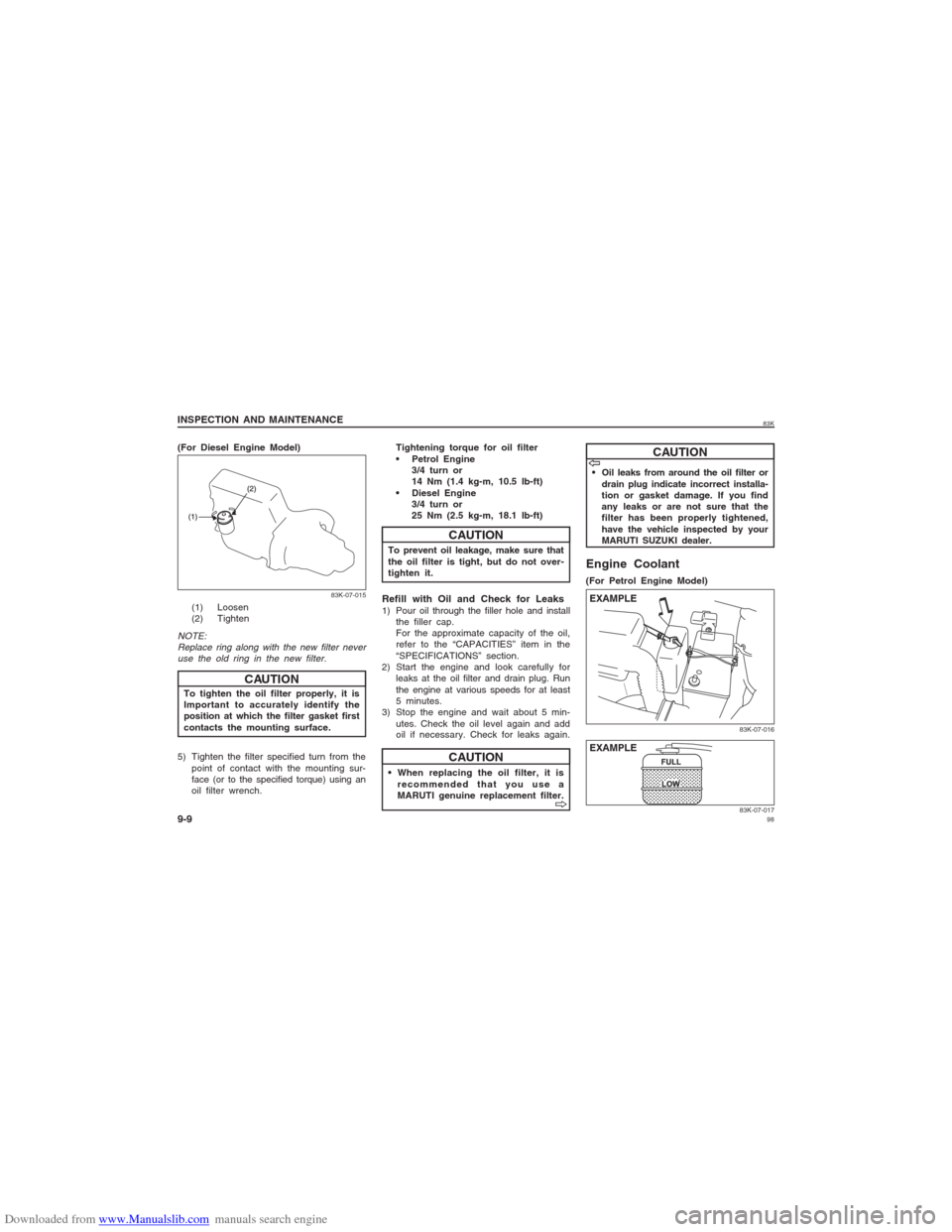
9-9(For Diesel Engine Model)
83K-07-015
CAUTION
To tighten the oil filter properly, it is
Important to accurately identify the
position at which the filter gasket first
contacts the mounting surface.
CAUTION
To prevent oil leakage, make sure that
the oil filter is tight, but do not over-
tighten it.
(1) Loosen
(2) Tighten
NOTE:
Replace ring along with the new filter never
use the old ring in the new filter.5) Tighten the filter specified turn from the
point of contact with the mounting sur-
face (or to the specified torque) using an
oil filter wrench.Tightening torque for oil filter
Petrol Engine
3/4 turn or
14 Nm (1.4 kg-m, 10.5 lb-ft)
Diesel Engine
3/4 turn or
25 Nm (2.5 kg-m, 18.1 lb-ft)
Refill with Oil and Check for Leaks1) Pour oil through the filler hole and install
the filler cap.
For the approximate capacity of the oil,
refer to the “CAPACITIES” item in the
“SPECIFICATIONS” section.
2) Start the engine and look carefully for
leaks at the oil filter and drain plug. Run
the engine at various speeds for at least
5 minutes.
3) Stop the engine and wait about 5 min-
utes. Check the oil level again and add
oil if necessary. Check for leaks again.
CAUTION
When replacing the oil filter, it is
recommended that you use a
MARUTI genuine replacement filter.
V VV V
V
CAUTION
V VV V
V Oil leaks from around the oil filter or
drain plug indicate incorrect installa-
tion or gasket damage. If you find
any leaks or are not sure that the
filter has been properly tightened,
have the vehicle inspected by your
MARUTI SUZUKI dealer.Engine Coolant(For Petrol Engine Model)
83K-07-016
EXAMPLE
EXAMPLE
83K-07-017