maintenance SUZUKI MARUTI 2005 1.G User Guide
[x] Cancel search | Manufacturer: SUZUKI, Model Year: 2005, Model line: MARUTI, Model: SUZUKI MARUTI 2005 1.GPages: 136, PDF Size: 2.93 MB
Page 57 of 136
Downloaded from www.Manualslib.com manuals search engine 5783K4) Make sure the bonnet is fully closed and
latched.
5) Check the headlights, turn signal lights,
brake lights and horn for proper opera-
tion.
6) Adjust the seat and adjustable head
restraint (if equipped).
7) Check the brake pedal and the parking
brake lever.
8) Adjust the mirrors.
9) Make sure that you and all passengers
have properly fastened your seat belts.
10)Make sure that all warning lights come
on as the key is turned to the “ON” or
“START” position.
11)Check all gauges.
12)Make sure that the BRAKE SYSTEM
WARNING light turns off when the
parking brake is released.
Once a week, or each time you fill your fuel
tank, perform the following under-hood
checks:
1) Engine oil level
2) Coolant level
3) Brake fluid level
4) Windshield washer fluid level
5) Battery solution level
6) Bonnet latch operation
Pull the Bonnet release handle inside the
vehicle. Make sure that you cannot open
the Bonnet all the way without releasingthe secondary latch. Be sure to close
the Bonnet securely after checking for
proper latch operation. See “All latches,
hinges & locks” of “CHASSIS AND
BODY” in the “Periodic Maintenance
Schedule” in the “INSPECTION AND
MAINTENANCE” section for lubrication
schedule.
w ww w
w WARNING
Make sure the bonnet is fully closed
and latched before driving. If it is not,
it can fly up unexpectedly during
driving, obstructing your view and
resulting in an accident.
Once a month, or each time you fill your
fuel tank, check the tyre pressure using a
tyre pressure gauge. Also check the tyre
pressure of the spare tyre.since its pistons, piston rings and cylinder
walls have not yet become conditioned. New
engines reach the normal level of oil
consumption only after approximately 5000
km (3000 miles) driving.
When judging the amount of oil consump-
tion, note that the oil may become diluted
and make it difficult to accurately judge the
true oil level.
As an example, if a vehicle is used for
repeated short trips, and consumes a nor-
mal amount of oil, the dipstick may not
show any drop in the oil level at all, even
after 1000 km (600 miles) or more of driv-
ing. This is because the oil is gradually
becoming diluted with fuel or moisture,
making it appear that the oil level has not
changed.
You should also be aware that the diluting
ingredients evaporate out when the vehicle
is subsequently driven at high speeds, such
as on an expressway, making it appear that
oil is excessively consumed after high-speed
driving.
OPERATING YOUR VEHICLE
5-2
Engine Oil ConsumptionIt is normal for the engine to consume some
engine oil during normal vehicle operation.
The amount of engine oil consumed
depends on the viscosity of the oil, the
quality of the oil and the conditions the
vehicle is driven under.
More oil is consumed during high-speed
driving and when there is frequent acceler-
ation and deceleration. Under high loads,
your engine also will consume more oil.
A new engine also consumes more oil,
83K-03-003
Ignition SwitchEXAMPLE
Page 69 of 136
Downloaded from www.Manualslib.com manuals search engine 6983K
DRIVING TIPS
6-3
(Diesel engine)
No cleaning is required. Replace as per
periodic maintenance schedule.
Keep weight to a minimum
The heavier the load, the more fuel the
vehicle consumes. Take out any luggage or
cargo when it is not necessary.
Keep tyre pressures correct
Underinflation of the tyres can waste fuel
due to increased running resistance of the
tyres. Keep your tyres inflated to the cor-
rect pressure shown on the label on the
driver’s side door pillar.Highway DrivingWhen driving at high speeds, pay attention
to the following:
Stopping distance progressively increa-
ses with vehicle speed. Apply the brakes
far enough ahead of the stopping point
to allow for the extra stopping distance.
On rainy days, “Aquaplaning” can occur.
“Aquaplaning” is the loss of direct con-
tact between the road surface and the
vehicle’s tyres due to a water film form-
ing between them. Steering or braking
the vehicle while “Aquaplaning” can be
very difficult, and loss of control can
occur. Keep speed down when the road
surface is wet.
At high speeds, the vehicle may be
affected by side winds. Therefore, reducespeed and be prepared for unexpected
buffeting, which can occur at the exits
of tunnels, when passing by a cut of a
hill, or when being overtaken by large
vehicles, etc.
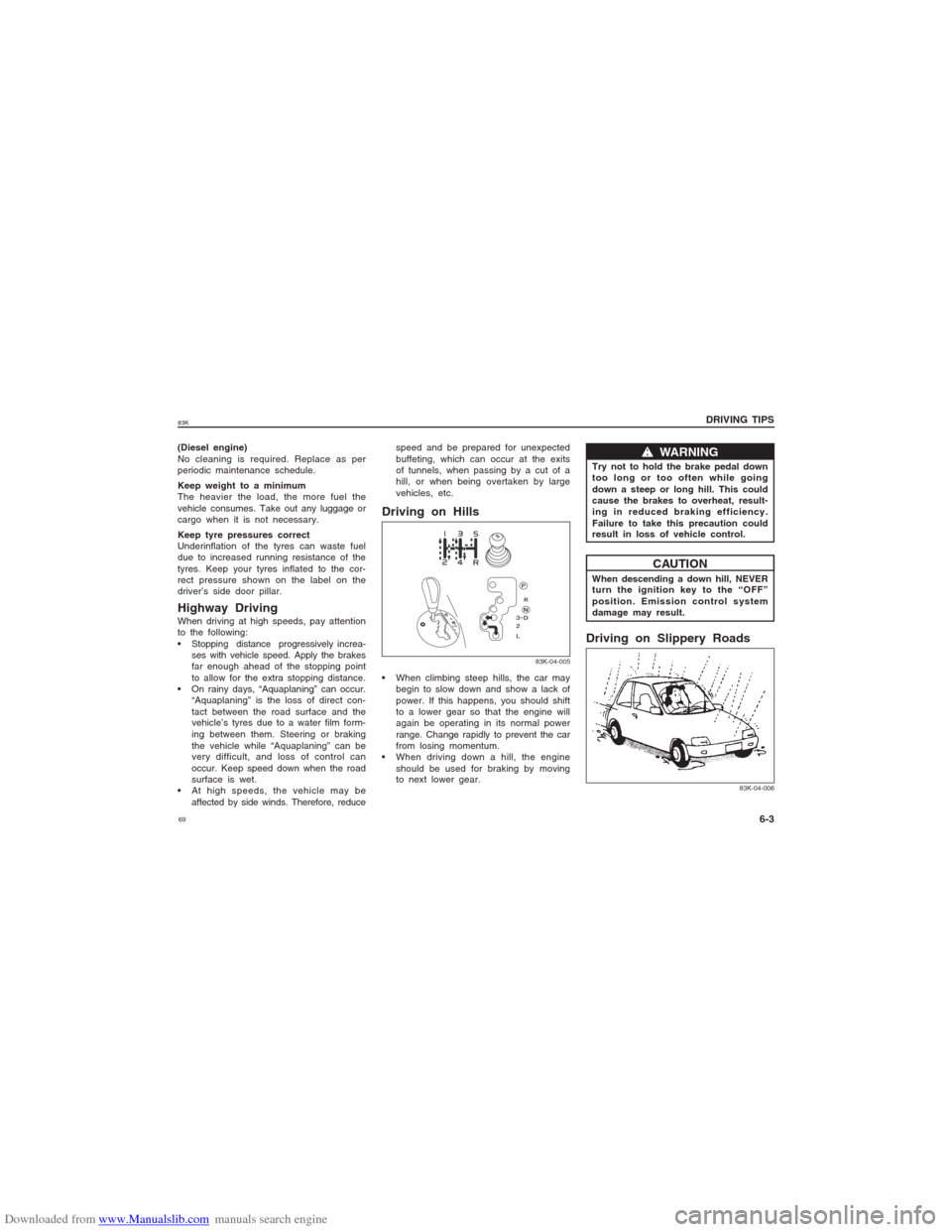
Driving on Hills
w ww w
w WARNING
Try not to hold the brake pedal down
too long or too often while going
down a steep or long hill. This could
cause the brakes to overheat, result-
ing in reduced braking efficiency.
Failure to take this precaution could
result in loss of vehicle control.
CAUTION
When descending a down hill, NEVER
turn the ignition key to the “OFF”
position. Emission control system
damage may result.Driving on Slippery Roads
83K-04-006
83K-04-005
When climbing steep hills, the car may
begin to slow down and show a lack of
power. If this happens, you should shift
to a lower gear so that the engine will
again be operating in its normal power
range. Change rapidly to prevent the car
from losing momentum.
When driving down a hill, the engine
should be used for braking by moving
to next lower gear.
Page 71 of 136
Downloaded from www.Manualslib.com manuals search engine 7183K
Starting
1. Adjust the driver’s seat for the proper
driving posture.
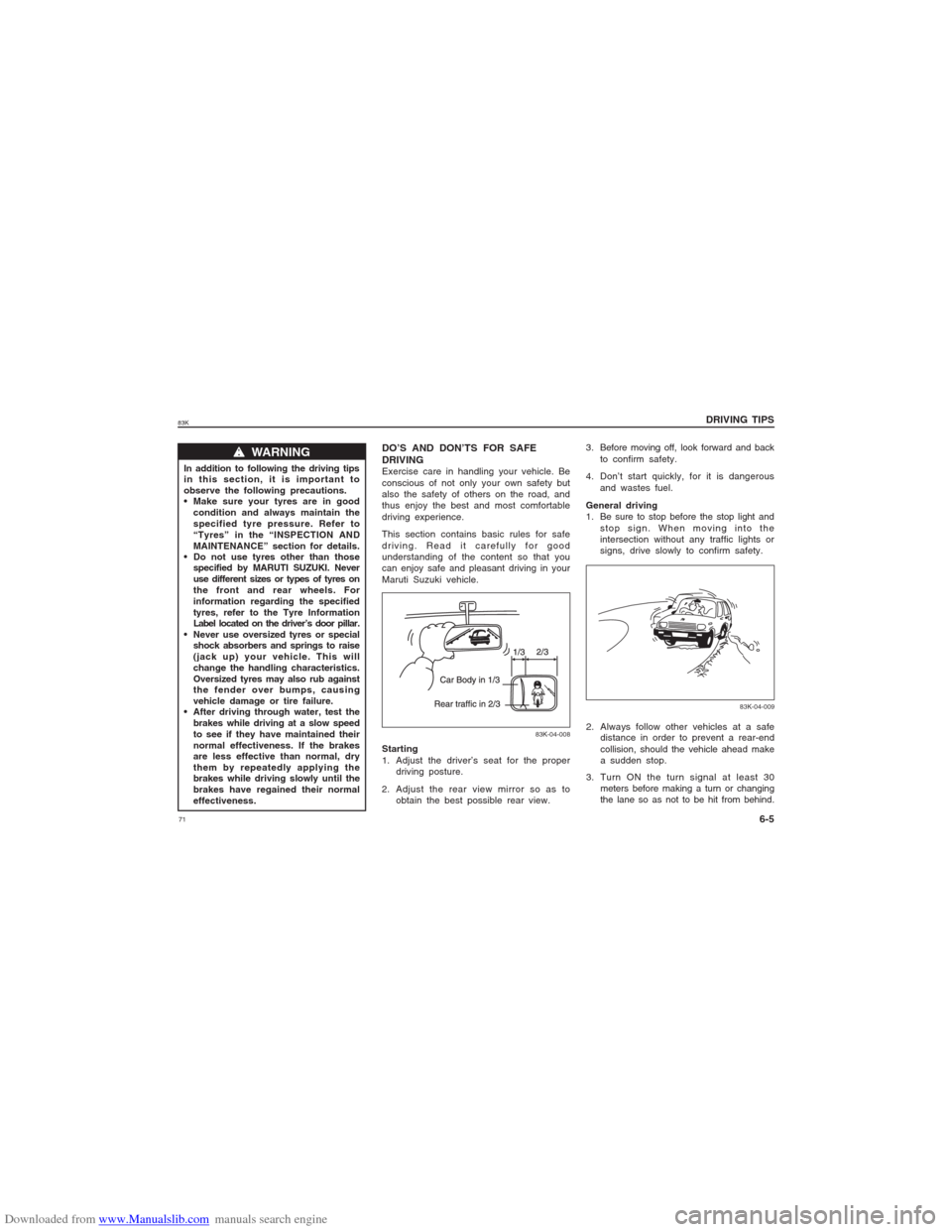
2. Adjust the rear view mirror so as to
obtain the best possible rear view.
83K-04-008
83K-04-009
2. Always follow other vehicles at a safe
distance in order to prevent a rear-end
collision, should the vehicle ahead make
a sudden stop.
3. Turn ON the turn signal at least 30
meters before making a turn or changing
the lane so as not to be hit from behind.
DRIVING TIPS
6-5
DO’S AND DON’TS FOR SAFE
DRIVINGExercise care in handling your vehicle. Be
conscious of not only your own safety but
also the safety of others on the road, and
thus enjoy the best and most comfortable
driving experience.
This section contains basic rules for safe
driving. Read it carefully for good
understanding of the content so that you
can enjoy safe and pleasant driving in your
Maruti Suzuki vehicle.3. Before moving off, look forward and back
to confirm safety.
4. Don’t start quickly, for it is dangerous
and wastes fuel.
General driving
1. Be sure to stop before the stop light and
stop sign. When moving into the
intersection without any traffic lights or
signs, drive slowly to confirm safety.
w ww w
w WARNING
In addition to following the driving tips
in this section, it is important to
observe the following precautions.
Make sure your tyres are in good
condition and always maintain the
specified tyre pressure. Refer to
“Tyres” in the “INSPECTION AND
MAINTENANCE” section for details.
Do not use tyres other than those
specified by MARUTI SUZUKI. Never
use different sizes or types of tyres on
the front and rear wheels. For
information regarding the specified
tyres, refer to the Tyre Information
Label located on the driver’s door pillar.
Never use oversized tyres or special
shock absorbers and springs to raise
(jack up) your vehicle. This will
change the handling characteristics.
Oversized tyres may also rub against
the fender over bumps, causing
vehicle damage or tire failure.
After driving through water, test the
brakes while driving at a slow speed
to see if they have maintained their
normal effectiveness. If the brakes
are less effective than normal, dry
them by repeatedly applying the
brakes while driving slowly until the
brakes have regained their normal
effectiveness.
Page 78 of 136
Downloaded from www.Manualslib.com manuals search engine 7883K
OTHER CONTROLS AND EQUIPMENT
7-4Using the wrong refrigerant may
damage your air conditioning system.
Use R-134a only. Do not mix or replace
the R-134a with other refrigerants.
CAUTION
NOTE:
If you need maximum demisting:
set the air flow selector to “DEMIST”,
set the blower speed selector to HIGH,
adjust the temperature selector to the
HOT end,
turn on the “A/C” switch, and
adjust the side outlets so the air blows
on the side windows.MaintenanceIf you do not use the air conditioner for a
long period, such as during winter, it may
not give the best performance when you
start using it again. To help maintain opti-
mum performance and durability of your air
conditioner, it needs to be run periodically.
Operate the air conditioner at least once a
month for one minute with the engine idling.
This circulates the refrigerant and oil and
helps protect the internal components.NOTE:
Your vehicle uses the air conditioning
refrigerant HFC-134a, commonly called “R-
134a”. Only R-134a should be used in your
vehicle.
Audio System (if equipped)Refer supplementary manual for audio
system (if equipped), provided along with
the vehicle.Radio Antenna
83K-05-013
To avoid damage to the radio antenna:
Remove the antenna when using an
automatic car wash.
Remove the antenna when the
antenna hits anything such as a low
ceiling in a parking garage or
putting a car cover over your car.
CAUTION
Remote Audio Controls
(if equipped)
83K-05-014
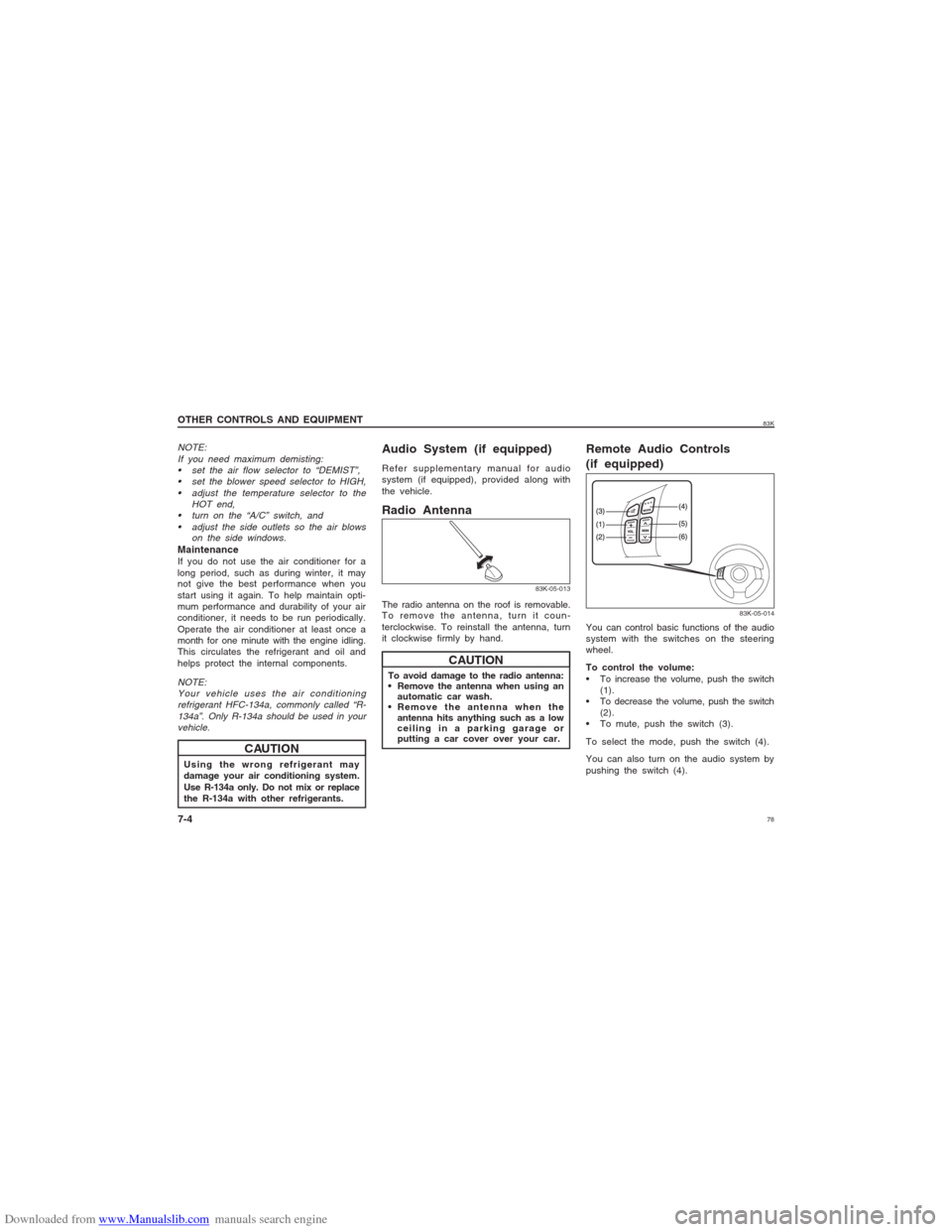
You can control basic functions of the audio
system with the switches on the steering
wheel.
To control the volume:
To increase the volume, push the switch
(1).
To decrease the volume, push the switch
(2).
To mute, push the switch (3).
To select the mode, push the switch (4).
You can also turn on the audio system by
pushing the switch (4). The radio antenna on the roof is removable.
To remove the antenna, turn it coun-
terclockwise. To reinstall the antenna, turn
it clockwise firmly by hand.
Page 89 of 136
Downloaded from www.Manualslib.com manuals search engine 8983KINSPECTION AND MAINTENANCE
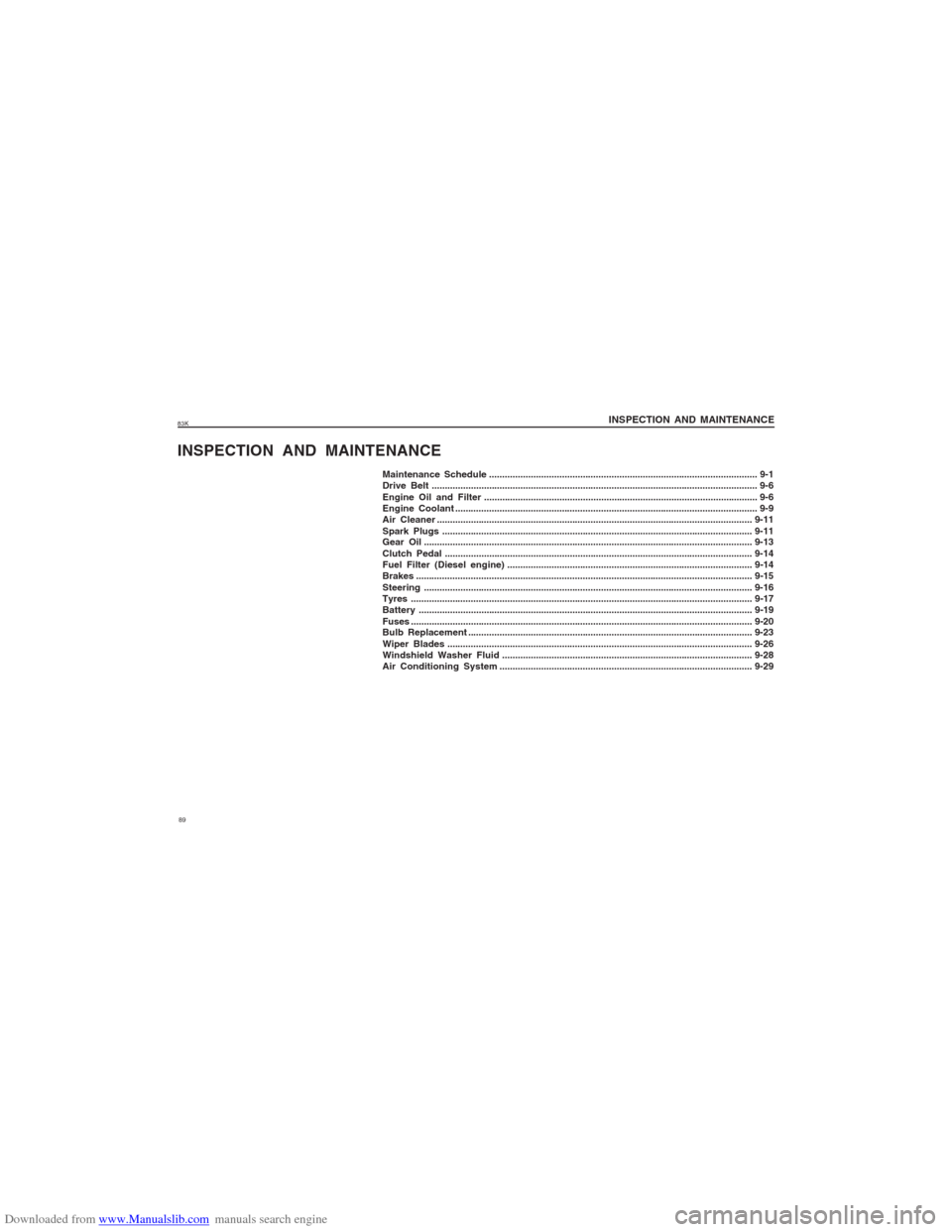
Maintenance Schedule ....................................................................................................... 9-1
Drive Belt ............................................................................................................................. 9-6
Engine Oil and Filter......................................................................................................... 9-6
Engine Coolant.................................................................................................................... 9-9
Air Cleaner ......................................................................................................................... 9-11
Spark Plugs....................................................................................................................... 9-11
Gear Oil.............................................................................................................................. 9-13
Clutch Pedal...................................................................................................................... 9-14
Fuel Filter (Diesel engine) .............................................................................................. 9-14
Brakes ................................................................................................................................. 9-15
Steering.............................................................................................................................. 9-16
Tyres ................................................................................................................................... 9-17
Battery................................................................................................................................ 9-19
Fuses ................................................................................................................................... 9-20
Bulb Replacement............................................................................................................. 9-23
Wiper Blades..................................................................................................................... 9-26
Windshield Washer Fluid................................................................................................9-28
Air Conditioning System.................................................................................................9-29
INSPECTION AND MAINTENANCE
Page 90 of 136
Downloaded from www.Manualslib.com manuals search engine 9083K
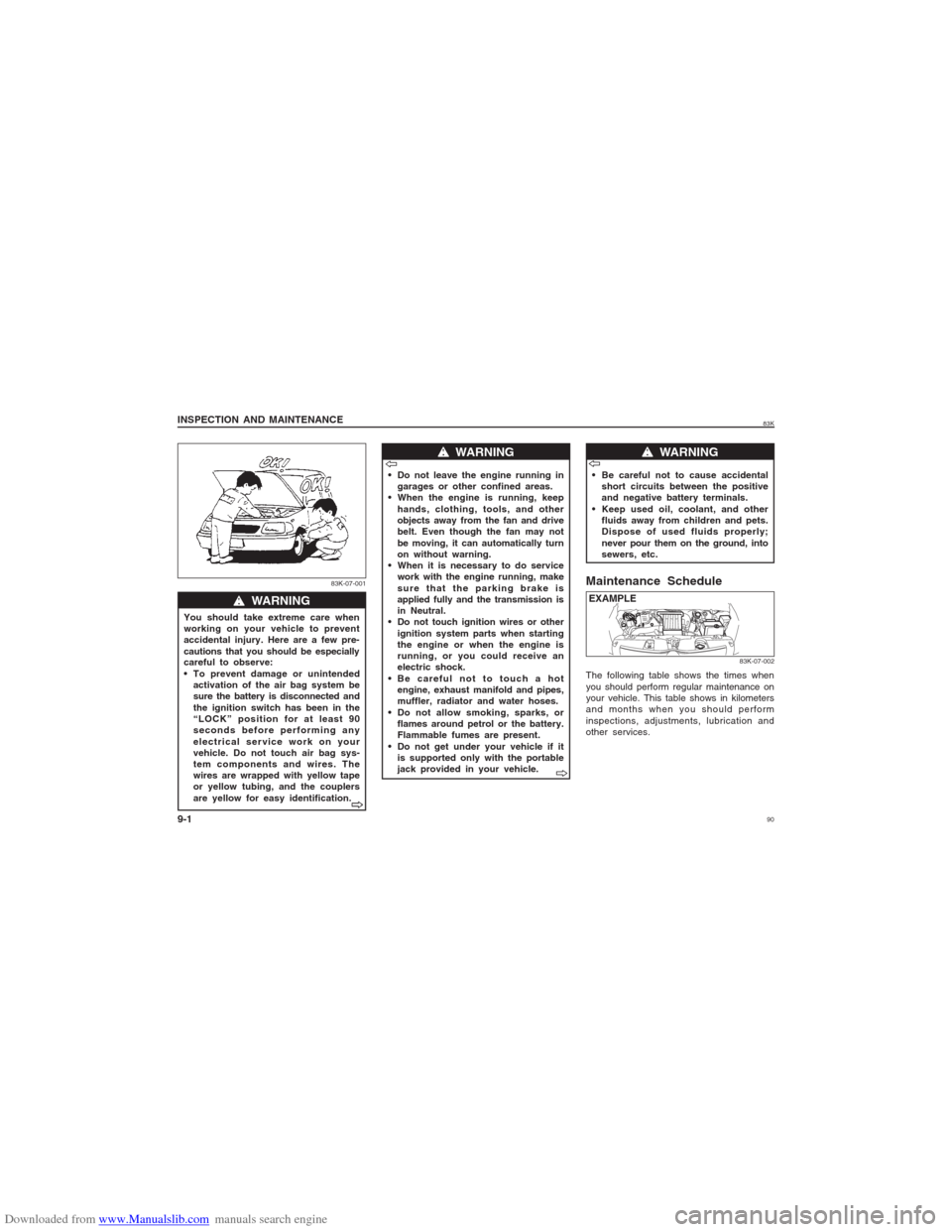
You should take extreme care when
working on your vehicle to prevent
accidental injury. Here are a few pre-
cautions that you should be especially
careful to observe:
To prevent damage or unintended
activation of the air bag system be
sure the battery is disconnected and
the ignition switch has been in the
“LOCK” position for at least 90
seconds before performing any
electrical service work on your
vehicle. Do not touch air bag sys-
tem components and wires. The
wires are wrapped with yellow tape
or yellow tubing, and the couplers
are yellow for easy identification.
w ww w
w WARNING
83K-07-001
w ww w
w WARNING
w ww w
w WARNING
INSPECTION AND MAINTENANCE
9-1
V VV V
V
Do not leave the engine running in
garages or other confined areas.
When the engine is running, keep
hands, clothing, tools, and other
objects away from the fan and drive
belt. Even though the fan may not
be moving, it can automatically turn
on without warning.
When it is necessary to do service
work with the engine running, make
sure that the parking brake is
applied fully and the transmission is
in Neutral.
Do not touch ignition wires or other
ignition system parts when starting
the engine or when the engine is
running, or you could receive an
electric shock.
Be careful not to touch a hot
engine, exhaust manifold and pipes,
muffler, radiator and water hoses.
Do not allow smoking, sparks, or
flames around petrol or the battery.
Flammable fumes are present.
Do not get under your vehicle if it
is supported only with the portable
jack provided in your vehicle.V VV V
V
V VV V
V
Be careful not to cause accidental
short circuits between the positive
and negative battery terminals.
Keep used oil, coolant, and other
fluids away from children and pets.
Dispose of used fluids properly;
never pour them on the ground, into
sewers, etc.V VV V
V
83K-07-002
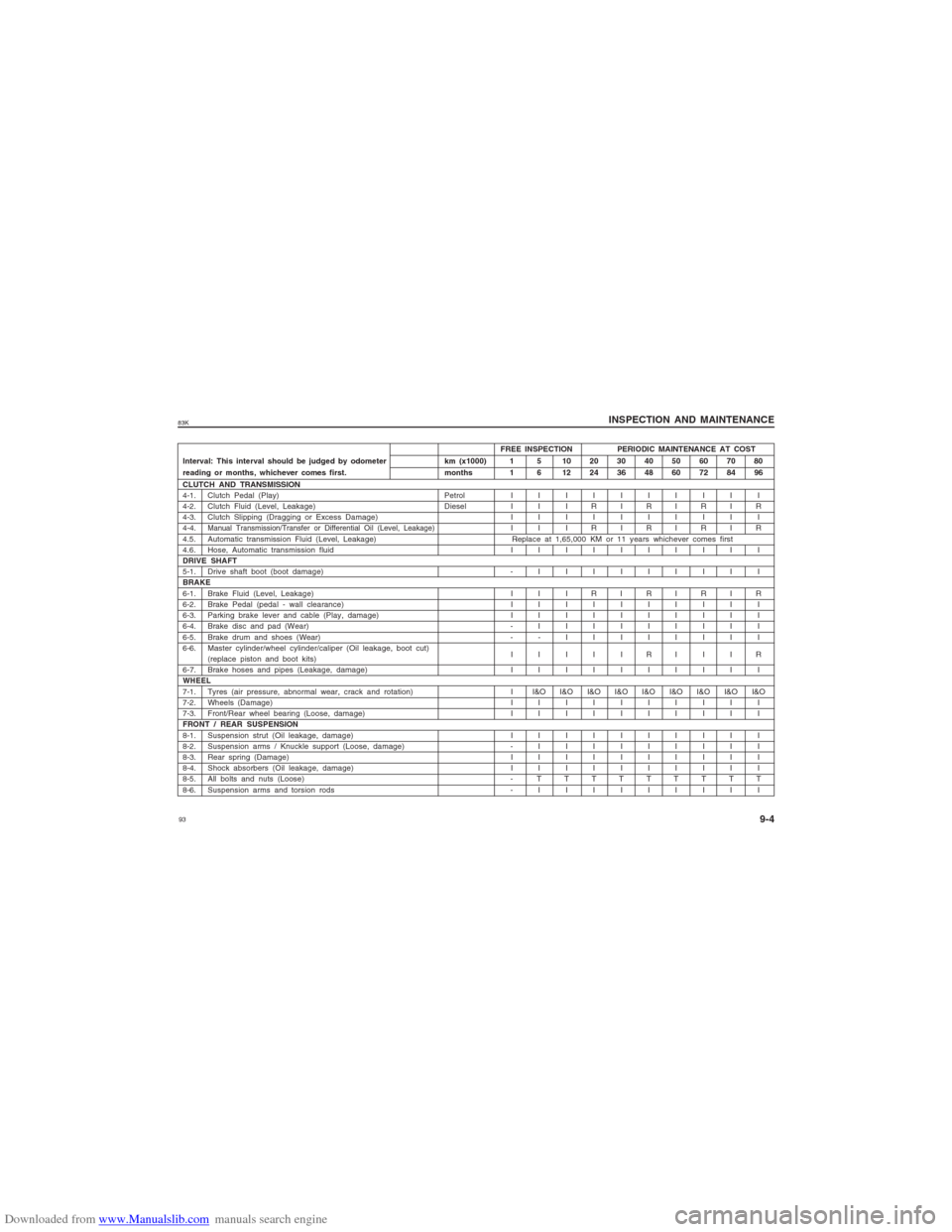
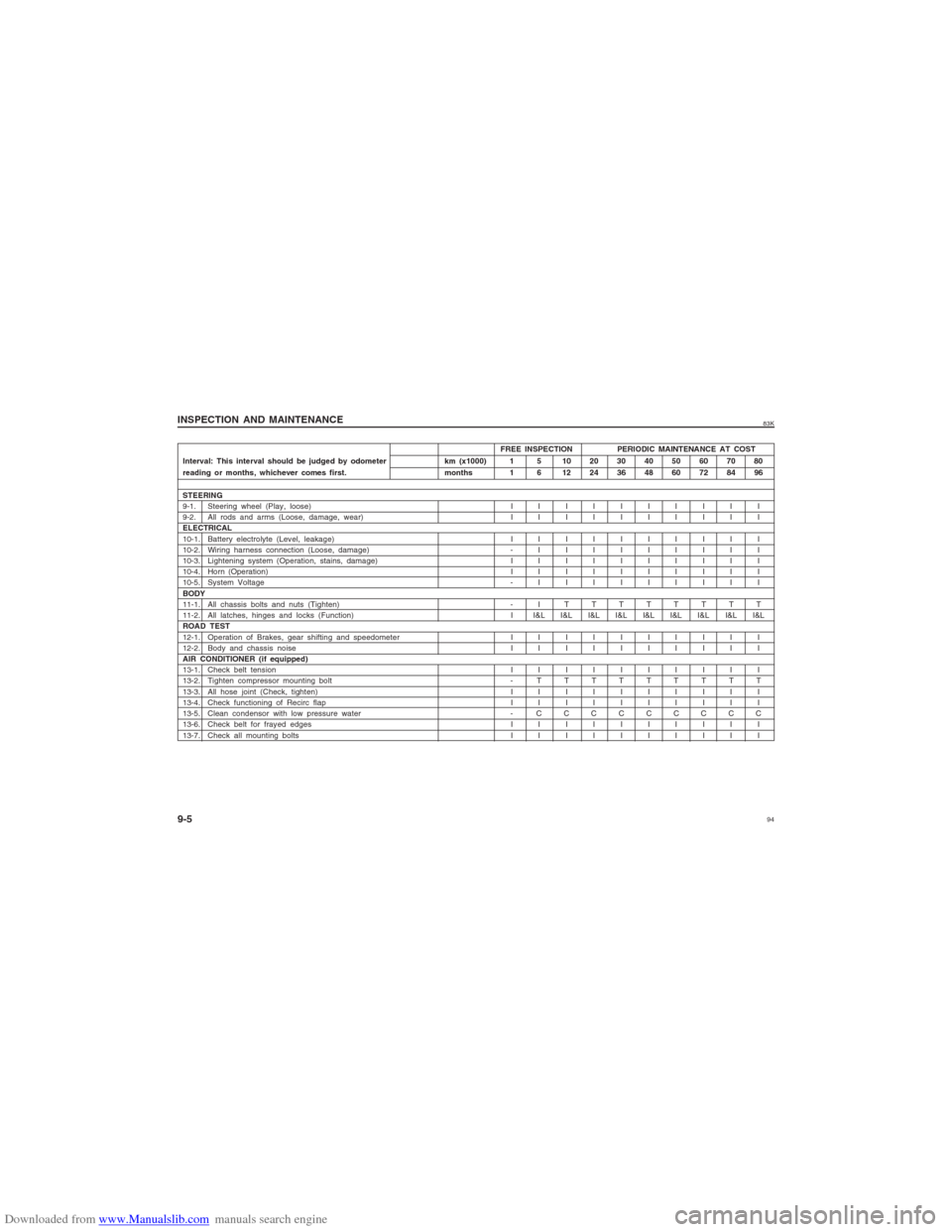
Maintenance ScheduleThe following table shows the times when
you should perform regular maintenance on
your vehicle. This table shows in kilometers
and months when you should perform
inspections, adjustments, lubrication and
other services.EXAMPLE
Page 91 of 136
Downloaded from www.Manualslib.com manuals search engine 9183K
INSPECTION AND MAINTENANCE
9-2
w ww w
w WARNING
MARUTI SUZUKI recommends that
maintenance on your MARUTI SUZUKI
vehicle should be performed by
MARUTI SUZUKI authorised Dealer/
Service Station.
CAUTION
Whenever it becomes necessary to
replace parts on your vehicle, it is
recommended that you use MARUTI
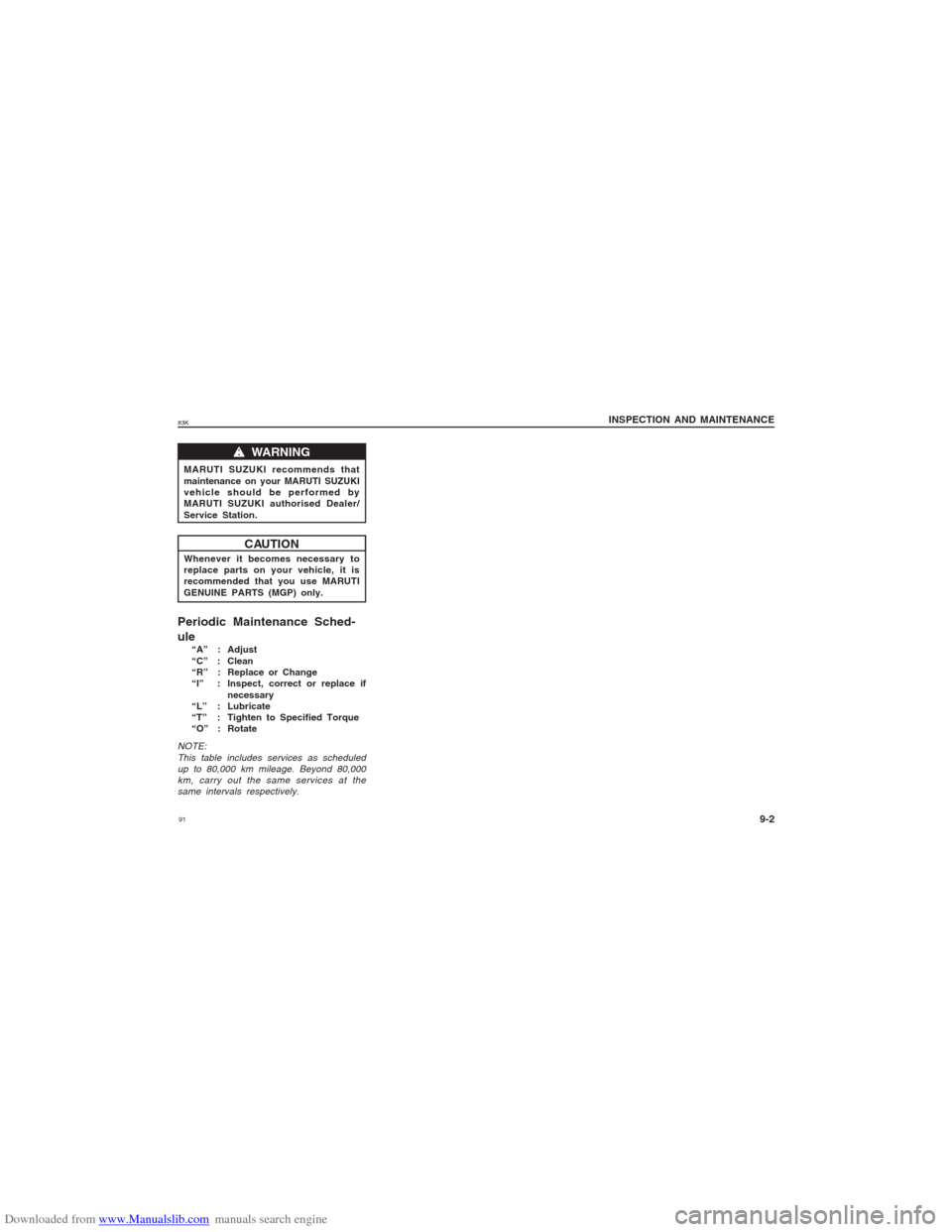
GENUINE PARTS (MGP) only.Periodic Maintenance Sched-
ule
“A” : Adjust
“C” : Clean
“R” : Replace or Change
“I” : Inspect, correct or replace if
necessary
“L” : Lubricate
“T” : Tighten to Specified Torque
“O” : Rotate
NOTE:
This table includes services as scheduled
up to 80,000 km mileage. Beyond 80,000
km, carry out the same services at the
same intervals respectively.
Page 92 of 136
Downloaded from www.Manualslib.com manuals search engine 9283K
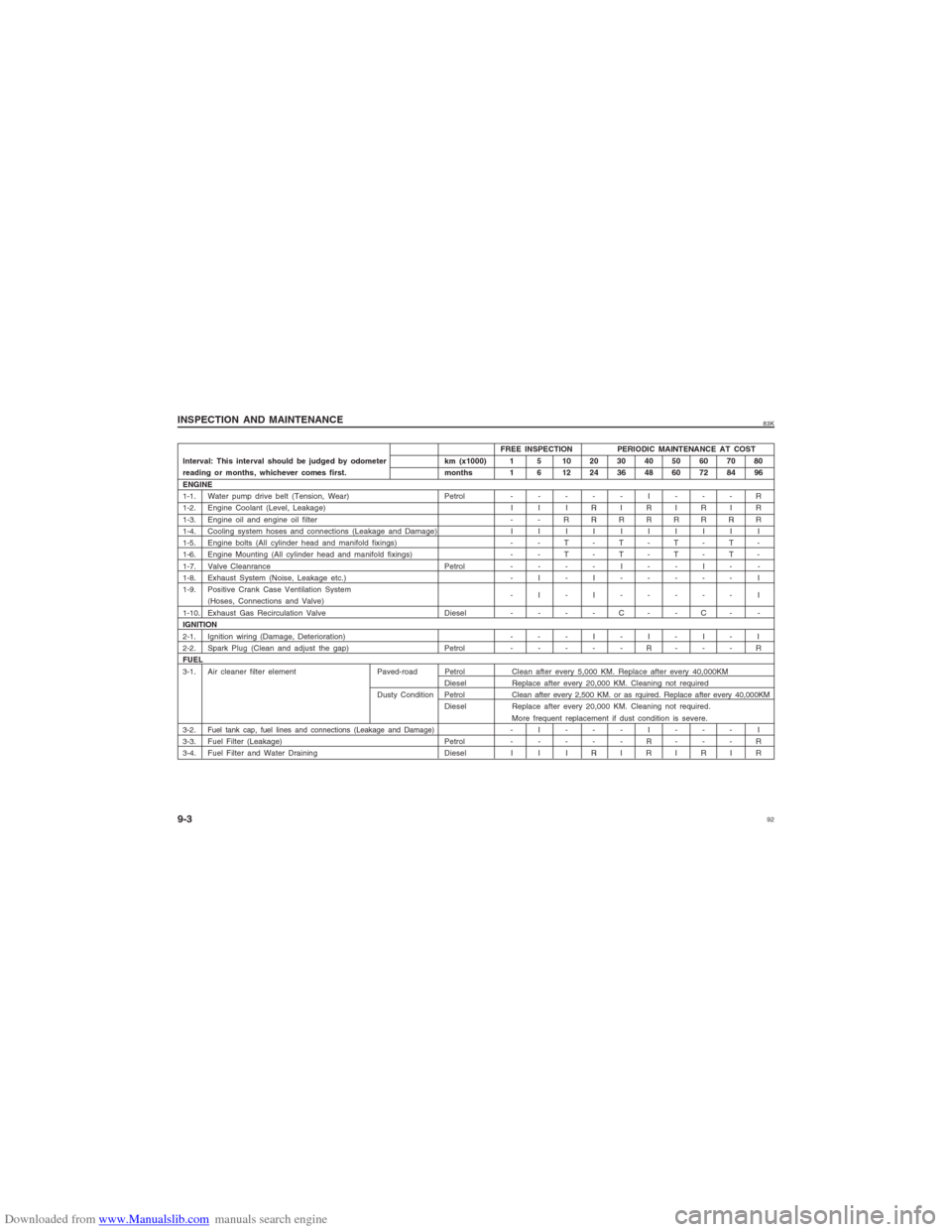
FREE INSPECTION PERIODIC MAINTENANCE AT COST
Interval: This interval should be judged by odometer km (x1000) 1 5 10 20 30 40 50 60 70 80
reading or months, whichever comes first.months 1 6 12 24 36 48 60 72 84 96
ENGINE
1-1. Water pump drive belt (Tension, Wear) Petrol-----I---R
1-2.Engine Coolant (Level, Leakage) I I I R I R I R I R
1-3. Engine oil and engine oil filter - - R RRRRRRR
1-4.Cooling system hoses and connections (Leakage and Damage)IIIIIIIIII
1-5.Engine bolts (All cylinder head and manifold fixings) - - T - T - T - T -
1-6.Engine Mounting (All cylinder head and manifold fixings) - - T - T - T - T -
1-7. Valve Cleanrance Petrol----I--I--
1-8.Exhaust System (Noise, Leakage etc.) - I - I-----I
1-9. Positive Crank Case Ventilation System
(Hoses, Connections and Valve)-I-I-----I
1-10.Exhaust Gas Recirculation Valve Diesel----C--C--
IGNITION
2-1.Ignition wiring (Damage, Deterioration) - - - I - I - I - I
2-2. Spark Plug (Clean and adjust the gap) Petrol-----R---R
FUEL
3-1. Air cleaner filter element Paved-road Petrol Clean after every 5,000 KM. Replace after every 40,000KM
Diesel Replace after every 20,000 KM. Cleaning not required
Dusty Condition Petrol Clean after every 2,500 KM. or as rquired. Replace after every 40,000KM
Diesel Replace after every 20,000 KM. Cleaning not required.
More frequent replacement if dust condition is severe.
3-2.
Fuel tank cap, fuel lines and connections (Leakage and Damage)
-I---I---I
3-3. Fuel Filter (Leakage) Petrol-----R---R
3-4. Fuel Filter and Water Draining Diesel I I I R I R I R I R
INSPECTION AND MAINTENANCE
9-3
Page 93 of 136
Downloaded from www.Manualslib.com manuals search engine 9383K
FREE INSPECTION PERIODIC MAINTENANCE AT COST
Interval: This interval should be judged by odometer km (x1000) 1 5 10 20 30 40 50 60 70 80
reading or months, whichever comes first.months 1 6 12 24 36 48 60 72 84 96
CLUTCH AND TRANSMISSION
4-1. Clutch Pedal (Play) PetrolIIIIIIIIII
4-2.Clutch Fluid (Level, Leakage) Diesel I I I R I R I R I R
4-3. Clutch Slipping (Dragging or Excess Damage)IIIIIIIIII
4-4.
Manual Transmission/Transfer or Differential Oil (Level, Leakage)
I I IRIRIRIR
4.5. Automatic transmission Fluid (Level, Leakage) Replace at 1,65,000 KM or 11 years whichever comes first
4.6. Hose, Automatic transmission fluidIIIIIIIIII
DRIVE SHAFT
5-1. Drive shaft boot (boot damage) -IIIIIIIII
BRAKE
6-1. Brake Fluid (Level, Leakage) I I I R I R I R I R
6-2.Brake Pedal (pedal - wall clearance)IIIIIIIIII
6-3.Parking brake lever and cable (Play, damage)IIIIIIIIII
6-4.Brake disc and pad (Wear) -IIIIIIIII
6-5.Brake drum and shoes (Wear) - -IIIIIIII
6-6. Master cylinder/wheel cylinder/caliper (Oil leakage, boot cut)
IIIIIRIIIR
(replace piston and boot kits)
6-7.Brake hoses and pipes (Leakage, damage)IIIIIIIIII
WHEEL
7-1.Tyres (air pressure, abnormal wear, crack and rotation) I I&O I&O I&O I&O I&O I&O I&O I&O I&O
7-2. Wheels (Damage)IIIIIIIIII
7-3.Front/Rear wheel bearing (Loose, damage)IIIIIIIIII
FRONT / REAR SUSPENSION
8-1.Suspension strut (Oil leakage, damage)IIIIIIIIII
8-2. Suspension arms / Knuckle support (Loose, damage) -IIIIIIIII
8-3.Rear spring (Damage)IIIIIIIIII
8-4.Shock absorbers (Oil leakage, damage)IIIIIIIIII
8-5.All bolts and nuts (Loose) -TTTTTTTTT
8-6. Suspension arms and torsion rods -IIIIIIIII
INSPECTION AND MAINTENANCE
9-4
Page 94 of 136
Downloaded from www.Manualslib.com manuals search engine 9483K
FREE INSPECTION PERIODIC MAINTENANCE AT COST
Interval: This interval should be judged by odometer km (x1000) 1 5 10 20 30 40 50 60 70 80
reading or months, whichever comes first.months 1 6 12 24 36 48 60 72 84 96
STEERING
9-1.Steering wheel (Play, loose)IIIIIIIIII
9-2. All rods and arms (Loose, damage, wear)IIIIIIIIII
ELECTRICAL
10-1.Battery electrolyte (Level, leakage)IIIIIIIIII
10-2. Wiring harness connection (Loose, damage) -IIIIIIIII
10-3. Lightening system (Operation, stains, damage)IIIIIIIIII
10-4.Horn (Operation)IIIIIIIIII
10-5.System Voltage -IIIIIIIII
BODY
11-1.All chassis bolts and nuts (Tighten) - ITTTTTTTT
11-2. All latches, hinges and locks (Function) I I&L I&L I&L I&L I&L I&L I&L I&L I&L
ROAD TEST
12-1.Operation of Brakes, gear shifting and speedometerIIIIIIIIII
12-2.Body and chassis noiseIIIIIIIIII
AIR CONDITIONER (if equipped)
13-1. Check belt tensionIIIIIIIIII
13-2.Tighten compressor mounting bolt -TTTTTTTTT
13-3. All hose joint (Check, tighten)IIIIIIIIII
13-4.Check functioning of Recirc flapIIIIIIIIII
13-5. Clean condensor with low pressure water - C C CCCCCCC
13-6. Check belt for frayed edgesIIIIIIIIII
13-7.Check all mounting boltsIIIIIIIIII
INSPECTION AND MAINTENANCE
9-5