warning SUZUKI MARUTI 2005 1.G User Guide
[x] Cancel search | Manufacturer: SUZUKI, Model Year: 2005, Model line: MARUTI, Model: SUZUKI MARUTI 2005 1.GPages: 136, PDF Size: 2.93 MB
Page 27 of 136

Downloaded from www.Manualslib.com manuals search engine 2783K
BEFORE DRIVING
4-15
w ww w
w WARNING
Never drive the vehicle with the
head restraints removed.
Do not attempt to adjust the head
restraint while driving.
83K-02-031
To adjust the seatback angle of front seats,
pull up the lever on the outboard side of
the seat, move the seatback to the desired
position, and release the lever to lock the
seatback in place.Adjustable Head Restraints
(if equipped)Head restraints are designed to help reduce
the risk of neck injuries in the case of an
accident.
NOTE:
It may be necessary to recline the seatback
to provide enough overhead clearance to
remove the head restraint.
83K-02-032
Adjust the head restraint to the position
which places the center of the head restraint
closest to the top of your ears. If this is not
possible for very tall passengers, adjust the
head restraint as high as possible.
EXAMPLE
Seat Height Adjuster (if equipped)If the driver’s seat is equipped with a seat
height adjuster lever on the outboard side
of the seat, raise or lower the seat by pull-
ing up or down the adjuster lever.Adjusting Seatbacks
83K-02-030
w ww w
w WARNING
All seatbacks should always be in an
upright position when driving, or seat
belt effectiveness may be reduced.
Seat belts are designed to offer maxi-
mum protection when seatbacks are in
the upright position.EXAMPLE
Page 29 of 136
Downloaded from www.Manualslib.com manuals search engine 2983K
BEFORE DRIVING
4-17
NOTICE
After folding the rear seatback for-
ward, do not allow any foreign mate-
rial to enter the lock opening. This
may cause damage to the inside of
the lock and prevent the seatback
from being locked securely.
w ww w
w WARNING
If you need to carry cargo in the pas-
senger compartment with the rear seat
back folded forward, be sure to secure
the cargo or it may be thrown about,
causing injury. Never pile cargo higher
than the seatbacks.
To return the seat to the normal position,
follow the procedure below.
When returning the rear seatback to
the normal position, be careful that
your finger is not caught between the
lock and the striker.
When returning the rear seatback to
the normal position, make sure that
there is nothing around the striker.
Any foreign materials prevent the
seatback from being locked securely.
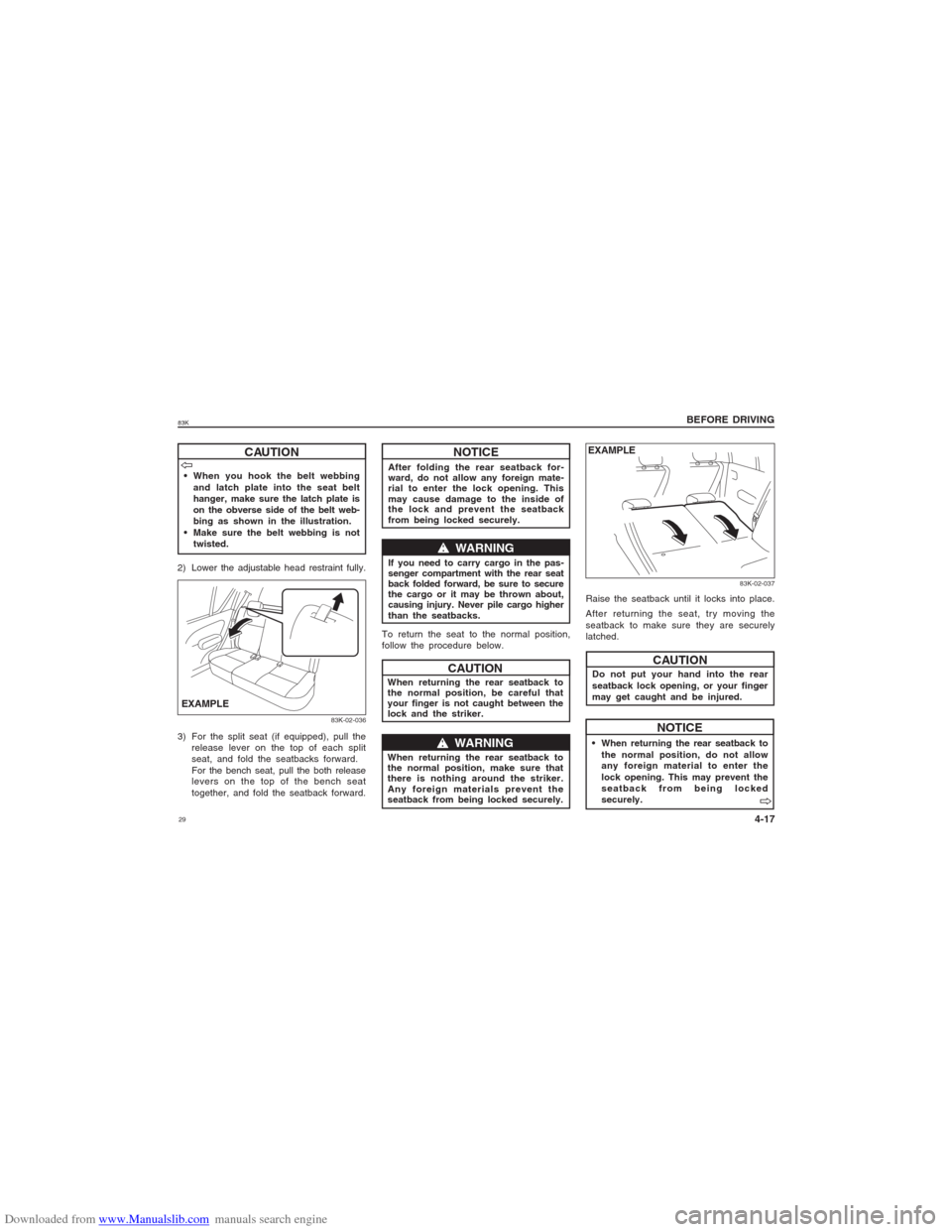
83K-02-037
Raise the seatback until it locks into place.
After returning the seat, try moving the
seatback to make sure they are securely
latched.
Do not put your hand into the rear
seatback lock opening, or your finger
may get caught and be injured.
When returning the rear seatback to
the normal position, do not allow
any foreign material to enter the
lock opening. This may prevent the
seatback from being locked
securely.
NOTICE
EXAMPLE
When you hook the belt webbing
and latch plate into the seat belt
hanger, make sure the latch plate is
on the obverse side of the belt web-
bing as shown in the illustration.
Make sure the belt webbing is not
twisted.
CAUTION
2) Lower the adjustable head restraint fully.
83K-02-036
3) For the split seat (if equipped), pull the
release lever on the top of each split
seat, and fold the seatbacks forward.
For the bench seat, pull the both release
levers on the top of the bench seat
together, and fold the seatback forward.EXAMPLEV VV V
V
CAUTIONw ww w
w WARNING
CAUTION
V VV V
V
Page 30 of 136
Downloaded from www.Manualslib.com manuals search engine 3083K
BEFORE DRIVING
4-18
w ww w
w WARNING
An air bag supplements, or adds to,
the frontal crash protection offered by
seat belts. The driver and all pas-
sengers must be properly restrained
by wearing seat belts at all times,
whether or not an air bag is mounted
at their seating position, to minimize
the risk of severe injury or death in
the event of a crash.
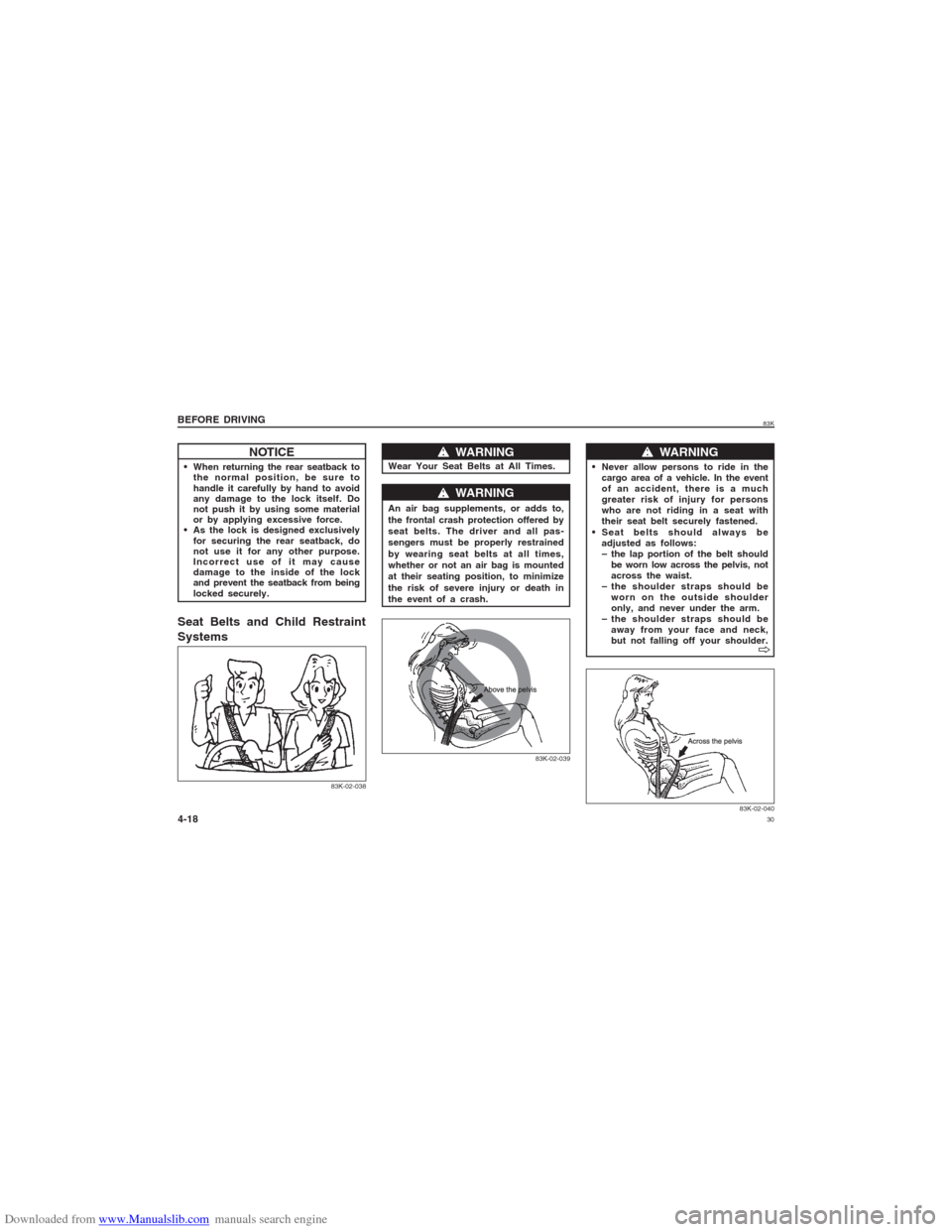
83K-02-039
w ww w
w WARNING
Never allow persons to ride in the
cargo area of a vehicle. In the event
of an accident, there is a much
greater risk of injury for persons
who are not riding in a seat with
their seat belt securely fastened.
Seat belts should always be
adjusted as follows:
– the lap portion of the belt should
be worn low across the pelvis, not
across the waist.
– the shoulder straps should be
worn on the outside shoulder
only, and never under the arm.
– the shoulder straps should be
away from your face and neck,
but not falling off your shoulder.
83K-02-040
NOTICE
When returning the rear seatback to
the normal position, be sure to
handle it carefully by hand to avoid
any damage to the lock itself. Do
not push it by using some material
or by applying excessive force.
As the lock is designed exclusively
for securing the rear seatback, do
not use it for any other purpose.
Incorrect use of it may cause
damage to the inside of the lock
and prevent the seatback from being
locked securely.Seat Belts and Child Restraint
Systems
w ww w
w WARNING
Wear Your Seat Belts at All Times.
83K-02-038
V VV V
V
Page 31 of 136
Downloaded from www.Manualslib.com manuals search engine 3183K
BEFORE DRIVING
4-19
w ww w
w WARNING
w ww w
w WARNING
V VV V
V
V VV V
V
V VV V
V
w ww w
w WARNING
Seat belts should never be worn
with the straps twisted and should
be adjusted as tightly as is com-
fortable to provide the protection for
which they have been designed. A
slack belt will provide less pro-
tection than one which is snug.
Make sure that each seat belt buckle
is inserted into the proper buckle
catch. It is possible to cross the
buckles in the rear seat.
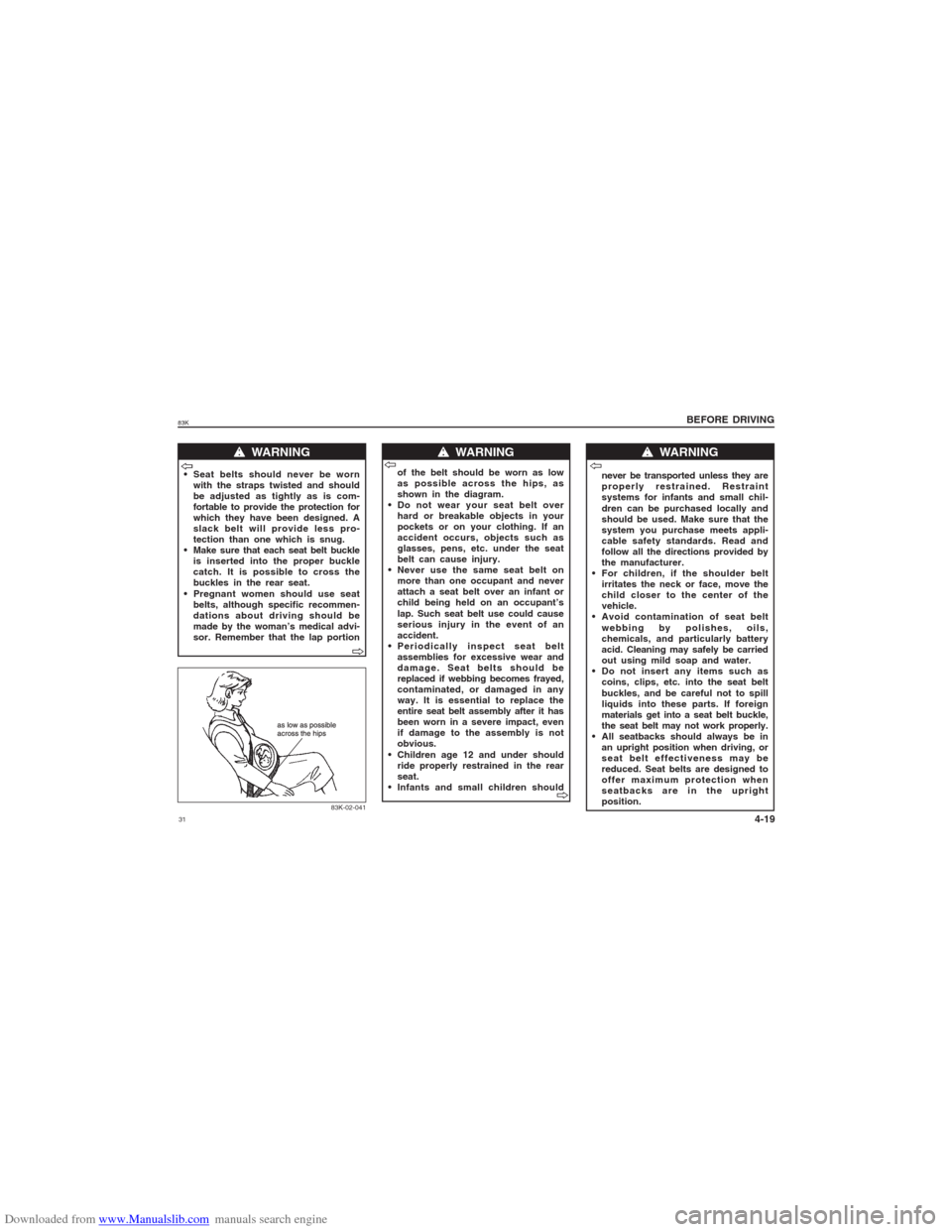
Pregnant women should use seat
belts, although specific recommen-
dations about driving should be
made by the woman’s medical advi-
sor. Remember that the lap portion
83K-02-041
V VV V
V
V VV V
V
of the belt should be worn as low
as possible across the hips, as
shown in the diagram.
Do not wear your seat belt over
hard or breakable objects in your
pockets or on your clothing. If an
accident occurs, objects such as
glasses, pens, etc. under the seat
belt can cause injury.
Never use the same seat belt on
more than one occupant and never
attach a seat belt over an infant or
child being held on an occupant’s
lap. Such seat belt use could cause
serious injury in the event of an
accident.
Periodically inspect seat belt
assemblies for excessive wear and
damage. Seat belts should be
replaced if webbing becomes frayed,
contaminated, or damaged in any
way. It is essential to replace the
entire seat belt assembly after it has
been worn in a severe impact, even
if damage to the assembly is not
obvious.
Children age 12 and under should
ride properly restrained in the rear
seat.
Infants and small children shouldnever be transported unless they are
properly restrained. Restraint
systems for infants and small chil-
dren can be purchased locally and
should be used. Make sure that the
system you purchase meets appli-
cable safety standards. Read and
follow all the directions provided by
the manufacturer.
For children, if the shoulder belt
irritates the neck or face, move the
child closer to the center of the
vehicle.
Avoid contamination of seat belt
webbing by polishes, oils,
chemicals, and particularly battery
acid. Cleaning may safely be carried
out using mild soap and water.
Do not insert any items such as
coins, clips, etc. into the seat belt
buckles, and be careful not to spill
liquids into these parts. If foreign
materials get into a seat belt buckle,
the seat belt may not work properly.
All seatbacks should always be in
an upright position when driving, or
seat belt effectiveness may be
reduced. Seat belts are designed to
offer maximum protection when
seatbacks are in the upright
position.
Page 33 of 136
Downloaded from www.Manualslib.com manuals search engine 3383K
BEFORE DRIVING
4-21
NOTE:
The word “CENTER” is molded into the
buckle for the rear center belt. The buckles
are designed so a latch plate can not be
inserted into the wrong buckle.Driver’s Seat Belt Reminder (if
equipped)
83K-02-047
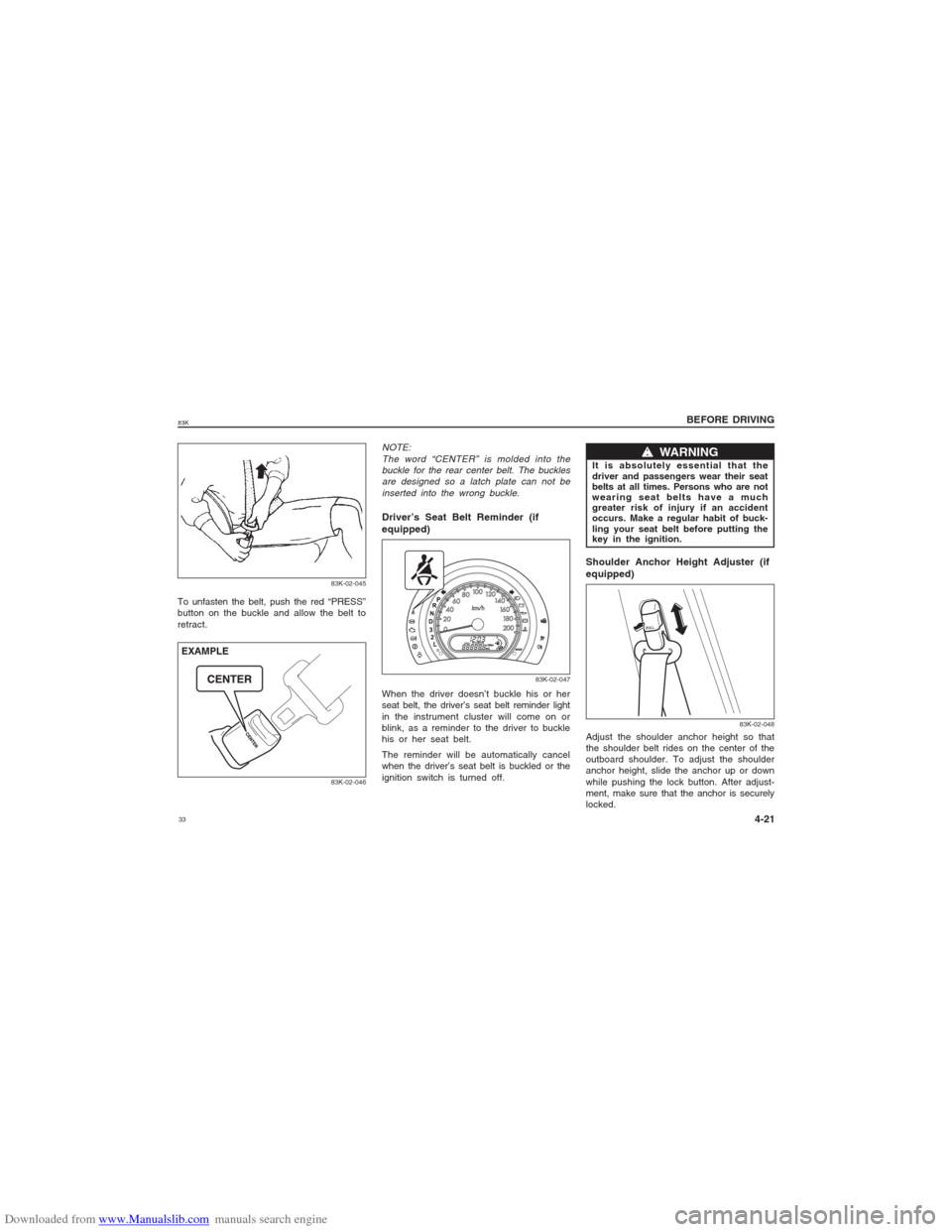
When the driver doesn’t buckle his or her
seat belt, the driver’s seat belt reminder light
in the instrument cluster will come on or
blink, as a reminder to the driver to buckle
his or her seat belt.
The reminder will be automatically cancel
when the driver’s seat belt is buckled or the
ignition switch is turned off.
Shoulder Anchor Height Adjuster (if
equipped)Adjust the shoulder anchor height so that
the shoulder belt rides on the center of the
outboard shoulder. To adjust the shoulder
anchor height, slide the anchor up or down
while pushing the lock button. After adjust-
ment, make sure that the anchor is securely
locked.
83K-02-048
w ww w
w WARNING
It is absolutely essential that the
driver and passengers wear their seat
belts at all times. Persons who are not
wearing seat belts have a much
greater risk of injury if an accident
occurs. Make a regular habit of buck-
ling your seat belt before putting the
key in the ignition.
83K-02-045
To unfasten the belt, push the red “PRESS”
button on the buckle and allow the belt to
retract.
83K-02-046
EXAMPLE
Page 34 of 136
Downloaded from www.Manualslib.com manuals search engine 3483K
BEFORE DRIVING
4-22
CAUTION
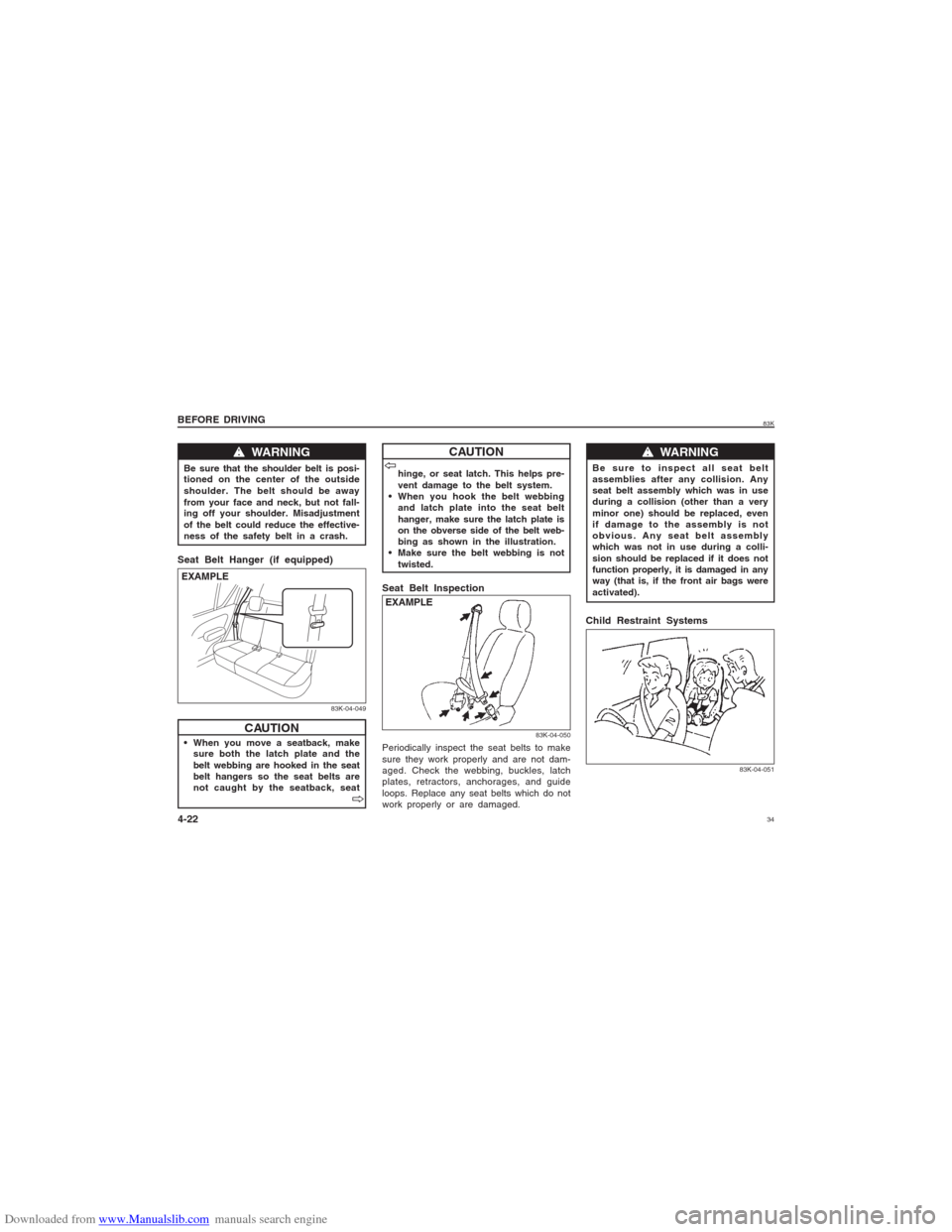
Seat Belt InspectionPeriodically inspect the seat belts to make
sure they work properly and are not dam-
aged. Check the webbing, buckles, latch
plates, retractors, anchorages, and guide
loops. Replace any seat belts which do not
work properly or are damaged.
83K-04-050
w ww w
w WARNING
Be sure to inspect all seat belt
assemblies after any collision. Any
seat belt assembly which was in use
during a collision (other than a very
minor one) should be replaced, even
if damage to the assembly is not
obvious. Any seat belt assembly
which was not in use during a colli-
sion should be replaced if it does not
function properly, it is damaged in any
way (that is, if the front air bags were
activated).
EXAMPLE
hinge, or seat latch. This helps pre-
vent damage to the belt system.
When you hook the belt webbing
and latch plate into the seat belt
hanger, make sure the latch plate is
on the obverse side of the belt web-
bing as shown in the illustration.
Make sure the belt webbing is not
twisted.
83K-04-051
Child Restraint Systems
V VV V
V
w ww w
w WARNING
Be sure that the shoulder belt is posi-
tioned on the center of the outside
shoulder. The belt should be away
from your face and neck, but not fall-
ing off your shoulder. Misadjustment
of the belt could reduce the effective-
ness of the safety belt in a crash.Seat Belt Hanger (if equipped)
83K-04-049
EXAMPLE When you move a seatback, make
sure both the latch plate and the
belt webbing are hooked in the seat
belt hangers so the seat belts are
not caught by the seatback, seat
CAUTION
V VV V
V
Page 35 of 136
Downloaded from www.Manualslib.com manuals search engine 3583K
BEFORE DRIVING
4-23
Booster seat
83K-04-054
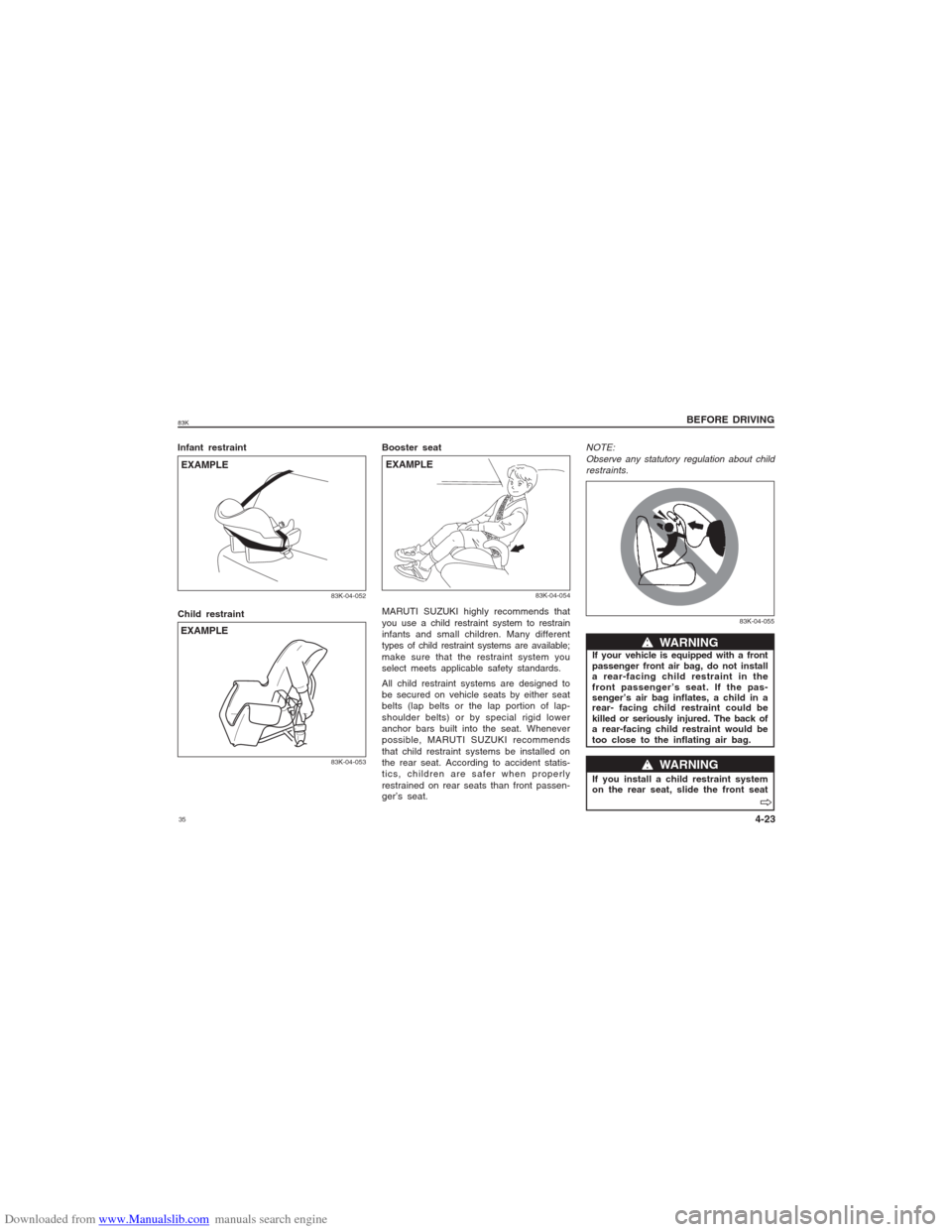
EXAMPLEMARUTI SUZUKI highly recommends that
you use a child restraint system to restrain
infants and small children. Many different
types of child restraint systems are available;
make sure that the restraint system you
select meets applicable safety standards.
All child restraint systems are designed to
be secured on vehicle seats by either seat
belts (lap belts or the lap portion of lap-
shoulder belts) or by special rigid lower
anchor bars built into the seat. Whenever
possible, MARUTI SUZUKI recommends
that child restraint systems be installed on
the rear seat. According to accident statis-
tics, children are safer when properly
restrained on rear seats than front passen-
ger’s seat.
NOTE:
Observe any statutory regulation about child
restraints.
83K-04-055
w ww w
w WARNING
If your vehicle is equipped with a front
passenger front air bag, do not install
a rear-facing child restraint in the
front passenger’s seat. If the pas-
senger’s air bag inflates, a child in a
rear- facing child restraint could be
killed or seriously injured. The back of
a rear-facing child restraint would be
too close to the inflating air bag.
w ww w
w WARNING
If you install a child restraint system
on the rear seat, slide the front seat
V VV V
V
Infant restraint
Child restraint
83K-04-05283K-04-053
EXAMPLEEXAMPLE
Page 36 of 136
Downloaded from www.Manualslib.com manuals search engine 3683K
BEFORE DRIVING
4-24
Children could be endangered in a
crash if their child restraints are not
properly secured in the vehicle. Be
sure to secure the child in the
restraint system according to the
manufacturer’s instructions.
w ww w
w WARNING
w ww w
w WARNING
far enough forward so that the child’s
feet do not contact the front seatback.
This will help avoid injury to the child
in the event of an accident.
83K-04-05683K-04-057
V VV V
V
Supplemental Restraint Sys-
tem (air bags)
(if equipped)
w ww w
w WARNING
This section of the owner’s manual
describes the protection provided by
your MARUTI SUZUKI SUPPLEMEN-
TAL RESTRAINT SYSTEM (air bags).
Please read and follow ALL these
instructions carefully to minimize your
risk of severe injury or death in the
event of a collision.
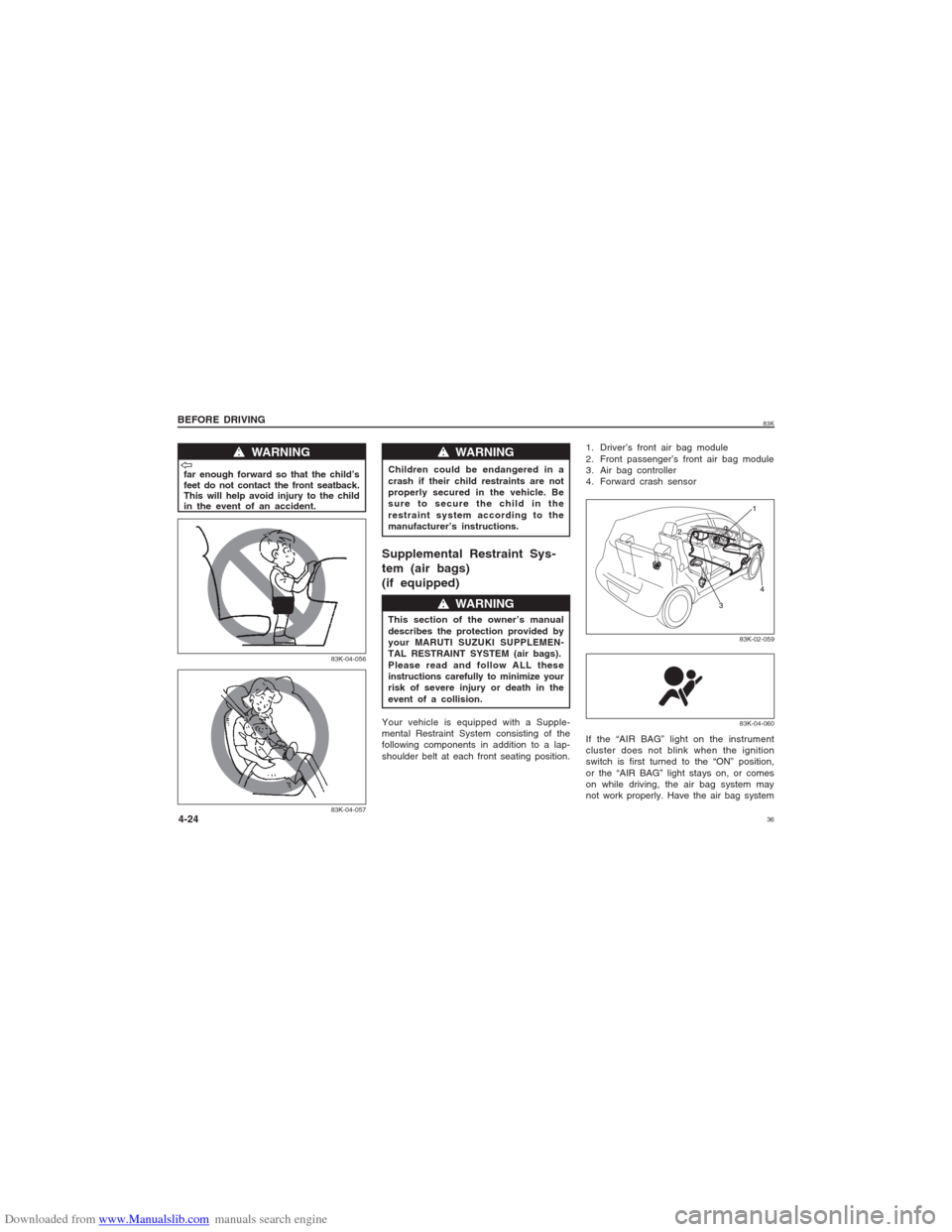
Your vehicle is equipped with a Supple-
mental Restraint System consisting of the
following components in addition to a lap-
shoulder belt at each front seating position.1. Driver’s front air bag module
2. Front passenger’s front air bag module
3. Air bag controller
4. Forward crash sensor
83K-02-059
If the “AIR BAG” light on the instrument
cluster does not blink when the ignition
switch is first turned to the “ON” position,
or the “AIR BAG” light stays on, or comes
on while driving, the air bag system may
not work properly. Have the air bag system
83K-04-060
Page 38 of 136
Downloaded from www.Manualslib.com manuals search engine 3883K
BEFORE DRIVING
4-26
If you must use a front-facing child restraint
in the front passenger’s seat, be sure to
move the front passenger’s seat as far back
as possible. Please refer to the “Seat Belts
and Child Restraint Systems” section in the
“BEFORE DRIVING” section for details on
securing your child.
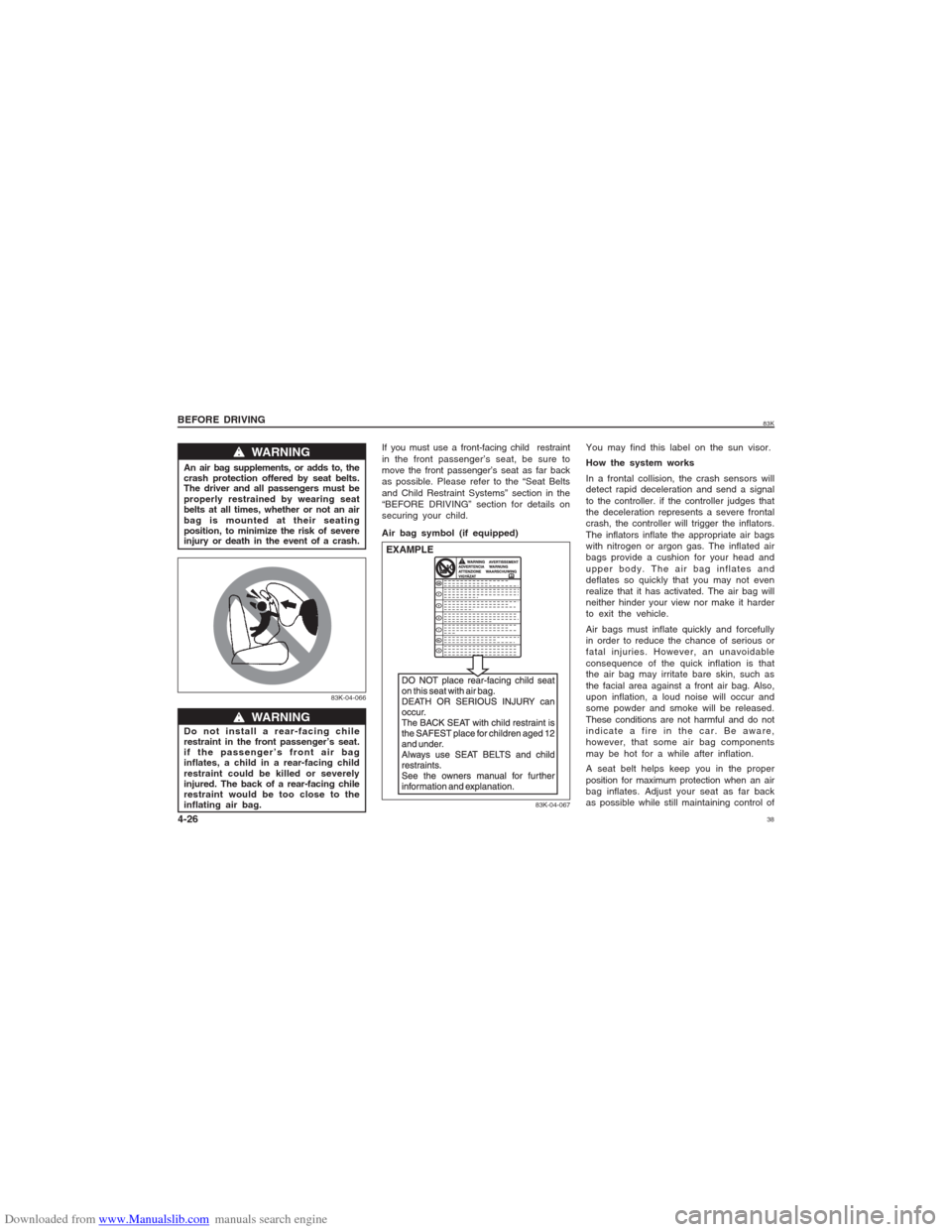
Air bag symbol (if equipped)
83K-04-067
EXAMPLE
You may find this label on the sun visor.
How the system works
In a frontal collision, the crash sensors will
detect rapid deceleration and send a signal
to the controller. if the controller judges that
the deceleration represents a severe frontal
crash, the controller will trigger the inflators.
The inflators inflate the appropriate air bags
with nitrogen or argon gas. The inflated air
bags provide a cushion for your head and
upper body. The air bag inflates and
deflates so quickly that you may not even
realize that it has activated. The air bag will
neither hinder your view nor make it harder
to exit the vehicle.
Air bags must inflate quickly and forcefully
in order to reduce the chance of serious or
fatal injuries. However, an unavoidable
consequence of the quick inflation is that
the air bag may irritate bare skin, such as
the facial area against a front air bag. Also,
upon inflation, a loud noise will occur and
some powder and smoke will be released.
These conditions are not harmful and do not
indicate a fire in the car. Be aware,
however, that some air bag components
may be hot for a while after inflation.
A seat belt helps keep you in the proper
position for maximum protection when an air
bag inflates. Adjust your seat as far back
as possible while still maintaining control of
w ww w
w WARNING
An air bag supplements, or adds to, the
crash protection offered by seat belts.
The driver and all passengers must be
properly restrained by wearing seat
belts at all times, whether or not an air
bag is mounted at their seating
position, to minimize the risk of severe
injury or death in the event of a crash.
83K-04-066
w ww w
w WARNING
Do not install a rear-facing chile
restraint in the front passenger’s seat.
if the passenger’s front air bag
inflates, a child in a rear-facing child
restraint could be killed or severely
injured. The back of a rear-facing chile
restraint would be too close to the
inflating air bag.
Page 39 of 136
Downloaded from www.Manualslib.com manuals search engine 3983K
BEFORE DRIVING
4-27
w ww w
w WARNING
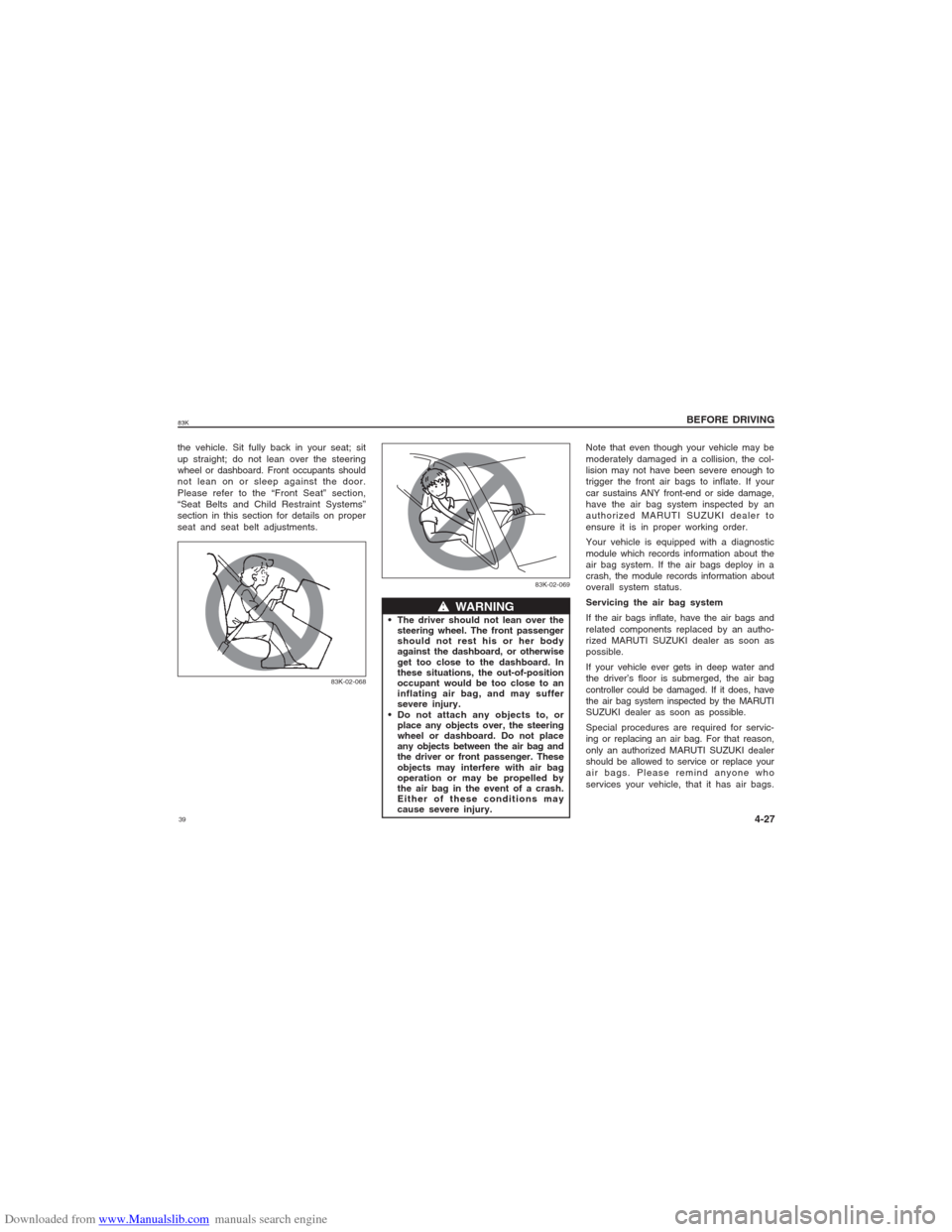
The driver should not lean over the
steering wheel. The front passenger
should not rest his or her body
against the dashboard, or otherwise
get too close to the dashboard. In
these situations, the out-of-position
occupant would be too close to an
inflating air bag, and may suffer
severe injury.
Do not attach any objects to, or
place any objects over, the steering
wheel or dashboard. Do not place
any objects between the air bag and
the driver or front passenger. These
objects may interfere with air bag
operation or may be propelled by
the air bag in the event of a crash.
Either of these conditions may
cause severe injury.
83K-02-068
the vehicle. Sit fully back in your seat; sit
up straight; do not lean over the steering
wheel or dashboard. Front occupants should
not lean on or sleep against the door.
Please refer to the “Front Seat” section,
“Seat Belts and Child Restraint Systems”
section in this section for details on proper
seat and seat belt adjustments.Note that even though your vehicle may be
moderately damaged in a collision, the col-
lision may not have been severe enough to
trigger the front air bags to inflate. If your
car sustains ANY front-end or side damage,
have the air bag system inspected by an
authorized MARUTI SUZUKI dealer to
ensure it is in proper working order.
Your vehicle is equipped with a diagnostic
module which records information about the
air bag system. If the air bags deploy in a
crash, the module records information about
overall system status.
Servicing the air bag system
If the air bags inflate, have the air bags and
related components replaced by an autho-
rized MARUTI SUZUKI dealer as soon as
possible.
If your vehicle ever gets in deep water and
the driver’s floor is submerged, the air bag
controller could be damaged. If it does, have
the air bag system inspected by the MARUTI
SUZUKI dealer as soon as possible.
Special procedures are required for servic-
ing or replacing an air bag. For that reason,
only an authorized MARUTI SUZUKI dealer
should be allowed to service or replace your
air bags. Please remind anyone who
services your vehicle, that it has air bags.
83K-02-069