wheel SUZUKI MARUTI 2005 1.G User Guide
[x] Cancel search | Manufacturer: SUZUKI, Model Year: 2005, Model line: MARUTI, Model: SUZUKI MARUTI 2005 1.GPages: 136, PDF Size: 2.93 MB
Page 64 of 136
Downloaded from www.Manualslib.com manuals search engine 6483K
w ww w
w WARNING
If water gets into the brake drums,
brake performance may become poor
and unpredictable.
After driving through water or wash-
ing the underside of the vehicle, test
the brakes while driving at a slow
speed to see if they have maintained
their normal effectiveness. If the
brakes are less effective than normal,
dry them by repeatedly applying the
brakes while driving slowly until the
brakes have regained their normal
effectiveness.
w ww w
w WARNING
Even without reserve power in the
brake system, you can still stop the
vehicle by pressing the brake pedal
harder than normally required. How-
ever, the stopping distance may be
longer.
OPERATING YOUR VEHICLE
5-9Braking
83K-03-012
EXAMPLE4) With pushing the release button (1), shift
the gearshift lever to the desired
position.
This procedure is for emergency use only.
If repeated use of this procedure is
necessary, or the procedure does not work
as described, take the vehicle to your dealer
for repair.
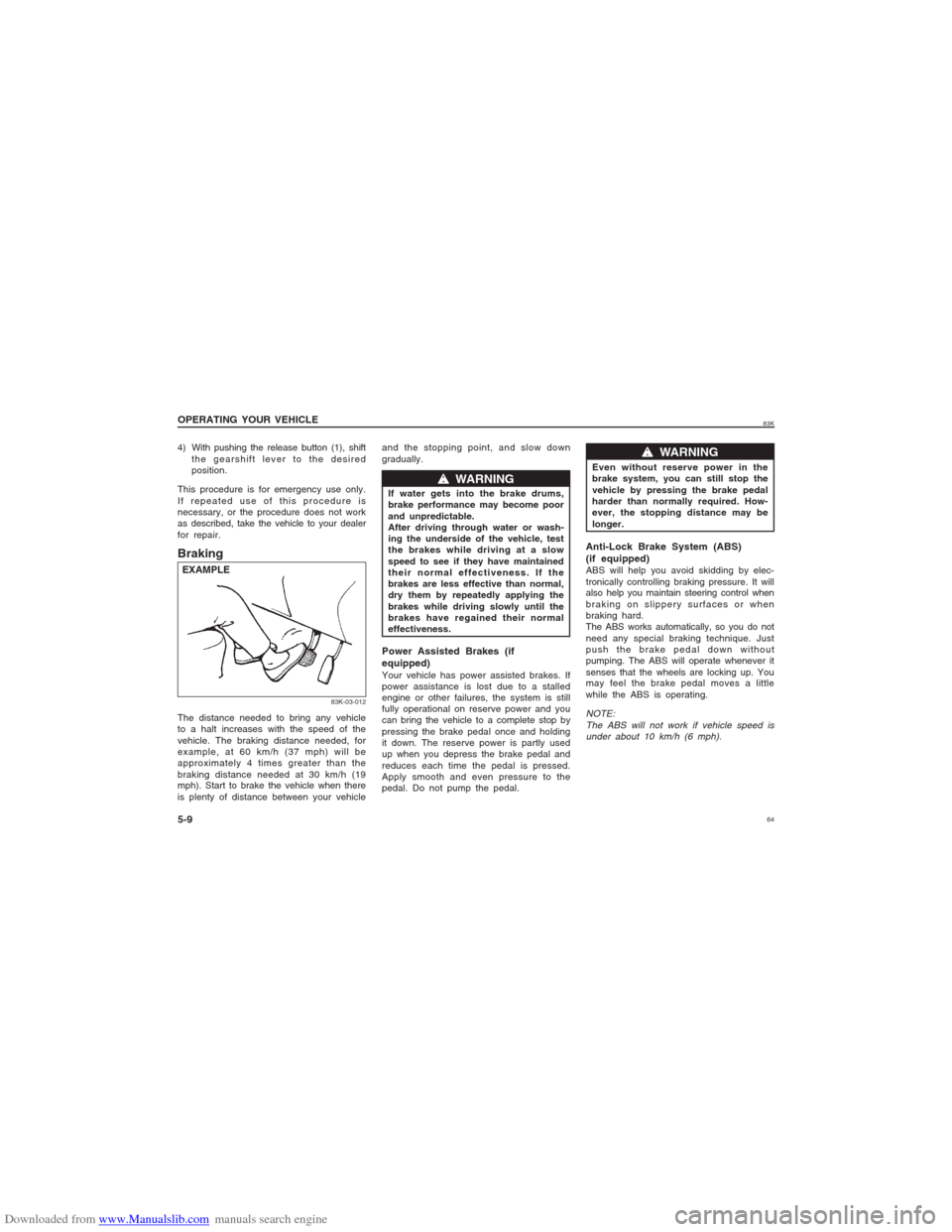
The distance needed to bring any vehicle
to a halt increases with the speed of the
vehicle. The braking distance needed, for
example, at 60 km/h (37 mph) will be
approximately 4 times greater than the
braking distance needed at 30 km/h (19
mph). Start to brake the vehicle when there
is plenty of distance between your vehicleand the stopping point, and slow down
gradually.
Power Assisted Brakes (if
equipped)Your vehicle has power assisted brakes. If
power assistance is lost due to a stalled
engine or other failures, the system is still
fully operational on reserve power and you
can bring the vehicle to a complete stop by
pressing the brake pedal once and holding
it down. The reserve power is partly used
up when you depress the brake pedal and
reduces each time the pedal is pressed.
Apply smooth and even pressure to the
pedal. Do not pump the pedal.
Anti-Lock Brake System (ABS)
(if equipped)ABS will help you avoid skidding by elec-
tronically controlling braking pressure. It will
also help you maintain steering control when
braking on slippery surfaces or when
braking hard.
The ABS works automatically, so you do not
need any special braking technique. Just
push the brake pedal down without
pumping. The ABS will operate whenever it
senses that the wheels are locking up. You
may feel the brake pedal moves a little
while the ABS is operating.NOTE:
The ABS will not work if vehicle speed is
under about 10 km/h (6 mph).
Page 65 of 136
Downloaded from www.Manualslib.com manuals search engine 6583K
OPERATING YOUR VEHICLE
5-10
(1) ABS warning light
(2) Brake system warning light
w ww w
w WARNING
If the ABS warning light (1) on the
instrument panel comes on and
stays on while driving, there may be
a problem with the ABS system.
Ask your MARUTI SUZUKI dealer to
inspect the ABS system immedi-
ately. If the ABS system becomes
inoperative, the brake system will
function as an ordinary brake sys-
tem that has no ABS.
If the ABS warning light (1) and the
Brake system warning light (2) on
the instrument panel simultaneously
stays on or comes on when driving,
both anti-lock function and rear
brake force control function
(Proportioning valve function) of the
ABS system may have failed. If so,
the rear wheels may easily skid or
the vehicle can even spin in the
83K-03-013
V VV V
V
w ww w
w WARNING
V VV V
V
w ww w
w WARNING
The ABS may not work properly if
tyres or wheels other than those
specified in the owner’s manual are
used. This is because the ABS works
by comparing changes in wheel
speed. When replacing tyres or
wheels, use only the size and type
specified in this owner’s manual.worst case when braking on a
slippery road or when hard braking
even on a dry paved road. Contact
your MARUTI SUZUKI dealer to
inspect the ABS system immediately.
Drive carefully, avoiding hard braking
as much as possible.How the ABS WorksA computer continuously monitors wheel
speed. The computer compares the
changes in wheel speed when braking. If
the wheels slow suddenly, indicating a
skidding situation, the computer will change
braking pressure several times each second
to prevent the wheels from locking. When
you start your vehicle after a stop you may
hear a momentary motor noise as the
system checks itself.
w ww w
w WARNING
On some types of loose surfaces
(such as gravel, snow-covered
roads, etc.) the stopping distance
required for an ABS-equipped vehi-
cle may be slightly greater than for
a comparable vehicle with a con-
ventional brake system. With a
conventional brake system, skidding
tyres are able to “plow” the gravel
or snow layer, shortening the
stopping distance, ABS minimizes
this resistance effect. Allow for extra
stopping distance when driving on
loose surfaces.
On regular paved roads, some driv-
ers may be able to obtain slightly
shorter stopping distances with
conventional brake systems than
with ABS.
In both of the above conditions,
ABS will still offer the advantage of
helping you maintain directional
control. However, remember that
ABS will not compensate for bad
road or weather conditions or poor
driver judgment. Use good judgment
and do not drive faster than
conditions will safely allow.
Page 70 of 136
Downloaded from www.Manualslib.com manuals search engine 7083K
DRIVING TIPS
6-4
w ww w
w WARNING
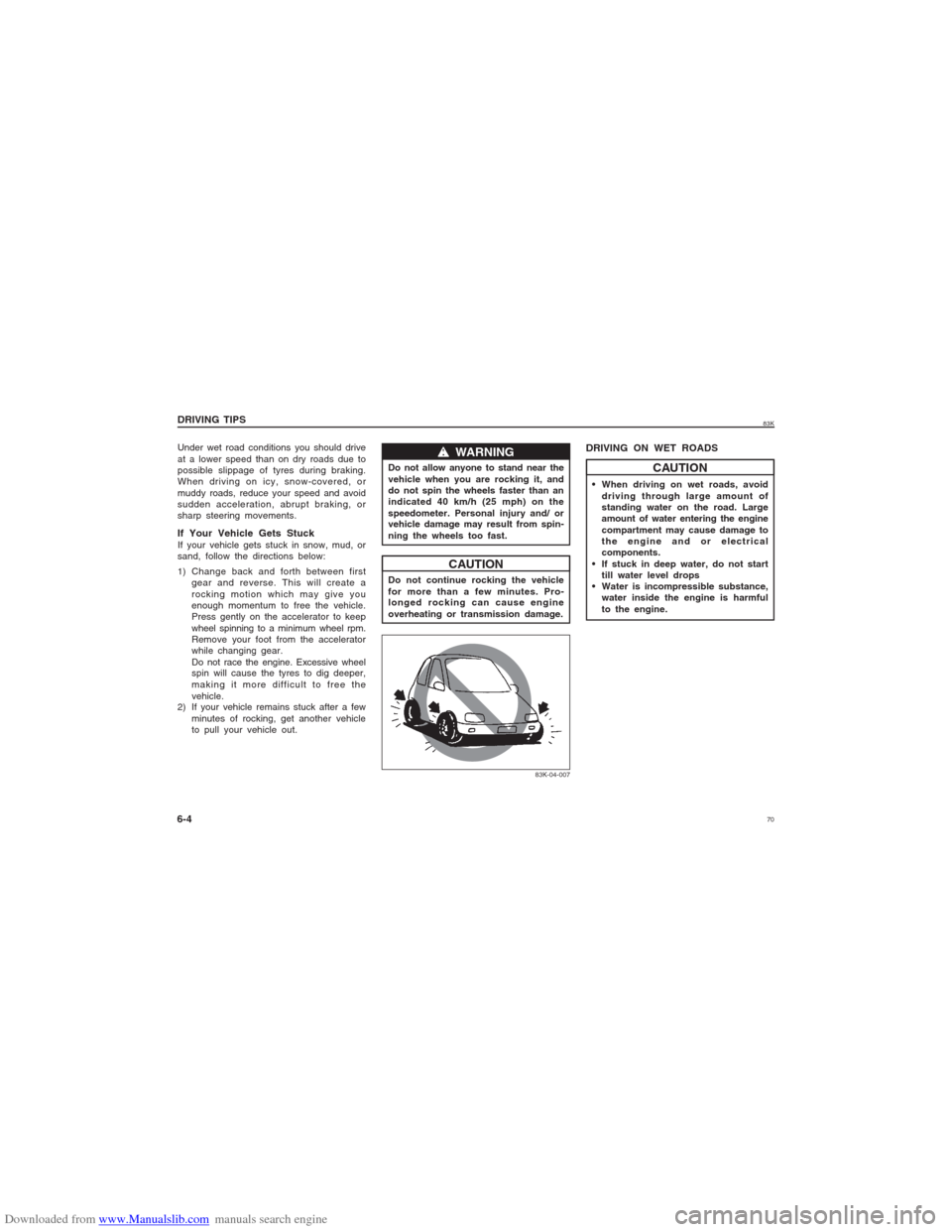
Do not allow anyone to stand near the
vehicle when you are rocking it, and
do not spin the wheels faster than an
indicated 40 km/h (25 mph) on the
speedometer. Personal injury and/ or
vehicle damage may result from spin-
ning the wheels too fast.
CAUTION
83K-04-007
Do not continue rocking the vehicle
for more than a few minutes. Pro-
longed rocking can cause engine
overheating or transmission damage.
Under wet road conditions you should drive
at a lower speed than on dry roads due to
possible slippage of tyres during braking.
When driving on icy, snow-covered, or
muddy roads, reduce your speed and avoid
sudden acceleration, abrupt braking, or
sharp steering movements.If Your Vehicle Gets StuckIf your vehicle gets stuck in snow, mud, or
sand, follow the directions below:
1) Change back and forth between first
gear and reverse. This will create a
rocking motion which may give you
enough momentum to free the vehicle.
Press gently on the accelerator to keep
wheel spinning to a minimum wheel rpm.
Remove your foot from the accelerator
while changing gear.
Do not race the engine. Excessive wheel
spin will cause the tyres to dig deeper,
making it more difficult to free the
vehicle.
2) If your vehicle remains stuck after a few
minutes of rocking, get another vehicle
to pull your vehicle out.
CAUTION
When driving on wet roads, avoid
driving through large amount of
standing water on the road. Large
amount of water entering the engine
compartment may cause damage to
the engine and or electrical
components.
If stuck in deep water, do not start
till water level drops
Water is incompressible substance,
water inside the engine is harmful
to the engine.DRIVING ON WET ROADS
Page 71 of 136
Downloaded from www.Manualslib.com manuals search engine 7183K
Starting
1. Adjust the driver’s seat for the proper
driving posture.
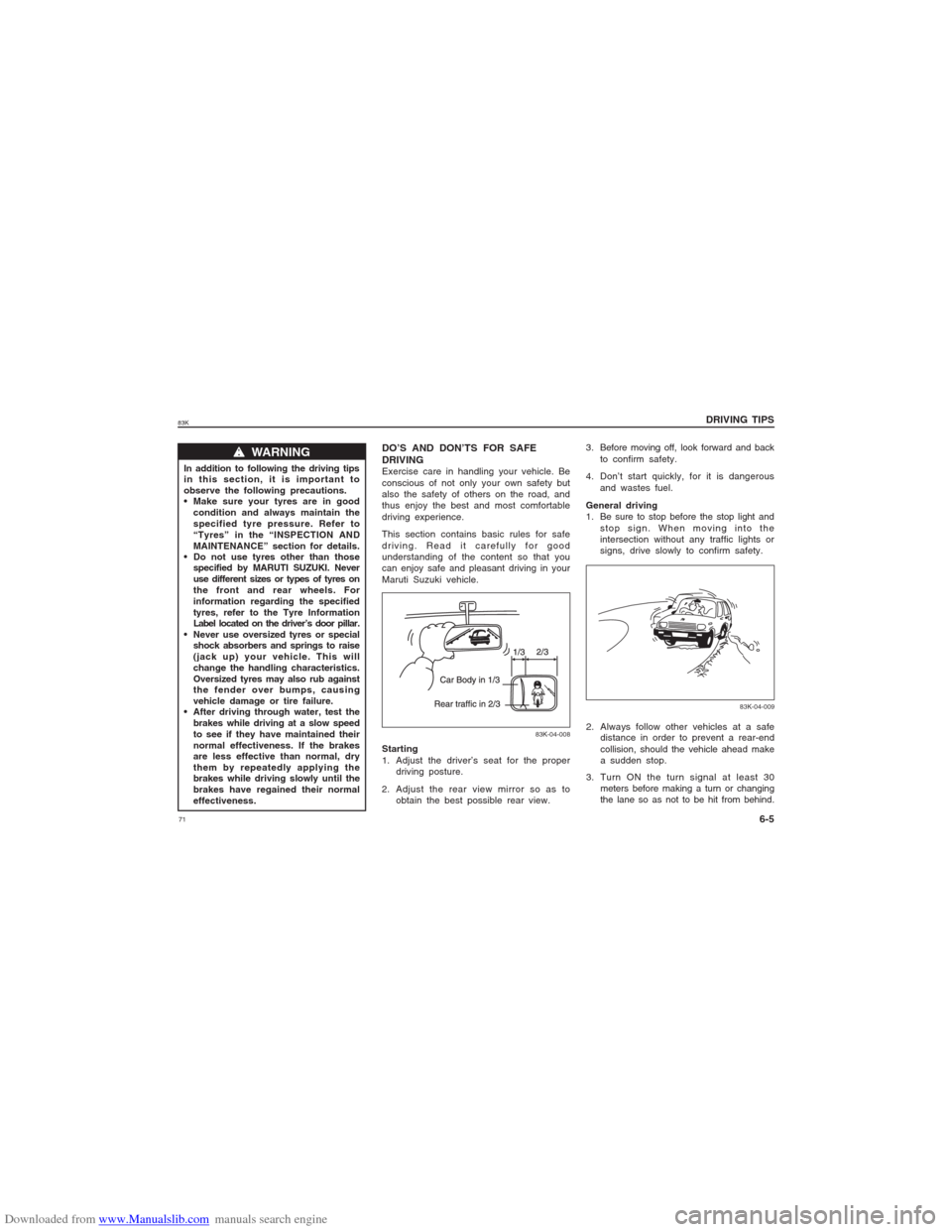
2. Adjust the rear view mirror so as to
obtain the best possible rear view.
83K-04-008
83K-04-009
2. Always follow other vehicles at a safe
distance in order to prevent a rear-end
collision, should the vehicle ahead make
a sudden stop.
3. Turn ON the turn signal at least 30
meters before making a turn or changing
the lane so as not to be hit from behind.
DRIVING TIPS
6-5
DO’S AND DON’TS FOR SAFE
DRIVINGExercise care in handling your vehicle. Be
conscious of not only your own safety but
also the safety of others on the road, and
thus enjoy the best and most comfortable
driving experience.
This section contains basic rules for safe
driving. Read it carefully for good
understanding of the content so that you
can enjoy safe and pleasant driving in your
Maruti Suzuki vehicle.3. Before moving off, look forward and back
to confirm safety.
4. Don’t start quickly, for it is dangerous
and wastes fuel.
General driving
1. Be sure to stop before the stop light and
stop sign. When moving into the
intersection without any traffic lights or
signs, drive slowly to confirm safety.
w ww w
w WARNING
In addition to following the driving tips
in this section, it is important to
observe the following precautions.
Make sure your tyres are in good
condition and always maintain the
specified tyre pressure. Refer to
“Tyres” in the “INSPECTION AND
MAINTENANCE” section for details.
Do not use tyres other than those
specified by MARUTI SUZUKI. Never
use different sizes or types of tyres on
the front and rear wheels. For
information regarding the specified
tyres, refer to the Tyre Information
Label located on the driver’s door pillar.
Never use oversized tyres or special
shock absorbers and springs to raise
(jack up) your vehicle. This will
change the handling characteristics.
Oversized tyres may also rub against
the fender over bumps, causing
vehicle damage or tire failure.
After driving through water, test the
brakes while driving at a slow speed
to see if they have maintained their
normal effectiveness. If the brakes
are less effective than normal, dry
them by repeatedly applying the
brakes while driving slowly until the
brakes have regained their normal
effectiveness.
Page 78 of 136
Downloaded from www.Manualslib.com manuals search engine 7883K
OTHER CONTROLS AND EQUIPMENT
7-4Using the wrong refrigerant may
damage your air conditioning system.
Use R-134a only. Do not mix or replace
the R-134a with other refrigerants.
CAUTION
NOTE:
If you need maximum demisting:
set the air flow selector to “DEMIST”,
set the blower speed selector to HIGH,
adjust the temperature selector to the
HOT end,
turn on the “A/C” switch, and
adjust the side outlets so the air blows
on the side windows.MaintenanceIf you do not use the air conditioner for a
long period, such as during winter, it may
not give the best performance when you
start using it again. To help maintain opti-
mum performance and durability of your air
conditioner, it needs to be run periodically.
Operate the air conditioner at least once a
month for one minute with the engine idling.
This circulates the refrigerant and oil and
helps protect the internal components.NOTE:
Your vehicle uses the air conditioning
refrigerant HFC-134a, commonly called “R-
134a”. Only R-134a should be used in your
vehicle.
Audio System (if equipped)Refer supplementary manual for audio
system (if equipped), provided along with
the vehicle.Radio Antenna
83K-05-013
To avoid damage to the radio antenna:
Remove the antenna when using an
automatic car wash.
Remove the antenna when the
antenna hits anything such as a low
ceiling in a parking garage or
putting a car cover over your car.
CAUTION
Remote Audio Controls
(if equipped)
83K-05-014
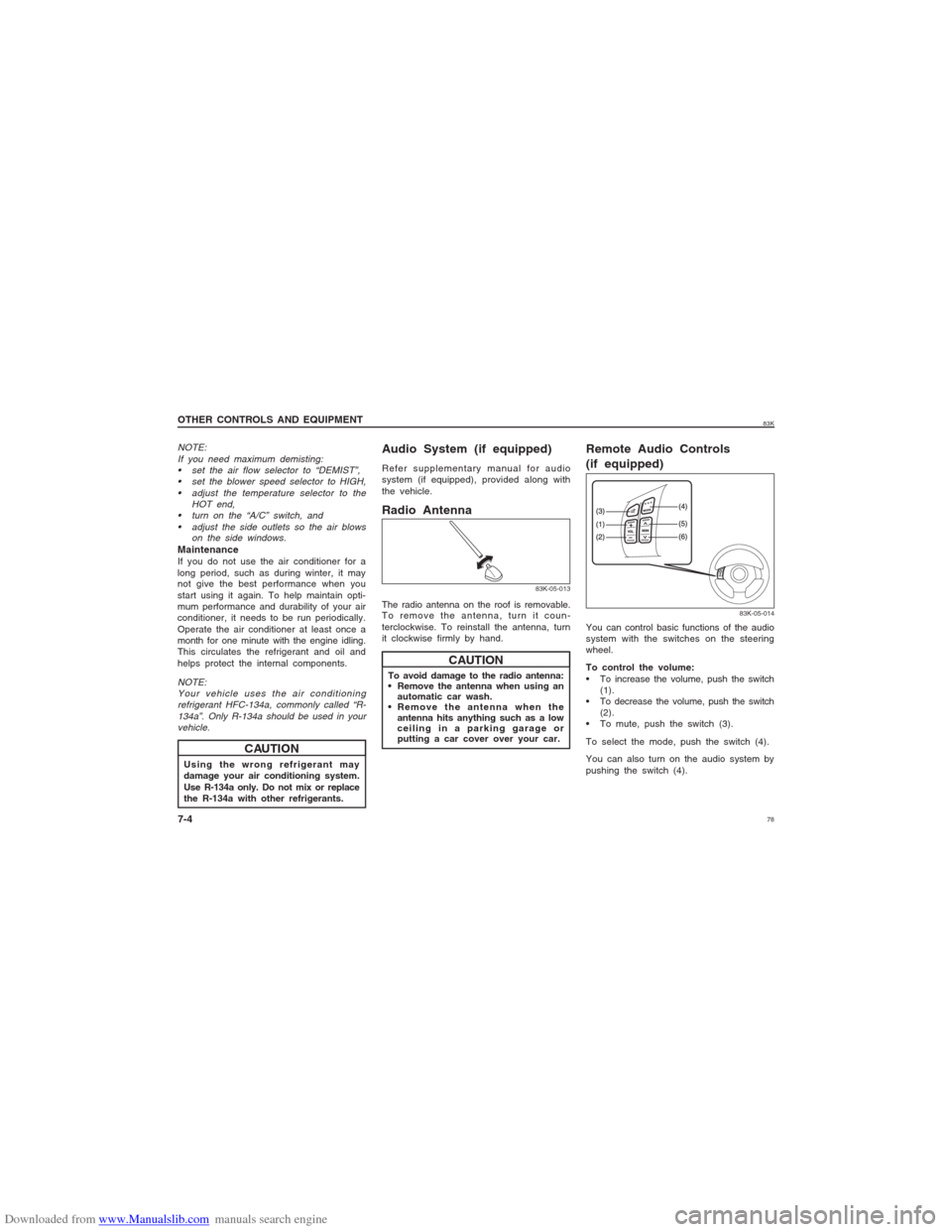
You can control basic functions of the audio
system with the switches on the steering
wheel.
To control the volume:
To increase the volume, push the switch
(1).
To decrease the volume, push the switch
(2).
To mute, push the switch (3).
To select the mode, push the switch (4).
You can also turn on the audio system by
pushing the switch (4). The radio antenna on the roof is removable.
To remove the antenna, turn it coun-
terclockwise. To reinstall the antenna, turn
it clockwise firmly by hand.
Page 88 of 136
Downloaded from www.Manualslib.com manuals search engine 8883K
VEHICLE LOADING AND TOWING
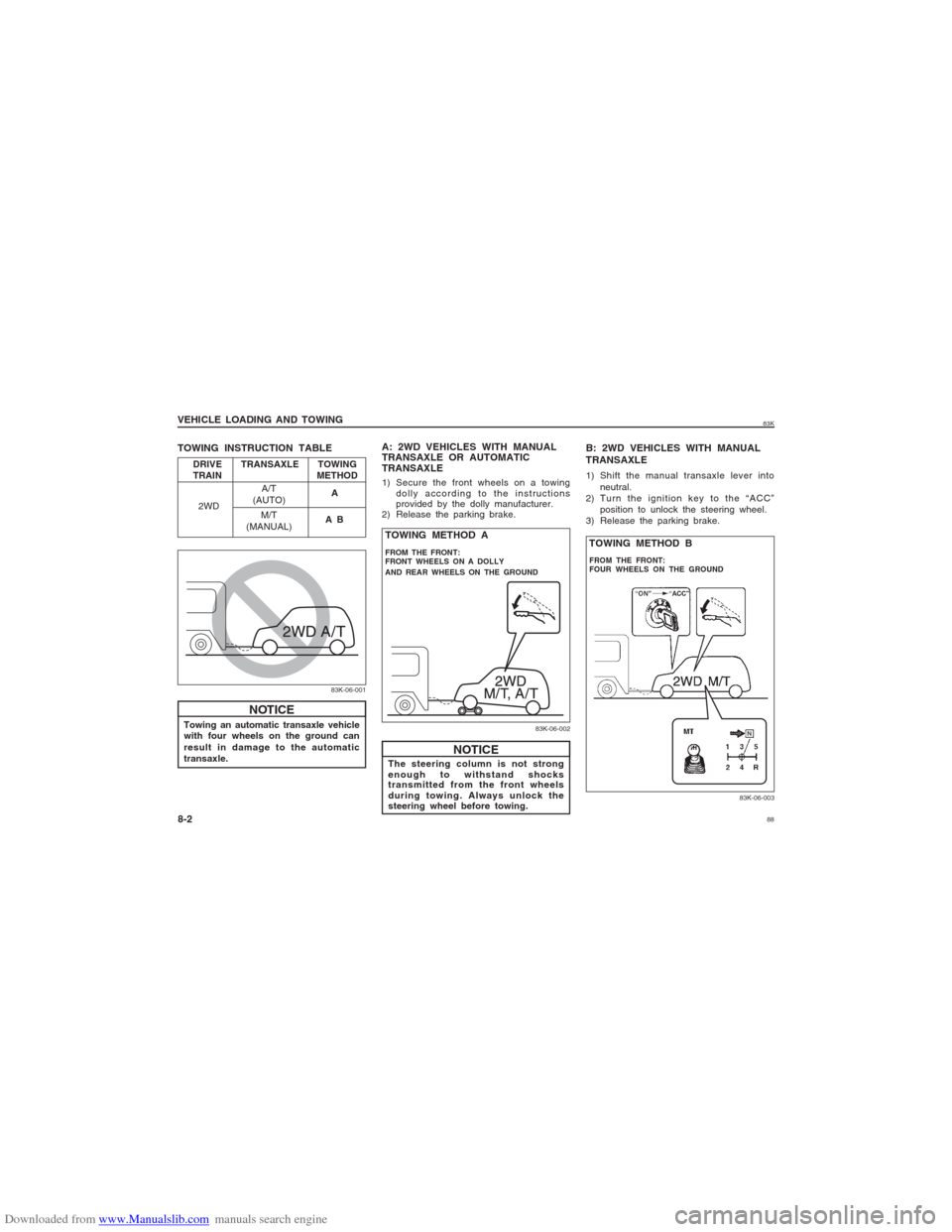
TOWING INSTRUCTION TABLE
DRIVE TRANSAXLE TOWING
TRAIN METHOD2WDA/T
(AUTO)
M/T
(MANUAL)A
A B
Towing an automatic transaxle vehicle
with four wheels on the ground can
result in damage to the automatic
transaxle.
83K-06-001
NOTICE
A: 2WD VEHICLES WITH MANUAL
TRANSAXLE OR AUTOMATIC
TRANSAXLE1) Secure the front wheels on a towing
dolly according to the instructions
provided by the dolly manufacturer.
2) Release the parking brake.
83K-06-002
TOWING METHOD AFROM THE FRONT:
FRONT WHEELS ON A DOLLY
AND REAR WHEELS ON THE GROUND
B: 2WD VEHICLES WITH MANUAL
TRANSAXLE1) Shift the manual transaxle lever into
neutral.
2) Turn the ignition key to the “ACC”
position to unlock the steering wheel.
3) Release the parking brake.
83K-06-003
TOWING METHOD BFROM THE FRONT:
FOUR WHEELS ON THE GROUND
NOTICE
The steering column is not strong
enough to withstand shocks
transmitted from the front wheels
during towing. Always unlock the
steering wheel before towing.
8-2
Page 93 of 136
Downloaded from www.Manualslib.com manuals search engine 9383K
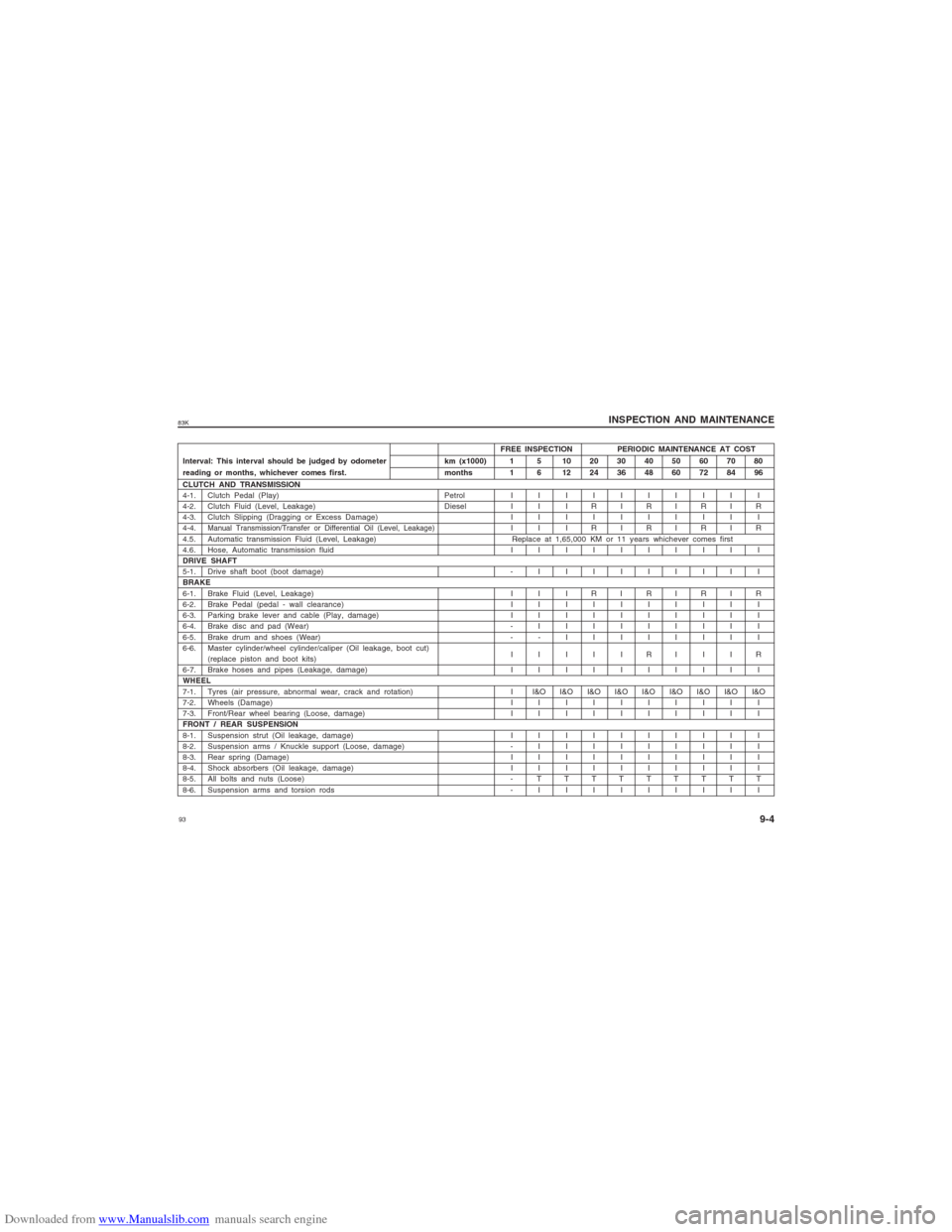
FREE INSPECTION PERIODIC MAINTENANCE AT COST
Interval: This interval should be judged by odometer km (x1000) 1 5 10 20 30 40 50 60 70 80
reading or months, whichever comes first.months 1 6 12 24 36 48 60 72 84 96
CLUTCH AND TRANSMISSION
4-1. Clutch Pedal (Play) PetrolIIIIIIIIII
4-2.Clutch Fluid (Level, Leakage) Diesel I I I R I R I R I R
4-3. Clutch Slipping (Dragging or Excess Damage)IIIIIIIIII
4-4.
Manual Transmission/Transfer or Differential Oil (Level, Leakage)
I I IRIRIRIR
4.5. Automatic transmission Fluid (Level, Leakage) Replace at 1,65,000 KM or 11 years whichever comes first
4.6. Hose, Automatic transmission fluidIIIIIIIIII
DRIVE SHAFT
5-1. Drive shaft boot (boot damage) -IIIIIIIII
BRAKE
6-1. Brake Fluid (Level, Leakage) I I I R I R I R I R
6-2.Brake Pedal (pedal - wall clearance)IIIIIIIIII
6-3.Parking brake lever and cable (Play, damage)IIIIIIIIII
6-4.Brake disc and pad (Wear) -IIIIIIIII
6-5.Brake drum and shoes (Wear) - -IIIIIIII
6-6. Master cylinder/wheel cylinder/caliper (Oil leakage, boot cut)
IIIIIRIIIR
(replace piston and boot kits)
6-7.Brake hoses and pipes (Leakage, damage)IIIIIIIIII
WHEEL
7-1.Tyres (air pressure, abnormal wear, crack and rotation) I I&O I&O I&O I&O I&O I&O I&O I&O I&O
7-2. Wheels (Damage)IIIIIIIIII
7-3.Front/Rear wheel bearing (Loose, damage)IIIIIIIIII
FRONT / REAR SUSPENSION
8-1.Suspension strut (Oil leakage, damage)IIIIIIIIII
8-2. Suspension arms / Knuckle support (Loose, damage) -IIIIIIIII
8-3.Rear spring (Damage)IIIIIIIIII
8-4.Shock absorbers (Oil leakage, damage)IIIIIIIIII
8-5.All bolts and nuts (Loose) -TTTTTTTTT
8-6. Suspension arms and torsion rods -IIIIIIIII
INSPECTION AND MAINTENANCE
9-4
Page 94 of 136
Downloaded from www.Manualslib.com manuals search engine 9483K
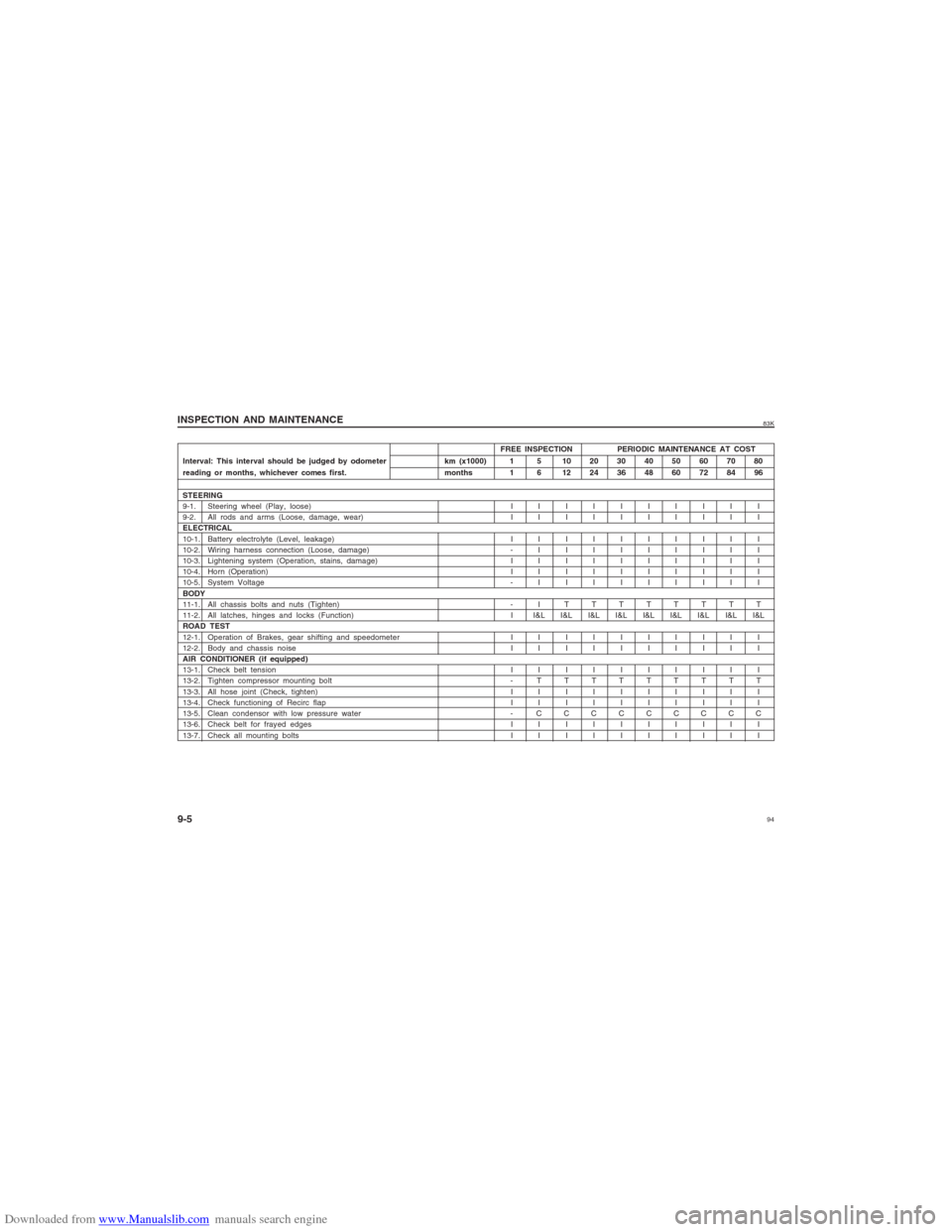
FREE INSPECTION PERIODIC MAINTENANCE AT COST
Interval: This interval should be judged by odometer km (x1000) 1 5 10 20 30 40 50 60 70 80
reading or months, whichever comes first.months 1 6 12 24 36 48 60 72 84 96
STEERING
9-1.Steering wheel (Play, loose)IIIIIIIIII
9-2. All rods and arms (Loose, damage, wear)IIIIIIIIII
ELECTRICAL
10-1.Battery electrolyte (Level, leakage)IIIIIIIIII
10-2. Wiring harness connection (Loose, damage) -IIIIIIIII
10-3. Lightening system (Operation, stains, damage)IIIIIIIIII
10-4.Horn (Operation)IIIIIIIIII
10-5.System Voltage -IIIIIIIII
BODY
11-1.All chassis bolts and nuts (Tighten) - ITTTTTTTT
11-2. All latches, hinges and locks (Function) I I&L I&L I&L I&L I&L I&L I&L I&L I&L
ROAD TEST
12-1.Operation of Brakes, gear shifting and speedometerIIIIIIIIII
12-2.Body and chassis noiseIIIIIIIIII
AIR CONDITIONER (if equipped)
13-1. Check belt tensionIIIIIIIIII
13-2.Tighten compressor mounting bolt -TTTTTTTTT
13-3. All hose joint (Check, tighten)IIIIIIIIII
13-4.Check functioning of Recirc flapIIIIIIIIII
13-5. Clean condensor with low pressure water - C C CCCCCCC
13-6. Check belt for frayed edgesIIIIIIIIII
13-7.Check all mounting boltsIIIIIIIIII
INSPECTION AND MAINTENANCE
9-5
Page 107 of 136
Downloaded from www.Manualslib.com manuals search engine 10783K
INSPECTION AND MAINTENANCE
9-18
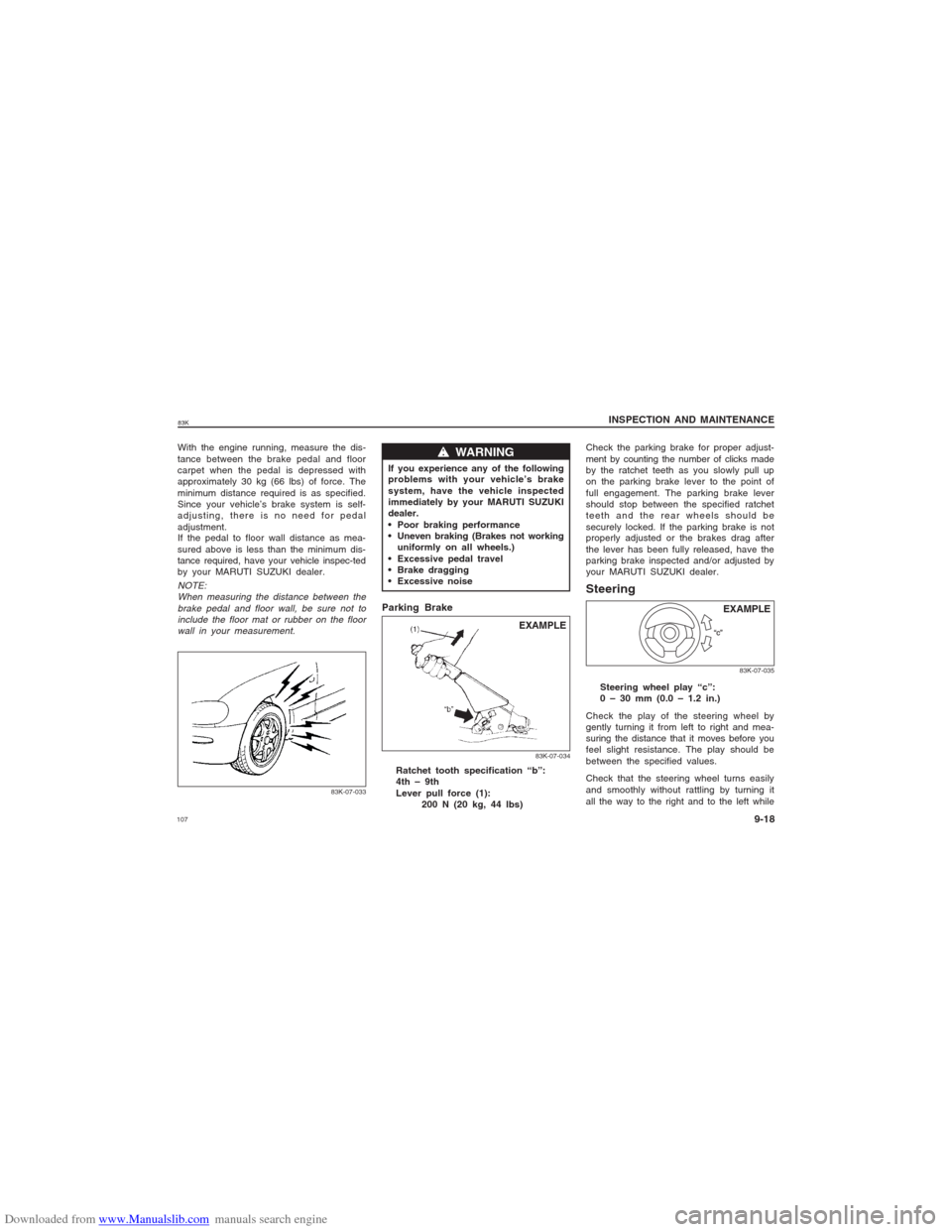
With the engine running, measure the dis-
tance between the brake pedal and floor
carpet when the pedal is depressed with
approximately 30 kg (66 lbs) of force. The
minimum distance required is as specified.
Since your vehicle’s brake system is self-
adjusting, there is no need for pedal
adjustment.
If the pedal to floor wall distance as mea-
sured above is less than the minimum dis-
tance required, have your vehicle inspec-ted
by your MARUTI SUZUKI dealer.NOTE:
When measuring the distance between the
brake pedal and floor wall, be sure not to
include the floor mat or rubber on the floor
wall in your measurement.
83K-07-033
Parking Brake
Ratchet tooth specification “b”:
4th – 9th
Lever pull force (1):
200 N (20 kg, 44 lbs)
w ww w
w WARNING
If you experience any of the following
problems with your vehicle’s brake
system, have the vehicle inspected
immediately by your MARUTI SUZUKI
dealer.
Poor braking performance
Uneven braking (Brakes not working
uniformly on all wheels.)
Excessive pedal travel
Brake dragging
Excessive noise
83K-07-034
EXAMPLE
Check the parking brake for proper adjust-
ment by counting the number of clicks made
by the ratchet teeth as you slowly pull up
on the parking brake lever to the point of
full engagement. The parking brake lever
should stop between the specified ratchet
teeth and the rear wheels should be
securely locked. If the parking brake is not
properly adjusted or the brakes drag after
the lever has been fully released, have the
parking brake inspected and/or adjusted by
your MARUTI SUZUKI dealer.Steering
EXAMPLE
Steering wheel play “c”:
0 – 30 mm (0.0 – 1.2 in.)
Check the play of the steering wheel by
gently turning it from left to right and mea-
suring the distance that it moves before you
feel slight resistance. The play should be
between the specified values.
Check that the steering wheel turns easily
and smoothly without rattling by turning it
all the way to the right and to the left while
83K-07-035
Page 108 of 136
Downloaded from www.Manualslib.com manuals search engine 10883K
INSPECTION AND MAINTENANCE
9-19driving very slowly in an open area. If the
amount of free play is outside the specifi-
cation or you find anything else to be
wrong, an inspection must be performed by
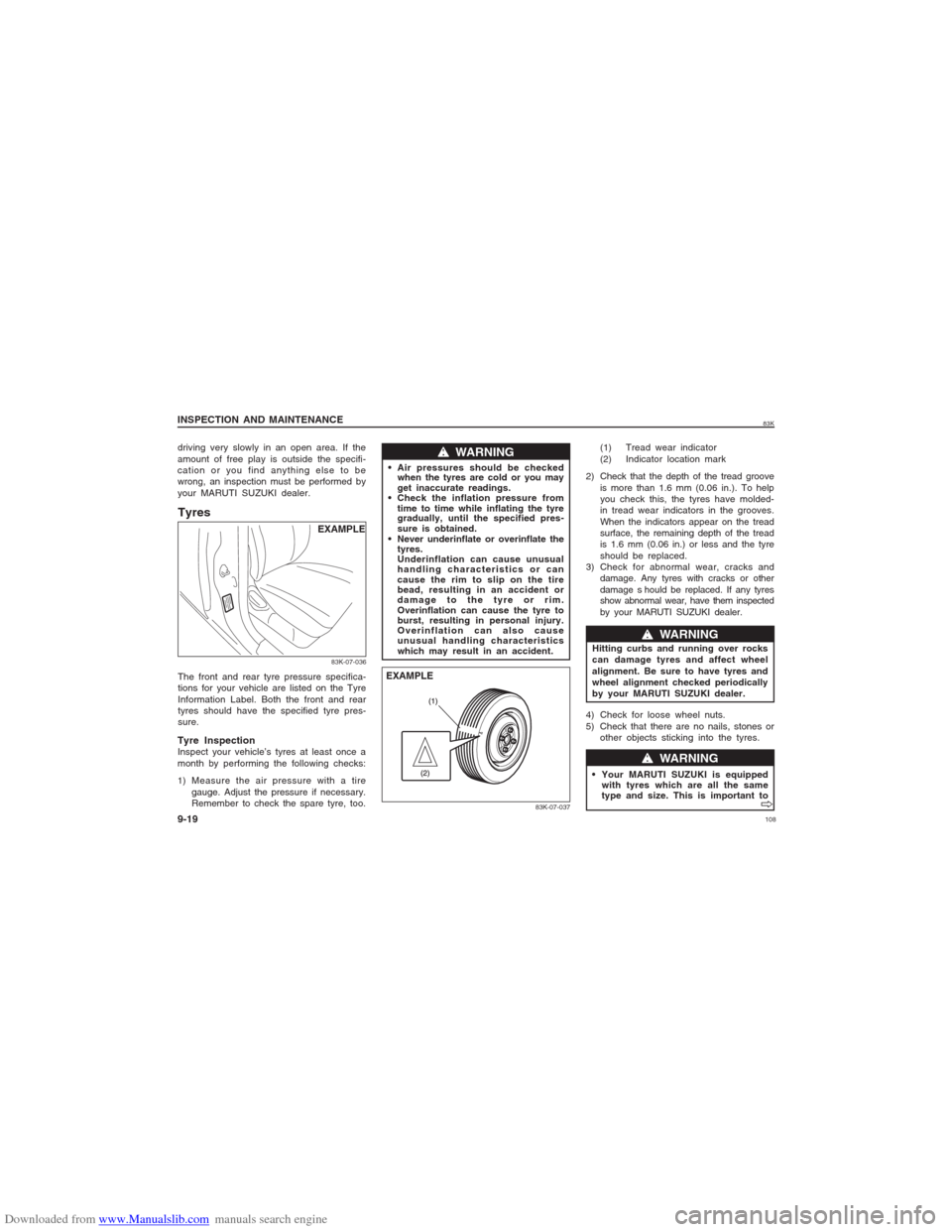
your MARUTI SUZUKI dealer.TyresThe front and rear tyre pressure specifica-
tions for your vehicle are listed on the Tyre
Information Label. Both the front and rear
tyres should have the specified tyre pres-
sure.
83K-07-036
w ww w
w WARNING
Air pressures should be checked
when the tyres are cold or you may
get inaccurate readings.
Check the inflation pressure from
time to time while inflating the tyre
gradually, until the specified pres-
sure is obtained.
Never underinflate or overinflate the
tyres.
Underinflation can cause unusual
handling characteristics or can
cause the rim to slip on the tire
bead, resulting in an accident or
damage to the tyre or rim.
Overinflation can cause the tyre to
burst, resulting in personal injury.
Overinflation can also cause
unusual handling characteristics
which may result in an accident.
EXAMPLE
83K-07-037
EXAMPLE
Tyre Inspection
Inspect your vehicle’s tyres at least once a
month by performing the following checks:
1) Measure the air pressure with a tire
gauge. Adjust the pressure if necessary.
Remember to check the spare tyre, too.(1) Tread wear indicator
(2) Indicator location mark
2) Check that the depth of the tread groove
is more than 1.6 mm (0.06 in.). To help
you check this, the tyres have molded-
in tread wear indicators in the grooves.
When the indicators appear on the tread
surface, the remaining depth of the tread
is 1.6 mm (0.06 in.) or less and the tyre
should be replaced.
3) Check for abnormal wear, cracks and
damage. Any tyres with cracks or other
damage s hould be replaced. If any tyres
show abnormal wear, have them inspected
by your MARUTI SUZUKI dealer.
Hitting curbs and running over rocks
can damage tyres and affect wheel
alignment. Be sure to have tyres and
wheel alignment checked periodically
by your MARUTI SUZUKI dealer.
w ww w
w WARNING
4) Check for loose wheel nuts.
5) Check that there are no nails, stones or
other objects sticking into the tyres.
w ww w
w WARNING
Your MARUTI SUZUKI is equipped
with tyres which are all the same
type and size. This is important to
V VV V
V