wheel SUZUKI MARUTI 2005 1.G Owners Manual
[x] Cancel search | Manufacturer: SUZUKI, Model Year: 2005, Model line: MARUTI, Model: SUZUKI MARUTI 2005 1.GPages: 136, PDF Size: 2.93 MB
Page 6 of 136
Downloaded from www.Manualslib.com manuals search engine 683K
WARRANTY POLICY
2-1WARRANTY POLICYMaruti Suzuki India Limited (hereinafter called "Maruti Suzuki"),
warrants that each new Maruti Suzuki vehicle distributed in India
by Maruti Suzuki and sold by an authorised Maruti Suzuki dealer
will be free, under normal use and service, from any defects in
material and workmanship at the time of manufacture SUBJECT
TO THE FOLLOWING TERMS AND CONDITIONS:
(1) Qualification:
To qualify for this warranty:
(a) The Maruti Suzuki vehicle must be delivered by Maruti
Suzuki authorised dealer and set-up, serviced by Maruti
Suzuki authorised dealer/service station.
(b) The warranty registration card in respect of each vehicle
must be completed by the dealer at the time of delivery
of the vehicle and dealer should retain the same.
(2) Term:
The term of the warranty shall be twenty four (24) months
or 40,000 kilometers (whichever occurs first) from the date
of delivery to the first owner.
(3) Maruti Suzuki's Warranty Obligation:
If any defect(s) should be found in a Maruti Suzuki vehicle
within the term stipulated above, Maruti Suzuki's only obligation
is to repair or replace at its sole discretion any part shown
to be defec-tive, with a new part or the equivalent at no cost
to the owner for parts or labour, when Maruti Suzuki
acknowledges that such a defect is attributable to faulty
material or workmanship at the time of manufacture. The
owner is responsible for any repair or replacements which are
not covered by this warranty.(4) Limitation:
This warranty shall not apply to:
(1) Normal maintenance service required other than the three
free services, including without limitation, oil and fluid
changes, headlight aiming, fastener retightening, wheel bal-
ancing, wheel alignment and tyre rotation, cleaning of injec-
tors, adjustments of carburettor, ignition timing, clutch and
valve clearance.
(2) The replacement of normal wear parts including without
limitation, bulbs, tyres and tubes, spark plugs, belts, hoses,
filters, wiper blades, brushes, contact points, fuses, clutch
disc, brake shoes, brake pads, cable and all rubber parts
(except oil seal and glass run).
(3) Any vehicle which has been used for competition or racing.
(4) Any repairs or replacement required as a result of
accidents or collision.
(5) Any defects caused by misuse, negligence, abnormal use
or insufficient care.
(6) Any vehicle which has been modified or altered, including
without limitation, the installation of performance accessories.
(7) Any vehicle on which parts or accessories not approved
by Maruti Suzuki have been used.
(8) Any vehicle which has not been operated in accordance
with the operating instructions in the Maruti Suzuki Owner’s
Manual.
(9) Any vehicle which has not received, during the warranty
term, the service inspections prescribed in the Maruti
Suzuki Owner’s Manual.
(10) Any vehicle which has been assembled, disassembled,
adjusted or repaired by other than an Maruti Suzuki
authorised dealer/service station.
Page 37 of 136
Downloaded from www.Manualslib.com manuals search engine 3783K
BEFORE DRIVING
4-25
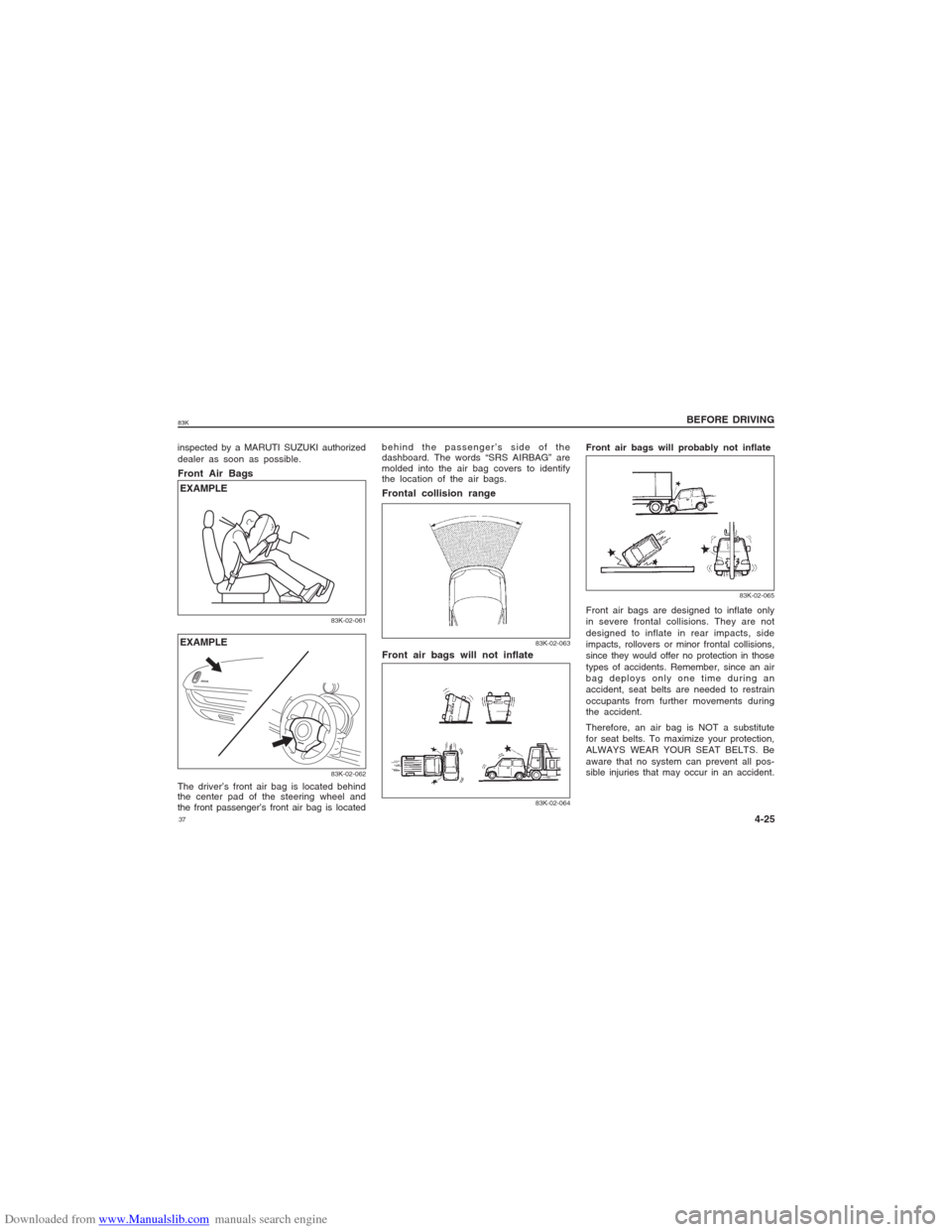
behind the passenger’s side of the
dashboard. The words “SRS AIRBAG” are
molded into the air bag covers to identify
the location of the air bags.Frontal collision range
83K-02-063
Front air bags will not inflate
83K-02-064
Front air bags will probably not inflate
83K-02-065
Front air bags are designed to inflate only
in severe frontal collisions. They are not
designed to inflate in rear impacts, side
impacts, rollovers or minor frontal collisions,
since they would offer no protection in those
types of accidents. Remember, since an air
bag deploys only one time during an
accident, seat belts are needed to restrain
occupants from further movements during
the accident.
Therefore, an air bag is NOT a substitute
for seat belts. To maximize your protection,
ALWAYS WEAR YOUR SEAT BELTS. Be
aware that no system can prevent all pos-
sible injuries that may occur in an accident.
inspected by a MARUTI SUZUKI authorized
dealer as soon as possible.Front Air Bags
83K-02-061
EXAMPLE
83K-02-062
EXAMPLEThe driver’s front air bag is located behind
the center pad of the steering wheel and
the front passenger’s front air bag is located
Page 39 of 136
Downloaded from www.Manualslib.com manuals search engine 3983K
BEFORE DRIVING
4-27
w ww w
w WARNING
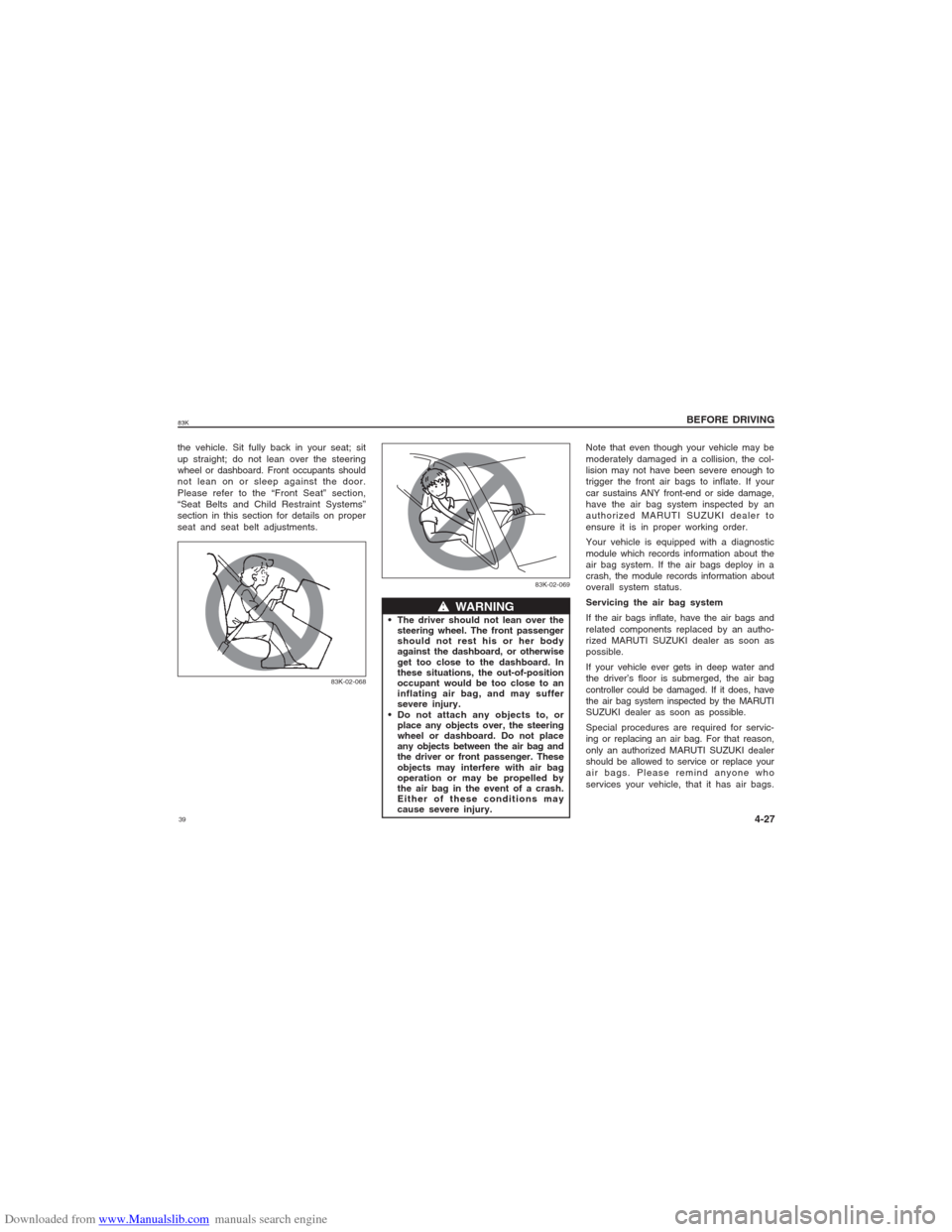
The driver should not lean over the
steering wheel. The front passenger
should not rest his or her body
against the dashboard, or otherwise
get too close to the dashboard. In
these situations, the out-of-position
occupant would be too close to an
inflating air bag, and may suffer
severe injury.
Do not attach any objects to, or
place any objects over, the steering
wheel or dashboard. Do not place
any objects between the air bag and
the driver or front passenger. These
objects may interfere with air bag
operation or may be propelled by
the air bag in the event of a crash.
Either of these conditions may
cause severe injury.
83K-02-068
the vehicle. Sit fully back in your seat; sit
up straight; do not lean over the steering
wheel or dashboard. Front occupants should
not lean on or sleep against the door.
Please refer to the “Front Seat” section,
“Seat Belts and Child Restraint Systems”
section in this section for details on proper
seat and seat belt adjustments.Note that even though your vehicle may be
moderately damaged in a collision, the col-
lision may not have been severe enough to
trigger the front air bags to inflate. If your
car sustains ANY front-end or side damage,
have the air bag system inspected by an
authorized MARUTI SUZUKI dealer to
ensure it is in proper working order.
Your vehicle is equipped with a diagnostic
module which records information about the
air bag system. If the air bags deploy in a
crash, the module records information about
overall system status.
Servicing the air bag system
If the air bags inflate, have the air bags and
related components replaced by an autho-
rized MARUTI SUZUKI dealer as soon as
possible.
If your vehicle ever gets in deep water and
the driver’s floor is submerged, the air bag
controller could be damaged. If it does, have
the air bag system inspected by the MARUTI
SUZUKI dealer as soon as possible.
Special procedures are required for servic-
ing or replacing an air bag. For that reason,
only an authorized MARUTI SUZUKI dealer
should be allowed to service or replace your
air bags. Please remind anyone who
services your vehicle, that it has air bags.
83K-02-069
Page 50 of 136
Downloaded from www.Manualslib.com manuals search engine 5083K
road condition
surrounding traffic condition
driving condition
vehicle condition
when the malfunction indicator light
comes on or blinksUnit indication of fuel consumption
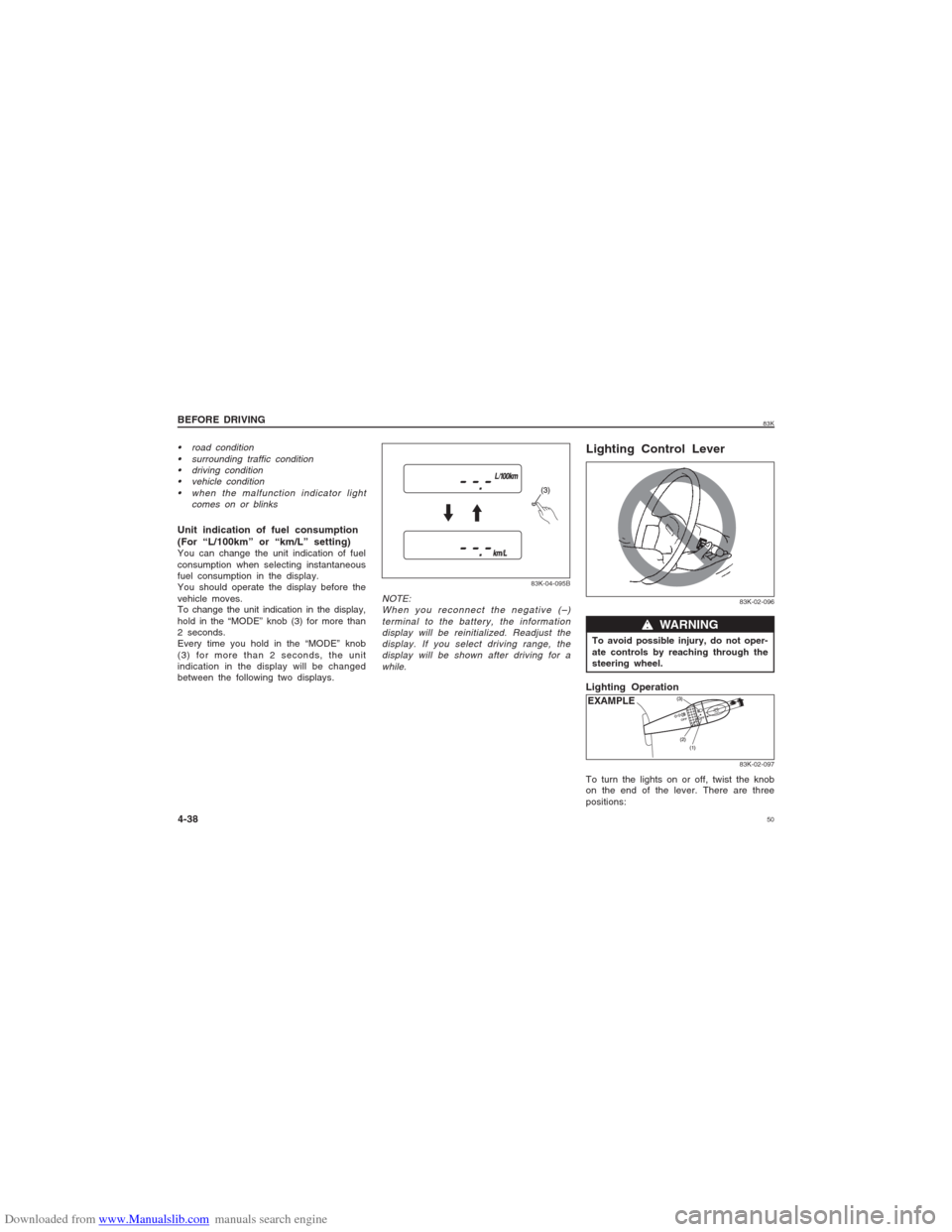
(For “L/100km” or “km/L” setting)You can change the unit indication of fuel
consumption when selecting instantaneous
fuel consumption in the display.
You should operate the display before the
vehicle moves.
To change the unit indication in the display,
hold in the “MODE” knob (3) for more than
2 seconds.
Every time you hold in the “MODE” knob
(3) for more than 2 seconds, the unit
indication in the display will be changed
between the following two displays.
83K-04-095B
NOTE:
When you reconnect the negative (–)
terminal to the battery, the information
display will be reinitialized. Readjust the
display. If you select driving range, the
display will be shown after driving for a
while.
83K-02-096
w ww w
w WARNING
To avoid possible injury, do not oper-
ate controls by reaching through the
steering wheel.Lighting Control LeverLighting Operation
EXAMPLE
83K-02-097
To turn the lights on or off, twist the knob
on the end of the lever. There are three
positions:
BEFORE DRIVING
4-38
Page 52 of 136
Downloaded from www.Manualslib.com manuals search engine 5283K
BEFORE DRIVING
4-40Driver only 0 0
Driver + 1 passenger 0 0
(in front seat)
Driver + 4 passengers,
no cargo 2 2
Driver + 4 passengers,
cargo added 3 3
Driver + full cargo 4 4Vehicle Load
Condition
Switch PositionPetrol Diesel
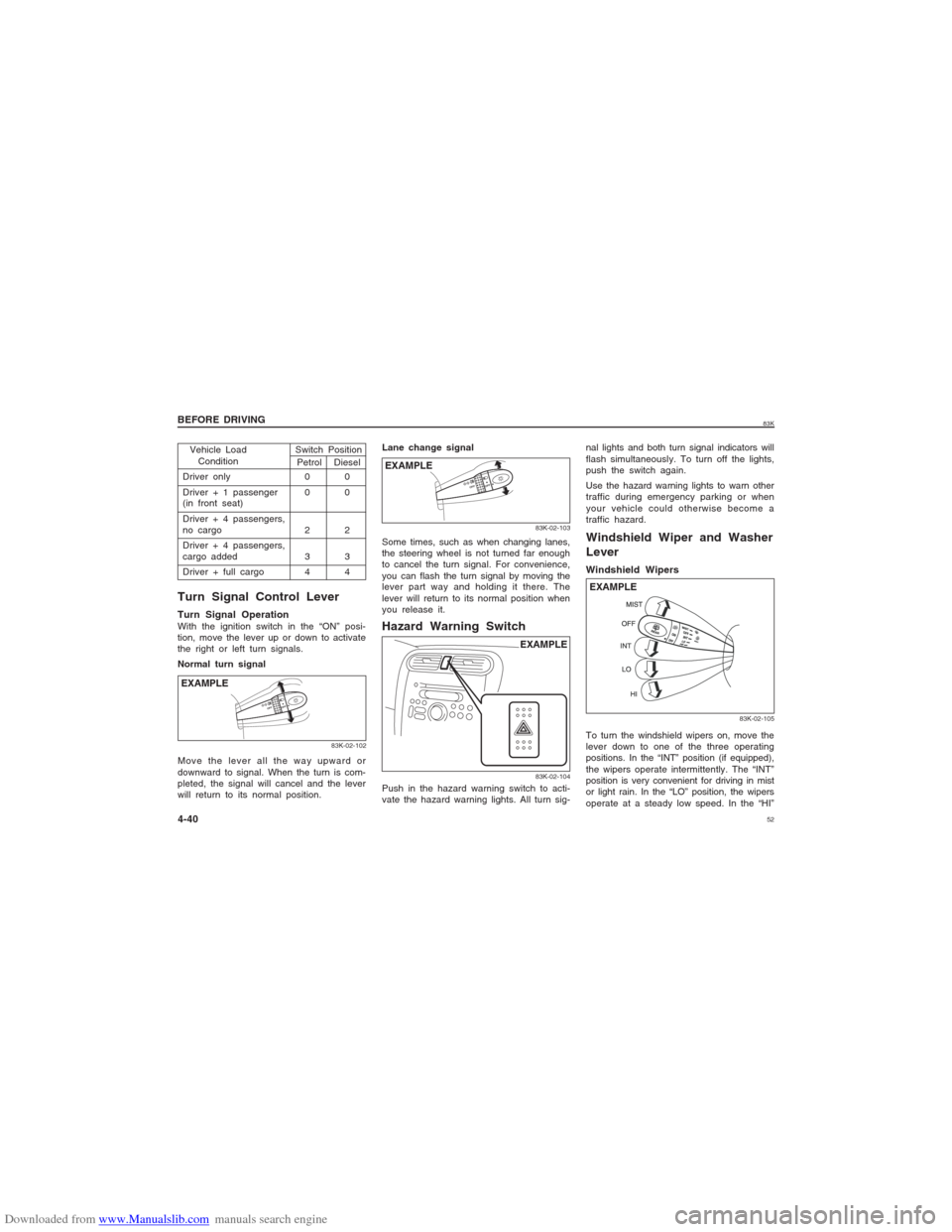
Turn Signal Control LeverTurn Signal OperationWith the ignition switch in the “ON” posi-
tion, move the lever up or down to activate
the right or left turn signals.
Normal turn signalEXAMPLE
83K-02-102
Lane change signalEXAMPLE
83K-02-103
Some times, such as when changing lanes,
the steering wheel is not turned far enough
to cancel the turn signal. For convenience,
you can flash the turn signal by moving the
lever part way and holding it there. The
lever will return to its normal position when
you release it.Hazard Warning Switch
Move the lever all the way upward or
downward to signal. When the turn is com-
pleted, the signal will cancel and the lever
will return to its normal position.
83K-02-104
Windshield Wiper and Washer
LeverWindshield Wipers
83K-02-105
EXAMPLE
Push in the hazard warning switch to acti-
vate the hazard warning lights. All turn sig-nal lights and both turn signal indicators will
flash simultaneously. To turn off the lights,
push the switch again.
Use the hazard warning lights to warn other
traffic during emergency parking or when
your vehicle could otherwise become a
traffic hazard.
To turn the windshield wipers on, move the
lever down to one of the three operating
positions. In the “INT” position (if equipped),
the wipers operate intermittently. The “INT”
position is very convenient for driving in mist
or light rain. In the “LO” position, the wipers
operate at a steady low speed. In the “HI”
EXAMPLE
Page 54 of 136
Downloaded from www.Manualslib.com manuals search engine 5483K
BEFORE DRIVING
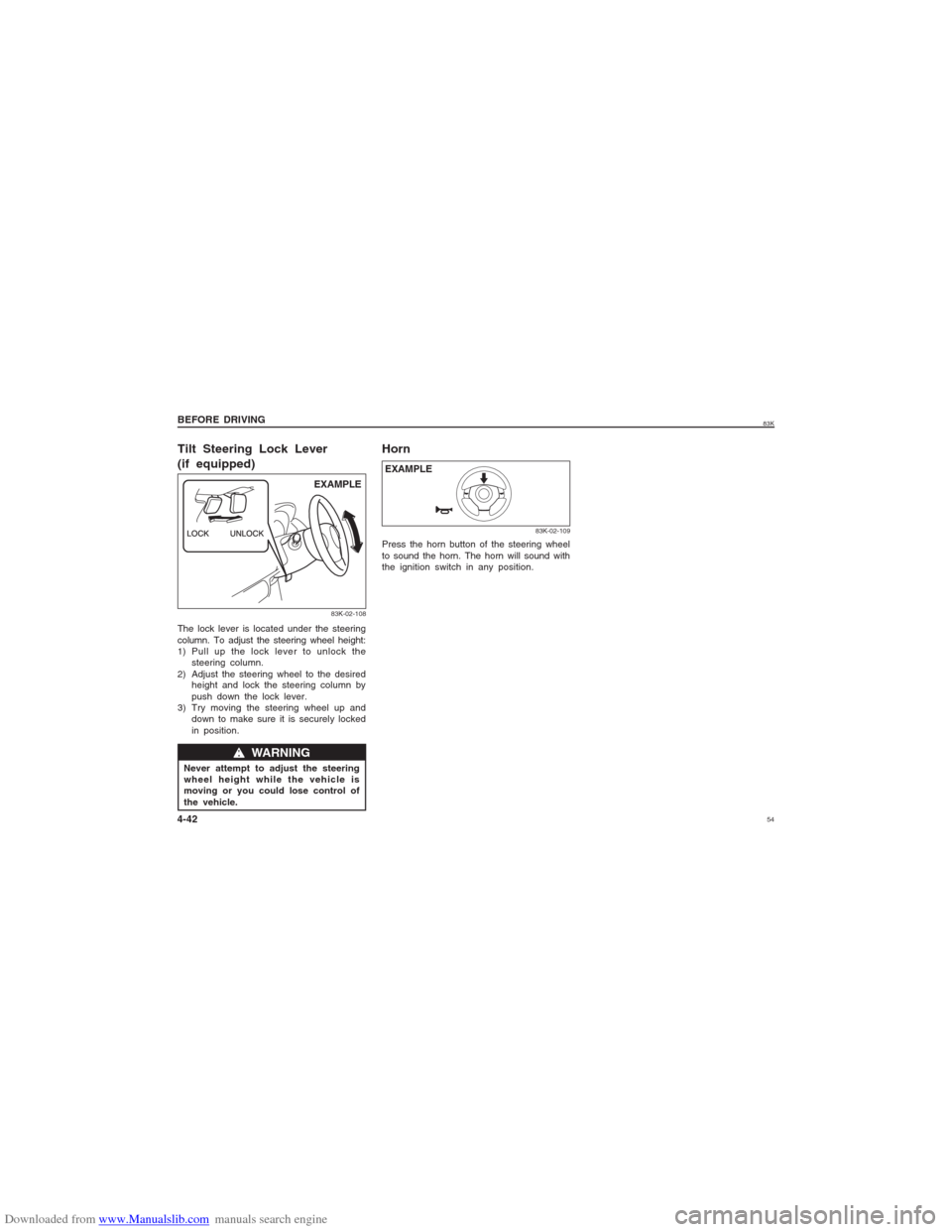
4-42Tilt Steering Lock Lever
(if equipped)
83K-02-108
EXAMPLE
w ww w
w WARNING
Never attempt to adjust the steering
wheel height while the vehicle is
moving or you could lose control of
the vehicle.
83K-02-109
HornPress the horn button of the steering wheel
to sound the horn. The horn will sound with
the ignition switch in any position.EXAMPLE
The lock lever is located under the steering
column. To adjust the steering wheel height:
1) Pull up the lock lever to unlock the
steering column.
2) Adjust the steering wheel to the desired
height and lock the steering column by
push down the lock lever.
3) Try moving the steering wheel up and
down to make sure it is securely locked
in position.
Page 56 of 136
Downloaded from www.Manualslib.com manuals search engine 5683K
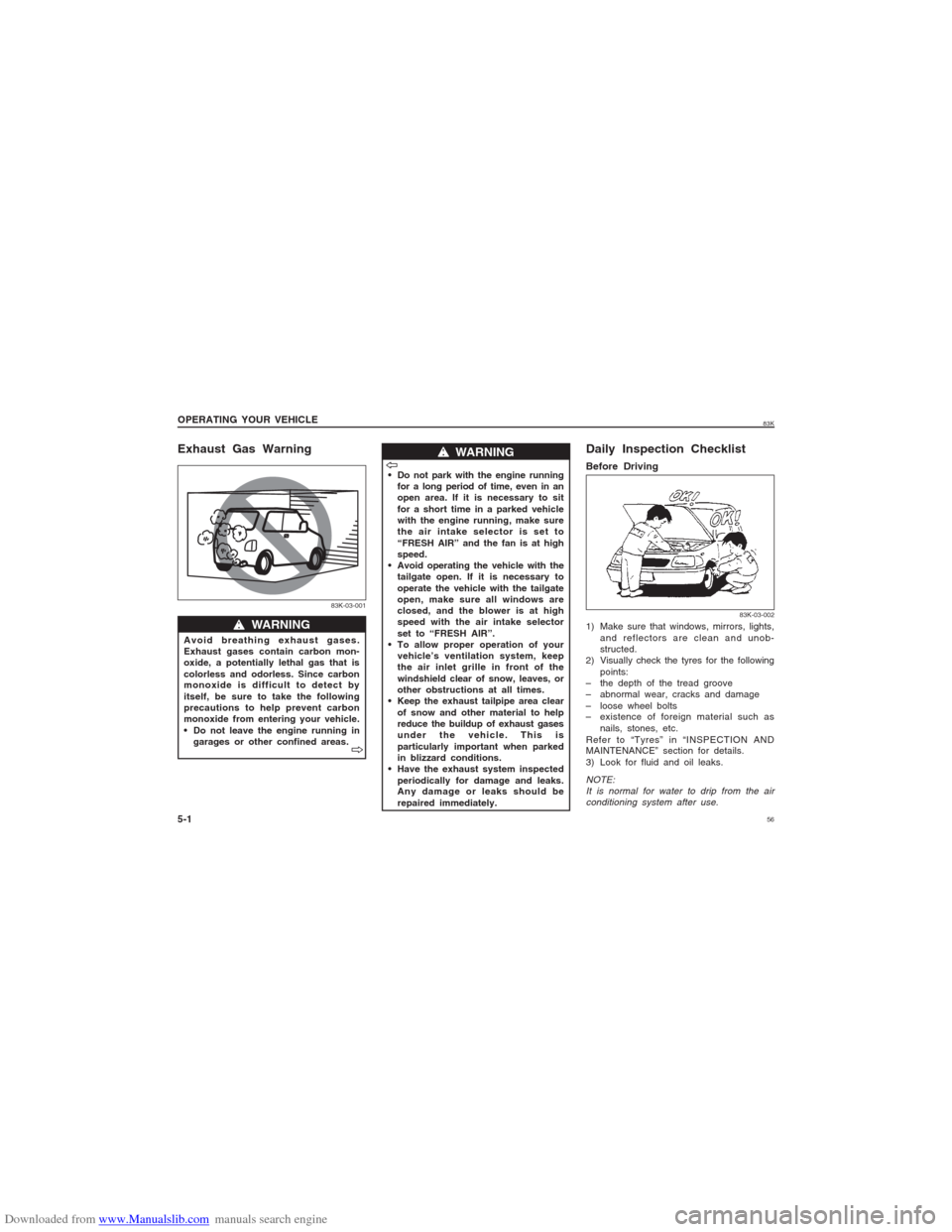
Exhaust Gas Warning
83K-03-001
w ww w
w WARNING
Avoid breathing exhaust gases.
Exhaust gases contain carbon mon-
oxide, a potentially lethal gas that is
colorless and odorless. Since carbon
monoxide is difficult to detect by
itself, be sure to take the following
precautions to help prevent carbon
monoxide from entering your vehicle.
Do not leave the engine running in
garages or other confined areas.
w ww w
w WARNING
Do not park with the engine running
for a long period of time, even in an
open area. If it is necessary to sit
for a short time in a parked vehicle
with the engine running, make sure
the air intake selector is set to
“FRESH AIR” and the fan is at high
speed.
Avoid operating the vehicle with the
tailgate open. If it is necessary to
operate the vehicle with the tailgate
open, make sure all windows are
closed, and the blower is at high
speed with the air intake selector
set to “FRESH AIR”.
To allow proper operation of your
vehicle’s ventilation system, keep
the air inlet grille in front of the
windshield clear of snow, leaves, or
other obstructions at all times.
Keep the exhaust tailpipe area clear
of snow and other material to help
reduce the buildup of exhaust gases
under the vehicle. This is
particularly important when parked
in blizzard conditions.
Have the exhaust system inspected
periodically for damage and leaks.
Any damage or leaks should be
repaired immediately.
Daily Inspection ChecklistBefore Driving1) Make sure that windows, mirrors, lights,
and reflectors are clean and unob-
structed.
2) Visually check the tyres for the following
points:
– the depth of the tread groove
– abnormal wear, cracks and damage
– loose wheel bolts
– existence of foreign material such as
nails, stones, etc.
Refer to “Tyres” in “INSPECTION AND
MAINTENANCE” section for details.
3) Look for fluid and oil leaks.NOTE:
It is normal for water to drip from the air
conditioning system after use.
83K-03-002
OPERATING YOUR VEHICLE
5-1
V VV V
V
V VV V
V
Page 58 of 136
Downloaded from www.Manualslib.com manuals search engine 5883K
w ww w
w WARNING
To avoid possible injury, do not oper-
ate controls by reaching through the
steering wheel.
83K-03-004
EXAMPLE OPERATING YOUR VEHICLE
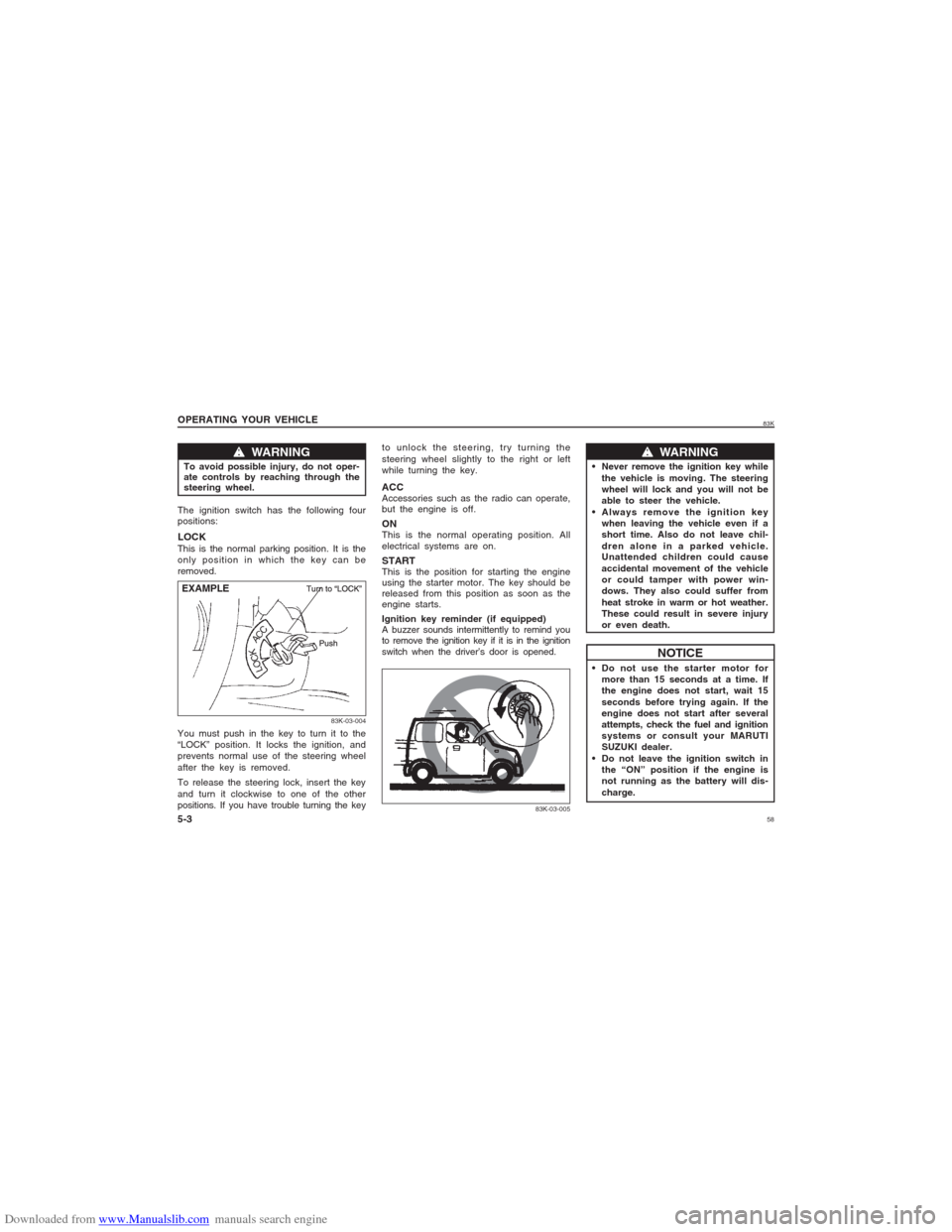
5-3The ignition switch has the following four
positions:LOCKThis is the normal parking position. It is the
only position in which the key can be
removed.
You must push in the key to turn it to the
“LOCK” position. It locks the ignition, and
prevents normal use of the steering wheel
after the key is removed.
To release the steering lock, insert the key
and turn it clockwise to one of the other
positions. If you have trouble turning the keyto unlock the steering, try turning the
steering wheel slightly to the right or left
while turning the key.
ACCAccessories such as the radio can operate,
but the engine is off.ONThis is the normal operating position. All
electrical systems are on.STARTThis is the position for starting the engine
using the starter motor. The key should be
released from this position as soon as the
engine starts.
Ignition key reminder (if equipped)
A buzzer sounds intermittently to remind you
to remove the ignition key if it is in the ignition
switch when the driver’s door is opened.
w ww w
w WARNING
Never remove the ignition key while
the vehicle is moving. The steering
wheel will lock and you will not be
able to steer the vehicle.
Always remove the ignition key
when leaving the vehicle even if a
short time. Also do not leave chil-
dren alone in a parked vehicle.
Unattended children could cause
accidental movement of the vehicle
or could tamper with power win-
dows. They also could suffer from
heat stroke in warm or hot weather.
These could result in severe injury
or even death.
NOTICE
Do not use the starter motor for
more than 15 seconds at a time. If
the engine does not start, wait 15
seconds before trying again. If the
engine does not start after several
attempts, check the fuel and ignition
systems or consult your MARUTI
SUZUKI dealer.
Do not leave the ignition switch in
the “ON” position if the engine is
not running as the battery will dis-
charge.
83K-03-005
Page 59 of 136
Downloaded from www.Manualslib.com manuals search engine 5983K
OPERATING YOUR VEHICLE
5-4
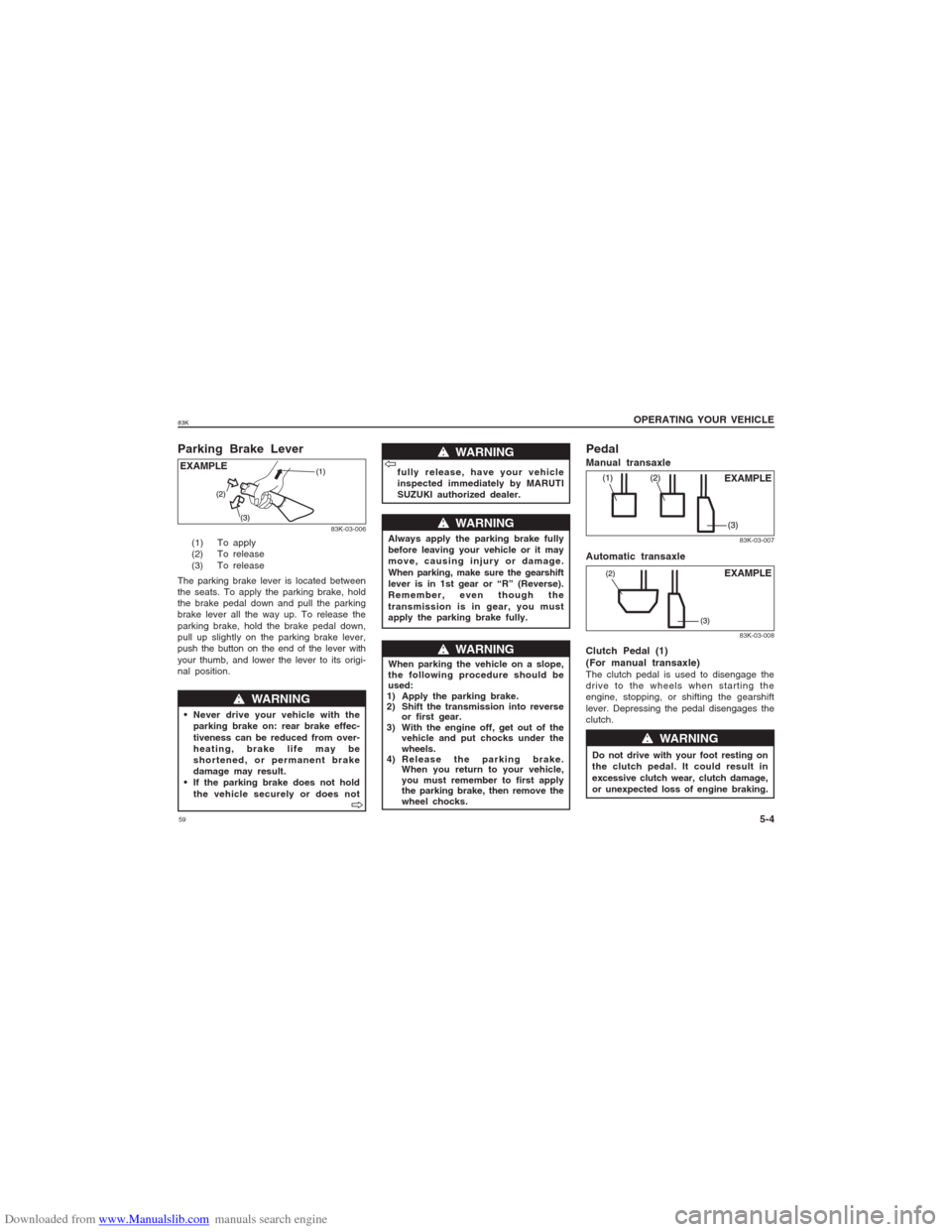
Parking Brake Lever
83K-03-006
w ww w
w WARNING
Never drive your vehicle with the
parking brake on: rear brake effec-
tiveness can be reduced from over-
heating, brake life may be
shortened, or permanent brake
damage may result.
If the parking brake does not hold
the vehicle securely or does not (1) To apply
(2) To release
(3) To release
The parking brake lever is located between
the seats. To apply the parking brake, hold
the brake pedal down and pull the parking
brake lever all the way up. To release the
parking brake, hold the brake pedal down,
pull up slightly on the parking brake lever,
push the button on the end of the lever with
your thumb, and lower the lever to its origi-
nal position.
V VV V
V
w ww w
w WARNING
V VV V
V
w ww w
w WARNING
Always apply the parking brake fully
before leaving your vehicle or it may
move, causing injury or damage.
When parking, make sure the gearshift
lever is in 1st gear or “R” (Reverse).
Remember, even though the
transmission is in gear, you must
apply the parking brake fully.fully release, have your vehicle
inspected immediately by MARUTI
SUZUKI authorized dealer.
w ww w
w WARNING
When parking the vehicle on a slope,
the following procedure should be
used:
1) Apply the parking brake.
2) Shift the transmission into reverse
or first gear.
3) With the engine off, get out of the
vehicle and put chocks under the
wheels.
4) Release the parking brake.
When you return to your vehicle,
you must remember to first apply
the parking brake, then remove the
wheel chocks.
EXAMPLE
PedalManual transaxle
83K-03-007
EXAMPLE
Automatic transaxle
83K-03-008
EXAMPLE
Clutch Pedal (1)
(For manual transaxle)The clutch pedal is used to disengage the
drive to the wheels when starting the
engine, stopping, or shifting the gearshift
lever. Depressing the pedal disengages the
clutch.
w ww w
w WARNING
Do not drive with your foot resting on
the clutch pedal. It could result in
excessive clutch wear, clutch damage,
or unexpected loss of engine braking.
Page 63 of 136

Downloaded from www.Manualslib.com manuals search engine 6383K
OPERATING YOUR VEHICLE
5-8
Use the gearshift lever positions as
described below:
P (Park)
Use this position to lock the transaxle when
the vehicle is parked or when starting the
engine. Shift into Park only when the vehicle
is completely stationary.
R (Reverse)
Use this position to reverse the vehicle from
stop. Make sure that vehicle is completely
stationary before shifting into Reverse.
N (Neutral)
Use this position for starting the engine if the
engine stalls and you need to restart it while
the vehicle is moving. You may also shift into
Neutral and depress the brake pedal to hold
the vehicle stationary during idling.
D (Drive)
Use this position for all normal driving. With
the gearshift lever in “D” range you can get
an automatic downshift by pressing the
accelerator pedal. The higher the vehicle
speed is, the more you need to press the
accelerator pedal to get a downshift.
3 (Low 3)
Use this position for driving on moderate
uphill and downhill gradients. The engine
braking effect on moderate downhills can be
used in this position. The transaxle shifts up
only to 3rd gear.2 (Low 2)
Use this position to provide extra power
when climbing hills, or to provide engine
braking when going down hills.
L (Low 1)
Use this position to provide maximum power
when climbing steep hills or driving through
deep snow or mud, or to provide maximum
engine braking when going down steep hills.
NOTE:
If you move the gearshift lever to a lower
gear while driving faster than the maximum
allowable speed for the lower gear, the
transaxle will not actually downshift until
your speed drops below the maximum
speed for the lower gear.
NOTICE
Be sure to take the following
precautions to help avoid damage to
the automatic transaxle:
Make sure that the vehicle is
completely stationary before shifting
into “P” or “R”.
Do not shift from “P” or “N” to “R”,
“D”, “3”, “2”, or “L” when the
engine is running above idle speed.
Do not rev the engine with the
transaxle in a drive position (“R”,
“D”, “3”, “2”, or “L”) and the front
wheels not moving.
If You Cannot Shift Automatic Tran-
saxle Gearshift Lever Out of “P”
(PARK)
83K-03-011C
Vehicles with an automatic transaxle have
an electrically operated park-lock feature. If
the vehicle’s battery is discharged, or there
is some other electrical failure, the
automatic transaxle cannot be shifted out of
Park in the normal way. Jump starting may
correct the condition. If not, follow the
procedure described below. This procedure
will permit shifting the transaxle out of Park.
NOTICE
Do not use the accelerator to hold
the vehicle on a hill. Use the
vehicle’s brakes.
1) Be sure the parking brake is firmly
applied.
2) If the engine is running, stop the engine.
3) Make sure the key is in the “ON” or
“ACC” position.