Valve SUZUKI SX4 2006 1.G Service Workshop Manual
[x] Cancel search | Manufacturer: SUZUKI, Model Year: 2006, Model line: SX4, Model: SUZUKI SX4 2006 1.GPages: 1556, PDF Size: 37.31 MB
Page 325 of 1556
Downloaded from www.Manualslib.com manuals search engine Engine Mechanical: 1D-43
Assembly
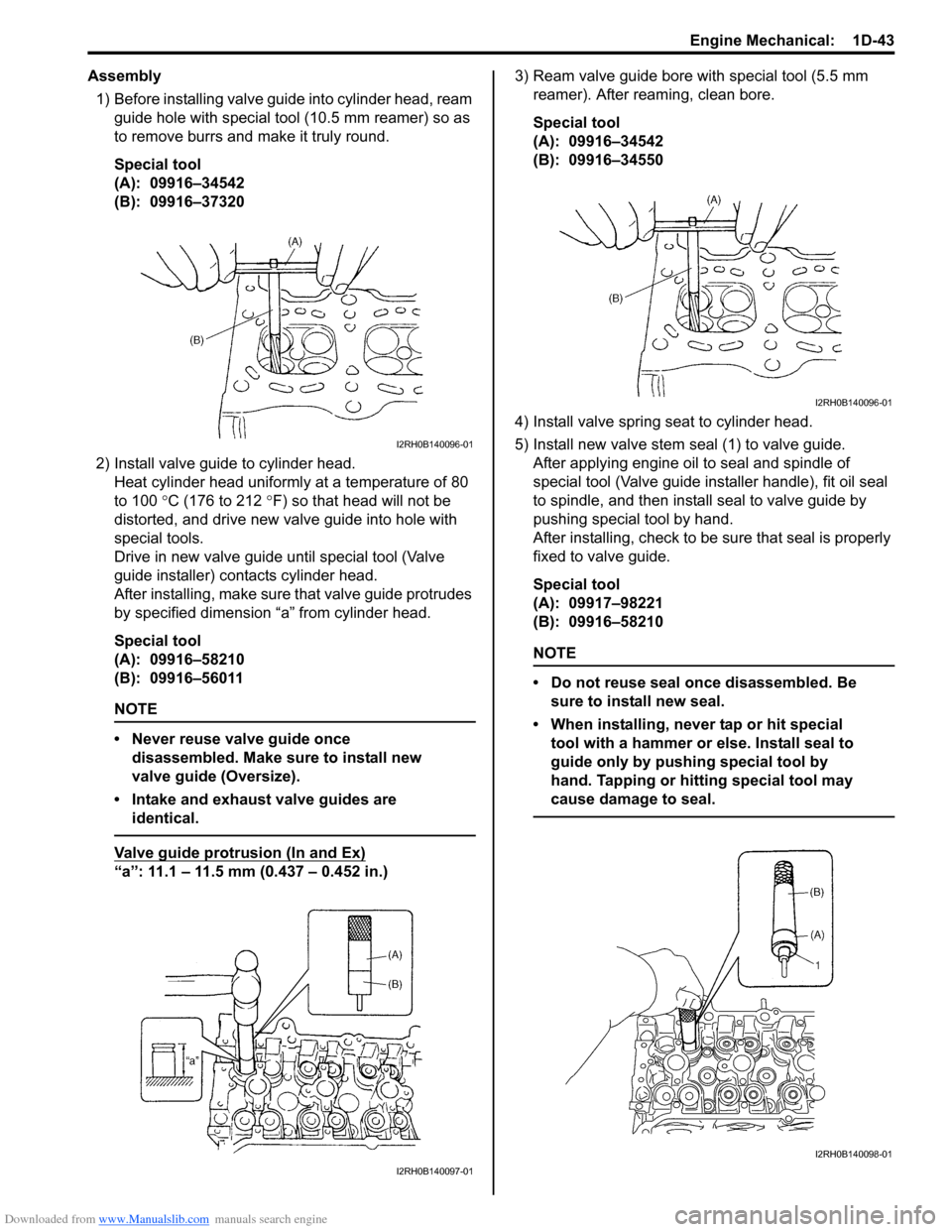
1) Before installing valve guide into cylinder head, ream
guide hole with special tool (10.5 mm reamer) so as
to remove burrs and make it truly round.
Special tool
(A): 09916–34542
(B): 09916–37320
2) Install valve guide to cylinder head.
Heat cylinder head uniformly at a temperature of 80
to 100 °C (176 to 212 °F) so that head will not be
distorted, and drive new valve guide into hole with
special tools.
Drive in new valve guide until special tool (Valve
guide installer) contacts cylinder head.
After installing, make sure that valve guide protrudes
by specified dimension “a” from cylinder head.
Special tool
(A): 09916–58210
(B): 09916–56011
NOTE
• Never reuse valve guide once
disassembled. Make sure to install new
valve guide (Oversize).
• Intake and exhaust valve guides are
identical.
Valve guide protrusion (In and Ex)
“a”: 11.1 – 11.5 mm (0.437 – 0.452 in.)3) Ream valve guide bore with special tool (5.5 mm
reamer). After reaming, clean bore.
Special tool
(A): 09916–34542
(B): 09916–34550
4) Install valve spring seat to cylinder head.
5) Install new valve stem seal (1) to valve guide.
After applying engine oil to seal and spindle of
special tool (Valve guide installer handle), fit oil seal
to spindle, and then install seal to valve guide by
pushing special tool by hand.
After installing, check to be sure that seal is properly
fixed to valve guide.
Special tool
(A): 09917–98221
(B): 09916–58210
NOTE
• Do not reuse seal once disassembled. Be
sure to install new seal.
• When installing, never tap or hit special
tool with a hammer or else. Install seal to
guide only by pushing special tool by
hand. Tapping or hitting special tool may
cause damage to seal.
I2RH0B140096-01
I2RH0B140097-01
I2RH0B140096-01
I2RH0B140098-01
Page 326 of 1556
Downloaded from www.Manualslib.com manuals search engine 1D-44 Engine Mechanical:
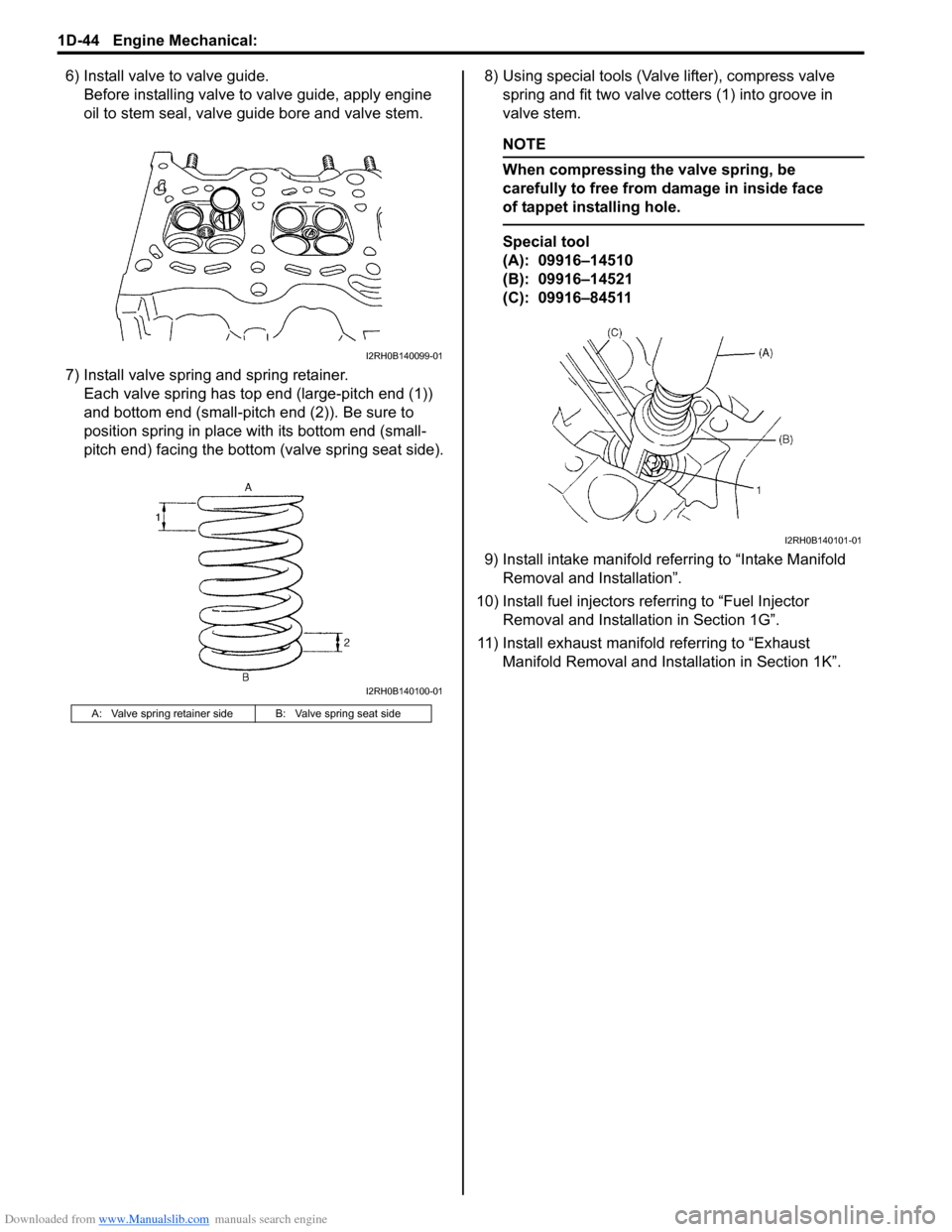
6) Install valve to valve guide.
Before installing valve to valve guide, apply engine
oil to stem seal, valve guide bore and valve stem.
7) Install valve spring and spring retainer.
Each valve spring has top end (large-pitch end (1))
and bottom end (small-pitch end (2)). Be sure to
position spring in place with its bottom end (small-
pitch end) facing the bottom (valve spring seat side).8) Using special tools (Valve lifter), compress valve
spring and fit two valve cotters (1) into groove in
valve stem.
NOTE
When compressing the valve spring, be
carefully to free from damage in inside face
of tappet installing hole.
Special tool
(A): 09916–14510
(B): 09916–14521
(C): 09916–84511
9) Install intake manifold referring to “Intake Manifold
Removal and Installation”.
10) Install fuel injectors referring to “Fuel Injector
Removal and Installation in Section 1G”.
11) Install exhaust manifold referring to “Exhaust
Manifold Removal and Installation in Section 1K”.
A: Valve spring retainer side B: Valve spring seat side
I2RH0B140099-01
I2RH0B140100-01
I2RH0B140101-01
Page 327 of 1556
Downloaded from www.Manualslib.com manuals search engine Engine Mechanical: 1D-45
Valves and Valve Guides InspectionS6RW0D1406028
Valve Guide
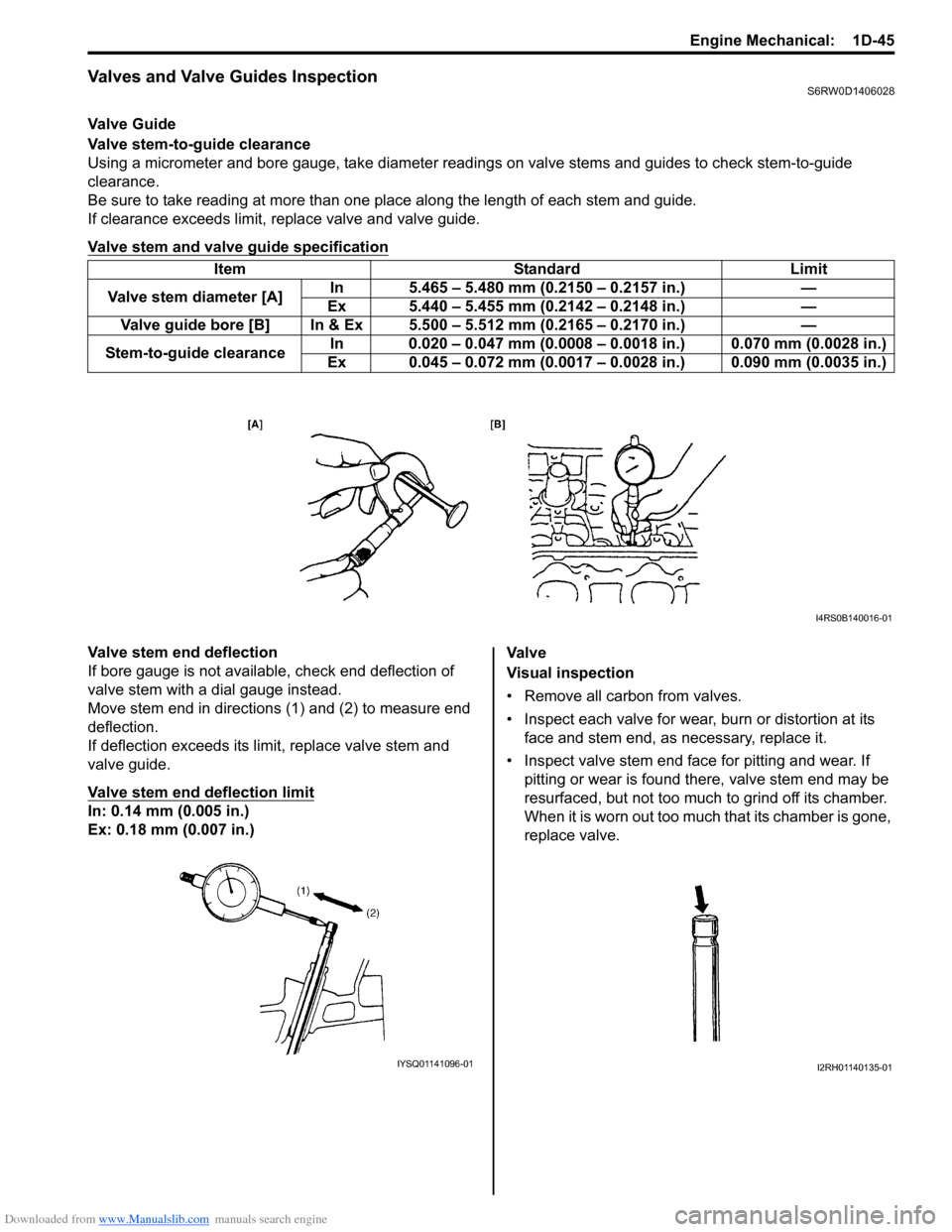
Valve stem-to-guide clearance
Using a micrometer and bore gauge, take diameter readings on valve stems and guides to check stem-to-guide
clearance.
Be sure to take reading at more than one place along the length of each stem and guide.
If clearance exceeds limit, replace valve and valve guide.
Valve stem and valve guide specification
Valve stem end deflection
If bore gauge is not available, check end deflection of
valve stem with a dial gauge instead.
Move stem end in directions (1) and (2) to measure end
deflection.
If deflection exceeds its limit, replace valve stem and
valve guide.
Valve stem end deflection limit
In: 0.14 mm (0.005 in.)
Ex: 0.18 mm (0.007 in.)Va l v e
Visual inspection
• Remove all carbon from valves.
• Inspect each valve for wear, burn or distortion at its
face and stem end, as necessary, replace it.
• Inspect valve stem end face for pitting and wear. If
pitting or wear is found there, valve stem end may be
resurfaced, but not too much to grind off its chamber.
When it is worn out too much that its chamber is gone,
replace valve. Item Standard Limit
Valve stem diameter [A]In 5.465 – 5.480 mm (0.2150 – 0.2157 in.) —
Ex 5.440 – 5.455 mm (0.2142 – 0.2148 in.) —
Valve guide bore [B] In & Ex 5.500 – 5.512 mm (0.2165 – 0.2170 in.) —
Stem-to-guide clearanceIn 0.020 – 0.047 mm (0.0008 – 0.0018 in.) 0.070 mm (0.0028 in.)
Ex 0.045 – 0.072 mm (0.0017 – 0.0028 in.) 0.090 mm (0.0035 in.)
I4RS0B140016-01
IYSQ01141096-01I2RH01140135-01
Page 328 of 1556
Downloaded from www.Manualslib.com manuals search engine 1D-46 Engine Mechanical:
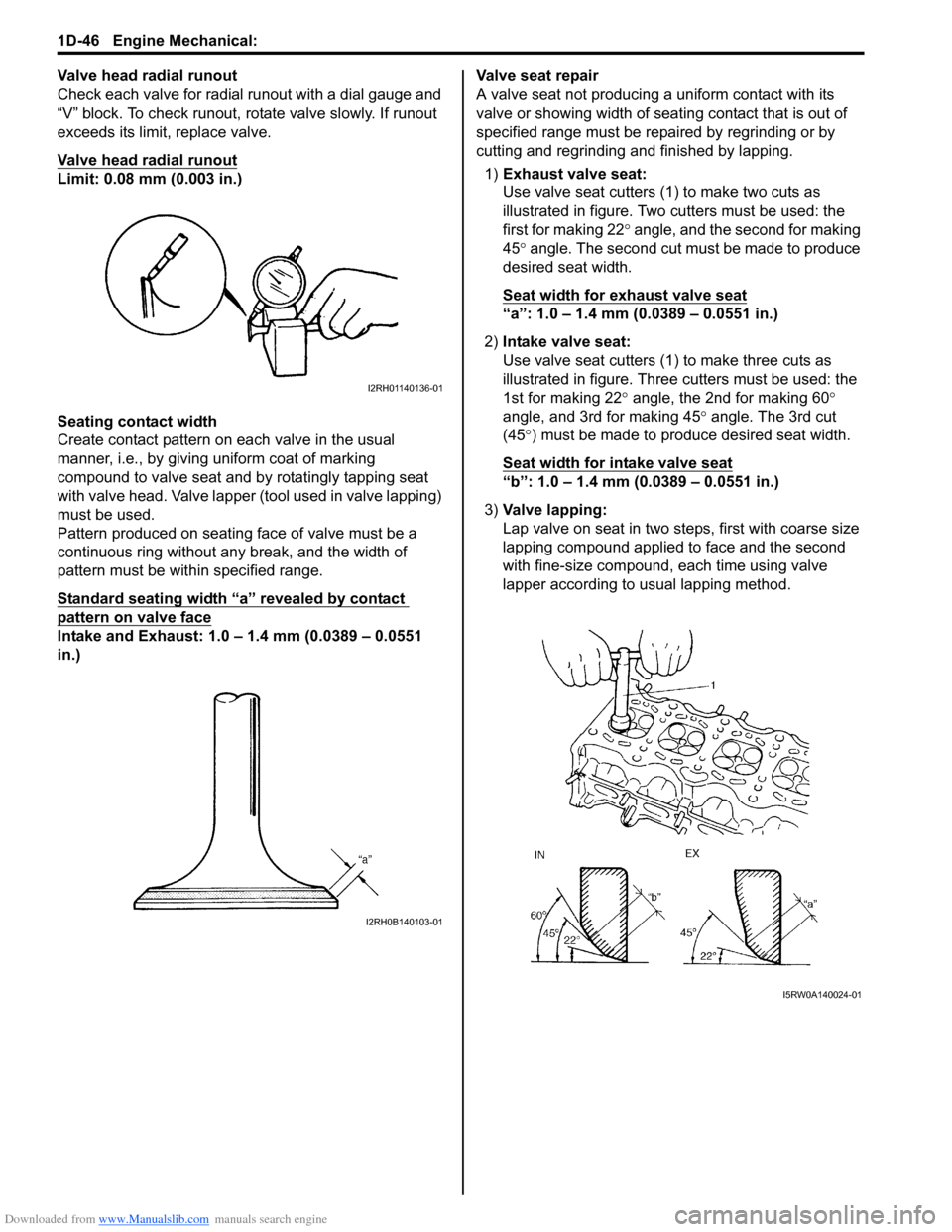
Valve head radial runout
Check each valve for radial runout with a dial gauge and
“V” block. To check runout, rotate valve slowly. If runout
exceeds its limit, replace valve.
Valve head radial runout
Limit: 0.08 mm (0.003 in.)
Seating contact width
Create contact pattern on each valve in the usual
manner, i.e., by giving uniform coat of marking
compound to valve seat and by rotatingly tapping seat
with valve head. Valve lapper (tool used in valve lapping)
must be used.
Pattern produced on seating face of valve must be a
continuous ring without any break, and the width of
pattern must be within specified range.
Standard seating width “a” revealed by contact
pattern on valve face
Intake and Exhaust: 1.0 – 1.4 mm (0.0389 – 0.0551
in.)Valve seat repair
A valve seat not producing a uniform contact with its
valve or showing width of seating contact that is out of
specified range must be repaired by regrinding or by
cutting and regrinding and finished by lapping.
1)Exhaust valve seat:
Use valve seat cutters (1) to make two cuts as
illustrated in figure. Two cutters must be used: the
first for making 22° angle, and the second for making
45° angle. The second cut must be made to produce
desired seat width.
Seat width for exhaust valve seat
“a”: 1.0 – 1.4 mm (0.0389 – 0.0551 in.)
2)Intake valve seat:
Use valve seat cutters (1) to make three cuts as
illustrated in figure. Three cutters must be used: the
1st for making 22° angle, the 2nd for making 60°
angle, and 3rd for making 45° angle. The 3rd cut
(45°) must be made to produce desired seat width.
Seat width for intake valve seat
“b”: 1.0 – 1.4 mm (0.0389 – 0.0551 in.)
3)Valve lapping:
Lap valve on seat in two steps, first with coarse size
lapping compound applied to face and the second
with fine-size compound, each time using valve
lapper according to usual lapping method.
I2RH01140136-01
I2RH0B140103-01
I5RW0A140024-01
Page 329 of 1556
Downloaded from www.Manualslib.com manuals search engine Engine Mechanical: 1D-47
Cylinder Head InspectionS6RW0D1406029
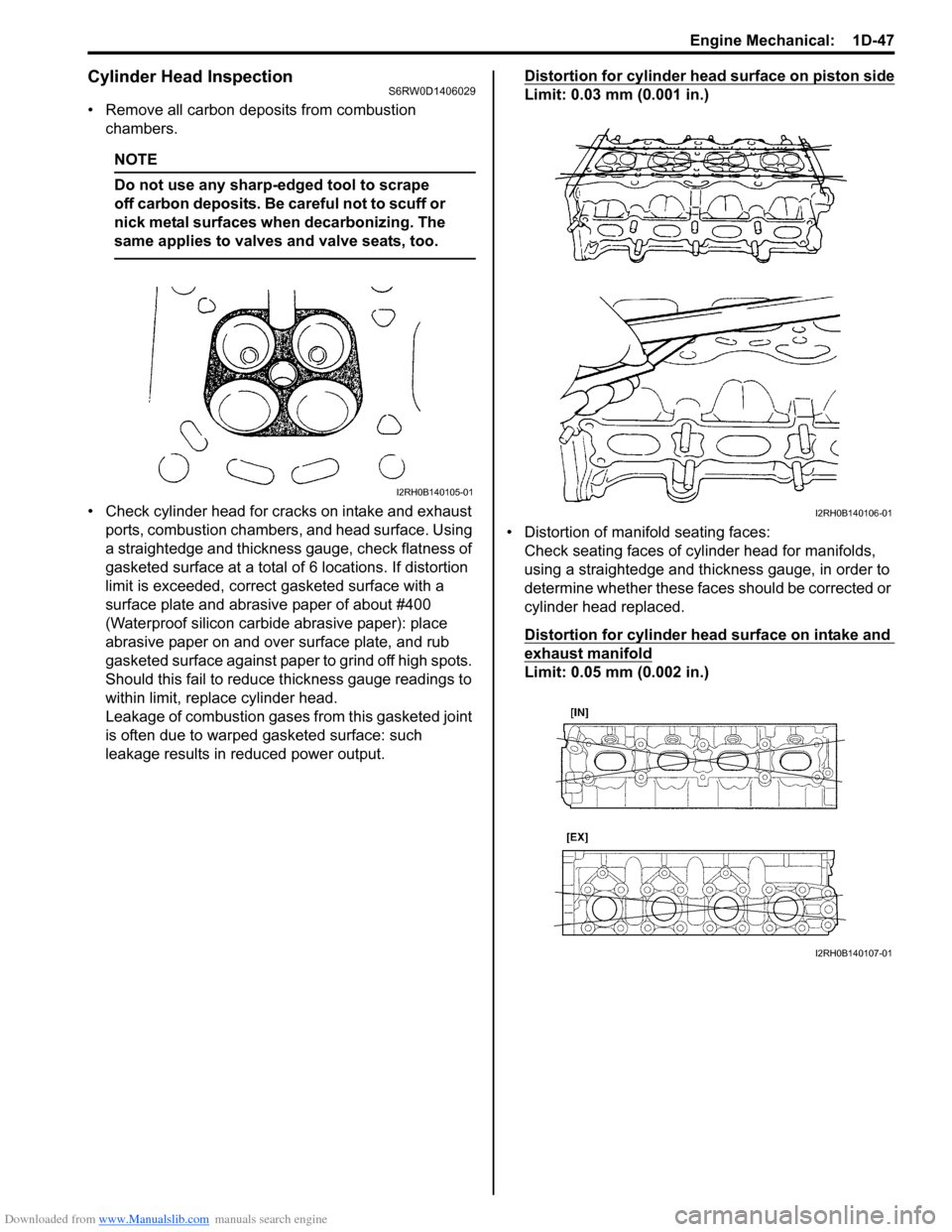
• Remove all carbon deposits from combustion
chambers.
NOTE
Do not use any sharp-edged tool to scrape
off carbon deposits. Be careful not to scuff or
nick metal surfaces when decarbonizing. The
same applies to valves and valve seats, too.
• Check cylinder head for cracks on intake and exhaust
ports, combustion chambers, and head surface. Using
a straightedge and thickness gauge, check flatness of
gasketed surface at a total of 6 locations. If distortion
limit is exceeded, correct gasketed surface with a
surface plate and abrasive paper of about #400
(Waterproof silicon carbide abrasive paper): place
abrasive paper on and over surface plate, and rub
gasketed surface against paper to grind off high spots.
Should this fail to reduce thickness gauge readings to
within limit, replace cylinder head.
Leakage of combustion gases from this gasketed joint
is often due to warped gasketed surface: such
leakage results in reduced power output.Distortion for cylinder head surface on piston side
Limit: 0.03 mm (0.001 in.)
• Distortion of manifold seating faces:
Check seating faces of cylinder head for manifolds,
using a straightedge and thickness gauge, in order to
determine whether these faces should be corrected or
cylinder head replaced.
Distortion for cylinder head surface on intake and
exhaust manifold
Limit: 0.05 mm (0.002 in.)
I2RH0B140105-01
I2RH0B140106-01
I2RH0B140107-01
Page 330 of 1556
Downloaded from www.Manualslib.com manuals search engine 1D-48 Engine Mechanical:
Valve Spring InspectionS6RW0D1406030
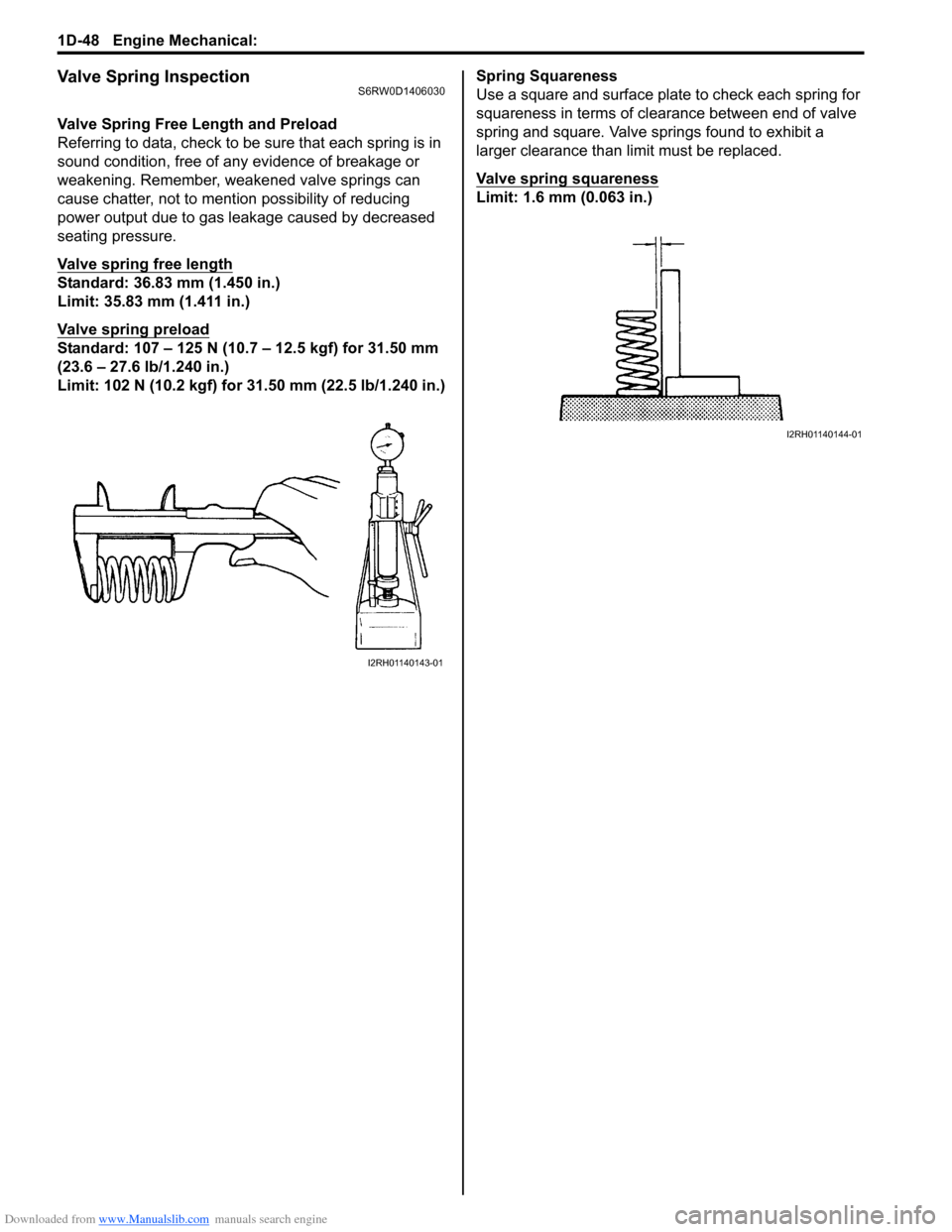
Valve Spring Free Length and Preload
Referring to data, check to be sure that each spring is in
sound condition, free of any evidence of breakage or
weakening. Remember, weakened valve springs can
cause chatter, not to mention possibility of reducing
power output due to gas leakage caused by decreased
seating pressure.
Valve spring free length
Standard: 36.83 mm (1.450 in.)
Limit: 35.83 mm (1.411 in.)
Valve spring preload
Standard: 107 – 125 N (10.7 – 12.5 kgf) for 31.50 mm
(23.6 – 27.6 lb/1.240 in.)
Limit: 102 N (10.2 kgf) for 31.50 mm (22.5 lb/1.240 in.)Spring Squareness
Use a square and surface plate to check each spring for
squareness in terms of clearance between end of valve
spring and square. Valve springs found to exhibit a
larger clearance than limit must be replaced.
Valve spring squareness
Limit: 1.6 mm (0.063 in.)
I2RH01140143-01
I2RH01140144-01
Page 331 of 1556
Downloaded from www.Manualslib.com manuals search engine Engine Mechanical: 1D-49
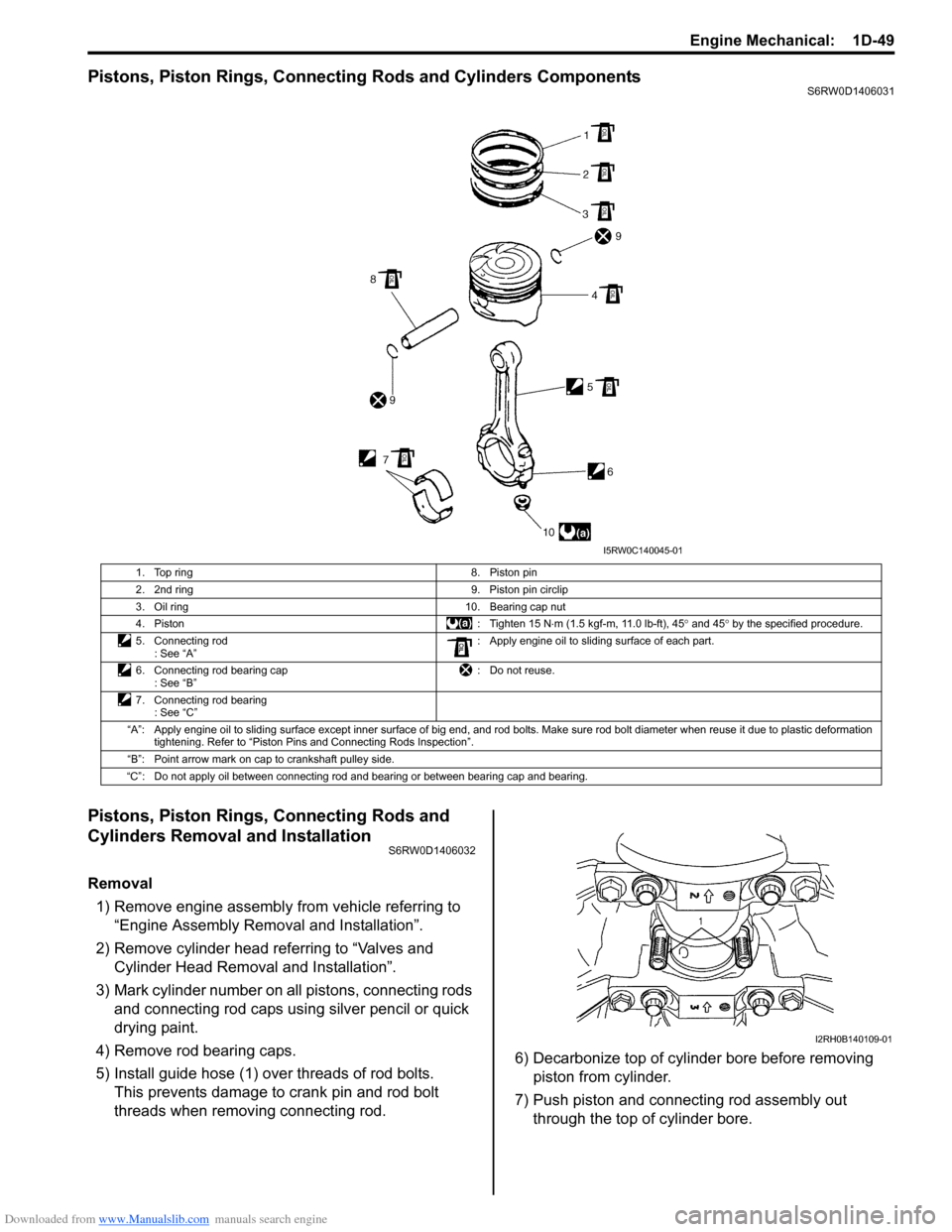
Pistons, Piston Rings, Connecting Rods and Cylinders ComponentsS6RW0D1406031
Pistons, Piston Rings, Connecting Rods and
Cylinders Removal and Installation
S6RW0D1406032
Removal
1) Remove engine assembly from vehicle referring to
“Engine Assembly Removal and Installation”.
2) Remove cylinder head referring to “Valves and
Cylinder Head Removal and Installation”.
3) Mark cylinder number on all pistons, connecting rods
and connecting rod caps using silver pencil or quick
drying paint.
4) Remove rod bearing caps.
5) Install guide hose (1) over threads of rod bolts.
This prevents damage to crank pin and rod bolt
threads when removing connecting rod.6) Decarbonize top of cylinder bore before removing
piston from cylinder.
7) Push piston and connecting rod assembly out
through the top of cylinder bore.
1. Top ring 8. Piston pin
2. 2nd ring 9. Piston pin circlip
3. Oil ring 10. Bearing cap nut
4. Piston : Tighten 15 N⋅m (1.5 kgf-m, 11.0 lb-ft), 45° and 45° by the specified procedure.
5. Connecting rod
: See “A”: Apply engine oil to sliding surface of each part.
6. Connecting rod bearing cap
: See “B”: Do not reuse.
7. Connecting rod bearing
: See “C”
“A”: Apply engine oil to sliding surface except inner surface of big end, and rod bolts. Make sure rod bolt diameter when reuse it due to plastic deformation
tightening. Refer to “Piston Pins and Connecting Rods Inspection”.
“B”: Point arrow mark on cap to crankshaft pulley side.
“C”: Do not apply oil between connecting rod and bearing or between bearing cap and bearing.
I5RW0C140045-01
I2RH0B140109-01
Page 332 of 1556
Downloaded from www.Manualslib.com manuals search engine 1D-50 Engine Mechanical:
Installation
1) Apply engine oil to pistons, rings, cylinder walls,
connecting rod bearings and crank pins.
NOTE
Do not apply oil between connecting rod and
bearing or between bearing cap and bearing.
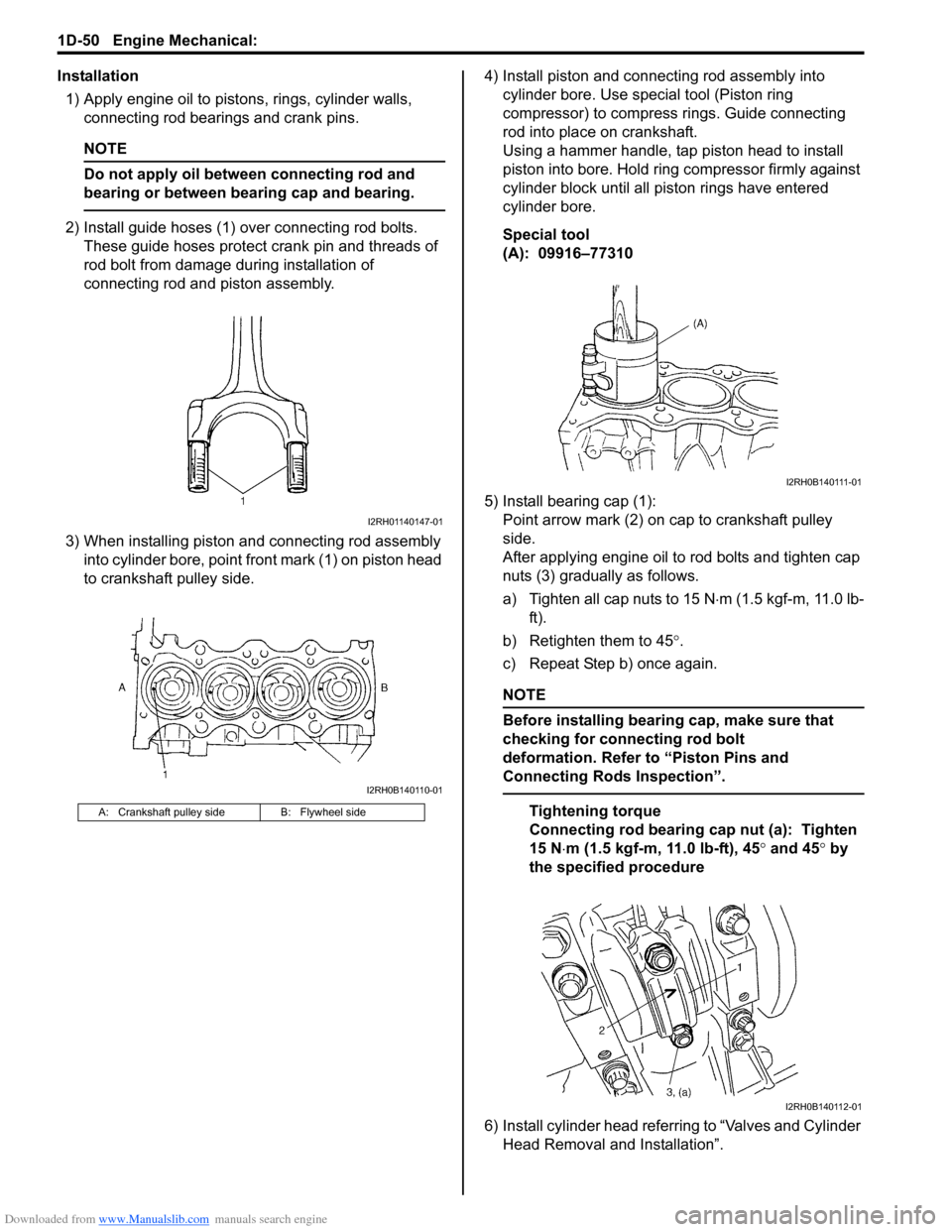
2) Install guide hoses (1) over connecting rod bolts.
These guide hoses protect crank pin and threads of
rod bolt from damage during installation of
connecting rod and piston assembly.
3) When installing piston and connecting rod assembly
into cylinder bore, point front mark (1) on piston head
to crankshaft pulley side.4) Install piston and connecting rod assembly into
cylinder bore. Use special tool (Piston ring
compressor) to compress rings. Guide connecting
rod into place on crankshaft.
Using a hammer handle, tap piston head to install
piston into bore. Hold ring compressor firmly against
cylinder block until all piston rings have entered
cylinder bore.
Special tool
(A): 09916–77310
5) Install bearing cap (1):
Point arrow mark (2) on cap to crankshaft pulley
side.
After applying engine oil to rod bolts and tighten cap
nuts (3) gradually as follows.
a) Tighten all cap nuts to 15 N⋅m (1.5 kgf-m, 11.0 lb-
ft).
b) Retighten them to 45°.
c) Repeat Step b) once again.
NOTE
Before installing bearing cap, make sure that
checking for connecting rod bolt
deformation. Refer to “Piston Pins and
Connecting Rods Inspection”.
Tightening torque
Connecting rod bearing cap nut (a): Tighten
15 N⋅m (1.5 kgf-m, 11.0 lb-ft), 45° and 45° by
the specified procedure
6) Install cylinder head referring to “Valves and Cylinder
Head Removal and Installation”.A: Crankshaft pulley side B: Flywheel side
I2RH01140147-01
I2RH0B140110-01
I2RH0B140111-01
I2RH0B140112-01
Page 345 of 1556
Downloaded from www.Manualslib.com manuals search engine Engine Mechanical: 1D-63
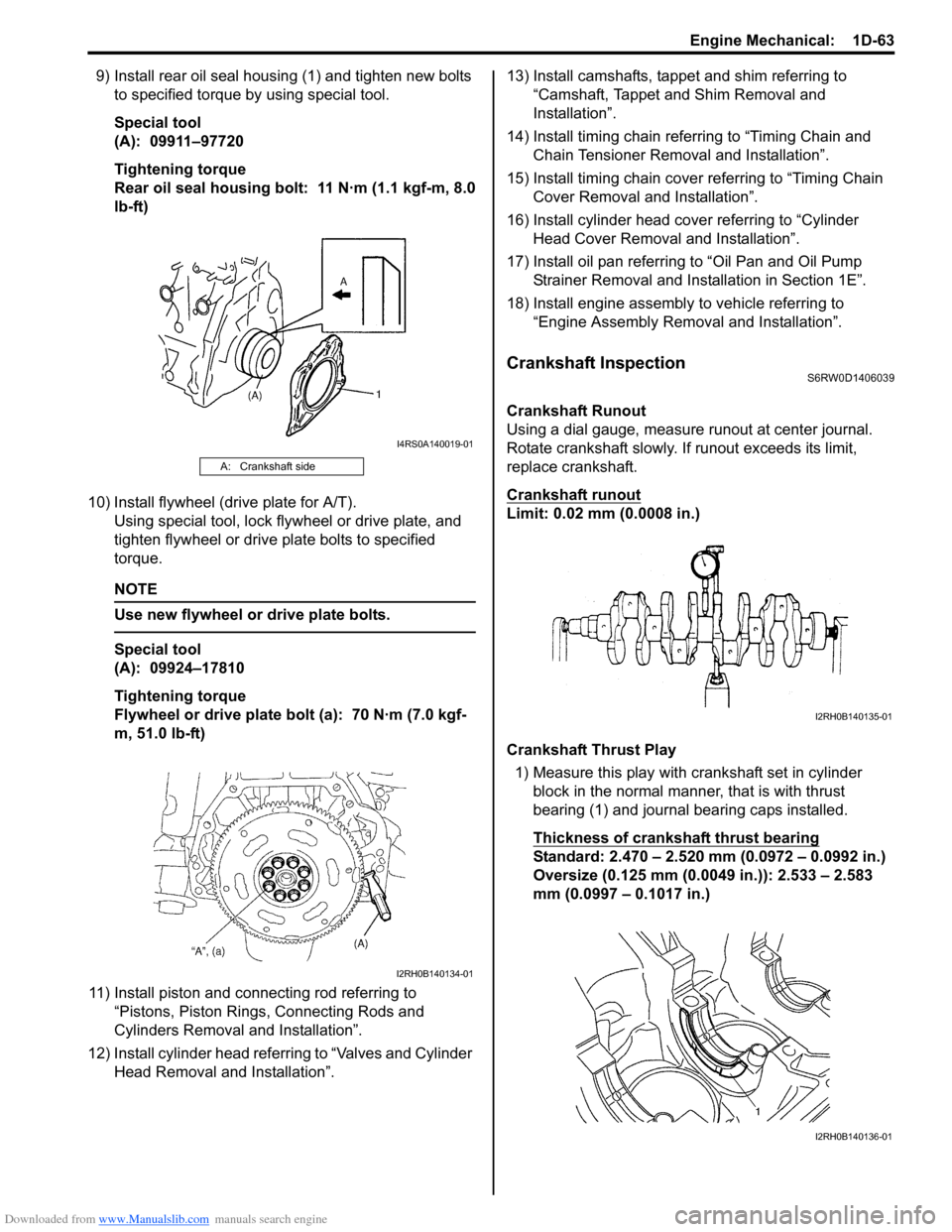
9) Install rear oil seal housing (1) and tighten new bolts
to specified torque by using special tool.
Special tool
(A): 09911–97720
Tightening torque
Rear oil seal housing bolt: 11 N·m (1.1 kgf-m, 8.0
lb-ft)
10) Install flywheel (drive plate for A/T).
Using special tool, lock flywheel or drive plate, and
tighten flywheel or drive plate bolts to specified
torque.
NOTE
Use new flywheel or drive plate bolts.
Special tool
(A): 09924–17810
Tightening torque
Flywheel or drive plate bolt (a): 70 N·m (7.0 kgf-
m, 51.0 lb-ft)
11) Install piston and connecting rod referring to
“Pistons, Piston Rings, Connecting Rods and
Cylinders Removal and Installation”.
12) Install cylinder head referring to “Valves and Cylinder
Head Removal and Installation”.13) Install camshafts, tappet and shim referring to
“Camshaft, Tappet and Shim Removal and
Installation”.
14) Install timing chain referring to “Timing Chain and
Chain Tensioner Removal and Installation”.
15) Install timing chain cover referring to “Timing Chain
Cover Removal and Installation”.
16) Install cylinder head cover referring to “Cylinder
Head Cover Removal and Installation”.
17) Install oil pan referring to “Oil Pan and Oil Pump
Strainer Removal and Installation in Section 1E”.
18) Install engine assembly to vehicle referring to
“Engine Assembly Removal and Installation”.
Crankshaft InspectionS6RW0D1406039
Crankshaft Runout
Using a dial gauge, measure runout at center journal.
Rotate crankshaft slowly. If runout exceeds its limit,
replace crankshaft.
Crankshaft runout
Limit: 0.02 mm (0.0008 in.)
Crankshaft Thrust Play
1) Measure this play with crankshaft set in cylinder
block in the normal manner, that is with thrust
bearing (1) and journal bearing caps installed.
Thickness of crankshaft thrust bearing
Standard: 2.470 – 2.520 mm (0.0972 – 0.0992 in.)
Oversize (0.125 mm (0.0049 in.)): 2.533 – 2.583
mm (0.0997 – 0.1017 in.)
A: Crankshaft side
I4RS0A140019-01
I2RH0B140134-01
I2RH0B140135-01
I2RH0B140136-01
Page 353 of 1556
Downloaded from www.Manualslib.com manuals search engine Engine Mechanical: 1D-71
Honing or Reboring Cylinders
1) When any cylinder needs reboring, all other
cylinders must also be rebored at the same time.
2) Select oversized piston according to amount of
cylinder wear.
Oversize piston specification
Oversize 0.50: 78.453 – 78.468 mm (3.0887 –
3.0893 in.)
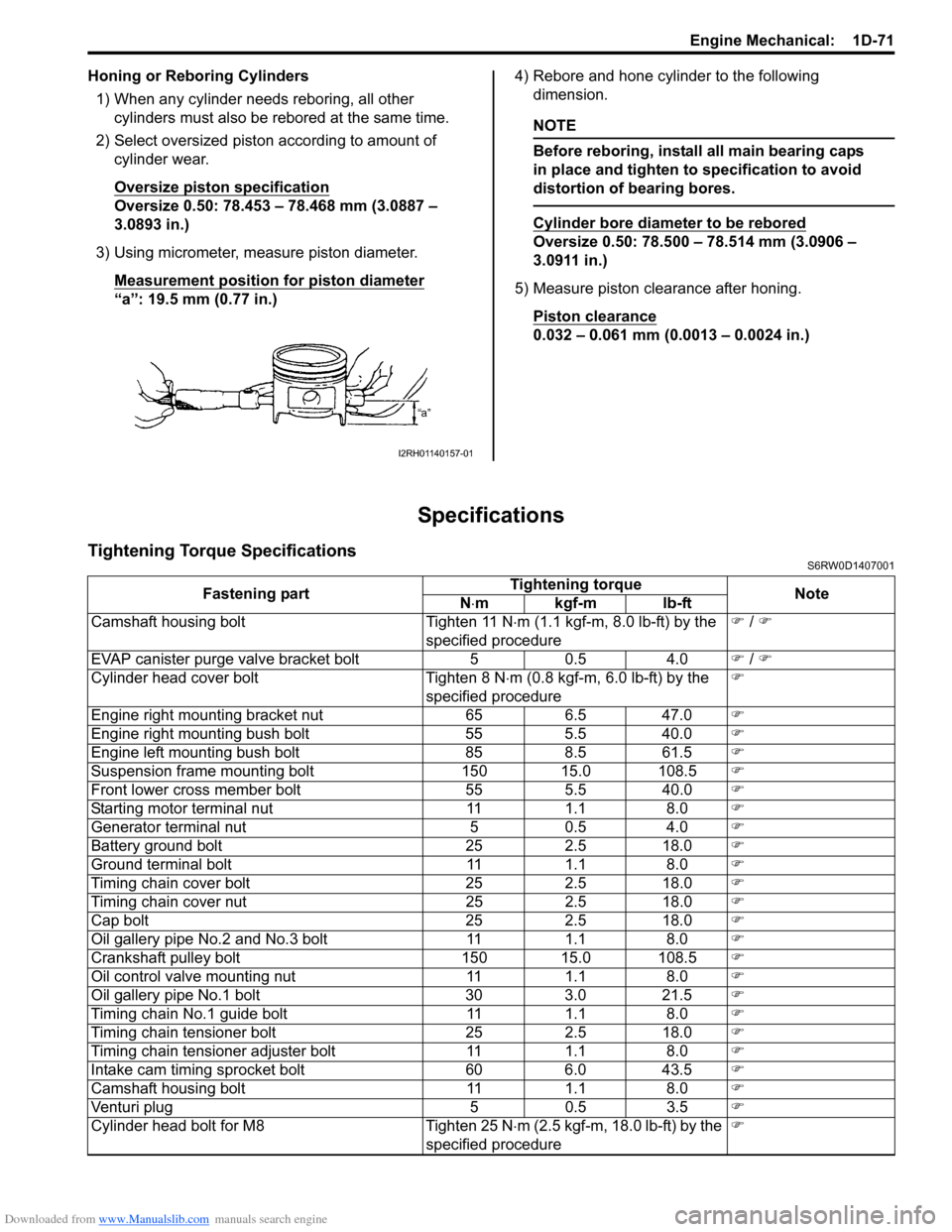
3) Using micrometer, measure piston diameter.
Measurement position for piston diameter
“a”: 19.5 mm (0.77 in.)4) Rebore and hone cylinder to the following
dimension.
NOTE
Before reboring, install all main bearing caps
in place and tighten to specification to avoid
distortion of bearing bores.
Cylinder bore diameter to be rebored
Oversize 0.50: 78.500 – 78.514 mm (3.0906 –
3.0911 in.)
5) Measure piston clearance after honing.
Piston clearance
0.032 – 0.061 mm (0.0013 – 0.0024 in.)
Specifications
Tightening Torque SpecificationsS6RW0D1407001
I2RH01140157-01
Fastening partTightening torque
Note
N⋅mkgf-mlb-ft
Camshaft housing bolt Tighten 11 N⋅m (1.1 kgf-m, 8.0 lb-ft) by the
specified procedure) / )
EVAP canister purge valve bracket bolt 5 0.5 4.0) / )
Cylinder head cover bolt Tighten 8 N⋅m (0.8 kgf-m, 6.0 lb-ft) by the
specified procedure)
Engine right mounting bracket nut 65 6.5 47.0)
Engine right mounting bush bolt 55 5.5 40.0)
Engine left mounting bush bolt 85 8.5 61.5)
Suspension frame mounting bolt 150 15.0 108.5)
Front lower cross member bolt 55 5.5 40.0)
Starting motor terminal nut 11 1.1 8.0)
Generator terminal nut 5 0.5 4.0)
Battery ground bolt 25 2.5 18.0)
Ground terminal bolt 11 1.1 8.0)
Timing chain cover bolt 25 2.5 18.0)
Timing chain cover nut 25 2.5 18.0)
Cap bolt 25 2.5 18.0)
Oil gallery pipe No.2 and No.3 bolt 11 1.1 8.0)
Crankshaft pulley bolt 150 15.0 108.5)
Oil control valve mounting nut 11 1.1 8.0)
Oil gallery pipe No.1 bolt 30 3.0 21.5)
Timing chain No.1 guide bolt 11 1.1 8.0)
Timing chain tensioner bolt 25 2.5 18.0)
Timing chain tensioner adjuster bolt 11 1.1 8.0)
Intake cam timing sprocket bolt 60 6.0 43.5)
Camshaft housing bolt 11 1.1 8.0)
Venturi plug 5 0.5 3.5)
Cylinder head bolt for M8 Tighten 25 N⋅m (2.5 kgf-m, 18.0 lb-ft) by the
specified procedure)