Valve SUZUKI SX4 2006 1.G Service Repair Manual
[x] Cancel search | Manufacturer: SUZUKI, Model Year: 2006, Model line: SX4, Model: SUZUKI SX4 2006 1.GPages: 1556, PDF Size: 37.31 MB
Page 226 of 1556

Downloaded from www.Manualslib.com manuals search engine 1A-176 Engine General Information and Diagnosis:
C01-34 — — — — —
C01-35 — — — — —
C01-36 — — — — —
C01-37 — — — — —
C01-38 — — — — —
C01-39 — — — — —
C01-40 WHTThrottle position
sensor (sub) signal1.57 – 1.90 VIgnition switch turned ON
and accelerator pedal at
idle position after warmed
up engine.
—
3.88 – 4.45 V
(“Reference
waveform No.29: ”)Ignition switch turned ON
and accelerator pedal at
full depressed position
after warmed up engine.
C01-41 GRYGround for shield
wire of TP sensor
circuitBelow 0.3 V Ignition switch turned ON. —
C01-42 BLKGround for throttle
position sensorBelow 0.3 V Ignition switch turned ON. —
C01-43 REDOutput for 5 V
power source of
throttle position
sensor4.5 – 5.5 V Ignition switch turned ON. —
C01-44 YELOutput of throttle
actuator0 – 1 VIgnition switch turned ON
and accelerator pedal at
idle position after warmed
up engine. Output signal is pulse.
Duty ratio varies
depending on throttle
valve and accelerator
pedal position. *0 – 1 V
↑↓
10 – 14 V
(“Reference
waveform No.26: ”
and “Reference
waveform No.27: ”)Ignition switch turned ON
and accelerator pedal at
full depressed position
after warmed up engine.
C01-45 BLUOutput of throttle
actuator0 – 1 VIgnition switch turned ON
and accelerator pedal at
full depressed position
after warmed up engine. Output signal is pulse.
Duty ratio varies
depending on throttle
valve and accelerator
pedal position. *0 – 1 V
↑↓
10 – 14 V
(“Reference
waveform No.26: ”
and “Reference
waveform No.27: ”)Ignition switch turned ON
and accelerator pedal at
idle position after warmed
up engine.
C01-46BLK/
REDHeater output of
heated oxygen
sensor-110 – 14 V Ignition switch turned ON. —
*0 – 2 V
↑↓
10 – 14 V
(“Reference
waveform No.8: ” and
“Reference waveform
No.9: ”)Engine running at idle
after warmed up engine.Output signal is active low
duty pulse. Duty ratio
varies depending on
engine condition.
C01-47RED/
BLUHeater output of
heated oxygen
sensor-2 (if
equipped)10 – 14 V Ignition switch turned ON.
— 0 – 1 V
(“Reference
waveform No.10: ”)Engine running at idle
after vehicle running over
30 km/h, 19 mph for 5 min. Terminal
No.Wire
colorCircuit Normal voltage Condition Remarks
Page 227 of 1556
Downloaded from www.Manualslib.com manuals search engine Engine General Information and Diagnosis: 1A-177
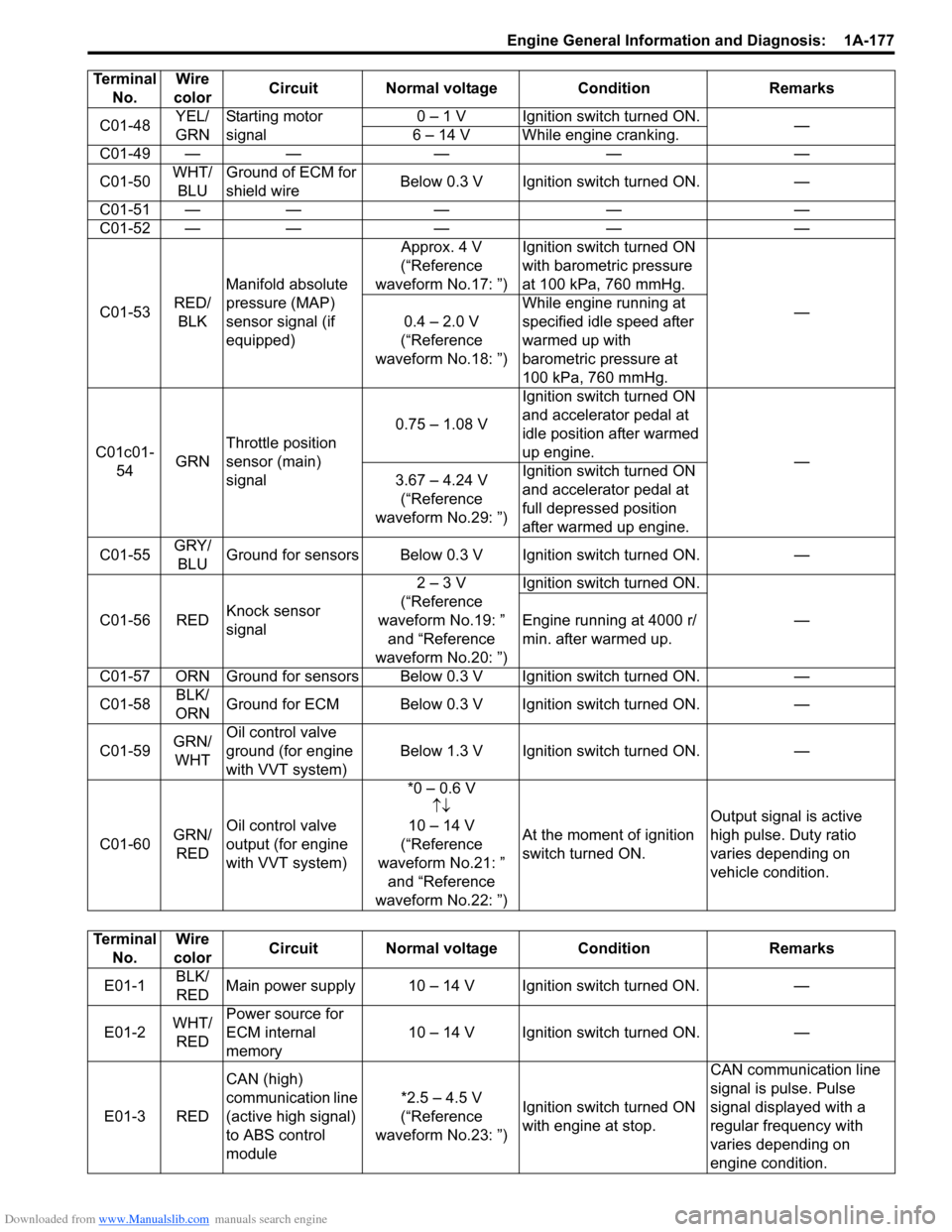
C01-48YEL/
GRNStarting motor
signal0 – 1 V Ignition switch turned ON.
—
6 – 14 V While engine cranking.
C01-49 — — — — —
C01-50WHT/
BLUGround of ECM for
shield wireBelow 0.3 V Ignition switch turned ON. —
C01-51 — — — — —
C01-52 — — — — —
C01-53RED/
BLKManifold absolute
pressure (MAP)
sensor signal (if
equipped)Approx. 4 V
(“Reference
waveform No.17: ”)Ignition switch turned ON
with barometric pressure
at 100 kPa, 760 mmHg.
—
0.4 – 2.0 V
(“Reference
waveform No.18: ”)While engine running at
specified idle speed after
warmed up with
barometric pressure at
100 kPa, 760 mmHg.
C01c01-
54GRNThrottle position
sensor (main)
signal0.75 – 1.08 VIgnition switch turned ON
and accelerator pedal at
idle position after warmed
up engine.
—
3.67 – 4.24 V
(“Reference
waveform No.29: ”)Ignition switch turned ON
and accelerator pedal at
full depressed position
after warmed up engine.
C01-55GRY/
BLUGround for sensors Below 0.3 V Ignition switch turned ON. —
C01-56 REDKnock sensor
signal2 – 3 V
(“Reference
waveform No.19: ”
and “Reference
waveform No.20: ”)Ignition switch turned ON.
— Engine running at 4000 r/
min. after warmed up.
C01-57 ORN Ground for sensors Below 0.3 V Ignition switch turned ON. —
C01-58BLK/
ORNGround for ECM Below 0.3 V Ignition switch turned ON. —
C01-59GRN/
WHTOil control valve
ground (for engine
with VVT system)Below 1.3 V Ignition switch turned ON. —
C01-60GRN/
REDOil control valve
output (for engine
with VVT system)*0 – 0.6 V
↑↓
10 – 14 V
(“Reference
waveform No.21: ”
and “Reference
waveform No.22: ”)At the moment of ignition
switch turned ON.Output signal is active
high pulse. Duty ratio
varies depending on
vehicle condition. Terminal
No.Wire
colorCircuit Normal voltage Condition Remarks
Terminal
No.Wire
colorCircuit Normal voltage Condition Remarks
E01-1BLK/
REDMain power supply 10 – 14 V Ignition switch turned ON. —
E01-2WHT/
REDPower source for
ECM internal
memory10 – 14 V Ignition switch turned ON. —
E01-3 REDCAN (high)
communication line
(active high signal)
to ABS control
module*2.5 – 4.5 V
(“Reference
waveform No.23: ”)Ignition switch turned ON
with engine at stop.CAN communication line
signal is pulse. Pulse
signal displayed with a
regular frequency with
varies depending on
engine condition.
Page 232 of 1556

Downloaded from www.Manualslib.com manuals search engine 1A-182 Engine General Information and Diagnosis:
Reference waveform No.3
No.2 fuel injector signal (2) with engine idlingReference waveform No.4
EGR valve signal
Measurement
terminalCH1: “C01-20” to “C01-58”
CH2: “C01-2” to “C01-58”
Oscilloscope
settingCH1: 5 V/DIV, CH2: 20 V/DIV
TIME: 40 ms/DIV
Measurement
condition• After warmed up to normal
operating temperature
• Engine at specified idle speed
[A]: For VVT model
[B]: For non-VVT model
1. Cylinder reference signal (CMP reference signal)
3. 720° crank angle
I4RS0B110052-01
Measurement
terminalCH1: “C01-4” to “C01-58”
CH2: “C01-3” to “C01-58”
CH3: “C01-19” to “C01-58”
CH4: “C01-18” to “C01-58”
Oscilloscope
settingCH1: 20 V/DIV, CH2: 20 V/DIV
CH3: 20 V/DIV, CH4: 20 V/DIV
TIME: 40 ms/DIV
Measurement
conditionEngine at cranking
1. EGR valve stepper motor coil 1 signal
2. EGR valve stepper motor coil 2 signal
3. EGR valve stepper motor coil 3 signal
4. EGR valve stepper motor coil 4 signal
5. ON signal
6. OFF signal
I4RS0B110053-01
Page 237 of 1556
Downloaded from www.Manualslib.com manuals search engine Engine General Information and Diagnosis: 1A-187
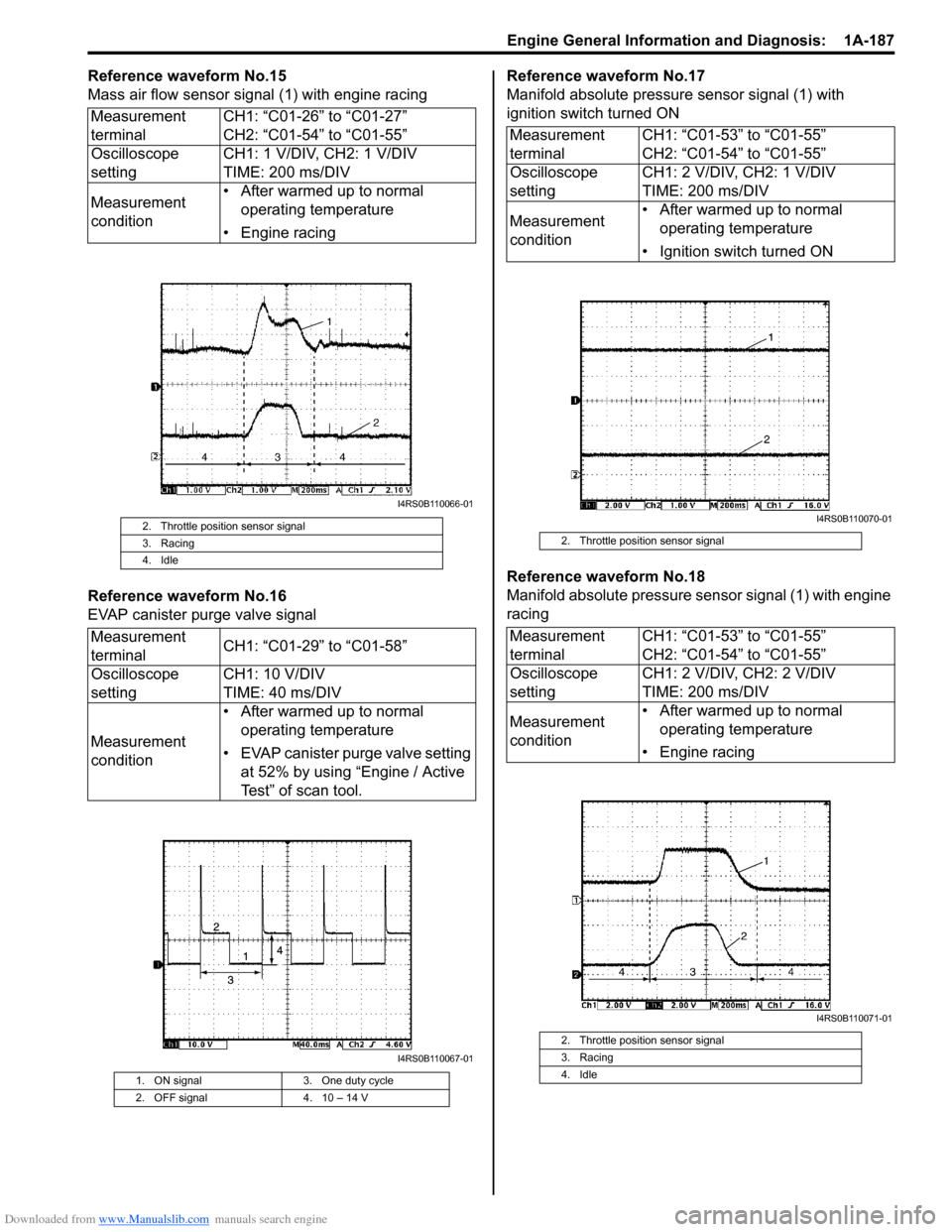
Reference waveform No.15
Mass air flow sensor signal (1) with engine racing
Reference waveform No.16
EVAP canister purge valve signalReference waveform No.17
Manifold absolute pressure sensor signal (1) with
ignition switch turned ON
Reference waveform No.18
Manifold absolute pressure sensor signal (1) with engine
racing Measurement
terminalCH1: “C01-26” to “C01-27”
CH2: “C01-54” to “C01-55”
Oscilloscope
settingCH1: 1 V/DIV, CH2: 1 V/DIV
TIME: 200 ms/DIV
Measurement
condition• After warmed up to normal
operating temperature
• Engine racing
2. Throttle position sensor signal
3. Racing
4. Idle
Measurement
terminalCH1: “C01-29” to “C01-58”
Oscilloscope
settingCH1: 10 V/DIV
TIME: 40 ms/DIV
Measurement
condition• After warmed up to normal
operating temperature
• EVAP canister purge valve setting
at 52% by using “Engine / Active
Test” of scan tool.
1. ON signal 3. One duty cycle
2. OFF signal 4. 10 – 14 V
I4RS0B110066-01
I4RS0B110067-01
Measurement
terminalCH1: “C01-53” to “C01-55”
CH2: “C01-54” to “C01-55”
Oscilloscope
settingCH1: 2 V/DIV, CH2: 1 V/DIV
TIME: 200 ms/DIV
Measurement
condition• After warmed up to normal
operating temperature
• Ignition switch turned ON
2. Throttle position sensor signal
Measurement
terminalCH1: “C01-53” to “C01-55”
CH2: “C01-54” to “C01-55”
Oscilloscope
settingCH1: 2 V/DIV, CH2: 2 V/DIV
TIME: 200 ms/DIV
Measurement
condition• After warmed up to normal
operating temperature
• Engine racing
2. Throttle position sensor signal
3. Racing
4. Idle
I4RS0B110070-01
I4RS0B110071-01
Page 238 of 1556

Downloaded from www.Manualslib.com manuals search engine 1A-188 Engine General Information and Diagnosis:
Reference waveform No.19
Knock sensor signal at engine speed 4000 r/min.
Reference waveform No.20
Knock sensor signal at engine speed 4000 r/min.Reference waveform No.21
Oil control valve signal with engine idling (for engine with
VVT system)
Reference waveform No.22
Oil control valve signal with engine racing (for engine
with VVT system) Measurement
terminalCH1: “C01-56” to “C01-58”
Oscilloscope
settingCH1: 1 V/DIV
TIME: 10 ms/DIV
Measurement
condition• After warmed up to normal
operating temperature
• Engine running at 4000 r/min.
Measurement
terminalCH1: “C01-56” to “C01-58”
Oscilloscope
settingCH1: 1 V/DIV
TIME: 200 µs/DIV
Measurement
condition• After warmed up to normal
operating temperature
• Engine running at 4000 r/min.
I4RS0B110072-01
I4RS0B110073-01
Measurement
terminalCH1: “C01-60” to “C01-59”
Oscilloscope
settingCH1: 5 V/DIV
TIME: 2 ms/DIV
Measurement
conditionAt the moment of the ignition switch
turned on
1. ON signal 3. Only duty cycle
2. OFF signal
Measurement
terminalCH1: “C01-60” to “C01-59”
Oscilloscope
settingCH1: 5 V/DIV
TIME: 400 µs/DIV
Measurement
condition• After warmed up to normal
operating temperature
• Vehicle running at 20 km/h (12
mph) and depress accelerator
pedal fully
1. Accelerator pedal depressed fully 4. ON signal
2. Accelerator pedal depressed partially 5. OFF signal
3. Oil control valve signal
I4RS0B110074-01
I4RS0B110075-01
Page 242 of 1556

Downloaded from www.Manualslib.com manuals search engine 1A-192 Engine General Information and Diagnosis:
Resistance Check
1) Remove ECM from its bracket referring to “Engine Control Module (ECM) Removal and Installation in Section 1C”.
CAUTION!
Never touch terminals of ECM itself or connect voltmeter or ohmmeter (2).
2) Connect special tool to ECM connectors (1) securely.
NOTE
Do not connect the other connector of special tool to ECM.
Special tool
(A): 09933–06320
3) Check resistance between each pair of terminals of special tool connectors (1) as listed in the following table.
CAUTION!
• Be sure to connect ohmmeter probe from wire harness side of coupler.
• Be sure to turn OFF ignition switch for this check.
• Resistance in the following table represents that measured when parts temperature is 20 °C (68 °F).
1
(A)
2
3
I7RW01110032-02
Terminals Circuit Standard resistance Condition
C01-47 to E01-29 Heater of HO2S-2 4 – 15 Ω—
E01-46 to E01-1/16 Radiator cooling fan relay No.1 160 – 240 Ω—
E01-60 to E01-29 Main relay 160 – 240 ΩBattery disconnected and
ignition switch turned ON
E01-15 to E01-29 Fuel pump relay 160 – 240 Ω—
C01-16 to E01-1/16No.3 fuel injector
10.8 – 18.2 Ω—
C01-17 to E01-1/16No.4 fuel injector
C01-4 to E01-1/16EGR valve (stepping motor No.1 coil) (if
equipped)20 – 31 Ω—
C01-29 to E01-1/16 EVAP canister purge valve 28 – 35 Ω—
C01-2 to E01-1/16 No.2 fuel injector 10.8 – 18.2 Ω—
C01-3 to E01-1/16EGR valve (stepping motor No.2 coil) (if
equipped)
20 – 31 Ω— C01-18 to E01-1/16EGR valve (stepping motor No.4 coil) (if
equipped)
C01-19 to E01-1/16EGR valve (stepping motor No.3 coil) (if
equipped)
C01-46 to E01-29 Heater of HO2S-1 2 – 11 Ω—
C01-1 to E01-1/16 No.1 fuel injector 10.8 – 18.2 Ω—
E01-29 to E01-47 A/C compressor relay (if equipped with A/C) 160 – 240 Ω—
E01-58 to E01-1/16A/C condenser cooling fan relay
(if equipped with A/C)160 – 240 Ω—
C01-60 to C01-59 Oil control valve (for engine with VVT system) 6 – 15 Ω—
E01-45 to E01-1/16 Throttle actuator control relay 160 – 240 Ω—
Page 262 of 1556
Downloaded from www.Manualslib.com manuals search engine 1A-212 Engine General Information and Diagnosis:
Repair Instructions
Idle Speed and IAC Throttle Valve Opening
Inspection
S6RW0D1106001
Before idle speed check, make sure of the following.
• Lead wires and hoses of electronic fuel injection and
engine and emission control systems are connected
securely.
• Valve lash is checked according to maintenance
schedule.
• Ignition timing is within specification.
• All accessories (wipers, heater, lights, A/C, etc.) are
out of service.
• Air cleaner has been properly installed and is in good
condition.
• No abnormal air drawn in from air intake system.After all items are confirmed, check idle speed and IAC
throttle opening as follows.NOTE
Before starting engine, place transmission
gear shift lever in “Neutral”, and set parking
brake and block drive wheels.
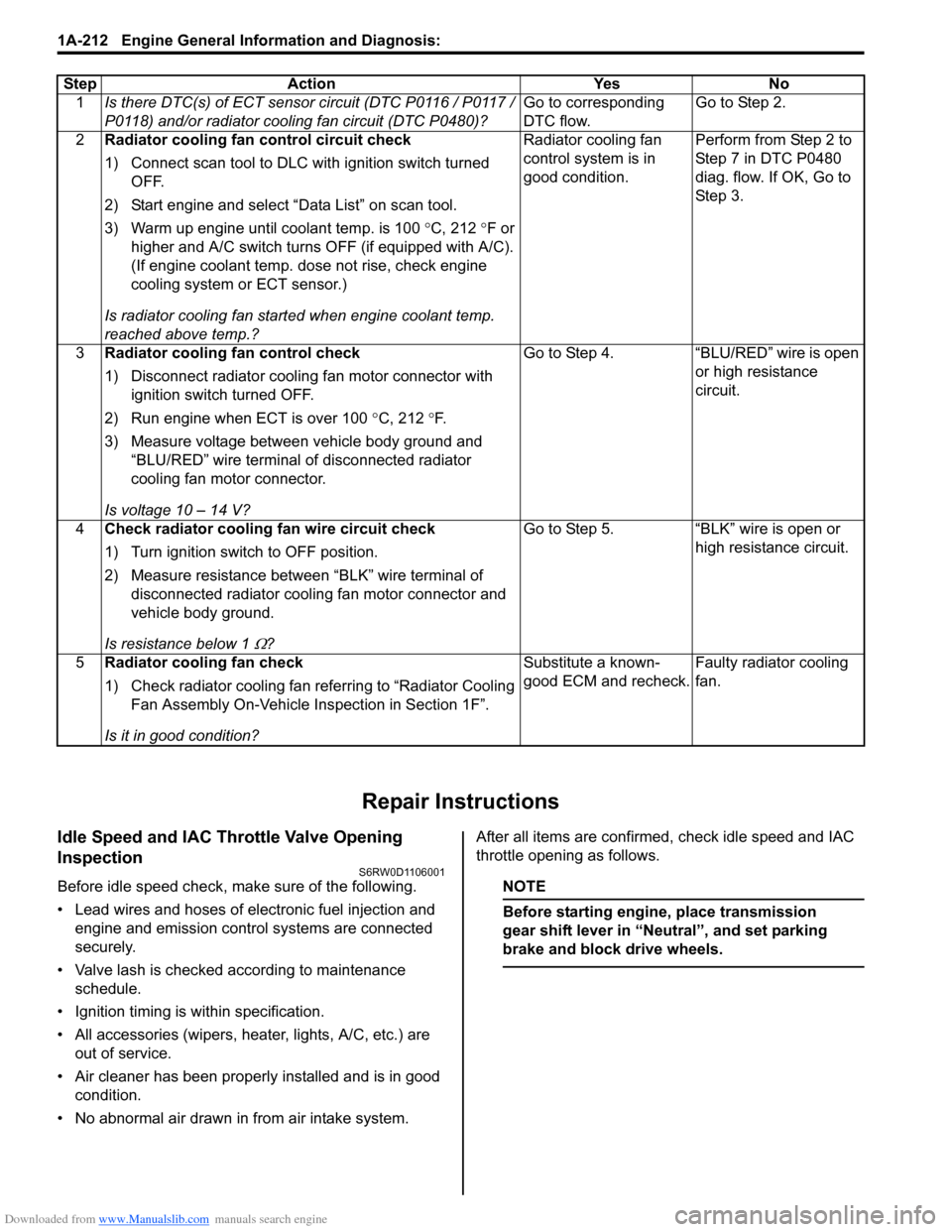
Step Action Yes No
1Is there DTC(s) of ECT sensor circuit (DTC P0116 / P0117 /
P0118) and/or radiator cooling fan circuit (DTC P0480)?Go to corresponding
DTC flow.Go to Step 2.
2Radiator cooling fan control circuit check
1) Connect scan tool to DLC with ignition switch turned
OFF.
2) Start engine and select “Data List” on scan tool.
3) Warm up engine until coolant temp. is 100 °C, 212 °F or
higher and A/C switch turns OFF (if equipped with A/C).
(If engine coolant temp. dose not rise, check engine
cooling system or ECT sensor.)
Is radiator cooling fan started when engine coolant temp.
reached above temp.?Radiator cooling fan
control system is in
good condition.Perform from Step 2 to
Step 7 in DTC P0480
diag. flow. If OK, Go to
Ste p 3.
3Radiator cooling fan control check
1) Disconnect radiator cooling fan motor connector with
ignition switch turned OFF.
2) Run engine when ECT is over 100 °C, 212 °F.
3) Measure voltage between vehicle body ground and
“BLU/RED” wire terminal of disconnected radiator
cooling fan motor connector.
Is voltage 10 – 14 V?Go to Step 4. “BLU/RED” wire is open
or high resistance
circuit.
4Check radiator cooling fan wire circuit check
1) Turn ignition switch to OFF position.
2) Measure resistance between “BLK” wire terminal of
disconnected radiator cooling fan motor connector and
vehicle body ground.
Is resistance below 1
Ω?Go to Step 5. “BLK” wire is open or
high resistance circuit.
5Radiator cooling fan check
1) Check radiator cooling fan referring to “Radiator Cooling
Fan Assembly On-Vehicle Inspection in Section 1F”.
Is it in good condition?Substitute a known-
good ECM and recheck.Faulty radiator cooling
fan.
Page 264 of 1556
Downloaded from www.Manualslib.com manuals search engine 1B-1 Aux. Emission Control Devices:
Engine
Aux. Emission Control Devices
Diagnostic Information and Procedures
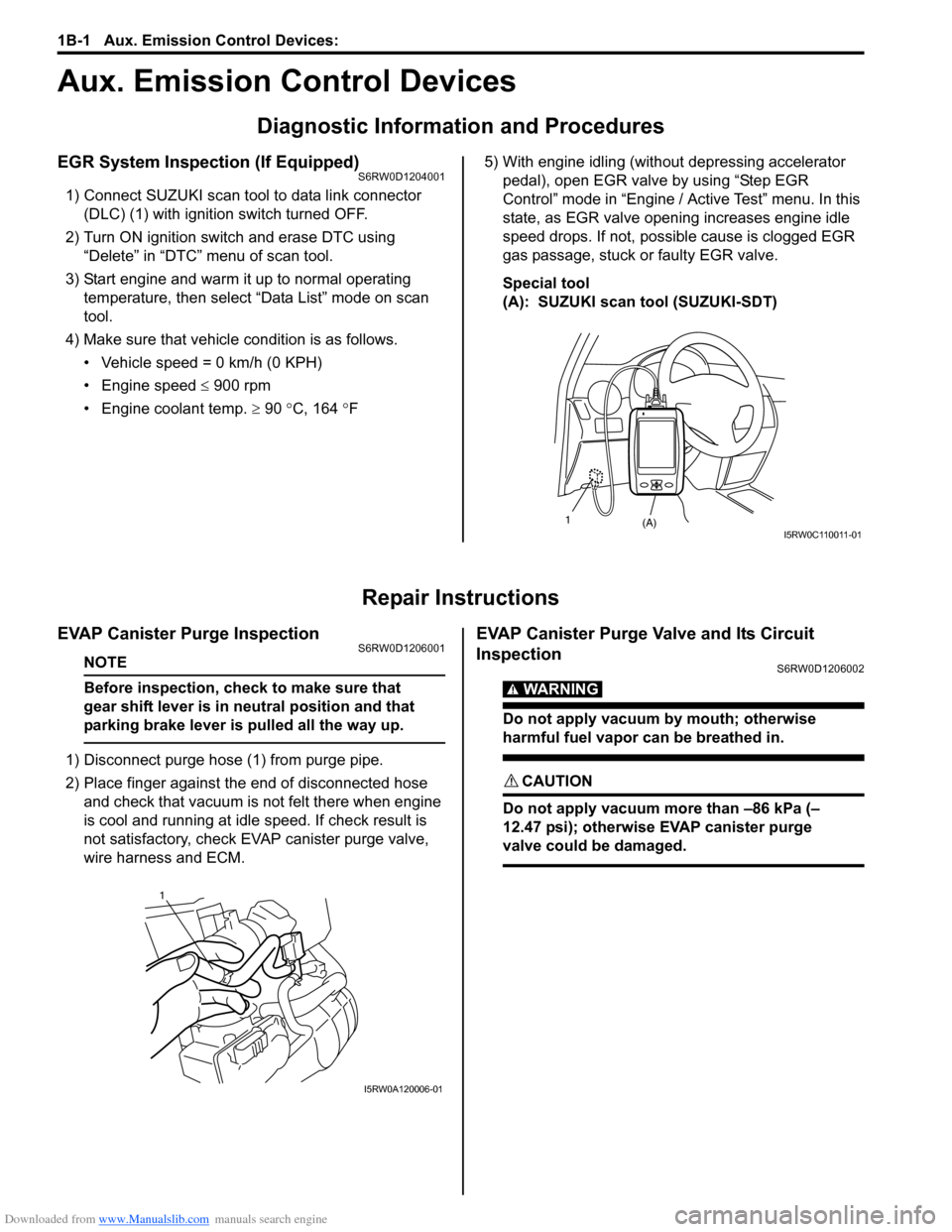
EGR System Inspection (If Equipped)S6RW0D1204001
1) Connect SUZUKI scan tool to data link connector
(DLC) (1) with ignition switch turned OFF.
2) Turn ON ignition switch and erase DTC using
“Delete” in “DTC” menu of scan tool.
3) Start engine and warm it up to normal operating
temperature, then select “Data List” mode on scan
tool.
4) Make sure that vehicle condition is as follows.
• Vehicle speed = 0 km/h (0 KPH)
• Engine speed ≤ 900 rpm
• Engine coolant temp. ≥ 90 °C, 164 °F5) With engine idling (without depressing accelerator
pedal), open EGR valve by using “Step EGR
Control” mode in “Engine / Active Test” menu. In this
state, as EGR valve opening increases engine idle
speed drops. If not, possible cause is clogged EGR
gas passage, stuck or faulty EGR valve.
Special tool
(A): SUZUKI scan tool (SUZUKI-SDT)
Repair Instructions
EVAP Canister Purge InspectionS6RW0D1206001
NOTE
Before inspection, check to make sure that
gear shift lever is in neutral position and that
parking brake lever is pulled all the way up.
1) Disconnect purge hose (1) from purge pipe.
2) Place finger against the end of disconnected hose
and check that vacuum is not felt there when engine
is cool and running at idle speed. If check result is
not satisfactory, check EVAP canister purge valve,
wire harness and ECM.
EVAP Canister Purge Valve and Its Circuit
Inspection
S6RW0D1206002
WARNING!
Do not apply vacuum by mouth; otherwise
harmful fuel vapor can be breathed in.
CAUTION!
Do not apply vacuum more than –86 kPa (–
12.47 psi); otherwise EVAP canister purge
valve could be damaged.
(A) 1I5RW0C110011-01
1
I5RW0A120006-01
Page 265 of 1556
Downloaded from www.Manualslib.com manuals search engine Aux. Emission Control Devices: 1B-2
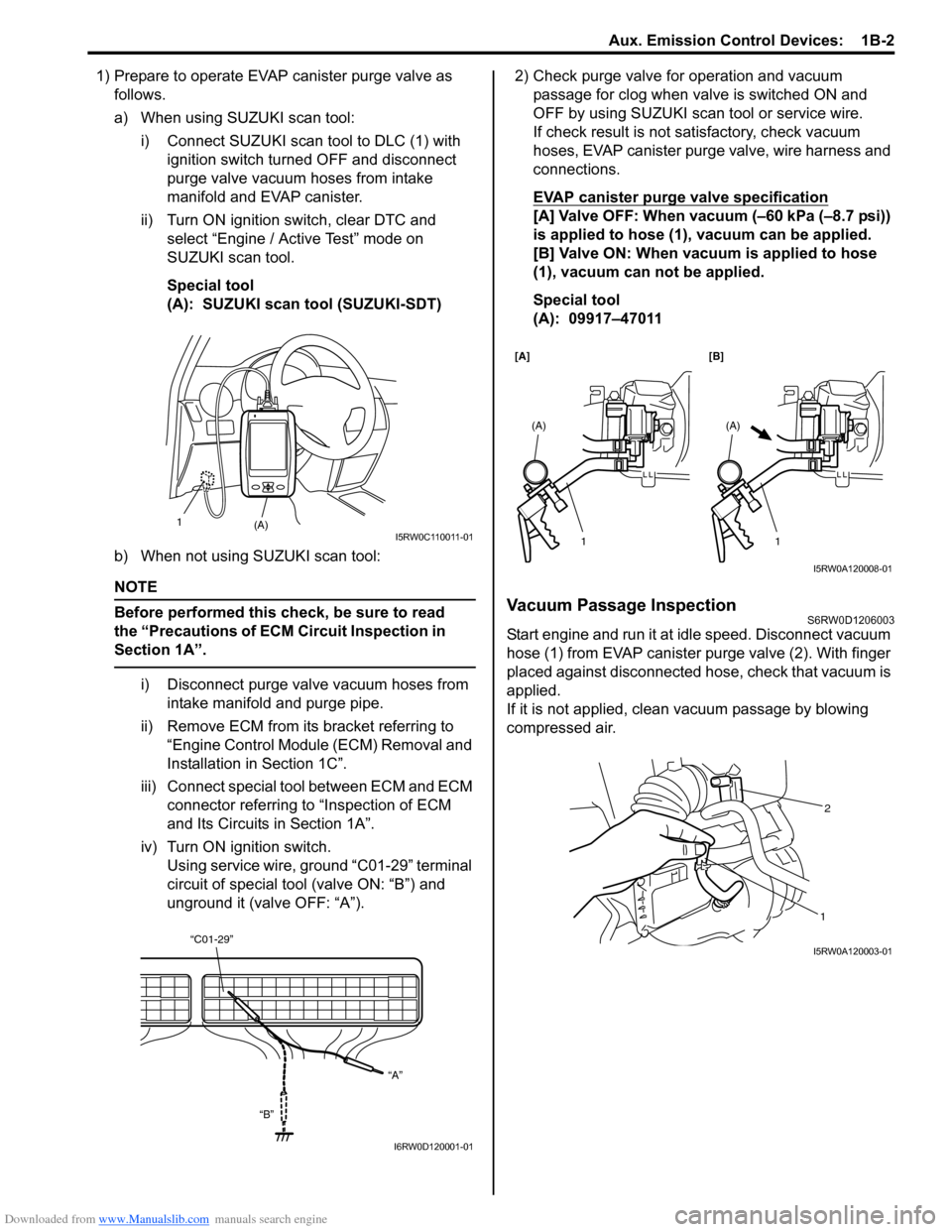
1) Prepare to operate EVAP canister purge valve as
follows.
a) When using SUZUKI scan tool:
i) Connect SUZUKI scan tool to DLC (1) with
ignition switch turned OFF and disconnect
purge valve vacuum hoses from intake
manifold and EVAP canister.
ii) Turn ON ignition switch, clear DTC and
select “Engine / Active Test” mode on
SUZUKI scan tool.
Special tool
(A): SUZUKI scan tool (SUZUKI-SDT)
b) When not using SUZUKI scan tool:
NOTE
Before performed this check, be sure to read
the “Precautions of ECM Circuit Inspection in
Section 1A”.
i) Disconnect purge valve vacuum hoses from
intake manifold and purge pipe.
ii) Remove ECM from its bracket referring to
“Engine Control Module (ECM) Removal and
Installation in Section 1C”.
iii) Connect special tool between ECM and ECM
connector referring to “Inspection of ECM
and Its Circuits in Section 1A”.
iv) Turn ON ignition switch.
Using service wire, ground “C01-29” terminal
circuit of special tool (valve ON: “B”) and
unground it (valve OFF: “A”).2) Check purge valve for operation and vacuum
passage for clog when valve is switched ON and
OFF by using SUZUKI scan tool or service wire.
If check result is not satisfactory, check vacuum
hoses, EVAP canister purge valve, wire harness and
connections.
EVAP canister purge valve specification
[A] Valve OFF: When vacuum (–60 kPa (–8.7 psi))
is applied to hose (1), vacuum can be applied.
[B] Valve ON: When vacuum is applied to hose
(1), vacuum can not be applied.
Special tool
(A): 09917–47011
Vacuum Passage InspectionS6RW0D1206003
Start engine and run it at idle speed. Disconnect vacuum
hose (1) from EVAP canister purge valve (2). With finger
placed against disconnected hose, check that vacuum is
applied.
If it is not applied, clean vacuum passage by blowing
compressed air.
(A) 1I5RW0C110011-01
“C01-29”
“A”
“B”
I6RW0D120001-01
[A]
1 (A)
[B]
1 (A)
I5RW0A120008-01
1
2
I5RW0A120003-01
Page 266 of 1556
Downloaded from www.Manualslib.com manuals search engine 1B-3 Aux. Emission Control Devices:
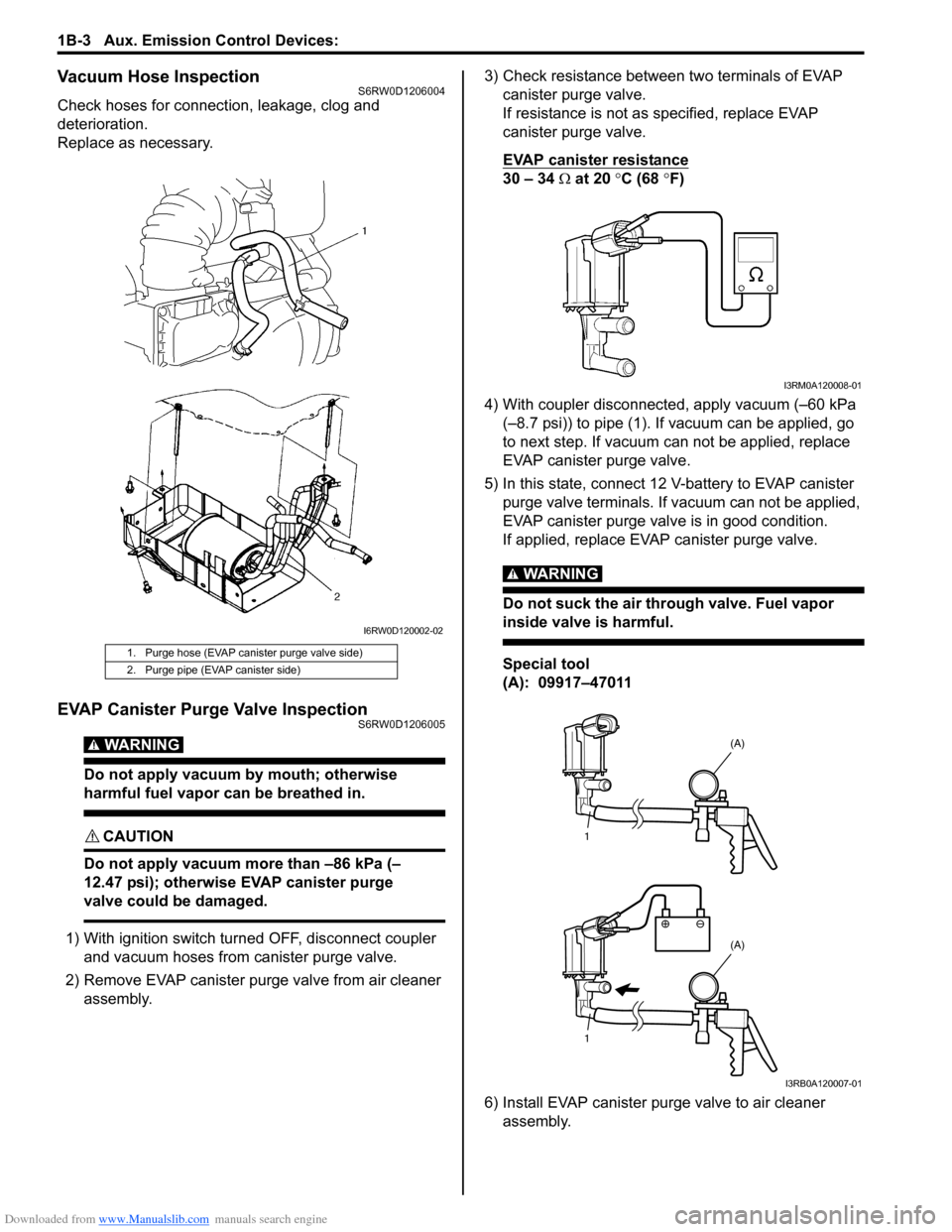
Vacuum Hose InspectionS6RW0D1206004
Check hoses for connection, leakage, clog and
deterioration.
Replace as necessary.
EVAP Canister Purge Valve InspectionS6RW0D1206005
WARNING!
Do not apply vacuum by mouth; otherwise
harmful fuel vapor can be breathed in.
CAUTION!
Do not apply vacuum more than –86 kPa (–
12.47 psi); otherwise EVAP canister purge
valve could be damaged.
1) With ignition switch turned OFF, disconnect coupler
and vacuum hoses from canister purge valve.
2) Remove EVAP canister purge valve from air cleaner
assembly.3) Check resistance between two terminals of EVAP
canister purge valve.
If resistance is not as specified, replace EVAP
canister purge valve.
EVAP canister resistance
30 – 34 Ω at 20 °C (68 °F)
4) With coupler disconnected, apply vacuum (–60 kPa
(–8.7 psi)) to pipe (1). If vacuum can be applied, go
to next step. If vacuum can not be applied, replace
EVAP canister purge valve.
5) In this state, connect 12 V-battery to EVAP canister
purge valve terminals. If vacuum can not be applied,
EVAP canister purge valve is in good condition.
If applied, replace EVAP canister purge valve.
WARNING!
Do not suck the air through valve. Fuel vapor
inside valve is harmful.
Special tool
(A): 09917–47011
6) Install EVAP canister purge valve to air cleaner
assembly.1. Purge hose (EVAP canister purge valve side)
2. Purge pipe (EVAP canister side)
I6RW0D120002-02
I3RM0A120008-01
1
1(A)
(A)
I3RB0A120007-01