MAIN SUZUKI SX4 2006 1.G Service Workshop Manual
[x] Cancel search | Manufacturer: SUZUKI, Model Year: 2006, Model line: SX4, Model: SUZUKI SX4 2006 1.GPages: 1556, PDF Size: 37.31 MB
Page 477 of 1556
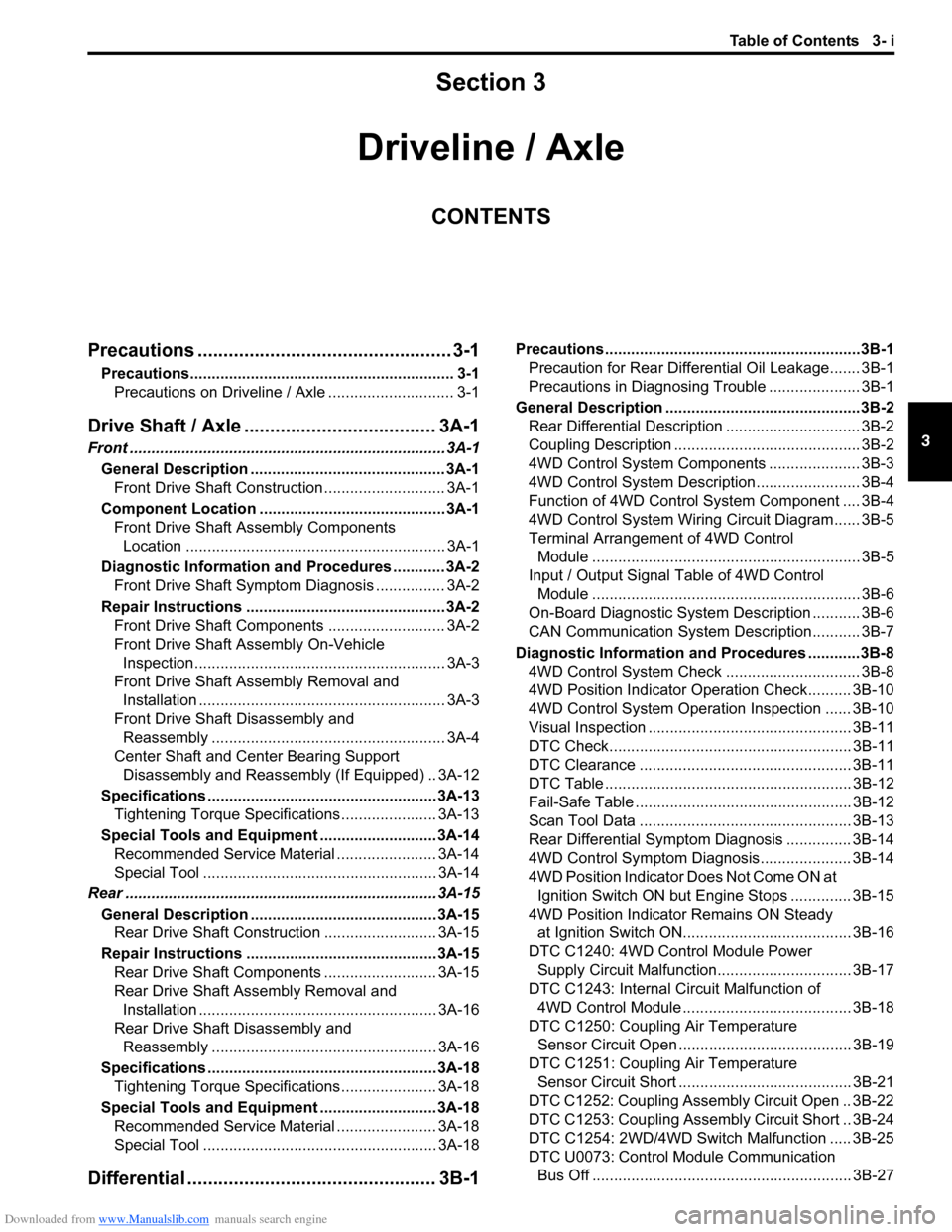
Downloaded from www.Manualslib.com manuals search engine Table of Contents 3- i
3
Section 3
CONTENTS
Driveline / Axle
Precautions ................................................. 3-1
Precautions............................................................. 3-1
Precautions on Driveline / Axle ............................. 3-1
Drive Shaft / Axle ..................................... 3A-1
Front ......................................................................... 3A-1
General Description ............................................. 3A-1
Front Drive Shaft Construction ............................ 3A-1
Component Location ........................................... 3A-1
Front Drive Shaft Assembly Components
Location ............................................................ 3A-1
Diagnostic Information and Procedures ............ 3A-2
Front Drive Shaft Symptom Diagnosis ................ 3A-2
Repair Instructions .............................................. 3A-2
Front Drive Shaft Components ........................... 3A-2
Front Drive Shaft Assembly On-Vehicle
Inspection.......................................................... 3A-3
Front Drive Shaft Assembly Removal and
Installation ......................................................... 3A-3
Front Drive Shaft Disassembly and
Reassembly ...................................................... 3A-4
Center Shaft and Center Bearing Support
Disassembly and Reassembly (If Equipped) .. 3A-12
Specifications..................................................... 3A-13
Tightening Torque Specifications ...................... 3A-13
Special Tools and Equipment ........................... 3A-14
Recommended Service Material ....................... 3A-14
Special Tool ...................................................... 3A-14
Rear ........................................................................ 3A-15
General Description ........................................... 3A-15
Rear Drive Shaft Construction .......................... 3A-15
Repair Instructions ............................................ 3A-15
Rear Drive Shaft Components .......................... 3A-15
Rear Drive Shaft Assembly Removal and
Installation ....................................................... 3A-16
Rear Drive Shaft Disassembly and
Reassembly .................................................... 3A-16
Specifications..................................................... 3A-18
Tightening Torque Specifications ...................... 3A-18
Special Tools and Equipment ........................... 3A-18
Recommended Service Material ....................... 3A-18
Special Tool ...................................................... 3A-18
Differential ................................................ 3B-1
Precautions...........................................................3B-1
Precaution for Rear Differential Oil Leakage....... 3B-1
Precautions in Diagnosing Trouble ..................... 3B-1
General Description .............................................3B-2
Rear Differential Description ............................... 3B-2
Coupling Description ........................................... 3B-2
4WD Control System Components ..................... 3B-3
4WD Control System Description........................ 3B-4
Function of 4WD Control System Component .... 3B-4
4WD Control System Wiring Circuit Diagram...... 3B-5
Terminal Arrangement of 4WD Control
Module .............................................................. 3B-5
Input / Output Signal Table of 4WD Control
Module .............................................................. 3B-6
On-Board Diagnostic System Description ........... 3B-6
CAN Communication System Description........... 3B-7
Diagnostic Information and Procedures ............3B-8
4WD Control System Check ............................... 3B-8
4WD Position Indicator Operation Check.......... 3B-10
4WD Control System Operation Inspection ...... 3B-10
Visual Inspection ............................................... 3B-11
DTC Check........................................................ 3B-11
DTC Clearance ................................................. 3B-11
DTC Table ......................................................... 3B-12
Fail-Safe Table .................................................. 3B-12
Scan Tool Data ................................................. 3B-13
Rear Differential Symptom Diagnosis ............... 3B-14
4WD Control Symptom Diagnosis..................... 3B-14
4WD Position Indicator Does Not Come ON at
Ignition Switch ON but Engine Stops .............. 3B-15
4WD Position Indicator Remains ON Steady
at Ignition Switch ON....................................... 3B-16
DTC C1240: 4WD Control Module Power
Supply Circuit Malfunction............................... 3B-17
DTC C1243: Internal Circuit Malfunction of
4WD Control Module ....................................... 3B-18
DTC C1250: Coupling Air Temperature
Sensor Circuit Open ........................................ 3B-19
DTC C1251: Coupling Air Temperature
Sensor Circuit Short ........................................ 3B-21
DTC C1252: Coupling Assembly Circuit Open .. 3B-22
DTC C1253: Coupling Assembly Circuit Short .. 3B-24
DTC C1254: 2WD/4WD Switch Malfunction ..... 3B-25
DTC U0073: Control Module Communication
Bus Off ............................................................ 3B-27
Page 498 of 1556
Downloaded from www.Manualslib.com manuals search engine 3B-1 Differential:
Driveline / Axle
Differential
Precautions
Precaution for Rear Differential Oil LeakageS6RW0D3200001
Whenever vehicle is hoisted for any other service work than oil change, also be sure to check for oil leakage.
Precautions in Diagnosing TroubleS6RW0D3200002
• Do not disconnect the following parts before confirming diagnostic information (DTC, etc.) stored in 4WD control
module memory. These actions will erase memorized information in 4WD control module memory.
– Disconnection of coupler from 4WD control module
– Disconnection of battery cable from battery
– Disconnection of ground wire harness of 4WD control module
– Disconnect main fuse from fuse box
• Diagnostic information stored in 4WD control module memory can be cleared as well as checked by using SUZUKI
scan tool. Before using scan tool, read its Operator’s (Instruction) Manual carefully to have good understanding as
to what functions are available and how to use it.
• Be sure to read “Precautions for Electrical Circuit Service:” before inspection and observe what is written there.
Page 502 of 1556
Downloaded from www.Manualslib.com manuals search engine 3B-5 Differential:
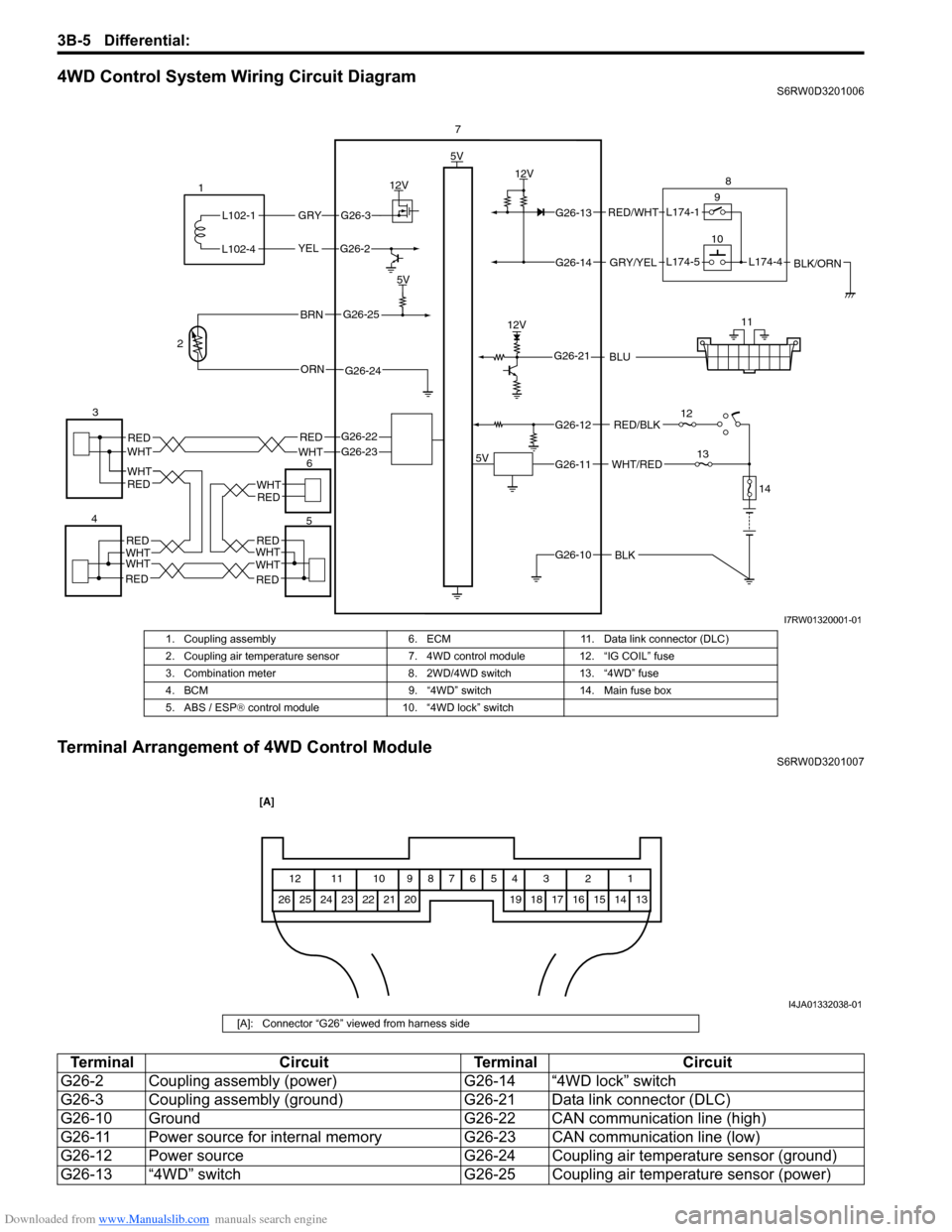
4WD Control System Wiring Circuit DiagramS6RW0D3201006
Terminal Arrangement of 4WD Control ModuleS6RW0D3201007
5V
5V
12V
G26-3
YEL
GRY
G26-2
G26-22G26-23REDWHT
G26-13
G26-14
G26-12
G26-11
G26-10BLK
WHT/RED
RED/BLK
GRY/YEL
RED/WHT
12V
L102-1
L102-4
1
37
9
10
12
13
14
12V
G26-21BLU
G26-25
G26-24ORN
BRN
5V
28
11
WHT
WHT
WHTWHTWHTWHT
WHT
RED
RED
RED
REDRED
RED
RED
46
5
L174-4BLK/ORNL174-5L174-1
I7RW01320001-01
1. Coupling assembly 6. ECM 11. Data link connector (DLC)
2. Coupling air temperature sensor 7. 4WD control module 12. “IG COIL” fuse
3. Combination meter 8. 2WD/4WD switch 13. “4WD” fuse
4. BCM 9. “4WD” switch 14. Main fuse box
5. ABS / ESP® control module 10. “4WD lock” switch
1 2 3 4 5 6 7 8 9 10 11 12
13 14 15 16 17 18 19 20 21 22 23 24 25 26
[A]
I4JA01332038-01
[A]: Connector “G26” viewed from harness side
Te r m i n a l C i r c u i t Te r m i n a l C i r c u i t
G26-2 Coupling assembly (power) G26-14 “4WD lock” switch
G26-3 Coupling assembly (ground) G26-21 Data link connector (DLC)
G26-10 Ground G26-22 CAN communication line (high)
G26-11 Power source for internal memory G26-23 CAN communication line (low)
G26-12 Power source G26-24 Coupling air temperature sensor (ground)
G26-13 “4WD” switch G26-25 Coupling air temperature sensor (power)
Page 507 of 1556
Downloaded from www.Manualslib.com manuals search engine Differential: 3B-10
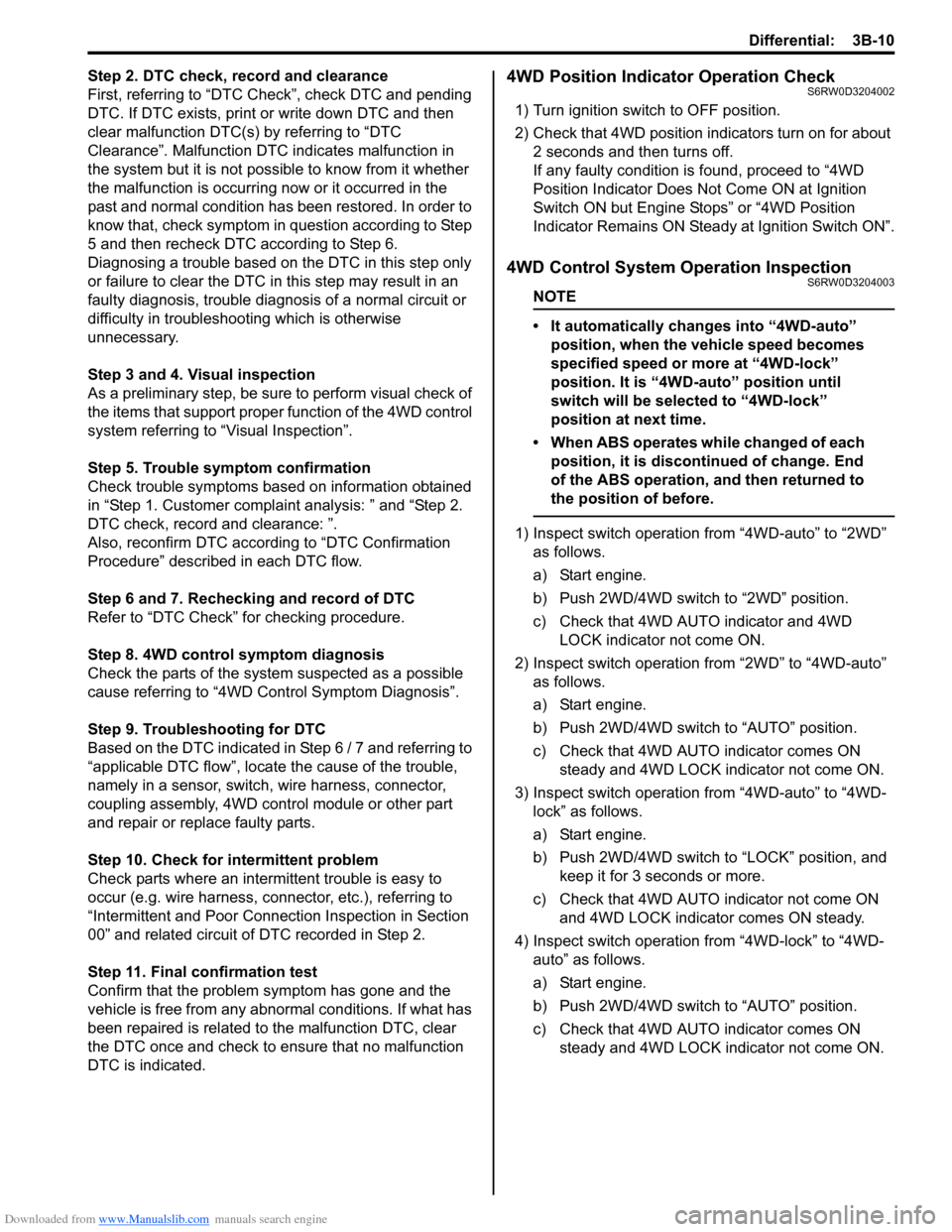
Step 2. DTC check, record and clearance
First, referring to “DTC Check”, check DTC and pending
DTC. If DTC exists, print or write down DTC and then
clear malfunction DTC(s) by referring to “DTC
Clearance”. Malfunction DTC indicates malfunction in
the system but it is not possible to know from it whether
the malfunction is occurring now or it occurred in the
past and normal condition has been restored. In order to
know that, check symptom in question according to Step
5 and then recheck DTC according to Step 6.
Diagnosing a trouble based on the DTC in this step only
or failure to clear the DTC in this step may result in an
faulty diagnosis, trouble diagnosis of a normal circuit or
difficulty in troubleshooting which is otherwise
unnecessary.
Step 3 and 4. Visual inspection
As a preliminary step, be sure to perform visual check of
the items that support proper function of the 4WD control
system referring to “Visual Inspection”.
Step 5. Trouble symptom confirmation
Check trouble symptoms based on information obtained
in “Step 1. Customer complaint analysis: ” and “Step 2.
DTC check, record and clearance: ”.
Also, reconfirm DTC according to “DTC Confirmation
Procedure” described in each DTC flow.
Step 6 and 7. Rechecking and record of DTC
Refer to “DTC Check” for checking procedure.
Step 8. 4WD control symptom diagnosis
Check the parts of the system suspected as a possible
cause referring to “4WD Control Symptom Diagnosis”.
Step 9. Troubleshooting for DTC
Based on the DTC indicated in Step 6 / 7 and referring to
“applicable DTC flow”, locate the cause of the trouble,
namely in a sensor, switch, wire harness, connector,
coupling assembly, 4WD control module or other part
and repair or replace faulty parts.
Step 10. Check for intermittent problem
Check parts where an intermittent trouble is easy to
occur (e.g. wire harness, connector, etc.), referring to
“Intermittent and Poor Connection Inspection in Section
00” and related circuit of DTC recorded in Step 2.
Step 11. Final confirmation test
Confirm that the problem symptom has gone and the
vehicle is free from any abnormal conditions. If what has
been repaired is related to the malfunction DTC, clear
the DTC once and check to ensure that no malfunction
DTC is indicated.4WD Position Indicator Operation CheckS6RW0D3204002
1) Turn ignition switch to OFF position.
2) Check that 4WD position indicators turn on for about
2 seconds and then turns off.
If any faulty condition is found, proceed to “4WD
Position Indicator Does Not Come ON at Ignition
Switch ON but Engine Stops” or “4WD Position
Indicator Remains ON Steady at Ignition Switch ON”.
4WD Control System Operation InspectionS6RW0D3204003
NOTE
• It automatically changes into “4WD-auto”
position, when the vehicle speed becomes
specified speed or more at “4WD-lock”
position. It is “4WD-auto” position until
switch will be selected to “4WD-lock”
position at next time.
• When ABS operates while changed of each
position, it is discontinued of change. End
of the ABS operation, and then returned to
the position of before.
1) Inspect switch operation from “4WD-auto” to “2WD”
as follows.
a) Start engine.
b) Push 2WD/4WD switch to “2WD” position.
c) Check that 4WD AUTO indicator and 4WD
LOCK indicator not come ON.
2) Inspect switch operation from “2WD” to “4WD-auto”
as follows.
a) Start engine.
b) Push 2WD/4WD switch to “AUTO” position.
c) Check that 4WD AUTO indicator comes ON
steady and 4WD LOCK indicator not come ON.
3) Inspect switch operation from “4WD-auto” to “4WD-
lock” as follows.
a) Start engine.
b) Push 2WD/4WD switch to “LOCK” position, and
keep it for 3 seconds or more.
c) Check that 4WD AUTO indicator not come ON
and 4WD LOCK indicator comes ON steady.
4) Inspect switch operation from “4WD-lock” to “4WD-
auto” as follows.
a) Start engine.
b) Push 2WD/4WD switch to “AUTO” position.
c) Check that 4WD AUTO indicator comes ON
steady and 4WD LOCK indicator not come ON.
Page 512 of 1556
Downloaded from www.Manualslib.com manuals search engine 3B-15 Differential:
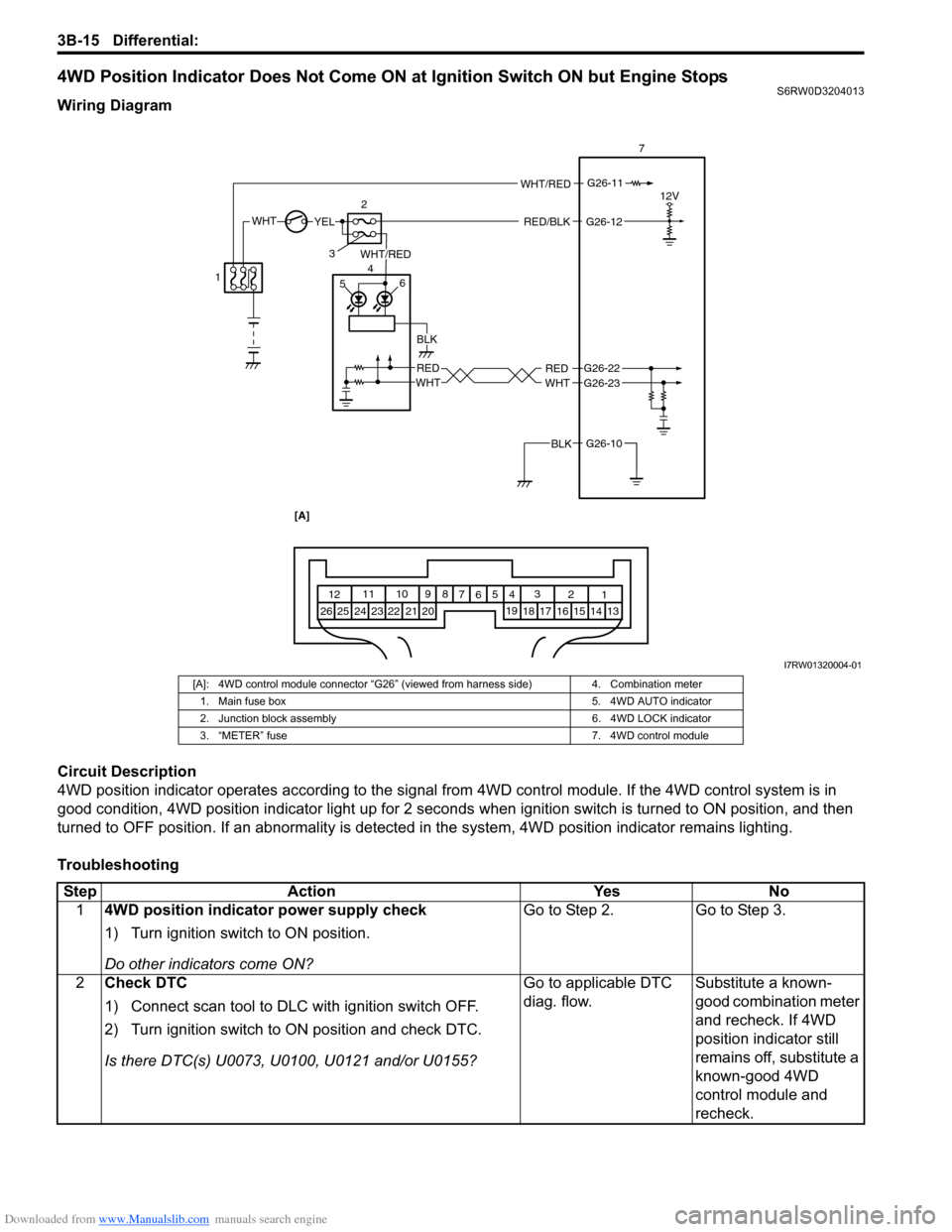
4WD Position Indicator Does Not Come ON at Ignition Switch ON but Engine StopsS6RW0D3204013
Wiring Diagram
Circuit Description
4WD position indicator operates according to the signal from 4WD control module. If the 4WD control system is in
good condition, 4WD position indicator light up for 2 seconds when ignition switch is turned to ON position, and then
turned to OFF position. If an abnormality is detected in the system, 4WD position indicator remains lighting.
Troubleshooting
WHTYELRED/BLK
12
WHT/RED
WHT/RED
G26-12
G26-11
RED
BLK
WHT 56 47
12V
G26-10BLK
G26-22
G26-23REDWHT
3
1 2 3
4 5
6 7 8 9 10 11
12
13
14 15 16
17 18 19
20
21 22
23
24 25 26
[A]
I7RW01320004-01
[A]: 4WD control module connector “G26” (viewed from harness side) 4. Combination meter
1. Main fuse box 5. 4WD AUTO indicator
2. Junction block assembly 6. 4WD LOCK indicator
3. “METER” fuse 7. 4WD control module
Step Action Yes No
14WD position indicator power supply check
1) Turn ignition switch to ON position.
Do other indicators come ON?Go to Step 2. Go to Step 3.
2Check DTC
1) Connect scan tool to DLC with ignition switch OFF.
2) Turn ignition switch to ON position and check DTC.
Is there DTC(s) U0073, U0100, U0121 and/or U0155?Go to applicable DTC
diag. flow.Substitute a known-
good combination meter
and recheck. If 4WD
position indicator still
remains off, substitute a
known-good 4WD
control module and
recheck.
Page 513 of 1556
Downloaded from www.Manualslib.com manuals search engine Differential: 3B-16
4WD Position Indicator Remains ON Steady at Ignition Switch ONS6RW0D3204014
Wiring Diagram
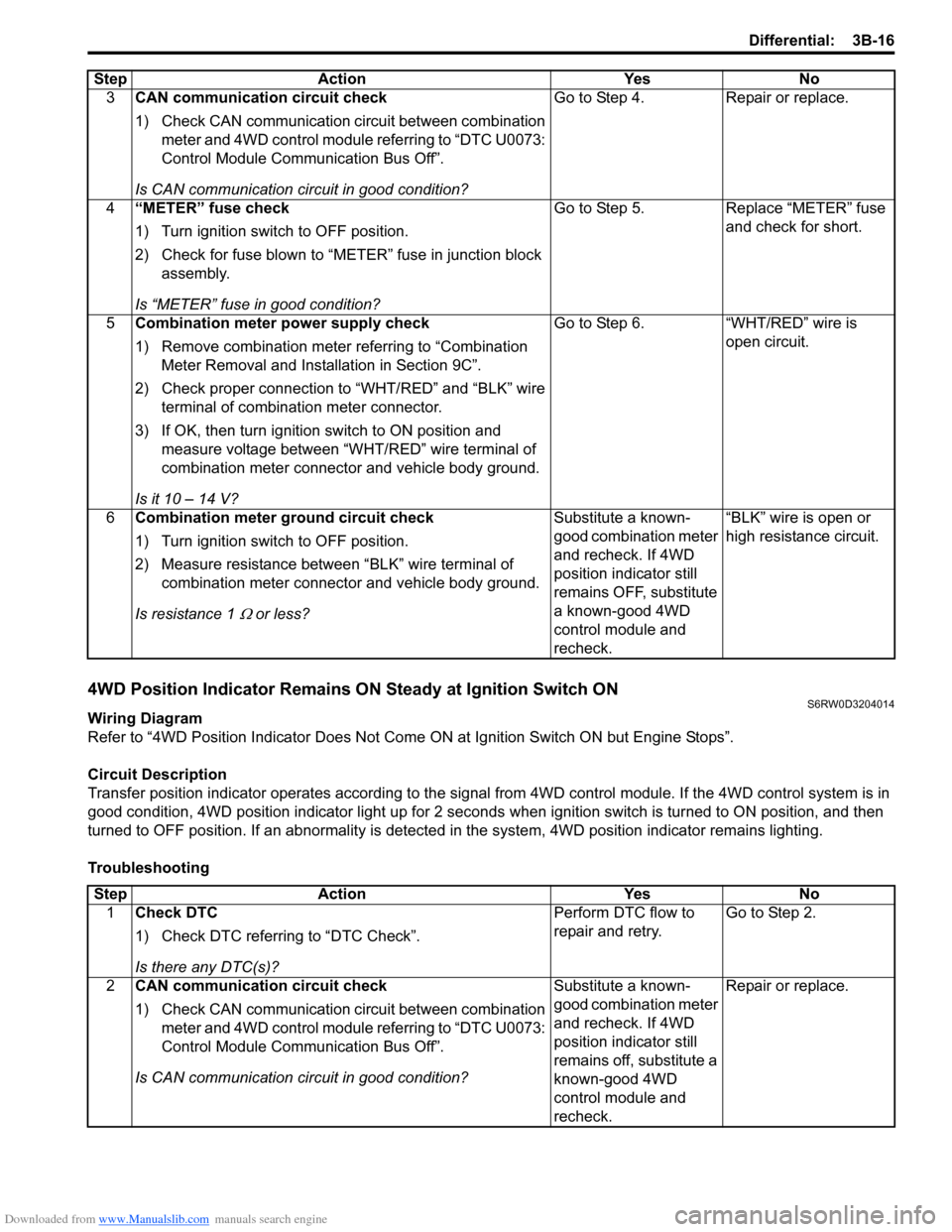
Refer to “4WD Position Indicator Does Not Come ON at Ignition Switch ON but Engine Stops”.
Circuit Description
Transfer position indicator operates according to the signal from 4WD control module. If the 4WD control system is in
good condition, 4WD position indicator light up for 2 seconds when ignition switch is turned to ON position, and then
turned to OFF position. If an abnormality is detected in the system, 4WD position indicator remains lighting.
Troubleshooting3CAN communication circuit check
1) Check CAN communication circuit between combination
meter and 4WD control module referring to “DTC U0073:
Control Module Communication Bus Off”.
Is CAN communication circuit in good condition?Go to Step 4. Repair or replace.
4“METER” fuse check
1) Turn ignition switch to OFF position.
2) Check for fuse blown to “METER” fuse in junction block
assembly.
Is “METER” fuse in good condition?Go to Step 5. Replace “METER” fuse
and check for short.
5Combination meter power supply check
1) Remove combination meter referring to “Combination
Meter Removal and Installation in Section 9C”.
2) Check proper connection to “WHT/RED” and “BLK” wire
terminal of combination meter connector.
3) If OK, then turn ignition switch to ON position and
measure voltage between “WHT/RED” wire terminal of
combination meter connector and vehicle body ground.
Is it 10 – 14 V?Go to Step 6. “WHT/RED” wire is
open circuit.
6Combination meter ground circuit check
1) Turn ignition switch to OFF position.
2) Measure resistance between “BLK” wire terminal of
combination meter connector and vehicle body ground.
Is resistance 1
Ω or less?Substitute a known-
good combination meter
and recheck. If 4WD
position indicator still
remains OFF, substitute
a known-good 4WD
control module and
recheck.“BLK” wire is open or
high resistance circuit. Step Action Yes No
Step Action Yes No
1Check DTC
1) Check DTC referring to “DTC Check”.
Is there any DTC(s)?Perform DTC flow to
repair and retry.Go to Step 2.
2CAN communication circuit check
1) Check CAN communication circuit between combination
meter and 4WD control module referring to “DTC U0073:
Control Module Communication Bus Off”.
Is CAN communication circuit in good condition?Substitute a known-
good combination meter
and recheck. If 4WD
position indicator still
remains off, substitute a
known-good 4WD
control module and
recheck.Repair or replace.
Page 514 of 1556
Downloaded from www.Manualslib.com manuals search engine 3B-17 Differential:
DTC C1240: 4WD Control Module Power Supply Circuit MalfunctionS6RW0D3204015
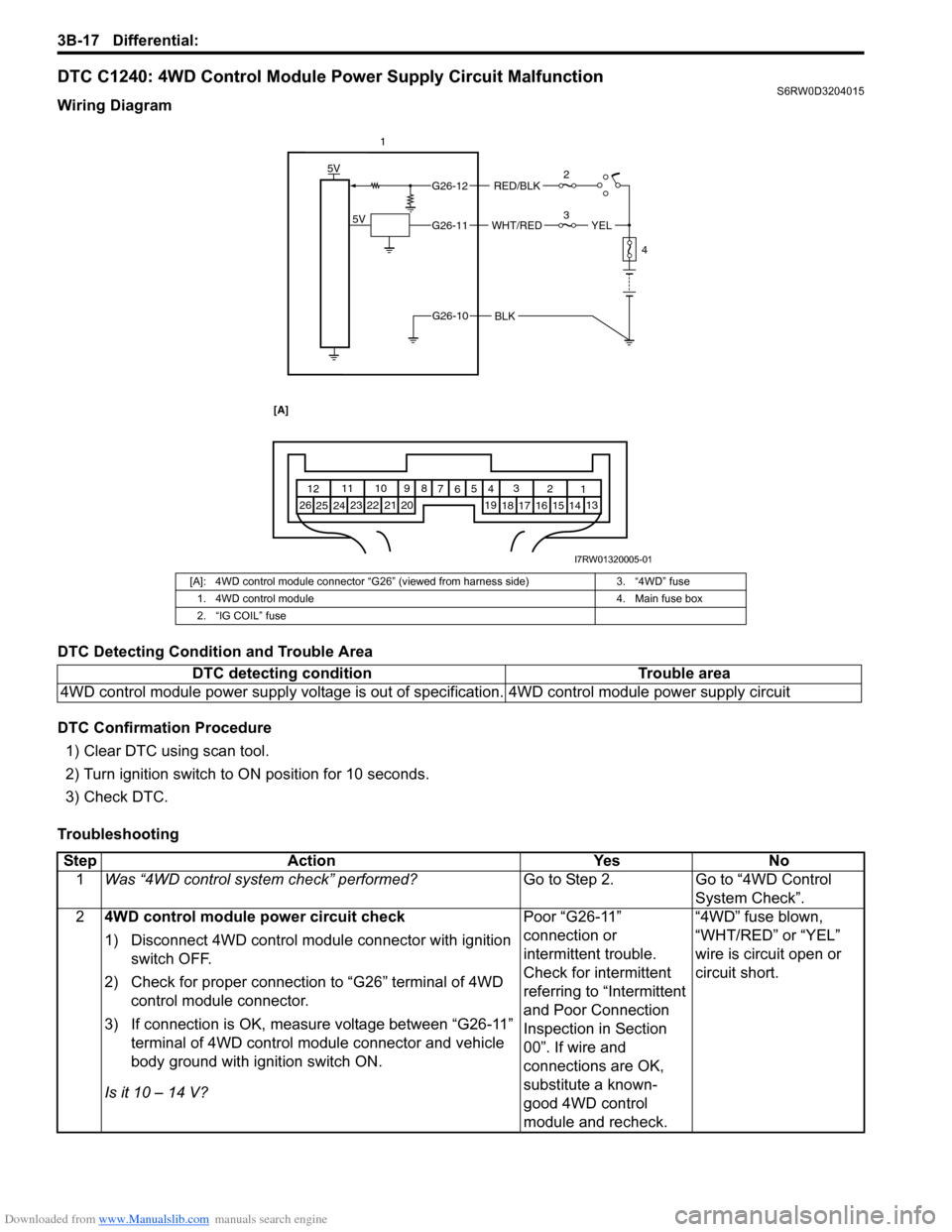
Wiring Diagram
DTC Detecting Condition and Trouble Area
DTC Confirmation Procedure
1) Clear DTC using scan tool.
2) Turn ignition switch to ON position for 10 seconds.
3) Check DTC.
Troubleshooting
[A]: 4WD control module connector “G26” (viewed from harness side) 3. “4WD” fuse
1. 4WD control module 4. Main fuse box
2. “IG COIL” fuse
DTC detecting condition Trouble area
4WD control module power supply voltage is out of specification. 4WD control module power supply circuit
5V
5V
G26-12
G26-11
G26-10BLK
WHT/RED
RED/BLK
1
2
3
4
YEL
1 2 3
4 5
6 7 8 9 10 11
12
13
14 15 16
17 18 19
20
21 22
23
24 25 26
[A]
I7RW01320005-01
Step Action Yes No
1Was “4WD control system check” performed?Go to Step 2. Go to “4WD Control
System Check”.
24WD control module power circuit check
1) Disconnect 4WD control module connector with ignition
switch OFF.
2) Check for proper connection to “G26” terminal of 4WD
control module connector.
3) If connection is OK, measure voltage between “G26-11”
terminal of 4WD control module connector and vehicle
body ground with ignition switch ON.
Is it 10 – 14 V?Poor “G26-11”
connection or
intermittent trouble.
Check for intermittent
referring to “Intermittent
and Poor Connection
Inspection in Section
00”. If wire and
connections are OK,
substitute a known-
good 4WD control
module and recheck.“4WD” fuse blown,
“WHT/RED” or “YEL”
wire is circuit open or
circuit short.
Page 566 of 1556
Downloaded from www.Manualslib.com manuals search engine 3D-1 Propeller Shafts:
Driveline / Axle
Propeller Shafts
Precautions
Propeller Shaft CautionS6RW0D3400001
CAUTION!
• All propeller shaft fasteners are an important attaching part in that it could affect the performance of
vital parts and systems, and/or could result in major repair expense. They must be replaced with one
of the same part number or with an equivalent part if replacement becomes necessary. Do not use a
replacement part of lesser quality or substitute design. Torque values must be used as specified
during reassembly to assure proper retention of this part.
• Never attempt to heat, quench or straighten any propeller shaft part. Replace it with a new part, or
damage to the part may result.
General Description
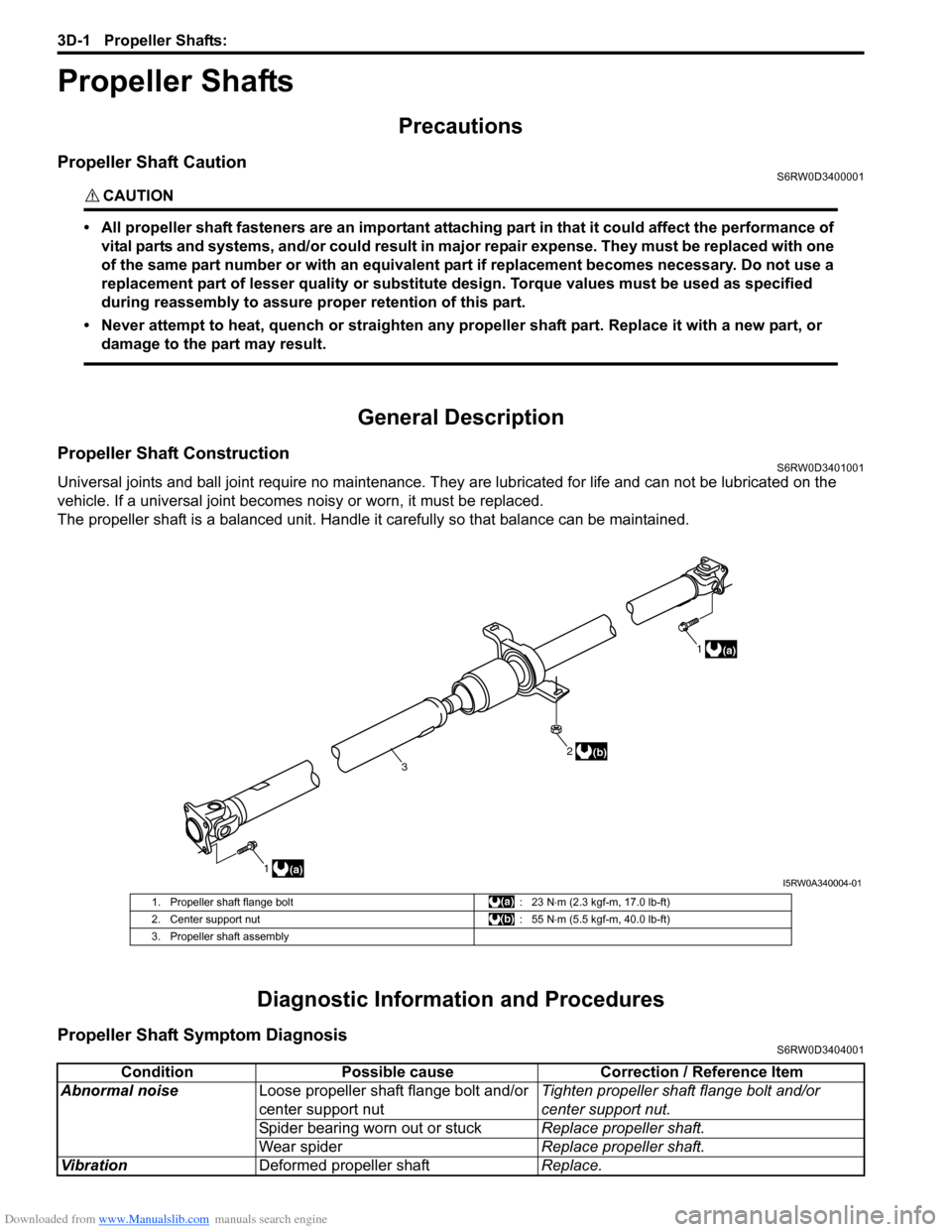
Propeller Shaft ConstructionS6RW0D3401001
Universal joints and ball joint require no maintenance. They are lubricated for life and can not be lubricated on the
vehicle. If a universal joint becomes noisy or worn, it must be replaced.
The propeller shaft is a balanced unit. Handle it carefully so that balance can be maintained.
Diagnostic Information and Procedures
Propeller Shaft Symptom DiagnosisS6RW0D3404001
1(a)1
(a)
2
3(b)
I5RW0A340004-01
1. Propeller shaft flange bolt : 23 N⋅m (2.3 kgf-m, 17.0 lb-ft)
2. Center support nut : 55 N⋅m (5.5 kgf-m, 40.0 lb-ft)
3. Propeller shaft assembly
Condition Possible cause Correction / Reference Item
Abnormal noiseLoose propeller shaft flange bolt and/or
center support nutTighten propeller shaft flange bolt and/or
center support nut.
Spider bearing worn out or stuckReplace propeller shaft.
Wear spiderReplace propeller shaft.
VibrationDeformed propeller shaftReplace.
Page 575 of 1556
Downloaded from www.Manualslib.com manuals search engine Brake Control System and Diagnosis: 4A-4
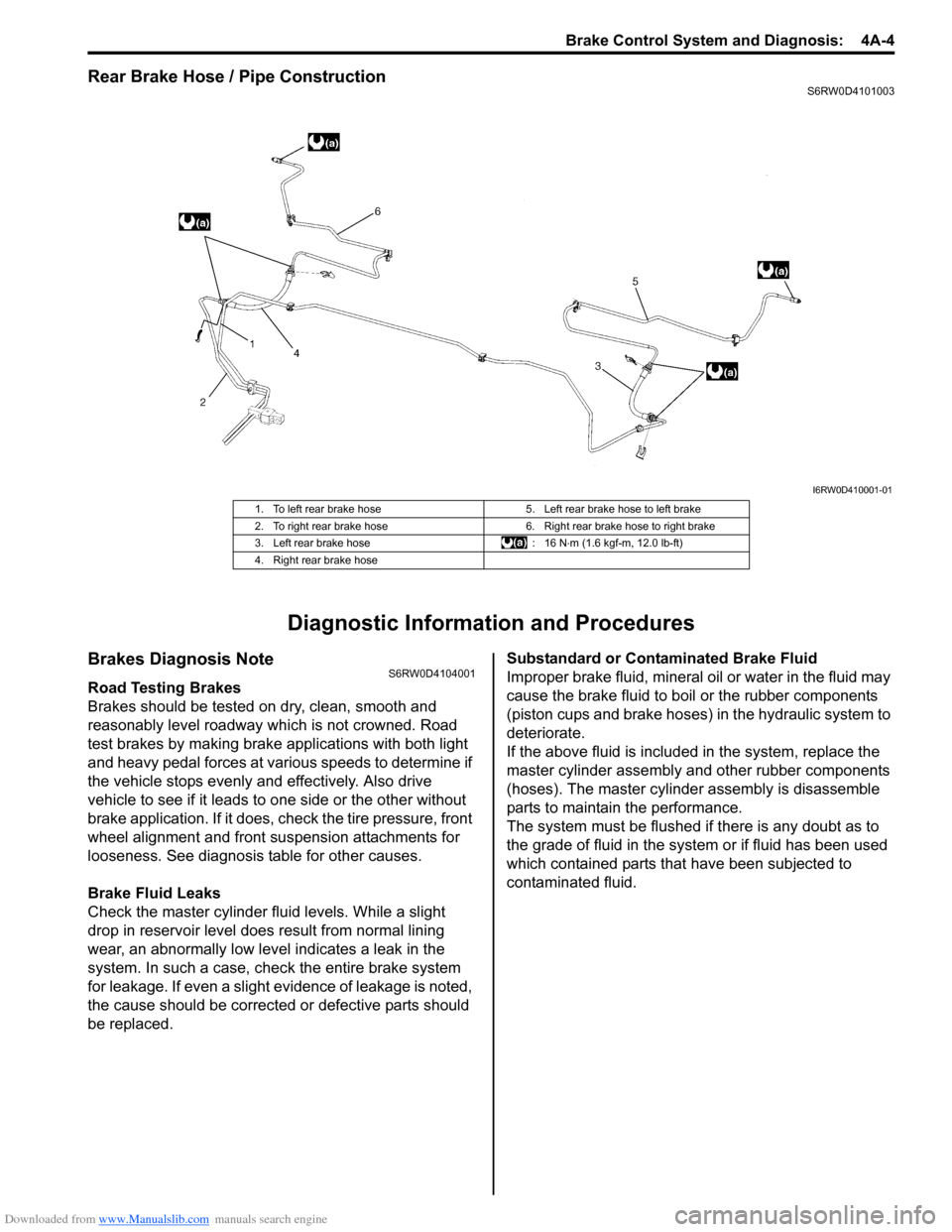
Rear Brake Hose / Pipe ConstructionS6RW0D4101003
Diagnostic Information and Procedures
Brakes Diagnosis NoteS6RW0D4104001
Road Testing Brakes
Brakes should be tested on dry, clean, smooth and
reasonably level roadway which is not crowned. Road
test brakes by making brake applications with both light
and heavy pedal forces at various speeds to determine if
the vehicle stops evenly and effectively. Also drive
vehicle to see if it leads to one side or the other without
brake application. If it does, check the tire pressure, front
wheel alignment and front suspension attachments for
looseness. See diagnosis table for other causes.
Brake Fluid Leaks
Check the master cylinder fluid levels. While a slight
drop in reservoir level does result from normal lining
wear, an abnormally low level indicates a leak in the
system. In such a case, check the entire brake system
for leakage. If even a slight evidence of leakage is noted,
the cause should be corrected or defective parts should
be replaced.Substandard or Contaminated Brake Fluid
Improper brake fluid, mineral oil or water in the fluid may
cause the brake fluid to boil or the rubber components
(piston cups and brake hoses) in the hydraulic system to
deteriorate.
If the above fluid is included in the system, replace the
master cylinder assembly and other rubber components
(hoses). The master cylinder assembly is disassemble
parts to maintain the performance.
The system must be flushed if there is any doubt as to
the grade of fluid in the system or if fluid has been used
which contained parts that have been subjected to
contaminated fluid.
I6RW0D410001-01
1. To left rear brake hose 5. Left rear brake hose to left brake
2. To right rear brake hose 6. Right rear brake hose to right brake
3. Left rear brake hose : 16 N⋅m (1.6 kgf-m, 12.0 lb-ft)
4. Right rear brake hose
Page 578 of 1556
Downloaded from www.Manualslib.com manuals search engine 4A-7 Brake Control System and Diagnosis:
Repair Instructions
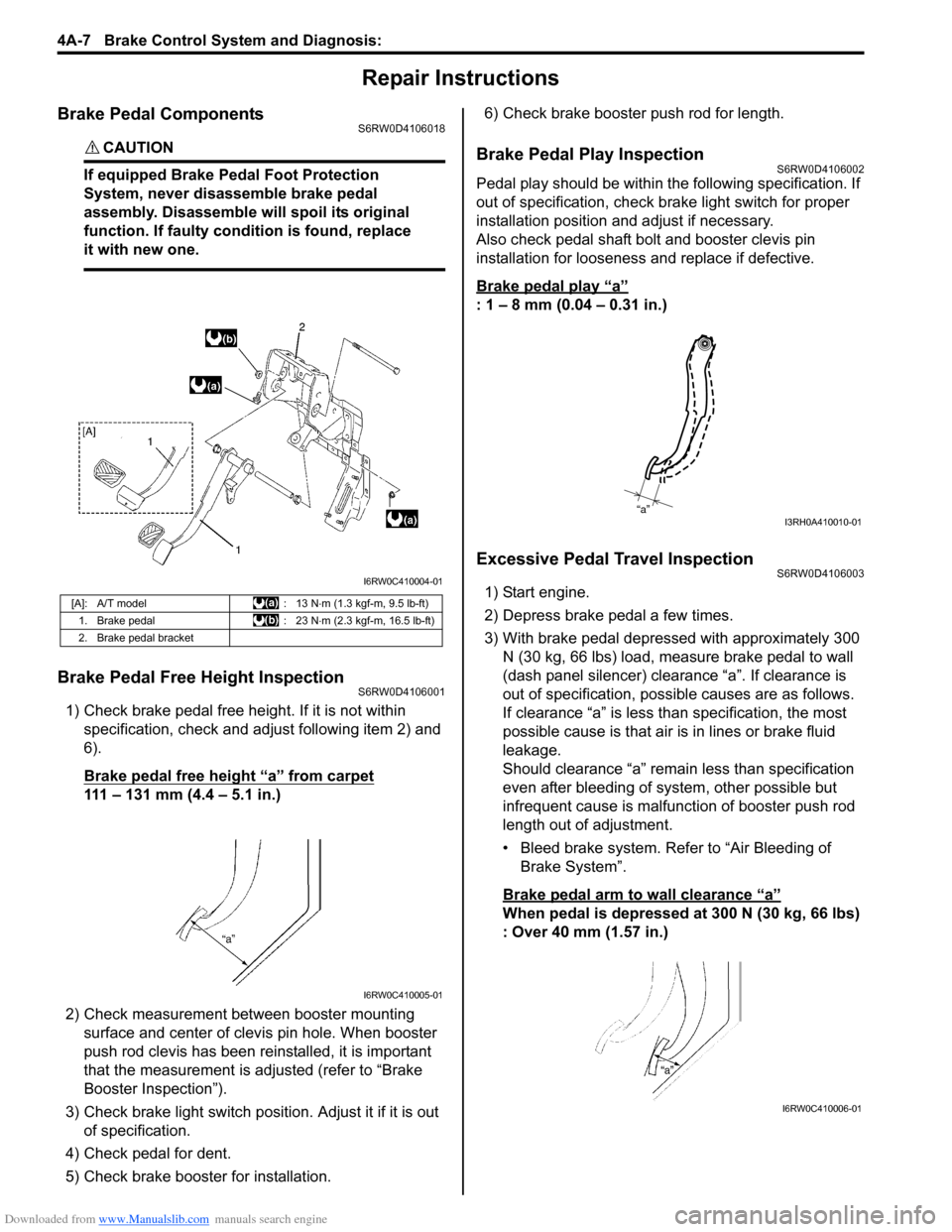
Brake Pedal ComponentsS6RW0D4106018
CAUTION!
If equipped Brake Pedal Foot Protection
System, never disassemble brake pedal
assembly. Disassemble will spoil its original
function. If faulty condition is found, replace
it with new one.
Brake Pedal Free Height InspectionS6RW0D4106001
1) Check brake pedal free height. If it is not within
specification, check and adjust following item 2) and
6).
Brake pedal free height “a” from carpet
111 – 131 mm (4.4 – 5.1 in.)
2) Check measurement between booster mounting
surface and center of clevis pin hole. When booster
push rod clevis has been reinstalled, it is important
that the measurement is adjusted (refer to “Brake
Booster Inspection”).
3) Check brake light switch position. Adjust it if it is out
of specification.
4) Check pedal for dent.
5) Check brake booster for installation.6) Check brake booster push rod for length.
Brake Pedal Play InspectionS6RW0D4106002
Pedal play should be within the following specification. If
out of specification, check brake light switch for proper
installation position and adjust if necessary.
Also check pedal shaft bolt and booster clevis pin
installation for looseness and replace if defective.
Brake pedal play
“a”
: 1 – 8 mm (0.04 – 0.31 in.)
Excessive Pedal Travel InspectionS6RW0D4106003
1) Start engine.
2) Depress brake pedal a few times.
3) With brake pedal depressed with approximately 300
N (30 kg, 66 lbs) load, measure brake pedal to wall
(dash panel silencer) clearance “a”. If clearance is
out of specification, possible causes are as follows.
If clearance “a” is less than specification, the most
possible cause is that air is in lines or brake fluid
leakage.
Should clearance “a” remain less than specification
even after bleeding of system, other possible but
infrequent cause is malfunction of booster push rod
length out of adjustment.
• Bleed brake system. Refer to “Air Bleeding of
Brake System”.
Brake pedal arm to wall clearance
“a”
When pedal is depressed at 300 N (30 kg, 66 lbs)
: Over 40 mm (1.57 in.)
[A]: A/T model : 13 N⋅m (1.3 kgf-m, 9.5 lb-ft)
1. Brake pedal : 23 N⋅m (2.3 kgf-m, 16.5 lb-ft)
2. Brake pedal bracket
I6RW0C410004-01
I6RW0C410005-01
“a”I3RH0A410010-01
I6RW0C410006-01