602 SUZUKI SX4 2006 1.G Service User Guide
[x] Cancel search | Manufacturer: SUZUKI, Model Year: 2006, Model line: SX4, Model: SUZUKI SX4 2006 1.GPages: 1556, PDF Size: 37.31 MB
Page 315 of 1556
Downloaded from www.Manualslib.com manuals search engine Engine Mechanical: 1D-33
Camshaft, Tappet and Shim Removal and
Installation
S6RW0D1406023
CAUTION!
• Keep working table, tools and hands clean
while overhauling.
• Use special care to handle aluminum parts
so as not to damage them.
• Do not expose removed parts to dust.
Keep them always clean.
Removal
1) Remove timing chain cover referring to “Timing
Chain Cover Removal and Installation”.
2) Remove timing chain referring to “Timing Chain and
Chain Tensioner Removal and Installation”.
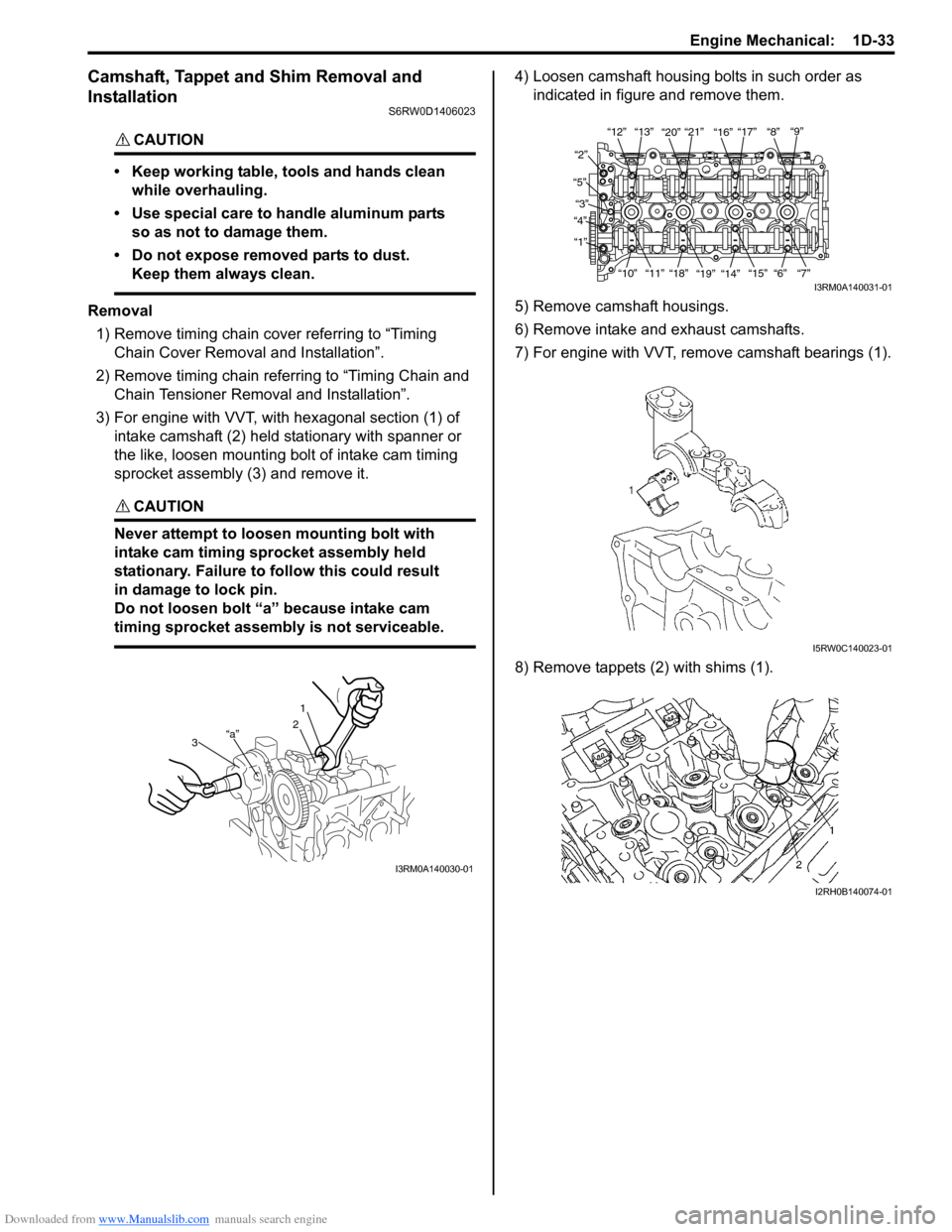
3) For engine with VVT, with hexagonal section (1) of
intake camshaft (2) held stationary with spanner or
the like, loosen mounting bolt of intake cam timing
sprocket assembly (3) and remove it.
CAUTION!
Never attempt to loosen mounting bolt with
intake cam timing sprocket assembly held
stationary. Failure to follow this could result
in damage to lock pin.
Do not loosen bolt “a” because intake cam
timing sprocket assembly is not serviceable.
4) Loosen camshaft housing bolts in such order as
indicated in figure and remove them.
5) Remove camshaft housings.
6) Remove intake and exhaust camshafts.
7) For engine with VVT, remove camshaft bearings (1).
8) Remove tappets (2) with shims (1).
3“a”
1
2
I3RM0A140030-01
“12”“13”
“20”“21”
“16”“17” “8”“9”
“2”
“5”
“3”
“4”
“1”
“10”
“11”“18”
“19” “14”“15” “6” “7”
I3RM0A140031-01
I5RW0C140023-01
I2RH0B140074-01
Page 318 of 1556
Downloaded from www.Manualslib.com manuals search engine 1D-36 Engine Mechanical:
Camshaft, Tappet and Shim InspectionS6RW0D1406024
Intake Cam Timing Sprocket Assembly (For engine
with VVT)
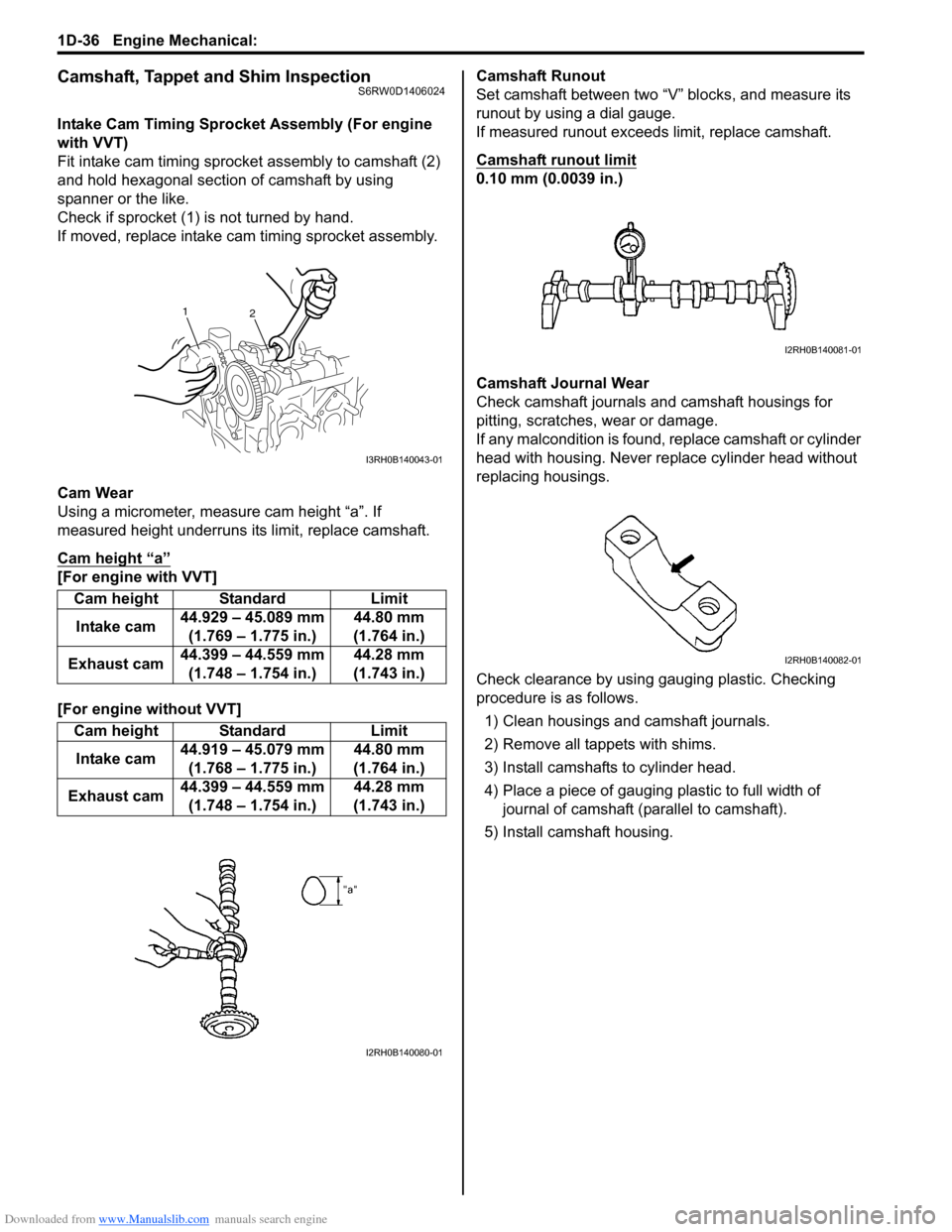
Fit intake cam timing sprocket assembly to camshaft (2)
and hold hexagonal section of camshaft by using
spanner or the like.
Check if sprocket (1) is not turned by hand.
If moved, replace intake cam timing sprocket assembly.
Cam Wear
Using a micrometer, measure cam height “a”. If
measured height underruns its limit, replace camshaft.
Cam height “a”
[For engine with VVT]
[For engine without VVT]Camshaft Runout
Set camshaft between two “V” blocks, and measure its
runout by using a dial gauge.
If measured runout exceeds limit, replace camshaft.
Camshaft runout limit
0.10 mm (0.0039 in.)
Camshaft Journal Wear
Check camshaft journals and camshaft housings for
pitting, scratches, wear or damage.
If any malcondition is found, replace camshaft or cylinder
head with housing. Never replace cylinder head without
replacing housings.
Check clearance by using gauging plastic. Checking
procedure is as follows.
1) Clean housings and camshaft journals.
2) Remove all tappets with shims.
3) Install camshafts to cylinder head.
4) Place a piece of gauging plastic to full width of
journal of camshaft (parallel to camshaft).
5) Install camshaft housing. Cam height Standard Limit
Intake cam44.929 – 45.089 mm
(1.769 – 1.775 in.)44.80 mm
(1.764 in.)
Exhaust cam44.399 – 44.559 mm
(1.748 – 1.754 in.)44.28 mm
(1.743 in.)
Cam height Standard Limit
Intake cam44.919 – 45.079 mm
(1.768 – 1.775 in.)44.80 mm
(1.764 in.)
Exhaust cam44.399 – 44.559 mm
(1.748 – 1.754 in.)44.28 mm
(1.743 in.)
2 1
I3RH0B140043-01
I2RH0B140080-01
I2RH0B140081-01
I2RH0B140082-01
Page 321 of 1556
Downloaded from www.Manualslib.com manuals search engine Engine Mechanical: 1D-39
Valves and Cylinder Head ComponentsS6RW0D1406025
I4RS0A140015-01
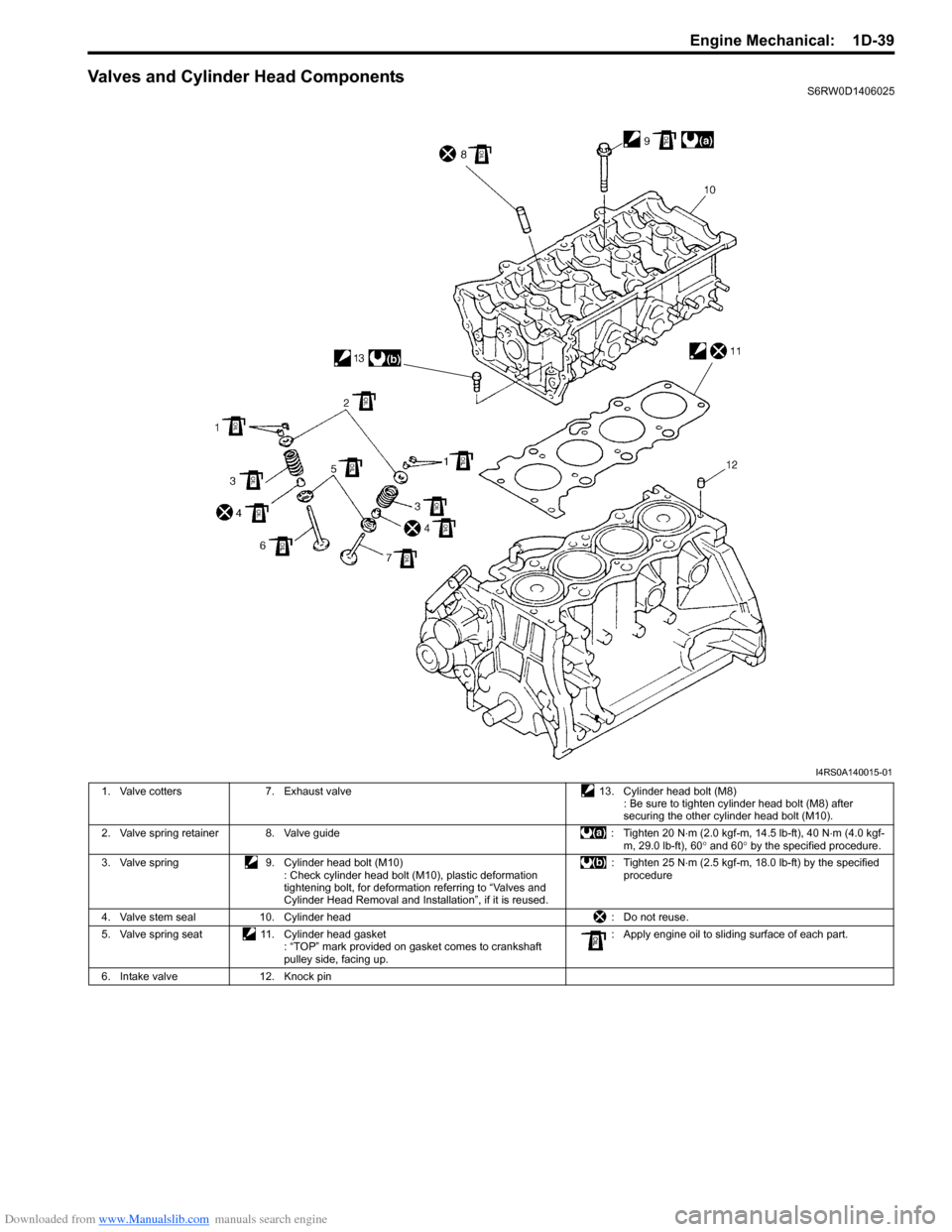
1. Valve cotters 7. Exhaust valve 13. Cylinder head bolt (M8)
: Be sure to tighten cylinder head bolt (M8) after
securing the other cylinder head bolt (M10).
2. Valve spring retainer 8. Valve guide : Tighten 20 N⋅m (2.0 kgf-m, 14.5 lb-ft), 40 N⋅m (4.0 kgf-
m, 29.0 lb-ft), 60° and 60° by the specified procedure.
3. Valve spring 9. Cylinder head bolt (M10)
: Check cylinder head bolt (M10), plastic deformation
tightening bolt, for deformation referring to “Valves and
Cylinder Head Removal and Installation”, if it is reused.: Tighten 25 N⋅m (2.5 kgf-m, 18.0 lb-ft) by the specified
procedure
4. Valve stem seal 10. Cylinder head : Do not reuse.
5. Valve spring seat 11. Cylinder head gasket
: “TOP” mark provided on gasket comes to crankshaft
pulley side, facing up.: Apply engine oil to sliding surface of each part.
6. Intake valve 12. Knock pin
Page 322 of 1556
Downloaded from www.Manualslib.com manuals search engine 1D-40 Engine Mechanical:
Valves and Cylinder Head Removal and
Installation
S6RW0D1406026
Removal
1) Remove engine assembly from vehicle referring to
“Engine Assembly Removal and Installation”.
2) Remove oil pan referring to “Oil Pan and Oil Pump
Strainer Removal and Installation in Section 1E”.
3) Remove cylinder head cover referring to “Cylinder
Head Cover Removal and Installation”.
4) Remove timing chain cover referring to Steps 2) to
11) of “Removal” in “Timing Chain Cover Removal
and Installation”.
5) Remove timing chain referring to Steps 2) to 6) of
“Removal” in “Timing Chain and Chain Tensioner
Removal and Installation”.
6) Remove intake and exhaust camshafts referring to
Steps 3) to 8) of “Removal” in “Camshaft, Tappet and
Shim Removal and Installation”.
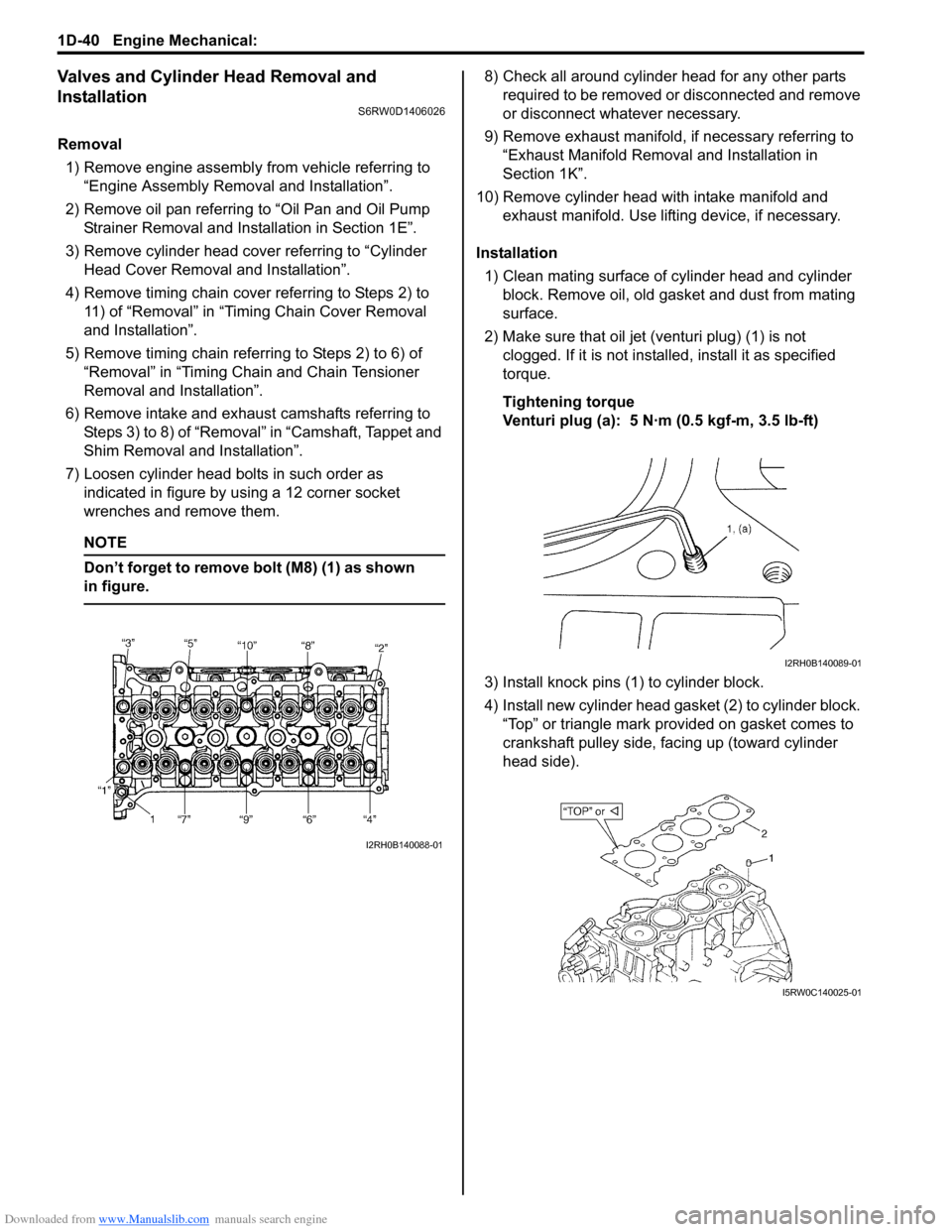
7) Loosen cylinder head bolts in such order as
indicated in figure by using a 12 corner socket
wrenches and remove them.
NOTE
Don’t forget to remove bolt (M8) (1) as shown
in figure.
8) Check all around cylinder head for any other parts
required to be removed or disconnected and remove
or disconnect whatever necessary.
9) Remove exhaust manifold, if necessary referring to
“Exhaust Manifold Removal and Installation in
Section 1K”.
10) Remove cylinder head with intake manifold and
exhaust manifold. Use lifting device, if necessary.
Installation
1) Clean mating surface of cylinder head and cylinder
block. Remove oil, old gasket and dust from mating
surface.
2) Make sure that oil jet (venturi plug) (1) is not
clogged. If it is not installed, install it as specified
torque.
Tightening torque
Venturi plug (a): 5 N·m (0.5 kgf-m, 3.5 lb-ft)
3) Install knock pins (1) to cylinder block.
4) Install new cylinder head gasket (2) to cylinder block.
“Top” or triangle mark provided on gasket comes to
crankshaft pulley side, facing up (toward cylinder
head side).
I2RH0B140088-01
I2RH0B140089-01
I5RW0C140025-01
Page 324 of 1556
Downloaded from www.Manualslib.com manuals search engine 1D-42 Engine Mechanical:
Valves and Cylinder Head Disassembly and
Assembly
S6RW0D1406027
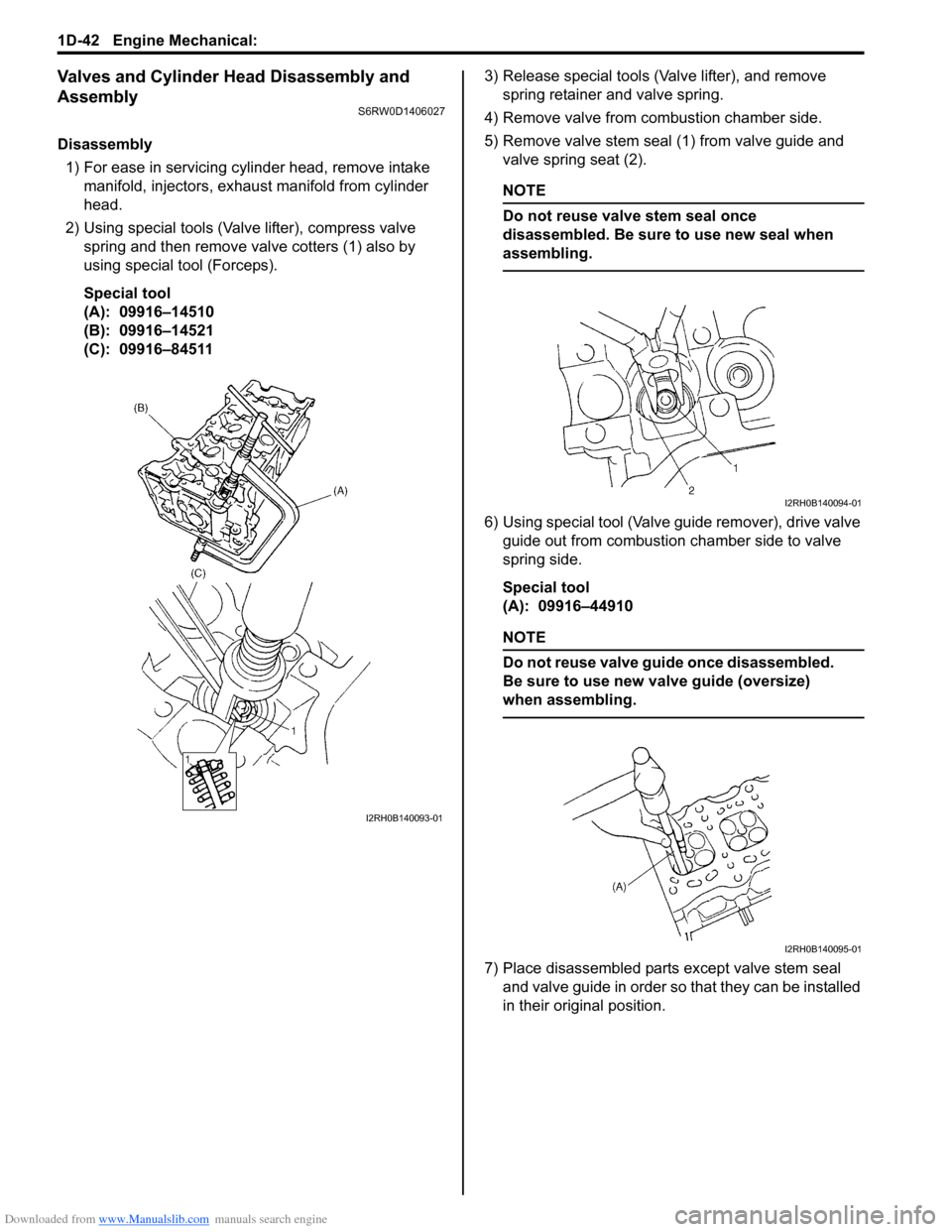
Disassembly
1) For ease in servicing cylinder head, remove intake
manifold, injectors, exhaust manifold from cylinder
head.
2) Using special tools (Valve lifter), compress valve
spring and then remove valve cotters (1) also by
using special tool (Forceps).
Special tool
(A): 09916–14510
(B): 09916–14521
(C): 09916–845113) Release special tools (Valve lifter), and remove
spring retainer and valve spring.
4) Remove valve from combustion chamber side.
5) Remove valve stem seal (1) from valve guide and
valve spring seat (2).
NOTE
Do not reuse valve stem seal once
disassembled. Be sure to use new seal when
assembling.
6) Using special tool (Valve guide remover), drive valve
guide out from combustion chamber side to valve
spring side.
Special tool
(A): 09916–44910
NOTE
Do not reuse valve guide once disassembled.
Be sure to use new valve guide (oversize)
when assembling.
7) Place disassembled parts except valve stem seal
and valve guide in order so that they can be installed
in their original position.
I2RH0B140093-01
I2RH0B140094-01
I2RH0B140095-01
Page 327 of 1556
Downloaded from www.Manualslib.com manuals search engine Engine Mechanical: 1D-45
Valves and Valve Guides InspectionS6RW0D1406028
Valve Guide
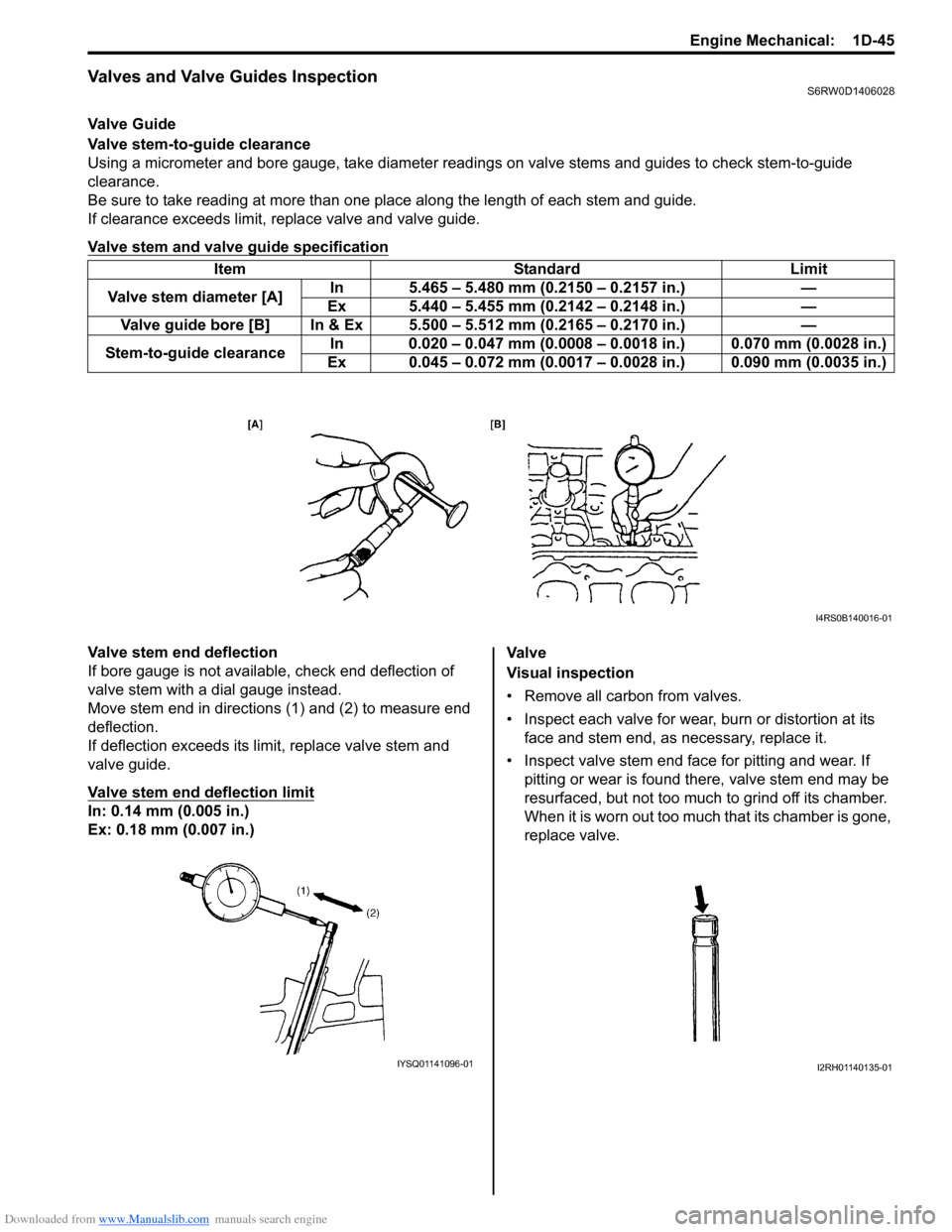
Valve stem-to-guide clearance
Using a micrometer and bore gauge, take diameter readings on valve stems and guides to check stem-to-guide
clearance.
Be sure to take reading at more than one place along the length of each stem and guide.
If clearance exceeds limit, replace valve and valve guide.
Valve stem and valve guide specification
Valve stem end deflection
If bore gauge is not available, check end deflection of
valve stem with a dial gauge instead.
Move stem end in directions (1) and (2) to measure end
deflection.
If deflection exceeds its limit, replace valve stem and
valve guide.
Valve stem end deflection limit
In: 0.14 mm (0.005 in.)
Ex: 0.18 mm (0.007 in.)Va l v e
Visual inspection
• Remove all carbon from valves.
• Inspect each valve for wear, burn or distortion at its
face and stem end, as necessary, replace it.
• Inspect valve stem end face for pitting and wear. If
pitting or wear is found there, valve stem end may be
resurfaced, but not too much to grind off its chamber.
When it is worn out too much that its chamber is gone,
replace valve. Item Standard Limit
Valve stem diameter [A]In 5.465 – 5.480 mm (0.2150 – 0.2157 in.) —
Ex 5.440 – 5.455 mm (0.2142 – 0.2148 in.) —
Valve guide bore [B] In & Ex 5.500 – 5.512 mm (0.2165 – 0.2170 in.) —
Stem-to-guide clearanceIn 0.020 – 0.047 mm (0.0008 – 0.0018 in.) 0.070 mm (0.0028 in.)
Ex 0.045 – 0.072 mm (0.0017 – 0.0028 in.) 0.090 mm (0.0035 in.)
I4RS0B140016-01
IYSQ01141096-01I2RH01140135-01
Page 329 of 1556
Downloaded from www.Manualslib.com manuals search engine Engine Mechanical: 1D-47
Cylinder Head InspectionS6RW0D1406029
• Remove all carbon deposits from combustion
chambers.
NOTE
Do not use any sharp-edged tool to scrape
off carbon deposits. Be careful not to scuff or
nick metal surfaces when decarbonizing. The
same applies to valves and valve seats, too.
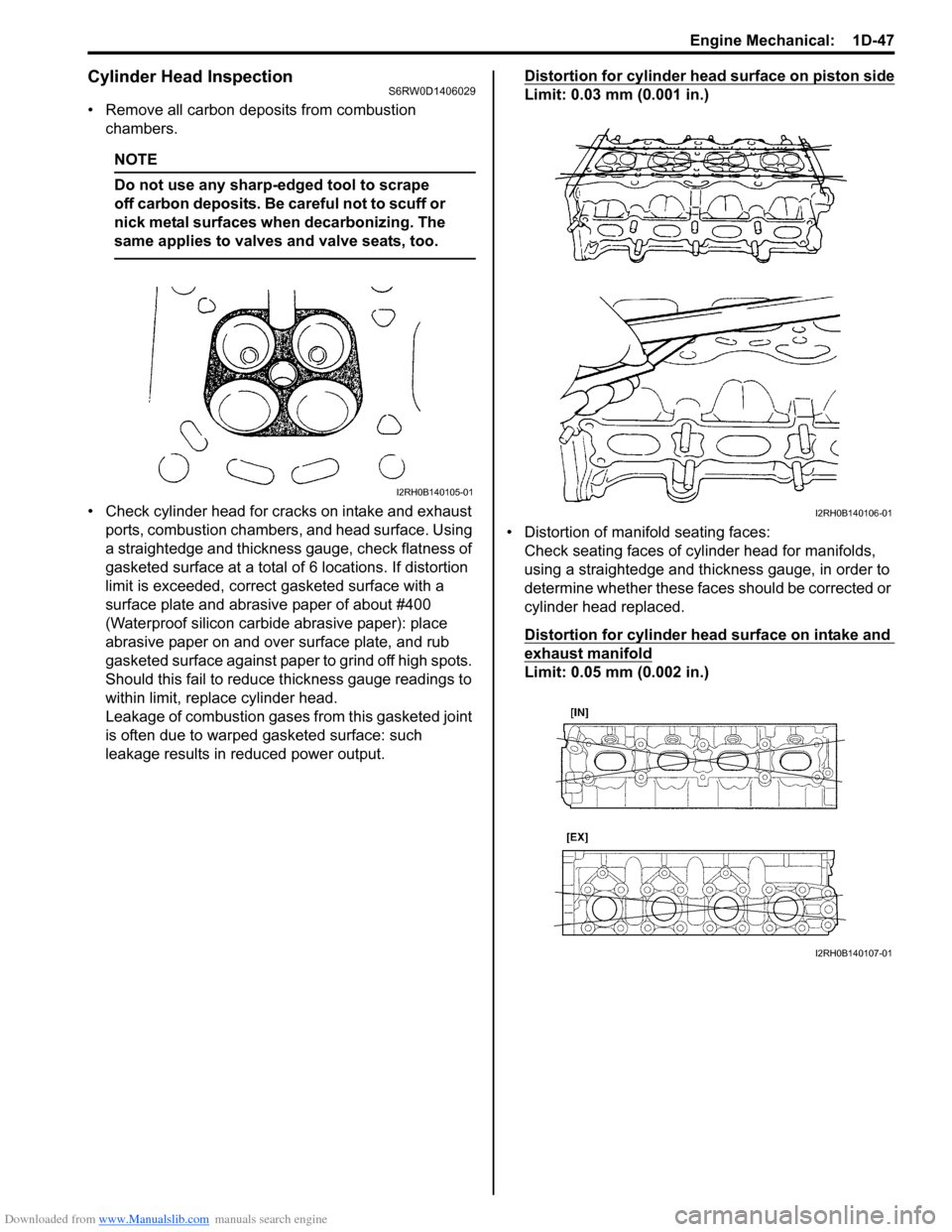
• Check cylinder head for cracks on intake and exhaust
ports, combustion chambers, and head surface. Using
a straightedge and thickness gauge, check flatness of
gasketed surface at a total of 6 locations. If distortion
limit is exceeded, correct gasketed surface with a
surface plate and abrasive paper of about #400
(Waterproof silicon carbide abrasive paper): place
abrasive paper on and over surface plate, and rub
gasketed surface against paper to grind off high spots.
Should this fail to reduce thickness gauge readings to
within limit, replace cylinder head.
Leakage of combustion gases from this gasketed joint
is often due to warped gasketed surface: such
leakage results in reduced power output.Distortion for cylinder head surface on piston side
Limit: 0.03 mm (0.001 in.)
• Distortion of manifold seating faces:
Check seating faces of cylinder head for manifolds,
using a straightedge and thickness gauge, in order to
determine whether these faces should be corrected or
cylinder head replaced.
Distortion for cylinder head surface on intake and
exhaust manifold
Limit: 0.05 mm (0.002 in.)
I2RH0B140105-01
I2RH0B140106-01
I2RH0B140107-01
Page 367 of 1556
Downloaded from www.Manualslib.com manuals search engine Engine Cooling System: 1F-2
Schematic and Routing Diagram
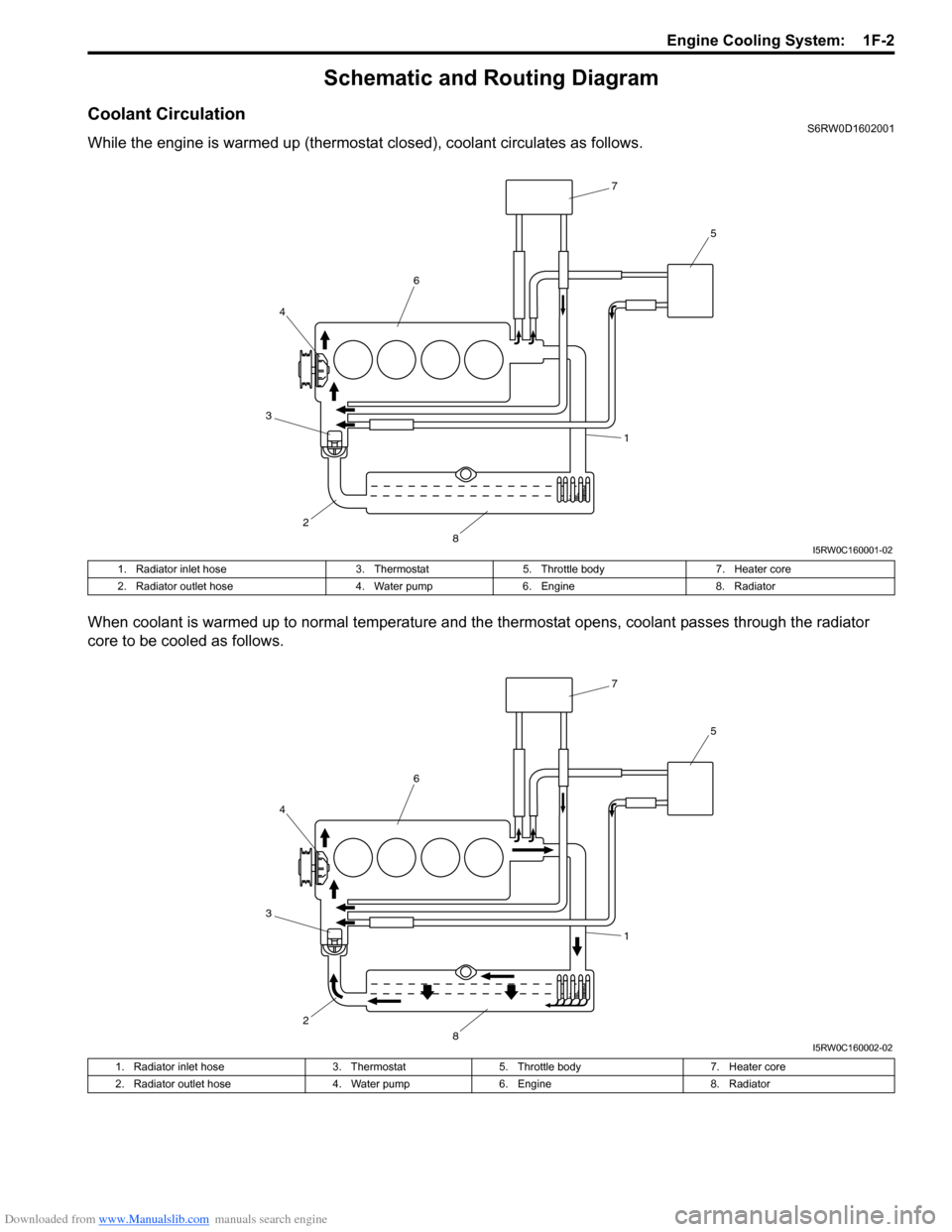
Coolant CirculationS6RW0D1602001
While the engine is warmed up (thermostat closed), coolant circulates as follows.
When coolant is warmed up to normal temperature and the thermostat opens, coolant passes through the radiator
core to be cooled as follows.
7
5
6
4
3
2
81
I5RW0C160001-02
1. Radiator inlet hose 3. Thermostat 5. Throttle body 7. Heater core
2. Radiator outlet hose 4. Water pump 6. Engine 8. Radiator
7
5
6
4
3
2
81
I5RW0C160002-02
1. Radiator inlet hose 3. Thermostat 5. Throttle body 7. Heater core
2. Radiator outlet hose 4. Water pump 6. Engine 8. Radiator
Page 531 of 1556
Downloaded from www.Manualslib.com manuals search engine Differential: 3B-34
Front Mounting Arm and/or Rear Mounting
Bracket Assembly Removal and Installation
S6RW0D3206010
Remove and install front mounting arm and/or rear
mounting bracket after rear differential removed.
For tightening torque of each bolt and nut, refer to “Rear
Differential Mountings Components”.
Rear Mounting Bracket Assembly Disassembly
and Reassembly
S6RW0D3206011
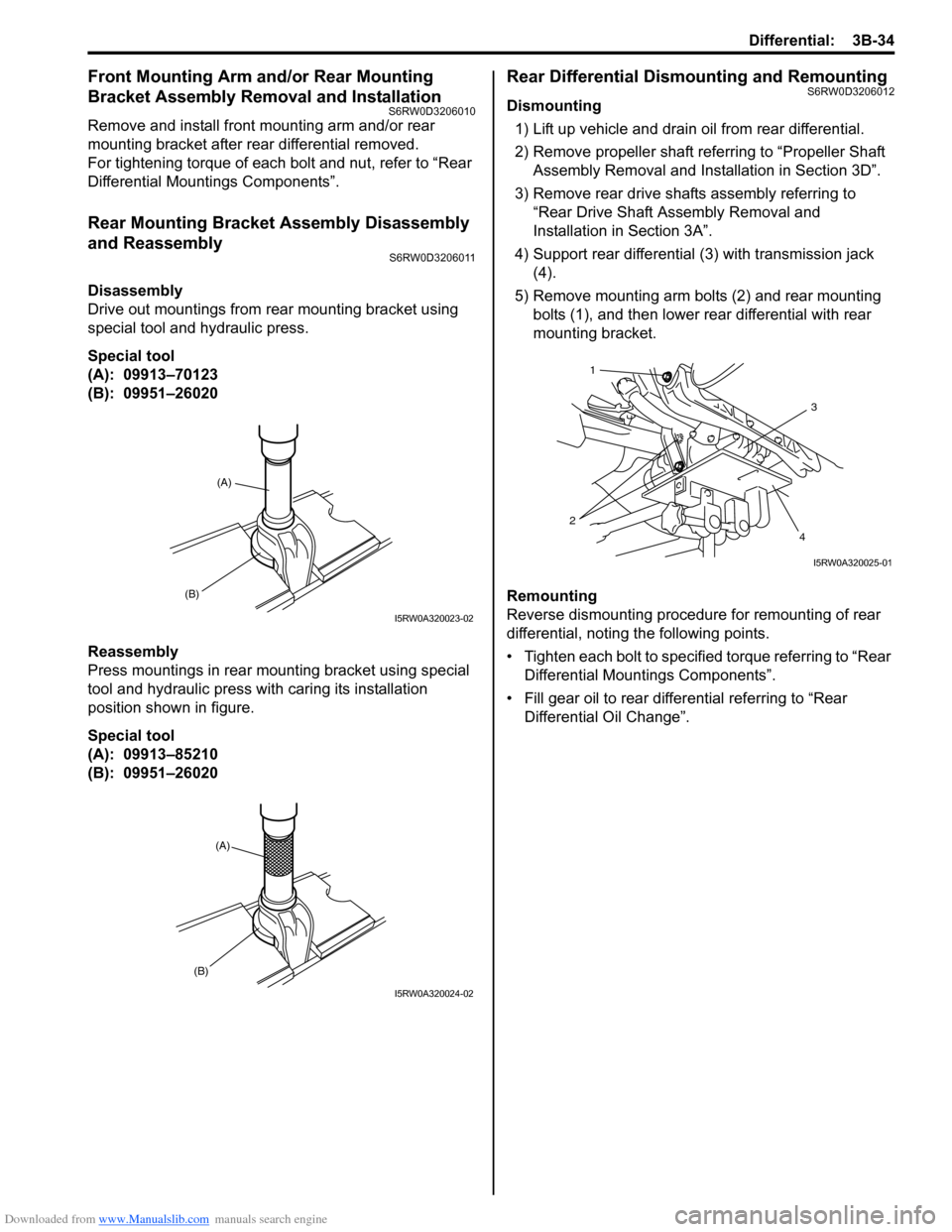
Disassembly
Drive out mountings from rear mounting bracket using
special tool and hydraulic press.
Special tool
(A): 09913–70123
(B): 09951–26020
Reassembly
Press mountings in rear mounting bracket using special
tool and hydraulic press with caring its installation
position shown in figure.
Special tool
(A): 09913–85210
(B): 09951–26020
Rear Differential Dismounting and RemountingS6RW0D3206012
Dismounting
1) Lift up vehicle and drain oil from rear differential.
2) Remove propeller shaft referring to “Propeller Shaft
Assembly Removal and Installation in Section 3D”.
3) Remove rear drive shafts assembly referring to
“Rear Drive Shaft Assembly Removal and
Installation in Section 3A”.
4) Support rear differential (3) with transmission jack
(4).
5) Remove mounting arm bolts (2) and rear mounting
bolts (1), and then lower rear differential with rear
mounting bracket.
Remounting
Reverse dismounting procedure for remounting of rear
differential, noting the following points.
• Tighten each bolt to specified torque referring to “Rear
Differential Mountings Components”.
• Fill gear oil to rear differential referring to “Rear
Differential Oil Change”.
(B)
(A)
I5RW0A320023-02
(A)
(B)
I5RW0A320024-02
3
4 21
I5RW0A320025-01
Page 547 of 1556
Downloaded from www.Manualslib.com manuals search engine Differential: 3B-50
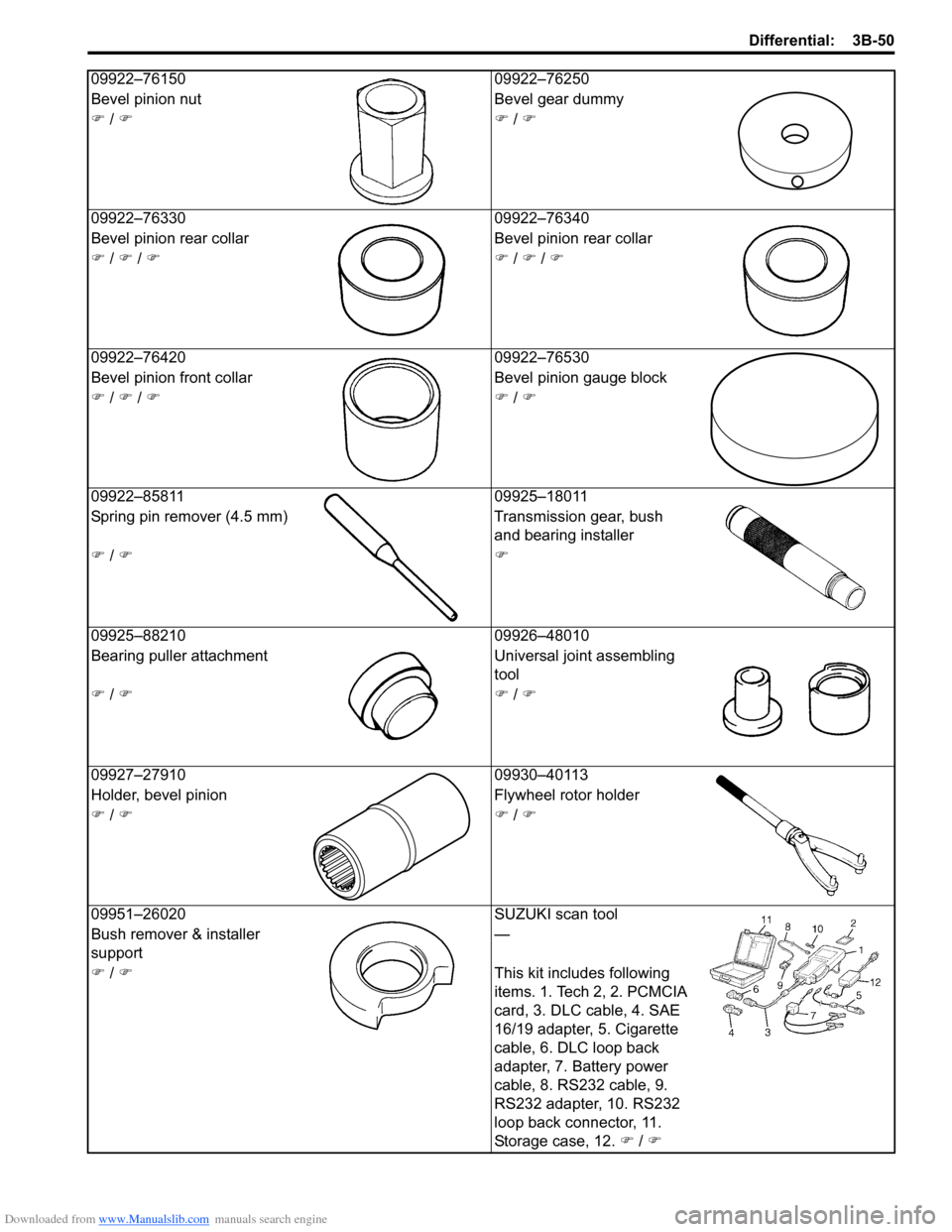
09922–76150 09922–76250
Bevel pinion nut Bevel gear dummy
) / )) / )
09922–76330 09922–76340
Bevel pinion rear collar Bevel pinion rear collar
) / ) / )) / ) / )
09922–76420 09922–76530
Bevel pinion front collar Bevel pinion gauge block
) / ) / )) / )
09922–85811 09925–18011
Spring pin remover (4.5 mm) Transmission gear, bush
and bearing installer
) / ))
09925–88210 09926–48010
Bearing puller attachment Universal joint assembling
tool
) / )) / )
09927–27910 09930–40113
Holder, bevel pinion Flywheel rotor holder
) / )) / )
09951–26020 SUZUKI scan tool
Bush remover & installer
support—
) / )This kit includes following
items. 1. Tech 2, 2. PCMCIA
card, 3. DLC cable, 4. SAE
16/19 adapter, 5. Cigarette
cable, 6. DLC loop back
adapter, 7. Battery power
cable, 8. RS232 cable, 9.
RS232 adapter, 10. RS232
loop back connector, 11.
Storage case, 12. ) / )