Oil pressure switch SUZUKI SX4 2006 1.G Service User Guide
[x] Cancel search | Manufacturer: SUZUKI, Model Year: 2006, Model line: SX4, Model: SUZUKI SX4 2006 1.GPages: 1556, PDF Size: 37.31 MB
Page 107 of 1556
Downloaded from www.Manualslib.com manuals search engine Engine General Information and Diagnosis: 1A-57
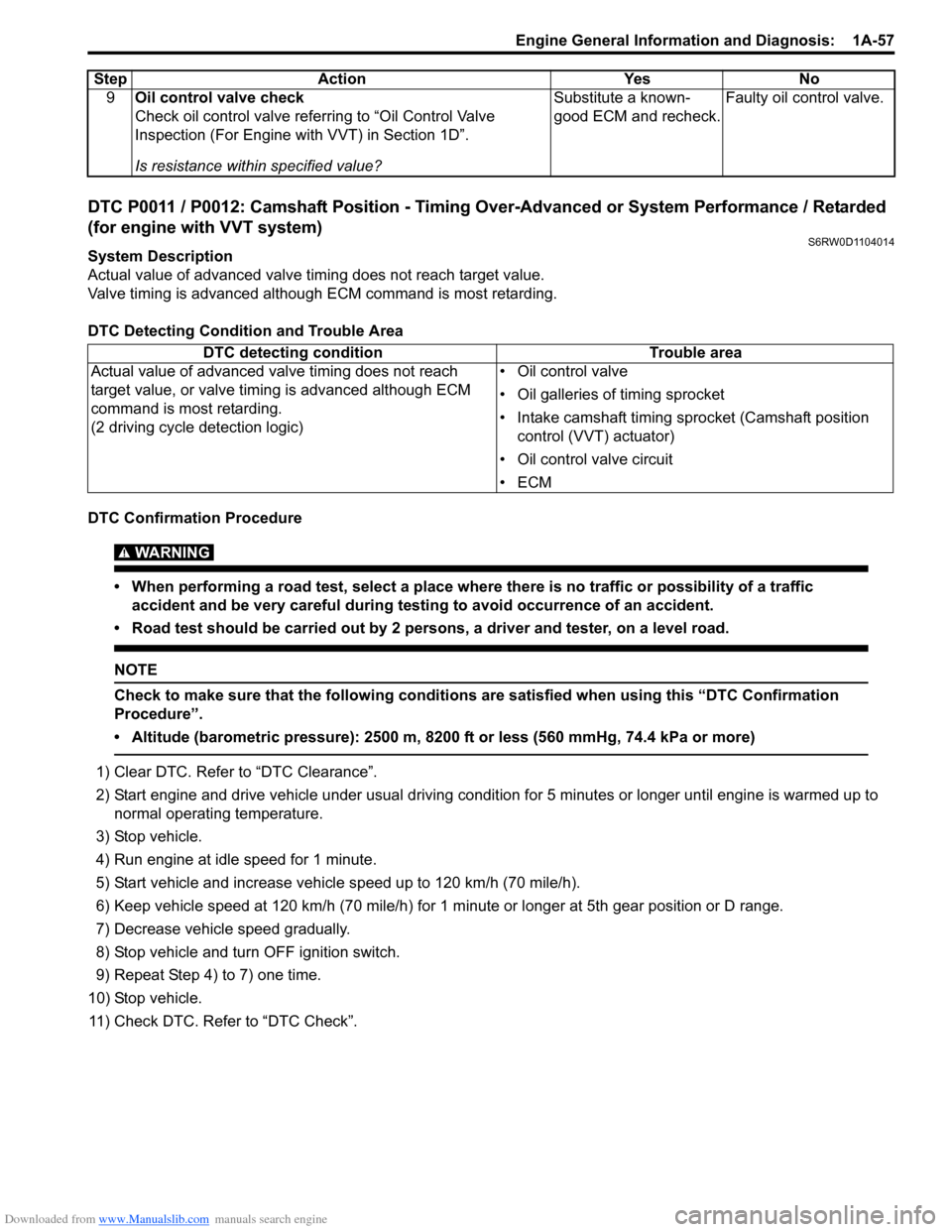
DTC P0011 / P0012: Camshaft Position - Timing Over-Advanced or System Performance / Retarded
(for engine with VVT system)
S6RW0D1104014
System Description
Actual value of advanced valve timing does not reach target value.
Valve timing is advanced although ECM command is most retarding.
DTC Detecting Condition and Trouble Area
DTC Confirmation Procedure
WARNING!
• When performing a road test, select a place where there is no traffic or possibility of a traffic
accident and be very careful during testing to avoid occurrence of an accident.
• Road test should be carried out by 2 persons, a driver and tester, on a level road.
NOTE
Check to make sure that the following conditions are satisfied when using this “DTC Confirmation
Procedure”.
• Altitude (barometric pressure): 2500 m, 8200 ft or less (560 mmHg, 74.4 kPa or more)
1) Clear DTC. Refer to “DTC Clearance”.
2) Start engine and drive vehicle under usual driving condition for 5 minutes or longer until engine is warmed up to
normal operating temperature.
3) Stop vehicle.
4) Run engine at idle speed for 1 minute.
5) Start vehicle and increase vehicle speed up to 120 km/h (70 mile/h).
6) Keep vehicle speed at 120 km/h (70 mile/h) for 1 minute or longer at 5th gear position or D range.
7) Decrease vehicle speed gradually.
8) Stop vehicle and turn OFF ignition switch.
9) Repeat Step 4) to 7) one time.
10) Stop vehicle.
11) Check DTC. Refer to “DTC Check”.9Oil control valve check
Check oil control valve referring to “Oil Control Valve
Inspection (For Engine with VVT) in Section 1D”.
Is resistance within specified value?Substitute a known-
good ECM and recheck.Faulty oil control valve. Step Action Yes No
DTC detecting condition Trouble area
Actual value of advanced valve timing does not reach
target value, or valve timing is advanced although ECM
command is most retarding.
(2 driving cycle detection logic)• Oil control valve
• Oil galleries of timing sprocket
• Intake camshaft timing sprocket (Camshaft position
control (VVT) actuator)
• Oil control valve circuit
•ECM
Page 108 of 1556
Downloaded from www.Manualslib.com manuals search engine 1A-58 Engine General Information and Diagnosis:
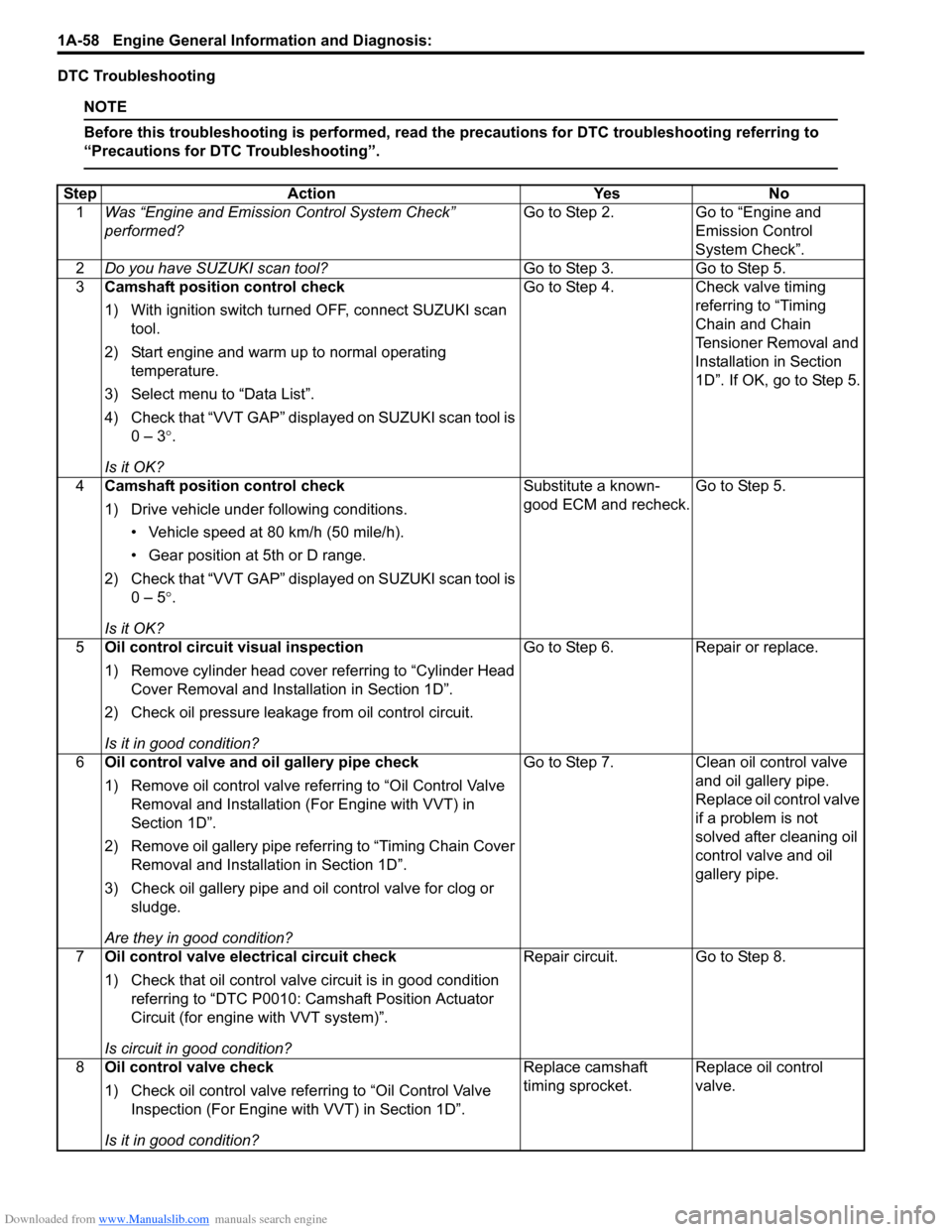
DTC Troubleshooting
NOTE
Before this troubleshooting is performed, read the precautions for DTC troubleshooting referring to
“Precautions for DTC Troubleshooting”.
Step Action Yes No
1Was “Engine and Emission Control System Check”
performed?Go to Step 2. Go to “Engine and
Emission Control
System Check”.
2Do you have SUZUKI scan tool?Go to Step 3. Go to Step 5.
3Camshaft position control check
1) With ignition switch turned OFF, connect SUZUKI scan
tool.
2) Start engine and warm up to normal operating
temperature.
3) Select menu to “Data List”.
4) Check that “VVT GAP” displayed on SUZUKI scan tool is
0 – 3°.
Is it OK?Go to Step 4. Check valve timing
referring to “Timing
Chain and Chain
Tensioner Removal and
Installation in Section
1D”. If OK, go to Step 5.
4Camshaft position control check
1) Drive vehicle under following conditions.
• Vehicle speed at 80 km/h (50 mile/h).
• Gear position at 5th or D range.
2) Check that “VVT GAP” displayed on SUZUKI scan tool is
0 – 5°.
Is it OK?Substitute a known-
good ECM and recheck.Go to Step 5.
5Oil control circuit visual inspection
1) Remove cylinder head cover referring to “Cylinder Head
Cover Removal and Installation in Section 1D”.
2) Check oil pressure leakage from oil control circuit.
Is it in good condition?Go to Step 6. Repair or replace.
6Oil control valve and oil gallery pipe check
1) Remove oil control valve referring to “Oil Control Valve
Removal and Installation (For Engine with VVT) in
Section 1D”.
2) Remove oil gallery pipe referring to “Timing Chain Cover
Removal and Installation in Section 1D”.
3) Check oil gallery pipe and oil control valve for clog or
sludge.
Are they in good condition?Go to Step 7. Clean oil control valve
and oil gallery pipe.
Replace oil control valve
if a problem is not
solved after cleaning oil
control valve and oil
gallery pipe.
7Oil control valve electrical circuit check
1) Check that oil control valve circuit is in good condition
referring to “DTC P0010: Camshaft Position Actuator
Circuit (for engine with VVT system)”.
Is circuit in good condition?Repair circuit. Go to Step 8.
8Oil control valve check
1) Check oil control valve referring to “Oil Control Valve
Inspection (For Engine with VVT) in Section 1D”.
Is it in good condition?Replace camshaft
timing sprocket.Replace oil control
valve.
Page 224 of 1556
Downloaded from www.Manualslib.com manuals search engine 1A-174 Engine General Information and Diagnosis:
C01-10 WHTOxygen signal of
heated oxygen
sensor-10 – 1 V Ignition switch turned ON.
— *Deflects between
over 0.5 V and under
0.45 V
(“Reference
waveform No.8: ” and
“Reference waveform
No.9: ”)While engine running at
2,000 r/min. for 1 min. or
longer after warmed up.
C01-11 BRNOxygen signal of
heated oxygen
sensor-2 (if
equipped)4 – 5 V Ignition switch turned ON.
— *Deflects between
over 0.5 V and under
0.45 V
(“Reference
waveform No.10: ”)While engine running at
2,000 r/min. or more after
vehicle running over 30
km/h, 19 mph for 5 min.
C01-12 WHTCAN (low)
communication line
(active low signal)
to TCM (for A/T
model)*0.5 – 2.5 V
(“Reference
waveform No.23: ”)
Ignition switch turned ON
with engine stop.CAN communication line
signal is pulse. Pulse
signal displayed with a
regular frequency which
varies depending on
engine condition. C01-13 REDCAN (high)
communication line
(active high signal)
to TCM (for A/T
model)*2.5 – 4.5 V
(“Reference
waveform No.23: ”)
C01-14GRY/
REDOutput of 5 V
power source for
MAP sensor and A/
C refrigerant
pressure sensor (if
equipped with A/C)4.5 – 5.5 V Ignition switch turned ON. —
C01-15 BLK Ground for ECM Below 0.3 V Ignition switch turned ON. —
C01-16BLU/
REDFuel injector No.3
output10 – 14 V Ignition switch turned ON. —
*0 – 0.6 V
↑↓
10 – 14 V
(“Reference
waveform No.1: ” and
“Reference waveform
No.11: ”)Engine running at idle
after warmed up engine.Output signal is active low
pulse. Pulse frequency
varies depending on
engine speed.
C01-17BLU/
ORNFuel injector No.4
output10 – 14 V Ignition switch turned ON. —
*0 – 0.6 V
↑↓
10 – 14 V
(“Reference
waveform No.1: ” and
“Reference waveform
No.12: ”)Engine running at idle
after warmed up engine.Output signal is active low
pulse. Pulse frequency
varies depending on
engine speed.
C01-18BRN/
YELEGR valve
(stepper motor coil
4) output (if
equipped)10 – 14 V Ignition switch turned ON. —
*0 – 1 V
↑↓
10 – 14 V
(“Reference
waveform No.4: ”)Ignition switch is turned to
ST (cranking) position.Output signal is active low
duty pulse. Number of
pulse generated times
varies depending on
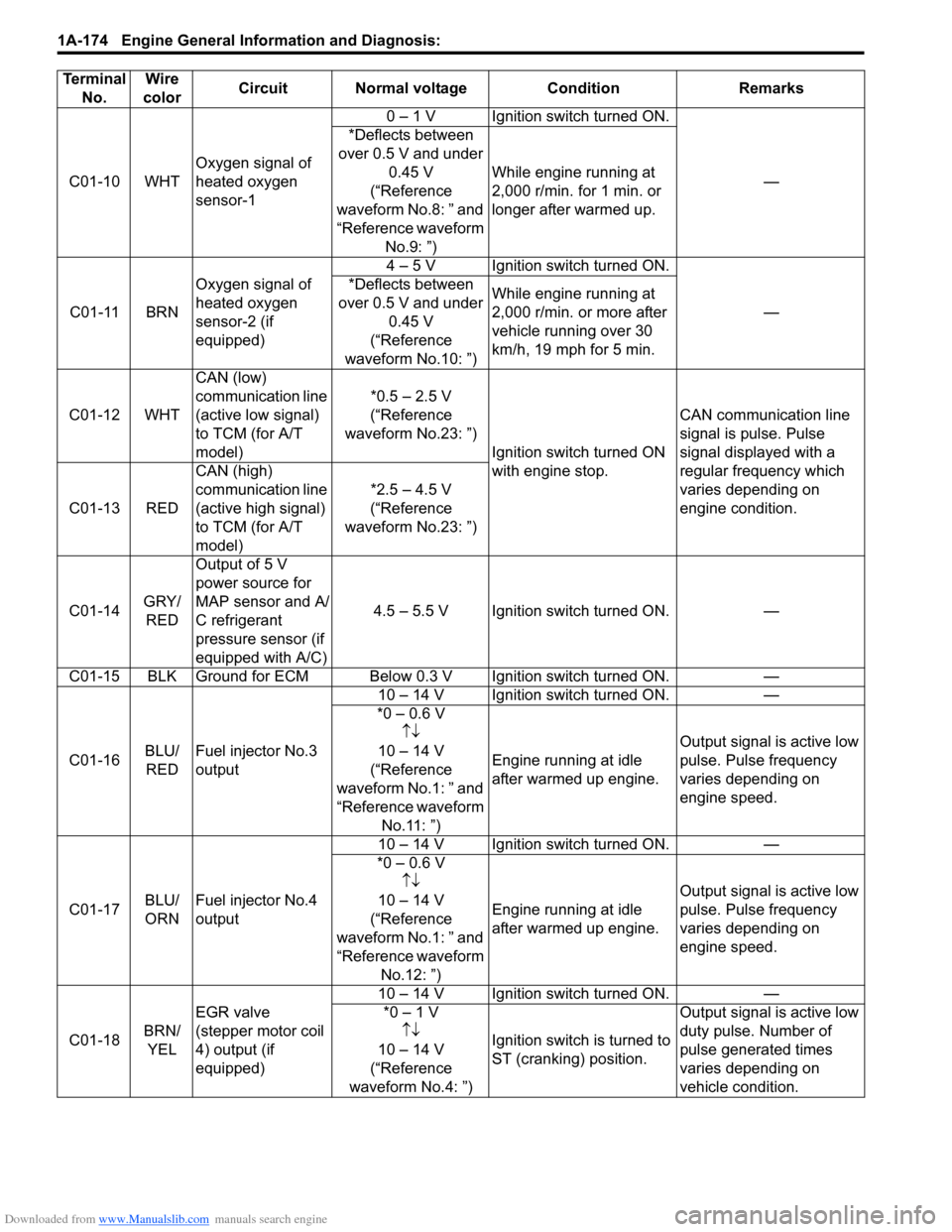
vehicle condition. Terminal
No.Wire
colorCircuit Normal voltage Condition Remarks
Page 227 of 1556
Downloaded from www.Manualslib.com manuals search engine Engine General Information and Diagnosis: 1A-177
C01-48YEL/
GRNStarting motor
signal0 – 1 V Ignition switch turned ON.
—
6 – 14 V While engine cranking.
C01-49 — — — — —
C01-50WHT/
BLUGround of ECM for
shield wireBelow 0.3 V Ignition switch turned ON. —
C01-51 — — — — —
C01-52 — — — — —
C01-53RED/
BLKManifold absolute
pressure (MAP)
sensor signal (if
equipped)Approx. 4 V
(“Reference
waveform No.17: ”)Ignition switch turned ON
with barometric pressure
at 100 kPa, 760 mmHg.
—
0.4 – 2.0 V
(“Reference
waveform No.18: ”)While engine running at
specified idle speed after
warmed up with
barometric pressure at
100 kPa, 760 mmHg.
C01c01-
54GRNThrottle position
sensor (main)
signal0.75 – 1.08 VIgnition switch turned ON
and accelerator pedal at
idle position after warmed
up engine.
—
3.67 – 4.24 V
(“Reference
waveform No.29: ”)Ignition switch turned ON
and accelerator pedal at
full depressed position
after warmed up engine.
C01-55GRY/
BLUGround for sensors Below 0.3 V Ignition switch turned ON. —
C01-56 REDKnock sensor
signal2 – 3 V
(“Reference
waveform No.19: ”
and “Reference
waveform No.20: ”)Ignition switch turned ON.
— Engine running at 4000 r/
min. after warmed up.
C01-57 ORN Ground for sensors Below 0.3 V Ignition switch turned ON. —
C01-58BLK/
ORNGround for ECM Below 0.3 V Ignition switch turned ON. —
C01-59GRN/
WHTOil control valve
ground (for engine
with VVT system)Below 1.3 V Ignition switch turned ON. —
C01-60GRN/
REDOil control valve
output (for engine
with VVT system)*0 – 0.6 V
↑↓
10 – 14 V
(“Reference
waveform No.21: ”
and “Reference
waveform No.22: ”)At the moment of ignition
switch turned ON.Output signal is active
high pulse. Duty ratio
varies depending on
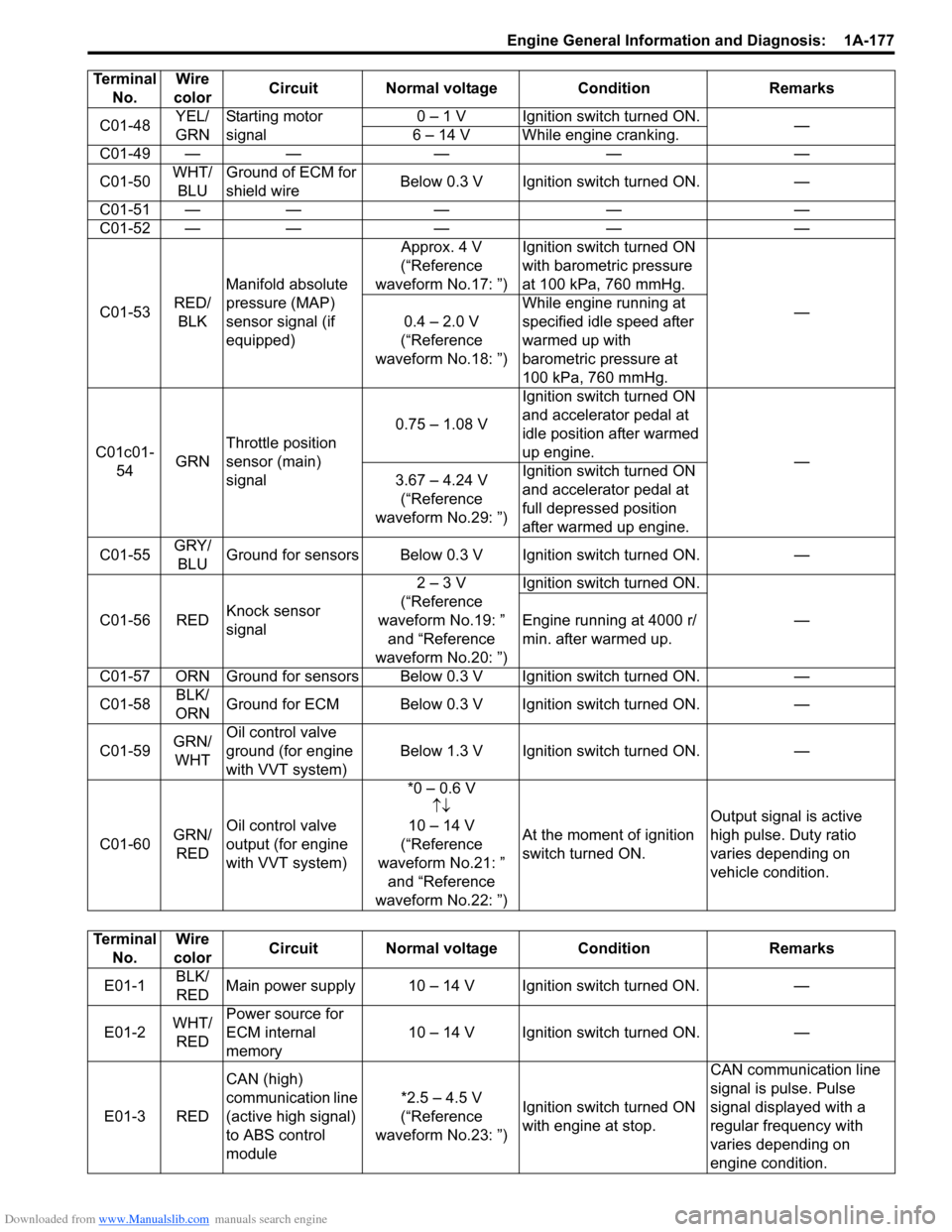
vehicle condition. Terminal
No.Wire
colorCircuit Normal voltage Condition Remarks
Terminal
No.Wire
colorCircuit Normal voltage Condition Remarks
E01-1BLK/
REDMain power supply 10 – 14 V Ignition switch turned ON. —
E01-2WHT/
REDPower source for
ECM internal
memory10 – 14 V Ignition switch turned ON. —
E01-3 REDCAN (high)
communication line
(active high signal)
to ABS control
module*2.5 – 4.5 V
(“Reference
waveform No.23: ”)Ignition switch turned ON
with engine at stop.CAN communication line
signal is pulse. Pulse
signal displayed with a
regular frequency with
varies depending on
engine condition.
Page 243 of 1556
Downloaded from www.Manualslib.com manuals search engine Engine General Information and Diagnosis: 1A-193
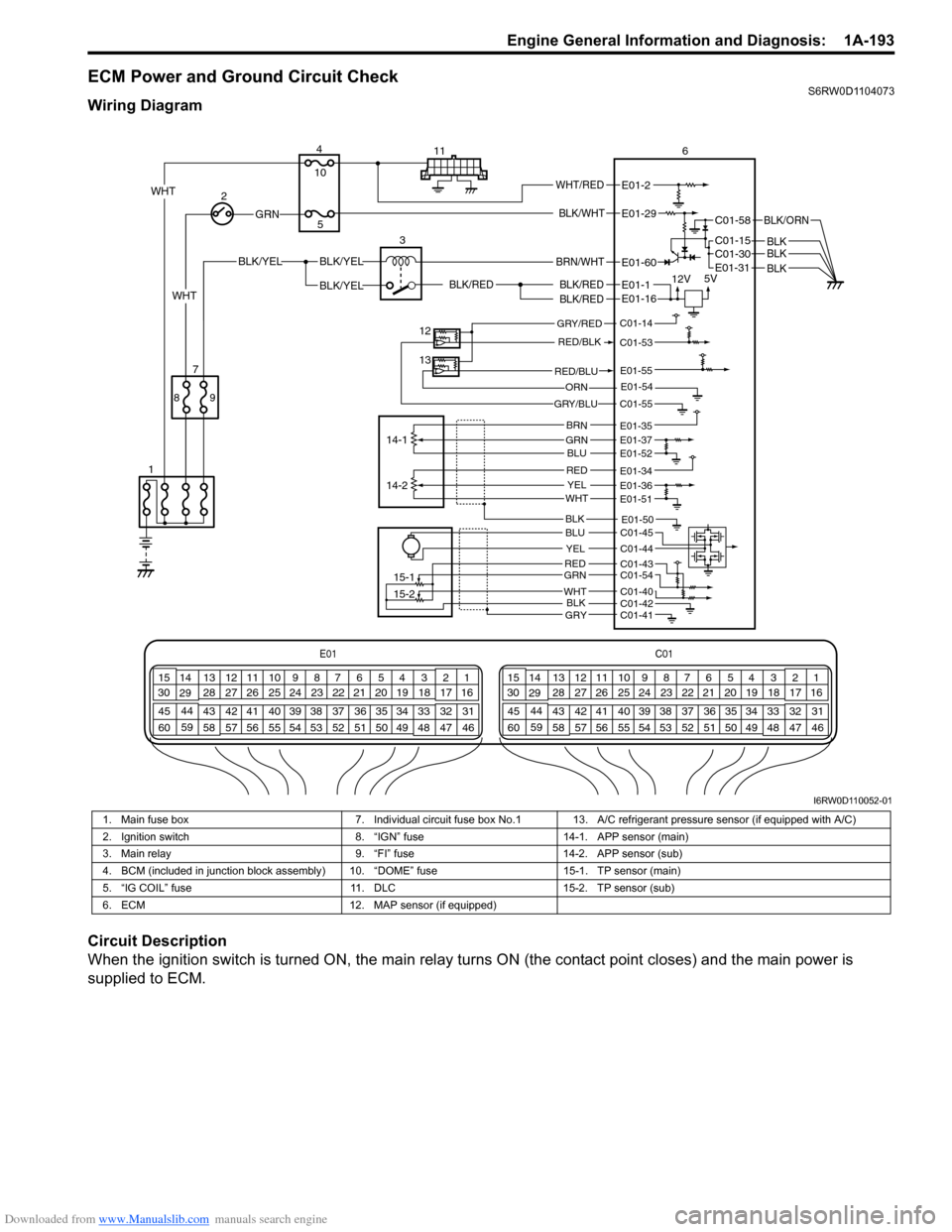
ECM Power and Ground Circuit CheckS6RW0D1104073
Wiring Diagram
Circuit Description
When the ignition switch is turned ON, the main relay turns ON (the contact point closes) and the main power is
supplied to ECM.
E01C01
3 4
18 19 5 6 7 10 11
17 20
47 46 49 50 51 21 22
5216 259
24 14
29
55 57 54 53 59
60 582
26 27 28 15
30
56 4832 31 34 35 36 37 40 42 39 38 44
45 43 41 331 12 13
238 3 4
18 19 5 6 7 10 11
17 20
47 46 49 50 51 21 22
5216 259
24 14
29
55 57 54 53 59
60 582
26 27 28 15
30
56 4832 31 34 35 36 37 40 42 39 38 44
45 43 41 331 12 13
238
BLK/WHT
BLK/RED
BLK/RED
BLK/RED
BLK/YELBLK/YEL
BLK/YEL
GRN
BRN/WHT
12V5V
2
13
12
13
14-1
15-1
15-2 14-2 4
56
E01-29
E01-1
E01-60
E01-16
9 87
1011
WHTWHT/REDE01-2
C01-58
C01-15 C01-30
BLK/ORN
BLKBLKBLK
WHT
GRY/RED
RED/BLK
GRY/BLU
C01-14
C01-53
C01-55
E01-54ORN
RED/BLUE01-55
BRNGRNBLU
REDYELWHT
E01-35E01-37E01-52
E01-51
E01-34E01-36
E01-50
REDGRN
WHTBLK
BLU
YEL
C01-43C01-54
C01-40C01-42
C01-45
C01-44
C01-41
E01-31
GRY
BLK
I6RW0D110052-01
1. Main fuse box 7. Individual circuit fuse box No.1 13. A/C refrigerant pressure sensor (if equipped with A/C)
2. Ignition switch 8. “IGN” fuse 14-1. APP sensor (main)
3. Main relay 9. “FI” fuse 14-2. APP sensor (sub)
4. BCM (included in junction block assembly) 10. “DOME” fuse 15-1. TP sensor (main)
5. “IG COIL” fuse 11. DLC 15-2. TP sensor (sub)
6. ECM 12. MAP sensor (if equipped)
Page 246 of 1556
Downloaded from www.Manualslib.com manuals search engine 1A-196 Engine General Information and Diagnosis:
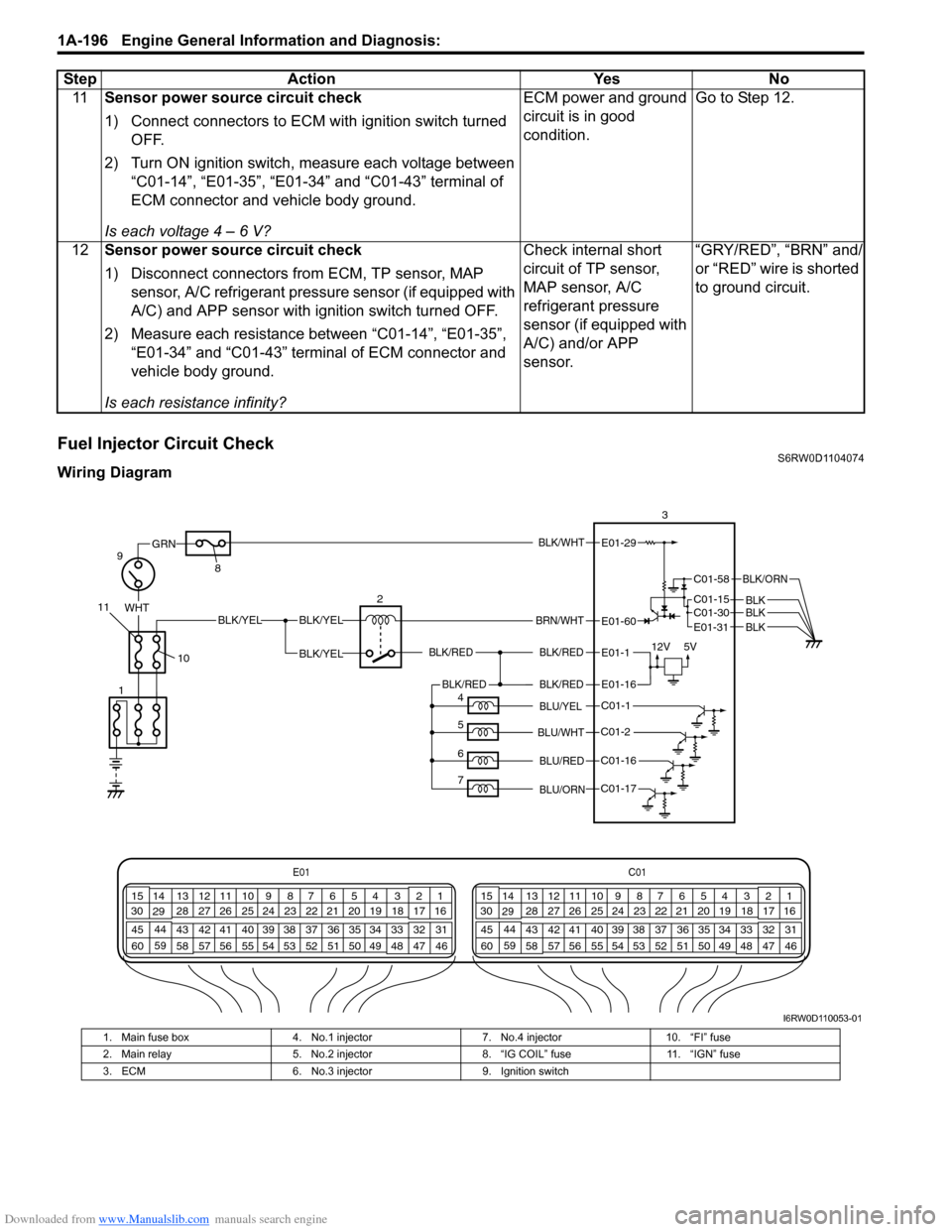
Fuel Injector Circuit CheckS6RW0D1104074
Wiring Diagram11Sensor power source circuit check
1) Connect connectors to ECM with ignition switch turned
OFF.
2) Turn ON ignition switch, measure each voltage between
“C01-14”, “E01-35”, “E01-34” and “C01-43” terminal of
ECM connector and vehicle body ground.
Is each voltage 4 – 6 V?ECM power and ground
circuit is in good
condition.Go to Step 12.
12Sensor power source circuit check
1) Disconnect connectors from ECM, TP sensor, MAP
sensor, A/C refrigerant pressure sensor (if equipped with
A/C) and APP sensor with ignition switch turned OFF.
2) Measure each resistance between “C01-14”, “E01-35”,
“E01-34” and “C01-43” terminal of ECM connector and
vehicle body ground.
Is each resistance infinity?Check internal short
circuit of TP sensor,
MAP sensor, A/C
refrigerant pressure
sensor (if equipped with
A/C) and/or APP
sensor.“GRY/RED”, “BRN” and/
or “RED” wire is shorted
to ground circuit. Step Action Yes No
BLK/WHT
BLK/RED
BLK/RED
WHTBLK/YELBLK/YEL
BLK/YEL
GRN
BRN/WHT
12V5V
9
2 83E01-29
E01-1
E01-60
10 11
E01C01
3 4
18 19 5 6 7 10 11
17 20
47 46 49 50 51 21 22
5216 259
24 14
29
55 57 54 53 59
60 582
26 27 28 15
30
56 4832 31 34 35 36 37 40 42 39 38 44
45 43 41 331 12 13
238 3 4
18 19 5 6 7 10 11
17 20
47 46 49 50 51 21 22
5216 259
24 14
29
55 57 54 53 59
60 582
26 27 28 15
30
56 4832 31 34 35 36 37 40 42 39 38 44
45 43 41 331 12 13
238
C01-1
C01-2
C01-16
C01-17
BLK/REDBLK/RED
BLU/YEL
BLU/RED
BLU/ORN
BLU/WHT
E01-16
4
5
6
71
C01-58
C01-15 C01-30
BLK/ORN
BLKBLKBLKE01-31
I6RW0D110053-01
1. Main fuse box 4. No.1 injector 7. No.4 injector 10. “FI” fuse
2. Main relay 5. No.2 injector 8. “IG COIL” fuse 11. “IGN” fuse
3. ECM 6. No.3 injector 9. Ignition switch
Page 252 of 1556
Downloaded from www.Manualslib.com manuals search engine 1A-202 Engine General Information and Diagnosis:
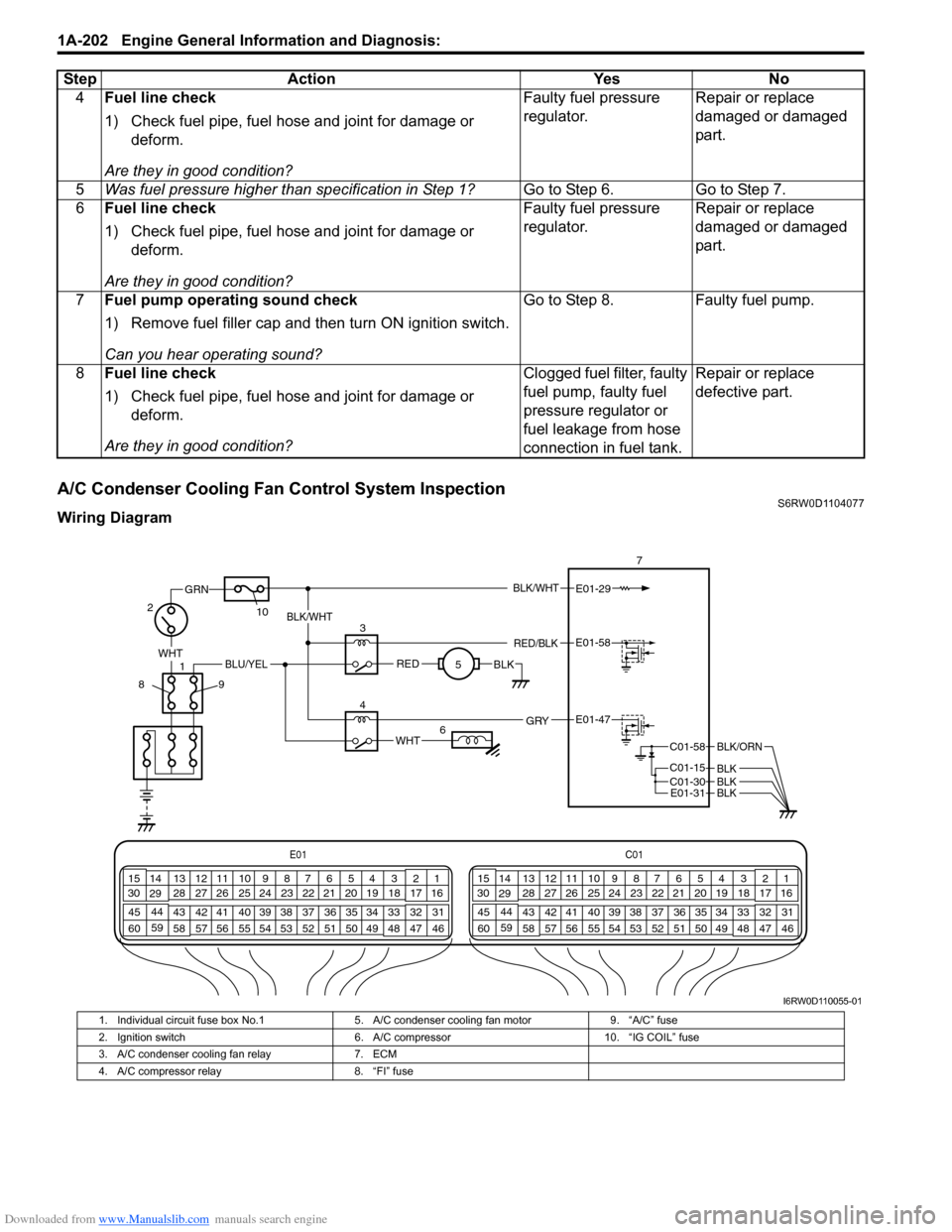
A/C Condenser Cooling Fan Control System InspectionS6RW0D1104077
Wiring Diagram4Fuel line check
1) Check fuel pipe, fuel hose and joint for damage or
deform.
Are they in good condition?Faulty fuel pressure
regulator.Repair or replace
damaged or damaged
part.
5Was fuel pressure higher than specification in Step 1?Go to Step 6. Go to Step 7.
6Fuel line check
1) Check fuel pipe, fuel hose and joint for damage or
deform.
Are they in good condition?Faulty fuel pressure
regulator.Repair or replace
damaged or damaged
part.
7Fuel pump operating sound check
1) Remove fuel filler cap and then turn ON ignition switch.
Can you hear operating sound?Go to Step 8. Faulty fuel pump.
8Fuel line check
1) Check fuel pipe, fuel hose and joint for damage or
deform.
Are they in good condition?Clogged fuel filter, faulty
fuel pump, faulty fuel
pressure regulator or
fuel leakage from hose
connection in fuel tank.Repair or replace
defective part. Step Action Yes No
E01C01
3 4
18 19 5 6 7 10 11
17 20
47 46 49 50 51 21 22
5216 259
24 14
29
55 57 54 53 59
60 582
26 27 28 15
30
56 4832 31 34 35 36 37 40 42 39 38 44
45 43 41 331 12 13
238 3 4
18 19 5 6 7 10 11
17 20
47 46 49 50 51 21 22
5216 259
24 14
29
55 57 54 53 59
60 582
26 27 28 15
30
56 4832 31 34 35 36 37 40 42 39 38 44
45 43 41 331 12 13
238
BLK/WHT
WHT
1
GRN
27
E01-29
10
89
REDBLK
3
5BLK/WHT
RED/BLKE01-58
WHT
4E01-47 GRY
BLU/YEL
6
C01-58
C01-15 C01-30
BLK/ORN
BLKBLKE01-31BLK
I6RW0D110055-01
1. Individual circuit fuse box No.1 5. A/C condenser cooling fan motor 9. “A/C” fuse
2. Ignition switch 6. A/C compressor 10. “IG COIL” fuse
3. A/C condenser cooling fan relay 7. ECM
4. A/C compressor relay 8. “FI” fuse
Page 255 of 1556
Downloaded from www.Manualslib.com manuals search engine Engine General Information and Diagnosis: 1A-205
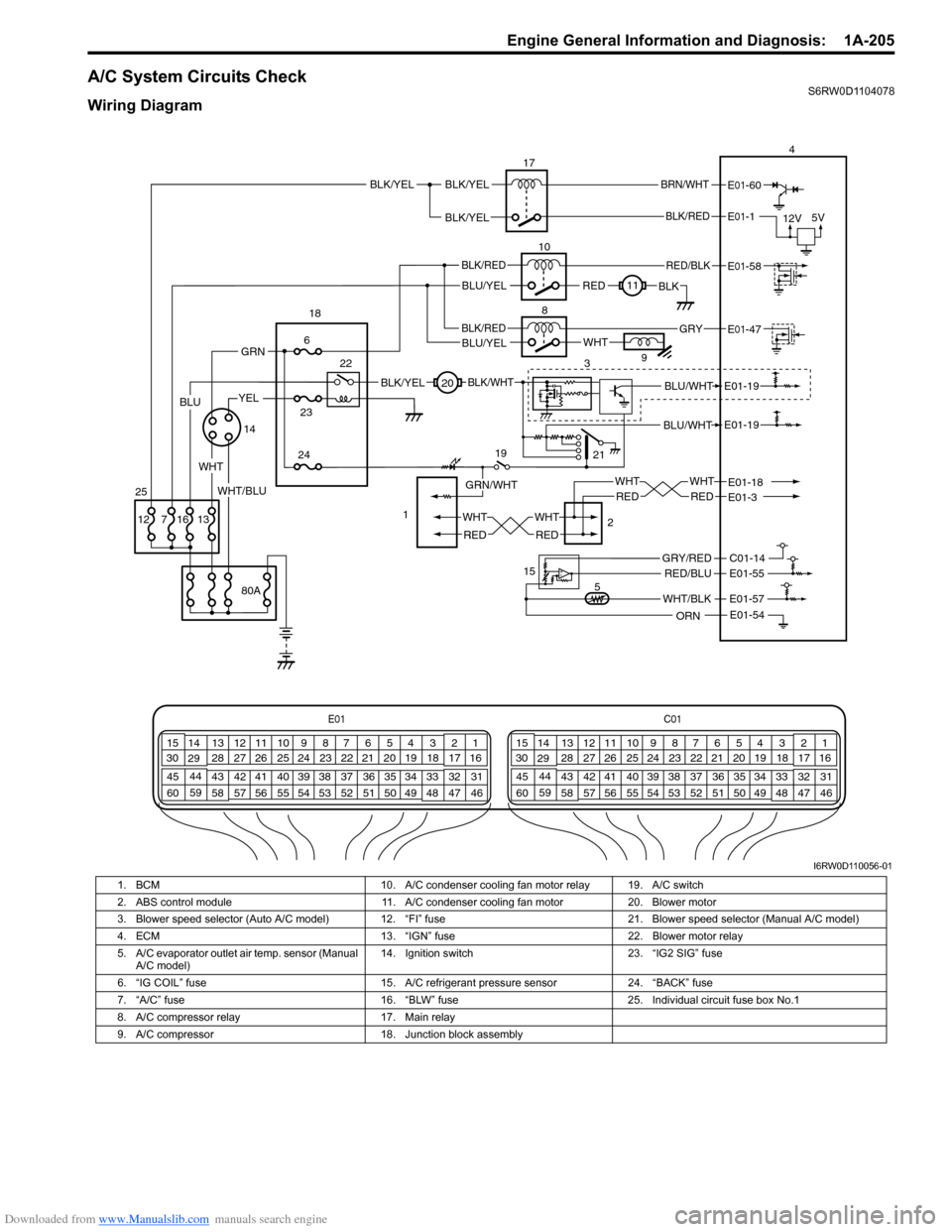
A/C System Circuits CheckS6RW0D1104078
Wiring Diagram
BLU/WHT
BLU/WHTE01-19
E01-19
21
E01C01
3 4
18 19 5 6 7 10 11
17 20
47 46 49 50 51 21 22
5216 259
24 14
29
55 57 54 53 59
60 582
26 27 28 15
30
56 4832 31 34 35 36 37 40 42 39 38 44
45 43 41 331 12 13
238 3 4
18 19 5 6 7 10 11
17 20
47 46 49 50 51 21 22
5216 259
24 14
29
55 57 54 53 59
60 582
26 27 28 15
30
56 4832 31 34 35 36 37 40 42 39 38 44
45 43 41 331 12 13
238
BLK/RED
BRN/WHT
12V5V
17
10
8
E01-1
E01-60
BLK/YEL
REDBLK11
WHT9
34
RED/BLK
BLK/REDE01-47
E01-58
BLU/YELGRY
19
2 1
20
5 15
WHT
RED
WHT
RED
WHT
RED
WHT
RED
E01-18E01-3
WHT/BLK
C01-14
E01-57
E01-54
E01-55RED/BLU
ORN
GRY/RED
BLK/YEL
GRN/WHT
BLK/WHT
WHT
1423
24
6
22 18
80A
1316 7 12
GRN
25
BLK/RED
BLU/YEL
YEL
WHT/BLU
BLK/YELBLK/YEL
BLU
I6RW0D110056-01
1. BCM 10. A/C condenser cooling fan motor relay 19. A/C switch
2. ABS control module 11. A/C condenser cooling fan motor 20. Blower motor
3. Blower speed selector (Auto A/C model) 12. “FI” fuse 21. Blower speed selector (Manual A/C model)
4. ECM 13. “IGN” fuse 22. Blower motor relay
5. A/C evaporator outlet air temp. sensor (Manual
A/C model)14. Ignition switch 23. “IG2 SIG” fuse
6. “IG COIL” fuse 15. A/C refrigerant pressure sensor 24. “BACK” fuse
7. “A/C” fuse 16. “BLW” fuse 25. Individual circuit fuse box No.1
8. A/C compressor relay 17. Main relay
9. A/C compressor 18. Junction block assembly
Page 285 of 1556
Downloaded from www.Manualslib.com manuals search engine Engine Mechanical: 1D-3
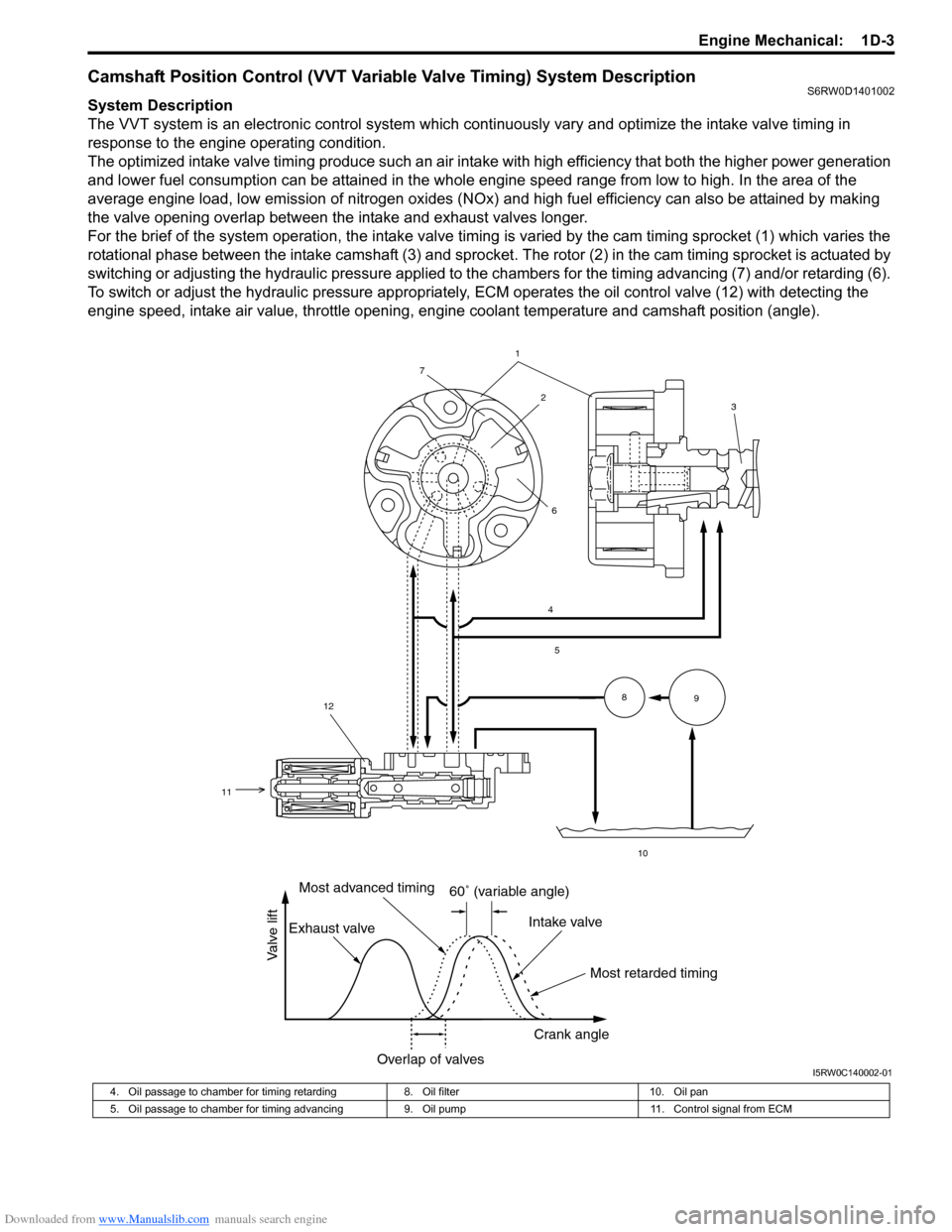
Camshaft Position Control (VVT Variable Valve Timing) System DescriptionS6RW0D1401002
System Description
The VVT system is an electronic control system which continuously vary and optimize the intake valve timing in
response to the engine operating condition.
The optimized intake valve timing produce such an air intake with high efficiency that both the higher power generation
and lower fuel consumption can be attained in the whole engine speed range from low to high. In the area of the
average engine load, low emission of nitrogen oxides (NOx) and high fuel efficiency can also be attained by making
the valve opening overlap between the intake and exhaust valves longer.
For the brief of the system operation, the intake valve timing is varied by the cam timing sprocket (1) which varies the
rotational phase between the intake camshaft (3) and sprocket. The rotor (2) in the cam timing sprocket is actuated by
switching or adjusting the hydraulic pressure applied to the chambers for the timing advancing (7) and/or retarding (6).
To switch or adjust the hydraulic pressure appropriately, ECM operates the oil control valve (12) with detecting the
engine speed, intake air value, throttle opening, engine coolant temperature and camshaft position (angle).
1
4
5
10
8
9
2
7
6
12
11
3
60˚ (variable angle)
Most retarded timing Most advanced timing
Exhaust valveIntake valve
Crank angle
Overlap of valves
Valve lift
I5RW0C140002-01
4. Oil passage to chamber for timing retarding 8. Oil filter 10. Oil pan
5. Oil passage to chamber for timing advancing 9. Oil pump 11. Control signal from ECM
Page 286 of 1556
Downloaded from www.Manualslib.com manuals search engine 1D-4 Engine Mechanical:
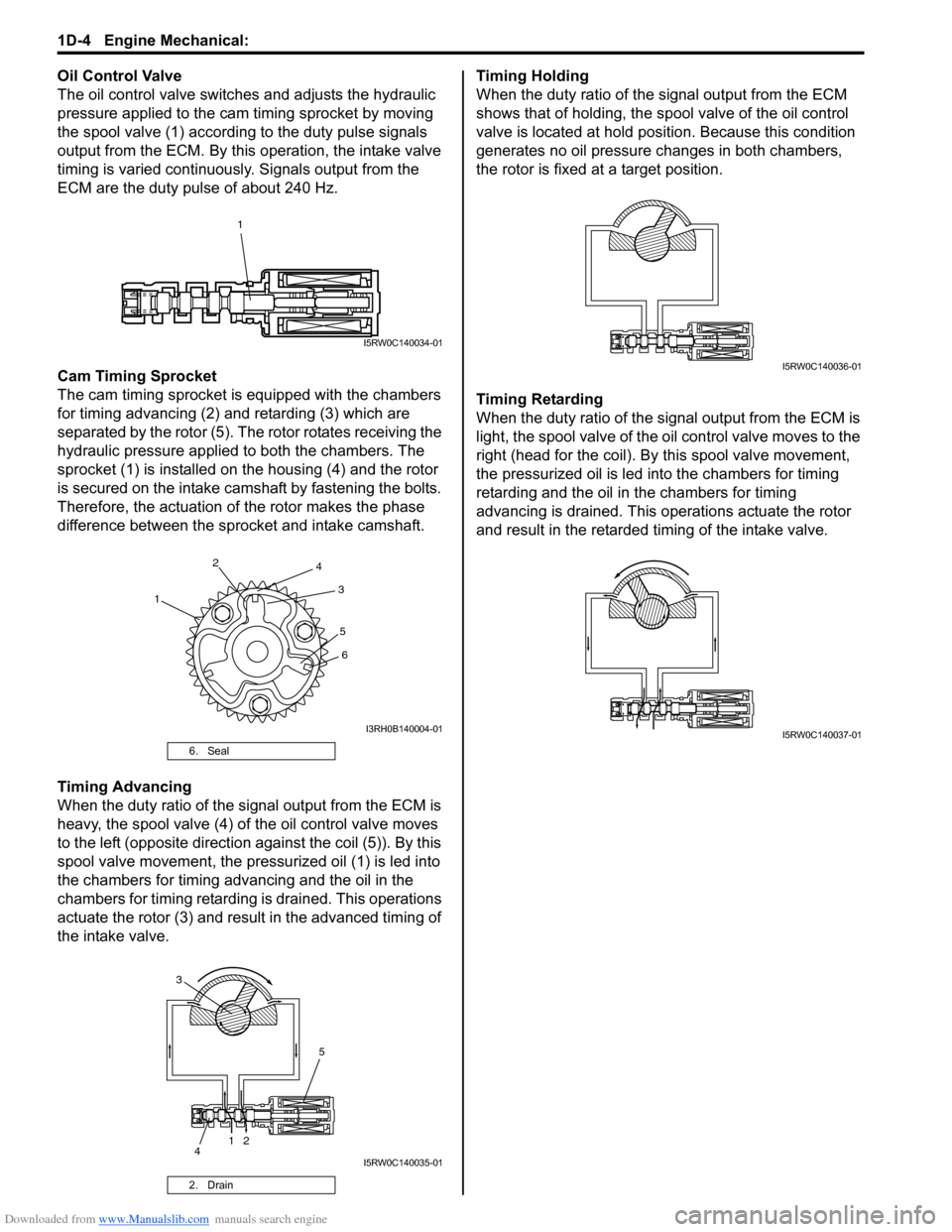
Oil Control Valve
The oil control valve switches and adjusts the hydraulic
pressure applied to the cam timing sprocket by moving
the spool valve (1) according to the duty pulse signals
output from the ECM. By this operation, the intake valve
timing is varied continuously. Signals output from the
ECM are the duty pulse of about 240 Hz.
Cam Timing Sprocket
The cam timing sprocket is equipped with the chambers
for timing advancing (2) and retarding (3) which are
separated by the rotor (5). The rotor rotates receiving the
hydraulic pressure applied to both the chambers. The
sprocket (1) is installed on the housing (4) and the rotor
is secured on the intake camshaft by fastening the bolts.
Therefore, the actuation of the rotor makes the phase
difference between the sprocket and intake camshaft.
Timing Advancing
When the duty ratio of the signal output from the ECM is
heavy, the spool valve (4) of the oil control valve moves
to the left (opposite direction against the coil (5)). By this
spool valve movement, the pressurized oil (1) is led into
the chambers for timing advancing and the oil in the
chambers for timing retarding is drained. This operations
actuate the rotor (3) and result in the advanced timing of
the intake valve.Timing Holding
When the duty ratio of the signal output from the ECM
shows that of holding, the spool valve of the oil control
valve is located at hold position. Because this condition
generates no oil pressure changes in both chambers,
the rotor is fixed at a target position.
Timing Retarding
When the duty ratio of the signal output from the ECM is
light, the spool valve of the oil control valve moves to the
right (head for the coil). By this spool valve movement,
the pressurized oil is led into the chambers for timing
retarding and the oil in the chambers for timing
advancing is drained. This operations actuate the rotor
and result in the retarded timing of the intake valve.
6. Seal
2. Drain
1
I5RW0C140034-01
12
3 4
5
6
I3RH0B140004-01
1
2
5
4
3
I5RW0C140035-01
I5RW0C140036-01
I5RW0C140037-01