Precautions SUZUKI SX4 2006 1.G Service User Guide
[x] Cancel search | Manufacturer: SUZUKI, Model Year: 2006, Model line: SX4, Model: SUZUKI SX4 2006 1.GPages: 1556, PDF Size: 37.31 MB
Page 15 of 1556
Downloaded from www.Manualslib.com manuals search engine Precautions: 00-8
Precautions for Installing Mobile
Communication Equipment
S6RW0D0000005
When installing mobile communication equipment such
as CB (Citizens-Band)-radio or cellular-telephone, be
sure to observe the following precautions.
Failure to follow cautions may adversely affect electronic
control system.
• Keep the antenna as far away as possible from the
vehicle’s electronic control unit.
• Keep the antenna feeder more than 20 cm (7.9 in.)
away from electronic control unit and its wire
harnesses.
• Do not run the antenna feeder parallel with other wire
harnesses.
• Confirm that the antenna and feeder are correctly
adjusted.
Precaution for CAN Communication SystemS6RW0D0000006
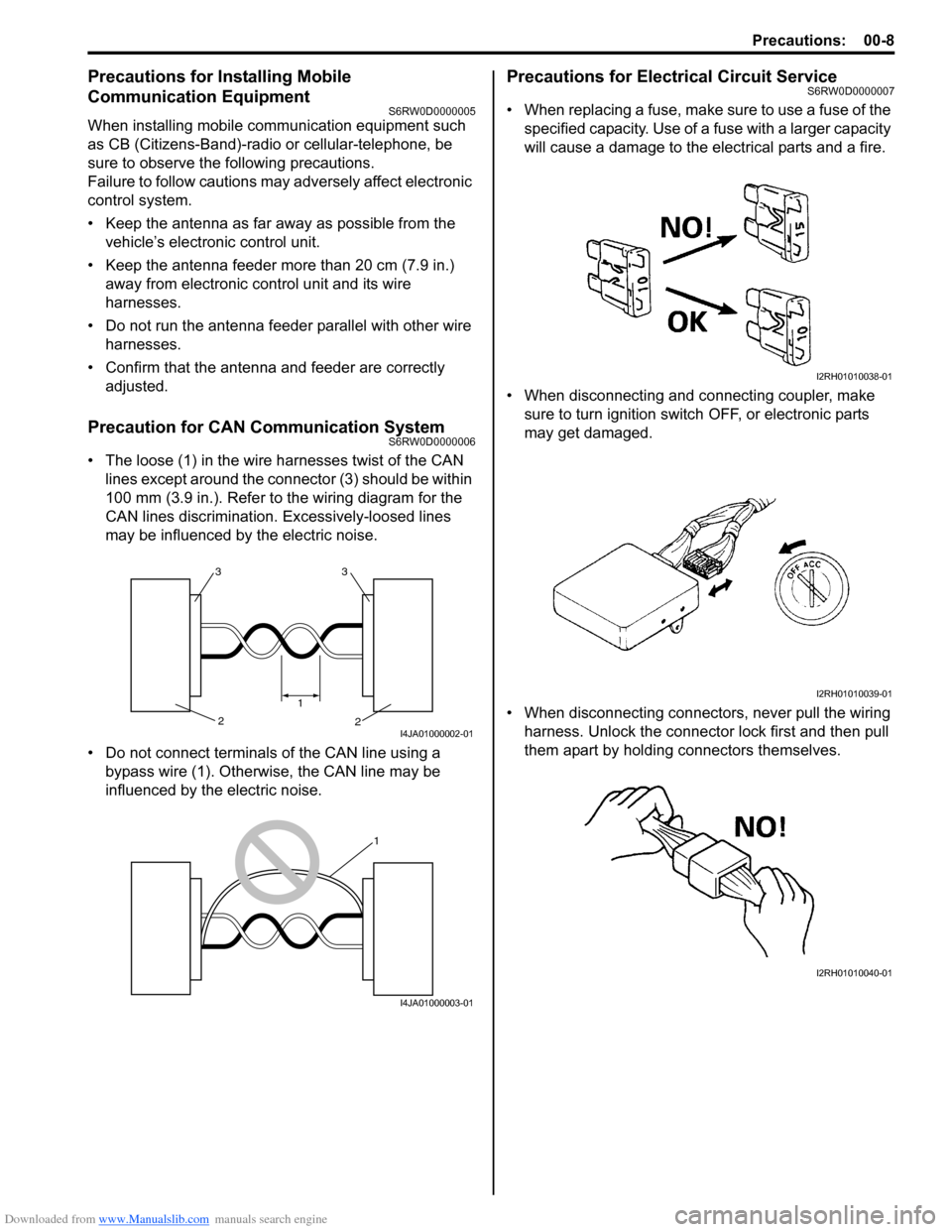
• The loose (1) in the wire harnesses twist of the CAN
lines except around the connector (3) should be within
100 mm (3.9 in.). Refer to the wiring diagram for the
CAN lines discrimination. Excessively-loosed lines
may be influenced by the electric noise.
• Do not connect terminals of the CAN line using a
bypass wire (1). Otherwise, the CAN line may be
influenced by the electric noise.
Precautions for Electrical Circuit ServiceS6RW0D0000007
• When replacing a fuse, make sure to use a fuse of the
specified capacity. Use of a fuse with a larger capacity
will cause a damage to the electrical parts and a fire.
• When disconnecting and connecting coupler, make
sure to turn ignition switch OFF, or electronic parts
may get damaged.
• When disconnecting connectors, never pull the wiring
harness. Unlock the connector lock first and then pull
them apart by holding connectors themselves.
33
2 2
1
I4JA01000002-01
1
I4JA01000003-01
I2RH01010038-01
I2RH01010039-01
I2RH01010040-01
Page 16 of 1556
Downloaded from www.Manualslib.com manuals search engine 00-9 Precautions:
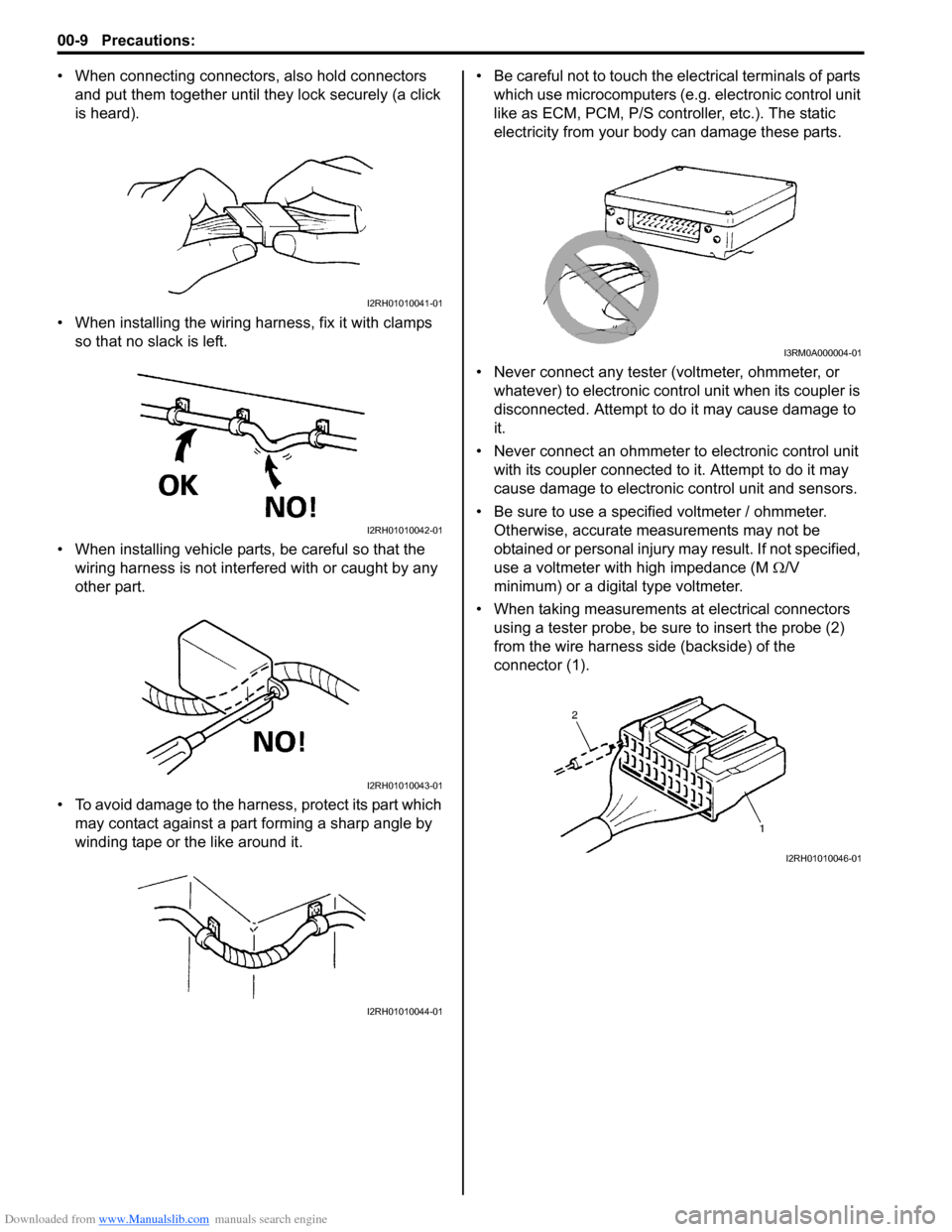
• When connecting connectors, also hold connectors
and put them together until they lock securely (a click
is heard).
• When installing the wiring harness, fix it with clamps
so that no slack is left.
• When installing vehicle parts, be careful so that the
wiring harness is not interfered with or caught by any
other part.
• To avoid damage to the harness, protect its part which
may contact against a part forming a sharp angle by
winding tape or the like around it.• Be careful not to touch the electrical terminals of parts
which use microcomputers (e.g. electronic control unit
like as ECM, PCM, P/S controller, etc.). The static
electricity from your body can damage these parts.
• Never connect any tester (voltmeter, ohmmeter, or
whatever) to electronic control unit when its coupler is
disconnected. Attempt to do it may cause damage to
it.
• Never connect an ohmmeter to electronic control unit
with its coupler connected to it. Attempt to do it may
cause damage to electronic control unit and sensors.
• Be sure to use a specified voltmeter / ohmmeter.
Otherwise, accurate measurements may not be
obtained or personal injury may result. If not specified,
use a voltmeter with high impedance (M Ω/V
minimum) or a digital type voltmeter.
• When taking measurements at electrical connectors
using a tester probe, be sure to insert the probe (2)
from the wire harness side (backside) of the
connector (1).
I2RH01010041-01
I2RH01010042-01
I2RH01010043-01
I2RH01010044-01
I3RM0A000004-01
I2RH01010046-01
Page 17 of 1556
Downloaded from www.Manualslib.com manuals search engine Precautions: 00-10
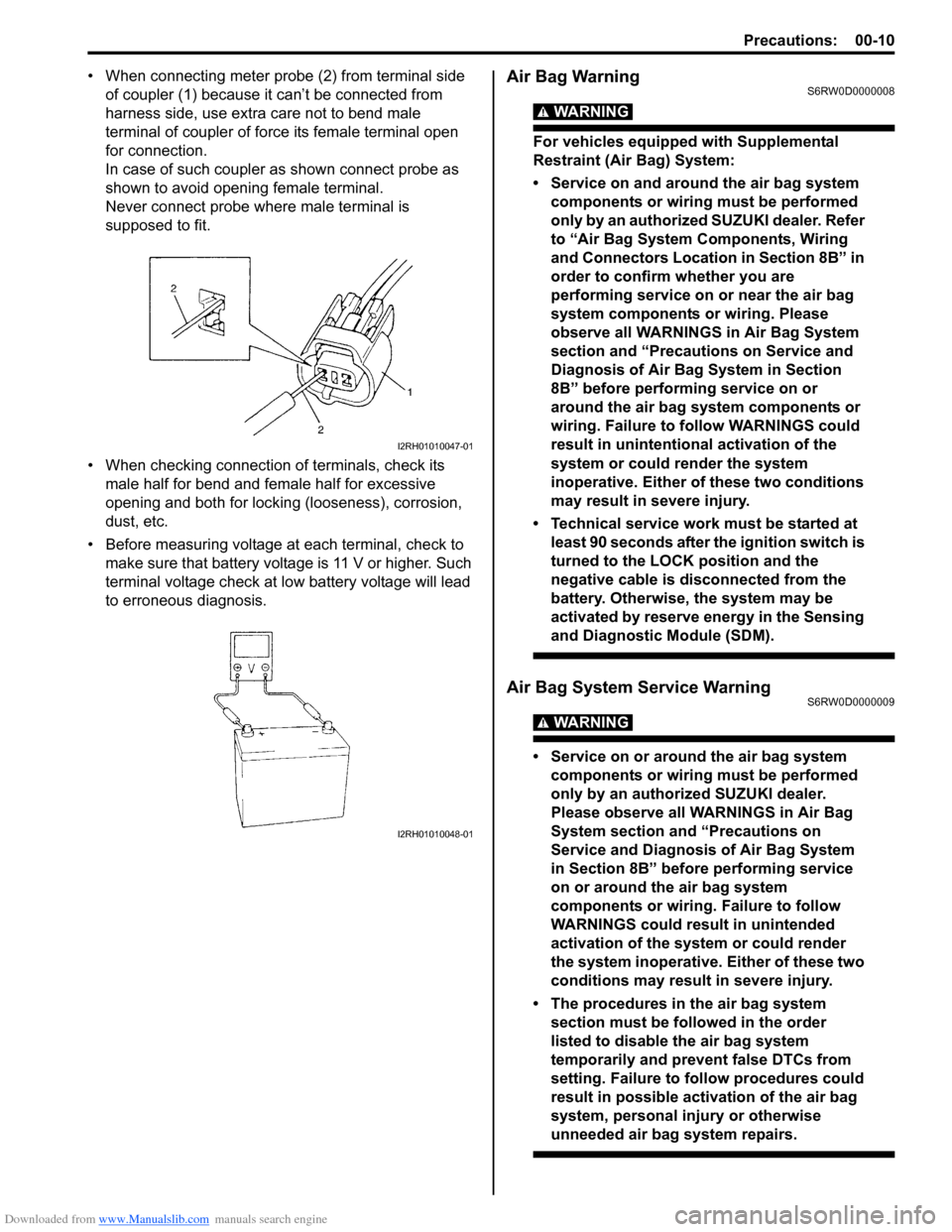
• When connecting meter probe (2) from terminal side
of coupler (1) because it can’t be connected from
harness side, use extra care not to bend male
terminal of coupler of force its female terminal open
for connection.
In case of such coupler as shown connect probe as
shown to avoid opening female terminal.
Never connect probe where male terminal is
supposed to fit.
• When checking connection of terminals, check its
male half for bend and female half for excessive
opening and both for locking (looseness), corrosion,
dust, etc.
• Before measuring voltage at each terminal, check to
make sure that battery voltage is 11 V or higher. Such
terminal voltage check at low battery voltage will lead
to erroneous diagnosis.Air Bag WarningS6RW0D0000008
WARNING!
For vehicles equipped with Supplemental
Restraint (Air Bag) System:
• Service on and around the air bag system
components or wiring must be performed
only by an authorized SUZUKI dealer. Refer
to “Air Bag System Components, Wiring
and Connectors Location in Section 8B” in
order to confirm whether you are
performing service on or near the air bag
system components or wiring. Please
observe all WARNINGS in Air Bag System
section and “Precautions on Service and
Diagnosis of Air Bag System in Section
8B” before performing service on or
around the air bag system components or
wiring. Failure to follow WARNINGS could
result in unintentional activation of the
system or could render the system
inoperative. Either of these two conditions
may result in severe injury.
• Technical service work must be started at
least 90 seconds after the ignition switch is
turned to the LOCK position and the
negative cable is disconnected from the
battery. Otherwise, the system may be
activated by reserve energy in the Sensing
and Diagnostic Module (SDM).
Air Bag System Service WarningS6RW0D0000009
WARNING!
• Service on or around the air bag system
components or wiring must be performed
only by an authorized SUZUKI dealer.
Please observe all WARNINGS in Air Bag
System section and “Precautions on
Service and Diagnosis of Air Bag System
in Section 8B” before performing service
on or around the air bag system
components or wiring. Failure to follow
WARNINGS could result in unintended
activation of the system or could render
the system inoperative. Either of these two
conditions may result in severe injury.
• The procedures in the air bag system
section must be followed in the order
listed to disable the air bag system
temporarily and prevent false DTCs from
setting. Failure to follow procedures could
result in possible activation of the air bag
system, personal injury or otherwise
unneeded air bag system repairs.
I2RH01010047-01
I2RH01010048-01
Page 18 of 1556
Downloaded from www.Manualslib.com manuals search engine 00-11 Precautions:
Fastener CautionS6RW0D0000010
CAUTION!
When fasteners are removed, always reinstall
them at the same location from which they
were removed. If a fastener needs to be
replaced, use the correct part number
fastener for that application. If the correct
part number fastener is not available, a
fastener of equal size and strength (or
stronger) may be used. Fasteners that are not
reused, and those requiring thread-locking
compound, will be called out. The correct
torque value must be used when installing
fasteners that require it. If the conditions are
not followed, parts or system damage could
result.
Suspension CautionS6RW0D0000011
CAUTION!
• All suspension fasteners are an important
attaching part in that it could affect the
performance of vital parts and systems,
and/or could result in major repair
expense. They must be replaced with one
of the same part number or with an
equivalent part if replacement becomes
necessary. Do not use a replacement part
of lesser quality or substitute design.
Torque values must be used as specified
during reassembly to assure proper
retention of this part.
• Never attempt to heat, quench or
straighten any suspension part. Replace it
with a new part or damage to the part may
result.
Wheels and Tires CautionS6RW0D0000012
CAUTION!
All wheel fasteners are important attaching
parts in that they could affect the
performance of vital parts and systems, and/
or could result in major repair expense. They
must be replaced with one of the same part
number or with an equivalent part if
replacement becomes necessary. Do not use
a replacement part of lesser quality or
substitute design. Torque values must be
used as specified during reassembly to
assure proper retention of all parts.
There is to be no welding as it may result in
extensive damage and weakening of the
metal.
Brake CautionS6RW0D0000013
CAUTION!
All brake fasteners are important attaching
parts in that they could affect the
performance of vital parts and systems, and/
or could result in major repair expense. They
must be replaced with one of same part
number or with an equivalent part if
replacement becomes necessary. Do not use
a replacement part of lesser quality or
substitute design. Torque values must be
used as specified during reassembly to
assure proper retention of all parts. There is
to be no welding as it may result in extensive
damage and weakening of the metal.
Page 19 of 1556

Downloaded from www.Manualslib.com manuals search engine Precautions: 00-12
Repair Instructions
Electrical Circuit Inspection ProcedureS6RW0D0006001
While there are various electrical circuit inspection
methods, described here is a general method to check
its open and short circuit by using an ohmmeter and a
voltmeter.
Open Circuit Check
Possible causes for the open circuit are as follows. As
the cause is in the connector or terminal in many cases,
they need to be checked particularly carefully.
• Loose connection of connector
• Poor contact of terminal (due to dirt, corrosion or rust
on it, poor contact tension, entry of foreign object etc.)
• Wire harness being open
When checking system circuits including an electronic
control unit such as ECM, TCM, ABS control module,
etc., it is important to perform careful check, starting with
items which are easier to check.
1) Disconnect negative (–) cable from battery
2) Check each connector at both ends of the circuit
being checked for loose connection. Also check lock
condition of connector if equipped with connector
lock.
3) Using a test male terminal, check both terminals of
the circuit being checked for contact tension of its
female terminal. Check each terminal visually for
poor contact (possibly caused by dirt, corrosion, rust
entry of foreign object, etc.). At the same time, check
to make sure that each terminal is locked in the
connector fully.4) Using continuity check or voltage check the following
procedure, check the wire harness for open circuit
and poor connection with its terminals. Locate
abnormality, if any.
Continuity Check
1) Measure resistance between connector terminals at
both ends of the circuit being checked (between “A-
1” and “C-1” in the figure). If no continuity is indicated
(infinity or over limit), that means that the circuit is
open between terminals “A-1” and “C-1”.
2) Disconnect the connector included in the circuit
(connector-B in the figure) and measure resistance
between terminals “A-1” and “B-1”.
If no continuity is indicated, that means that the
circuit is open between terminals “A-1” and “B-1”. If
continuity is indicated, there is an open circuit
between terminals “B-1” and “C-1” or an abnormality
in connector-B.
1. Check contact tension by inserting and removing just for once.
I2RH01010049-01
I2RH01010050-01
1. Looseness of crimping
2. Open
3. Thin wire (single strand of wire)
I2RH01010051-01
I2RH01010052-01
I2RH01010053-01
Page 20 of 1556
Downloaded from www.Manualslib.com manuals search engine 00-13 Precautions:
Voltage Check
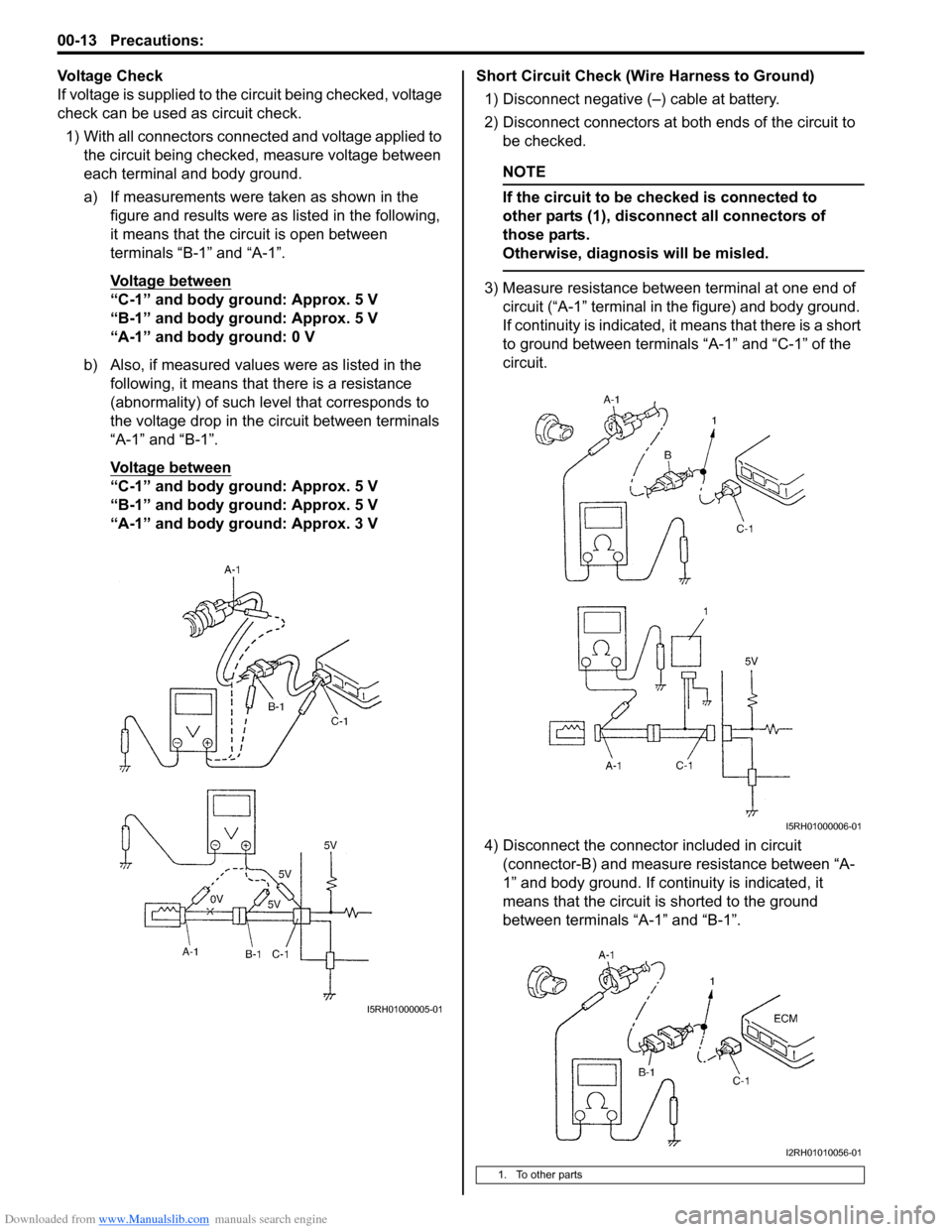
If voltage is supplied to the circuit being checked, voltage
check can be used as circuit check.
1) With all connectors connected and voltage applied to
the circuit being checked, measure voltage between
each terminal and body ground.
a) If measurements were taken as shown in the
figure and results were as listed in the following,
it means that the circuit is open between
terminals “B-1” and “A-1”.
Voltage between
“C-1” and body ground: Approx. 5 V
“B-1” and body ground: Approx. 5 V
“A-1” and body ground: 0 V
b) Also, if measured values were as listed in the
following, it means that there is a resistance
(abnormality) of such level that corresponds to
the voltage drop in the circuit between terminals
“A-1” and “B-1”.
Voltage between
“C-1” and body ground: Approx. 5 V
“B-1” and body ground: Approx. 5 V
“A-1” and body ground: Approx. 3 VShort Circuit Check (Wire Harness to Ground)
1) Disconnect negative (–) cable at battery.
2) Disconnect connectors at both ends of the circuit to
be checked.
NOTE
If the circuit to be checked is connected to
other parts (1), disconnect all connectors of
those parts.
Otherwise, diagnosis will be misled.
3) Measure resistance between terminal at one end of
circuit (“A-1” terminal in the figure) and body ground.
If continuity is indicated, it means that there is a short
to ground between terminals “A-1” and “C-1” of the
circuit.
4) Disconnect the connector included in circuit
(connector-B) and measure resistance between “A-
1” and body ground. If continuity is indicated, it
means that the circuit is shorted to the ground
between terminals “A-1” and “B-1”.
I5RH01000005-01
1. To other parts
I5RH01000006-01
I2RH01010056-01
Page 21 of 1556
Downloaded from www.Manualslib.com manuals search engine Precautions: 00-14
Intermittent and Poor Connection InspectionS6RW0D0006002
Most intermittent are caused by faulty electrical
connections or wiring, although a sticking relay or
solenoid can occasionally be at fault. When checking it
for proper connection, perform careful check of suspect
circuits for:
• Poor mating of connector halves, or terminals not fully
seated in the connector body (backed out).
• Dirt or corrosion on the terminals. The terminals must
be clean and free of any foreign material which could
impede proper terminal contact. However, cleaning
the terminal with a sand paper or the like is prohibited.
• Damaged connector body, exposing the terminals to
moisture and dirt, as well as not maintaining proper
terminal orientation with the component or mating
connector.
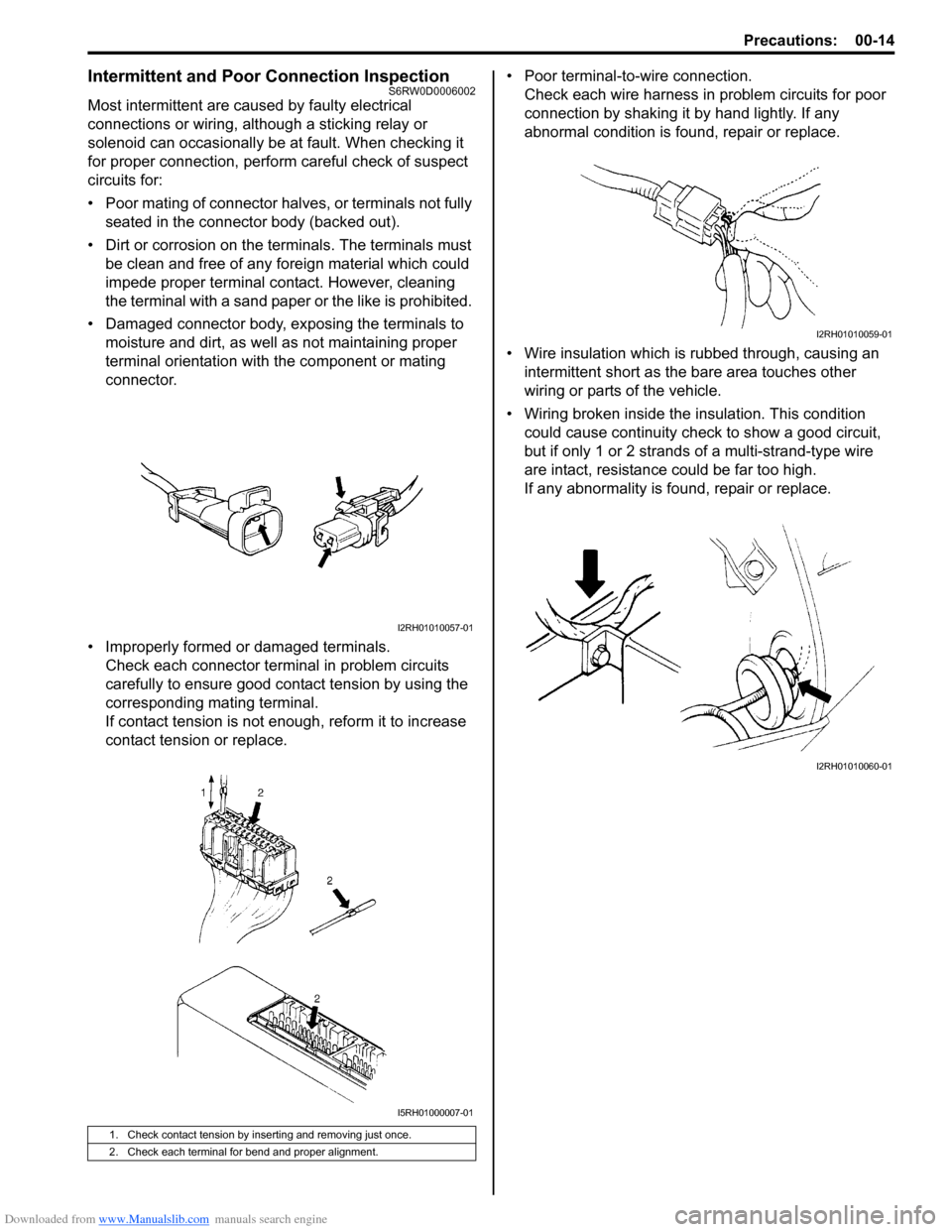
• Improperly formed or damaged terminals.
Check each connector terminal in problem circuits
carefully to ensure good contact tension by using the
corresponding mating terminal.
If contact tension is not enough, reform it to increase
contact tension or replace.• Poor terminal-to-wire connection.
Check each wire harness in problem circuits for poor
connection by shaking it by hand lightly. If any
abnormal condition is found, repair or replace.
• Wire insulation which is rubbed through, causing an
intermittent short as the bare area touches other
wiring or parts of the vehicle.
• Wiring broken inside the insulation. This condition
could cause continuity check to show a good circuit,
but if only 1 or 2 strands of a multi-strand-type wire
are intact, resistance could be far too high.
If any abnormality is found, repair or replace.
1. Check contact tension by inserting and removing just once.
2. Check each terminal for bend and proper alignment.
I2RH01010057-01
I5RH01000007-01
I2RH01010059-01
I2RH01010060-01
Page 22 of 1556
Downloaded from www.Manualslib.com manuals search engine 00-15 Precautions:
Page 23 of 1556
Downloaded from www.Manualslib.com manuals search engine Table of Contents 0- i
0
Section 0
CONTENTS
General Information
General Information ................................ 0A-1
General Description ............................................. 0A-1
Abbreviations ...................................................... 0A-1
Symbols .............................................................. 0A-2
Wire Color Symbols ............................................ 0A-2
Fasteners Information ......................................... 0A-3
Vehicle Lifting Points ........................................... 0A-5
Vehicle Identification Number ............................. 0A-6
Engine Identification Number .............................. 0A-6
Transmission Identification Number .................... 0A-6
Component Location ........................................... 0A-7
Warning, Caution and Information Labels
Location ............................................................ 0A-7
Maintenance and Lubrication ................. 0B-1
Precautions........................................................... 0B-1
Precautions for Maintenance and Lubrication ..... 0B-1
Scheduled Maintenance ...................................... 0B-1
Maintenance Schedule under Normal Driving
Conditions ......................................................... 0B-1
Maintenance Recommended under Severe
Driving Conditions ............................................. 0B-2
Repair Instructions .............................................. 0B-3
Accessory Drive Belt Inspection.......................... 0B-3
Accessory Drive Belt Replacement ..................... 0B-3
Valve Lash (Clearance) Inspection ..................... 0B-3
Engine Oil and Filter Change .............................. 0B-4
Engine Coolant Change ...................................... 0B-5
Exhaust System Inspection ................................. 0B-5
Spark Plug Replacement .................................... 0B-5
Air Cleaner Filter Inspection ................................ 0B-6
Air Cleaner Filter Replacement ........................... 0B-6
Fuel Lines and Connections Inspection .............. 0B-6
Fuel Filter Replacement ...................................... 0B-6
Fuel Tank Inspection ........................................... 0B-6PCV Valve Inspection ......................................... 0B-6
Fuel Evaporative Emission Control System
Inspection .......................................................... 0B-6
Brake Discs and Pads (Front) Inspection............ 0B-7
Brake Drums and Shoes (Rear) Inspection ........ 0B-7
Brake Hoses and Pipes Inspection ..................... 0B-7
Brake Fluid Replacement .................................... 0B-7
Brake Lever and Cable Inspection ...................... 0B-7
Clutch Fluid Inspection ........................................ 0B-8
Tires Inspection ................................................... 0B-8
Wheel Discs Inspection ....................................... 0B-8
Wheel Bearing Inspection ................................... 0B-8
Suspension System Inspection ........................... 0B-9
Steering System Inspection ................................ 0B-9
Drive Shaft (Axle) Boots Inspection .................... 0B-9
Propeller Shaft (4WD) Inspection...................... 0B-10
Manual Transaxle Oil Inspection ....................... 0B-10
Manual Transaxle Oil Replacement .................. 0B-10
Automatic Transaxle Fluid Level Inspection...... 0B-10
Automatic Transaxle Fluid Replacement .......... 0B-10
Automatic Transaxle Fluid Cooler Hose
Inspection ........................................................ 0B-10
Transfer Oil Inspection (4WD)........................... 0B-10
Transfer Oil Replacement (4WD) ...................... 0B-10
Rear Deferential Oil Inspection (4WD) .............. 0B-10
Rear Deferential Oil Replacement (4WD) ......... 0B-10
All Latches, Hinges and Locks Inspection......... 0B-10
HVAC Air Filter (If Equipped) Inspection ........... 0B-11
HVAC Air Filter (If Equipped) Replacement ...... 0B-11
Final Inspection for Maintenance Service ......... 0B-11
Specifications .....................................................0B-12
Tightening Torque Specifications ...................... 0B-12
Special Tools and Equipment ...........................0B-12
Recommended Fluids and Lubricants............... 0B-12
Special Tool ...................................................... 0B-12
Page 32 of 1556
Downloaded from www.Manualslib.com manuals search engine 0B-1 Maintenance and Lubrication:
General Information
Maintenance and Lubrication
Precautions
Precautions for Maintenance and LubricationS6RW0D0200001
Air Bag Warning
Refer to “Air Bag Warning in Section 00”.
Scheduled Maintenance
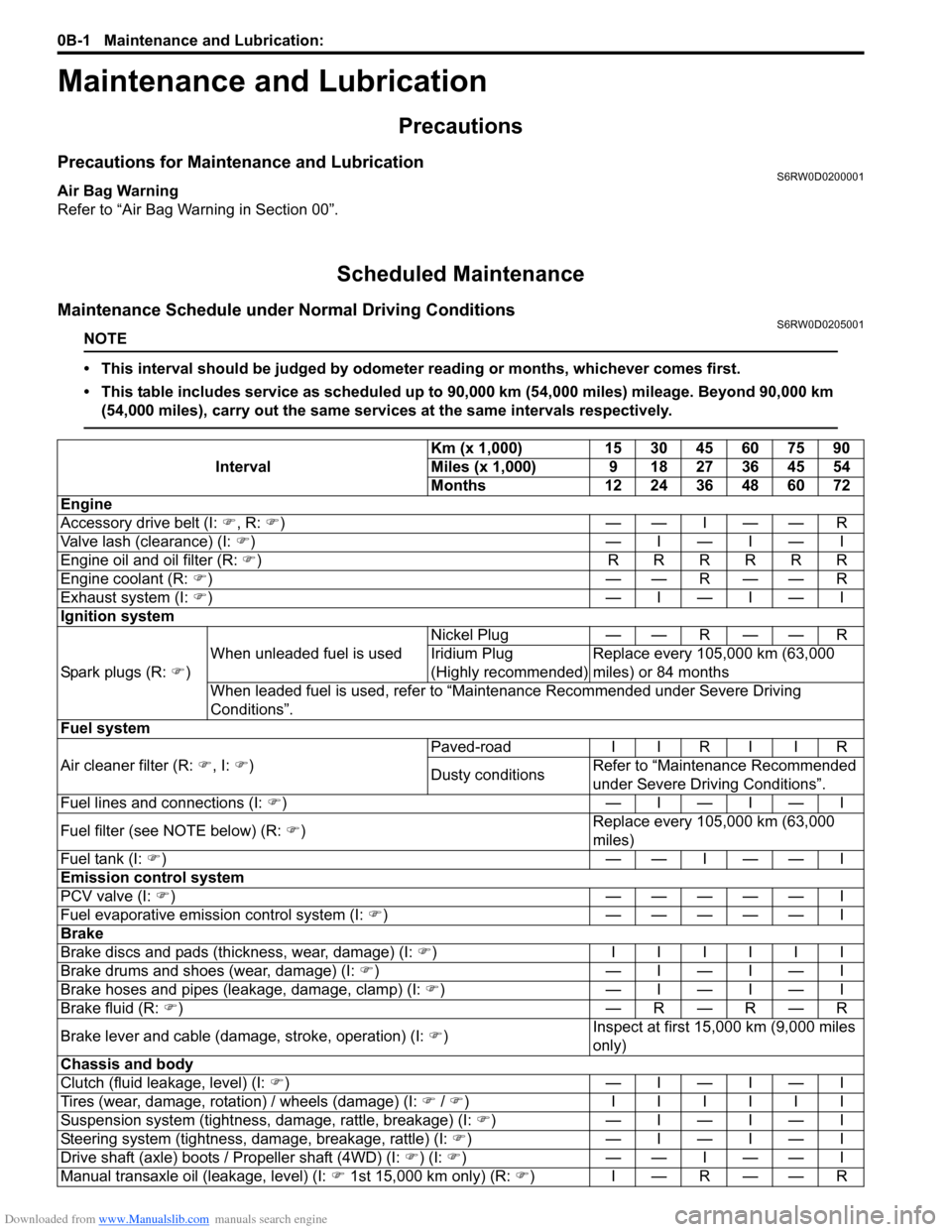
Maintenance Schedule under Normal Driving ConditionsS6RW0D0205001
NOTE
• This interval should be judged by odometer reading or months, whichever comes first.
• This table includes service as scheduled up to 90,000 km (54,000 miles) mileage. Beyond 90,000 km
(54,000 miles), carry out the same services at the same intervals respectively.
IntervalKm (x 1,000) 15 30 45 60 75 90
Miles (x 1,000) 9 18 27 36 45 54
Months 12 24 36 48 60 72
Engine
Accessory drive belt (I: ), R: ))——I——R
Valve lash (clearance) (I: ))—I—I—I
Engine oil and oil filter (R: )) RRRRRR
Engine coolant (R: ))——R——R
Exhaust system (I: ))—I—I—I
Ignition system
Spark plugs (R: ))When unleaded fuel is usedNickel Plug — — R — — R
Iridium Plug
(Highly recommended)Replace every 105,000 km (63,000
miles) or 84 months
When leaded fuel is used, refer to “Maintenance Recommended under Severe Driving
Conditions”.
Fuel system
Air cleaner filter (R: ), I: ))Paved-road I I R I I R
Dusty conditionsRefer to “Maintenance Recommended
under Severe Driving Conditions”.
Fuel lines and connections (I: ))—I—I—I
Fuel filter (see NOTE below) (R: ))Replace every 105,000 km (63,000
miles)
Fuel tank (I: ))——I——I
Emission control system
PCV valve (I: )) ————— I
Fuel evaporative emission control system (I: )) ————— I
Brake
Brake discs and pads (thickness, wear, damage) (I: )) IIIIII
Brake drums and shoes (wear, damage) (I: ))—I—I—I
Brake hoses and pipes (leakage, damage, clamp) (I: ))—I—I—I
Brake fluid (R: ))—R—R—R
Brake lever and cable (damage, stroke, operation) (I: ))Inspect at first 15,000 km (9,000 miles
only)
Chassis and body
Clutch (fluid leakage, level) (I: ))—I—I—I
Tires (wear, damage, rotation) / wheels (damage) (I: ) / )) IIIIII
Suspension system (tightness, damage, rattle, breakage) (I: ))—I—I—I
Steering system (tightness, damage, breakage, rattle) (I: ))—I—I—I
Drive shaft (axle) boots / Propeller shaft (4WD) (I: )) (I: ))——I——I
Manual transaxle oil (leakage, level) (I: ) 1st 15,000 km only) (R: ))I—R——R