Wheel sensor SUZUKI SX4 2006 1.G Service User Guide
[x] Cancel search | Manufacturer: SUZUKI, Model Year: 2006, Model line: SX4, Model: SUZUKI SX4 2006 1.GPages: 1556, PDF Size: 37.31 MB
Page 184 of 1556
Downloaded from www.Manualslib.com manuals search engine 1A-134 Engine General Information and Diagnosis:
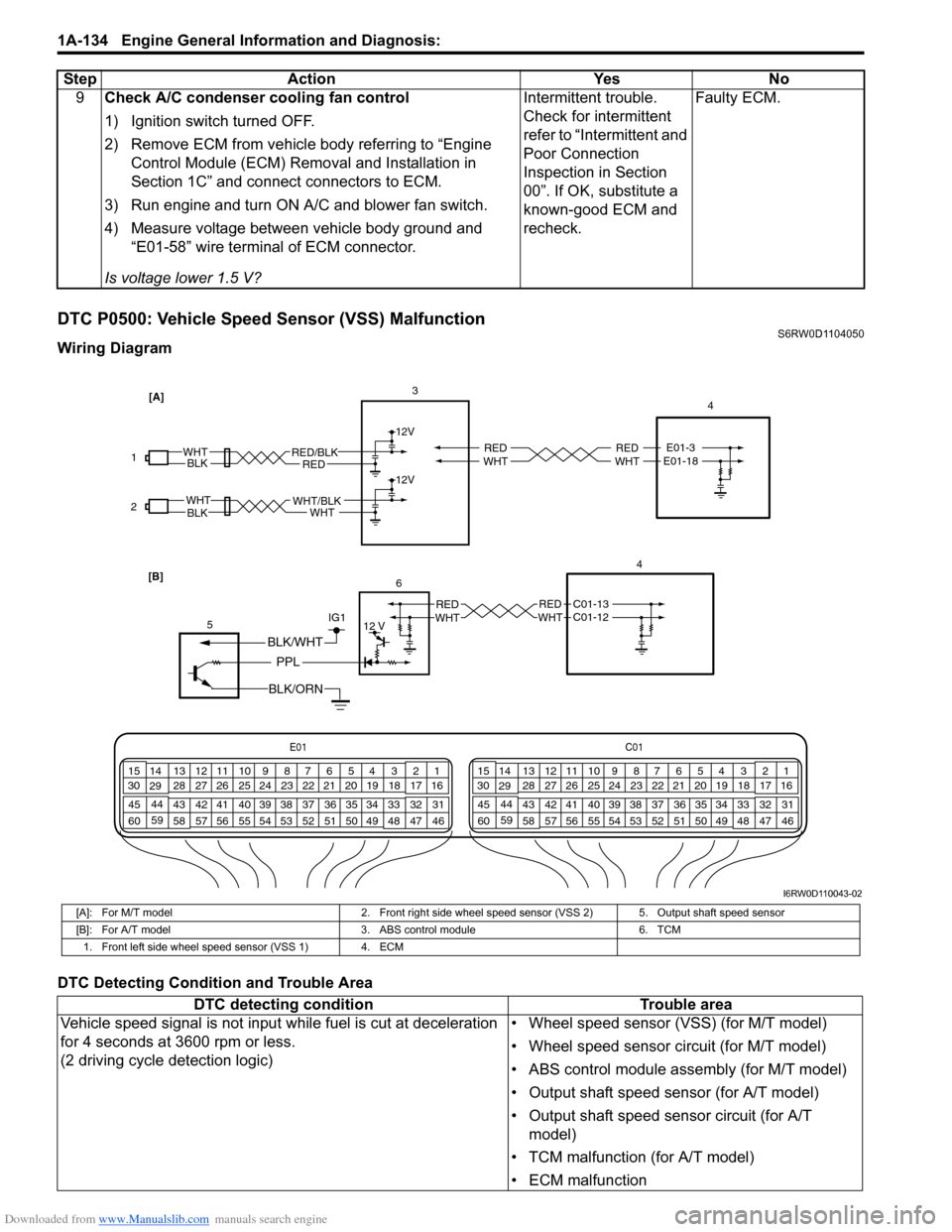
DTC P0500: Vehicle Speed Sensor (VSS) MalfunctionS6RW0D1104050
Wiring Diagram
DTC Detecting Condition and Trouble Area9Check A/C condenser cooling fan control
1) Ignition switch turned OFF.
2) Remove ECM from vehicle body referring to “Engine
Control Module (ECM) Removal and Installation in
Section 1C” and connect connectors to ECM.
3) Run engine and turn ON A/C and blower fan switch.
4) Measure voltage between vehicle body ground and
“E01-58” wire terminal of ECM connector.
Is voltage lower 1.5 V?Intermittent trouble.
Check for intermittent
refer to “Intermittent and
Poor Connection
Inspection in Section
00”. If OK, substitute a
known-good ECM and
recheck.Faulty ECM. Step Action Yes No
[B]
REDWHTC01-13C01-12REDWHT
PPL
5IG112 V
BLK/WHT
BLK/ORN
4
6 [A]
E01-3E01-18REDWHTREDWHT
E01C01
3 4
18 19 5 6 7 10 11
17 20
47 46 49 50 51 21 22
5216 259
24 14
29
55 57 54 53 59
60 582
26 27 28 15
30
56 4832 31 34 35 36 37 40 42 39 38 44
45 43 41 331 12 13
238 3 4
18 19 5 6 7 10 11
17 20
47 46 49 50 51 21 22
5216 259
24 14
29
55 57 54 53 59
60 582
26 27 28 15
30
56 4832 31 34 35 36 37 40 42 39 38 44
45 43 41 331 12 13
238
BLK
RED
WHT WHT
12V
12V
1
23
4
WHT/BLK
WHT BLKRED/BLK
I6RW0D110043-02
[A]: For M/T model 2. Front right side wheel speed sensor (VSS 2) 5. Output shaft speed sensor
[B]: For A/T model 3. ABS control module 6. TCM
1. Front left side wheel speed sensor (VSS 1) 4. ECM
DTC detecting condition Trouble area
Vehicle speed signal is not input while fuel is cut at deceleration
for 4 seconds at 3600 rpm or less.
(2 driving cycle detection logic)• Wheel speed sensor (VSS) (for M/T model)
• Wheel speed sensor circuit (for M/T model)
• ABS control module assembly (for M/T model)
• Output shaft speed sensor (for A/T model)
• Output shaft speed sensor circuit (for A/T
model)
• TCM malfunction (for A/T model)
• ECM malfunction
Page 229 of 1556
Downloaded from www.Manualslib.com manuals search engine Engine General Information and Diagnosis: 1A-179
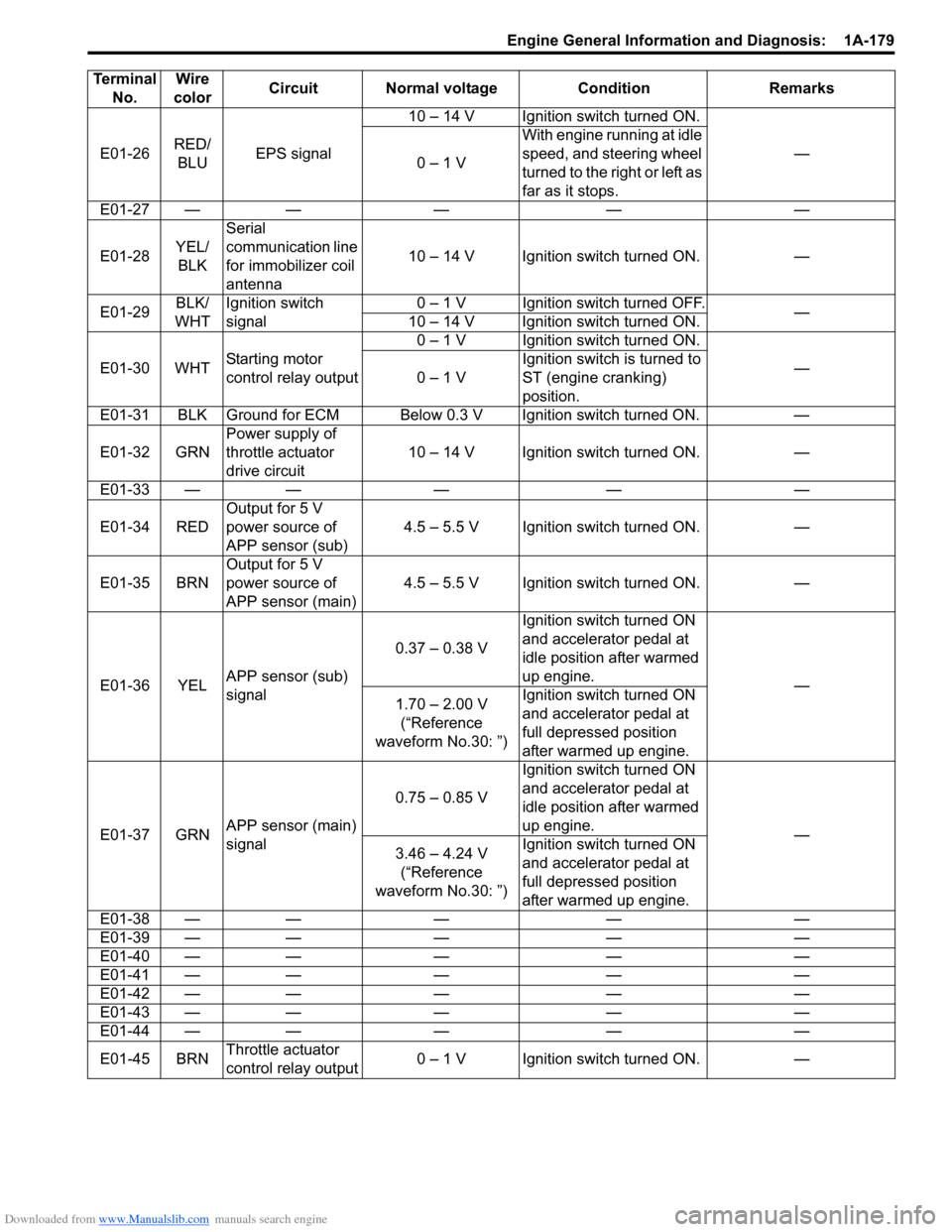
E01-26RED/
BLUEPS signal10 – 14 V Ignition switch turned ON.
—
0 – 1 VWith engine running at idle
speed, and steering wheel
turned to the right or left as
far as it stops.
E01-27 — — — — —
E01-28YEL/
BLKSerial
communication line
for immobilizer coil
antenna10 – 14 V Ignition switch turned ON. —
E01-29BLK/
WHTIgnition switch
signal0 – 1 V Ignition switch turned OFF.
—
10 – 14 V Ignition switch turned ON.
E01-30 WHTStarting motor
control relay output0 – 1 V Ignition switch turned ON.
—
0 – 1 VIgnition switch is turned to
ST (engine cranking)
position.
E01-31 BLK Ground for ECM Below 0.3 V Ignition switch turned ON. —
E01-32 GRNPower supply of
throttle actuator
drive circuit10 – 14 V Ignition switch turned ON. —
E01-33 — — — — —
E01-34 REDOutput for 5 V
power source of
APP sensor (sub)4.5 – 5.5 V Ignition switch turned ON. —
E01-35 BRNOutput for 5 V
power source of
APP sensor (main)4.5 – 5.5 V Ignition switch turned ON. —
E01-36 YELAPP sensor (sub)
signal0.37 – 0.38 VIgnition switch turned ON
and accelerator pedal at
idle position after warmed
up engine.
—
1.70 – 2.00 V
(“Reference
waveform No.30: ”)Ignition switch turned ON
and accelerator pedal at
full depressed position
after warmed up engine.
E01-37 GRNAPP sensor (main)
signal0.75 – 0.85 VIgnition switch turned ON
and accelerator pedal at
idle position after warmed
up engine.
—
3.46 – 4.24 V
(“Reference
waveform No.30: ”)Ignition switch turned ON
and accelerator pedal at
full depressed position
after warmed up engine.
E01-38 — — — — —
E01-39 — — — — —
E01-40 — — — — —
E01-41 — — — — —
E01-42 — — — — —
E01-43 — — — — —
E01-44 — — — — —
E01-45 BRNThrottle actuator
control relay output0 – 1 V Ignition switch turned ON. — Terminal
No.Wire
colorCircuit Normal voltage Condition Remarks
Page 262 of 1556
Downloaded from www.Manualslib.com manuals search engine 1A-212 Engine General Information and Diagnosis:
Repair Instructions
Idle Speed and IAC Throttle Valve Opening
Inspection
S6RW0D1106001
Before idle speed check, make sure of the following.
• Lead wires and hoses of electronic fuel injection and
engine and emission control systems are connected
securely.
• Valve lash is checked according to maintenance
schedule.
• Ignition timing is within specification.
• All accessories (wipers, heater, lights, A/C, etc.) are
out of service.
• Air cleaner has been properly installed and is in good
condition.
• No abnormal air drawn in from air intake system.After all items are confirmed, check idle speed and IAC
throttle opening as follows.NOTE
Before starting engine, place transmission
gear shift lever in “Neutral”, and set parking
brake and block drive wheels.
Step Action Yes No
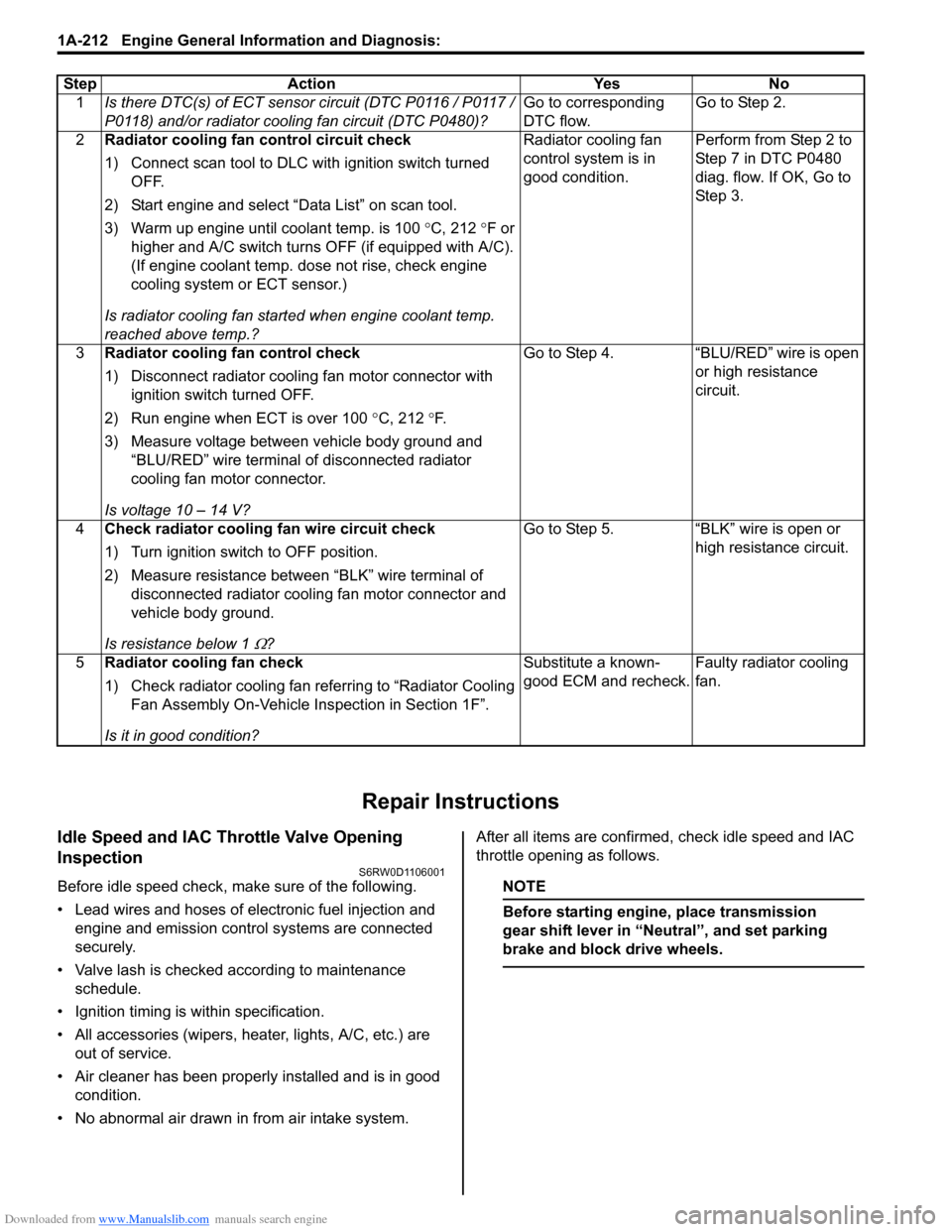
1Is there DTC(s) of ECT sensor circuit (DTC P0116 / P0117 /
P0118) and/or radiator cooling fan circuit (DTC P0480)?Go to corresponding
DTC flow.Go to Step 2.
2Radiator cooling fan control circuit check
1) Connect scan tool to DLC with ignition switch turned
OFF.
2) Start engine and select “Data List” on scan tool.
3) Warm up engine until coolant temp. is 100 °C, 212 °F or
higher and A/C switch turns OFF (if equipped with A/C).
(If engine coolant temp. dose not rise, check engine
cooling system or ECT sensor.)
Is radiator cooling fan started when engine coolant temp.
reached above temp.?Radiator cooling fan
control system is in
good condition.Perform from Step 2 to
Step 7 in DTC P0480
diag. flow. If OK, Go to
Ste p 3.
3Radiator cooling fan control check
1) Disconnect radiator cooling fan motor connector with
ignition switch turned OFF.
2) Run engine when ECT is over 100 °C, 212 °F.
3) Measure voltage between vehicle body ground and
“BLU/RED” wire terminal of disconnected radiator
cooling fan motor connector.
Is voltage 10 – 14 V?Go to Step 4. “BLU/RED” wire is open
or high resistance
circuit.
4Check radiator cooling fan wire circuit check
1) Turn ignition switch to OFF position.
2) Measure resistance between “BLK” wire terminal of
disconnected radiator cooling fan motor connector and
vehicle body ground.
Is resistance below 1
Ω?Go to Step 5. “BLK” wire is open or
high resistance circuit.
5Radiator cooling fan check
1) Check radiator cooling fan referring to “Radiator Cooling
Fan Assembly On-Vehicle Inspection in Section 1F”.
Is it in good condition?Substitute a known-
good ECM and recheck.Faulty radiator cooling
fan.
Page 341 of 1556

Downloaded from www.Manualslib.com manuals search engine Engine Mechanical: 1D-59
Main Bearings, Crankshaft and Cylinder Block ComponentsS6RW0D1406037
I6RW0D140003-01
1. CKP sensor
: See “A”11. Rear oil seal 21. Oil filter adapter bolt
2. Knock sensor 12. Input shaft bearing 22. Spring pin
3. Cylinder block 13. Flywheel or drive plate 23. Sensor plate bolt
4. Venturi plug 14. Main bearing cap 24. Oil pressure switch
Page 342 of 1556
Downloaded from www.Manualslib.com manuals search engine 1D-60 Engine Mechanical:
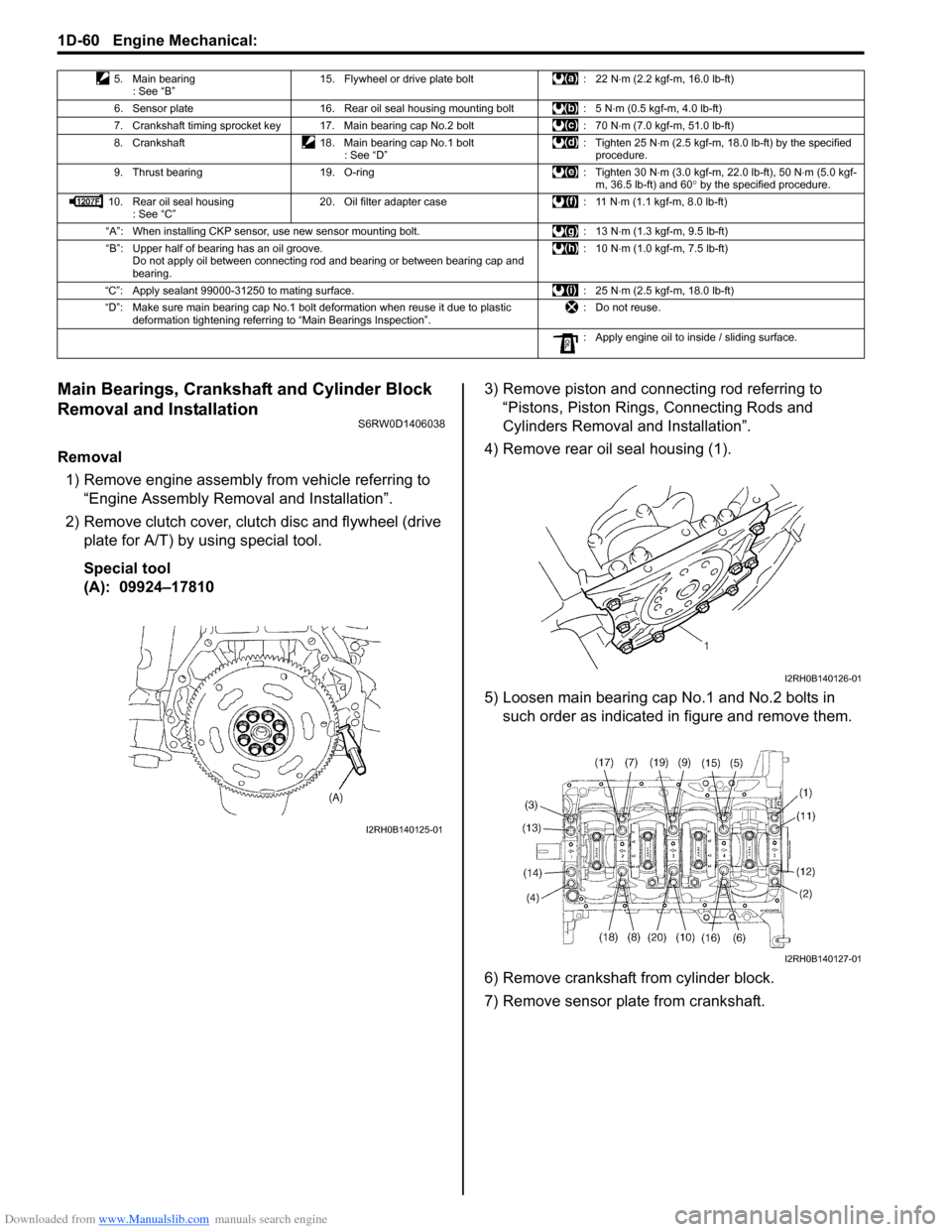
Main Bearings, Crankshaft and Cylinder Block
Removal and Installation
S6RW0D1406038
Removal
1) Remove engine assembly from vehicle referring to
“Engine Assembly Removal and Installation”.
2) Remove clutch cover, clutch disc and flywheel (drive
plate for A/T) by using special tool.
Special tool
(A): 09924–178103) Remove piston and connecting rod referring to
“Pistons, Piston Rings, Connecting Rods and
Cylinders Removal and Installation”.
4) Remove rear oil seal housing (1).
5) Loosen main bearing cap No.1 and No.2 bolts in
such order as indicated in figure and remove them.
6) Remove crankshaft from cylinder block.
7) Remove sensor plate from crankshaft.
5. Main bearing
: See “B”15. Flywheel or drive plate bolt : 22 N⋅m (2.2 kgf-m, 16.0 lb-ft)
6. Sensor plate 16. Rear oil seal housing mounting bolt : 5 N⋅m (0.5 kgf-m, 4.0 lb-ft)
7. Crankshaft timing sprocket key 17. Main bearing cap No.2 bolt : 70 N⋅m (7.0 kgf-m, 51.0 lb-ft)
8. Crankshaft 18. Main bearing cap No.1 bolt
: See “D”: Tighten 25 N⋅m (2.5 kgf-m, 18.0 lb-ft) by the specified
procedure.
9. Thrust bearing 19. O-ring : Tighten 30 N⋅m (3.0 kgf-m, 22.0 lb-ft), 50 N⋅m (5.0 kgf-
m, 36.5 lb-ft) and 60° by the specified procedure.
10. Rear oil seal housing
: See “C”20. Oil filter adapter case : 11 N⋅m (1.1 kgf-m, 8.0 lb-ft)
“A”: When installing CKP sensor, use new sensor mounting bolt. : 13 N⋅m (1.3 kgf-m, 9.5 lb-ft)
“B”: Upper half of bearing has an oil groove.
Do not apply oil between connecting rod and bearing or between bearing cap and
bearing.:10 N⋅m (1.0 kgf-m, 7.5 lb-ft)
“C”: Apply sealant 99000-31250 to mating surface. : 25 N⋅m (2.5 kgf-m, 18.0 lb-ft)
“D”: Make sure main bearing cap No.1 bolt deformation when reuse it due to plastic
deformation tightening referring to “Main Bearings Inspection”.: Do not reuse.
: Apply engine oil to inside / sliding surface.
I2RH0B140125-01
I2RH0B140126-01
I2RH0B140127-01
Page 352 of 1556
Downloaded from www.Manualslib.com manuals search engine 1D-70 Engine Mechanical:
Main Bearing Cap No.1 Bolt
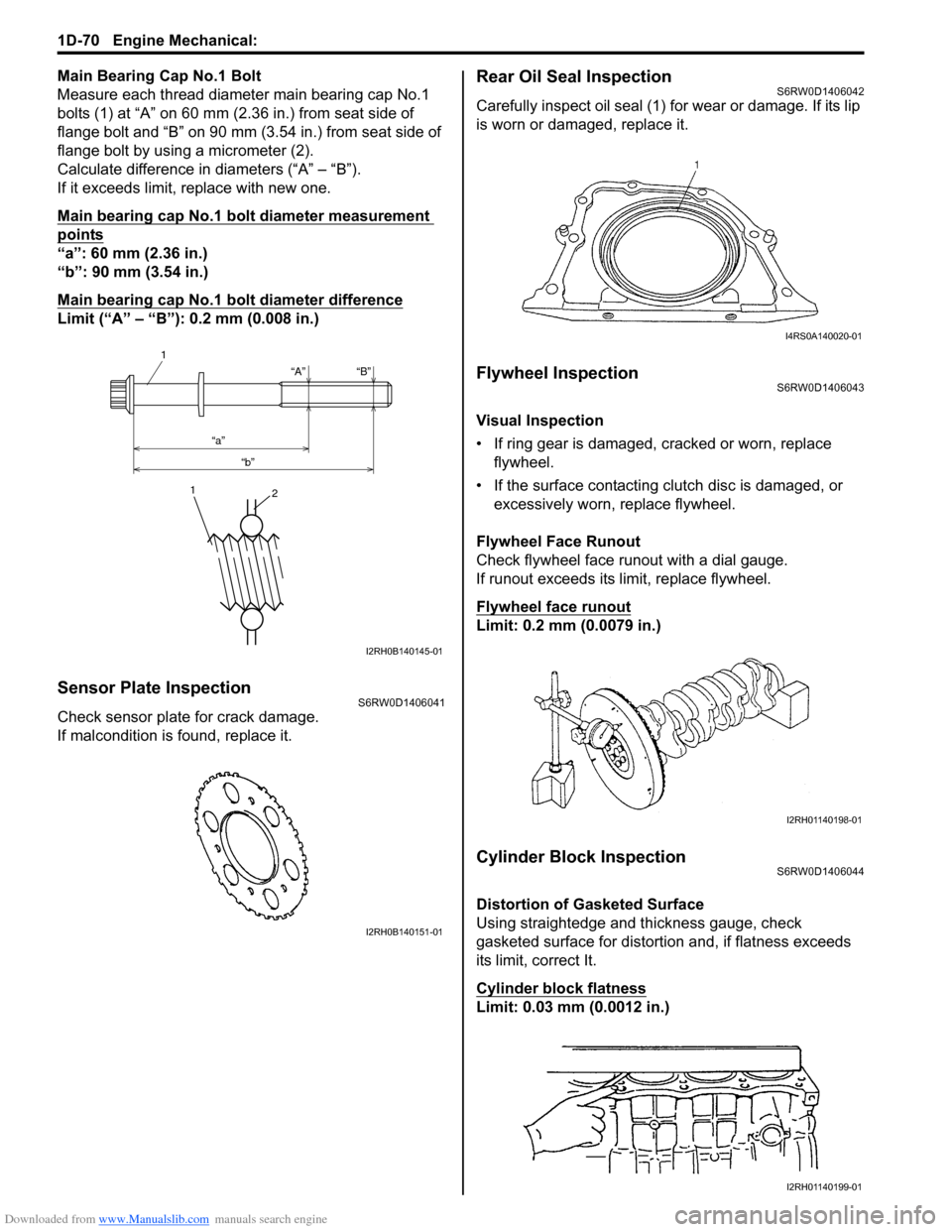
Measure each thread diameter main bearing cap No.1
bolts (1) at “A” on 60 mm (2.36 in.) from seat side of
flange bolt and “B” on 90 mm (3.54 in.) from seat side of
flange bolt by using a micrometer (2).
Calculate difference in diameters (“A” – “B”).
If it exceeds limit, replace with new one.
Main bearing cap No.1 bolt diameter measurement
points
“a”: 60 mm (2.36 in.)
“b”: 90 mm (3.54 in.)
Main bearing cap No.1 bolt diameter difference
Limit (“A” – “B”): 0.2 mm (0.008 in.)
Sensor Plate InspectionS6RW0D1406041
Check sensor plate for crack damage.
If malcondition is found, replace it.
Rear Oil Seal InspectionS6RW0D1406042
Carefully inspect oil seal (1) for wear or damage. If its lip
is worn or damaged, replace it.
Flywheel InspectionS6RW0D1406043
Visual Inspection
• If ring gear is damaged, cracked or worn, replace
flywheel.
• If the surface contacting clutch disc is damaged, or
excessively worn, replace flywheel.
Flywheel Face Runout
Check flywheel face runout with a dial gauge.
If runout exceeds its limit, replace flywheel.
Flywheel face runout
Limit: 0.2 mm (0.0079 in.)
Cylinder Block InspectionS6RW0D1406044
Distortion of Gasketed Surface
Using straightedge and thickness gauge, check
gasketed surface for distortion and, if flatness exceeds
its limit, correct It.
Cylinder block flatness
Limit: 0.03 mm (0.0012 in.)
“A”
“a”
“b”“B”
1
1
2
I2RH0B140145-01
I2RH0B140151-01
I4RS0A140020-01
I2RH01140198-01
I2RH01140199-01
Page 354 of 1556
Downloaded from www.Manualslib.com manuals search engine 1D-72 Engine Mechanical:
NOTE
The specified tightening torque is also described in the following.
“Air Intake System Components”
“Engine Mountings Components”
“Timing Chain Cover Components”
“Timing Chain and Chain Tensioner Components”
“Camshaft, Tappet and Shim Components”
“Valves and Cylinder Head Components”
“Pistons, Piston Rings, Connecting Rods and Cylinders Components”
“Main Bearings, Crankshaft and Cylinder Block Components”
Reference:
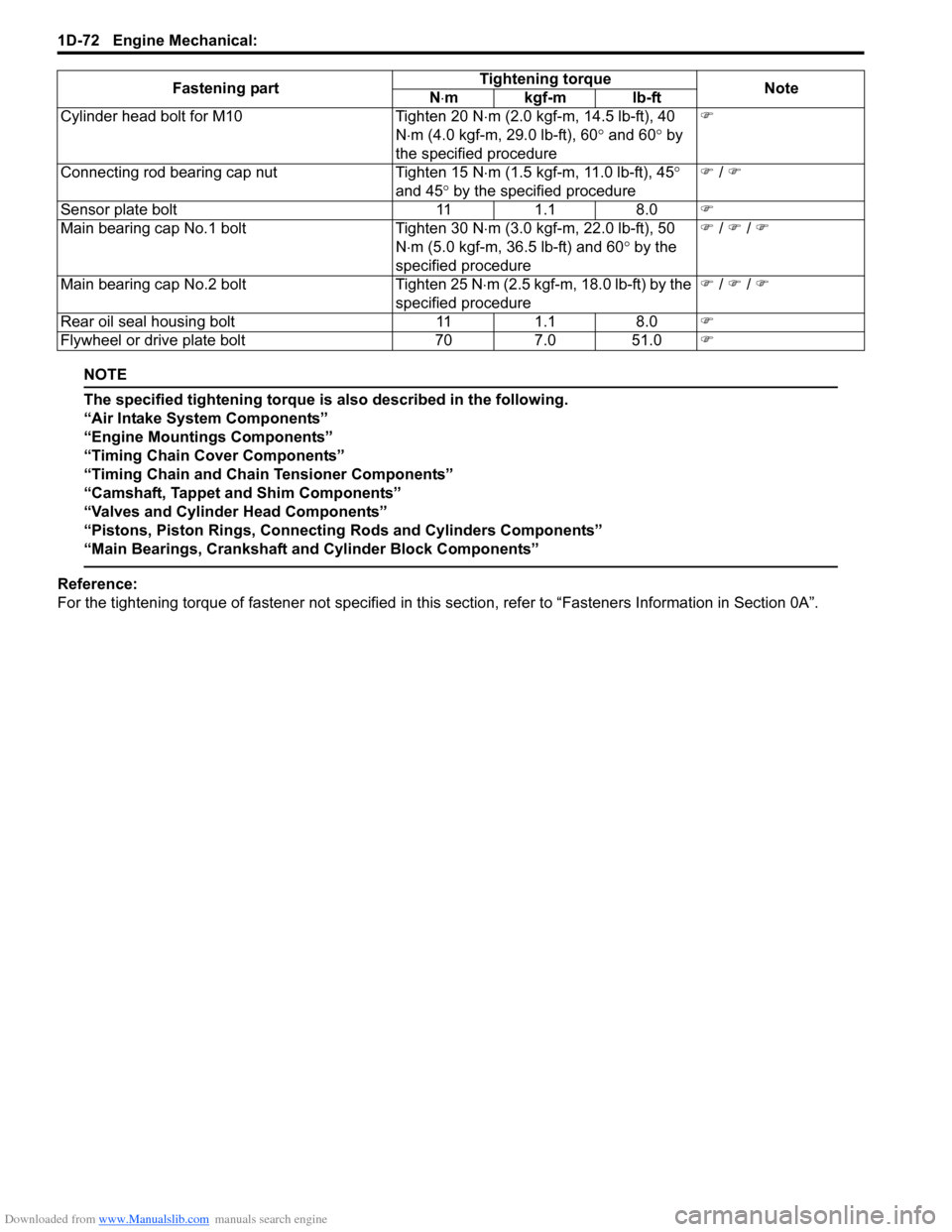
For the tightening torque of fastener not specified in this section, refer to “Fasteners Information in Section 0A”. Cylinder head bolt for M10 Tighten 20 N⋅m (2.0 kgf-m, 14.5 lb-ft), 40
N⋅m (4.0 kgf-m, 29.0 lb-ft), 60° and 60° by
the specified procedure)
Connecting rod bearing cap nut Tighten 15 N⋅m (1.5 kgf-m, 11.0 lb-ft), 45°
and 45° by the specified procedure) / )
Sensor plate bolt 11 1.1 8.0)
Main bearing cap No.1 bolt Tighten 30 N⋅m (3.0 kgf-m, 22.0 lb-ft), 50
N⋅m (5.0 kgf-m, 36.5 lb-ft) and 60° by the
specified procedure) / ) / )
Main bearing cap No.2 bolt Tighten 25 N⋅m (2.5 kgf-m, 18.0 lb-ft) by the
specified procedure) / ) / )
Rear oil seal housing bolt 11 1.1 8.0)
Flywheel or drive plate bolt 70 7.0 51.0) Fastening partTightening torque
Note
N⋅mkgf-mlb-ft
Page 407 of 1556
Downloaded from www.Manualslib.com manuals search engine Starting System: 1I-2
Condition Possible cause Correction / Reference Item
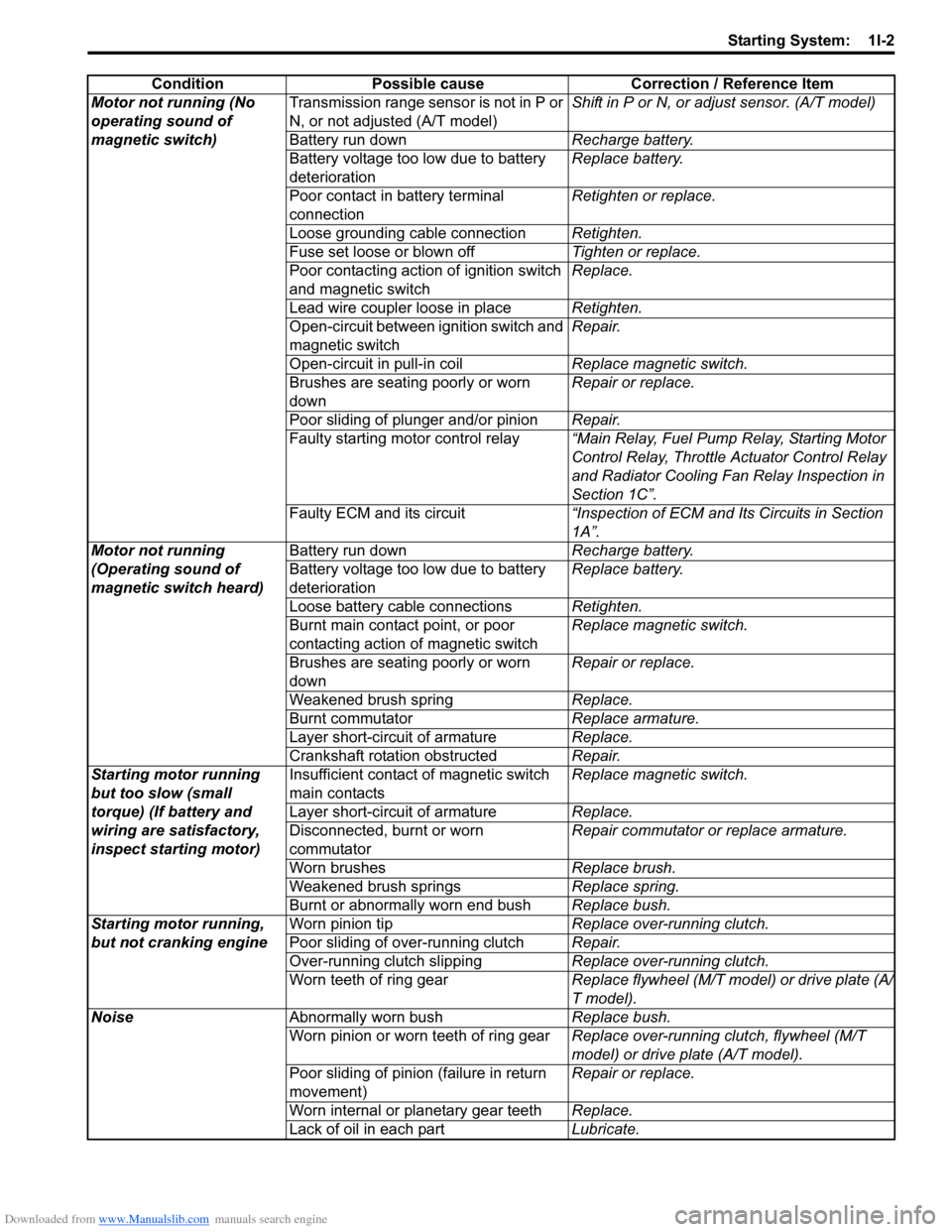
Motor not running (No
operating sound of
magnetic switch)Transmission range sensor is not in P or
N, or not adjusted (A/T model)Shift in P or N, or adjust sensor. (A/T model)
Battery run downRecharge battery.
Battery voltage too low due to battery
deteriorationReplace battery.
Poor contact in battery terminal
connectionRetighten or replace.
Loose grounding cable connectionRetighten.
Fuse set loose or blown offTighten or replace.
Poor contacting action of ignition switch
and magnetic switchReplace.
Lead wire coupler loose in placeRetighten.
Open-circuit between ignition switch and
magnetic switchRepair.
Open-circuit in pull-in coilReplace magnetic switch.
Brushes are seating poorly or worn
downRepair or replace.
Poor sliding of plunger and/or pinionRepair.
Faulty starting motor control relay“Main Relay, Fuel Pump Relay, Starting Motor
Control Relay, Throttle Actuator Control Relay
and Radiator Cooling Fan Relay Inspection in
Section 1C”.
Faulty ECM and its circuit“Inspection of ECM and Its Circuits in Section
1A”.
Motor not running
(Operating sound of
magnetic switch heard)Battery run downRecharge battery.
Battery voltage too low due to battery
deteriorationReplace battery.
Loose battery cable connectionsRetighten.
Burnt main contact point, or poor
contacting action of magnetic switchReplace magnetic switch.
Brushes are seating poorly or worn
downRepair or replace.
Weakened brush springReplace.
Burnt commutatorReplace armature.
Layer short-circuit of armatureReplace.
Crankshaft rotation obstructedRepair.
Starting motor running
but too slow (small
torque) (If battery and
wiring are satisfactory,
inspect starting motor)Insufficient contact of magnetic switch
main contactsReplace magnetic switch.
Layer short-circuit of armatureReplace.
Disconnected, burnt or worn
commutatorRepair commutator or replace armature.
Worn brushesReplace brush.
Weakened brush springsReplace spring.
Burnt or abnormally worn end bushReplace bush.
Starting motor running,
but not cranking engineWorn pinion tipReplace over-running clutch.
Poor sliding of over-running clutchRepair.
Over-running clutch slippingReplace over-running clutch.
Worn teeth of ring gearReplace flywheel (M/T model) or drive plate (A/
T model).
NoiseAbnormally worn bushReplace bush.
Worn pinion or worn teeth of ring gearReplace over-running clutch, flywheel (M/T
model) or drive plate (A/T model).
Poor sliding of pinion (failure in return
movement)Repair or replace.
Worn internal or planetary gear teethReplace.
Lack of oil in each partLubricate.
Page 442 of 1556
Downloaded from www.Manualslib.com manuals search engine 2B-5 Front Suspension:
Front Strut Assembly Removal and InstallationS6RW0D2206003
CAUTION!
When rebound stopper and strut assembly
were removed, check strut support lower nut
for specified torque before installing strut
assembly.
Removal
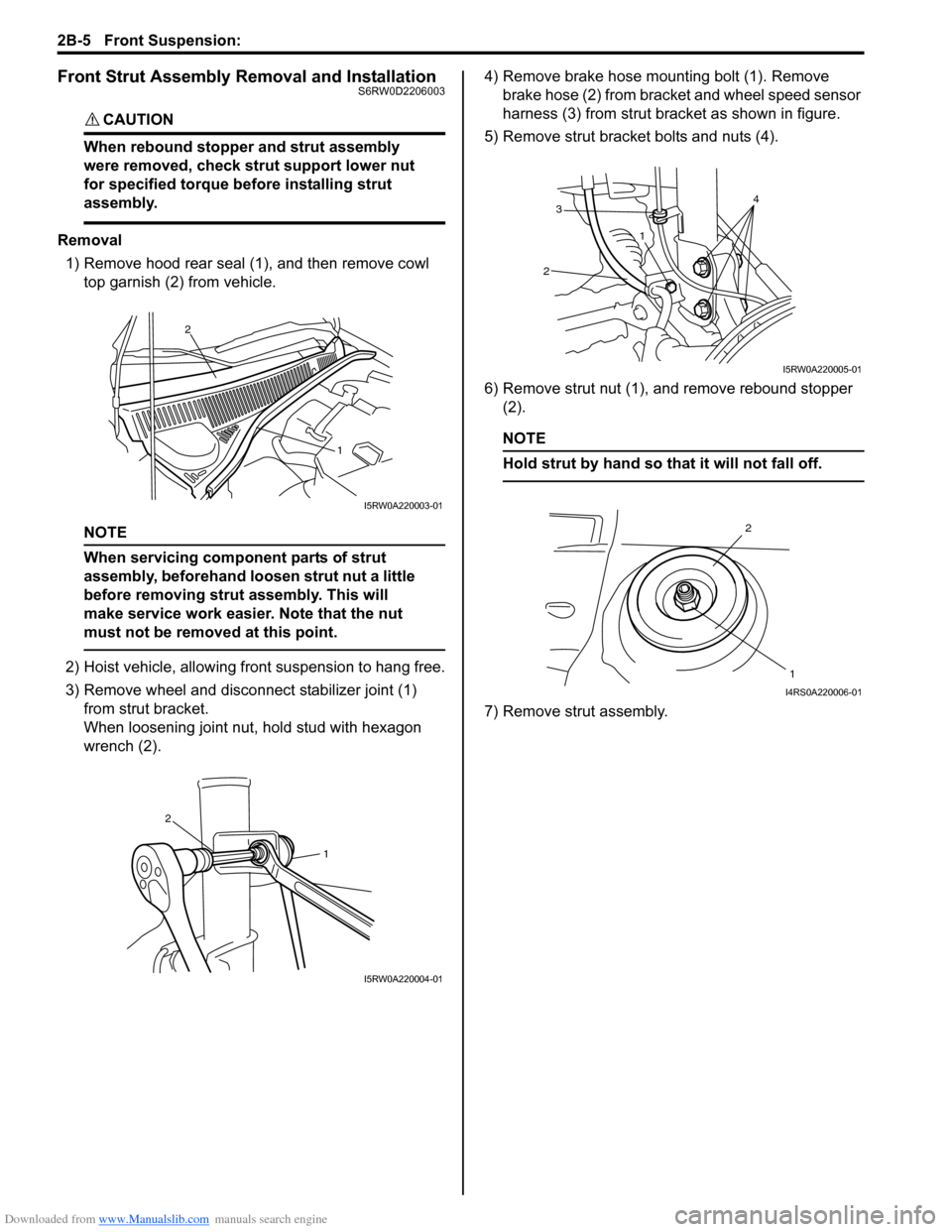
1) Remove hood rear seal (1), and then remove cowl
top garnish (2) from vehicle.
NOTE
When servicing component parts of strut
assembly, beforehand loosen strut nut a little
before removing strut assembly. This will
make service work easier. Note that the nut
must not be removed at this point.
2) Hoist vehicle, allowing front suspension to hang free.
3) Remove wheel and disconnect stabilizer joint (1)
from strut bracket.
When loosening joint nut, hold stud with hexagon
wrench (2).4) Remove brake hose mounting bolt (1). Remove
brake hose (2) from bracket and wheel speed sensor
harness (3) from strut bracket as shown in figure.
5) Remove strut bracket bolts and nuts (4).
6) Remove strut nut (1), and remove rebound stopper
(2).
NOTE
Hold strut by hand so that it will not fall off.
7) Remove strut assembly.
2
1
I5RW0A220003-01
1
2
I5RW0A220004-01
3
214
I5RW0A220005-01
2
1
I4RS0A220006-01
Page 443 of 1556
Downloaded from www.Manualslib.com manuals search engine Front Suspension: 2B-6
Installation
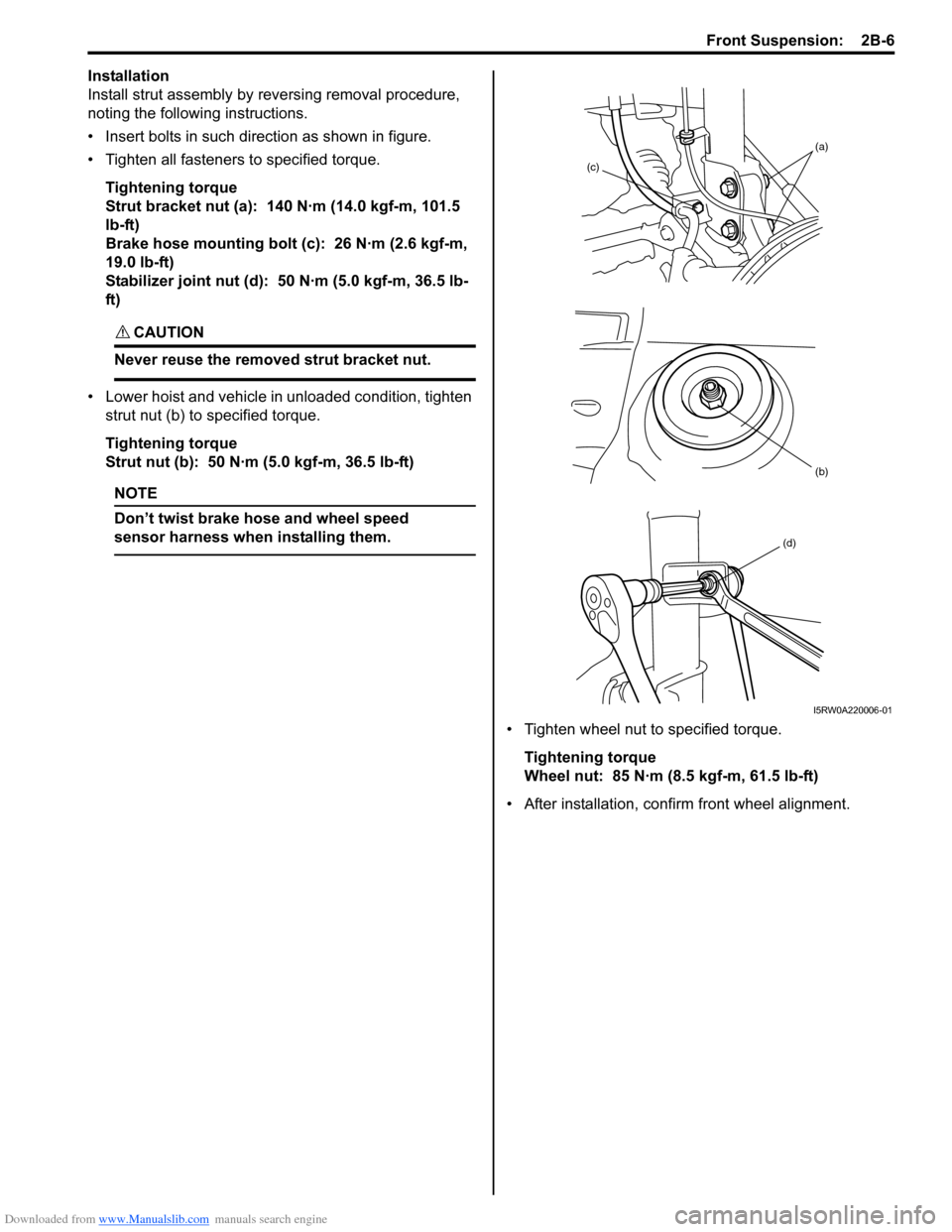
Install strut assembly by reversing removal procedure,
noting the following instructions.
• Insert bolts in such direction as shown in figure.
• Tighten all fasteners to specified torque.
Tightening torque
Strut bracket nut (a): 140 N·m (14.0 kgf-m, 101.5
lb-ft)
Brake hose mounting bolt (c): 26 N·m (2.6 kgf-m,
19.0 lb-ft)
Stabilizer joint nut (d): 50 N·m (5.0 kgf-m, 36.5 lb-
ft)
CAUTION!
Never reuse the removed strut bracket nut.
• Lower hoist and vehicle in unloaded condition, tighten
strut nut (b) to specified torque.
Tightening torque
Strut nut (b): 50 N·m (5.0 kgf-m, 36.5 lb-ft)
NOTE
Don’t twist brake hose and wheel speed
sensor harness when installing them.
• Tighten wheel nut to specified torque.
Tightening torque
Wheel nut: 85 N·m (8.5 kgf-m, 61.5 lb-ft)
• After installation, confirm front wheel alignment.
(b)
(a)
(c)
(d)
I5RW0A220006-01