drain bolt SUZUKI SX4 2006 1.G Service User Guide
[x] Cancel search | Manufacturer: SUZUKI, Model Year: 2006, Model line: SX4, Model: SUZUKI SX4 2006 1.GPages: 1556, PDF Size: 37.31 MB
Page 390 of 1556
Downloaded from www.Manualslib.com manuals search engine 1G-13 Fuel System:
Fuel Tank Removal and InstallationS6RW0D1706011
WARNING!
Before starting the following procedure, be
sure to observe “Precautions on Fuel System
Service” in order to reduce the risk of fire and
personal injury.
Removal
1) Relieve fuel pressure in fuel feed line according to
“Fuel Pressure Relief Procedure”.
2) Disconnect negative cable at battery.
3) Remove fuel filler cap.
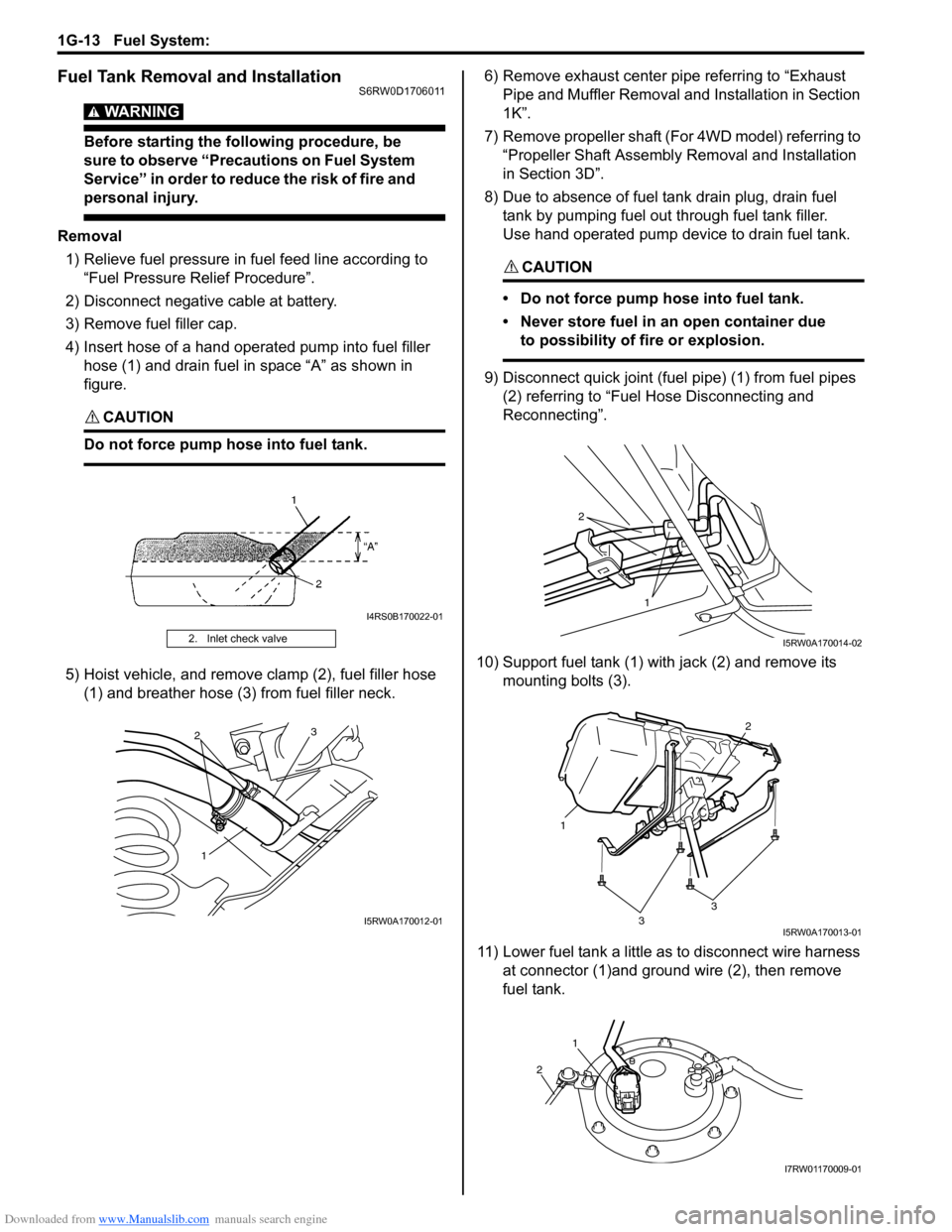
4) Insert hose of a hand operated pump into fuel filler
hose (1) and drain fuel in space “A” as shown in
figure.
CAUTION!
Do not force pump hose into fuel tank.
5) Hoist vehicle, and remove clamp (2), fuel filler hose
(1) and breather hose (3) from fuel filler neck.6) Remove exhaust center pipe referring to “Exhaust
Pipe and Muffler Removal and Installation in Section
1K”.
7) Remove propeller shaft (For 4WD model) referring to
“Propeller Shaft Assembly Removal and Installation
in Section 3D”.
8) Due to absence of fuel tank drain plug, drain fuel
tank by pumping fuel out through fuel tank filler.
Use hand operated pump device to drain fuel tank.
CAUTION!
• Do not force pump hose into fuel tank.
• Never store fuel in an open container due
to possibility of fire or explosion.
9) Disconnect quick joint (fuel pipe) (1) from fuel pipes
(2) referring to “Fuel Hose Disconnecting and
Reconnecting”.
10) Support fuel tank (1) with jack (2) and remove its
mounting bolts (3).
11) Lower fuel tank a little as to disconnect wire harness
at connector (1)and ground wire (2), then remove
fuel tank.
2. Inlet check valve
I4RS0B170022-01
1 23
I5RW0A170012-01
2
1
I5RW0A170014-02
1
2
33
I5RW0A170013-01
1
2
I7RW01170009-01
Page 482 of 1556
Downloaded from www.Manualslib.com manuals search engine 3A-3 Drive Shaft / Axle: Front
Front Drive Shaft Assembly On-Vehicle
Inspection
S6RW0D3116002
• Check boots for breakage or deterioration.
• Check wheel side joint for rattle or smooth rotation.
• Check differential side (or center shaft side) joint for
smooth rotation.
If any abnormality is found, replace.
Front Drive Shaft Assembly Removal and
Installation
S6RW0D3116003
Removal
1) Hoist vehicle and remove front wheel.
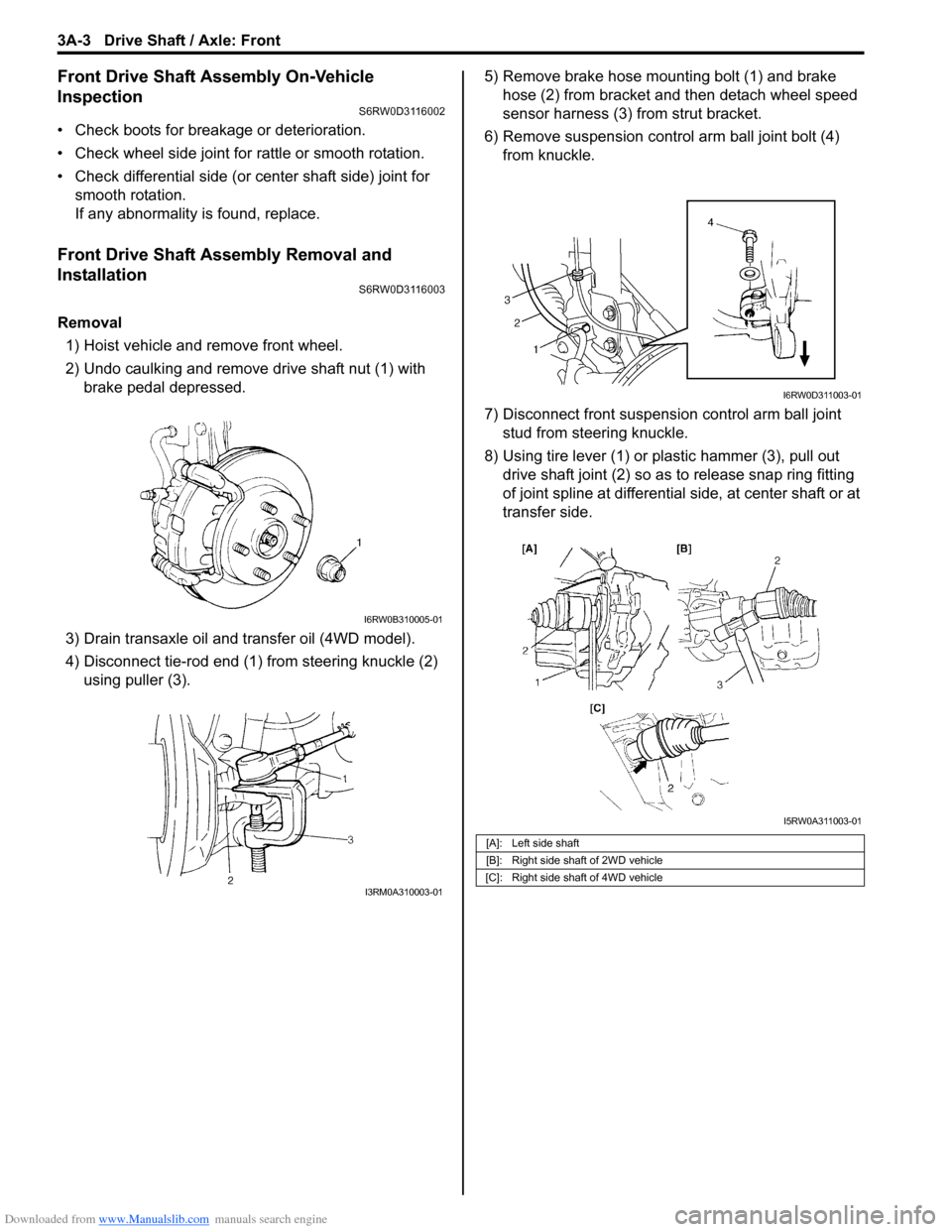
2) Undo caulking and remove drive shaft nut (1) with
brake pedal depressed.
3) Drain transaxle oil and transfer oil (4WD model).
4) Disconnect tie-rod end (1) from steering knuckle (2)
using puller (3).5) Remove brake hose mounting bolt (1) and brake
hose (2) from bracket and then detach wheel speed
sensor harness (3) from strut bracket.
6) Remove suspension control arm ball joint bolt (4)
from knuckle.
7) Disconnect front suspension control arm ball joint
stud from steering knuckle.
8) Using tire lever (1) or plastic hammer (3), pull out
drive shaft joint (2) so as to release snap ring fitting
of joint spline at differential side, at center shaft or at
transfer side.
I6RW0B310005-01
I3RM0A310003-01
[A]: Left side shaft
[B]: Right side shaft of 2WD vehicle
[C]: Right side shaft of 4WD vehicle
I6RW0D311003-01
I5RW0A311003-01
Page 531 of 1556
Downloaded from www.Manualslib.com manuals search engine Differential: 3B-34
Front Mounting Arm and/or Rear Mounting
Bracket Assembly Removal and Installation
S6RW0D3206010
Remove and install front mounting arm and/or rear
mounting bracket after rear differential removed.
For tightening torque of each bolt and nut, refer to “Rear
Differential Mountings Components”.
Rear Mounting Bracket Assembly Disassembly
and Reassembly
S6RW0D3206011
Disassembly
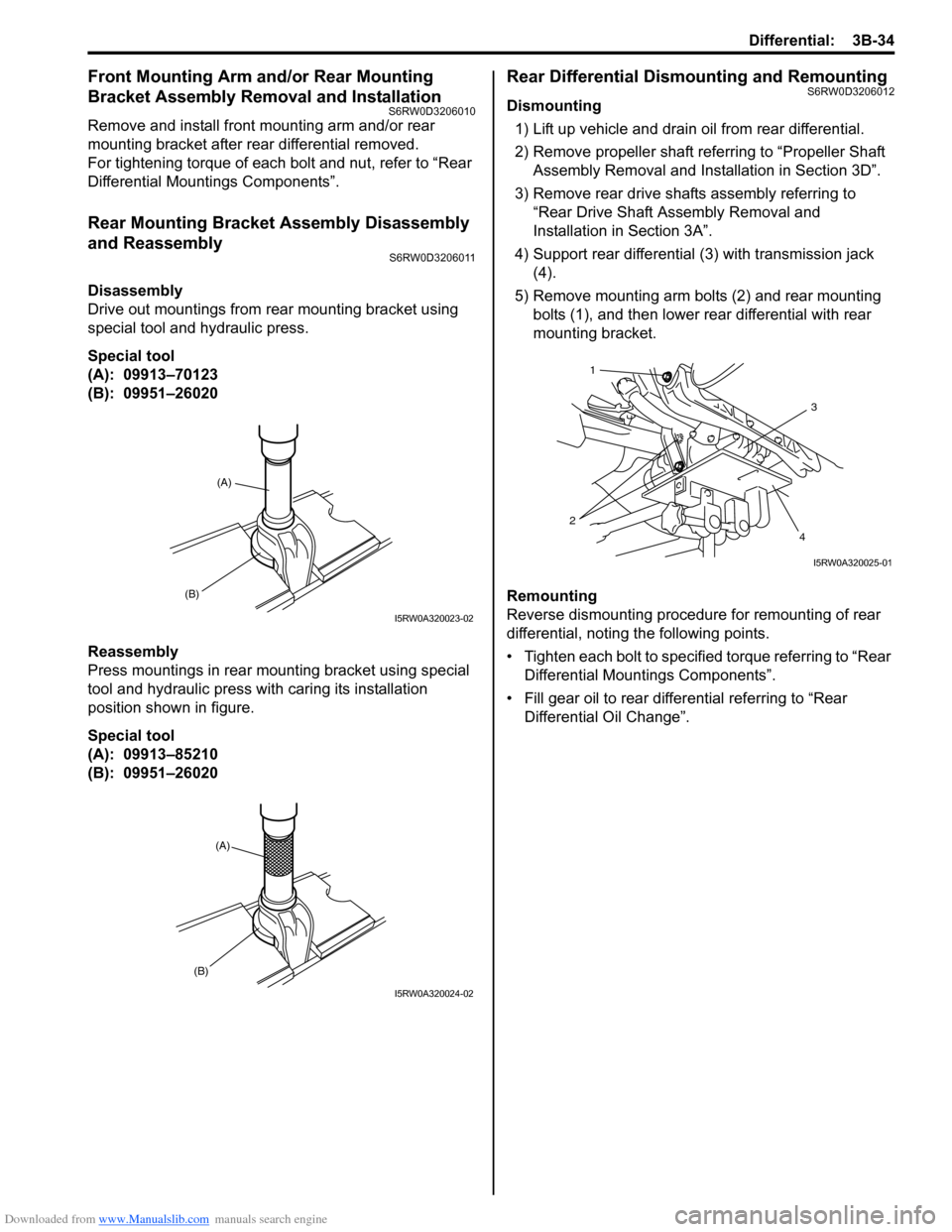
Drive out mountings from rear mounting bracket using
special tool and hydraulic press.
Special tool
(A): 09913–70123
(B): 09951–26020
Reassembly
Press mountings in rear mounting bracket using special
tool and hydraulic press with caring its installation
position shown in figure.
Special tool
(A): 09913–85210
(B): 09951–26020
Rear Differential Dismounting and RemountingS6RW0D3206012
Dismounting
1) Lift up vehicle and drain oil from rear differential.
2) Remove propeller shaft referring to “Propeller Shaft
Assembly Removal and Installation in Section 3D”.
3) Remove rear drive shafts assembly referring to
“Rear Drive Shaft Assembly Removal and
Installation in Section 3A”.
4) Support rear differential (3) with transmission jack
(4).
5) Remove mounting arm bolts (2) and rear mounting
bolts (1), and then lower rear differential with rear
mounting bracket.
Remounting
Reverse dismounting procedure for remounting of rear
differential, noting the following points.
• Tighten each bolt to specified torque referring to “Rear
Differential Mountings Components”.
• Fill gear oil to rear differential referring to “Rear
Differential Oil Change”.
(B)
(A)
I5RW0A320023-02
(A)
(B)
I5RW0A320024-02
3
4 21
I5RW0A320025-01
Page 545 of 1556
Downloaded from www.Manualslib.com manuals search engine Differential: 3B-48
Specifications
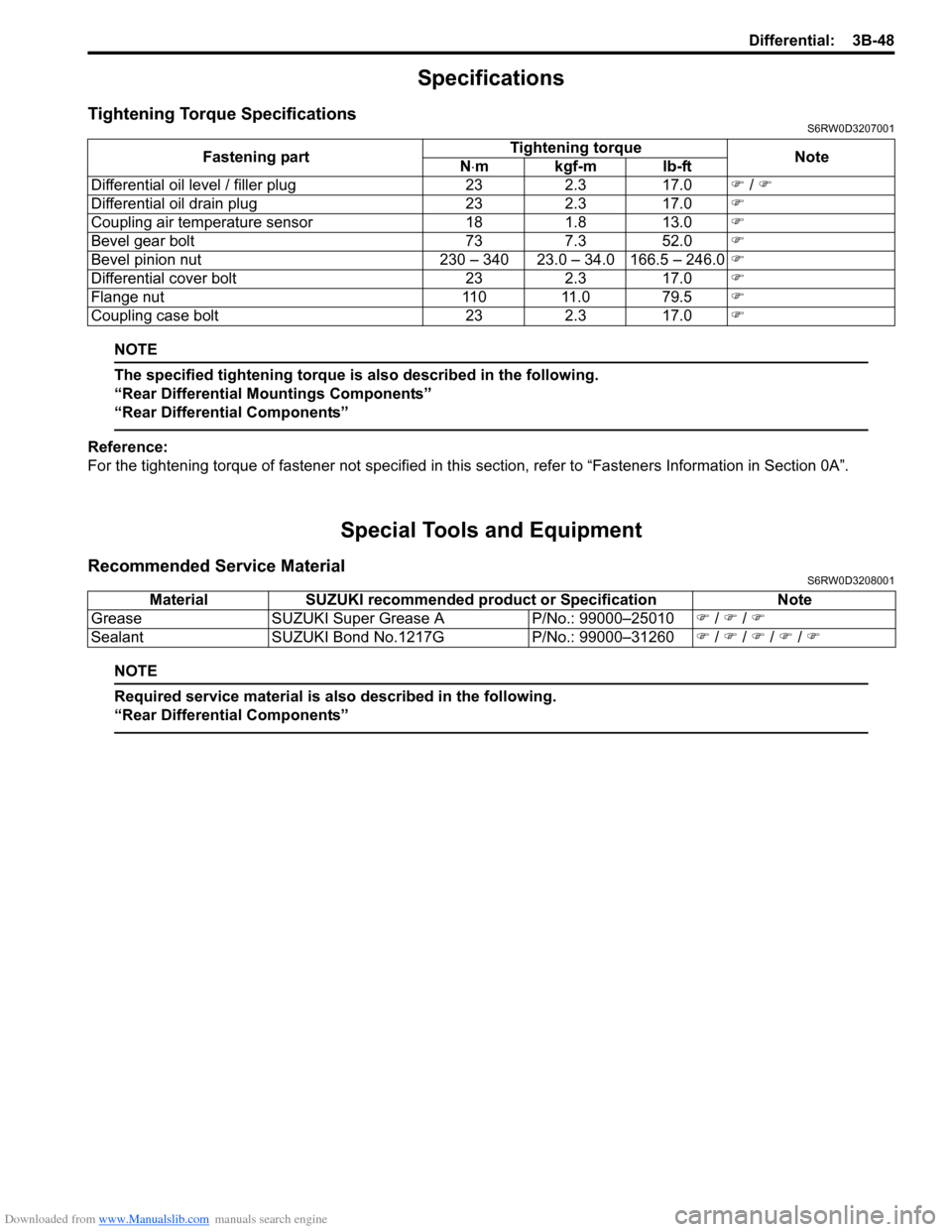
Tightening Torque SpecificationsS6RW0D3207001
NOTE
The specified tightening torque is also described in the following.
“Rear Differential Mountings Components”
“Rear Differential Components”
Reference:
For the tightening torque of fastener not specified in this section, refer to “Fasteners Information in Section 0A”.
Special Tools and Equipment
Recommended Service MaterialS6RW0D3208001
NOTE
Required service material is also described in the following.
“Rear Differential Components”
Fastening partTightening torque
Note
N⋅mkgf-mlb-ft
Differential oil level / filler plug 23 2.3 17.0) / )
Differential oil drain plug 23 2.3 17.0)
Coupling air temperature sensor 18 1.8 13.0)
Bevel gear bolt 73 7.3 52.0)
Bevel pinion nut 230 – 340 23.0 – 34.0 166.5 – 246.0)
Differential cover bolt 23 2.3 17.0)
Flange nut 110 11.0 79.5)
Coupling case bolt 23 2.3 17.0)
Material SUZUKI recommended product or Specification Note
Grease SUZUKI Super Grease A P/No.: 99000–25010) / ) / )
Sealant SUZUKI Bond No.1217G P/No.: 99000–31260) / ) / ) / ) / )
Page 550 of 1556
Downloaded from www.Manualslib.com manuals search engine 3C-3 Transfer:
Transfer Dismounting and RemountingS6RW0D3306003
Dismounting
1) Disconnect negative cable at battery.
2) Drain transaxle oil and transfer oil.
3) Remove drive shafts assembly referring to “Front
Drive Shaft Assembly Removal and Installation in
Section 3A”.
4) Remove exhaust No.1, No.2 and center pipes
referring to “Exhaust Pipe and Muffler Removal and
Installation in Section 1K”.
5) Remove suspension frame, engine front mounting
member and mounting member referring to “Front
Suspension Frame, Stabilizer Bar and/or Bushing
Removal and Installation in Section 2B” and “Engine
Assembly Removal and Installation in Section 1D”.
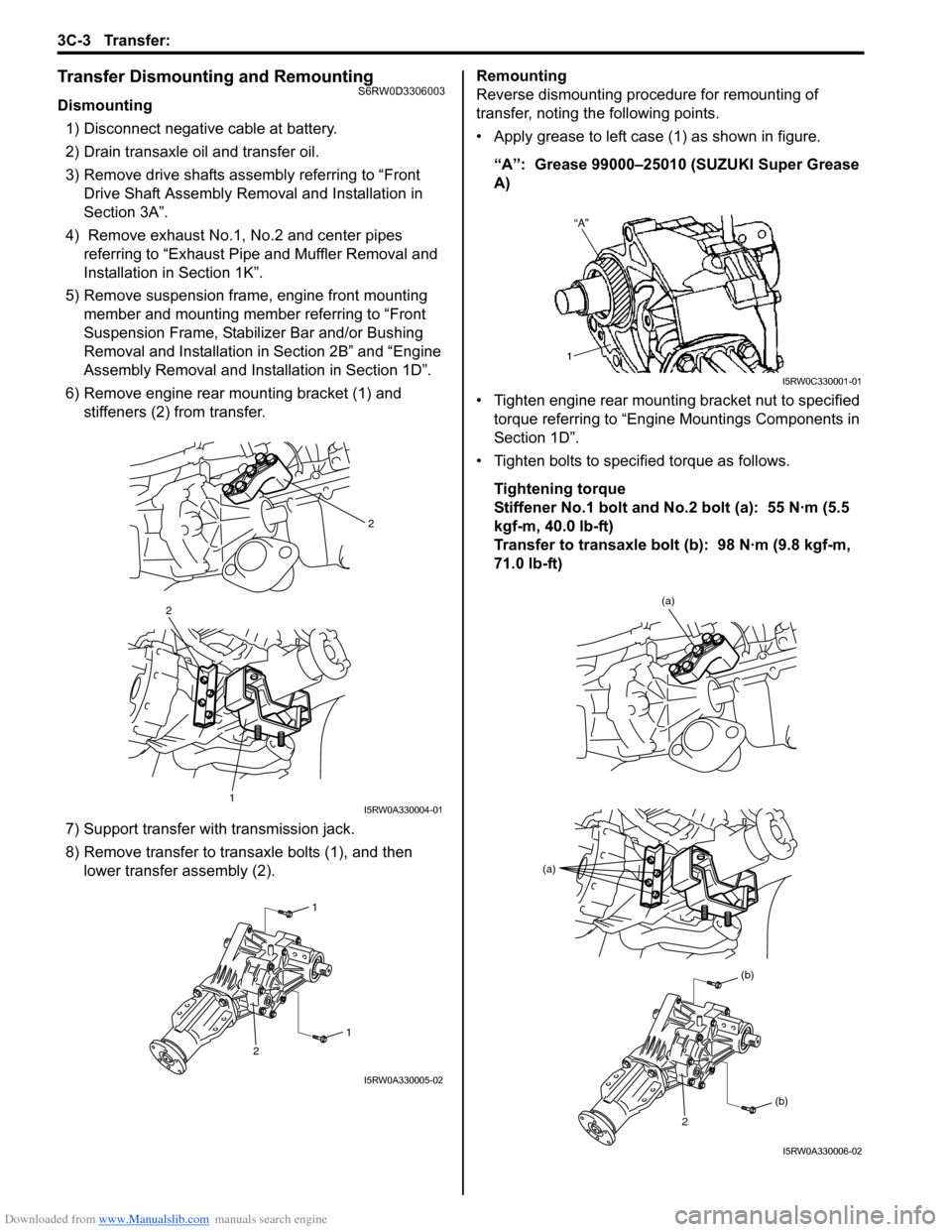
6) Remove engine rear mounting bracket (1) and
stiffeners (2) from transfer.
7) Support transfer with transmission jack.
8) Remove transfer to transaxle bolts (1), and then
lower transfer assembly (2).Remounting
Reverse dismounting procedure for remounting of
transfer, noting the following points.
• Apply grease to left case (1) as shown in figure.
“A”: Grease 99000–25010 (SUZUKI Super Grease
A)
• Tighten engine rear mounting bracket nut to specified
torque referring to “Engine Mountings Components in
Section 1D”.
• Tighten bolts to specified torque as follows.
Tightening torque
Stiffener No.1 bolt and No.2 bolt (a): 55 N·m (5.5
kgf-m, 40.0 lb-ft)
Transfer to transaxle bolt (b): 98 N·m (9.8 kgf-m,
71.0 lb-ft)
2
2
1I5RW0A330004-01
1
1
2
I5RW0A330005-02
I5RW0C330001-01
(a)
(a)
(b)
(b)
2
I5RW0A330006-02
Page 551 of 1556
Downloaded from www.Manualslib.com manuals search engine Transfer: 3C-4
• Pour transaxle oil and transfer oil referring to “Manual
Transaxle Oil Change in Section 5B” and “Transfer Oil
Change”.
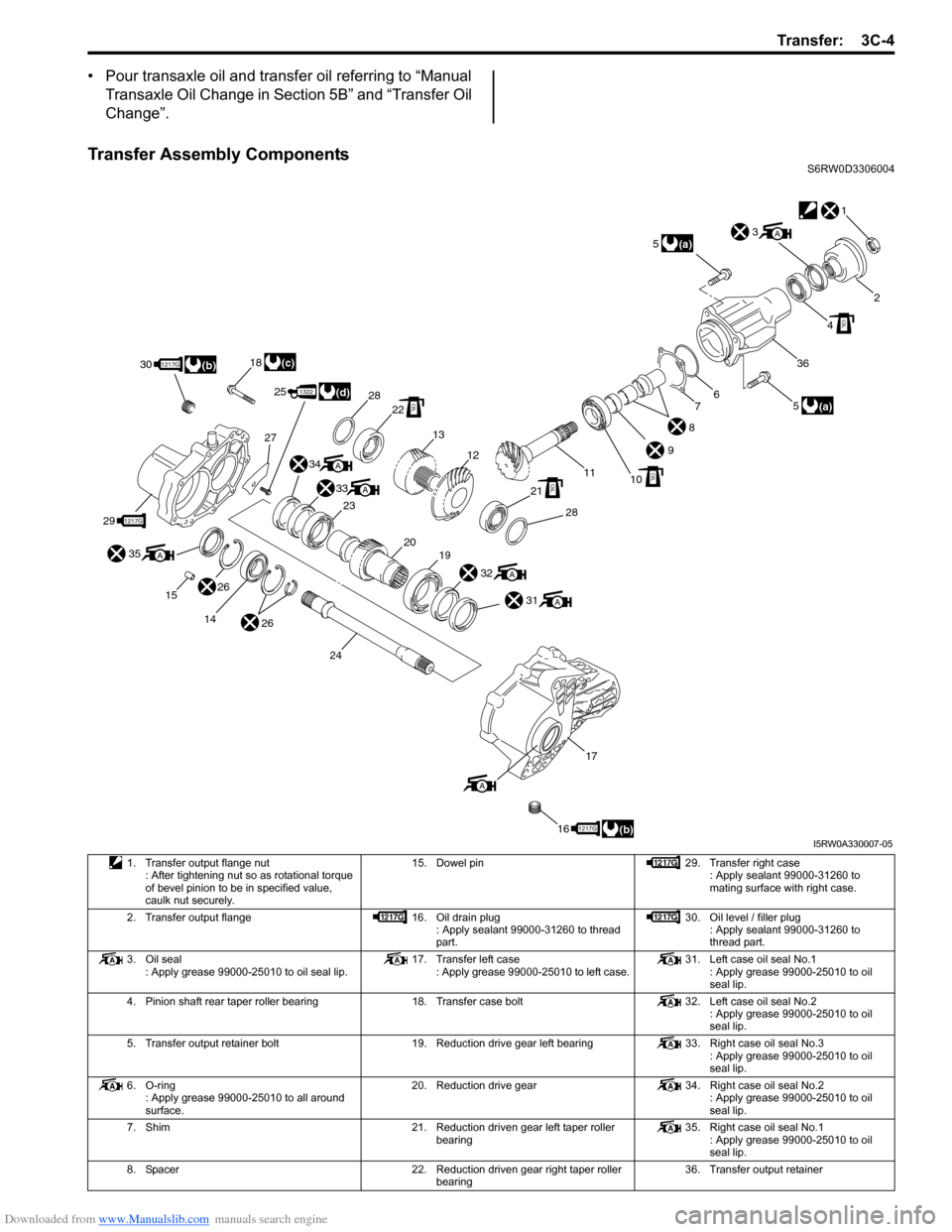
Transfer Assembly ComponentsS6RW0D3306004
1
2
6
9
1110
8
7
3A
4
5
36
OIL
(a) 5
(a)
OIL
28
18
30
27
25
21
28
13
12
22OIL
OIL
32A
31A
1322(d)
34A
33
23A
2019
(c)1217G
291217G
(b)
35
15A
26
26 14
24
17
161217G(b)
A
I5RW0A330007-05
1. Transfer output flange nut
: After tightening nut so as rotational torque
of bevel pinion to be in specified value,
caulk nut securely.15. Dowel pin 29. Transfer right case
: Apply sealant 99000-31260 to
mating surface with right case.
2. Transfer output flange 16. Oil drain plug
: Apply sealant 99000-31260 to thread
part.30. Oil level / filler plug
: Apply sealant 99000-31260 to
thread part.
3. Oil seal
: Apply grease 99000-25010 to oil seal lip.17. Transfer left case
: Apply grease 99000-25010 to left case.31. Left case oil seal No.1
: Apply grease 99000-25010 to oil
seal lip.
4. Pinion shaft rear taper roller bearing 18. Transfer case bolt 32. Left case oil seal No.2
: Apply grease 99000-25010 to oil
seal lip.
5. Transfer output retainer bolt 19. Reduction drive gear left bearing 33. Right case oil seal No.3
: Apply grease 99000-25010 to oil
seal lip.
6. O-ring
: Apply grease 99000-25010 to all around
surface.20. Reduction drive gear 34. Right case oil seal No.2
: Apply grease 99000-25010 to oil
seal lip.
7. Shim 21. Reduction driven gear left taper roller
bearing35. Right case oil seal No.1
: Apply grease 99000-25010 to oil
seal lip.
8. Spacer 22. Reduction driven gear right taper roller
bearing36. Transfer output retainer
Page 563 of 1556
Downloaded from www.Manualslib.com manuals search engine Transfer: 3C-16
Specifications
Tightening Torque SpecificationsS6RW0D3307001
NOTE
The specified tightening torque is also described in the following.
“Transfer Assembly Components”
Reference:
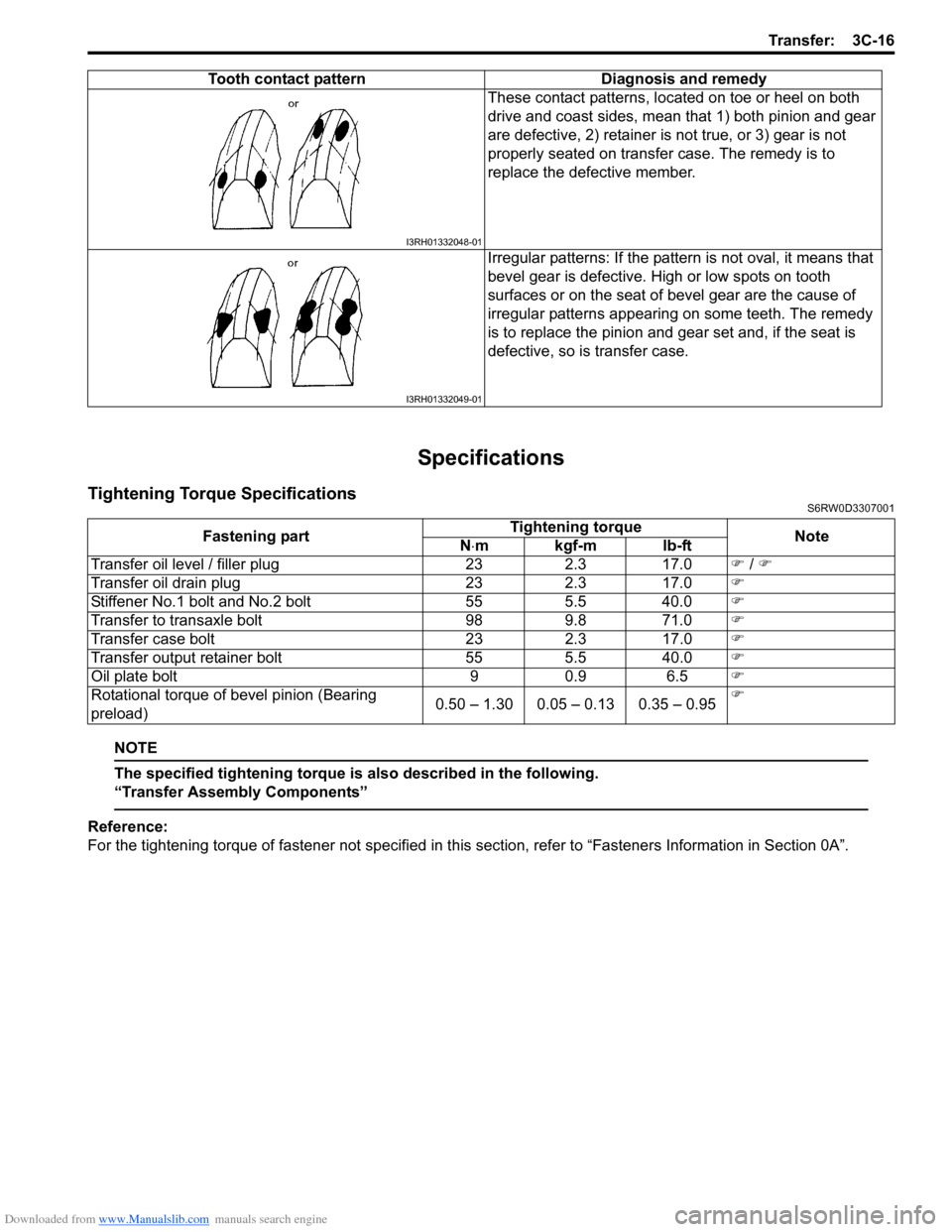
For the tightening torque of fastener not specified in this section, refer to “Fasteners Information in Section 0A”. These contact patterns, located on toe or heel on both
drive and coast sides, mean that 1) both pinion and gear
are defective, 2) retainer is not true, or 3) gear is not
properly seated on transfer case. The remedy is to
replace the defective member.
Irregular patterns: If the pattern is not oval, it means that
bevel gear is defective. High or low spots on tooth
surfaces or on the seat of bevel gear are the cause of
irregular patterns appearing on some teeth. The remedy
is to replace the pinion and gear set and, if the seat is
defective, so is transfer case. Tooth contact pattern Diagnosis and remedy
I3RH01332048-01
I3RH01332049-01
Fastening partTightening torque
Note
N⋅mkgf-mlb-ft
Transfer oil level / filler plug 23 2.3 17.0) / )
Transfer oil drain plug 23 2.3 17.0)
Stiffener No.1 bolt and No.2 bolt 55 5.5 40.0)
Transfer to transaxle bolt 98 9.8 71.0)
Transfer case bolt 23 2.3 17.0)
Transfer output retainer bolt 55 5.5 40.0)
Oil plate bolt 9 0.9 6.5)
Rotational torque of bevel pinion (Bearing
preload)0.50 – 1.30 0.05 – 0.13 0.35 – 0.95)
Page 580 of 1556
Downloaded from www.Manualslib.com manuals search engine 4A-9 Brake Control System and Diagnosis:
1) Fill master cylinder reservoir with specified brake
fluid and keep at least one-half full of fluid during
bleeding operation.
Brake fluid
: Refer to reservoir cap
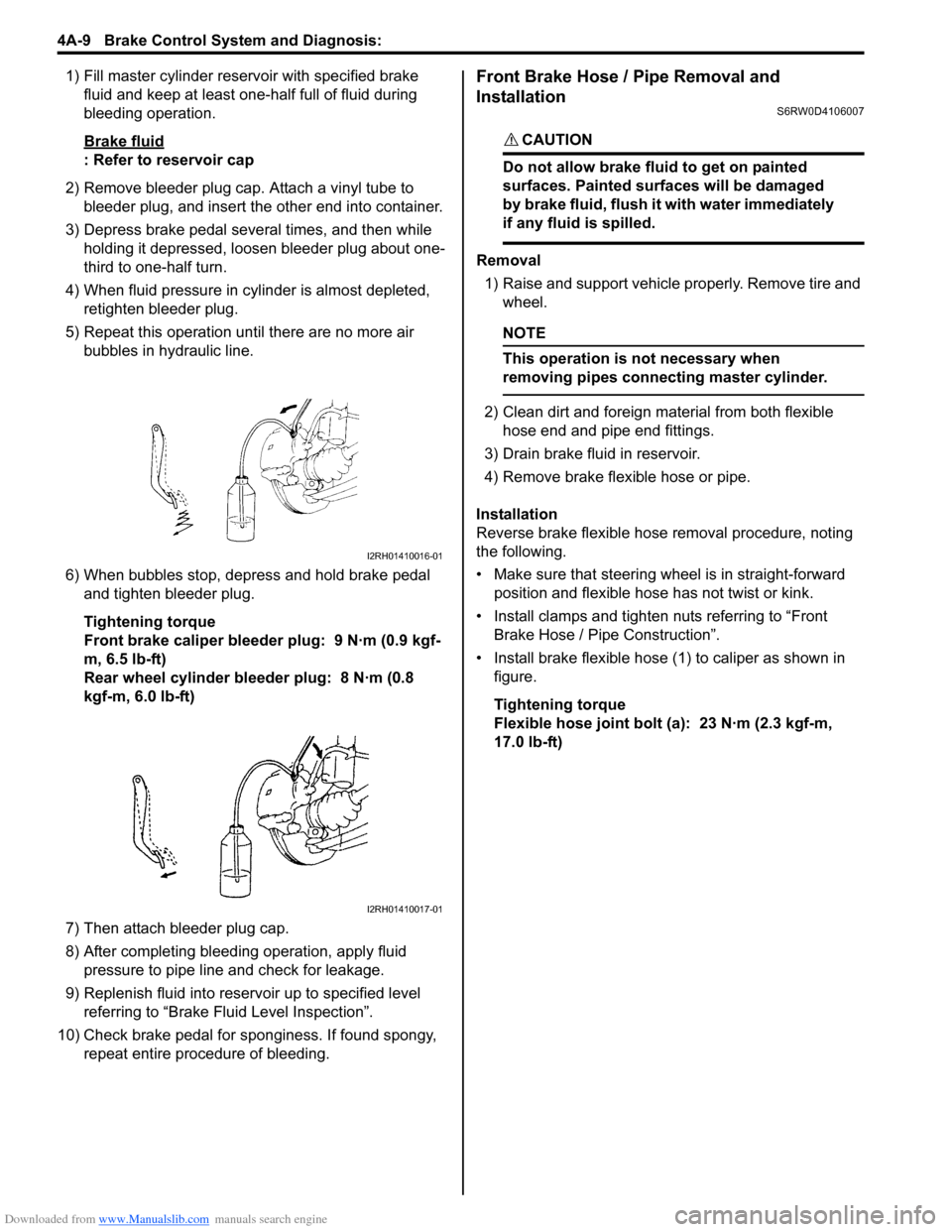
2) Remove bleeder plug cap. Attach a vinyl tube to
bleeder plug, and insert the other end into container.
3) Depress brake pedal several times, and then while
holding it depressed, loosen bleeder plug about one-
third to one-half turn.
4) When fluid pressure in cylinder is almost depleted,
retighten bleeder plug.
5) Repeat this operation until there are no more air
bubbles in hydraulic line.
6) When bubbles stop, depress and hold brake pedal
and tighten bleeder plug.
Tightening torque
Front brake caliper bleeder plug: 9 N·m (0.9 kgf-
m, 6.5 lb-ft)
Rear wheel cylinder bleeder plug: 8 N·m (0.8
kgf-m, 6.0 lb-ft)
7) Then attach bleeder plug cap.
8) After completing bleeding operation, apply fluid
pressure to pipe line and check for leakage.
9) Replenish fluid into reservoir up to specified level
referring to “Brake Fluid Level Inspection”.
10) Check brake pedal for sponginess. If found spongy,
repeat entire procedure of bleeding.
Front Brake Hose / Pipe Removal and
Installation
S6RW0D4106007
CAUTION!
Do not allow brake fluid to get on painted
surfaces. Painted surfaces will be damaged
by brake fluid, flush it with water immediately
if any fluid is spilled.
Removal
1) Raise and support vehicle properly. Remove tire and
wheel.
NOTE
This operation is not necessary when
removing pipes connecting master cylinder.
2) Clean dirt and foreign material from both flexible
hose end and pipe end fittings.
3) Drain brake fluid in reservoir.
4) Remove brake flexible hose or pipe.
Installation
Reverse brake flexible hose removal procedure, noting
the following.
• Make sure that steering wheel is in straight-forward
position and flexible hose has not twist or kink.
• Install clamps and tighten nuts referring to “Front
Brake Hose / Pipe Construction”.
• Install brake flexible hose (1) to caliper as shown in
figure.
Tightening torque
Flexible hose joint bolt (a): 23 N·m (2.3 kgf-m,
17.0 lb-ft)
I2RH01410016-01
I2RH01410017-01
Page 739 of 1556

Downloaded from www.Manualslib.com manuals search engine Automatic Transmission/Transaxle: 5A-91
Input Shaft Speed Sensor Removal and
Installation
S6RW0D5106012
Removal
1) Disconnect negative cable at battery.
2) Disconnect input shaft speed sensor connector (2).
3) Remove input shaft speed sensor (1) by removing its
bolt.
Installation
1) Apply A/T fluid to input shaft speed sensor O-ring.
2) Install input shaft speed sensor (1) to A/T case and
tighten bolt to specified torque.
Tightening torque
Input shaft speed sensor bolt (a): 5.5 N·m (0.55
kgf-m, 4.0 lb-ft)
3) Connect input shaft speed sensor connector (2) to
input shaft speed sensor (1).
4) Connect negative cable to battery.
Input Shaft Speed Sensor InspectionS6RW0D5106013
1) Disconnect negative cable at battery.
2) Disconnect input shaft speed sensor connector (2).
3) Check resistance between input shaft speed sensor
(1) terminals.
Input shaft speed sensor resistance
Standard: 560 – 680 Ω at 20 °C (68 °F)
Transmission Fluid Temperature Sensor
Removal and Installation
S6RW0D5106014
Removal
1) Disconnect negative cable at battery.
2) Lift up vehicle.
3) Remove left side engine under cover.
4) With engine is cool, remove drain plug and drain A/T
fluid.
5) Install drain plug. Refer to “A/T Fluid Change”.
6) Remove A/T oil pan.
7) Remove oil strainer assembly.
8) Remove valve body assembly referring to
“Automatic Transaxle Unit Disassembly”.
CAUTION!
When pulling valve body harness out of
transaxle case, take care not to damage
transmission fluid temperature sensor at
narrow exit of case.
Careless sensor treatment might cause
sensor malfunction.
9) Remove valve body harness (1).
12
I5RW0C510034-01
12
(a)I5RW0C510035-01
12I5RW0C510036-01
I2RH0B510050-01
Page 740 of 1556

Downloaded from www.Manualslib.com manuals search engine 5A-92 Automatic Transmission/Transaxle:
Installation
Reverse removal procedure to install valve body
harness and valve body assembly noting the following
points.
• For details of valve body assembly and their
connectors installation, refer to “Automatic Transaxle
Unit Assembly”.
• For details of A/T oil pan installation, refer to
“Automatic Transaxle Unit Assembly”. Use new oil
pan gasket.
• Tighten valve body harness connector bolt to
specified torque.
Tightening torque
Valve body harness connector bolt (a): 5.5 N·m (
0.55 kgf-m, 4.0 lb-ft)
• Pour A/T fluid and check fluid level according to
procedure described in “A/T Fluid Change”.
• Check for fluid leakage after warming up A/T.Transmission Fluid Temperature Sensor
Inspection
S6RW0D5106015
Warm up transmission fluid temperature sensor (2).
Check resistance between terminals of valve body
harness connector (1). Thus make sure its resistance
decrease as its temperature increase.
Transmission fluid temperature sensor resistance
10 °C (50 °F): 5.8 – 7.1 kΩ
11 0 °C (230 °F): 231 – 263 Ω
145 °C (293 °F): 105 – 117 Ω
Solenoid Valves (Shift Solenoid Valves and
Timing Solenoid Valve) Removal and
Installation
S6RW0D5106061
Removal
1) Disconnect negative cable at battery.
2) Lift up vehicle.
3) Remove left side engine under cover.
4) Remove drain plug and drain A/T fluid.
5) Install drain plug.
Tightening torque
A/T fluid drain plug: 17 N·m (1.7 kgf-m, 12.5 lb-ft)
6) Remove A/T oil pan (1) and oil pan gasket (2).
I2RH0B510051-01
I2RH0B510052-01