4WD SUZUKI SX4 2006 1.G Service Owner's Manual
[x] Cancel search | Manufacturer: SUZUKI, Model Year: 2006, Model line: SX4, Model: SUZUKI SX4 2006 1.GPages: 1556, PDF Size: 37.31 MB
Page 218 of 1556

Downloaded from www.Manualslib.com manuals search engine 1A-168 Engine General Information and Diagnosis:
Troubleshooting
Step Action Yes No
1DTC Check
1) Turn ignition switch to OFF position.
2) Connect scan tool to DLC.
3) Check DTC in the following control modules.
•ECM
•TCM
•BCM
• Keyless start control module
• 4WD control module
Is there any DTC other than CAN-DTC?Go to applicable
troubleshooting of DTC
other than CAN-DTC.Go to Step 2.
2Control module connector check
1) Turn ignition switch to OFF position.
2) Be sure to disconnect scan tool from DLC.
3) Disconnect all the following control module connectors.
• Control modules communicated by CAN
–ECM
–TCM
– ABS control module
–BCM
– Combination meter
– Keyless start control module
– 4WD control module
4) Check for proper connection to terminal of each CAN
line of all control module (communicated by CAN)
connectors.
5) If OK, connect all connectors of control module
communicated by CAN securely.
6) Recheck DTC for all control modules communicated by
CAN.
Is there any CAN-DTC?Go to Step 3. Intermittent trouble.
Check for intermittent
referring to “Intermittent
and Poor Connection
Inspection in Section
00”.
Page 219 of 1556
Downloaded from www.Manualslib.com manuals search engine Engine General Information and Diagnosis: 1A-169
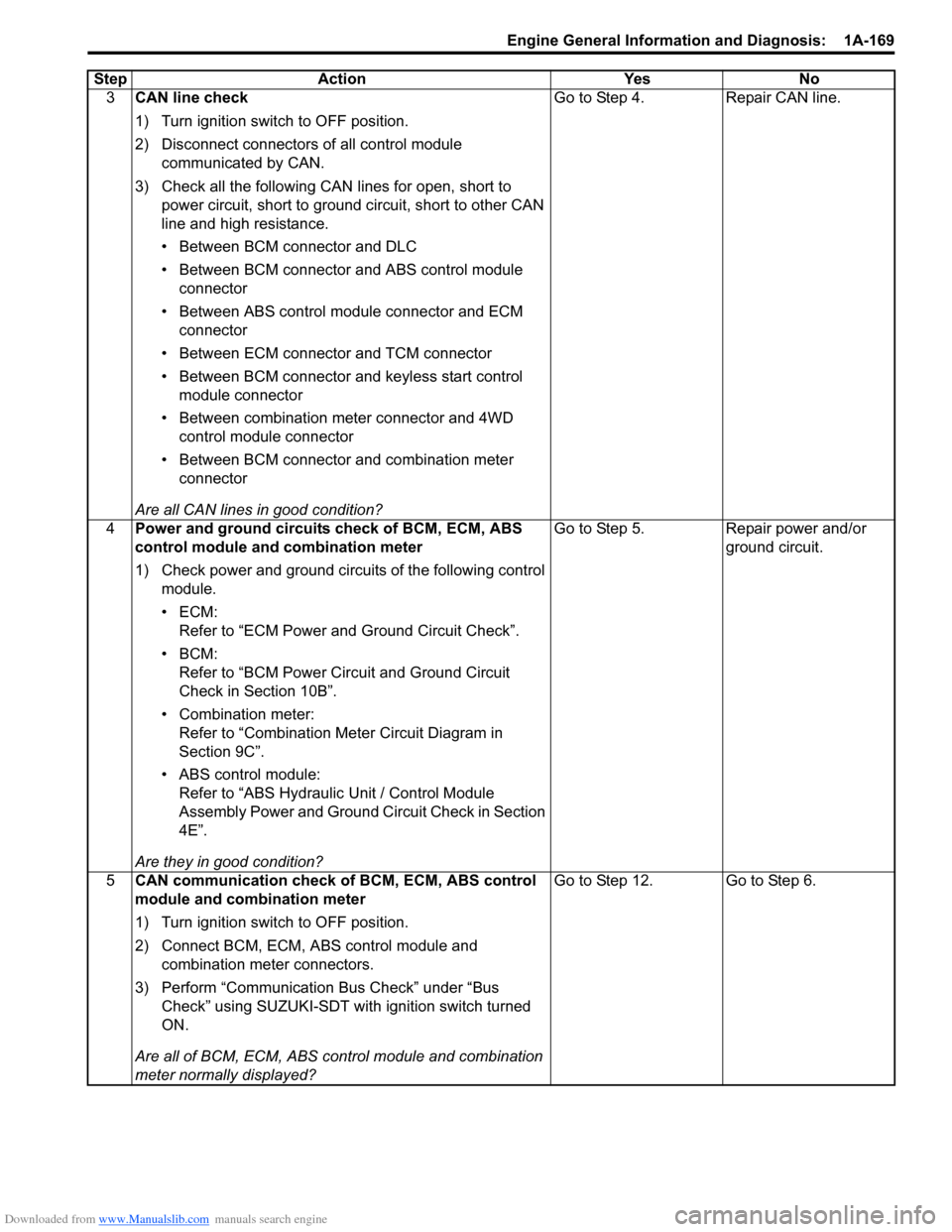
3CAN line check
1) Turn ignition switch to OFF position.
2) Disconnect connectors of all control module
communicated by CAN.
3) Check all the following CAN lines for open, short to
power circuit, short to ground circuit, short to other CAN
line and high resistance.
• Between BCM connector and DLC
• Between BCM connector and ABS control module
connector
• Between ABS control module connector and ECM
connector
• Between ECM connector and TCM connector
• Between BCM connector and keyless start control
module connector
• Between combination meter connector and 4WD
control module connector
• Between BCM connector and combination meter
connector
Are all CAN lines in good condition?Go to Step 4. Repair CAN line.
4Power and ground circuits check of BCM, ECM, ABS
control module and combination meter
1) Check power and ground circuits of the following control
module.
•ECM:
Refer to “ECM Power and Ground Circuit Check”.
•BCM:
Refer to “BCM Power Circuit and Ground Circuit
Check in Section 10B”.
• Combination meter:
Refer to “Combination Meter Circuit Diagram in
Section 9C”.
• ABS control module:
Refer to “ABS Hydraulic Unit / Control Module
Assembly Power and Ground Circuit Check in Section
4E”.
Are they in good condition?Go to Step 5. Repair power and/or
ground circuit.
5CAN communication check of BCM, ECM, ABS control
module and combination meter
1) Turn ignition switch to OFF position.
2) Connect BCM, ECM, ABS control module and
combination meter connectors.
3) Perform “Communication Bus Check” under “Bus
Check” using SUZUKI-SDT with ignition switch turned
ON.
Are all of BCM, ECM, ABS control module and combination
meter normally displayed?Go to Step 12. Go to Step 6. Step Action Yes No
Page 221 of 1556
Downloaded from www.Manualslib.com manuals search engine Engine General Information and Diagnosis: 1A-171
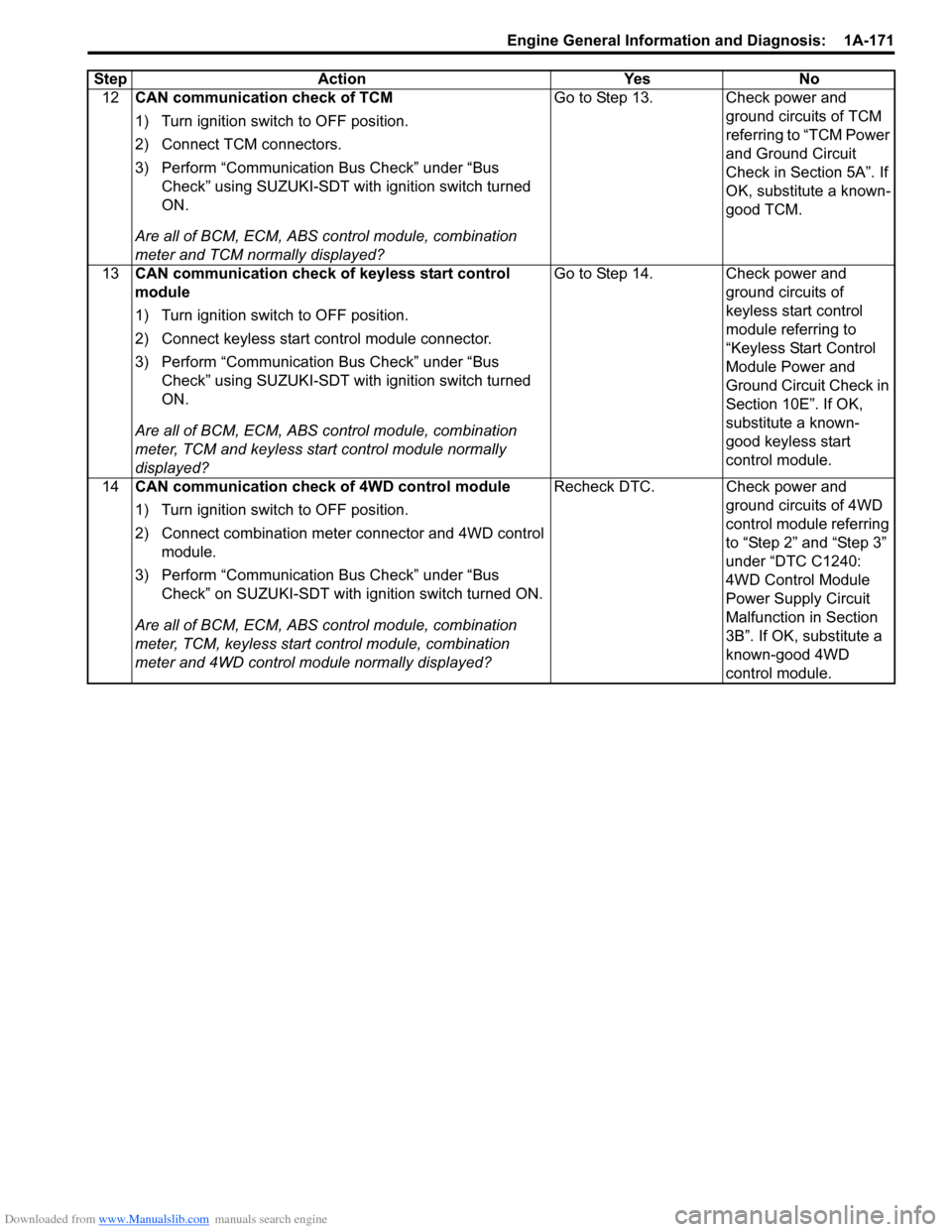
12CAN communication check of TCM
1) Turn ignition switch to OFF position.
2) Connect TCM connectors.
3) Perform “Communication Bus Check” under “Bus
Check” using SUZUKI-SDT with ignition switch turned
ON.
Are all of BCM, ECM, ABS control module, combination
meter and TCM normally displayed?Go to Step 13. Check power and
ground circuits of TCM
referring to “TCM Power
and Ground Circuit
Check in Section 5A”. If
OK, substitute a known-
good TCM.
13CAN communication check of keyless start control
module
1) Turn ignition switch to OFF position.
2) Connect keyless start control module connector.
3) Perform “Communication Bus Check” under “Bus
Check” using SUZUKI-SDT with ignition switch turned
ON.
Are all of BCM, ECM, ABS control module, combination
meter, TCM and keyless start control module normally
displayed?Go to Step 14. Check power and
ground circuits of
keyless start control
module referring to
“Keyless Start Control
Module Power and
Ground Circuit Check in
Section 10E”. If OK,
substitute a known-
good keyless start
control module.
14CAN communication check of 4WD control module
1) Turn ignition switch to OFF position.
2) Connect combination meter connector and 4WD control
module.
3) Perform “Communication Bus Check” under “Bus
Check” on SUZUKI-SDT with ignition switch turned ON.
Are all of BCM, ECM, ABS control module, combination
meter, TCM, keyless start control module, combination
meter and 4WD control module normally displayed?Recheck DTC. Check power and
ground circuits of 4WD
control module referring
to “Step 2” and “Step 3”
under “DTC C1240:
4WD Control Module
Power Supply Circuit
Malfunction in Section
3B”. If OK, substitute a
known-good 4WD
control module. Step Action Yes No
Page 298 of 1556
![SUZUKI SX4 2006 1.G Service Owners Manual Downloaded from www.Manualslib.com manuals search engine 1D-16 Engine Mechanical:
Engine Mountings ComponentsS6RW0D1406012
I6RW0D140002-01
[A]: For 4WD model 4. Engine left mounting
: Be sure to dire](/img/20/7612/w960_7612-297.png "SUZUKI SX4 2006 1.G Service Owners Manual Downloaded from www.Manualslib.com manuals search engine 1D-16 Engine Mechanical:
Engine Mountings ComponentsS6RW0D1406012
I6RW0D140002-01
[A]: For 4WD model 4. Engine left mounting
: Be sure to dire")
Downloaded from www.Manualslib.com manuals search engine 1D-16 Engine Mechanical:
Engine Mountings ComponentsS6RW0D1406012
I6RW0D140002-01
[A]: For 4WD model 4. Engine left mounting
: Be sure to direct paint mark to forward.12. Dynamic damper
[B]: For 2WD model 5. Engine rear mounting
: Be sure to direct paint mark to forward.13. Mounting member cushion
[C]: For M/T model 6. Engine rear mounting No.1 bracket 14. Yellow mark
[D]: For A/T model 7. Engine rear mounting No.2 bracket 15. Mounting member
Page 300 of 1556
Downloaded from www.Manualslib.com manuals search engine 1D-18 Engine Mechanical:
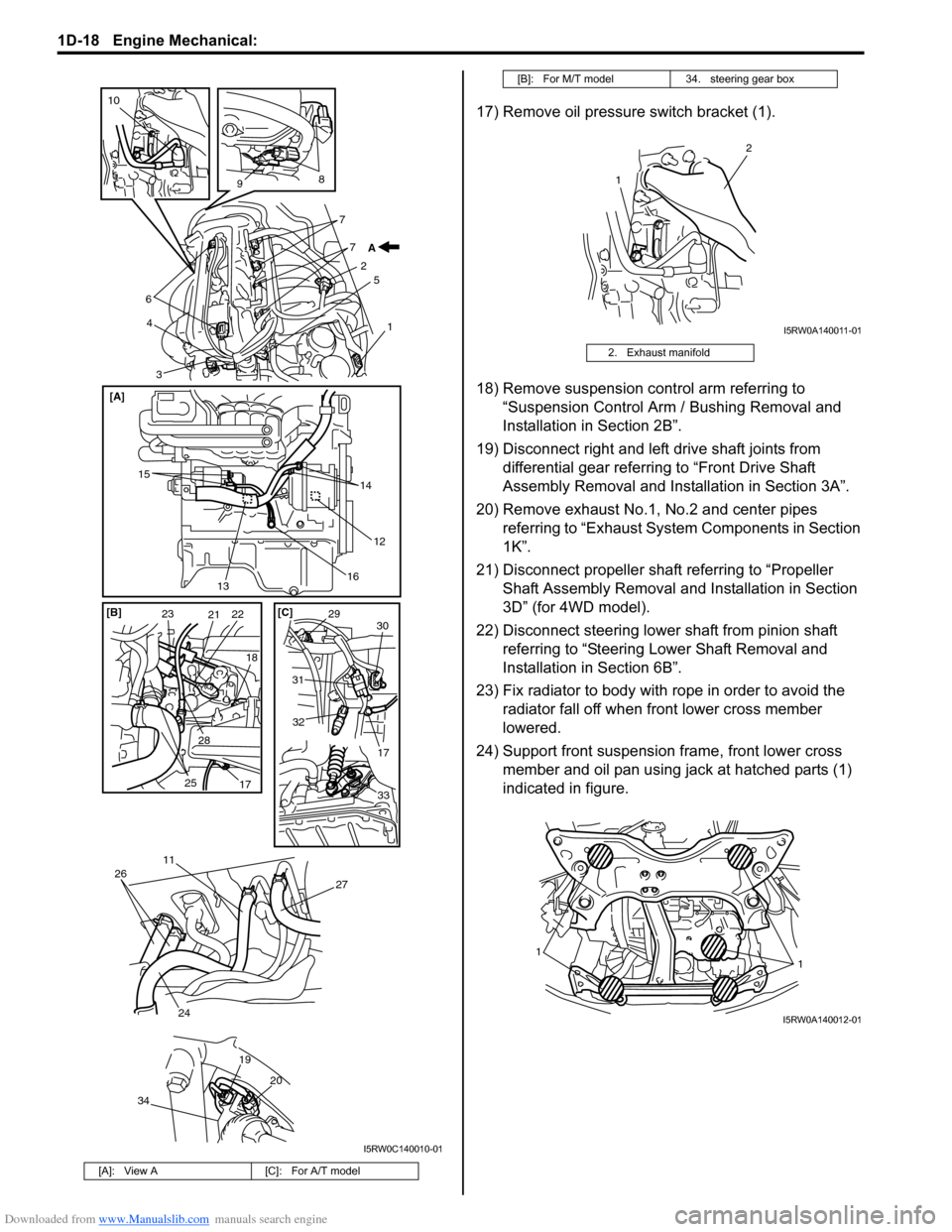
17) Remove oil pressure switch bracket (1).
18) Remove suspension control arm referring to
“Suspension Control Arm / Bushing Removal and
Installation in Section 2B”.
19) Disconnect right and left drive shaft joints from
differential gear referring to “Front Drive Shaft
Assembly Removal and Installation in Section 3A”.
20) Remove exhaust No.1, No.2 and center pipes
referring to “Exhaust System Components in Section
1K”.
21) Disconnect propeller shaft referring to “Propeller
Shaft Assembly Removal and Installation in Section
3D” (for 4WD model).
22) Disconnect steering lower shaft from pinion shaft
referring to “Steering Lower Shaft Removal and
Installation in Section 6B”.
23) Fix radiator to body with rope in order to avoid the
radiator fall off when front lower cross member
lowered.
24) Support front suspension frame, front lower cross
member and oil pan using jack at hatched parts (1)
indicated in figure.
[A]: View A [C]: For A/T model
6
3 45
1 7 7
2
8
9
10
A
15
14
16
20 19
26
24
27
12
13 [A]
11
34
232122
25
17 2818 [B] [C]
2930
31
32
17
33
I5RW0C140010-01
[B]: For M/T model 34. steering gear box
2. Exhaust manifold
1
2
I5RW0A140011-01
11
I5RW0A140012-01
Page 301 of 1556
Downloaded from www.Manualslib.com manuals search engine Engine Mechanical: 1D-19
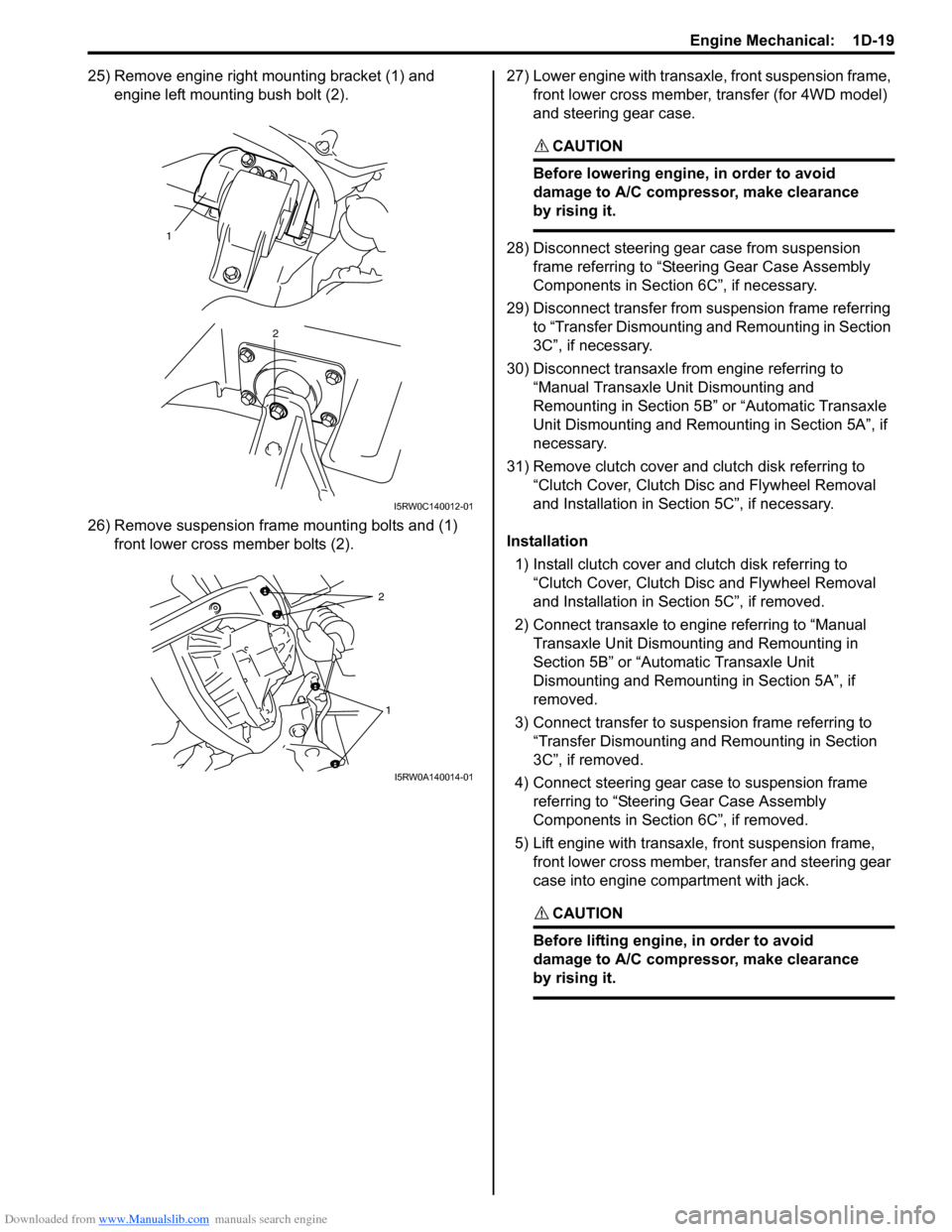
25) Remove engine right mounting bracket (1) and
engine left mounting bush bolt (2).
26) Remove suspension frame mounting bolts and (1)
front lower cross member bolts (2).27) Lower engine with transaxle, front suspension frame,
front lower cross member, transfer (for 4WD model)
and steering gear case.
CAUTION!
Before lowering engine, in order to avoid
damage to A/C compressor, make clearance
by rising it.
28) Disconnect steering gear case from suspension
frame referring to “Steering Gear Case Assembly
Components in Section 6C”, if necessary.
29) Disconnect transfer from suspension frame referring
to “Transfer Dismounting and Remounting in Section
3C”, if necessary.
30) Disconnect transaxle from engine referring to
“Manual Transaxle Unit Dismounting and
Remounting in Section 5B” or “Automatic Transaxle
Unit Dismounting and Remounting in Section 5A”, if
necessary.
31) Remove clutch cover and clutch disk referring to
“Clutch Cover, Clutch Disc and Flywheel Removal
and Installation in Section 5C”, if necessary.
Installation
1) Install clutch cover and clutch disk referring to
“Clutch Cover, Clutch Disc and Flywheel Removal
and Installation in Section 5C”, if removed.
2) Connect transaxle to engine referring to “Manual
Transaxle Unit Dismounting and Remounting in
Section 5B” or “Automatic Transaxle Unit
Dismounting and Remounting in Section 5A”, if
removed.
3) Connect transfer to suspension frame referring to
“Transfer Dismounting and Remounting in Section
3C”, if removed.
4) Connect steering gear case to suspension frame
referring to “Steering Gear Case Assembly
Components in Section 6C”, if removed.
5) Lift engine with transaxle, front suspension frame,
front lower cross member, transfer and steering gear
case into engine compartment with jack.
CAUTION!
Before lifting engine, in order to avoid
damage to A/C compressor, make clearance
by rising it.
1
2
I5RW0C140012-01
2
1
I5RW0A140014-01
Page 302 of 1556
Downloaded from www.Manualslib.com manuals search engine 1D-20 Engine Mechanical:
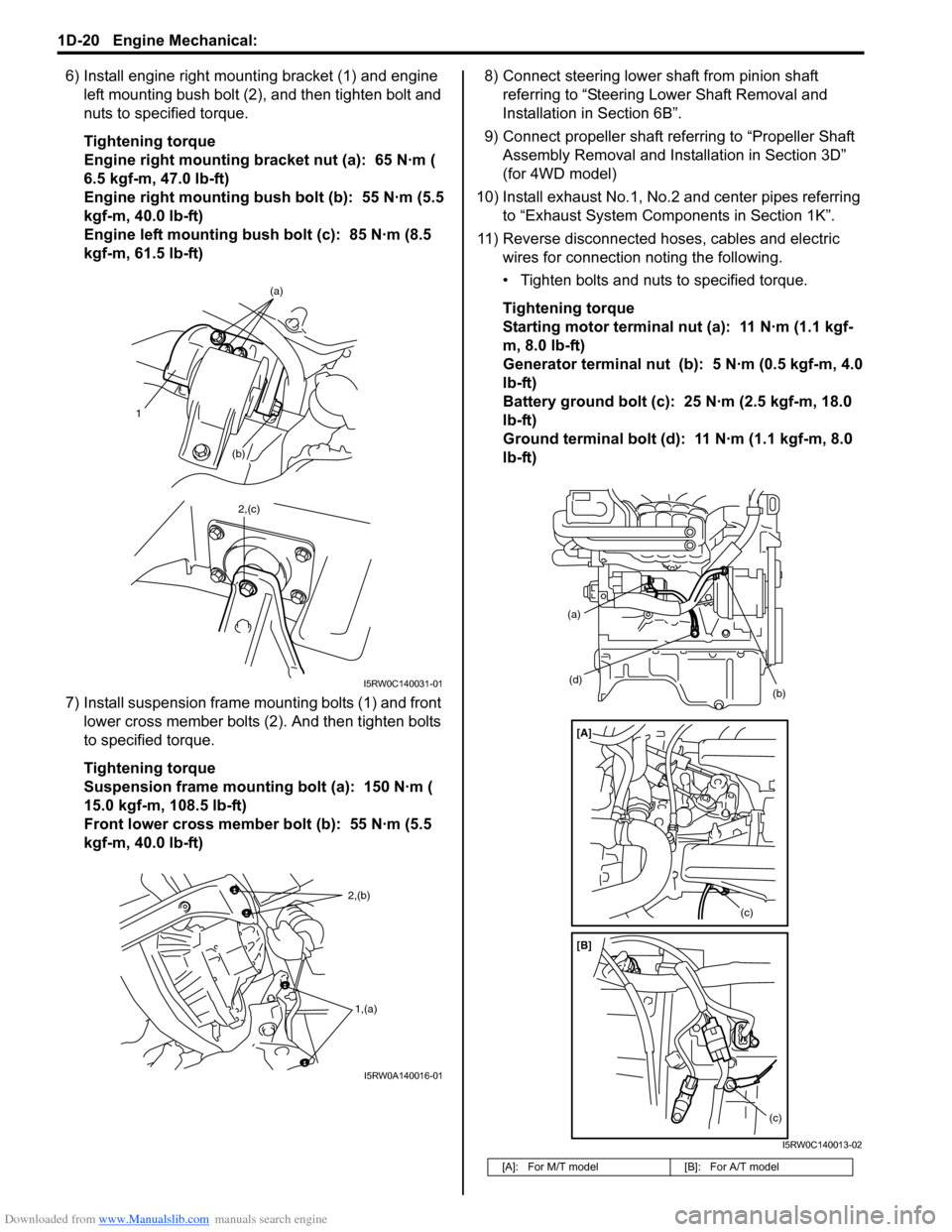
6) Install engine right mounting bracket (1) and engine
left mounting bush bolt (2), and then tighten bolt and
nuts to specified torque.
Tightening torque
Engine right mounting bracket nut (a): 65 N·m (
6.5 kgf-m, 47.0 lb-ft)
Engine right mounting bush bolt (b): 55 N·m (5.5
kgf-m, 40.0 lb-ft)
Engine left mounting bush bolt (c): 85 N·m (8.5
kgf-m, 61.5 lb-ft)
7) Install suspension frame mounting bolts (1) and front
lower cross member bolts (2). And then tighten bolts
to specified torque.
Tightening torque
Suspension frame mounting bolt (a): 150 N·m (
15.0 kgf-m, 108.5 lb-ft)
Front lower cross member bolt (b): 55 N·m (5.5
kgf-m, 40.0 lb-ft)8) Connect steering lower shaft from pinion shaft
referring to “Steering Lower Shaft Removal and
Installation in Section 6B”.
9) Connect propeller shaft referring to “Propeller Shaft
Assembly Removal and Installation in Section 3D”
(for 4WD model)
10) Install exhaust No.1, No.2 and center pipes referring
to “Exhaust System Components in Section 1K”.
11) Reverse disconnected hoses, cables and electric
wires for connection noting the following.
• Tighten bolts and nuts to specified torque.
Tightening torque
Starting motor terminal nut (a): 11 N·m (1.1 kgf-
m, 8.0 lb-ft)
Generator terminal nut (b): 5 N·m (0.5 kgf-m, 4.0
lb-ft)
Battery ground bolt (c): 25 N·m (2.5 kgf-m, 18.0
lb-ft)
Ground terminal bolt (d): 11 N·m (1.1 kgf-m, 8.0
lb-ft)
1
(b)(a)
2,(c)
I5RW0C140031-01
2,(b)
1,(a)
I5RW0A140016-01
[A]: For M/T model [B]: For A/T model
(d)
(a)
(b)
(c)
(c)
[A]
[B]
I5RW0C140013-02
Page 360 of 1556
Downloaded from www.Manualslib.com manuals search engine 1E-4 Engine Lubrication System:
Oil Pan and Oil Pump Strainer Removal and
Installation
S6RW0D1506002
Removal
1) Remove oil level gauge.
2) Drain engine oil by removing drain plug.
3) For 4WD model, dismount transfer referring to
“Transfer Dismounting and Remounting in Section
3C”.
4) Remove clutch housing lower plate (1).
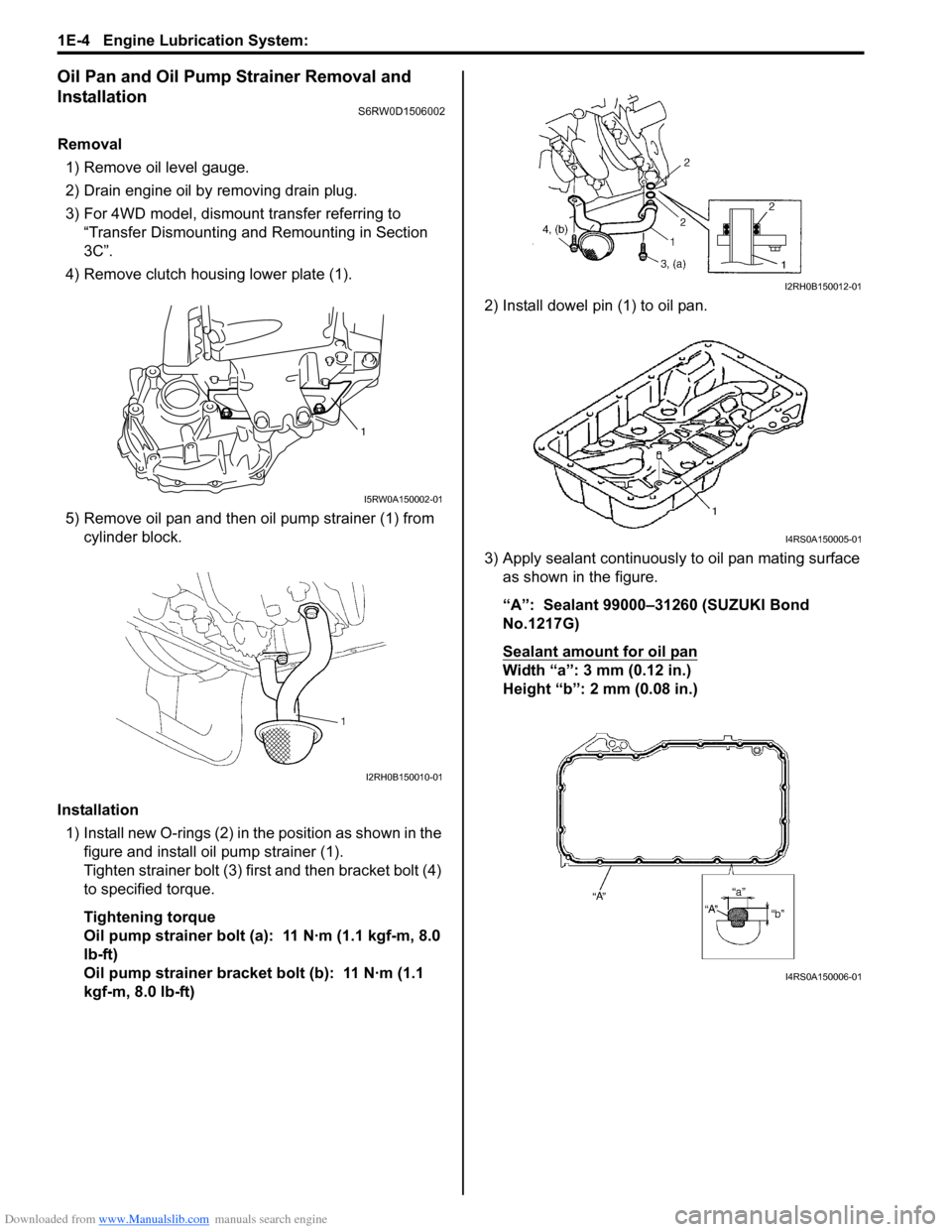
5) Remove oil pan and then oil pump strainer (1) from
cylinder block.
Installation
1) Install new O-rings (2) in the position as shown in the
figure and install oil pump strainer (1).
Tighten strainer bolt (3) first and then bracket bolt (4)
to specified torque.
Tightening torque
Oil pump strainer bolt (a): 11 N·m (1.1 kgf-m, 8.0
lb-ft)
Oil pump strainer bracket bolt (b): 11 N·m (1.1
kgf-m, 8.0 lb-ft)2) Install dowel pin (1) to oil pan.
3) Apply sealant continuously to oil pan mating surface
as shown in the figure.
“A”: Sealant 99000–31260 (SUZUKI Bond
No.1217G)
Sealant amount for oil pan
Width “a”: 3 mm (0.12 in.)
Height “b”: 2 mm (0.08 in.)
1
I5RW0A150002-01
I2RH0B150010-01
I2RH0B150012-01
I4RS0A150005-01
I4RS0A150006-01
Page 361 of 1556
Downloaded from www.Manualslib.com manuals search engine Engine Lubrication System: 1E-5
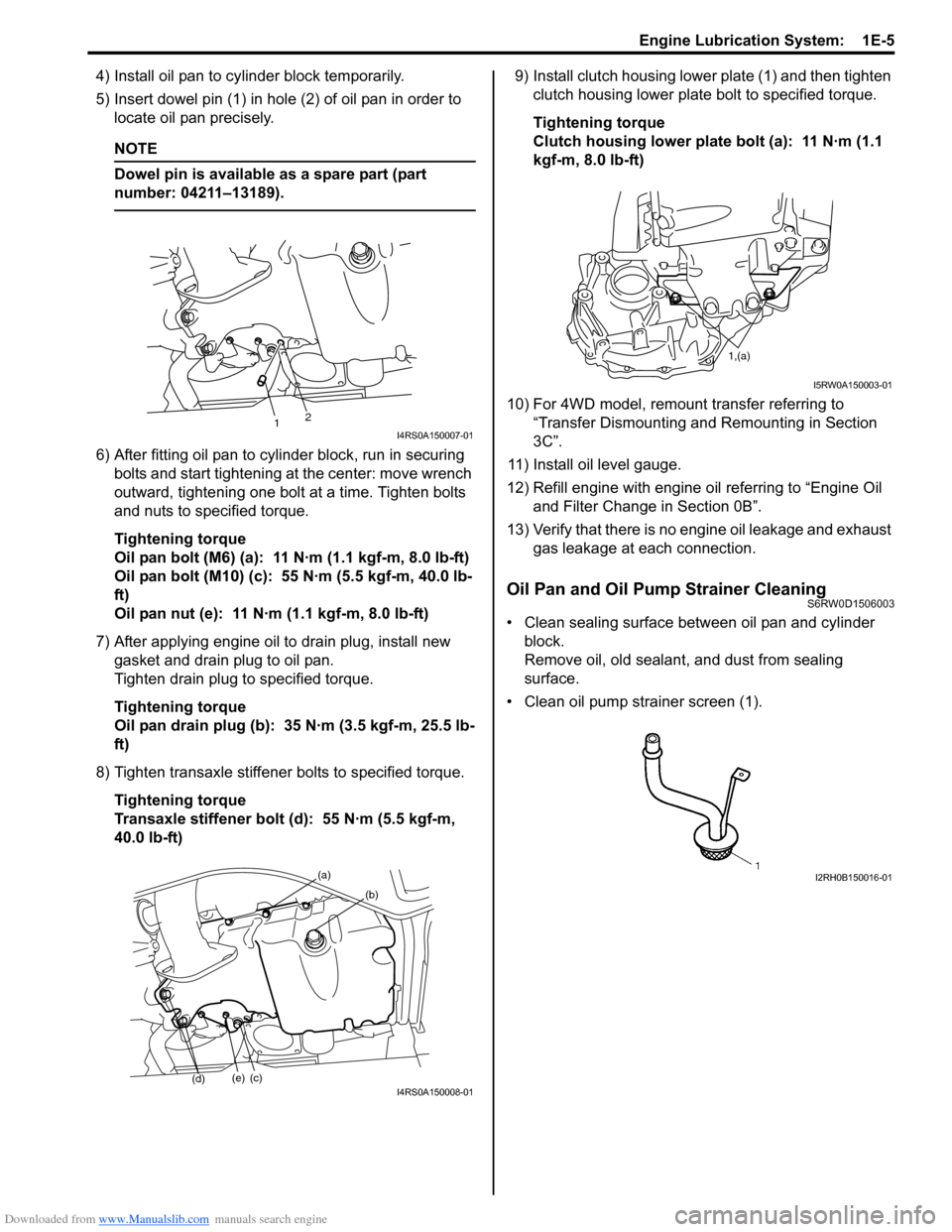
4) Install oil pan to cylinder block temporarily.
5) Insert dowel pin (1) in hole (2) of oil pan in order to
locate oil pan precisely.
NOTE
Dowel pin is available as a spare part (part
number: 04211–13189).
6) After fitting oil pan to cylinder block, run in securing
bolts and start tightening at the center: move wrench
outward, tightening one bolt at a time. Tighten bolts
and nuts to specified torque.
Tightening torque
Oil pan bolt (M6) (a): 11 N·m (1.1 kgf-m, 8.0 lb-ft)
Oil pan bolt (M10) (c): 55 N·m (5.5 kgf-m, 40.0 lb-
ft)
Oil pan nut (e): 11 N·m (1.1 kgf-m, 8.0 lb-ft)
7) After applying engine oil to drain plug, install new
gasket and drain plug to oil pan.
Tighten drain plug to specified torque.
Tightening torque
Oil pan drain plug (b): 35 N·m (3.5 kgf-m, 25.5 lb-
ft)
8) Tighten transaxle stiffener bolts to specified torque.
Tightening torque
Transaxle stiffener bolt (d): 55 N·m (5.5 kgf-m,
40.0 lb-ft)9) Install clutch housing lower plate (1) and then tighten
clutch housing lower plate bolt to specified torque.
Tightening torque
Clutch housing lower plate bolt (a): 11 N·m (1.1
kgf-m, 8.0 lb-ft)
10) For 4WD model, remount transfer referring to
“Transfer Dismounting and Remounting in Section
3C”.
11) Install oil level gauge.
12) Refill engine with engine oil referring to “Engine Oil
and Filter Change in Section 0B”.
13) Verify that there is no engine oil leakage and exhaust
gas leakage at each connection.
Oil Pan and Oil Pump Strainer CleaningS6RW0D1506003
• Clean sealing surface between oil pan and cylinder
block.
Remove oil, old sealant, and dust from sealing
surface.
• Clean oil pump strainer screen (1).
21I4RS0A150007-01
(a)
(b)
(c)(e)
(d)I4RS0A150008-01
1,(a)
I5RW0A150003-01
I2RH0B150016-01
Page 390 of 1556
Downloaded from www.Manualslib.com manuals search engine 1G-13 Fuel System:
Fuel Tank Removal and InstallationS6RW0D1706011
WARNING!
Before starting the following procedure, be
sure to observe “Precautions on Fuel System
Service” in order to reduce the risk of fire and
personal injury.
Removal
1) Relieve fuel pressure in fuel feed line according to
“Fuel Pressure Relief Procedure”.
2) Disconnect negative cable at battery.
3) Remove fuel filler cap.
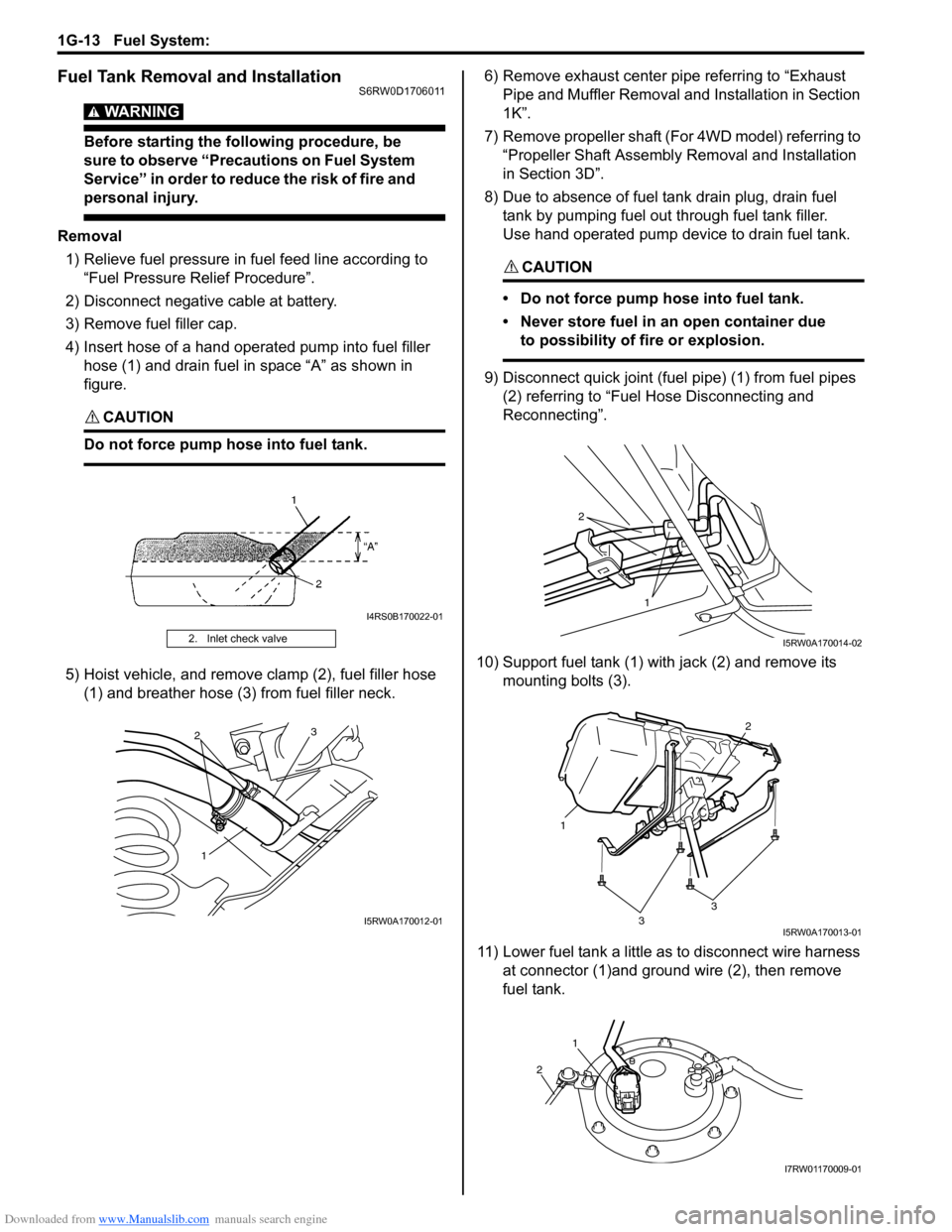
4) Insert hose of a hand operated pump into fuel filler
hose (1) and drain fuel in space “A” as shown in
figure.
CAUTION!
Do not force pump hose into fuel tank.
5) Hoist vehicle, and remove clamp (2), fuel filler hose
(1) and breather hose (3) from fuel filler neck.6) Remove exhaust center pipe referring to “Exhaust
Pipe and Muffler Removal and Installation in Section
1K”.
7) Remove propeller shaft (For 4WD model) referring to
“Propeller Shaft Assembly Removal and Installation
in Section 3D”.
8) Due to absence of fuel tank drain plug, drain fuel
tank by pumping fuel out through fuel tank filler.
Use hand operated pump device to drain fuel tank.
CAUTION!
• Do not force pump hose into fuel tank.
• Never store fuel in an open container due
to possibility of fire or explosion.
9) Disconnect quick joint (fuel pipe) (1) from fuel pipes
(2) referring to “Fuel Hose Disconnecting and
Reconnecting”.
10) Support fuel tank (1) with jack (2) and remove its
mounting bolts (3).
11) Lower fuel tank a little as to disconnect wire harness
at connector (1)and ground wire (2), then remove
fuel tank.
2. Inlet check valve
I4RS0B170022-01
1 23
I5RW0A170012-01
2
1
I5RW0A170014-02
1
2
33
I5RW0A170013-01
1
2
I7RW01170009-01