battery SUZUKI SX4 2006 1.G Service Owner's Manual
[x] Cancel search | Manufacturer: SUZUKI, Model Year: 2006, Model line: SX4, Model: SUZUKI SX4 2006 1.GPages: 1556, PDF Size: 37.31 MB
Page 193 of 1556
Downloaded from www.Manualslib.com manuals search engine Engine General Information and Diagnosis: 1A-143
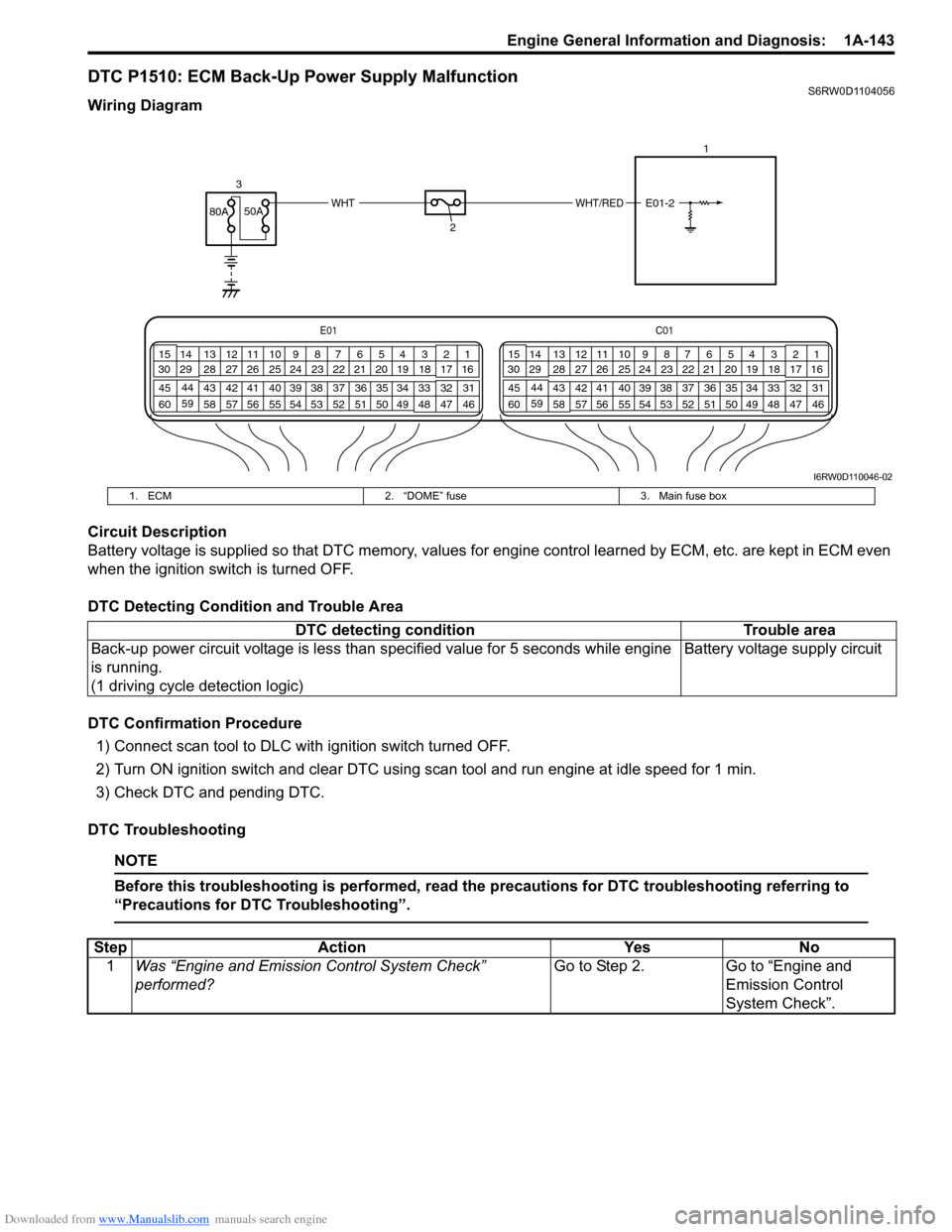
DTC P1510: ECM Back-Up Power Supply MalfunctionS6RW0D1104056
Wiring Diagram
Circuit Description
Battery voltage is supplied so that DTC memory, values for engine control learned by ECM, etc. are kept in ECM even
when the ignition switch is turned OFF.
DTC Detecting Condition and Trouble Area
DTC Confirmation Procedure
1) Connect scan tool to DLC with ignition switch turned OFF.
2) Turn ON ignition switch and clear DTC using scan tool and run engine at idle speed for 1 min.
3) Check DTC and pending DTC.
DTC Troubleshooting
NOTE
Before this troubleshooting is performed, read the precautions for DTC troubleshooting referring to
“Precautions for DTC Troubleshooting”.
E01C01
3 4
18 19 5 6 7 10 11
17 20
47 46 49 50 51 21 22
5216 259
24 14
29
55 57 54 53 59
60 582
26 27 28 15
30
56 4832 31 34 35 36 37 40 42 39 38 44
45 43 41 331 12 13
238 3 4
18 19 5 6 7 10 11
17 20
47 46 49 50 51 21 22
5216 259
24 14
29
55 57 54 53 59
60 582
26 27 28 15
30
56 4832 31 34 35 36 37 40 42 39 38 44
45 43 41 331 12 13
238
WHT/REDWHT80A50A
3
21
E01-2
I6RW0D110046-02
1. ECM 2. “DOME” fuse 3. Main fuse box
DTC detecting condition Trouble area
Back-up power circuit voltage is less than specified value for 5 seconds while engine
is running.
(1 driving cycle detection logic)Battery voltage supply circuit
Step Action Yes No
1Was “Engine and Emission Control System Check”
performed?Go to Step 2. Go to “Engine and
Emission Control
System Check”.
Page 194 of 1556
Downloaded from www.Manualslib.com manuals search engine 1A-144 Engine General Information and Diagnosis:
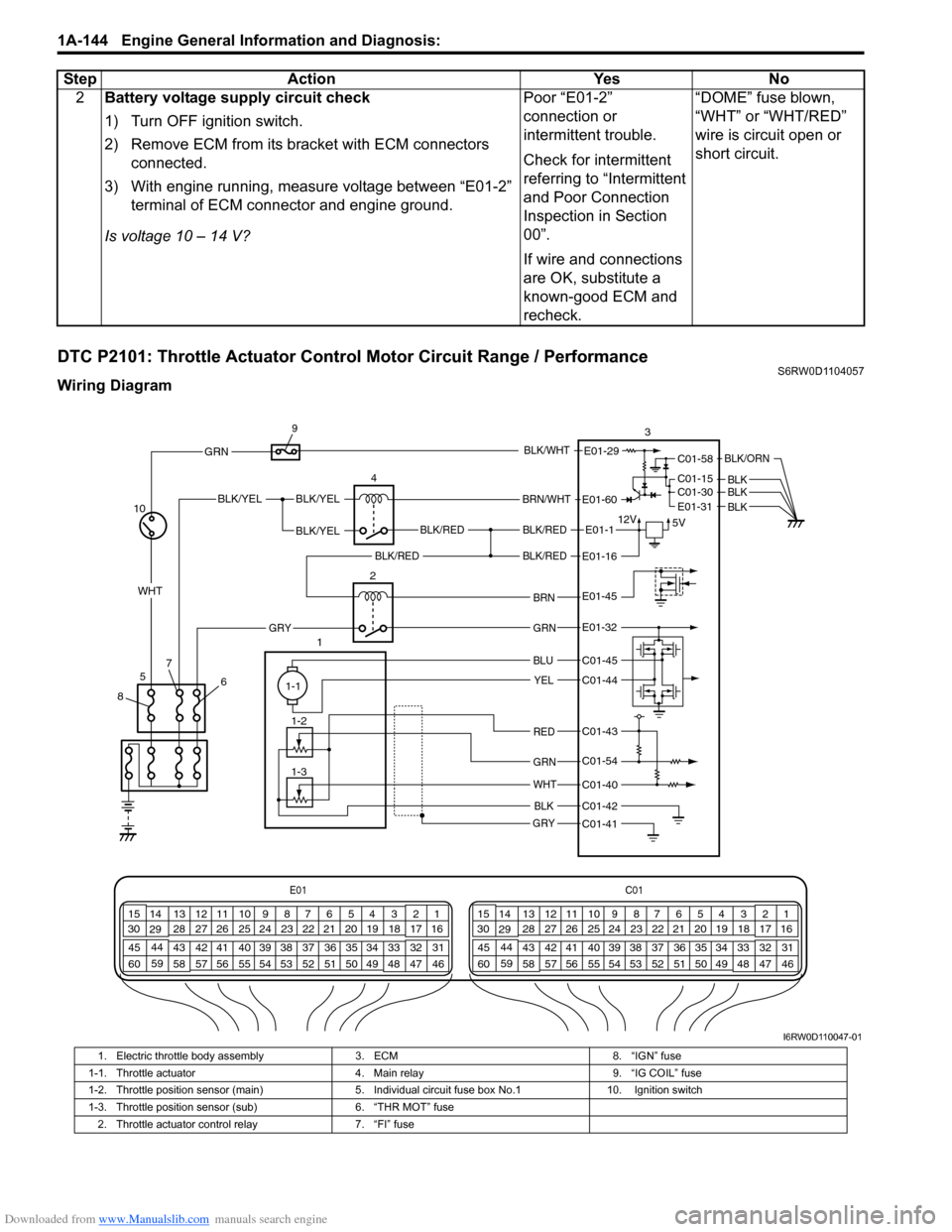
DTC P2101: Throttle Actuator Control Motor Circuit Range / PerformanceS6RW0D1104057
Wiring Diagram2Battery voltage supply circuit check
1) Turn OFF ignition switch.
2) Remove ECM from its bracket with ECM connectors
connected.
3) With engine running, measure voltage between “E01-2”
terminal of ECM connector and engine ground.
Is voltage 10 – 14 V?Poor “E01-2”
connection or
intermittent trouble.
Check for intermittent
referring to “Intermittent
and Poor Connection
Inspection in Section
00”.
If wire and connections
are OK, substitute a
known-good ECM and
recheck.“DOME” fuse blown,
“WHT” or “WHT/RED”
wire is circuit open or
short circuit. Step Action Yes No
E01C01
3 4
18 19 5 6 7 10 11
17 20
47 46 49 50 51 21 22
5216 259
24 14
29
55 57 54 53 59
60 582
26 27 28 15
30
56 4832 31 34 35 36 37 40 42 39 38 44
45 43 41 331 12 13
238 3 4
18 19 5 6 7 10 11
17 20
47 46 49 50 51 21 22
5216 259
24 14
29
55 57 54 53 59
60 582
26 27 28 15
30
56 4832 31 34 35 36 37 40 42 39 38 44
45 43 41 331 12 13
238
12V
5VBLK/REDBLK/RED
BLK/YEL
12BLK/YEL
BLK/YEL
BRN/WHT
E01-1
E01-60
C01-58
C01-15 C01-30
BLK/ORN
BLKBLKE01-31 BLK
BLK/RED
RED
BRN
BLU
GRN
GRNGRY
WHT
BLK
GRY
BLK/REDE01-16
E01-45
E01-32
C01-45
C01-44
C01-43
C01-54
C01-40
C01-42
C01-41
1-1
1-2
1-33
45
867
109
E01-29 GRNBLK/WHT
WHT
YEL
I6RW0D110047-01
1. Electric throttle body assembly 3. ECM 8. “IGN” fuse
1-1. Throttle actuator 4. Main relay 9. “IG COIL” fuse
1-2. Throttle position sensor (main) 5. Individual circuit fuse box No.1 10. Ignition switch
1-3. Throttle position sensor (sub) 6. “THR MOT” fuse
2. Throttle actuator control relay 7. “FI” fuse
Page 217 of 1556
Downloaded from www.Manualslib.com manuals search engine Engine General Information and Diagnosis: 1A-167
Troubleshooting for CAN-DTCS6RW0D1104084
Perform this troubleshooting when CAN-DTC is detected.
NOTE
• When performing this troubleshooting, be sure to have full understanding of “Precaution on CAN
Troubleshooting” and observe it.
• It may be possible that CAN system has trouble because of fuse blown or low battery voltage.
Before troubleshooting, check to make sure that fuse, battery voltage and generator status are
normal.
• When performing “Communication Bus Check” using SUZUKI scan tool (SUZUKI-SDT) in each step
of this troubleshooting, use the following table to determine whether the control module is in good
condition or not.
Also, while performing “Communication Bus Check”, do not perform any work other than instructed
in this troubleshooting. Or, it may occur that display of control module/sensor on SUZUKI-SDT
screen and/or its background color may change.
• When disconnecting each control module connector in this troubleshooting, various DTCs will be
detected. Be sure to clear DTCs in the following control modules after completing this
troubleshooting.
–ECM
– BCM
–TCM
– Keyless start control module
– 4WD control module
– HVAC control module (Auto A/C model)
– P/S control module
Wiring Diagram
Refer to “Troubleshooting for Communication Error with Scan Tool Using CAN”.
Trouble area
Refer to “Troubleshooting for Communication Error with Scan Tool Using CAN”. Judgment Display of Communication Bus Check
Normal• All connected control modules/sensors (communicated by CAN) are displayed and its back ground
color is “White”.
Abnormal• Even one of connected control modules/sensors (communicated by CAN) is not displayed.
• Display of even one of connected control modules/sensors (communicated by CAN) changes.
• Background color of even one of connected control modules/sensors (communicated by CAN) is
displayed in “Gray” or “Light green”.
• Background color of even one of connected control modules/sensors (communicated by CAN)
changes
Page 220 of 1556

Downloaded from www.Manualslib.com manuals search engine 1A-170 Engine General Information and Diagnosis:
6Terminating resistance check in ECM and combination
meter
1) Turn ignition switch to OFF position and then disconnect
negative (–) cable at battery.
2) Measure resistance between CAN High terminal (2) and
CAN Low terminal (3) on DLC (1).
If resistance 57 – 67
Ω?Go to Step 7. Go to Step 8.
7Substitute ECM and recheck
1) Substitute a known-good ECM and recheck.
Is it in good condition?End. Substitute a known-
good combination meter
and recheck. If NG, go
to Step 11.
8Terminating resistance check in ECM
1) Make sure that ignition switch is OFF position and
battery negative (–) cable is disconnected.
2) Disconnect combination meter connector.
3) Measure resistance between CAN high terminal and
CAN low terminal on DLC as the same manner as Step
6.
Is resistance 114 – 134
Ω?Substitute a known-
good combination
meter.Go to Step 9.
9Internal circuit check in BCM
1) Make sure that ignition switch is OFF position and
battery negative (–) cable is disconnected.
2) Disconnect ABS control module connector.
3) Measure resistance between the followings
• Between CAN high terminal on DLC and “E08-2”
terminal on ABS control module connector
• Between CAN low terminal on DLC and “E08-13”
terminal on ABS control module connector
Is each resistance 0 – 1
Ω?Go to Step 10. Substitute a known-
good BCM.
10Internal circuit check in ABS control module
1) Make sure that ignition switch is OFF position and
battery negative (–) cable is disconnected.
2) Connect ABS control module connector and disconnect
ECM connector.
3) Measure resistance between the followings
• Between CAN High terminal on DLC and “E01-3”
terminal on ECM connector
• Between CAN Low terminal on DLC and “E01-18”
terminal on ECM connector
If each resistance 0 – 1
Ω?Substitute a known-
good ECM and recheck.
If NG, go to step 11.Substitute a known-
good ABS control
module.
11Substitute BCM and recheck
1) Substitute a known-good BCM and recheck.
Is it in good condition?End. Substitute a known-
good ABS control
module. Step Action Yes No
2
1
9 10 11 12 13 14 15 16
1 2 3 4 5 6 7 8
3
I7RW01110098-01
Page 222 of 1556

Downloaded from www.Manualslib.com manuals search engine 1A-172 Engine General Information and Diagnosis:
Inspection of ECM and Its CircuitsS6RW0D1104072
ECM and its circuits can be checked by measuring voltage, pulse signal and resistance with special tool connected.
CAUTION!
ECM cannot be checked by itself. It is strictly prohibited to connect voltmeter or ohmmeter to ECM
with ECM connectors disconnected from it.
Voltage Check
1) Remove ECM (1) from its bracket referring to “Engine Control Module (ECM) Removal and Installation in Section
1C”.
2) Connect special tool between ECM and ECM connectors securely.
Special tool
(A): 09933–06320
3) Check voltage and/or pulse signal using voltmeter (2) and oscilloscope (3).
NOTE
• As each terminal voltage is affected by battery voltage, confirm that it is 11 V or more when ignition
switch is turned ON.
• Voltage with asterisk (*) cannot be measured with voltmeter because it is pulse signal. Use
oscilloscope for its check if necessary.
• Before this inspection, be sure to read the “Precautions of ECM Circuit Inspection”.
Viewed from harness side
1
2
3(A)
I5JB0A110073-01
E01C01
3 4
18 19 5 6 7 10 11
17 20
47 46 49 50 51 21 22
5216 259
24 14
29
55 57 54 53 59
60 582
26 27 28 15
30
56 4832 31 34 35 36 37 40 42 39 38 44
45 43 41 331 12 13
238 3 4
18 19 5 6 7 10 11
17 20
47 46 49 50 51 21 22
5216 259
24 14
29
55 57 54 53 59
60 582
26 27 28 15
30
56 4832 31 34 35 36 37 40 42 39 38 44
45 43 41 331 12 13
238
I6RW0D110051-01
Page 242 of 1556

Downloaded from www.Manualslib.com manuals search engine 1A-192 Engine General Information and Diagnosis:
Resistance Check
1) Remove ECM from its bracket referring to “Engine Control Module (ECM) Removal and Installation in Section 1C”.
CAUTION!
Never touch terminals of ECM itself or connect voltmeter or ohmmeter (2).
2) Connect special tool to ECM connectors (1) securely.
NOTE
Do not connect the other connector of special tool to ECM.
Special tool
(A): 09933–06320
3) Check resistance between each pair of terminals of special tool connectors (1) as listed in the following table.
CAUTION!
• Be sure to connect ohmmeter probe from wire harness side of coupler.
• Be sure to turn OFF ignition switch for this check.
• Resistance in the following table represents that measured when parts temperature is 20 °C (68 °F).
1
(A)
2
3
I7RW01110032-02
Terminals Circuit Standard resistance Condition
C01-47 to E01-29 Heater of HO2S-2 4 – 15 Ω—
E01-46 to E01-1/16 Radiator cooling fan relay No.1 160 – 240 Ω—
E01-60 to E01-29 Main relay 160 – 240 ΩBattery disconnected and
ignition switch turned ON
E01-15 to E01-29 Fuel pump relay 160 – 240 Ω—
C01-16 to E01-1/16No.3 fuel injector
10.8 – 18.2 Ω—
C01-17 to E01-1/16No.4 fuel injector
C01-4 to E01-1/16EGR valve (stepping motor No.1 coil) (if
equipped)20 – 31 Ω—
C01-29 to E01-1/16 EVAP canister purge valve 28 – 35 Ω—
C01-2 to E01-1/16 No.2 fuel injector 10.8 – 18.2 Ω—
C01-3 to E01-1/16EGR valve (stepping motor No.2 coil) (if
equipped)
20 – 31 Ω— C01-18 to E01-1/16EGR valve (stepping motor No.4 coil) (if
equipped)
C01-19 to E01-1/16EGR valve (stepping motor No.3 coil) (if
equipped)
C01-46 to E01-29 Heater of HO2S-1 2 – 11 Ω—
C01-1 to E01-1/16 No.1 fuel injector 10.8 – 18.2 Ω—
E01-29 to E01-47 A/C compressor relay (if equipped with A/C) 160 – 240 Ω—
E01-58 to E01-1/16A/C condenser cooling fan relay
(if equipped with A/C)160 – 240 Ω—
C01-60 to C01-59 Oil control valve (for engine with VVT system) 6 – 15 Ω—
E01-45 to E01-1/16 Throttle actuator control relay 160 – 240 Ω—
Page 251 of 1556
Downloaded from www.Manualslib.com manuals search engine Engine General Information and Diagnosis: 1A-201
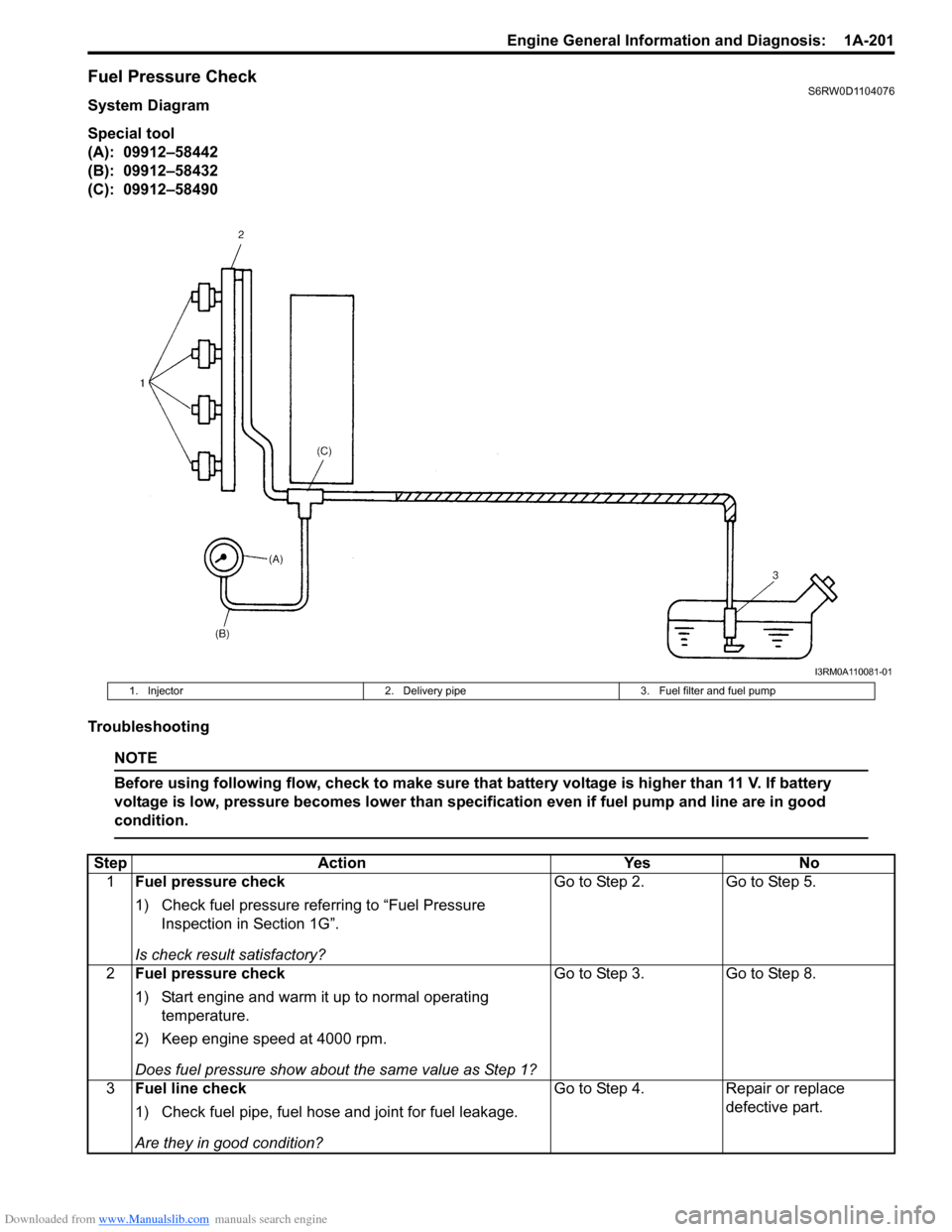
Fuel Pressure CheckS6RW0D1104076
System Diagram
Special tool
(A): 09912–58442
(B): 09912–58432
(C): 09912–58490
Troubleshooting
NOTE
Before using following flow, check to make sure that battery voltage is higher than 11 V. If battery
voltage is low, pressure becomes lower than specification even if fuel pump and line are in good
condition.
I3RM0A110081-01
1. Injector 2. Delivery pipe 3. Fuel filter and fuel pump
Step Action Yes No
1Fuel pressure check
1) Check fuel pressure referring to “Fuel Pressure
Inspection in Section 1G”.
Is check result satisfactory?Go to Step 2. Go to Step 5.
2Fuel pressure check
1) Start engine and warm it up to normal operating
temperature.
2) Keep engine speed at 4000 rpm.
Does fuel pressure show about the same value as Step 1?Go to Step 3. Go to Step 8.
3Fuel line check
1) Check fuel pipe, fuel hose and joint for fuel leakage.
Are they in good condition?Go to Step 4. Repair or replace
defective part.
Page 266 of 1556
Downloaded from www.Manualslib.com manuals search engine 1B-3 Aux. Emission Control Devices:
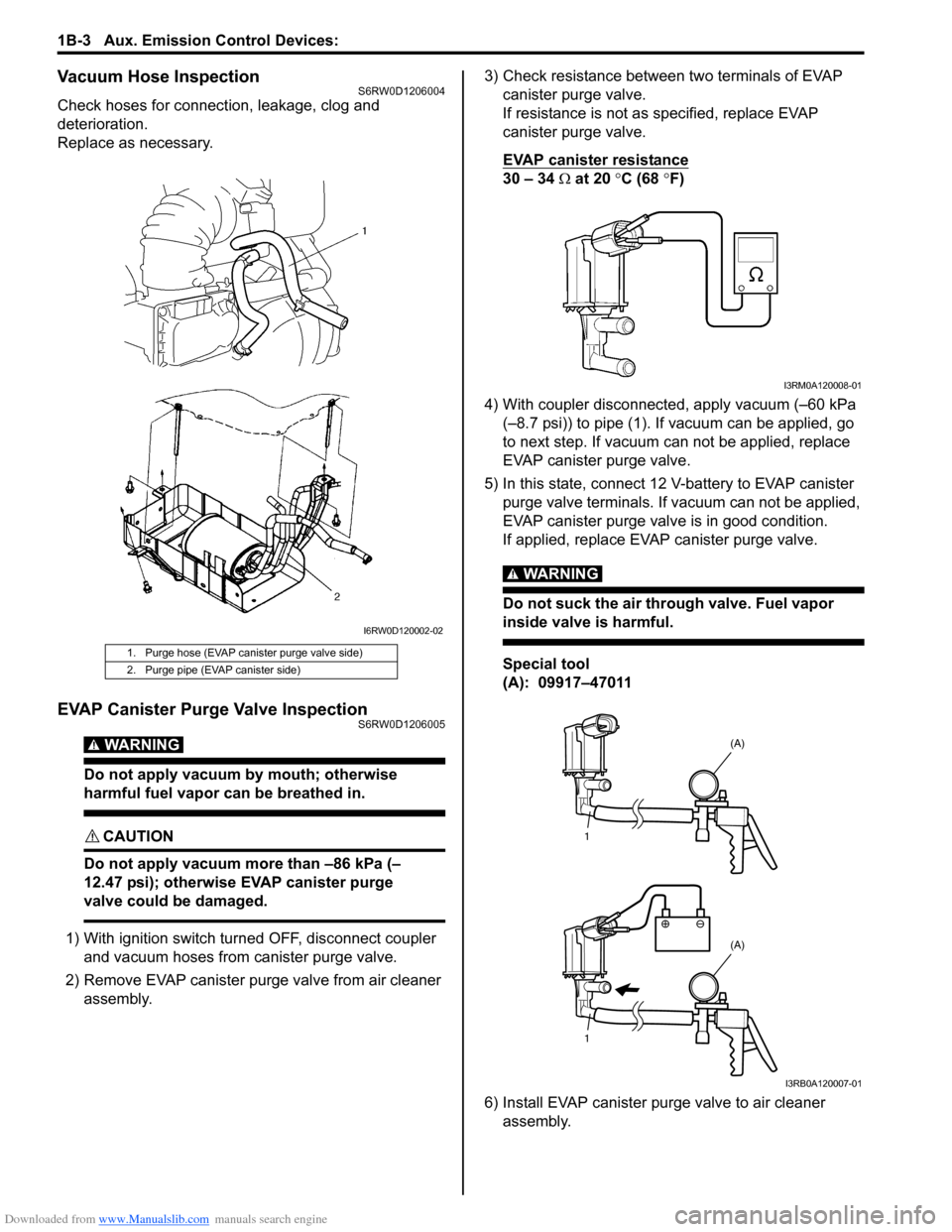
Vacuum Hose InspectionS6RW0D1206004
Check hoses for connection, leakage, clog and
deterioration.
Replace as necessary.
EVAP Canister Purge Valve InspectionS6RW0D1206005
WARNING!
Do not apply vacuum by mouth; otherwise
harmful fuel vapor can be breathed in.
CAUTION!
Do not apply vacuum more than –86 kPa (–
12.47 psi); otherwise EVAP canister purge
valve could be damaged.
1) With ignition switch turned OFF, disconnect coupler
and vacuum hoses from canister purge valve.
2) Remove EVAP canister purge valve from air cleaner
assembly.3) Check resistance between two terminals of EVAP
canister purge valve.
If resistance is not as specified, replace EVAP
canister purge valve.
EVAP canister resistance
30 – 34 Ω at 20 °C (68 °F)
4) With coupler disconnected, apply vacuum (–60 kPa
(–8.7 psi)) to pipe (1). If vacuum can be applied, go
to next step. If vacuum can not be applied, replace
EVAP canister purge valve.
5) In this state, connect 12 V-battery to EVAP canister
purge valve terminals. If vacuum can not be applied,
EVAP canister purge valve is in good condition.
If applied, replace EVAP canister purge valve.
WARNING!
Do not suck the air through valve. Fuel vapor
inside valve is harmful.
Special tool
(A): 09917–47011
6) Install EVAP canister purge valve to air cleaner
assembly.1. Purge hose (EVAP canister purge valve side)
2. Purge pipe (EVAP canister side)
I6RW0D120002-02
I3RM0A120008-01
1
1(A)
(A)
I3RB0A120007-01
Page 267 of 1556
Downloaded from www.Manualslib.com manuals search engine Aux. Emission Control Devices: 1B-4
EVAP Canister InspectionS6RW0D1206006
WARNING!
DO NOT SUCK nozzles on EVAP canister.
Fuel vapor inside EVAP canister is harmful.
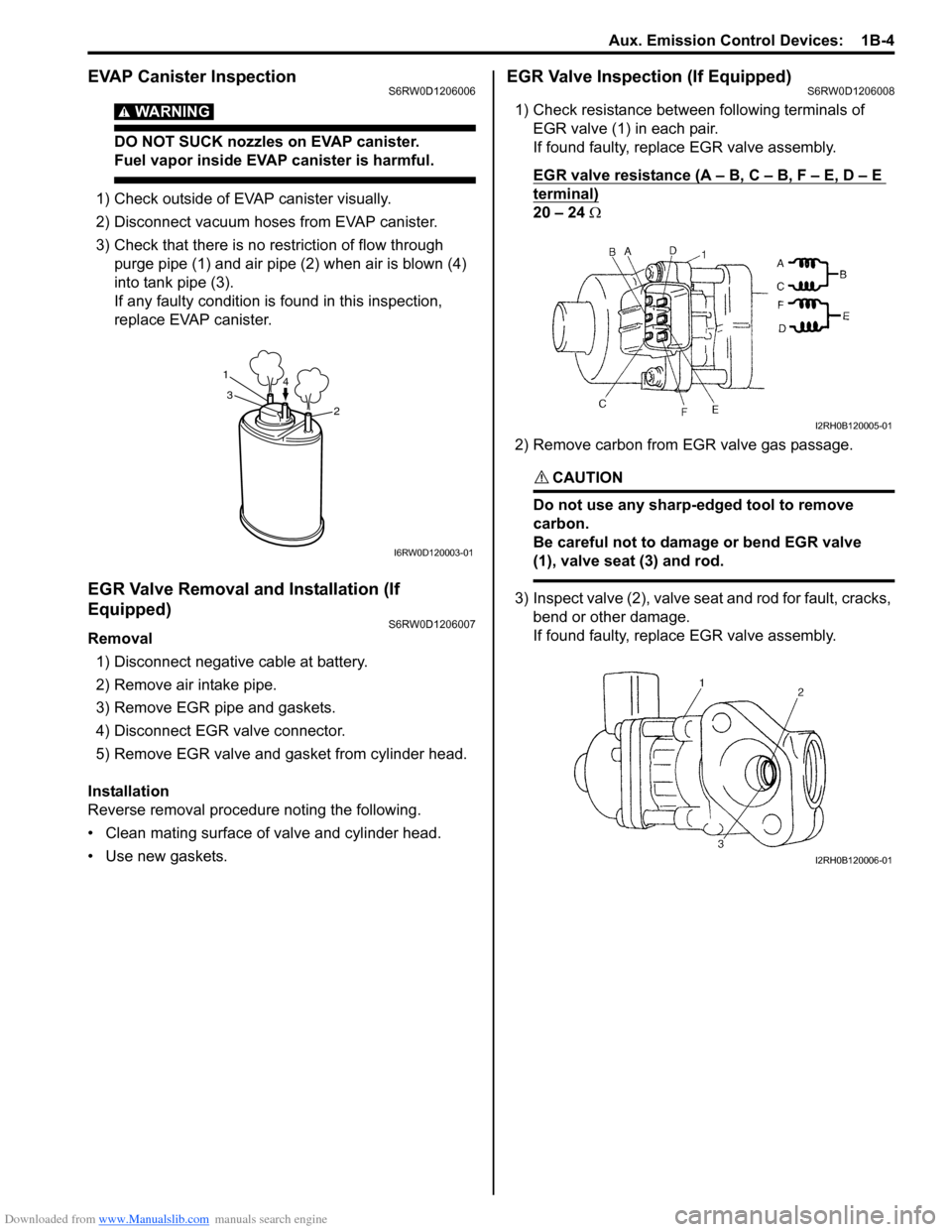
1) Check outside of EVAP canister visually.
2) Disconnect vacuum hoses from EVAP canister.
3) Check that there is no restriction of flow through
purge pipe (1) and air pipe (2) when air is blown (4)
into tank pipe (3).
If any faulty condition is found in this inspection,
replace EVAP canister.
EGR Valve Removal and Installation (If
Equipped)
S6RW0D1206007
Removal
1) Disconnect negative cable at battery.
2) Remove air intake pipe.
3) Remove EGR pipe and gaskets.
4) Disconnect EGR valve connector.
5) Remove EGR valve and gasket from cylinder head.
Installation
Reverse removal procedure noting the following.
• Clean mating surface of valve and cylinder head.
• Use new gaskets.
EGR Valve Inspection (If Equipped)S6RW0D1206008
1) Check resistance between following terminals of
EGR valve (1) in each pair.
If found faulty, replace EGR valve assembly.
EGR valve resistance (A – B, C – B, F – E, D – E
terminal)
20 – 24 Ω
2) Remove carbon from EGR valve gas passage.
CAUTION!
Do not use any sharp-edged tool to remove
carbon.
Be careful not to damage or bend EGR valve
(1), valve seat (3) and rod.
3) Inspect valve (2), valve seat and rod for fault, cracks,
bend or other damage.
If found faulty, replace EGR valve assembly.
4
3 1
2
I6RW0D120003-01
I2RH0B120005-01
I2RH0B120006-01
Page 269 of 1556
Downloaded from www.Manualslib.com manuals search engine Engine Electrical Devices: 1C-1
Engine
Engine Electrical Devices
Repair Instructions
Engine Control Module (ECM) Removal and
Installation
S6RW0D1306001
CAUTION!
As ECM consists of precision parts, be
careful not to expose it to excessive shock.
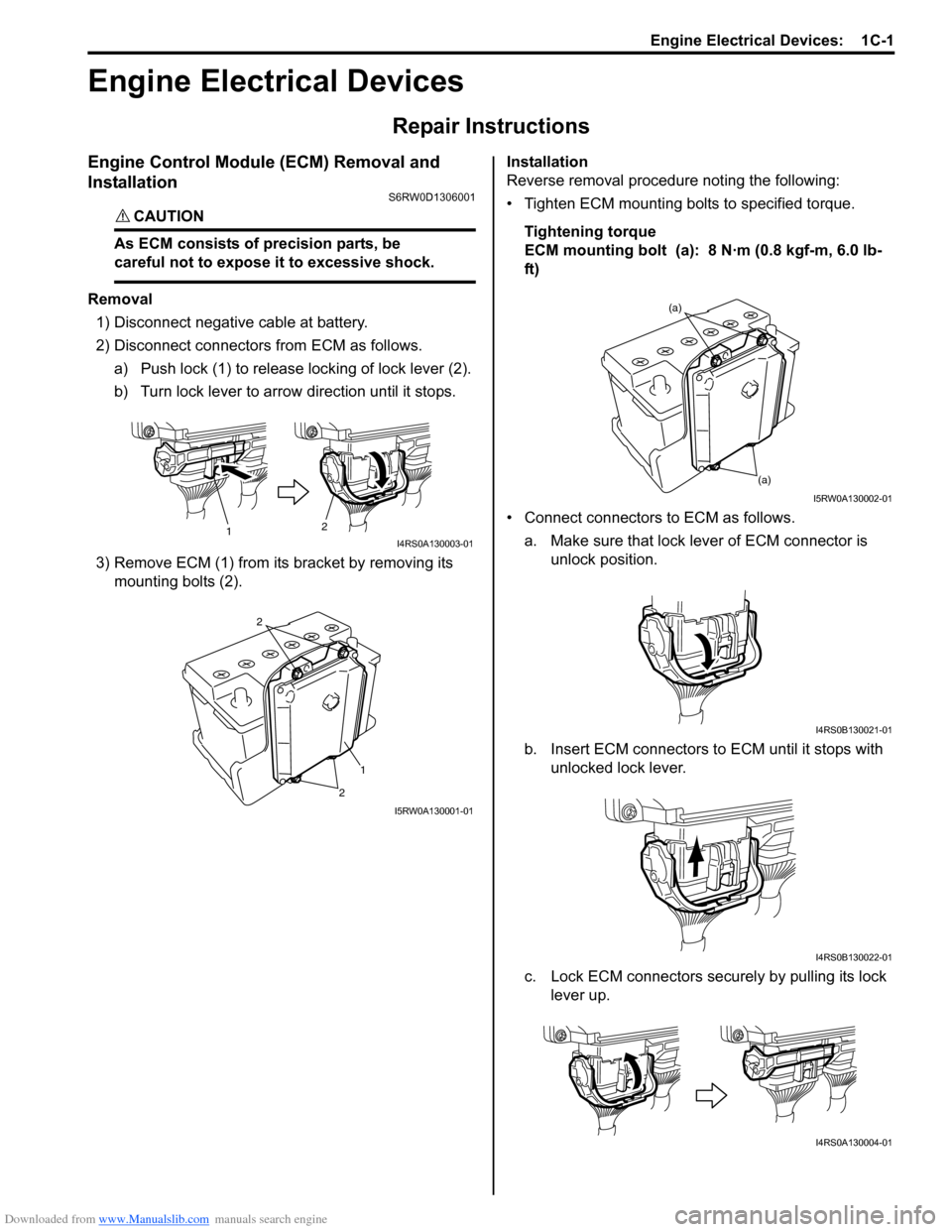
Removal
1) Disconnect negative cable at battery.
2) Disconnect connectors from ECM as follows.
a) Push lock (1) to release locking of lock lever (2).
b) Turn lock lever to arrow direction until it stops.
3) Remove ECM (1) from its bracket by removing its
mounting bolts (2).Installation
Reverse removal procedure noting the following:
• Tighten ECM mounting bolts to specified torque.
Tightening torque
ECM mounting bolt (a): 8 N·m (0.8 kgf-m, 6.0 lb-
ft)
• Connect connectors to ECM as follows.
a. Make sure that lock lever of ECM connector is
unlock position.
b. Insert ECM connectors to ECM until it stops with
unlocked lock lever.
c. Lock ECM connectors securely by pulling its lock
lever up.
12I4RS0A130003-01
1
2 2
I5RW0A130001-01
(a) (a)
I5RW0A130002-01
I4RS0B130021-01
I4RS0B130022-01
I4RS0A130004-01