heat SUZUKI SX4 2006 1.G Service Owner's Manual
[x] Cancel search | Manufacturer: SUZUKI, Model Year: 2006, Model line: SX4, Model: SUZUKI SX4 2006 1.GPages: 1556, PDF Size: 37.31 MB
Page 97 of 1556
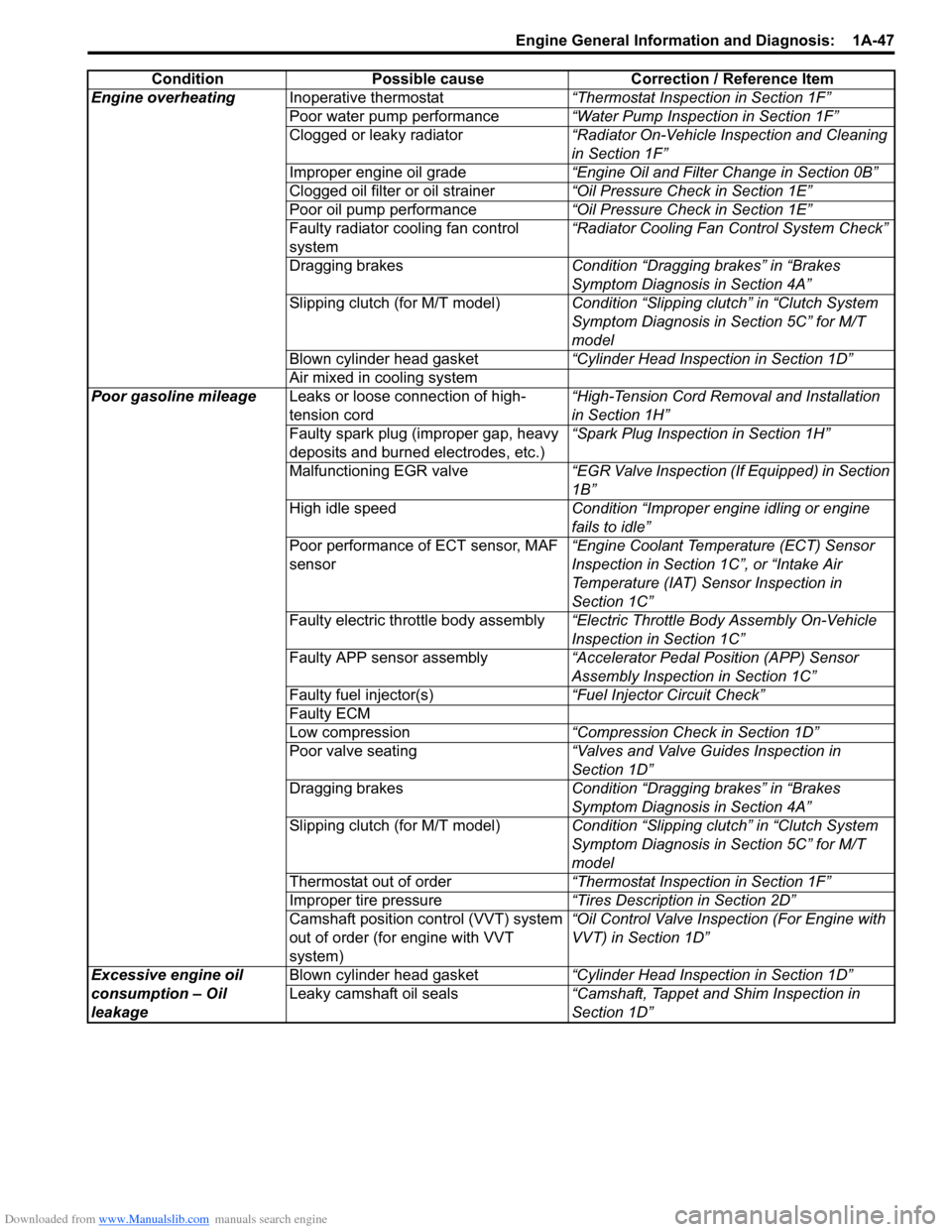
Downloaded from www.Manualslib.com manuals search engine Engine General Information and Diagnosis: 1A-47
Engine overheatingInoperative thermostat“Thermostat Inspection in Section 1F”
Poor water pump performance“Water Pump Inspection in Section 1F”
Clogged or leaky radiator“Radiator On-Vehicle Inspection and Cleaning
in Section 1F”
Improper engine oil grade“Engine Oil and Filter Change in Section 0B”
Clogged oil filter or oil strainer“Oil Pressure Check in Section 1E”
Poor oil pump performance“Oil Pressure Check in Section 1E”
Faulty radiator cooling fan control
system“Radiator Cooling Fan Control System Check”
Dragging brakesCondition “Dragging brakes” in “Brakes
Symptom Diagnosis in Section 4A”
Slipping clutch (for M/T model)Condition “Slipping clutch” in “Clutch System
Symptom Diagnosis in Section 5C” for M/T
model
Blown cylinder head gasket“Cylinder Head Inspection in Section 1D”
Air mixed in cooling system
Poor gasoline mileageLeaks or loose connection of high-
tension cord“High-Tension Cord Removal and Installation
in Section 1H”
Faulty spark plug (improper gap, heavy
deposits and burned electrodes, etc.)“Spark Plug Inspection in Section 1H”
Malfunctioning EGR valve“EGR Valve Inspection (If Equipped) in Section
1B”
High idle speedCondition “Improper engine idling or engine
fails to idle”
Poor performance of ECT sensor, MAF
sensor“Engine Coolant Temperature (ECT) Sensor
Inspection in Section 1C”, or “Intake Air
Temperature (IAT) Sensor Inspection in
Section 1C”
Faulty electric throttle body assembly“Electric Throttle Body Assembly On-Vehicle
Inspection in Section 1C”
Faulty APP sensor assembly“Accelerator Pedal Position (APP) Sensor
Assembly Inspection in Section 1C”
Faulty fuel injector(s)“Fuel Injector Circuit Check”
Faulty ECM
Low compression“Compression Check in Section 1D”
Poor valve seating“Valves and Valve Guides Inspection in
Section 1D”
Dragging brakesCondition “Dragging brakes” in “Brakes
Symptom Diagnosis in Section 4A”
Slipping clutch (for M/T model)Condition “Slipping clutch” in “Clutch System
Symptom Diagnosis in Section 5C” for M/T
model
Thermostat out of order“Thermostat Inspection in Section 1F”
Improper tire pressure“Tires Description in Section 2D”
Camshaft position control (VVT) system
out of order (for engine with VVT
system)“Oil Control Valve Inspection (For Engine with
VVT) in Section 1D”
Excessive engine oil
consumption – Oil
leakageBlown cylinder head gasket“Cylinder Head Inspection in Section 1D”
Leaky camshaft oil seals“Camshaft, Tappet and Shim Inspection in
Section 1D” Condition Possible cause Correction / Reference Item
Page 98 of 1556
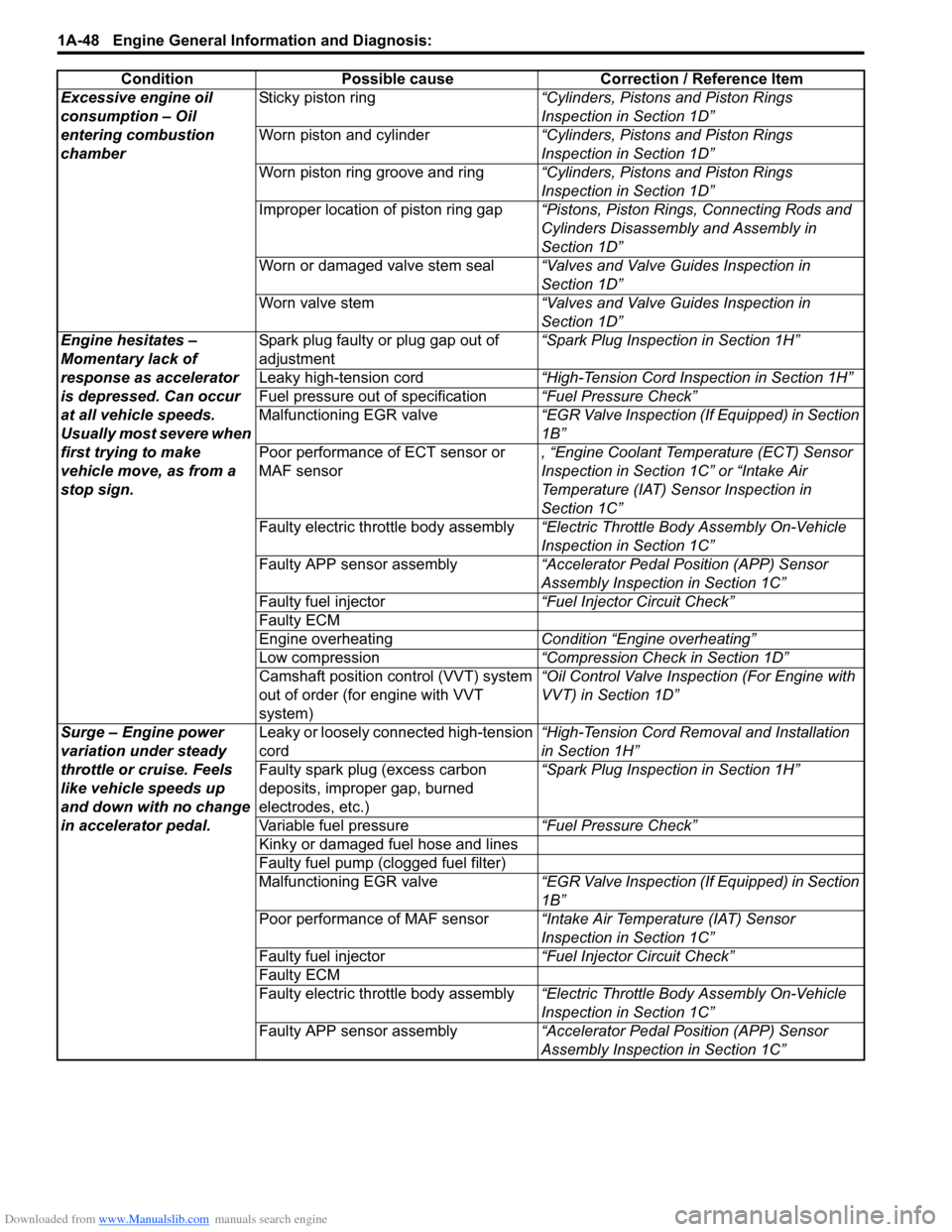
Downloaded from www.Manualslib.com manuals search engine 1A-48 Engine General Information and Diagnosis:
Excessive engine oil
consumption – Oil
entering combustion
chamberSticky piston ring“Cylinders, Pistons and Piston Rings
Inspection in Section 1D”
Worn piston and cylinder“Cylinders, Pistons and Piston Rings
Inspection in Section 1D”
Worn piston ring groove and ring“Cylinders, Pistons and Piston Rings
Inspection in Section 1D”
Improper location of piston ring gap“Pistons, Piston Rings, Connecting Rods and
Cylinders Disassembly and Assembly in
Section 1D”
Worn or damaged valve stem seal“Valves and Valve Guides Inspection in
Section 1D”
Worn valve stem“Valves and Valve Guides Inspection in
Section 1D”
Engine hesitates –
Momentary lack of
response as accelerator
is depressed. Can occur
at all vehicle speeds.
Usually most severe when
first trying to make
vehicle move, as from a
stop sign.Spark plug faulty or plug gap out of
adjustment“Spark Plug Inspection in Section 1H”
Leaky high-tension cord“High-Tension Cord Inspection in Section 1H”
Fuel pressure out of specification“Fuel Pressure Check”
Malfunctioning EGR valve“EGR Valve Inspection (If Equipped) in Section
1B”
Poor performance of ECT sensor or
MAF sensor, “Engine Coolant Temperature (ECT) Sensor
Inspection in Section 1C” or “Intake Air
Temperature (IAT) Sensor Inspection in
Section 1C”
Faulty electric throttle body assembly“Electric Throttle Body Assembly On-Vehicle
Inspection in Section 1C”
Faulty APP sensor assembly“Accelerator Pedal Position (APP) Sensor
Assembly Inspection in Section 1C”
Faulty fuel injector“Fuel Injector Circuit Check”
Faulty ECM
Engine overheatingCondition “Engine overheating”
Low compression“Compression Check in Section 1D”
Camshaft position control (VVT) system
out of order (for engine with VVT
system)“Oil Control Valve Inspection (For Engine with
VVT) in Section 1D”
Surge – Engine power
variation under steady
throttle or cruise. Feels
like vehicle speeds up
and down with no change
in accelerator pedal.Leaky or loosely connected high-tension
cord“High-Tension Cord Removal and Installation
in Section 1H”
Faulty spark plug (excess carbon
deposits, improper gap, burned
electrodes, etc.)“Spark Plug Inspection in Section 1H”
Variable fuel pressure“Fuel Pressure Check”
Kinky or damaged fuel hose and lines
Faulty fuel pump (clogged fuel filter)
Malfunctioning EGR valve“EGR Valve Inspection (If Equipped) in Section
1B”
Poor performance of MAF sensor“Intake Air Temperature (IAT) Sensor
Inspection in Section 1C”
Faulty fuel injector“Fuel Injector Circuit Check”
Faulty ECM
Faulty electric throttle body assembly“Electric Throttle Body Assembly On-Vehicle
Inspection in Section 1C”
Faulty APP sensor assembly“Accelerator Pedal Position (APP) Sensor
Assembly Inspection in Section 1C” Condition Possible cause Correction / Reference Item
Page 99 of 1556
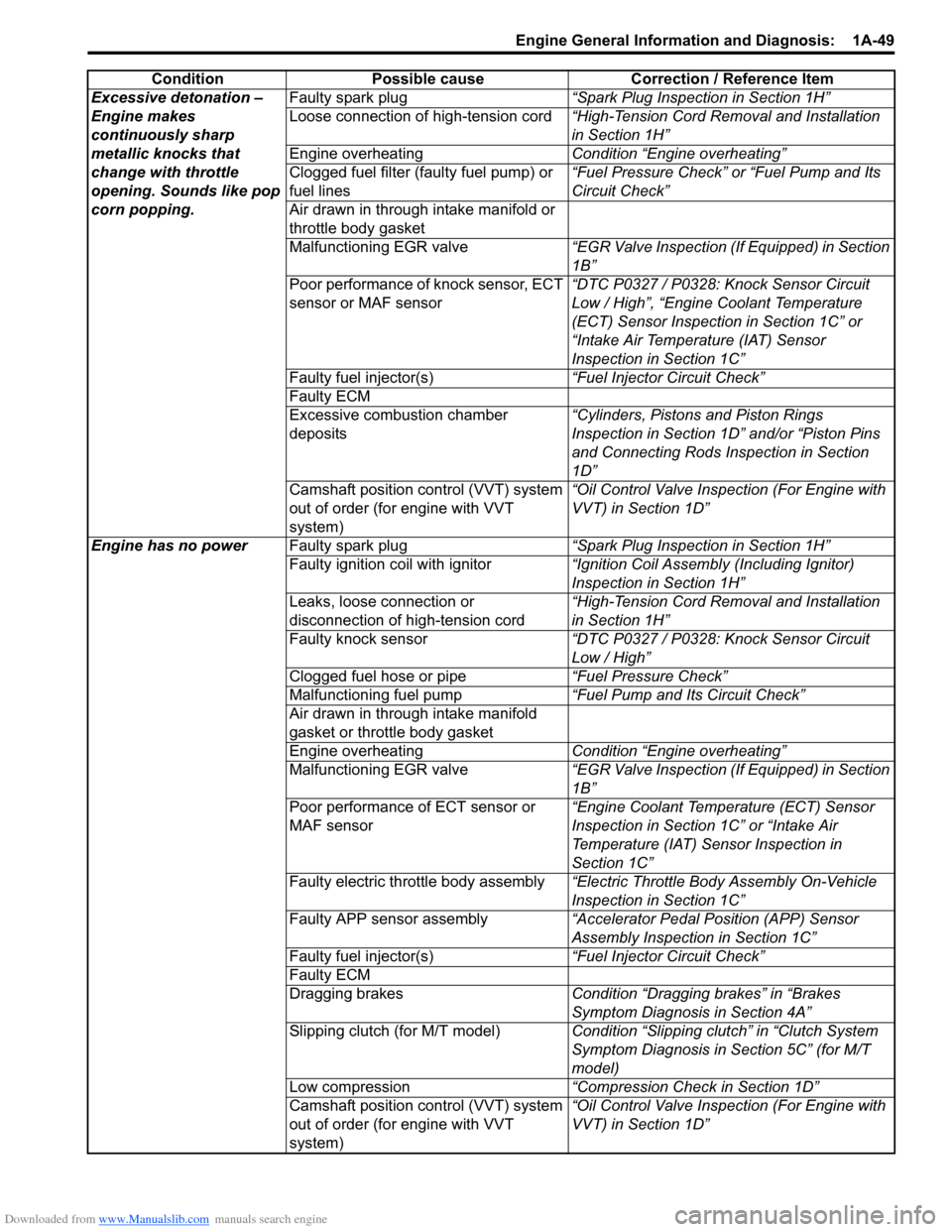
Downloaded from www.Manualslib.com manuals search engine Engine General Information and Diagnosis: 1A-49
Excessive detonation –
Engine makes
continuously sharp
metallic knocks that
change with throttle
opening. Sounds like pop
corn popping.Faulty spark plug“Spark Plug Inspection in Section 1H”
Loose connection of high-tension cord“High-Tension Cord Removal and Installation
in Section 1H”
Engine overheatingCondition “Engine overheating”
Clogged fuel filter (faulty fuel pump) or
fuel lines“Fuel Pressure Check” or “Fuel Pump and Its
Circuit Check”
Air drawn in through intake manifold or
throttle body gasket
Malfunctioning EGR valve“EGR Valve Inspection (If Equipped) in Section
1B”
Poor performance of knock sensor, ECT
sensor or MAF sensor“DTC P0327 / P0328: Knock Sensor Circuit
Low / High”, “Engine Coolant Temperature
(ECT) Sensor Inspection in Section 1C” or
“Intake Air Temperature (IAT) Sensor
Inspection in Section 1C”
Faulty fuel injector(s)“Fuel Injector Circuit Check”
Faulty ECM
Excessive combustion chamber
deposits“Cylinders, Pistons and Piston Rings
Inspection in Section 1D” and/or “Piston Pins
and Connecting Rods Inspection in Section
1D”
Camshaft position control (VVT) system
out of order (for engine with VVT
system)“Oil Control Valve Inspection (For Engine with
VVT) in Section 1D”
Engine has no powerFaulty spark plug“Spark Plug Inspection in Section 1H”
Faulty ignition coil with ignitor“Ignition Coil Assembly (Including Ignitor)
Inspection in Section 1H”
Leaks, loose connection or
disconnection of high-tension cord“High-Tension Cord Removal and Installation
in Section 1H”
Faulty knock sensor“DTC P0327 / P0328: Knock Sensor Circuit
Low / High”
Clogged fuel hose or pipe“Fuel Pressure Check”
Malfunctioning fuel pump“Fuel Pump and Its Circuit Check”
Air drawn in through intake manifold
gasket or throttle body gasket
Engine overheatingCondition “Engine overheating”
Malfunctioning EGR valve“EGR Valve Inspection (If Equipped) in Section
1B”
Poor performance of ECT sensor or
MAF sensor“Engine Coolant Temperature (ECT) Sensor
Inspection in Section 1C” or “Intake Air
Temperature (IAT) Sensor Inspection in
Section 1C”
Faulty electric throttle body assembly“Electric Throttle Body Assembly On-Vehicle
Inspection in Section 1C”
Faulty APP sensor assembly“Accelerator Pedal Position (APP) Sensor
Assembly Inspection in Section 1C”
Faulty fuel injector(s)“Fuel Injector Circuit Check”
Faulty ECM
Dragging brakesCondition “Dragging brakes” in “Brakes
Symptom Diagnosis in Section 4A”
Slipping clutch (for M/T model)Condition “Slipping clutch” in “Clutch System
Symptom Diagnosis in Section 5C” (for M/T
model)
Low compression“Compression Check in Section 1D”
Camshaft position control (VVT) system
out of order (for engine with VVT
system)“Oil Control Valve Inspection (For Engine with
VVT) in Section 1D” Condition Possible cause Correction / Reference Item
Page 100 of 1556
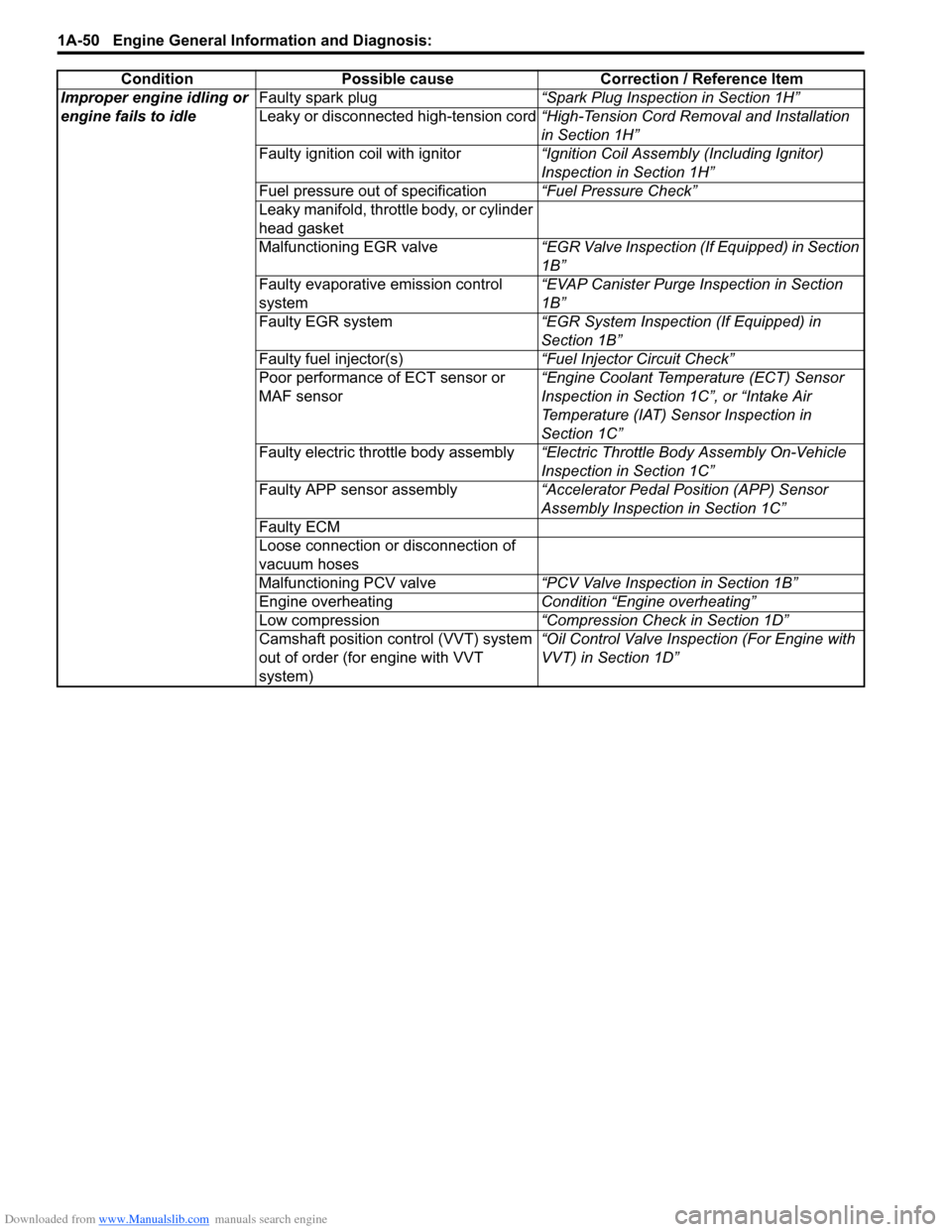
Downloaded from www.Manualslib.com manuals search engine 1A-50 Engine General Information and Diagnosis:
Improper engine idling or
engine fails to idleFaulty spark plug“Spark Plug Inspection in Section 1H”
Leaky or disconnected high-tension cord“High-Tension Cord Removal and Installation
in Section 1H”
Faulty ignition coil with ignitor“Ignition Coil Assembly (Including Ignitor)
Inspection in Section 1H”
Fuel pressure out of specification“Fuel Pressure Check”
Leaky manifold, throttle body, or cylinder
head gasket
Malfunctioning EGR valve“EGR Valve Inspection (If Equipped) in Section
1B”
Faulty evaporative emission control
system“EVAP Canister Purge Inspection in Section
1B”
Faulty EGR system“EGR System Inspection (If Equipped) in
Section 1B”
Faulty fuel injector(s)“Fuel Injector Circuit Check”
Poor performance of ECT sensor or
MAF sensor“Engine Coolant Temperature (ECT) Sensor
Inspection in Section 1C”, or “Intake Air
Temperature (IAT) Sensor Inspection in
Section 1C”
Faulty electric throttle body assembly“Electric Throttle Body Assembly On-Vehicle
Inspection in Section 1C”
Faulty APP sensor assembly“Accelerator Pedal Position (APP) Sensor
Assembly Inspection in Section 1C”
Faulty ECM
Loose connection or disconnection of
vacuum hoses
Malfunctioning PCV valve“PCV Valve Inspection in Section 1B”
Engine overheatingCondition “Engine overheating”
Low compression“Compression Check in Section 1D”
Camshaft position control (VVT) system
out of order (for engine with VVT
system)“Oil Control Valve Inspection (For Engine with
VVT) in Section 1D” Condition Possible cause Correction / Reference Item
Page 109 of 1556
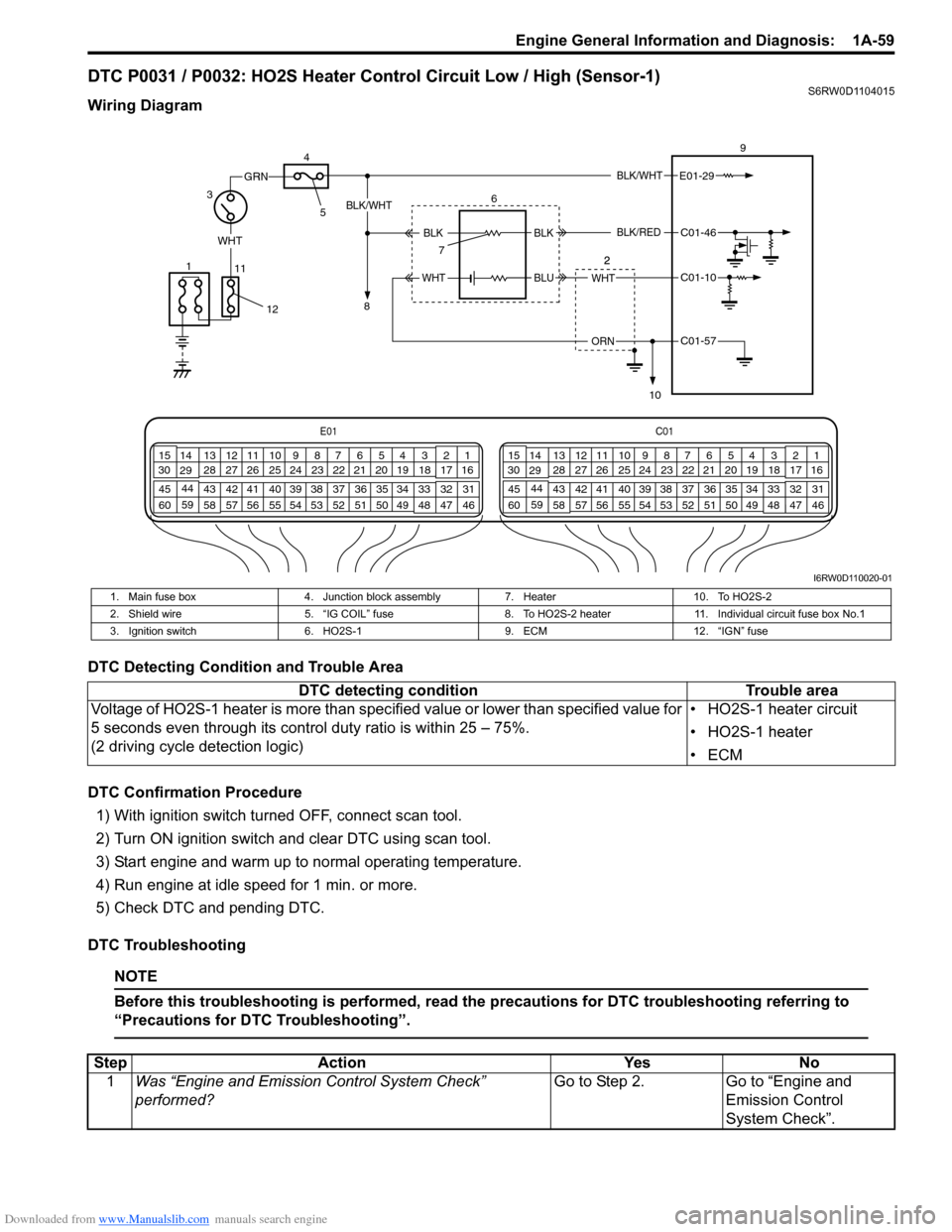
Downloaded from www.Manualslib.com manuals search engine Engine General Information and Diagnosis: 1A-59
DTC P0031 / P0032: HO2S Heater Control Circuit Low / High (Sensor-1)S6RW0D1104015
Wiring Diagram
DTC Detecting Condition and Trouble Area
DTC Confirmation Procedure
1) With ignition switch turned OFF, connect scan tool.
2) Turn ON ignition switch and clear DTC using scan tool.
3) Start engine and warm up to normal operating temperature.
4) Run engine at idle speed for 1 min. or more.
5) Check DTC and pending DTC.
DTC Troubleshooting
NOTE
Before this troubleshooting is performed, read the precautions for DTC troubleshooting referring to
“Precautions for DTC Troubleshooting”.
E01C01
3 4
18 19 5 6 7 10 11
17 20
47 46 49 50 51 21 22
5216 259
24 14
29
55 57 54 53 59
60 582
26 27 28 15
30
56 4832 31 34 35 36 37 40 42 39 38 44
45 43 41 331 12 13
238 3 4
18 19 5 6 7 10 11
17 20
47 46 49 50 51 21 22
5216 259
24 14
29
55 57 54 53 59
60 582
26 27 28 15
30
56 4832 31 34 35 36 37 40 42 39 38 44
45 43 41 331 12 13
238
BLK/WHT
WHT
11
GRN
39
E01-29
WHT
ORN
BLK/WHT
BLKC01-46
C01-10
C01-57
6
7
10
BLK
BLUWHT
BLK/RED
1
4
5
8
12
I6RW0D110020-01
1. Main fuse box 4. Junction block assembly 7. Heater 10. To HO2S-2
2. Shield wire 5. “IG COIL” fuse 8. To HO2S-2 heater 11. Individual circuit fuse box No.1
3. Ignition switch 6. HO2S-1 9. ECM 12. “IGN” fuse
DTC detecting condition Trouble area
Voltage of HO2S-1 heater is more than specified value or lower than specified value for
5 seconds even through its control duty ratio is within 25 – 75%.
(2 driving cycle detection logic)• HO2S-1 heater circuit
• HO2S-1 heater
•ECM
Step Action Yes No
1Was “Engine and Emission Control System Check”
performed?Go to Step 2. Go to “Engine and
Emission Control
System Check”.
Page 110 of 1556

Downloaded from www.Manualslib.com manuals search engine 1A-60 Engine General Information and Diagnosis:
2HO2S-1 heater power circuit check
1) Disconnect connector from HO2S-1 with ignition switch
turned OFF.
2) Check for proper connection to HO2S-1 at “BLK/WHT”
and “BLK/RED” wire terminals.
3) If wire and connection are OK, measure voltage
between “BLK/WHT” wire terminal and engine ground
with ignition switch turned ON.
Is voltage over 10 V?Go to Step 3. “BLK/WHT” wire is open
circuit or shorted to
ground circuit.
3HO2S-1 heater power circuit check
1) Disconnect connectors from ECM with ignition switch
turned OFF.
2) Measure resistance between “BLK/WHT” wire terminal
of HO2S-1 connector and “E01-29” terminal of ECM
connector.
Is resistance below 5
Ω?Go to Step 4. “BLK/WHT” wire is high
resistance circuit.
4HO2S-1 heater drive circuit check
1) Measure resistance between “C01-46” terminal of ECM
connector and vehicle body ground.
Is resistance infinity?Go to Step 5. “BLK/RED” wire is
shorted to ground
circuit.
5HO2S-1 heater drive circuit check
1) Turn ON ignition switch.
2) Measure voltage between “C01-46” terminal of ECM
connector and vehicle body ground.
Is voltage 0 V?Go to Step 6. “BLK/RED” wire is
shorted to power circuit.
6HO2S-1 heater drive circuit check
1) Connect connector to HO2S-1 with ignition switch turned
OFF.
2) Turn ON ignition switch.
3) Measure voltage between “C01-46” terminal of ECM
connector and vehicle body ground with connector
disconnected from ECM.
Is voltage over 10 V?Go to Step 7. “BLK/RED” wire is open
circuit.
7HO2S-1 heater check
1) Disconnect HO2S-1 connector with ignition switch
turned OFF.
2) Check HO2S-1 heater resistance referring to “Heated
Oxygen Sensor (HO2S-1 and HO2S-2) Heater On-
Vehicle Inspection (If Equipped) in Section 1C”.
Is resistance within specified value range?Go to Step 8. Replace HO2S-1.
8HO2S-1 heater power circuit check
1) Connect connector to HO2S-1 with ignition switch turned
OFF.
2) Measure resistance between “E01-29” and “C01-46”
terminals of ECM connector.
It resistance below 12
Ω?HO2S-1 heater circuit is
OK.
Substitute a known-
good ECM and recheck.“BLK/WHT”, “BLK/RED”
and / or “BLK” wire is
high resistance circuit. Step Action Yes No
Page 111 of 1556
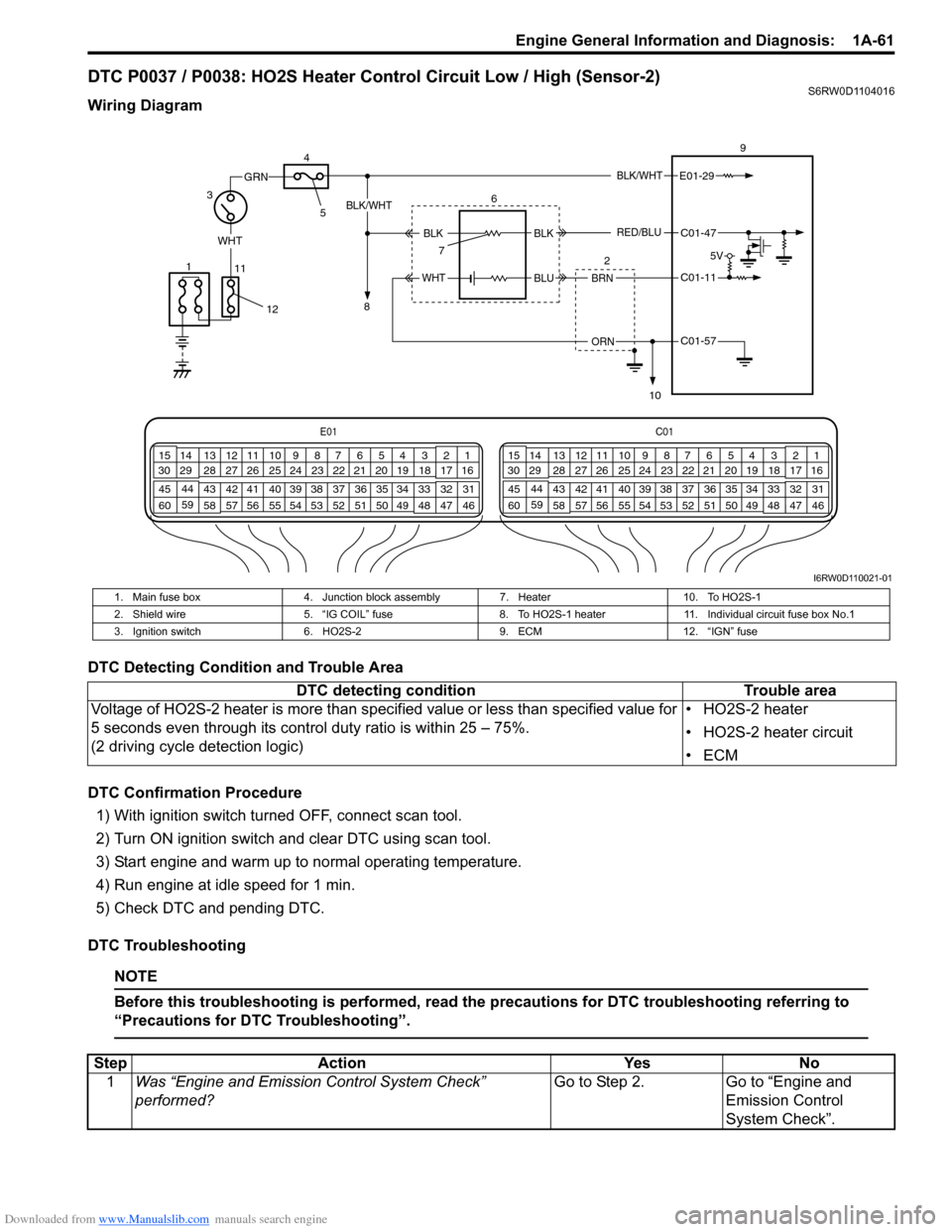
Downloaded from www.Manualslib.com manuals search engine Engine General Information and Diagnosis: 1A-61
DTC P0037 / P0038: HO2S Heater Control Circuit Low / High (Sensor-2)S6RW0D1104016
Wiring Diagram
DTC Detecting Condition and Trouble Area
DTC Confirmation Procedure
1) With ignition switch turned OFF, connect scan tool.
2) Turn ON ignition switch and clear DTC using scan tool.
3) Start engine and warm up to normal operating temperature.
4) Run engine at idle speed for 1 min.
5) Check DTC and pending DTC.
DTC Troubleshooting
NOTE
Before this troubleshooting is performed, read the precautions for DTC troubleshooting referring to
“Precautions for DTC Troubleshooting”.
E01C01
3 4
18 19 5 6 7 10 11
17 20
47 46 49 50 51 21 22
5216 259
24 14
29
55 57 54 53 59
60 582
26 27 28 15
30
56 4832 31 34 35 36 37 40 42 39 38 44
45 43 41 331 12 13
238 3 4
18 19 5 6 7 10 11
17 20
47 46 49 50 51 21 22
5216 259
24 14
29
55 57 54 53 59
60 582
26 27 28 15
30
56 4832 31 34 35 36 37 40 42 39 38 44
45 43 41 331 12 13
238
BLK/WHT
WHT
11
GRN
39
E01-29
BRN
ORN
BLK/WHT
BLKC01-47
C01-11
C01-57
6
2 7
10
BLK
BLUWHT
RED/BLU
1
4
5
8
12
5V
I6RW0D110021-01
1. Main fuse box 4. Junction block assembly 7. Heater 10. To HO2S-1
2. Shield wire 5. “IG COIL” fuse 8. To HO2S-1 heater 11. Individual circuit fuse box No.1
3. Ignition switch 6. HO2S-2 9. ECM 12. “IGN” fuse
DTC detecting condition Trouble area
Voltage of HO2S-2 heater is more than specified value or less than specified value for
5 seconds even through its control duty ratio is within 25 – 75%.
(2 driving cycle detection logic)• HO2S-2 heater
• HO2S-2 heater circuit
•ECM
Step Action Yes No
1Was “Engine and Emission Control System Check”
performed?Go to Step 2. Go to “Engine and
Emission Control
System Check”.
Page 112 of 1556

Downloaded from www.Manualslib.com manuals search engine 1A-62 Engine General Information and Diagnosis:
2HO2S-2 heater power circuit check
1) Disconnect connector from HO2S-2 with ignition switch
turned OFF.
2) Check for proper connection to HO2S-2 at “BLK/WHT”
and “RED/BLU” wire terminals.
3) If wire and connection are OK, measure voltage
between “BLK/WHT” wire terminal of HO2S-2 connector
and engine ground with ignition switch turned ON.
Is voltage over 10 V?Go to Step 3. “BLK/WHT” wire is open
circuit or shorted to
ground circuit.
3HO2S-2 heater power circuit check
1) Disconnect connectors from ECM with ignition switch
turned OFF.
2) Measure resistance between “BLK/WHT” wire terminal
of HO2S-2 connector and “E01-29” terminal wire of ECM
connector.
Is resistance below 5
Ω?Go to Step 4. “BLK/WHT” wire is high
resistance circuit.
4HO2S-2 heater drive circuit check
1) Measure resistance between “RED/BLU” wire terminal of
HO2S-2 connector and vehicle body ground.
Is resistance infinity?Go to Step 5. “RED/BLU” wire is
shorted to ground
circuit.
5HO2S-2 heater drive circuit check
1) Turn ON ignition switch.
2) Measure voltage between “RED/BLU” wire terminal of
HO2S-2 connector and vehicle body ground.
Is voltage 0 V?Go to Step 6. “RED/BLU” wire is
shorted to power circuit.
6HO2S-2 heater drive circuit check
1) Connect connector to HO2S-2 with ignition switch turned
OFF.
2) Turn ON ignition switch.
3) Measure voltage between “C01-47” terminal of
disconnected ECM connector and vehicle body ground.
Is voltage over 10 V?Go to Step 7. “RED/BLU” wire is open
circuit.
7HO2S-2 heater check
1) Disconnect HO2S-2 connector with ignition switch
turned OFF.
2) Check HO2S-2 heater resistance referring to “Heated
Oxygen Sensor (HO2S-1 and HO2S-2) Heater On-
Vehicle Inspection (If Equipped) in Section 1C”.
Is resistance within specified value?Go to Step 8. Replace HO2S-2.
8HO2S-2 heater power circuit check
1) Connect connector to HO2S-2 with ignition switch turned
OFF.
2) Measure resistance between “E01-29” and “C01-47”
terminals of ECM connector.
Is resistance below 30
Ω?HO2S-2 heater circuit is
OK. Substitute a known-
good ECM and recheck.“RED/BLU” wire is high
resistance circuit. Step Action Yes No
Page 131 of 1556

Downloaded from www.Manualslib.com manuals search engine Engine General Information and Diagnosis: 1A-81
DTC Confirmation Procedure
WARNING!
• When performing a road test, select a place where there is no traffic or possibility of a traffic
accident and be very careful during testing to avoid occurrence of an accident.
• Road test should be carried out by 2 persons, a driver and tester, on a level road.
NOTE
Check to make sure that following conditions are satisfied when using this “DTC Confirmation
Procedure”.
• Intake air temperature at engine start: –10 °C (14 °F) to 80 °C (176 °F)
• Intake air temperature: –10 °C (14 °F) to 70 °C (158 °F)
• Altitude (barometric pressure): 2500 m, 8200 ft or less (560 mmHg, 74.4 kPa or more)
1) With ignition switch turned OFF, connect scan tool.
2) Turn ON ignition switch, clear DTC.
3) Start engine.
4) Drive vehicle at 40 mph (60 km/h) or higher for 20 min. or more.
5) Stop vehicle.
6) Check DTC and pending DTC.
DTC Troubleshooting
NOTE
Before this troubleshooting is performed, read the precautions for DTC troubleshooting referring to
“Precautions for DTC Troubleshooting”.
Step Action Yes No
1Was “Engine and Emission Control System Check”
performed?Go to Step 2. Go to “Engine and
Emission Control
System Check”.
2DTC check
1) With ignition switch turned OFF, install scan tool to DLC.
2) Turn ON ignition switch and check DTC with scan tool.
Is DTC P0118 displayed?Go to “DTC P0118:
Engine Coolant
Temperature Circuit
High”.Go to Step 3.
3Engine coolant temp. check
1) Turn ON ignition switch and check engine coolant temp.
displayed on scan tool.
2) Warm up engine to normal operating temp. and check
engine coolant temp. displayed on scan tool.
Does engine coolant temp. vary more than 1
°C (1 °F) and
rise higher than 70
°C (158 °F)?Intermittent trouble.
Check for intermittent
referring to “Intermittent
and Poor Connection
Inspection in Section
00”.Go to Step 4.
4Thermostat check
Is there a symptom due to thermostat remaining open (it
takes a long time before vehicle heater becomes effective or
before engine is warmed to normal operating temp., etc.)?Check thermostat
referring to “Thermostat
Inspection in Section
1F”.Go to Step 5.
Page 142 of 1556
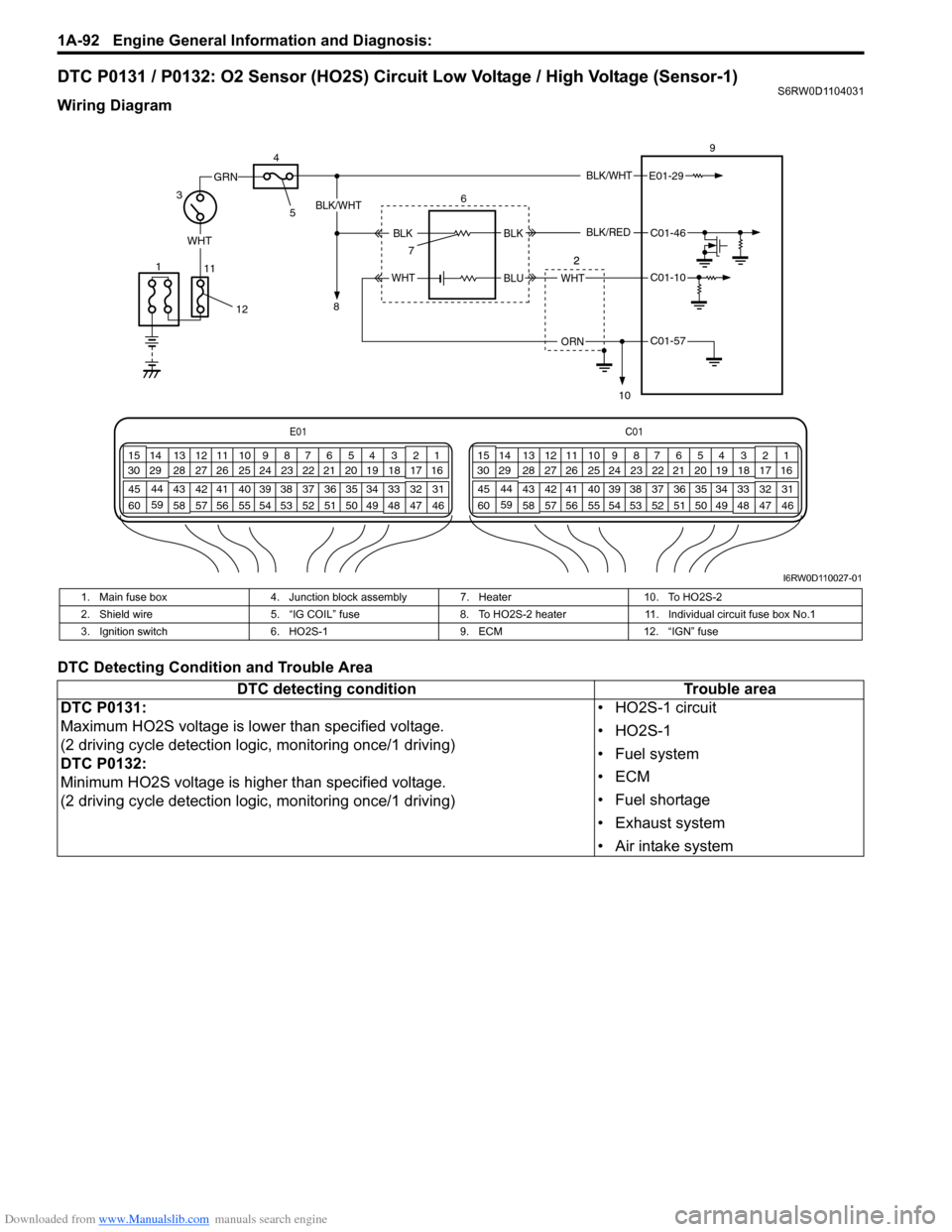
Downloaded from www.Manualslib.com manuals search engine 1A-92 Engine General Information and Diagnosis:
DTC P0131 / P0132: O2 Sensor (HO2S) Circuit Low Voltage / High Voltage (Sensor-1)S6RW0D1104031
Wiring Diagram
DTC Detecting Condition and Trouble Area
E01C01
3 4
18 19 5 6 7 10 11
17 20
47 46 49 50 51 21 22
5216 259
24 14
29
55 57 54 53 59
60 582
26 27 28 15
30
56 4832 31 34 35 36 37 40 42 39 38 44
45 43 41 331 12 13
238 3 4
18 19 5 6 7 10 11
17 20
47 46 49 50 51 21 22
5216 259
24 14
29
55 57 54 53 59
60 582
26 27 28 15
30
56 4832 31 34 35 36 37 40 42 39 38 44
45 43 41 331 12 13
238
BLK/WHT
WHT
11
GRN
39
E01-29
WHT
ORN
BLK/WHT
BLKC01-46
C01-10
C01-57
6
7
10
BLK
BLUWHT
BLK/RED
1
4
5
8
12
I6RW0D110027-01
1. Main fuse box 4. Junction block assembly 7. Heater 10. To HO2S-2
2. Shield wire 5. “IG COIL” fuse 8. To HO2S-2 heater 11. Individual circuit fuse box No.1
3. Ignition switch 6. HO2S-1 9. ECM 12. “IGN” fuse
DTC detecting condition Trouble area
DTC P0131:
Maximum HO2S voltage is lower than specified voltage.
(2 driving cycle detection logic, monitoring once/1 driving)
DTC P0132:
Minimum HO2S voltage is higher than specified voltage.
(2 driving cycle detection logic, monitoring once/1 driving)• HO2S-1 circuit
•HO2S-1
• Fuel system
•ECM
• Fuel shortage
• Exhaust system
• Air intake system