brake fluid SUZUKI SX4 2006 1.G Service Owner's Guide
[x] Cancel search | Manufacturer: SUZUKI, Model Year: 2006, Model line: SX4, Model: SUZUKI SX4 2006 1.GPages: 1556, PDF Size: 37.31 MB
Page 592 of 1556
Downloaded from www.Manualslib.com manuals search engine 4B-5 Front Brakes:
Assembly
Assemble parts in reverse order of disassembly,
observing the following instructions.
CAUTION!
• Wash each part cleanly before installation
in the same fluid as the one used in master
cylinder reservoir.
• Never use other fluid or thinner.
• Before installing piston seal and cylinder
boot to cylinder, apply rubber grease
included in piston seal set or brake fluid to
them.
• Install a new piston seal into groove in
cylinder securely making sure that it is not
twisted.
• After reassembling brake lines, bleed air
from them.
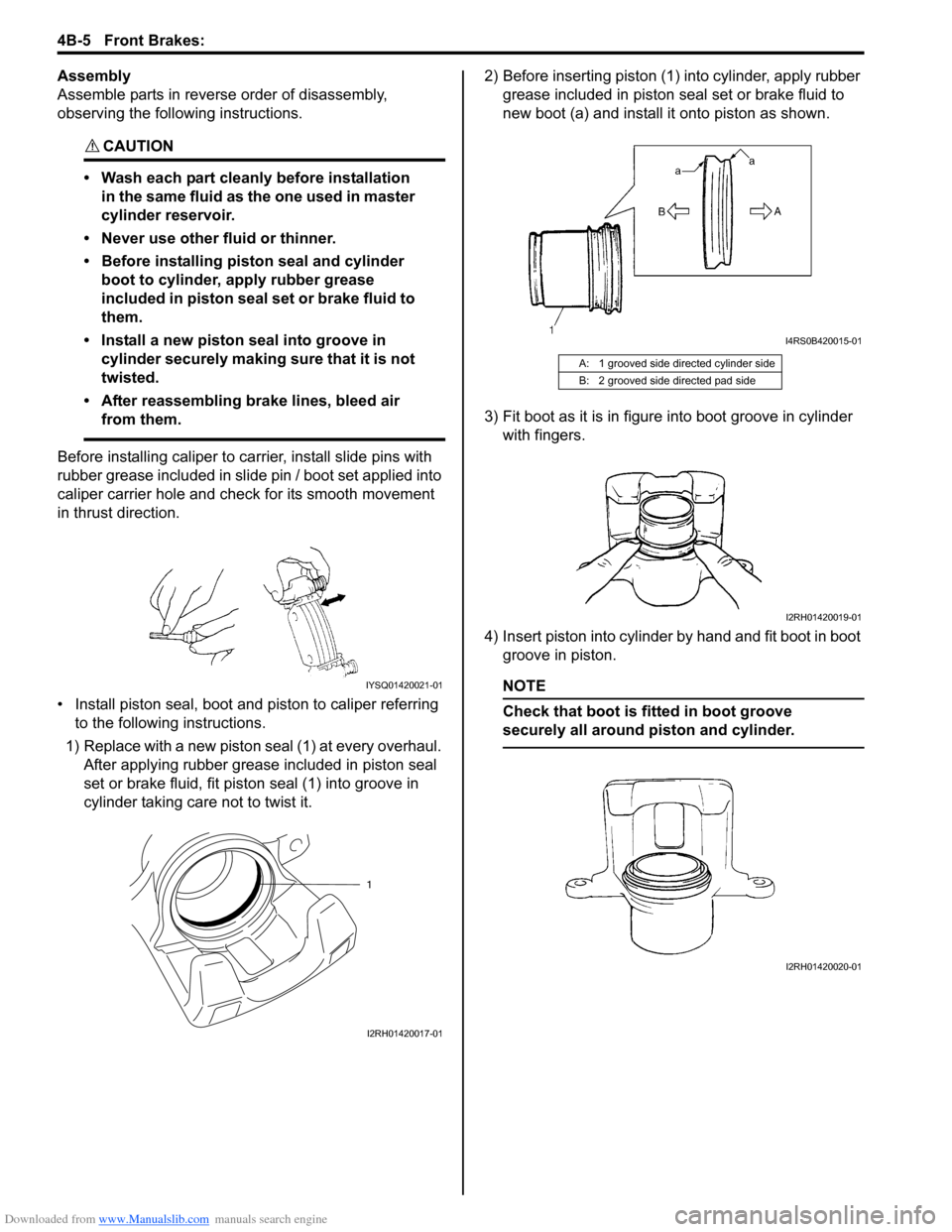
Before installing caliper to carrier, install slide pins with
rubber grease included in slide pin / boot set applied into
caliper carrier hole and check for its smooth movement
in thrust direction.
• Install piston seal, boot and piston to caliper referring
to the following instructions.
1) Replace with a new piston seal (1) at every overhaul.
After applying rubber grease included in piston seal
set or brake fluid, fit piston seal (1) into groove in
cylinder taking care not to twist it.2) Before inserting piston (1) into cylinder, apply rubber
grease included in piston seal set or brake fluid to
new boot (a) and install it onto piston as shown.
3) Fit boot as it is in figure into boot groove in cylinder
with fingers.
4) Insert piston into cylinder by hand and fit boot in boot
groove in piston.
NOTE
Check that boot is fitted in boot groove
securely all around piston and cylinder.
IYSQ01420021-01
1
I2RH01420017-01
A: 1 grooved side directed cylinder side
B: 2 grooved side directed pad side
I4RS0B420015-01
I2RH01420019-01
I2RH01420020-01
Page 596 of 1556
Downloaded from www.Manualslib.com manuals search engine 4C-1 Rear Brakes:
Brakes
Rear Brakes
Repair Instructions
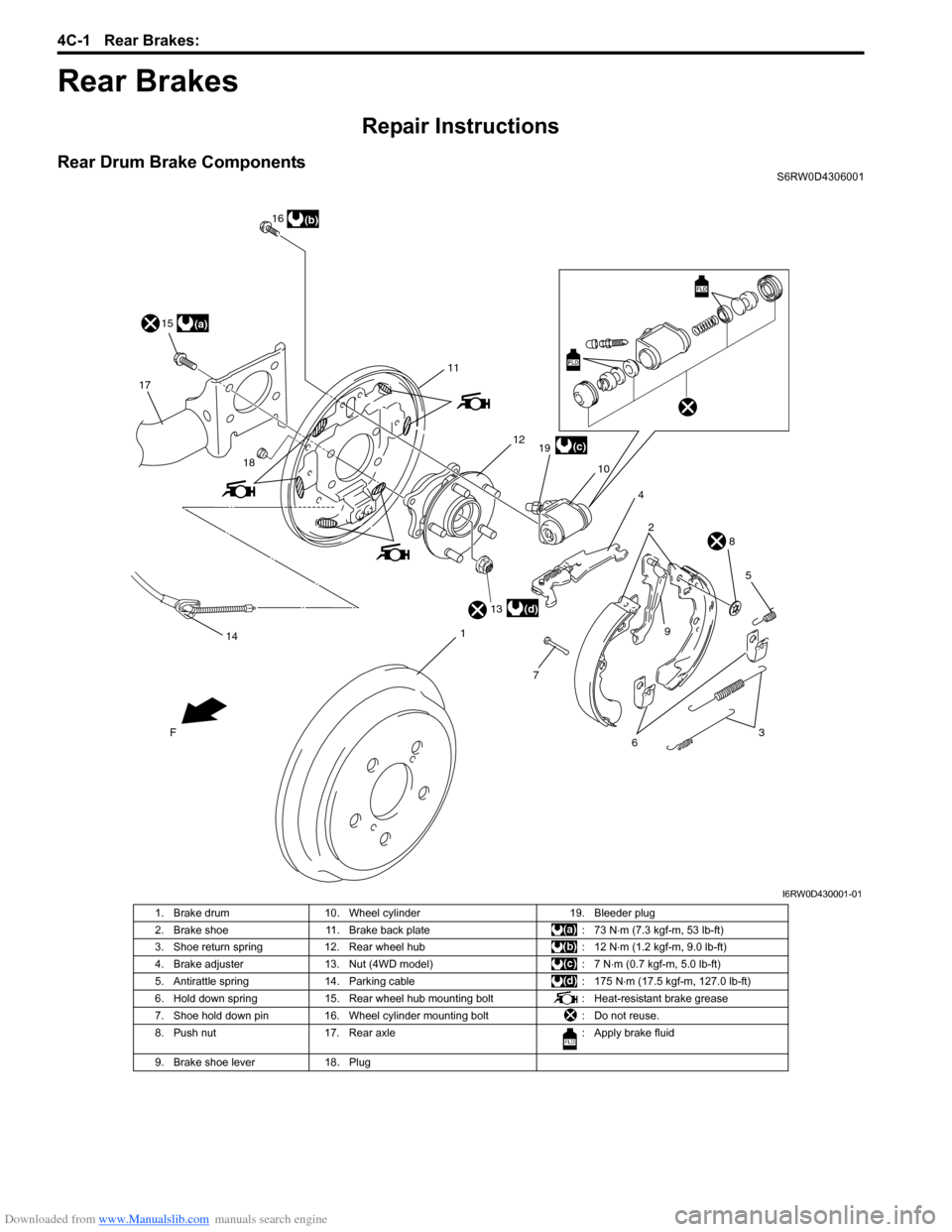
Rear Drum Brake ComponentsS6RW0D4306001
11
2
3
4
5
6 7
12
1411310 16
19 15
17
98
18
F
(a)
(b)
(c)
(d)
I6RW0D430001-01
1. Brake drum 10. Wheel cylinder 19. Bleeder plug
2. Brake shoe 11. Brake back plate : 73 N⋅m (7.3 kgf-m, 53 lb-ft)
3. Shoe return spring 12. Rear wheel hub : 12 N⋅m (1.2 kgf-m, 9.0 lb-ft)
4. Brake adjuster 13. Nut (4WD model) : 7 N⋅m (0.7 kgf-m, 5.0 lb-ft)
5. Antirattle spring 14. Parking cable : 175 N⋅m (17.5 kgf-m, 127.0 lb-ft)
6. Hold down spring 15. Rear wheel hub mounting bolt : Heat-resistant brake grease
7. Shoe hold down pin 16. Wheel cylinder mounting bolt : Do not reuse.
8. Push nut 17. Rear axle : Apply brake fluid
9. Brake shoe lever 18. Plug
Page 598 of 1556
Downloaded from www.Manualslib.com manuals search engine 4C-3 Rear Brakes:
Cracked, Scored or Grooved Drum
A cracked drum is unsafe for further service and must be
replaced. Do not attempt to weld a cracked drum.
Smooth up any slight scores. Heavy or extensive scoring
will cause excessive brake lining wear and it will
probably be necessary to resurface drum braking
surface.
If brake linings are slightly worn and drum is grooved,
drum should be polished with fine emery cloth in the
direction of drum depth but not circumferentially along
drum inner.
NOTE
When drum is removed, visually inspect
wheel cylinder for brake fluid leakage.
Correct leaky point, if any.
Brake Shoe
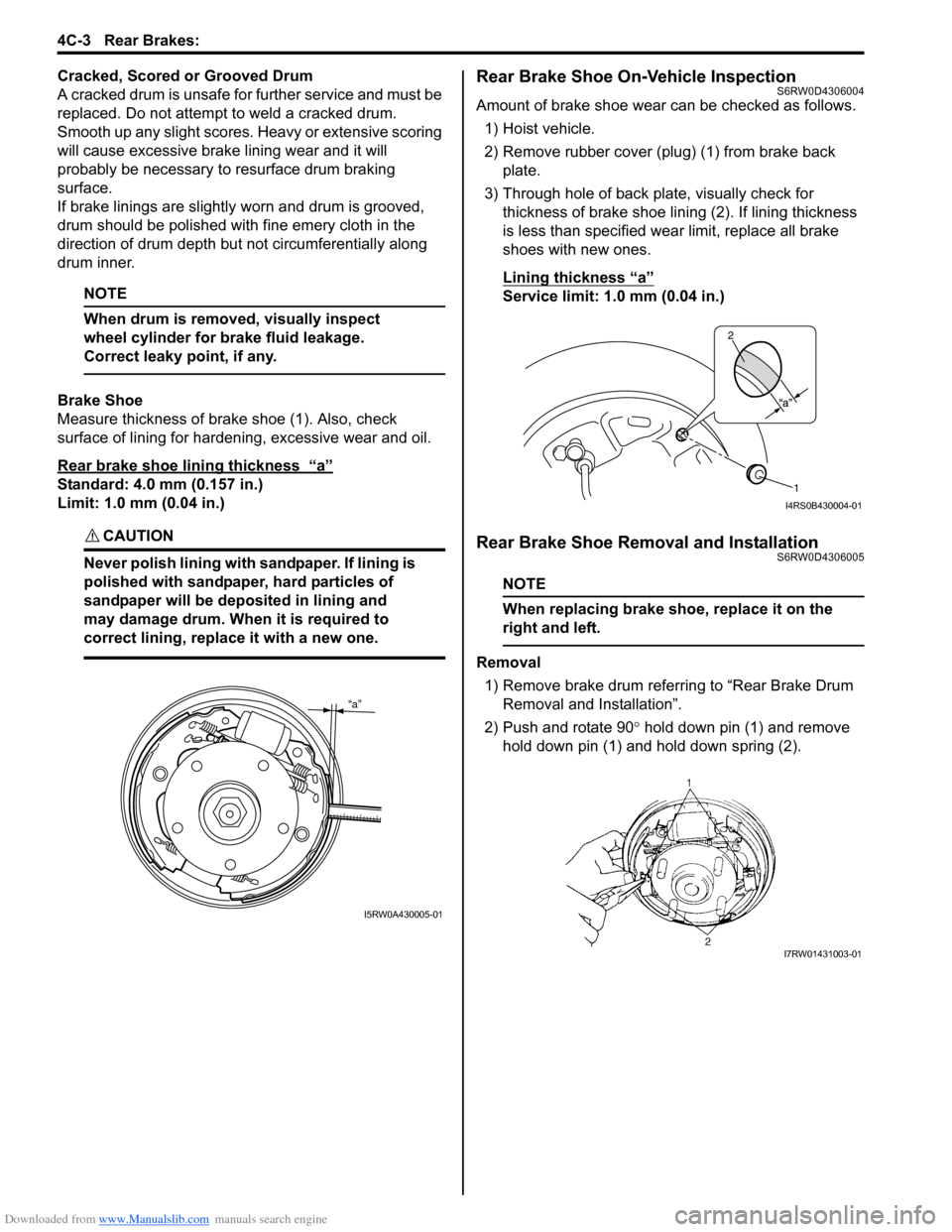
Measure thickness of brake shoe (1). Also, check
surface of lining for hardening, excessive wear and oil.
Rear brake shoe lining thickness
“a”
Standard: 4.0 mm (0.157 in.)
Limit: 1.0 mm (0.04 in.)
CAUTION!
Never polish lining with sandpaper. If lining is
polished with sandpaper, hard particles of
sandpaper will be deposited in lining and
may damage drum. When it is required to
correct lining, replace it with a new one.
Rear Brake Shoe On-Vehicle InspectionS6RW0D4306004
Amount of brake shoe wear can be checked as follows.
1) Hoist vehicle.
2) Remove rubber cover (plug) (1) from brake back
plate.
3) Through hole of back plate, visually check for
thickness of brake shoe lining (2). If lining thickness
is less than specified wear limit, replace all brake
shoes with new ones.
Lining thickness “a”
Service limit: 1.0 mm (0.04 in.)
Rear Brake Shoe Removal and InstallationS6RW0D4306005
NOTE
When replacing brake shoe, replace it on the
right and left.
Removal
1) Remove brake drum referring to “Rear Brake Drum
Removal and Installation”.
2) Push and rotate 90° hold down pin (1) and remove
hold down pin (1) and hold down spring (2).
“a”
I5RW0A430005-01
2
1
I4RS0B430004-01
I7RW01431003-01
Page 599 of 1556
Downloaded from www.Manualslib.com manuals search engine Rear Brakes: 4C-4
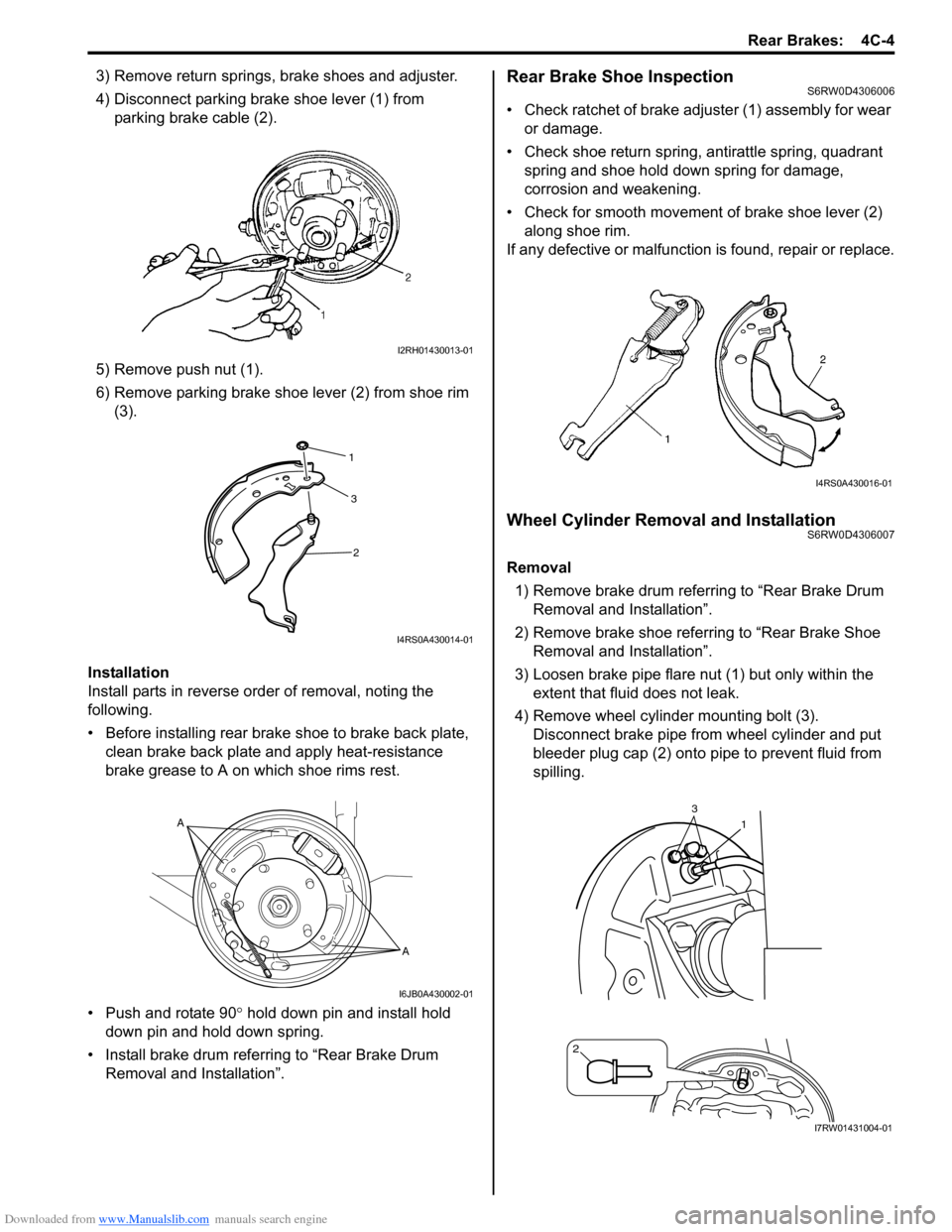
3) Remove return springs, brake shoes and adjuster.
4) Disconnect parking brake shoe lever (1) from
parking brake cable (2).
5) Remove push nut (1).
6) Remove parking brake shoe lever (2) from shoe rim
(3).
Installation
Install parts in reverse order of removal, noting the
following.
• Before installing rear brake shoe to brake back plate,
clean brake back plate and apply heat-resistance
brake grease to A on which shoe rims rest.
• Push and rotate 90° hold down pin and install hold
down pin and hold down spring.
• Install brake drum referring to “Rear Brake Drum
Removal and Installation”.Rear Brake Shoe InspectionS6RW0D4306006
• Check ratchet of brake adjuster (1) assembly for wear
or damage.
• Check shoe return spring, antirattle spring, quadrant
spring and shoe hold down spring for damage,
corrosion and weakening.
• Check for smooth movement of brake shoe lever (2)
along shoe rim.
If any defective or malfunction is found, repair or replace.
Wheel Cylinder Removal and InstallationS6RW0D4306007
Removal
1) Remove brake drum referring to “Rear Brake Drum
Removal and Installation”.
2) Remove brake shoe referring to “Rear Brake Shoe
Removal and Installation”.
3) Loosen brake pipe flare nut (1) but only within the
extent that fluid does not leak.
4) Remove wheel cylinder mounting bolt (3).
Disconnect brake pipe from wheel cylinder and put
bleeder plug cap (2) onto pipe to prevent fluid from
spilling.
I2RH01430013-01
1
2 3
I4RS0A430014-01
A
A
I6JB0A430002-01
I4RS0A430016-01
1
2
3
I7RW01431004-01
Page 600 of 1556
Downloaded from www.Manualslib.com manuals search engine 4C-5 Rear Brakes:
Installation
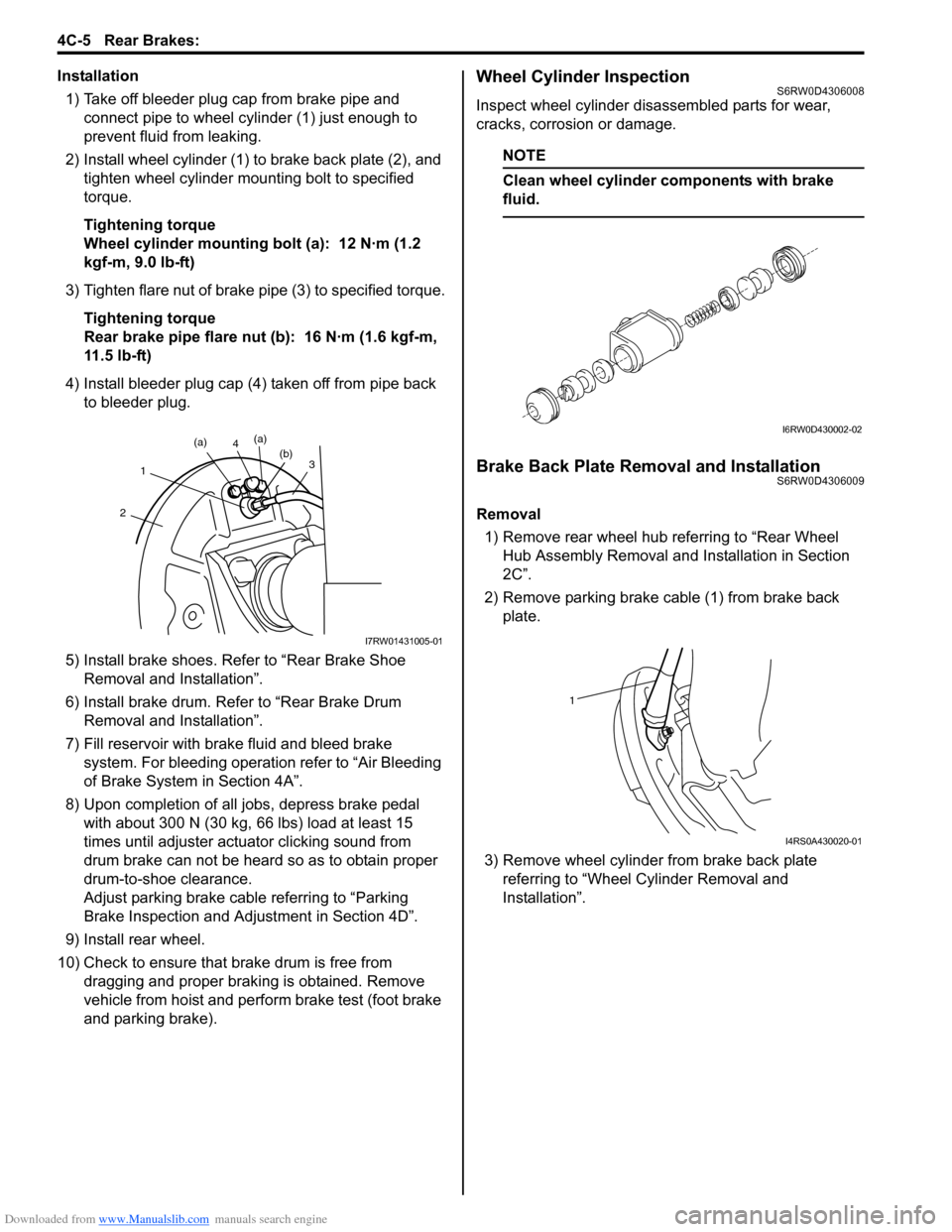
1) Take off bleeder plug cap from brake pipe and
connect pipe to wheel cylinder (1) just enough to
prevent fluid from leaking.
2) Install wheel cylinder (1) to brake back plate (2), and
tighten wheel cylinder mounting bolt to specified
torque.
Tightening torque
Wheel cylinder mounting bolt (a): 12 N·m (1.2
kgf-m, 9.0 lb-ft)
3) Tighten flare nut of brake pipe (3) to specified torque.
Tightening torque
Rear brake pipe flare nut (b): 16 N·m (1.6 kgf-m,
11.5 lb-ft)
4) Install bleeder plug cap (4) taken off from pipe back
to bleeder plug.
5) Install brake shoes. Refer to “Rear Brake Shoe
Removal and Installation”.
6) Install brake drum. Refer to “Rear Brake Drum
Removal and Installation”.
7) Fill reservoir with brake fluid and bleed brake
system. For bleeding operation refer to “Air Bleeding
of Brake System in Section 4A”.
8) Upon completion of all jobs, depress brake pedal
with about 300 N (30 kg, 66 lbs) load at least 15
times until adjuster actuator clicking sound from
drum brake can not be heard so as to obtain proper
drum-to-shoe clearance.
Adjust parking brake cable referring to “Parking
Brake Inspection and Adjustment in Section 4D”.
9) Install rear wheel.
10) Check to ensure that brake drum is free from
dragging and proper braking is obtained. Remove
vehicle from hoist and perform brake test (foot brake
and parking brake).Wheel Cylinder InspectionS6RW0D4306008
Inspect wheel cylinder disassembled parts for wear,
cracks, corrosion or damage.
NOTE
Clean wheel cylinder components with brake
fluid.
Brake Back Plate Removal and InstallationS6RW0D4306009
Removal
1) Remove rear wheel hub referring to “Rear Wheel
Hub Assembly Removal and Installation in Section
2C”.
2) Remove parking brake cable (1) from brake back
plate.
3) Remove wheel cylinder from brake back plate
referring to “Wheel Cylinder Removal and
Installation”.
(b)3
4(a)
(a)
1
2
I7RW01431005-01
I6RW0D430002-02
1
I4RS0A430020-01
Page 607 of 1556
Downloaded from www.Manualslib.com manuals search engine ABS: 4E-2
General Description
ABS DescriptionS6RW0D4501001
The ABS (Antilock Brake System) controls the fluid
pressure applied to the wheel cylinder of each brake
from the master cylinder so that each wheel is not locked
even when hard braking is applied.
This ABS has also the following function.
While braking is applied, but before ABS control
becomes effective, braking force is distributed between
the front and rear so as to prevent the rear wheels from
being locked too early for better stability of the vehicle.
The main component parts of this ABS include the
following parts in addition to those of the conventional
brake system.
• Wheel speed sensor which senses revolution speed
of each wheel and outputs its signal.
Rear wheel speed sensor of 4WD vehicle is
integrated in rear wheel hub assembly and supplied
as rear wheel hub assembly part.
Front wheel speed sensor and rear wheel speed
sensor of 2WD model are separated from wheel hub
assembly and supplied as spare parts.
• ABS warning light which lights to inform abnormality
when system fails to operate properly.• ABS hydraulic unit / control module assembly is
incorporated ABS control module, ABS hydraulic unit
(actuator assembly), solenoid valve power supply
driver (transistor), solenoid valve driver (transistor),
pump motor driver (transistor).
– ABS control module which sends operation signal
to ABS hydraulic unit to control fluid pressure
applied to each wheel cylinder based on signal
from each wheel speed sensor so as to prevent
wheel from locking.
– ABS hydraulic unit which operates according to
signal from ABS control module to control fluid
pressure applied to wheel cylinder of each 4
wheels.
– Solenoid valve power supply driver (transistor)
which supplies power to solenoid valve in ABS
hydraulic unit.
– Solenoid valve driver (transistor) which controls
each solenoid valves in ABS hydraulic unit.
– Pump motor driver (transistor) which supplies
power to pump motor in ABS hydraulic unit.
• G sensor which detects body deceleration speed for
4WD model.
This ABS is equipped with Electronic Brake force
Distribution (EBD) system that controls a fluid pressure
of rear wheels to best condition, which is the same
function as that of proportioning valve, by the signal from
wheel sensor independently of change of load due to
load capacity and so on. And if the EBD system fails to
operate properly, the brake warning light lights to inform
abnormality.
Page 611 of 1556
Downloaded from www.Manualslib.com manuals search engine ABS: 4E-6
17+BB
18BLU
WHT12VGRN/ORN 34
30E08-9
RED
WHT 1226
WHT/RED
12V
E08-7
19GRN
GRN
E08-16
12V
5
76
21REDRED/BLK
12V
BLKWHTE08-22 E08-11
23BLKWHTLT GRN/BLKLT GRN
12V
E08-10 E08-21
E08-23
E08-26
E08-1E08-12
24BLKWHT
12V
YELBRNE08-19 E08-20
27
1 2
RED/BLK
WHTRED
WHTRED
WHTRED9
E08-2E08-13WHT
E08-6
RED
9
9
11
9
9
9
REDWHT
WHTRED
12VE08-25
M
BLK
BLK
WHT/BLUWHT/RED
WHT/BLUE08-24
WHT
E08 [A]
1
2
3
4
5
6
7 12
13
14
15
16
17
18
19
20
21
228
9
10
11
23
24
25
26
GRN/WHT
22
12V
BLKWHTWHTWHT/BLKE08-17 E08-18
GRN/ORN28
2033
31
29
25
15
32
GRN/YELE08-3GRN/BLK
8
12V
12V
13
14RED/BLK
RED/BLU
WHTRED6
16
10
BLK [B]
I6RW0D450001-02
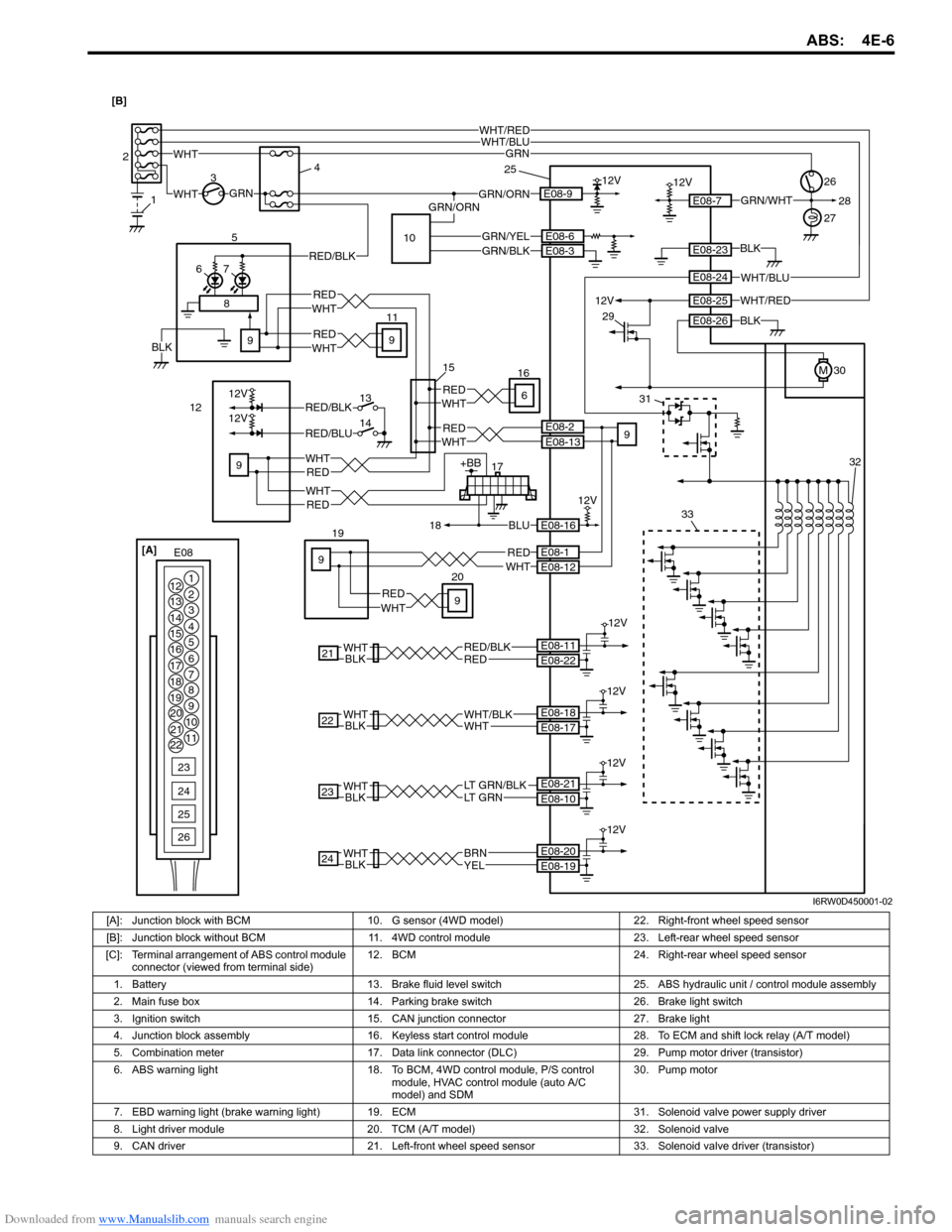
[A]: Junction block with BCM 10. G sensor (4WD model) 22. Right-front wheel speed sensor
[B]: Junction block without BCM 11. 4WD control module 23. Left-rear wheel speed sensor
[C]: Terminal arrangement of ABS control module
connector (viewed from terminal side)12. BCM 24. Right-rear wheel speed sensor
1. Battery 13. Brake fluid level switch 25. ABS hydraulic unit / control module assembly
2. Main fuse box 14. Parking brake switch 26. Brake light switch
3. Ignition switch 15. CAN junction connector 27. Brake light
4. Junction block assembly 16. Keyless start control module 28. To ECM and shift lock relay (A/T model)
5. Combination meter 17. Data link connector (DLC) 29. Pump motor driver (transistor)
6. ABS warning light 18. To BCM, 4WD control module, P/S control
module, HVAC control module (auto A/C
model) and SDM30. Pump motor
7. EBD warning light (brake warning light)19. ECM 31. Solenoid valve power supply driver
8. Light driver module 20. TCM (A/T model) 32. Solenoid valve
9. CAN driver 21. Left-front wheel speed sensor 33. Solenoid valve driver (transistor)
Page 619 of 1556
Downloaded from www.Manualslib.com manuals search engine ABS: 4E-14
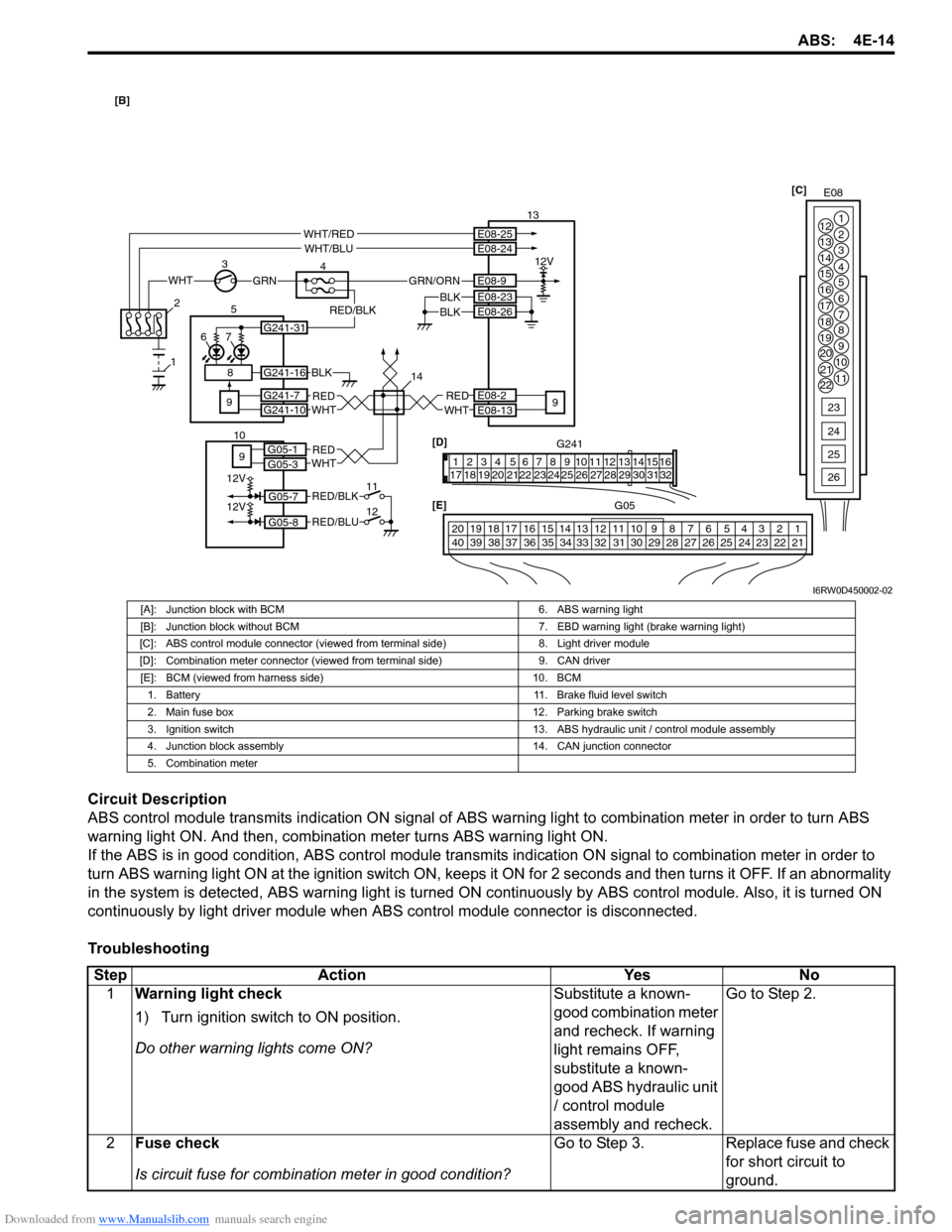
Circuit Description
ABS control module transmits indication ON signal of ABS warning light to combination meter in order to turn ABS
warning light ON. And then, combination meter turns ABS warning light ON.
If the ABS is in good condition, ABS control module transmits indication ON signal to combination meter in order to
turn ABS warning light ON at the ignition switch ON, keeps it ON for 2 seconds and then turns it OFF. If an abnormality
in the system is detected, ABS warning light is turned ON continuously by ABS control module. Also, it is turned ON
continuously by light driver module when ABS control module connector is disconnected.
Troubleshooting
G241 [D]
132 4 5 6 7 8 9 10111213141516
17 1918 20 2122 23 24 25 26 27 28 29 30 31 32E08 [C]
1
2
3
4
5
6
7 12
13
14
15
16
17
18
19
20
21
228
9
10
11
23
24
25
26
G05 [E]
1 2 3 4 765 8 9 10 11 14 15 16
36 34 33 32 3135 24 23 2122 28 27 2526 37 39 38 4018 17 13 12 19 20
30 29
WHTGRN
3
E08-2
E08-13REDWHT 5
4 13
9
E08-23
E08-26BLKBLK
67
BLK
REDWHTG241-7G241-10
G241-16
12V
E08-25E08-24
E08-9
WHT/REDWHT/BLU
GRN/ORN
9
2
1
14
G241-31
RED/BLK
8
REDWHT9
12V
12V
11
12G05-7
G05-1G05-3
G05-8
RED/BLK
RED/BLU
10
[B]
I6RW0D450002-02
[A]: Junction block with BCM 6. ABS warning light
[B]: Junction block without BCM 7. EBD warning light (brake warning light)
[C]: ABS control module connector (viewed from terminal side) 8. Light driver module
[D]: Combination meter connector (viewed from terminal side) 9. CAN driver
[E]: BCM (viewed from harness side) 10. BCM
1. Battery 11. Brake fluid level switch
2. Main fuse box 12. Parking brake switch
3. Ignition switch 13. ABS hydraulic unit / control module assembly
4. Junction block assembly 14. CAN junction connector
5. Combination meter
Step Action Yes No
1Warning light check
1) Turn ignition switch to ON position.
Do other warning lights come ON?Substitute a known-
good combination meter
and recheck. If warning
light remains OFF,
substitute a known-
good ABS hydraulic unit
/ control module
assembly and recheck.Go to Step 2.
2Fuse check
Is circuit fuse for combination meter in good condition?Go to Step 3. Replace fuse and check
for short circuit to
ground.
Page 621 of 1556
Downloaded from www.Manualslib.com manuals search engine ABS: 4E-16
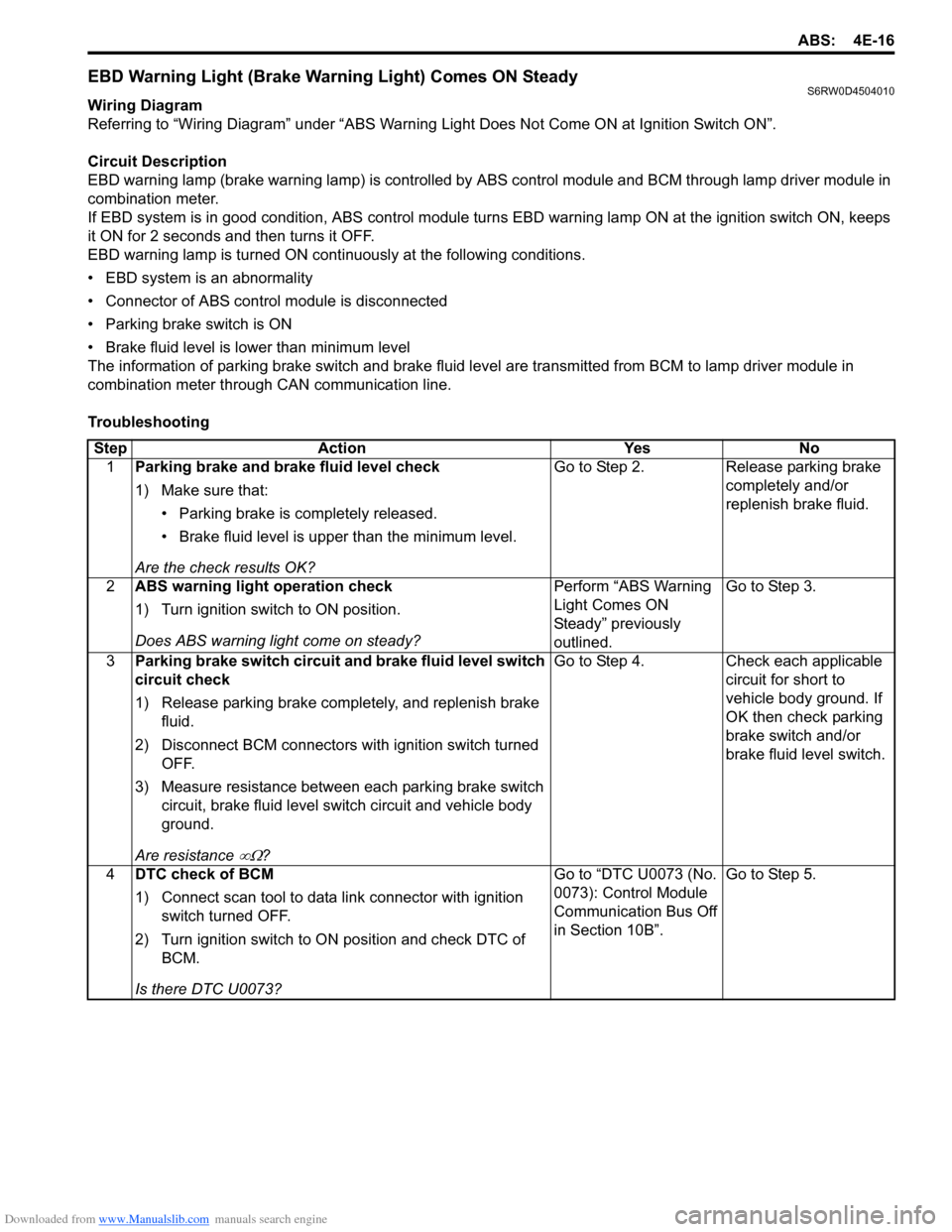
EBD Warning Light (Brake Warning Light) Comes ON SteadyS6RW0D4504010
Wiring Diagram
Referring to “Wiring Diagram” under “ABS Warning Light Does Not Come ON at Ignition Switch ON”.
Circuit Description
EBD warning lamp (brake warning lamp) is controlled by ABS control module and BCM through lamp driver module in
combination meter.
If EBD system is in good condition, ABS control module turns EBD warning lamp ON at the ignition switch ON, keeps
it ON for 2 seconds and then turns it OFF.
EBD warning lamp is turned ON continuously at the following conditions.
• EBD system is an abnormality
• Connector of ABS control module is disconnected
• Parking brake switch is ON
• Brake fluid level is lower than minimum level
The information of parking brake switch and brake fluid level are transmitted from BCM to lamp driver module in
combination meter through CAN communication line.
Troubleshooting
Step Action Yes No
1Parking brake and brake fluid level check
1) Make sure that:
• Parking brake is completely released.
• Brake fluid level is upper than the minimum level.
Are the check results OK?Go to Step 2. Release parking brake
completely and/or
replenish brake fluid.
2ABS warning light operation check
1) Turn ignition switch to ON position.
Does ABS warning light come on steady?Perform “ABS Warning
Light Comes ON
Steady” previously
outlined.Go to Step 3.
3Parking brake switch circuit and brake fluid level switch
circuit check
1) Release parking brake completely, and replenish brake
fluid.
2) Disconnect BCM connectors with ignition switch turned
OFF.
3) Measure resistance between each parking brake switch
circuit, brake fluid level switch circuit and vehicle body
ground.
Are resistance
∞Ω?Go to Step 4. Check each applicable
circuit for short to
vehicle body ground. If
OK then check parking
brake switch and/or
brake fluid level switch.
4DTC check of BCM
1) Connect scan tool to data link connector with ignition
switch turned OFF.
2) Turn ignition switch to ON position and check DTC of
BCM.
Is there DTC U0073?Go to “DTC U0073 (No.
0073): Control Module
Communication Bus Off
in Section 10B”.Go to Step 5.
Page 638 of 1556

Downloaded from www.Manualslib.com manuals search engine 4E-33 ABS:
ABS Hydraulic Unit / Control Module Assembly
On-Vehicle Inspection
S6RW0D4506003
CAUTION!
Never disassemble ABS hydraulic unit /
control module assembly, loosen blind plug
or remove motor. Performing any of these
prohibited services will affect original
performance of ABS hydraulic unit / control
module assembly.
Check hydraulic unit for fluid leakage.
If any, repair or replace.
ABS Hydraulic Unit / Control Module Assembly
Removal and Installation
S6RW0D4506004
CAUTION!
Never disassemble ABS hydraulic unit /
control module assembly, loosen blind plug
or remove motor. Performing any of these
prohibited services will affect original
performance of ABS hydraulic unit / control
module assembly.
Removal
1) Disconnect negative cable from battery.
2) Disconnect ABS hydraulic unit / control module
assembly connector (1) by pull up the lock (2).3) Using special tool, loosen flare nuts (1) and
disconnect brake pipes (2) from ABS hydraulic unit /
control module assembly (3).
Special tool
(A): 09950-78220
NOTE
Put bleeder plug cap or the like onto pipe to
prevent fluid from spilling. Do not allow brake
fluid to get on painted surfaces.
4) Remove ABS hydraulic unit / control module with
bracket from vehicle by removing two bracket bolts.
5) Remove bolt and pull out ABS hydraulic unit / control
module assembly (1) from bracket (3) using flat end
rod or the like (2).
CAUTION!
• Do not give an impact to hydraulic unit.
• Use care not to allow dust to enter
hydraulic unit.
• Do not place hydraulic unit on its side or
upside down. Handling it in inappropriate
way will affect its original performance.
[A]: Disconnect C: Pull up to disconnect
[B]: Connect D: Pull down to connect
2 1
CD
[A]
[B]
I5RW0A450001-01
(A)
1
3 2
I5RW0A450020-01
I5RW0A450021-01