Dif SUZUKI SX4 2006 1.G Service Repair Manual
[x] Cancel search | Manufacturer: SUZUKI, Model Year: 2006, Model line: SX4, Model: SUZUKI SX4 2006 1.GPages: 1556, PDF Size: 37.31 MB
Page 347 of 1556
Downloaded from www.Manualslib.com manuals search engine Engine Mechanical: 1D-65
Main Bearings InspectionS6RW0D1406040
General Information
• Service main bearings are available in standard size
and 0.25 mm (0.0098 in.) undersize, and each of them
has 5 kinds of bearings differing in tolerance.
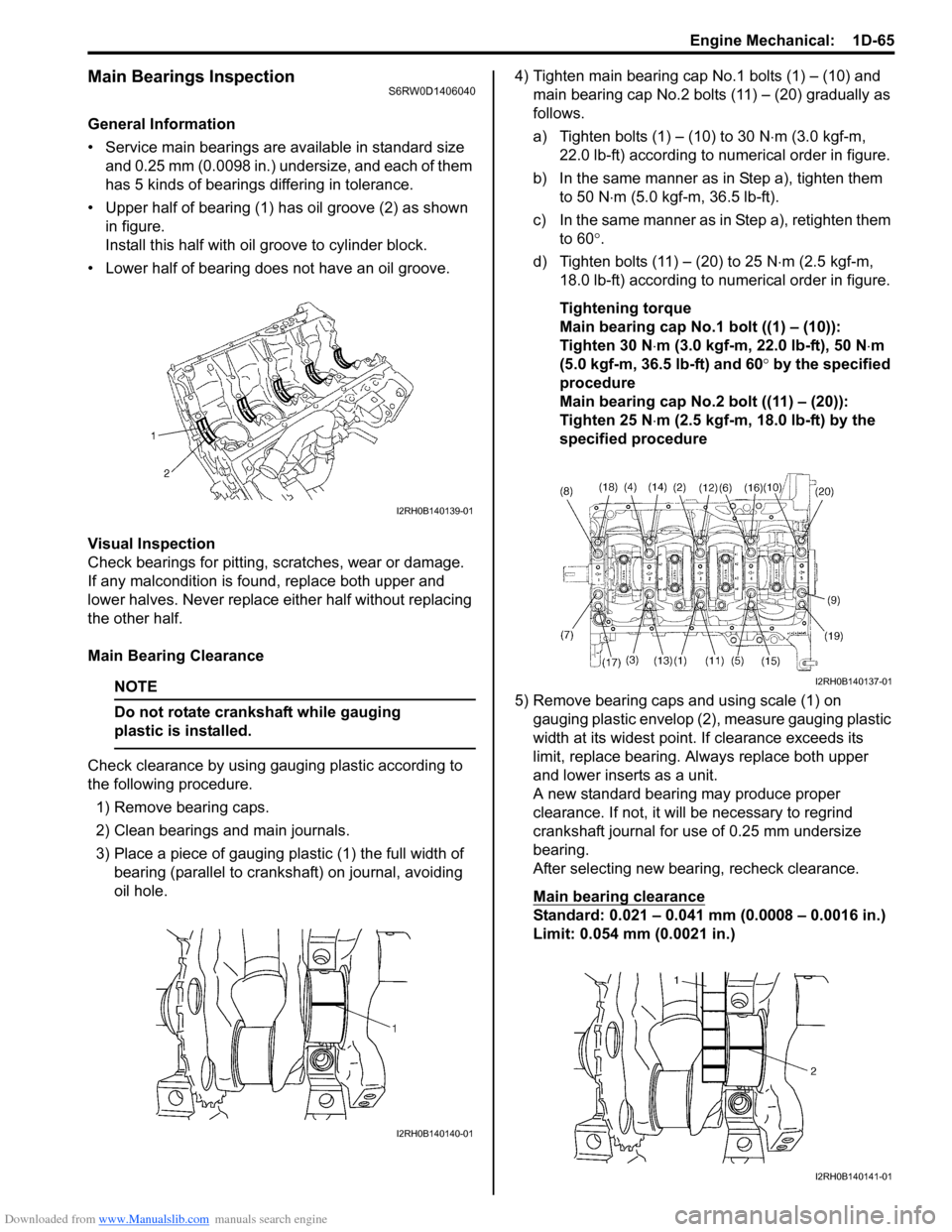
• Upper half of bearing (1) has oil groove (2) as shown
in figure.
Install this half with oil groove to cylinder block.
• Lower half of bearing does not have an oil groove.
Visual Inspection
Check bearings for pitting, scratches, wear or damage.
If any malcondition is found, replace both upper and
lower halves. Never replace either half without replacing
the other half.
Main Bearing Clearance
NOTE
Do not rotate crankshaft while gauging
plastic is installed.
Check clearance by using gauging plastic according to
the following procedure.
1) Remove bearing caps.
2) Clean bearings and main journals.
3) Place a piece of gauging plastic (1) the full width of
bearing (parallel to crankshaft) on journal, avoiding
oil hole.4) Tighten main bearing cap No.1 bolts (1) – (10) and
main bearing cap No.2 bolts (11) – (20) gradually as
follows.
a) Tighten bolts (1) – (10) to 30 N⋅m (3.0 kgf-m,
22.0 lb-ft) according to numerical order in figure.
b) In the same manner as in Step a), tighten them
to 50 N⋅m (5.0 kgf-m, 36.5 lb-ft).
c) In the same manner as in Step a), retighten them
to 60°.
d) Tighten bolts (11) – (20) to 25 N⋅m (2.5 kgf-m,
18.0 lb-ft) according to numerical order in figure.
Tightening torque
Main bearing cap No.1 bolt ((1) – (10)):
Tighten 30 N⋅m (3.0 kgf-m, 22.0 lb-ft), 50 N⋅m
(5.0 kgf-m, 36.5 lb-ft) and 60° by the specified
procedure
Main bearing cap No.2 bolt ((11) – (20)):
Tighten 25 N⋅m (2.5 kgf-m, 18.0 lb-ft) by the
specified procedure
5) Remove bearing caps and using scale (1) on
gauging plastic envelop (2), measure gauging plastic
width at its widest point. If clearance exceeds its
limit, replace bearing. Always replace both upper
and lower inserts as a unit.
A new standard bearing may produce proper
clearance. If not, it will be necessary to regrind
crankshaft journal for use of 0.25 mm undersize
bearing.
After selecting new bearing, recheck clearance.
Main bearing clearance
Standard: 0.021 – 0.041 mm (0.0008 – 0.0016 in.)
Limit: 0.054 mm (0.0021 in.)
I2RH0B140139-01
I2RH0B140140-01
I2RH0B140137-01
I2RH0B140141-01
Page 349 of 1556
Downloaded from www.Manualslib.com manuals search engine Engine Mechanical: 1D-67
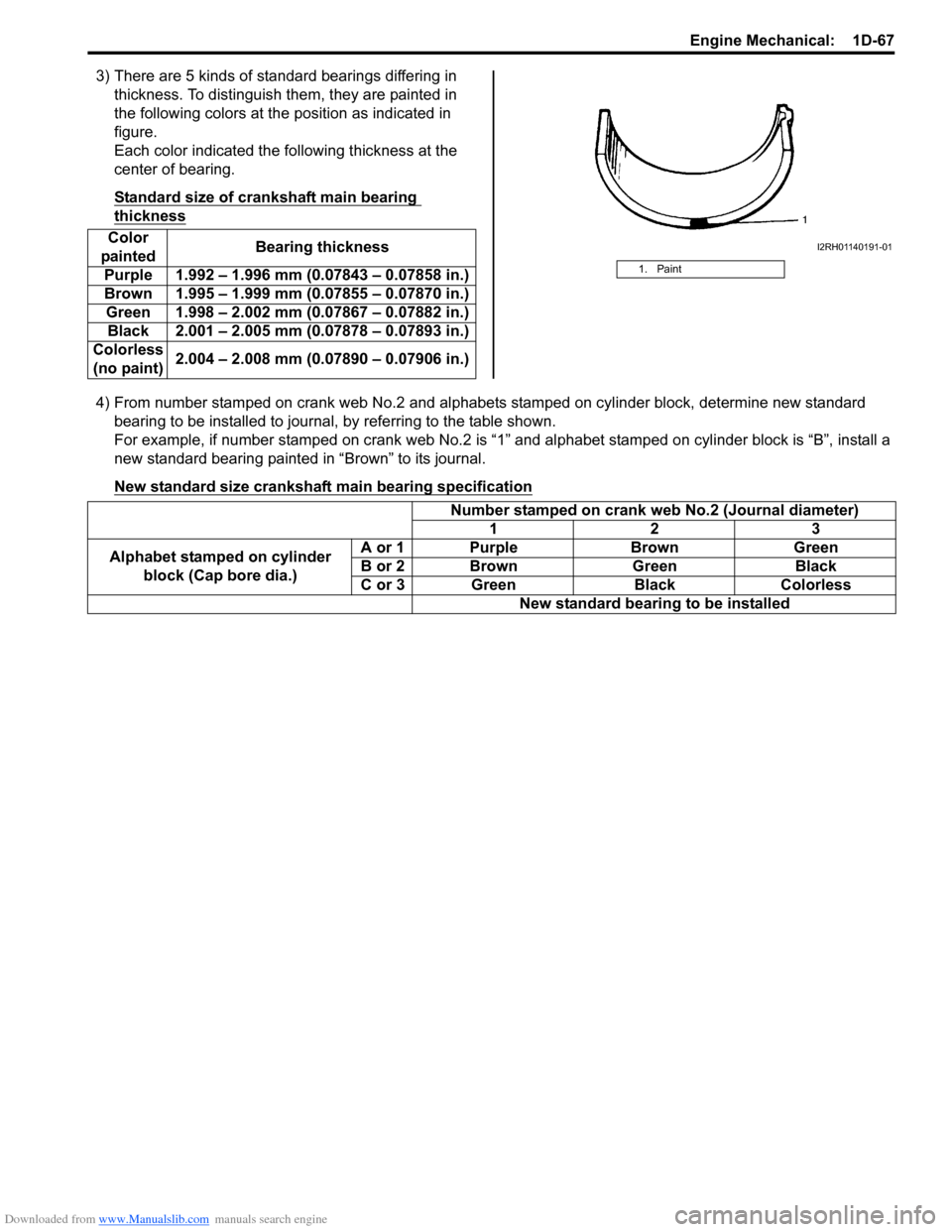
3) There are 5 kinds of standard bearings differing in
thickness. To distinguish them, they are painted in
the following colors at the position as indicated in
figure.
Each color indicated the following thickness at the
center of bearing.
Standard size of crankshaft main bearing
thickness
4) From number stamped on crank web No.2 and alphabets stamped on cylinder block, determine new standard
bearing to be installed to journal, by referring to the table shown.
For example, if number stamped on crank web No.2 is “1” and alphabet stamped on cylinder block is “B”, install a
new standard bearing painted in “Brown” to its journal.
New standard size crankshaft main bearing specification
Color
paintedBearing thickness
Purple 1.992 – 1.996 mm (0.07843 – 0.07858 in.)
Brown 1.995 – 1.999 mm (0.07855 – 0.07870 in.)
Green 1.998 – 2.002 mm (0.07867 – 0.07882 in.)
Black 2.001 – 2.005 mm (0.07878 – 0.07893 in.)
Colorless
(no paint)2.004 – 2.008 mm (0.07890 – 0.07906 in.)
1. Paint
I2RH01140191-01
Number stamped on crank web No.2 (Journal diameter)
123
Alphabet stamped on cylinder
block (Cap bore dia.)A or 1 Purple Brown Green
B or 2 Brown Green Black
C or 3 Green Black Colorless
New standard bearing to be installed
Page 352 of 1556
Downloaded from www.Manualslib.com manuals search engine 1D-70 Engine Mechanical:
Main Bearing Cap No.1 Bolt
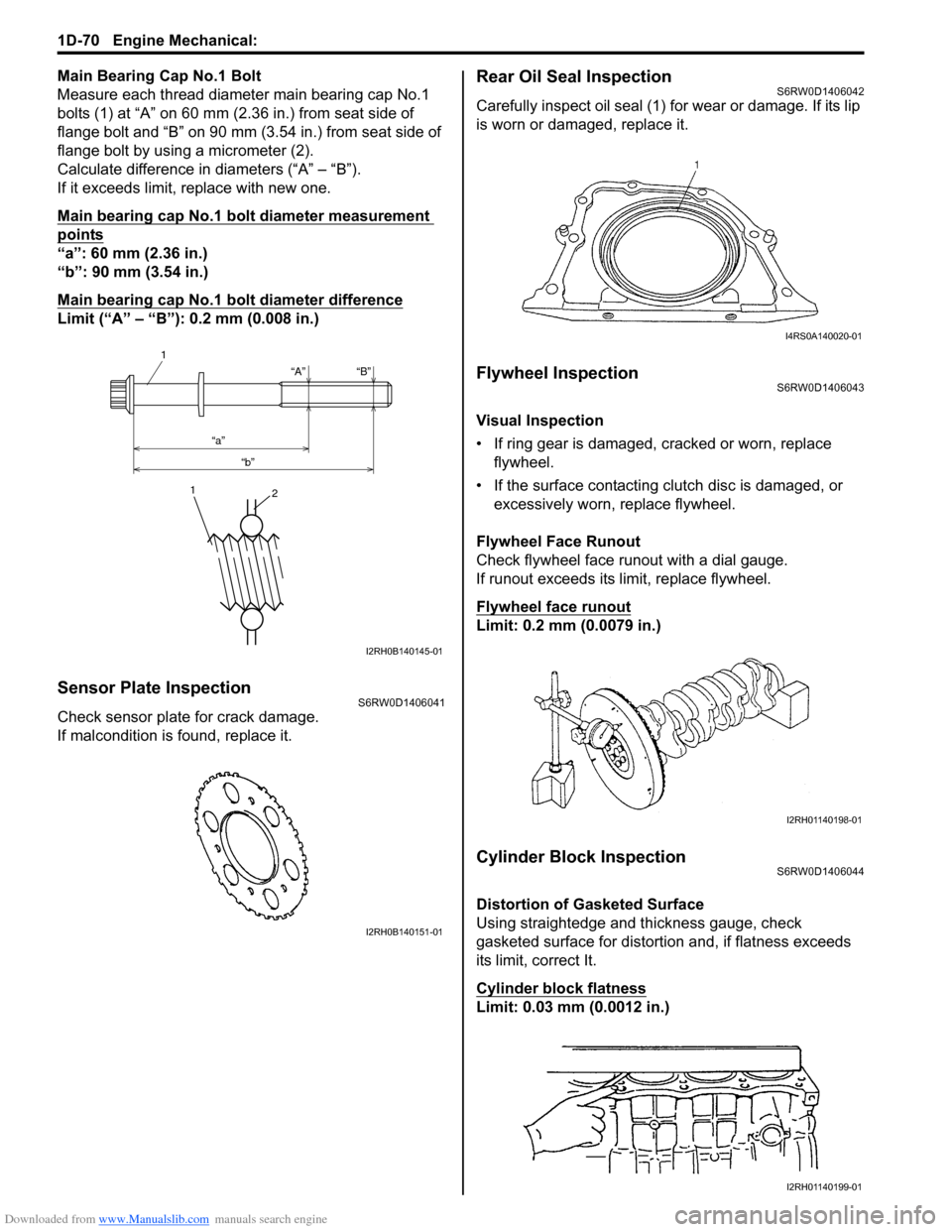
Measure each thread diameter main bearing cap No.1
bolts (1) at “A” on 60 mm (2.36 in.) from seat side of
flange bolt and “B” on 90 mm (3.54 in.) from seat side of
flange bolt by using a micrometer (2).
Calculate difference in diameters (“A” – “B”).
If it exceeds limit, replace with new one.
Main bearing cap No.1 bolt diameter measurement
points
“a”: 60 mm (2.36 in.)
“b”: 90 mm (3.54 in.)
Main bearing cap No.1 bolt diameter difference
Limit (“A” – “B”): 0.2 mm (0.008 in.)
Sensor Plate InspectionS6RW0D1406041
Check sensor plate for crack damage.
If malcondition is found, replace it.
Rear Oil Seal InspectionS6RW0D1406042
Carefully inspect oil seal (1) for wear or damage. If its lip
is worn or damaged, replace it.
Flywheel InspectionS6RW0D1406043
Visual Inspection
• If ring gear is damaged, cracked or worn, replace
flywheel.
• If the surface contacting clutch disc is damaged, or
excessively worn, replace flywheel.
Flywheel Face Runout
Check flywheel face runout with a dial gauge.
If runout exceeds its limit, replace flywheel.
Flywheel face runout
Limit: 0.2 mm (0.0079 in.)
Cylinder Block InspectionS6RW0D1406044
Distortion of Gasketed Surface
Using straightedge and thickness gauge, check
gasketed surface for distortion and, if flatness exceeds
its limit, correct It.
Cylinder block flatness
Limit: 0.03 mm (0.0012 in.)
“A”
“a”
“b”“B”
1
1
2
I2RH0B140145-01
I2RH0B140151-01
I4RS0A140020-01
I2RH01140198-01
I2RH01140199-01
Page 419 of 1556
Downloaded from www.Manualslib.com manuals search engine Charging System: 1J-5
Charging Indicator Lamp Operation
Generator Test (Undercharged Battery Check)S6RW0D1A04003
This condition, as evidenced by slow cranking or low
specific gravity can be caused by one or more of the
following conditions even though indicator lamp may be
operating normal. The following procedure also applies
to cars with voltmeter and ammeter.
• Make sure that undercharged condition has not been
caused by accessories left on for extended period of
time.
• Check drive belt for proper tension.
• If battery defect is suspected, refer to “Battery
Description”.
• Inspect wiring for defects. Check all connections for
tightness and cleanliness, battery cable connections
at battery, starting motor and ignition ground cable.
No-Load Check
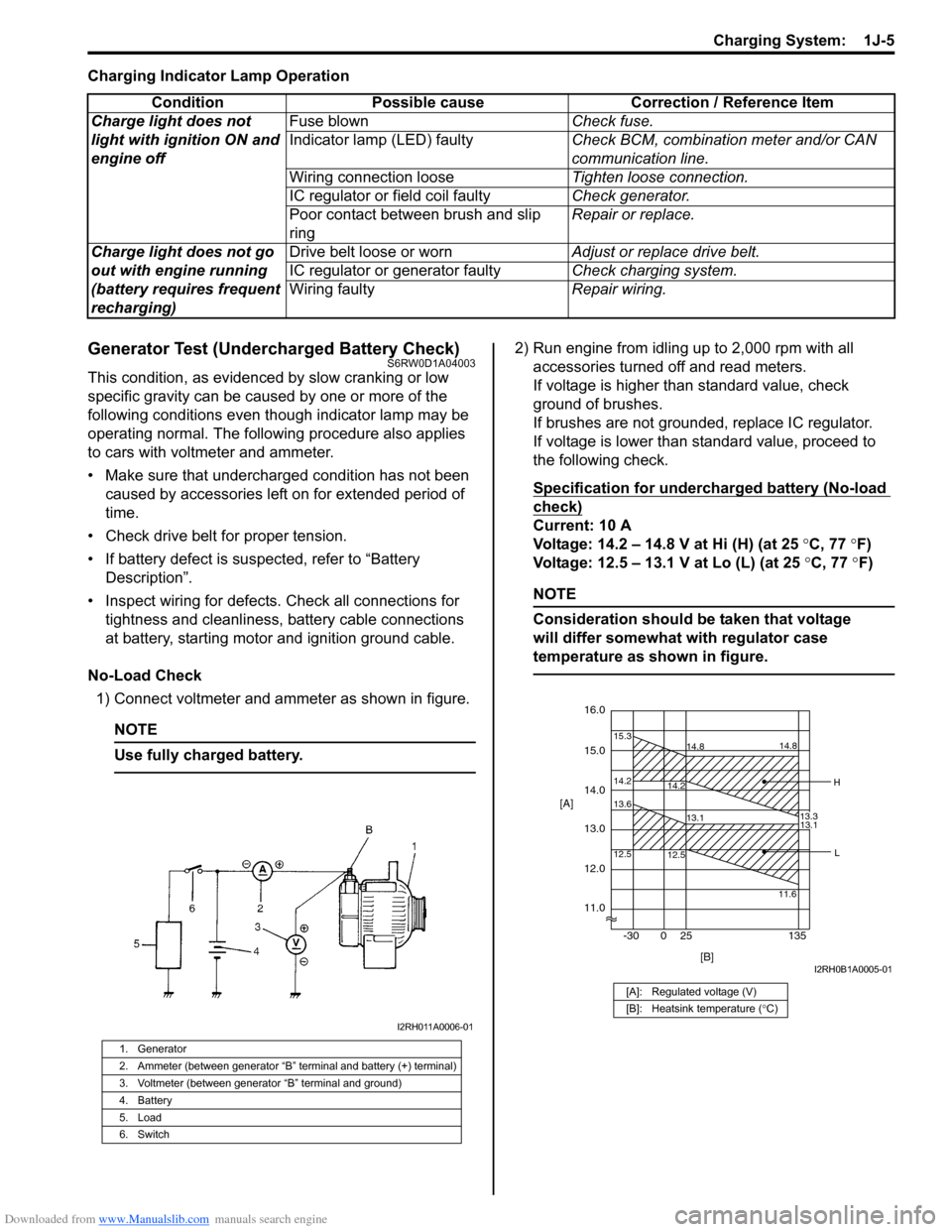
1) Connect voltmeter and ammeter as shown in figure.
NOTE
Use fully charged battery.
2) Run engine from idling up to 2,000 rpm with all
accessories turned off and read meters.
If voltage is higher than standard value, check
ground of brushes.
If brushes are not grounded, replace IC regulator.
If voltage is lower than standard value, proceed to
the following check.
Specification for undercharged battery (No-load
check)
Current: 10 A
Voltage: 14.2 – 14.8 V at Hi (H) (at 25 °C, 77 °F)
Voltage: 12.5 – 13.1 V at Lo (L) (at 25 °C, 77 °F)
NOTE
Consideration should be taken that voltage
will differ somewhat with regulator case
temperature as shown in figure.
Condition Possible cause Correction / Reference Item
Charge light does not
light with ignition ON and
engine offFuse blownCheck fuse.
Indicator lamp (LED) faultyCheck BCM, combination meter and/or CAN
communication line.
Wiring connection looseTighten loose connection.
IC regulator or field coil faultyCheck generator.
Poor contact between brush and slip
ringRepair or replace.
Charge light does not go
out with engine running
(battery requires frequent
recharging)Drive belt loose or wornAdjust or replace drive belt.
IC regulator or generator faultyCheck charging system.
Wiring faultyRepair wiring.
1. Generator
2. Ammeter (between generator “B” terminal and battery (+) terminal)
3. Voltmeter (between generator “B” terminal and ground)
4. Battery
5. Load
6. Switch
I2RH011A0006-01
[A]: Regulated voltage (V)
[B]: Heatsink temperature (°C)
16.0
12.0
14.2 15.3
14.8
14.2
13.3 14.8
15.0
11.0 14.0
13.0 [A]
12.5 13.6
13.1
12.5
11.613.1
[B] -30 0 25 135
H
L
I2RH0B1A0005-01
Page 436 of 1556
Downloaded from www.Manualslib.com manuals search engine 2A-2 Suspension General Diagnosis:
NOTE
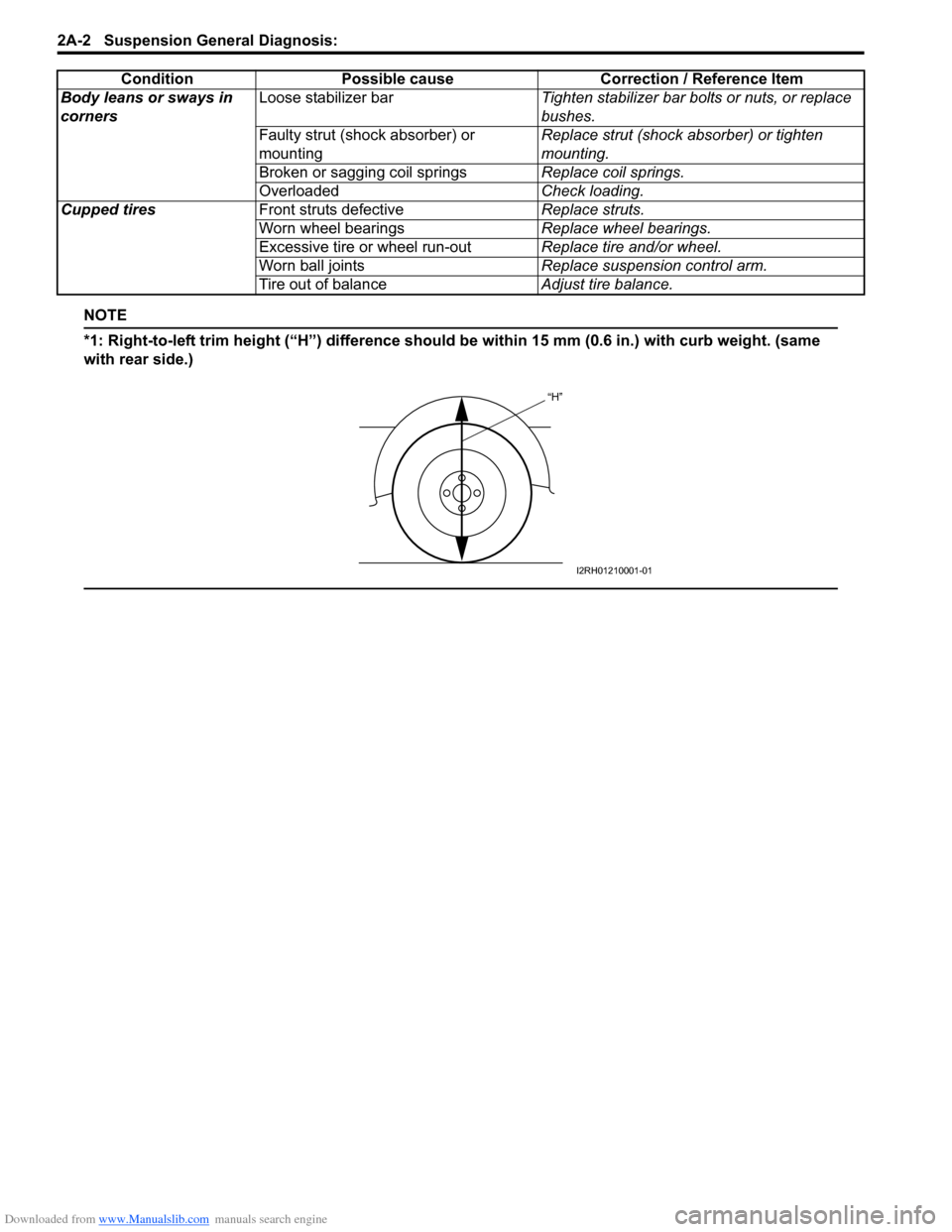
*1: Right-to-left trim height (“H”) difference should be within 15 mm (0.6 in.) with curb weight. (same
with rear side.)
Body leans or sways in
cornersLoose stabilizer barTighten stabilizer bar bolts or nuts, or replace
bushes.
Faulty strut (shock absorber) or
mountingReplace strut (shock absorber) or tighten
mounting.
Broken or sagging coil springsReplace coil springs.
OverloadedCheck loading.
Cupped tiresFront struts defectiveReplace struts.
Worn wheel bearingsReplace wheel bearings.
Excessive tire or wheel run-outReplace tire and/or wheel.
Worn ball jointsReplace suspension control arm.
Tire out of balanceAdjust tire balance. Condition Possible cause Correction / Reference Item
“H”
I2RH01210001-01
Page 440 of 1556
Downloaded from www.Manualslib.com manuals search engine 2B-3 Front Suspension:
Adjustment
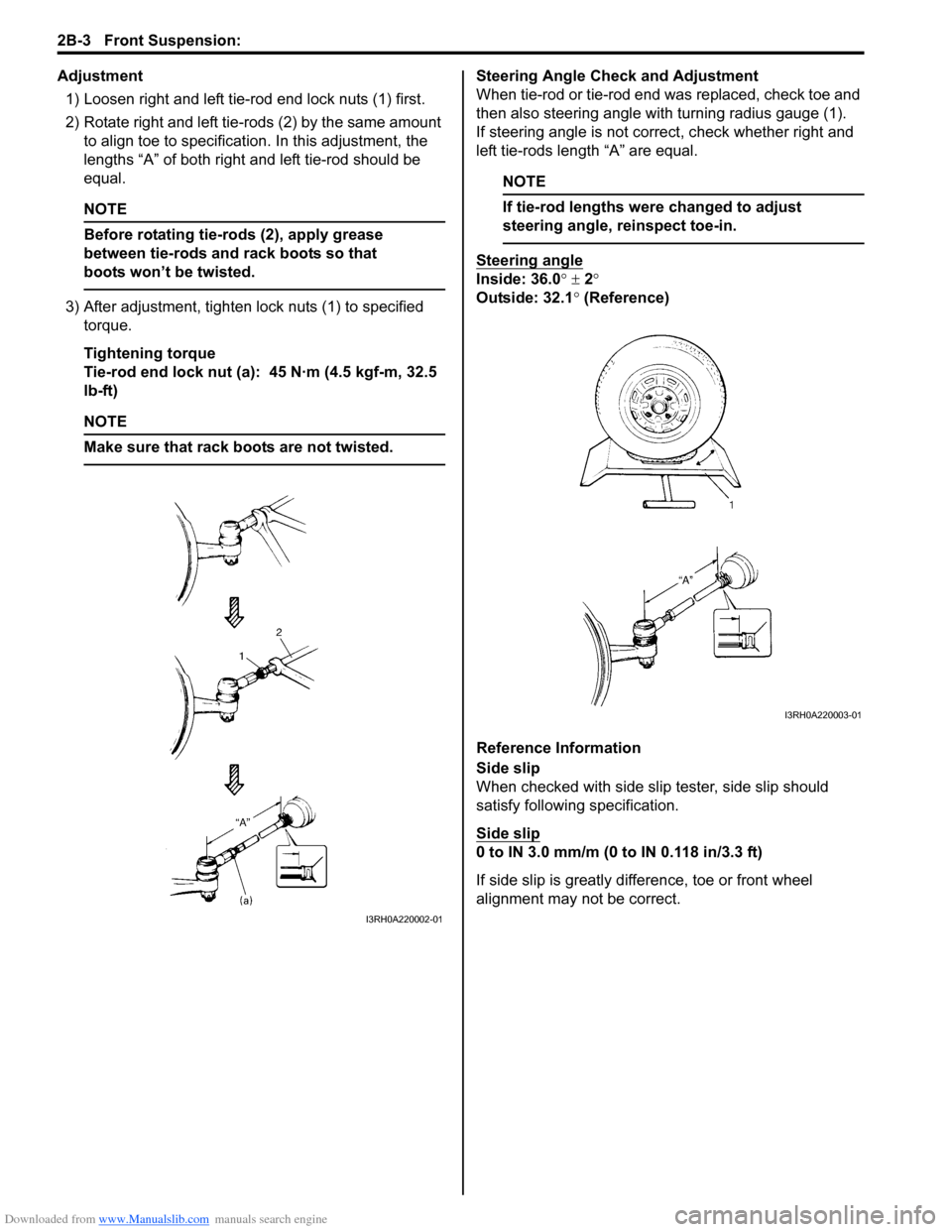
1) Loosen right and left tie-rod end lock nuts (1) first.
2) Rotate right and left tie-rods (2) by the same amount
to align toe to specification. In this adjustment, the
lengths “A” of both right and left tie-rod should be
equal.
NOTE
Before rotating tie-rods (2), apply grease
between tie-rods and rack boots so that
boots won’t be twisted.
3) After adjustment, tighten lock nuts (1) to specified
torque.
Tightening torque
Tie-rod end lock nut (a): 45 N·m (4.5 kgf-m, 32.5
lb-ft)
NOTE
Make sure that rack boots are not twisted.
Steering Angle Check and Adjustment
When tie-rod or tie-rod end was replaced, check toe and
then also steering angle with turning radius gauge (1).
If steering angle is not correct, check whether right and
left tie-rods length “A” are equal.
NOTE
If tie-rod lengths were changed to adjust
steering angle, reinspect toe-in.
Steering angle
Inside: 36.0° ± 2°
Outside: 32.1° (Reference)
Reference Information
Side slip
When checked with side slip tester, side slip should
satisfy following specification.
Side slip
0 to IN 3.0 mm/m (0 to IN 0.118 in/3.3 ft)
If side slip is greatly difference, toe or front wheel
alignment may not be correct.
I3RH0A220002-01
I3RH0A220003-01
Page 463 of 1556
Downloaded from www.Manualslib.com manuals search engine Rear Suspension: 2C-4
Rear Coil Spring Removal and InstallationS6RW0D2306005
CAUTION!
Removal and Installation both coil springs
(right and left) at the same time to avoid rear
axle twisting and other damage.
Removal
1) Hoist vehicle and remove rear wheels.
2) Dismount rear differential (4WD model) referring to
“Rear Differential Dismounting and Remounting in
Section 3B”.
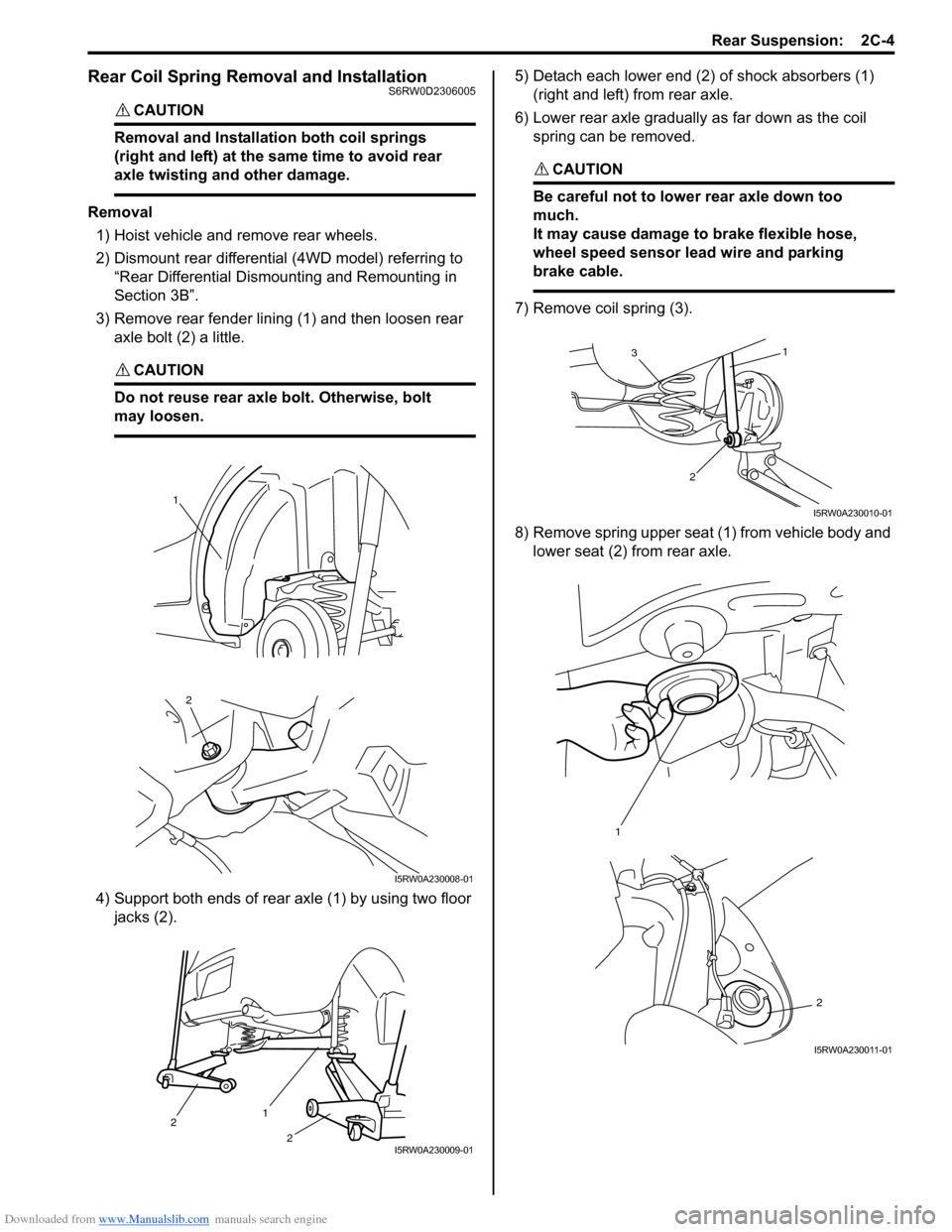
3) Remove rear fender lining (1) and then loosen rear
axle bolt (2) a little.
CAUTION!
Do not reuse rear axle bolt. Otherwise, bolt
may loosen.
4) Support both ends of rear axle (1) by using two floor
jacks (2).5) Detach each lower end (2) of shock absorbers (1)
(right and left) from rear axle.
6) Lower rear axle gradually as far down as the coil
spring can be removed.
CAUTION!
Be careful not to lower rear axle down too
much.
It may cause damage to brake flexible hose,
wheel speed sensor lead wire and parking
brake cable.
7) Remove coil spring (3).
8) Remove spring upper seat (1) from vehicle body and
lower seat (2) from rear axle.
2
1
I5RW0A230008-01
1
2
2
I5RW0A230009-01
1
2
3
I5RW0A230010-01
1
2
I5RW0A230011-01
Page 464 of 1556
Downloaded from www.Manualslib.com manuals search engine 2C-5 Rear Suspension:
Installation
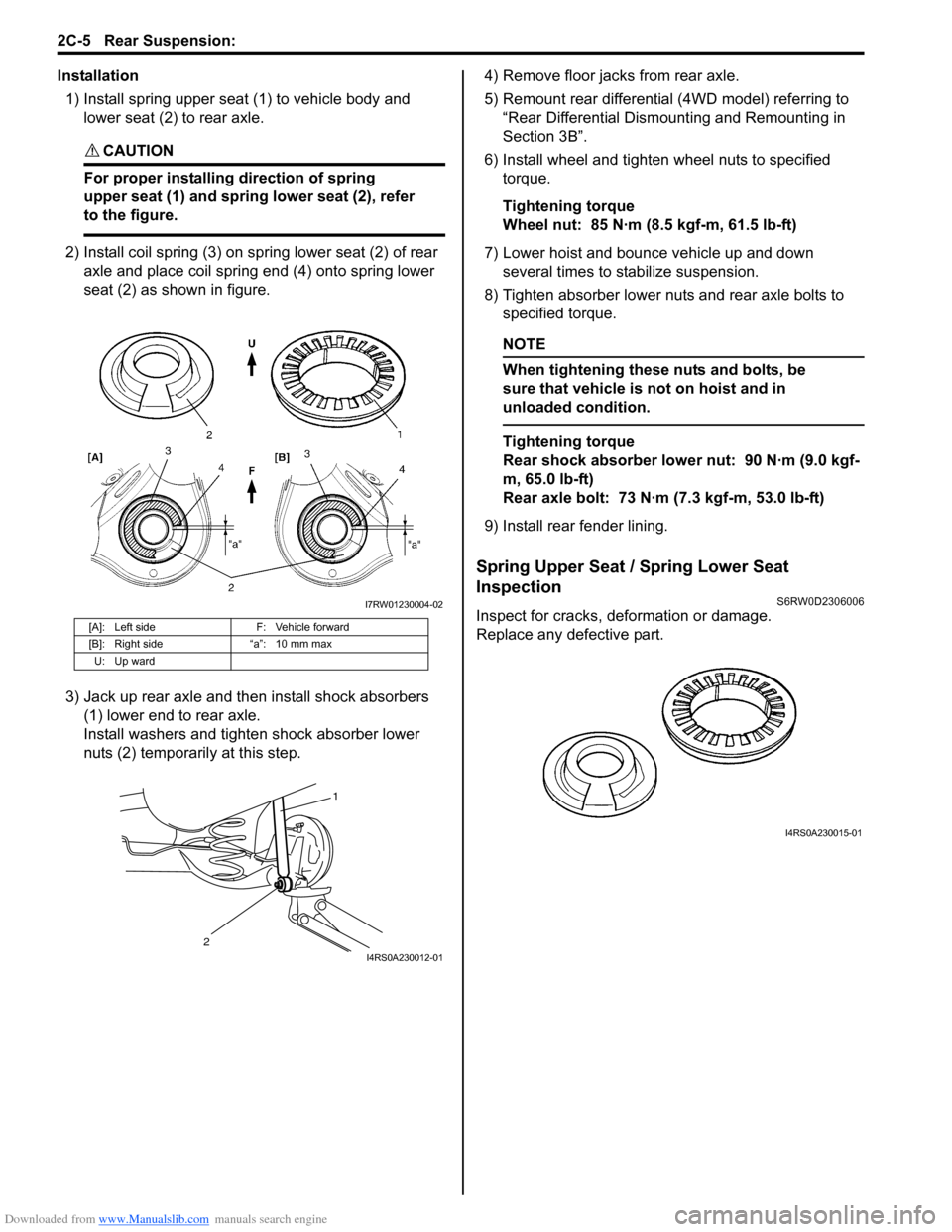
1) Install spring upper seat (1) to vehicle body and
lower seat (2) to rear axle.
CAUTION!
For proper installing direction of spring
upper seat (1) and spring lower seat (2), refer
to the figure.
2) Install coil spring (3) on spring lower seat (2) of rear
axle and place coil spring end (4) onto spring lower
seat (2) as shown in figure.
3) Jack up rear axle and then install shock absorbers
(1) lower end to rear axle.
Install washers and tighten shock absorber lower
nuts (2) temporarily at this step.4) Remove floor jacks from rear axle.
5) Remount rear differential (4WD model) referring to
“Rear Differential Dismounting and Remounting in
Section 3B”.
6) Install wheel and tighten wheel nuts to specified
torque.
Tightening torque
Wheel nut: 85 N·m (8.5 kgf-m, 61.5 lb-ft)
7) Lower hoist and bounce vehicle up and down
several times to stabilize suspension.
8) Tighten absorber lower nuts and rear axle bolts to
specified torque.
NOTE
When tightening these nuts and bolts, be
sure that vehicle is not on hoist and in
unloaded condition.
Tightening torque
Rear shock absorber lower nut: 90 N·m (9.0 kgf-
m, 65.0 lb-ft)
Rear axle bolt: 73 N·m (7.3 kgf-m, 53.0 lb-ft)
9) Install rear fender lining.
Spring Upper Seat / Spring Lower Seat
Inspection
S6RW0D2306006
Inspect for cracks, deformation or damage.
Replace any defective part.[A]: Left side F: Vehicle forward
[B]: Right side “a”: 10 mm max
U: Up ward
I7RW01230004-02
1
2I4RS0A230012-01
I4RS0A230015-01
Page 471 of 1556
Downloaded from www.Manualslib.com manuals search engine Wheels and Tires: 2D-2
Replacement Tires
When replacement is necessary, the original equipment
type tire should be used. Refer to the Tire Placard.
Replacement tires should be of the same size, load
range and construction as those originally on the vehicle.
Use of any other size or type tire may affect ride,
handling, speedometer / odometer calibration, vehicle
ground clearance and tire or snow chain clearance to the
body and chassis.
It is recommended that new tires be installed in pairs on
the same axle. If necessary to replace only one tire, it
should be paired with the tire having the most tread, to
equalize braking traction.
WARNING!
Do not mix different types of tires on the
same vehicle such as radial, bias and bias-
belted tires except in emergencies, because
handling may be seriously affected and may
result in loss of control.
The metric term for tire inflation pressure is the kilo
pascal (kPa). Tire pressures is usually printed in both
kPa and kgf/cm
2 on the “Tire Placard”.
Metric tire gauges are available from tool suppliers.
The chart, shown in the table, converts commonly used
inflation pressures from kPa to kgf/cm
2 and psi.
Wheels DescriptionS6RW0D2401002
Wheel Maintenance
Wheel repairs that use welding, heating, or peening are
not approved. All damaged wheels should be replaced.
Replacement Wheels
Wheels must be replaced if they are bent, dented, have
excessive lateral or radial runout, air leak through welds,
have elongated bolt holes, if lug wheel bolts won’t stay
tight, or if they are heavily rusted. Wheels with greater
runout than shown in the following may cause
objectional vibrations.
Replacement wheels must be equivalent to the original
equipment wheels in load capacity, diameter, rim with
offset and mounting configuration. A wheel of improper
size or type may affect wheel and bearing life, brake
cooling, speedometer / odometer calibration, vehicle
ground clearance and tire clearance to body and
chassis.How to Measure Wheel Runout
To measure the wheel runout, it is necessary to use an
accurate dial indicator. The tire may be on or off the
wheel. The wheel should be installed to the wheel
balancer of the like for proper measurement.
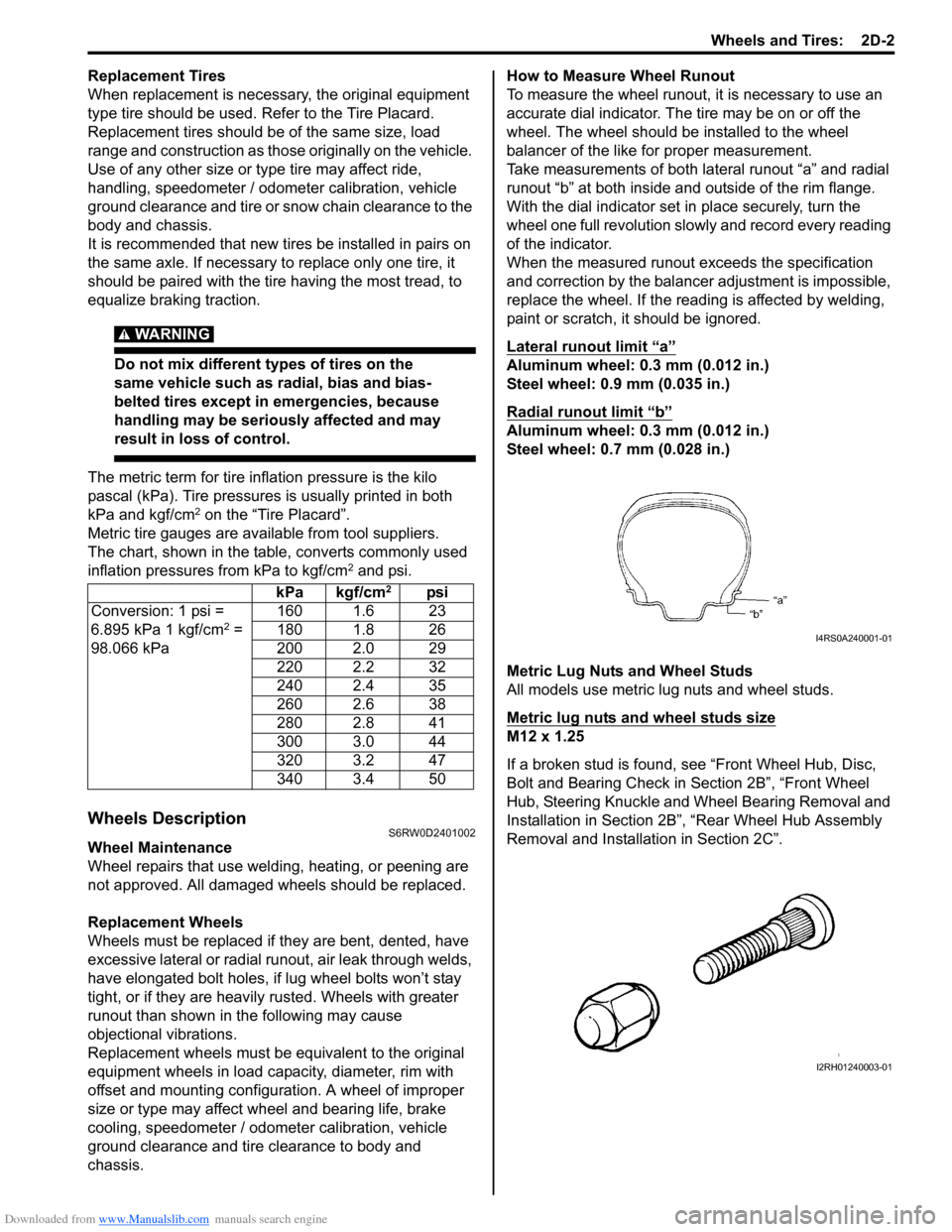
Take measurements of both lateral runout “a” and radial
runout “b” at both inside and outside of the rim flange.
With the dial indicator set in place securely, turn the
wheel one full revolution slowly and record every reading
of the indicator.
When the measured runout exceeds the specification
and correction by the balancer adjustment is impossible,
replace the wheel. If the reading is affected by welding,
paint or scratch, it should be ignored.
Lateral runout limit “a”
Aluminum wheel: 0.3 mm (0.012 in.)
Steel wheel: 0.9 mm (0.035 in.)
Radial runout limit “b”
Aluminum wheel: 0.3 mm (0.012 in.)
Steel wheel: 0.7 mm (0.028 in.)
Metric Lug Nuts and Wheel Studs
All models use metric lug nuts and wheel studs.
Metric lug nuts and wheel studs size
M12 x 1.25
If a broken stud is found, see “Front Wheel Hub, Disc,
Bolt and Bearing Check in Section 2B”, “Front Wheel
Hub, Steering Knuckle and Wheel Bearing Removal and
Installation in Section 2B”, “Rear Wheel Hub Assembly
Removal and Installation in Section 2C”. kPa kgf/cm
2psi
Conversion: 1 psi =
6.895 kPa 1 kgf/cm
2 =
98.066 kPa160 1.6 23
180 1.8 26
200 2.0 29
220 2.2 32
240 2.4 35
260 2.6 38
280 2.8 41
300 3.0 44
320 3.2 47
340 3.4 50I4RS0A240001-01
I2RH01240003-01
Page 472 of 1556
Downloaded from www.Manualslib.com manuals search engine 2D-3 Wheels and Tires:
Irregular and/or Premature Wear DescriptionS6RW0D2401003
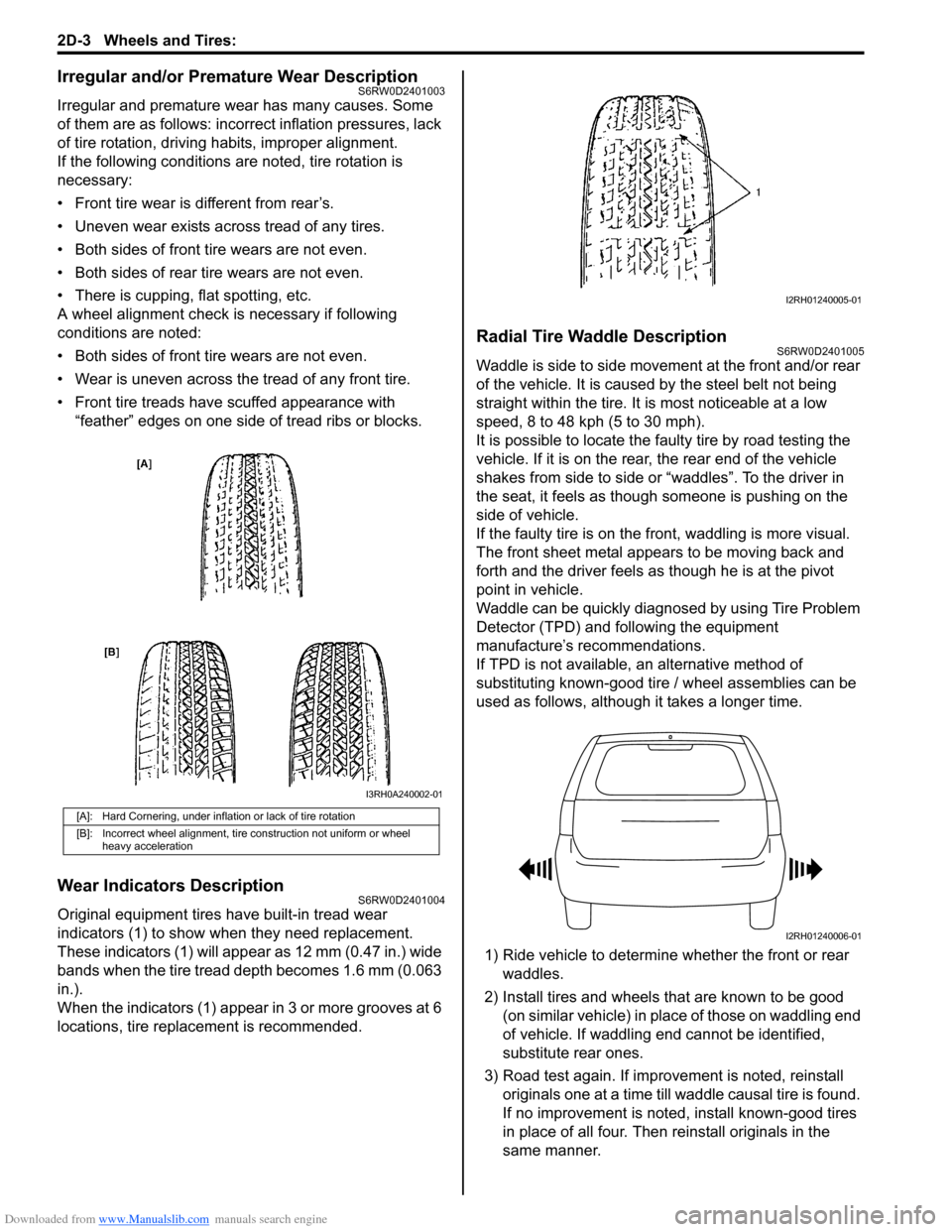
Irregular and premature wear has many causes. Some
of them are as follows: incorrect inflation pressures, lack
of tire rotation, driving habits, improper alignment.
If the following conditions are noted, tire rotation is
necessary:
• Front tire wear is different from rear’s.
• Uneven wear exists across tread of any tires.
• Both sides of front tire wears are not even.
• Both sides of rear tire wears are not even.
• There is cupping, flat spotting, etc.
A wheel alignment check is necessary if following
conditions are noted:
• Both sides of front tire wears are not even.
• Wear is uneven across the tread of any front tire.
• Front tire treads have scuffed appearance with
“feather” edges on one side of tread ribs or blocks.
Wear Indicators DescriptionS6RW0D2401004
Original equipment tires have built-in tread wear
indicators (1) to show when they need replacement.
These indicators (1) will appear as 12 mm (0.47 in.) wide
bands when the tire tread depth becomes 1.6 mm (0.063
in.).
When the indicators (1) appear in 3 or more grooves at 6
locations, tire replacement is recommended.
Radial Tire Waddle DescriptionS6RW0D2401005
Waddle is side to side movement at the front and/or rear
of the vehicle. It is caused by the steel belt not being
straight within the tire. It is most noticeable at a low
speed, 8 to 48 kph (5 to 30 mph).
It is possible to locate the faulty tire by road testing the
vehicle. If it is on the rear, the rear end of the vehicle
shakes from side to side or “waddles”. To the driver in
the seat, it feels as though someone is pushing on the
side of vehicle.
If the faulty tire is on the front, waddling is more visual.
The front sheet metal appears to be moving back and
forth and the driver feels as though he is at the pivot
point in vehicle.
Waddle can be quickly diagnosed by using Tire Problem
Detector (TPD) and following the equipment
manufacture’s recommendations.
If TPD is not available, an alternative method of
substituting known-good tire / wheel assemblies can be
used as follows, although it takes a longer time.
1) Ride vehicle to determine whether the front or rear
waddles.
2) Install tires and wheels that are known to be good
(on similar vehicle) in place of those on waddling end
of vehicle. If waddling end cannot be identified,
substitute rear ones.
3) Road test again. If improvement is noted, reinstall
originals one at a time till waddle causal tire is found.
If no improvement is noted, install known-good tires
in place of all four. Then reinstall originals in the
same manner.
[A]: Hard Cornering, under inflation or lack of tire rotation
[B]: Incorrect wheel alignment, tire construction not uniform or wheel
heavy acceleration
I3RH0A240002-01
I2RH01240005-01
I2RH01240006-01