Exhaus SUZUKI SX4 2006 1.G Service Repair Manual
[x] Cancel search | Manufacturer: SUZUKI, Model Year: 2006, Model line: SX4, Model: SUZUKI SX4 2006 1.GPages: 1556, PDF Size: 37.31 MB
Page 318 of 1556
Downloaded from www.Manualslib.com manuals search engine 1D-36 Engine Mechanical:
Camshaft, Tappet and Shim InspectionS6RW0D1406024
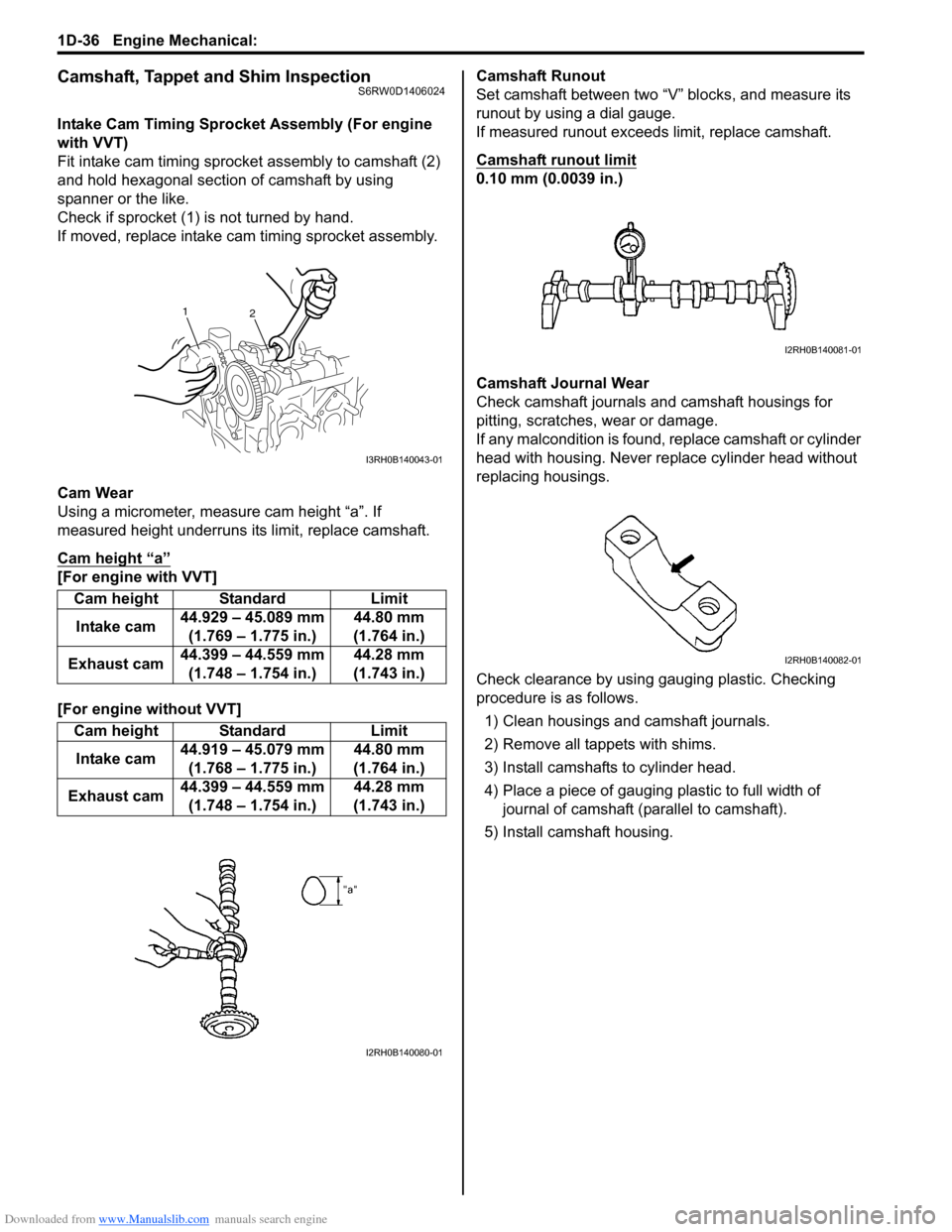
Intake Cam Timing Sprocket Assembly (For engine
with VVT)
Fit intake cam timing sprocket assembly to camshaft (2)
and hold hexagonal section of camshaft by using
spanner or the like.
Check if sprocket (1) is not turned by hand.
If moved, replace intake cam timing sprocket assembly.
Cam Wear
Using a micrometer, measure cam height “a”. If
measured height underruns its limit, replace camshaft.
Cam height “a”
[For engine with VVT]
[For engine without VVT]Camshaft Runout
Set camshaft between two “V” blocks, and measure its
runout by using a dial gauge.
If measured runout exceeds limit, replace camshaft.
Camshaft runout limit
0.10 mm (0.0039 in.)
Camshaft Journal Wear
Check camshaft journals and camshaft housings for
pitting, scratches, wear or damage.
If any malcondition is found, replace camshaft or cylinder
head with housing. Never replace cylinder head without
replacing housings.
Check clearance by using gauging plastic. Checking
procedure is as follows.
1) Clean housings and camshaft journals.
2) Remove all tappets with shims.
3) Install camshafts to cylinder head.
4) Place a piece of gauging plastic to full width of
journal of camshaft (parallel to camshaft).
5) Install camshaft housing. Cam height Standard Limit
Intake cam44.929 – 45.089 mm
(1.769 – 1.775 in.)44.80 mm
(1.764 in.)
Exhaust cam44.399 – 44.559 mm
(1.748 – 1.754 in.)44.28 mm
(1.743 in.)
Cam height Standard Limit
Intake cam44.919 – 45.079 mm
(1.768 – 1.775 in.)44.80 mm
(1.764 in.)
Exhaust cam44.399 – 44.559 mm
(1.748 – 1.754 in.)44.28 mm
(1.743 in.)
2 1
I3RH0B140043-01
I2RH0B140080-01
I2RH0B140081-01
I2RH0B140082-01
Page 319 of 1556
Downloaded from www.Manualslib.com manuals search engine Engine Mechanical: 1D-37
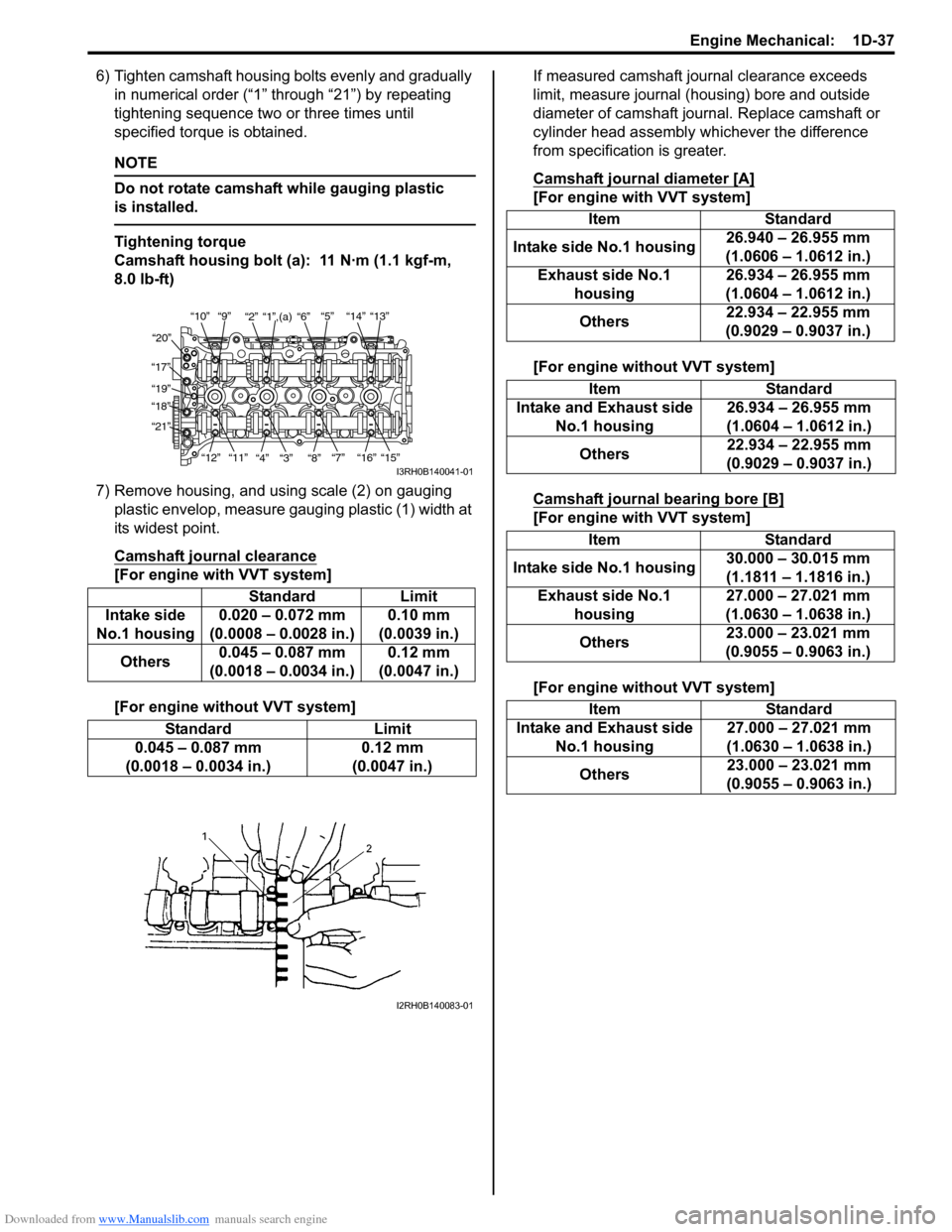
6) Tighten camshaft housing bolts evenly and gradually
in numerical order (“1” through “21”) by repeating
tightening sequence two or three times until
specified torque is obtained.
NOTE
Do not rotate camshaft while gauging plastic
is installed.
Tightening torque
Camshaft housing bolt (a): 11 N·m (1.1 kgf-m,
8.0 lb-ft)
7) Remove housing, and using scale (2) on gauging
plastic envelop, measure gauging plastic (1) width at
its widest point.
Camshaft journal clearance
[For engine with VVT system]
[For engine without VVT system]If measured camshaft journal clearance exceeds
limit, measure journal (housing) bore and outside
diameter of camshaft journal. Replace camshaft or
cylinder head assembly whichever the difference
from specification is greater.
Camshaft journal diameter [A]
[For engine with VVT system]
[For engine without VVT system]
Camshaft journal bearing bore [B]
[For engine with VVT system]
[For engine without VVT system] Standard Limit
Intake side
No.1 housing0.020 – 0.072 mm
(0.0008 – 0.0028 in.)0.10 mm
(0.0039 in.)
Others0.045 – 0.087 mm
(0.0018 – 0.0034 in.)0.12 mm
(0.0047 in.)
Standard Limit
0.045 – 0.087 mm
(0.0018 – 0.0034 in.)0.12 mm
(0.0047 in.)
“10”“9”
“2” “1”,(a) “6”“5” “14” “13”
“20”
“17”
“19”
“18”
“21”
“12”
“11”
“4” “3” “8”“7” “16” “15”
I3RH0B140041-01
I2RH0B140083-01
Item Standard
Intake side No.1 housing26.940 – 26.955 mm
(1.0606 – 1.0612 in.)
Exhaust side No.1
housing26.934 – 26.955 mm
(1.0604 – 1.0612 in.)
Others22.934 – 22.955 mm
(0.9029 – 0.9037 in.)
Item Standard
Intake and Exhaust side
No.1 housing26.934 – 26.955 mm
(1.0604 – 1.0612 in.)
Others22.934 – 22.955 mm
(0.9029 – 0.9037 in.)
Item Standard
Intake side No.1 housing30.000 – 30.015 mm
(1.1811 – 1.1816 in.)
Exhaust side No.1
housing27.000 – 27.021 mm
(1.0630 – 1.0638 in.)
Others23.000 – 23.021 mm
(0.9055 – 0.9063 in.)
Item Standard
Intake and Exhaust side
No.1 housing27.000 – 27.021 mm
(1.0630 – 1.0638 in.)
Others23.000 – 23.021 mm
(0.9055 – 0.9063 in.)
Page 321 of 1556
Downloaded from www.Manualslib.com manuals search engine Engine Mechanical: 1D-39
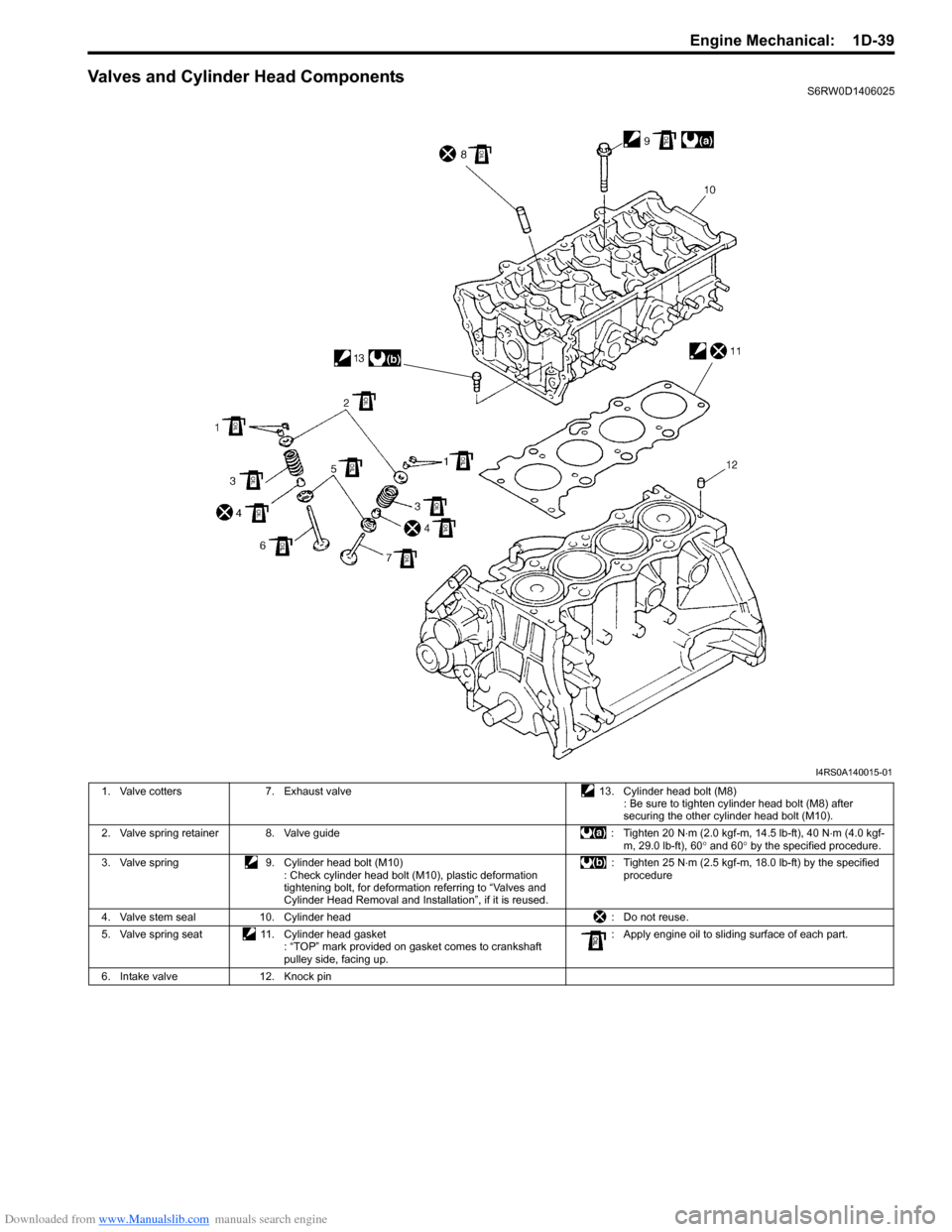
Valves and Cylinder Head ComponentsS6RW0D1406025
I4RS0A140015-01
1. Valve cotters 7. Exhaust valve 13. Cylinder head bolt (M8)
: Be sure to tighten cylinder head bolt (M8) after
securing the other cylinder head bolt (M10).
2. Valve spring retainer 8. Valve guide : Tighten 20 N⋅m (2.0 kgf-m, 14.5 lb-ft), 40 N⋅m (4.0 kgf-
m, 29.0 lb-ft), 60° and 60° by the specified procedure.
3. Valve spring 9. Cylinder head bolt (M10)
: Check cylinder head bolt (M10), plastic deformation
tightening bolt, for deformation referring to “Valves and
Cylinder Head Removal and Installation”, if it is reused.: Tighten 25 N⋅m (2.5 kgf-m, 18.0 lb-ft) by the specified
procedure
4. Valve stem seal 10. Cylinder head : Do not reuse.
5. Valve spring seat 11. Cylinder head gasket
: “TOP” mark provided on gasket comes to crankshaft
pulley side, facing up.: Apply engine oil to sliding surface of each part.
6. Intake valve 12. Knock pin
Page 322 of 1556
Downloaded from www.Manualslib.com manuals search engine 1D-40 Engine Mechanical:
Valves and Cylinder Head Removal and
Installation
S6RW0D1406026
Removal
1) Remove engine assembly from vehicle referring to
“Engine Assembly Removal and Installation”.
2) Remove oil pan referring to “Oil Pan and Oil Pump
Strainer Removal and Installation in Section 1E”.
3) Remove cylinder head cover referring to “Cylinder
Head Cover Removal and Installation”.
4) Remove timing chain cover referring to Steps 2) to
11) of “Removal” in “Timing Chain Cover Removal
and Installation”.
5) Remove timing chain referring to Steps 2) to 6) of
“Removal” in “Timing Chain and Chain Tensioner
Removal and Installation”.
6) Remove intake and exhaust camshafts referring to
Steps 3) to 8) of “Removal” in “Camshaft, Tappet and
Shim Removal and Installation”.
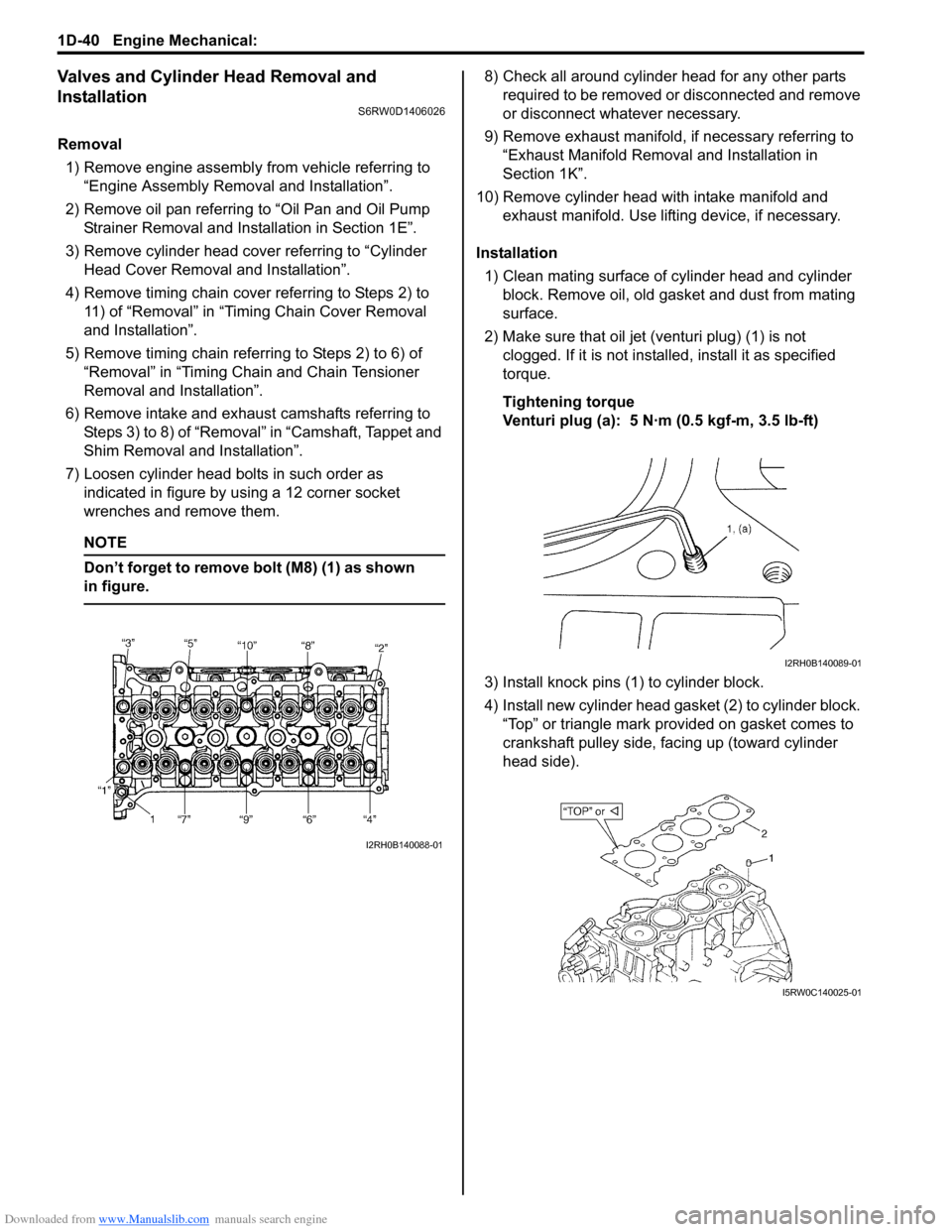
7) Loosen cylinder head bolts in such order as
indicated in figure by using a 12 corner socket
wrenches and remove them.
NOTE
Don’t forget to remove bolt (M8) (1) as shown
in figure.
8) Check all around cylinder head for any other parts
required to be removed or disconnected and remove
or disconnect whatever necessary.
9) Remove exhaust manifold, if necessary referring to
“Exhaust Manifold Removal and Installation in
Section 1K”.
10) Remove cylinder head with intake manifold and
exhaust manifold. Use lifting device, if necessary.
Installation
1) Clean mating surface of cylinder head and cylinder
block. Remove oil, old gasket and dust from mating
surface.
2) Make sure that oil jet (venturi plug) (1) is not
clogged. If it is not installed, install it as specified
torque.
Tightening torque
Venturi plug (a): 5 N·m (0.5 kgf-m, 3.5 lb-ft)
3) Install knock pins (1) to cylinder block.
4) Install new cylinder head gasket (2) to cylinder block.
“Top” or triangle mark provided on gasket comes to
crankshaft pulley side, facing up (toward cylinder
head side).
I2RH0B140088-01
I2RH0B140089-01
I5RW0C140025-01
Page 324 of 1556
Downloaded from www.Manualslib.com manuals search engine 1D-42 Engine Mechanical:
Valves and Cylinder Head Disassembly and
Assembly
S6RW0D1406027
Disassembly
1) For ease in servicing cylinder head, remove intake
manifold, injectors, exhaust manifold from cylinder
head.
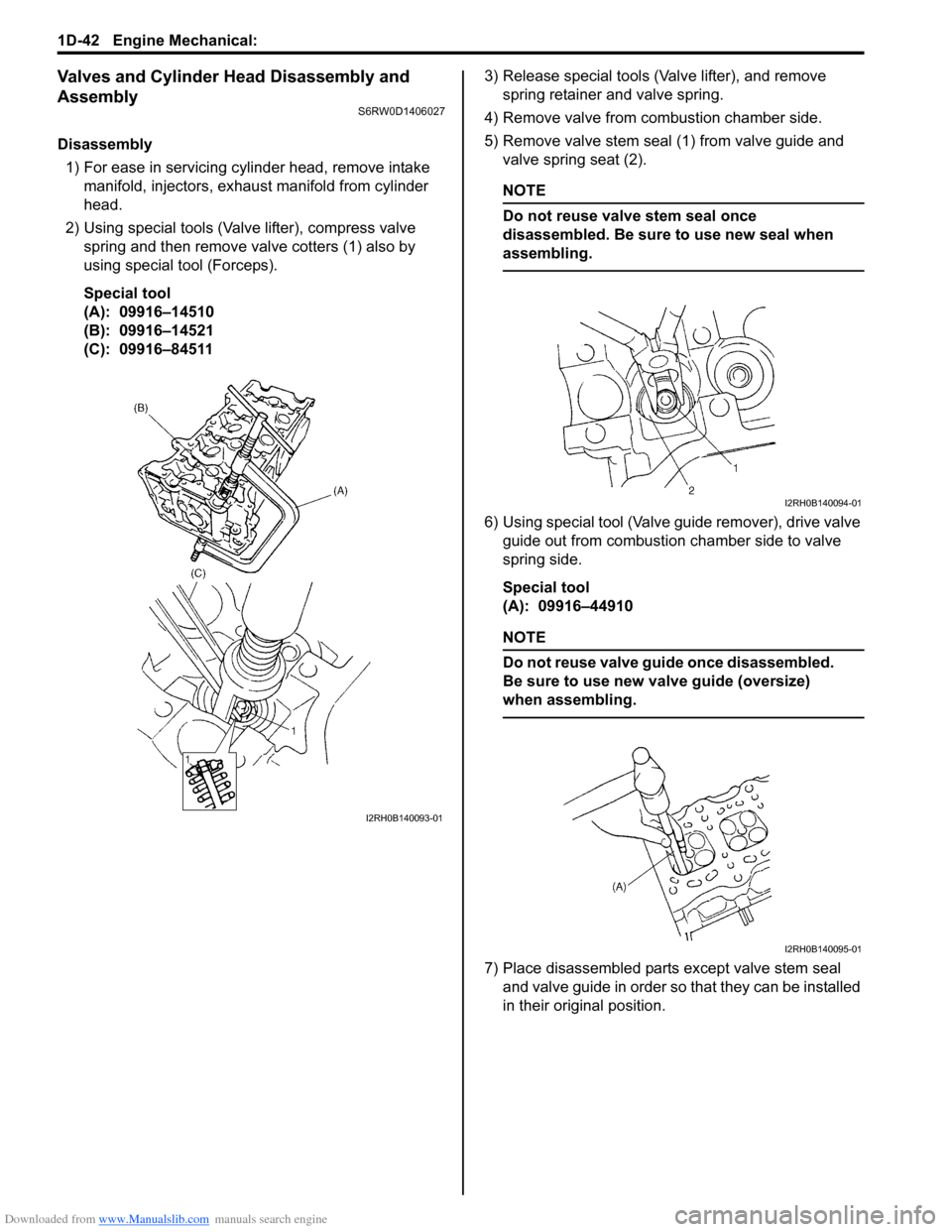
2) Using special tools (Valve lifter), compress valve
spring and then remove valve cotters (1) also by
using special tool (Forceps).
Special tool
(A): 09916–14510
(B): 09916–14521
(C): 09916–845113) Release special tools (Valve lifter), and remove
spring retainer and valve spring.
4) Remove valve from combustion chamber side.
5) Remove valve stem seal (1) from valve guide and
valve spring seat (2).
NOTE
Do not reuse valve stem seal once
disassembled. Be sure to use new seal when
assembling.
6) Using special tool (Valve guide remover), drive valve
guide out from combustion chamber side to valve
spring side.
Special tool
(A): 09916–44910
NOTE
Do not reuse valve guide once disassembled.
Be sure to use new valve guide (oversize)
when assembling.
7) Place disassembled parts except valve stem seal
and valve guide in order so that they can be installed
in their original position.
I2RH0B140093-01
I2RH0B140094-01
I2RH0B140095-01
Page 325 of 1556
Downloaded from www.Manualslib.com manuals search engine Engine Mechanical: 1D-43
Assembly
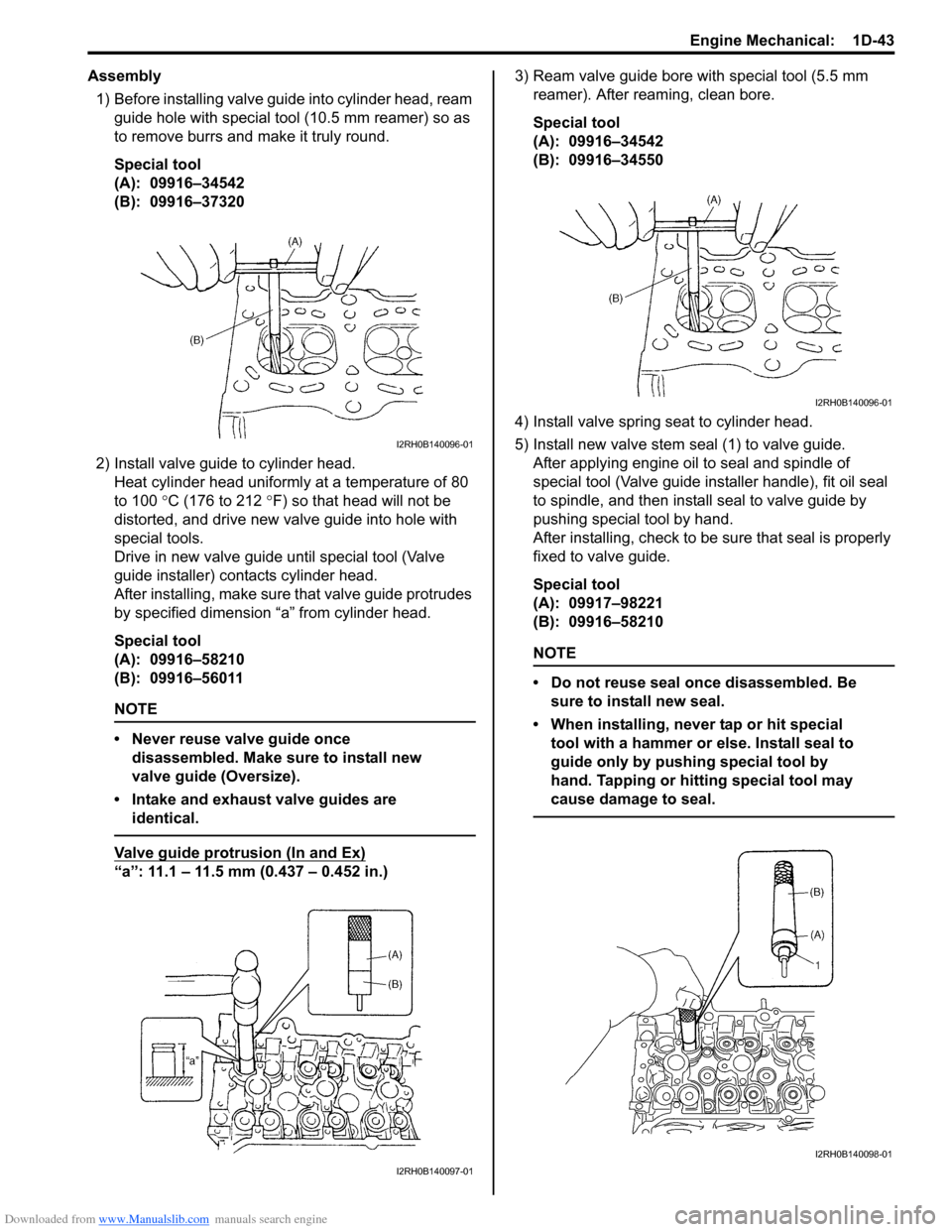
1) Before installing valve guide into cylinder head, ream
guide hole with special tool (10.5 mm reamer) so as
to remove burrs and make it truly round.
Special tool
(A): 09916–34542
(B): 09916–37320
2) Install valve guide to cylinder head.
Heat cylinder head uniformly at a temperature of 80
to 100 °C (176 to 212 °F) so that head will not be
distorted, and drive new valve guide into hole with
special tools.
Drive in new valve guide until special tool (Valve
guide installer) contacts cylinder head.
After installing, make sure that valve guide protrudes
by specified dimension “a” from cylinder head.
Special tool
(A): 09916–58210
(B): 09916–56011
NOTE
• Never reuse valve guide once
disassembled. Make sure to install new
valve guide (Oversize).
• Intake and exhaust valve guides are
identical.
Valve guide protrusion (In and Ex)
“a”: 11.1 – 11.5 mm (0.437 – 0.452 in.)3) Ream valve guide bore with special tool (5.5 mm
reamer). After reaming, clean bore.
Special tool
(A): 09916–34542
(B): 09916–34550
4) Install valve spring seat to cylinder head.
5) Install new valve stem seal (1) to valve guide.
After applying engine oil to seal and spindle of
special tool (Valve guide installer handle), fit oil seal
to spindle, and then install seal to valve guide by
pushing special tool by hand.
After installing, check to be sure that seal is properly
fixed to valve guide.
Special tool
(A): 09917–98221
(B): 09916–58210
NOTE
• Do not reuse seal once disassembled. Be
sure to install new seal.
• When installing, never tap or hit special
tool with a hammer or else. Install seal to
guide only by pushing special tool by
hand. Tapping or hitting special tool may
cause damage to seal.
I2RH0B140096-01
I2RH0B140097-01
I2RH0B140096-01
I2RH0B140098-01
Page 326 of 1556
Downloaded from www.Manualslib.com manuals search engine 1D-44 Engine Mechanical:
6) Install valve to valve guide.
Before installing valve to valve guide, apply engine
oil to stem seal, valve guide bore and valve stem.
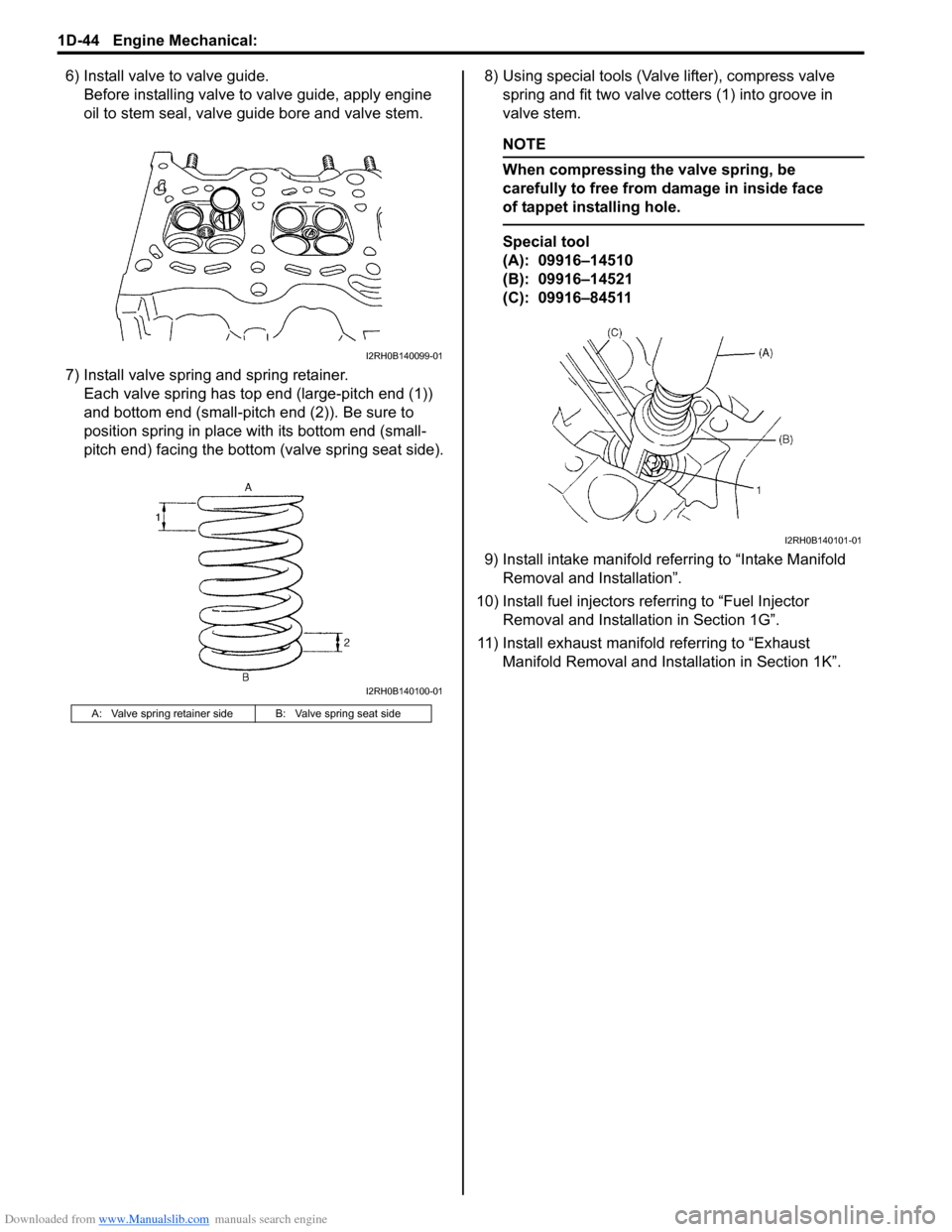
7) Install valve spring and spring retainer.
Each valve spring has top end (large-pitch end (1))
and bottom end (small-pitch end (2)). Be sure to
position spring in place with its bottom end (small-
pitch end) facing the bottom (valve spring seat side).8) Using special tools (Valve lifter), compress valve
spring and fit two valve cotters (1) into groove in
valve stem.
NOTE
When compressing the valve spring, be
carefully to free from damage in inside face
of tappet installing hole.
Special tool
(A): 09916–14510
(B): 09916–14521
(C): 09916–84511
9) Install intake manifold referring to “Intake Manifold
Removal and Installation”.
10) Install fuel injectors referring to “Fuel Injector
Removal and Installation in Section 1G”.
11) Install exhaust manifold referring to “Exhaust
Manifold Removal and Installation in Section 1K”.
A: Valve spring retainer side B: Valve spring seat side
I2RH0B140099-01
I2RH0B140100-01
I2RH0B140101-01
Page 328 of 1556
Downloaded from www.Manualslib.com manuals search engine 1D-46 Engine Mechanical:
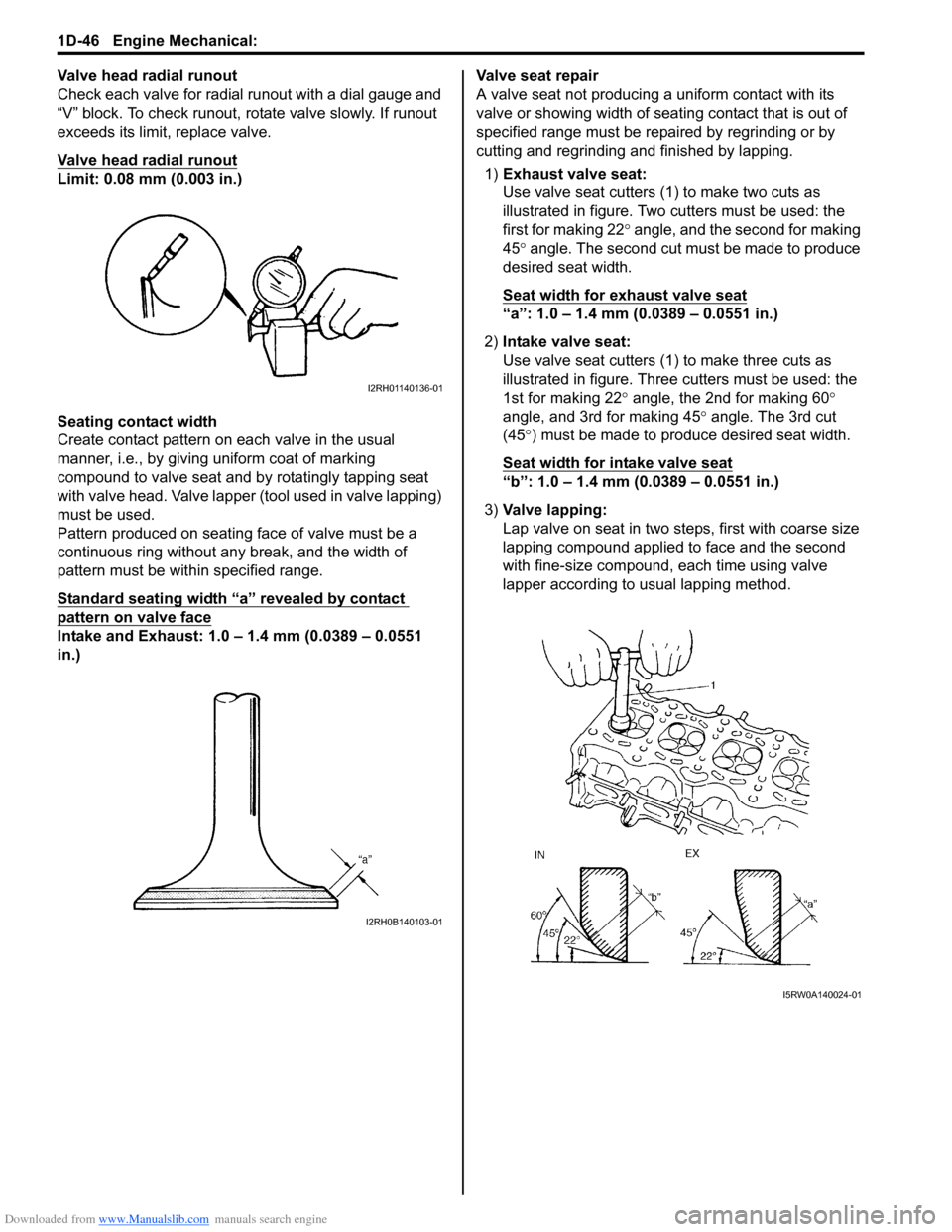
Valve head radial runout
Check each valve for radial runout with a dial gauge and
“V” block. To check runout, rotate valve slowly. If runout
exceeds its limit, replace valve.
Valve head radial runout
Limit: 0.08 mm (0.003 in.)
Seating contact width
Create contact pattern on each valve in the usual
manner, i.e., by giving uniform coat of marking
compound to valve seat and by rotatingly tapping seat
with valve head. Valve lapper (tool used in valve lapping)
must be used.
Pattern produced on seating face of valve must be a
continuous ring without any break, and the width of
pattern must be within specified range.
Standard seating width “a” revealed by contact
pattern on valve face
Intake and Exhaust: 1.0 – 1.4 mm (0.0389 – 0.0551
in.)Valve seat repair
A valve seat not producing a uniform contact with its
valve or showing width of seating contact that is out of
specified range must be repaired by regrinding or by
cutting and regrinding and finished by lapping.
1)Exhaust valve seat:
Use valve seat cutters (1) to make two cuts as
illustrated in figure. Two cutters must be used: the
first for making 22° angle, and the second for making
45° angle. The second cut must be made to produce
desired seat width.
Seat width for exhaust valve seat
“a”: 1.0 – 1.4 mm (0.0389 – 0.0551 in.)
2)Intake valve seat:
Use valve seat cutters (1) to make three cuts as
illustrated in figure. Three cutters must be used: the
1st for making 22° angle, the 2nd for making 60°
angle, and 3rd for making 45° angle. The 3rd cut
(45°) must be made to produce desired seat width.
Seat width for intake valve seat
“b”: 1.0 – 1.4 mm (0.0389 – 0.0551 in.)
3)Valve lapping:
Lap valve on seat in two steps, first with coarse size
lapping compound applied to face and the second
with fine-size compound, each time using valve
lapper according to usual lapping method.
I2RH01140136-01
I2RH0B140103-01
I5RW0A140024-01
Page 329 of 1556
Downloaded from www.Manualslib.com manuals search engine Engine Mechanical: 1D-47
Cylinder Head InspectionS6RW0D1406029
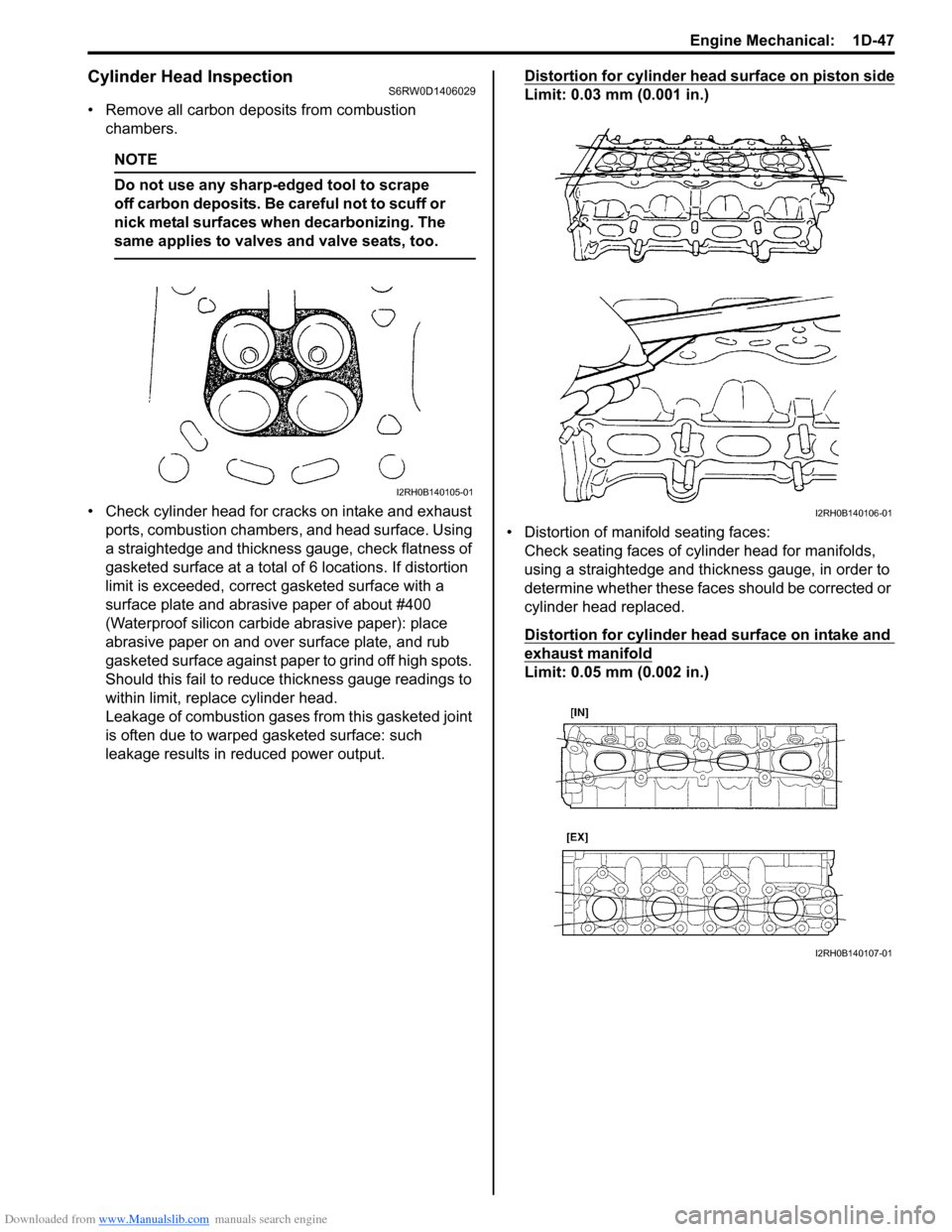
• Remove all carbon deposits from combustion
chambers.
NOTE
Do not use any sharp-edged tool to scrape
off carbon deposits. Be careful not to scuff or
nick metal surfaces when decarbonizing. The
same applies to valves and valve seats, too.
• Check cylinder head for cracks on intake and exhaust
ports, combustion chambers, and head surface. Using
a straightedge and thickness gauge, check flatness of
gasketed surface at a total of 6 locations. If distortion
limit is exceeded, correct gasketed surface with a
surface plate and abrasive paper of about #400
(Waterproof silicon carbide abrasive paper): place
abrasive paper on and over surface plate, and rub
gasketed surface against paper to grind off high spots.
Should this fail to reduce thickness gauge readings to
within limit, replace cylinder head.
Leakage of combustion gases from this gasketed joint
is often due to warped gasketed surface: such
leakage results in reduced power output.Distortion for cylinder head surface on piston side
Limit: 0.03 mm (0.001 in.)
• Distortion of manifold seating faces:
Check seating faces of cylinder head for manifolds,
using a straightedge and thickness gauge, in order to
determine whether these faces should be corrected or
cylinder head replaced.
Distortion for cylinder head surface on intake and
exhaust manifold
Limit: 0.05 mm (0.002 in.)
I2RH0B140105-01
I2RH0B140106-01
I2RH0B140107-01
Page 358 of 1556
Downloaded from www.Manualslib.com manuals search engine 1E-2 Engine Lubrication System:
Diagnostic Information and Procedures
Oil Pressure CheckS6RW0D1504001
WARNING!
To avoid the danger of being burned, do not
touch the exhaust system when the system is
hot. Any service on the exhaust system
should be performed when the system is
cool.
NOTE
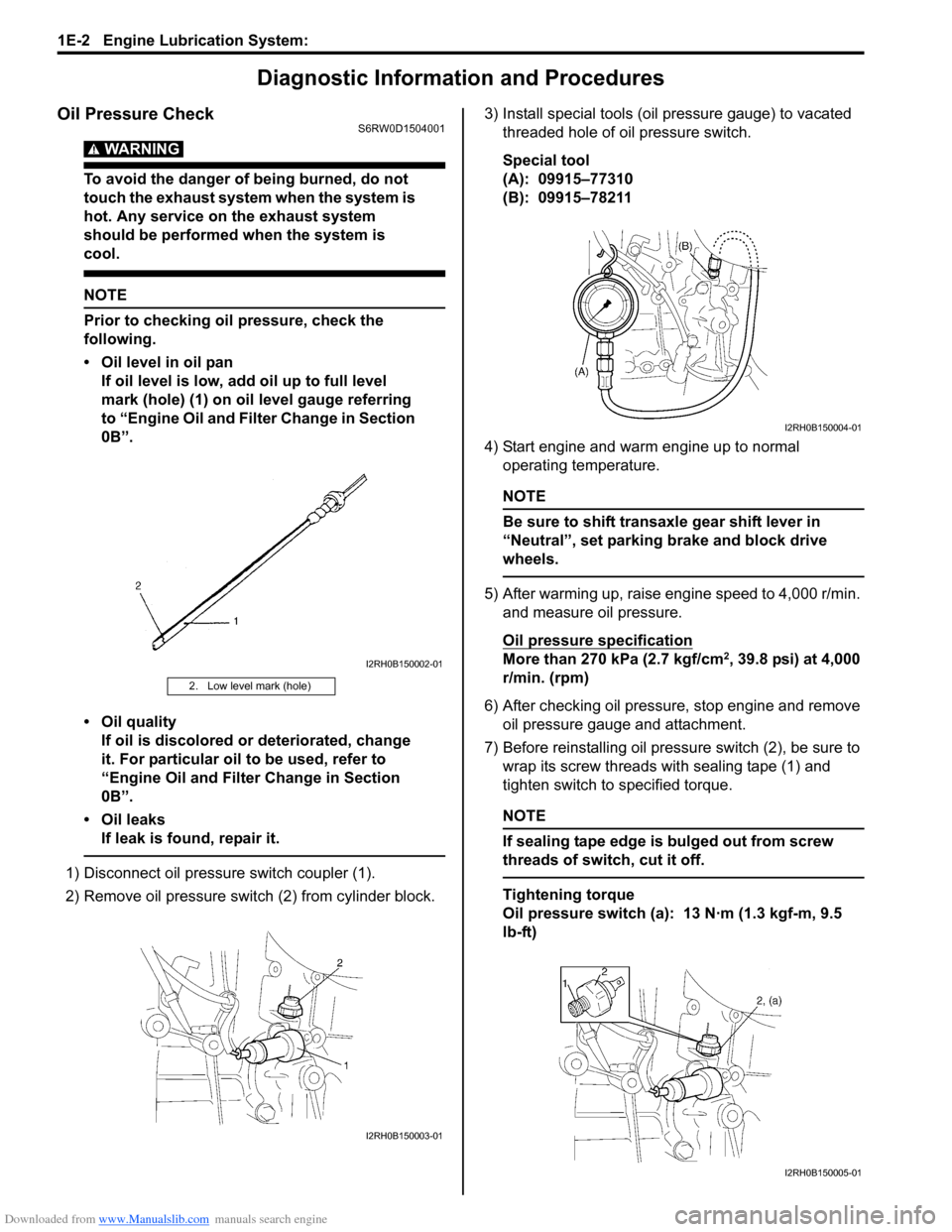
Prior to checking oil pressure, check the
following.
• Oil level in oil pan
If oil level is low, add oil up to full level
mark (hole) (1) on oil level gauge referring
to “Engine Oil and Filter Change in Section
0B”.
• Oil quality
If oil is discolored or deteriorated, change
it. For particular oil to be used, refer to
“Engine Oil and Filter Change in Section
0B”.
• Oil leaks
If leak is found, repair it.
1) Disconnect oil pressure switch coupler (1).
2) Remove oil pressure switch (2) from cylinder block.3) Install special tools (oil pressure gauge) to vacated
threaded hole of oil pressure switch.
Special tool
(A): 09915–77310
(B): 09915–78211
4) Start engine and warm engine up to normal
operating temperature.
NOTE
Be sure to shift transaxle gear shift lever in
“Neutral”, set parking brake and block drive
wheels.
5) After warming up, raise engine speed to 4,000 r/min.
and measure oil pressure.
Oil pressure specification
More than 270 kPa (2.7 kgf/cm2, 39.8 psi) at 4,000
r/min. (rpm)
6) After checking oil pressure, stop engine and remove
oil pressure gauge and attachment.
7) Before reinstalling oil pressure switch (2), be sure to
wrap its screw threads with sealing tape (1) and
tighten switch to specified torque.
NOTE
If sealing tape edge is bulged out from screw
threads of switch, cut it off.
Tightening torque
Oil pressure switch (a): 13 N·m (1.3 kgf-m, 9.5
lb-ft)
2. Low level mark (hole)
I2RH0B150002-01
I2RH0B150003-01
I2RH0B150004-01
I2RH0B150005-01