light SUZUKI SX4 2006 1.G Service Repair Manual
[x] Cancel search | Manufacturer: SUZUKI, Model Year: 2006, Model line: SX4, Model: SUZUKI SX4 2006 1.GPages: 1556, PDF Size: 37.31 MB
Page 475 of 1556
Downloaded from www.Manualslib.com manuals search engine Wheels and Tires: 2D-6
Wheel (with Tire) Removal and InstallationS6RW0D2406003
Removal
CAUTION!
Never use heat to loosen tight wheel because
the application of heat to wheel causes the
wheel life shorter and the wheel bearing
damage.
1) Loosen wheel nuts by approximately 180° (half a
rotation).
2) Hoist vehicle.
3) Make sure that the vehicle will not fall off by trying to
move vehicle body in both ways.
4) Remove wheel nuts except one.
5) Support the wheel and/or tire not to drop the wheel
and then remove the nut left with the wheel.
Installation
For installation, reverse removal procedure, noting the
following.
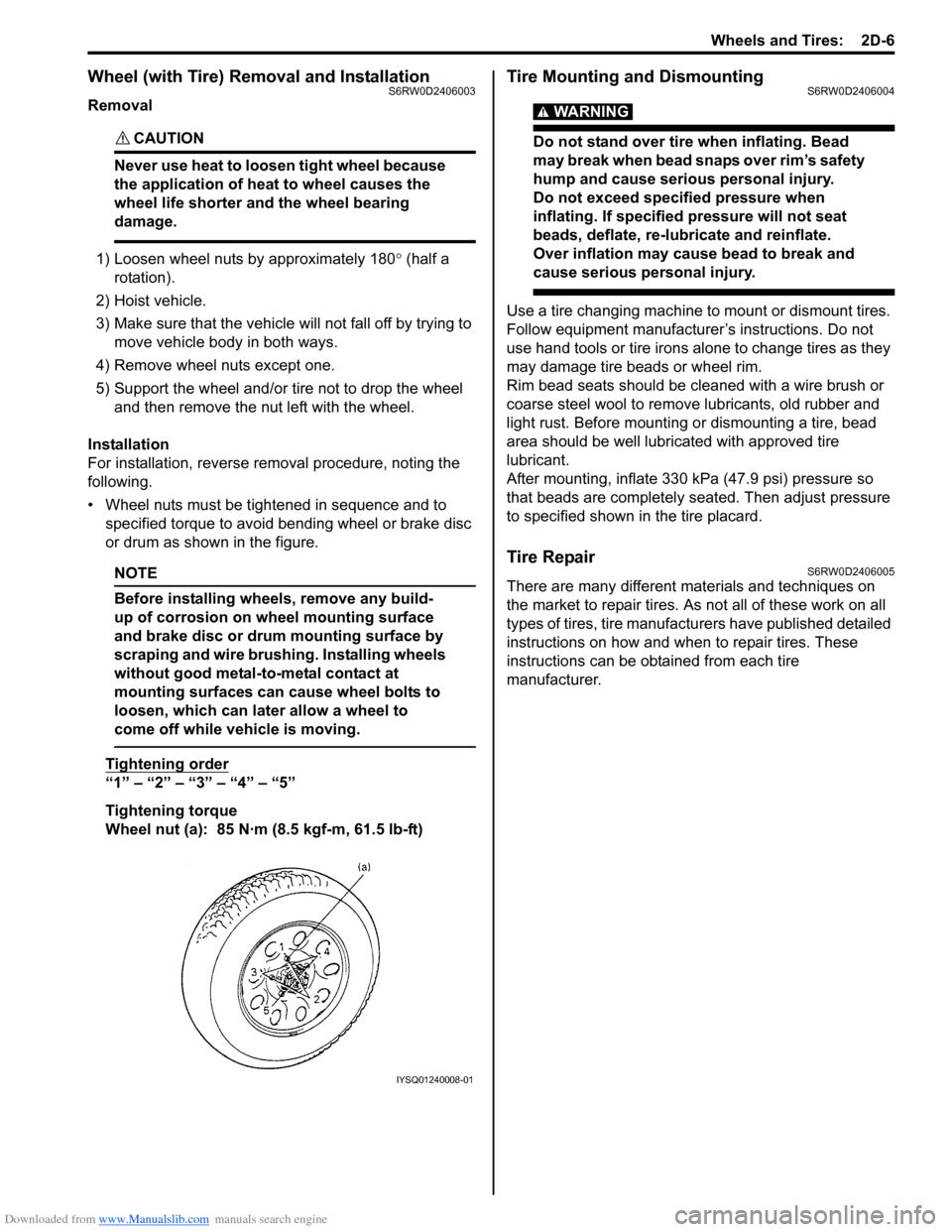
• Wheel nuts must be tightened in sequence and to
specified torque to avoid bending wheel or brake disc
or drum as shown in the figure.
NOTE
Before installing wheels, remove any build-
up of corrosion on wheel mounting surface
and brake disc or drum mounting surface by
scraping and wire brushing. Installing wheels
without good metal-to-metal contact at
mounting surfaces can cause wheel bolts to
loosen, which can later allow a wheel to
come off while vehicle is moving.
Tightening order
“1” – “2” – “3” – “4” – “5”
Tightening torque
Wheel nut (a): 85 N·m (8.5 kgf-m, 61.5 lb-ft)
Tire Mounting and DismountingS6RW0D2406004
WARNING!
Do not stand over tire when inflating. Bead
may break when bead snaps over rim’s safety
hump and cause serious personal injury.
Do not exceed specified pressure when
inflating. If specified pressure will not seat
beads, deflate, re-lubricate and reinflate.
Over inflation may cause bead to break and
cause serious personal injury.
Use a tire changing machine to mount or dismount tires.
Follow equipment manufacturer’s instructions. Do not
use hand tools or tire irons alone to change tires as they
may damage tire beads or wheel rim.
Rim bead seats should be cleaned with a wire brush or
coarse steel wool to remove lubricants, old rubber and
light rust. Before mounting or dismounting a tire, bead
area should be well lubricated with approved tire
lubricant.
After mounting, inflate 330 kPa (47.9 psi) pressure so
that beads are completely seated. Then adjust pressure
to specified shown in the tire placard.
Tire RepairS6RW0D2406005
There are many different materials and techniques on
the market to repair tires. As not all of these work on all
types of tires, tire manufacturers have published detailed
instructions on how and when to repair tires. These
instructions can be obtained from each tire
manufacturer.
IYSQ01240008-01
Page 509 of 1556
Downloaded from www.Manualslib.com manuals search engine Differential: 3B-12
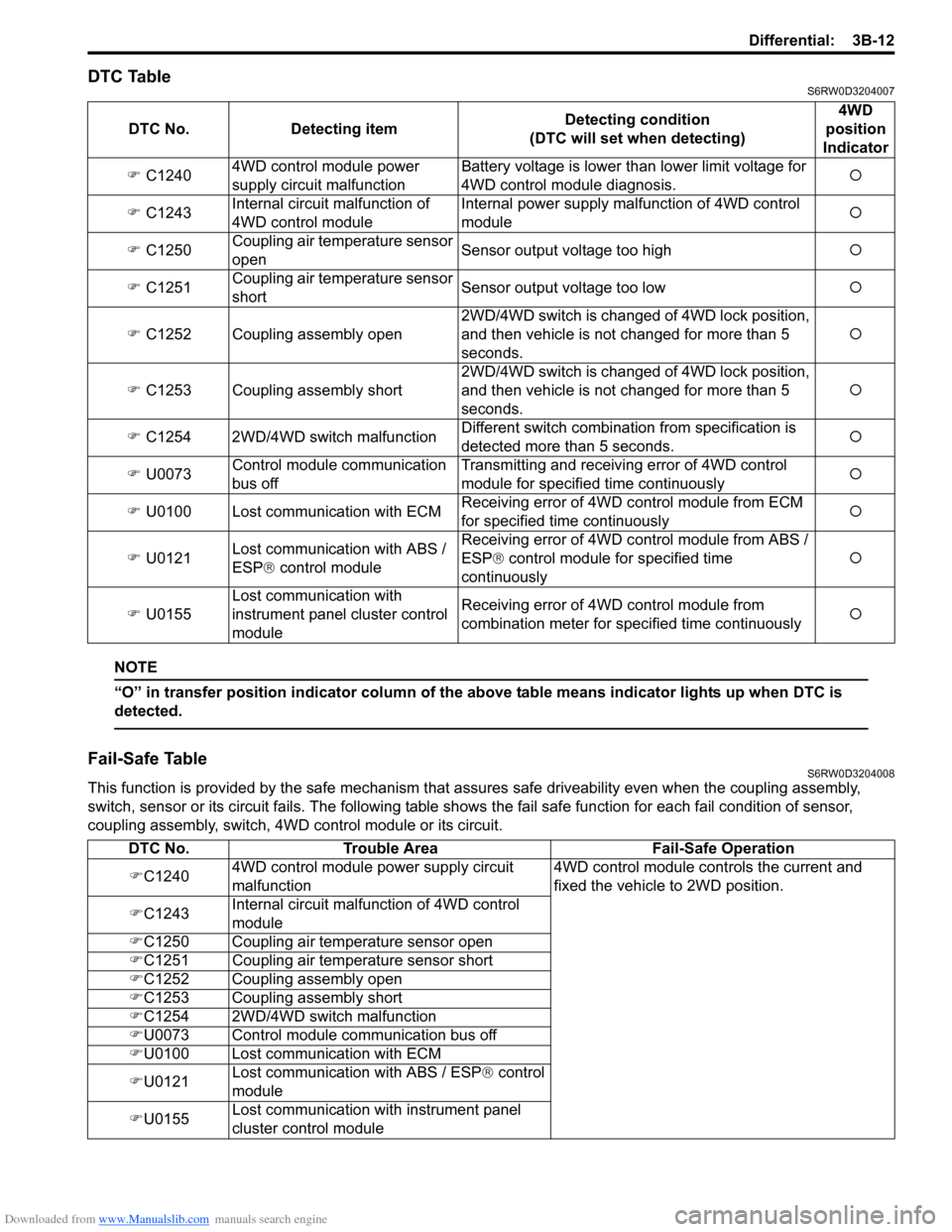
DTC TableS6RW0D3204007
NOTE
“O” in transfer position indicator column of the above table means indicator lights up when DTC is
detected.
Fail-Safe TableS6RW0D3204008
This function is provided by the safe mechanism that assures safe driveability even when the coupling assembly,
switch, sensor or its circuit fails. The following table shows the fail safe function for each fail condition of sensor,
coupling assembly, switch, 4WD control module or its circuit. DTC No. Detecting itemDetecting condition
(DTC will set when detecting)4WD
position
Indicator
) C12404WD control module power
supply circuit malfunctionBattery voltage is lower than lower limit voltage for
4WD control module diagnosis.{
) C1243Internal circuit malfunction of
4WD control moduleInternal power supply malfunction of 4WD control
module{
) C1250Coupling air temperature sensor
openSensor output voltage too high{
) C1251Coupling air temperature sensor
shortSensor output voltage too low{
) C1252 Coupling assembly open2WD/4WD switch is changed of 4WD lock position,
and then vehicle is not changed for more than 5
seconds.{
) C1253 Coupling assembly short2WD/4WD switch is changed of 4WD lock position,
and then vehicle is not changed for more than 5
seconds.{
) C1254 2WD/4WD switch malfunctionDifferent switch combination from specification is
detected more than 5 seconds.{
) U0073Control module communication
bus offTransmitting and receiving error of 4WD control
module for specified time continuously{
) U0100 Lost communication with ECMReceiving error of 4WD control module from ECM
for specified time continuously{
) U0121Lost communication with ABS /
ESP® control moduleReceiving error of 4WD control module from ABS /
ESP® control module for specified time
continuously{
) U0155Lost communication with
instrument panel cluster control
moduleReceiving error of 4WD control module from
combination meter for specified time continuously{
DTC No. Trouble Area Fail-Safe Operation
)C12404WD control module power supply circuit
malfunction4WD control module controls the current and
fixed the vehicle to 2WD position.
)C1243Internal circuit malfunction of 4WD control
module
)C1250 Coupling air temperature sensor open
)C1251 Coupling air temperature sensor short
)C1252 Coupling assembly open
)C1253 Coupling assembly short
)C1254 2WD/4WD switch malfunction
)U0073 Control module communication bus off
)U0100 Lost communication with ECM
)U0121Lost communication with ABS / ESP® control
module
)U0155Lost communication with instrument panel
cluster control module
Page 512 of 1556
Downloaded from www.Manualslib.com manuals search engine 3B-15 Differential:
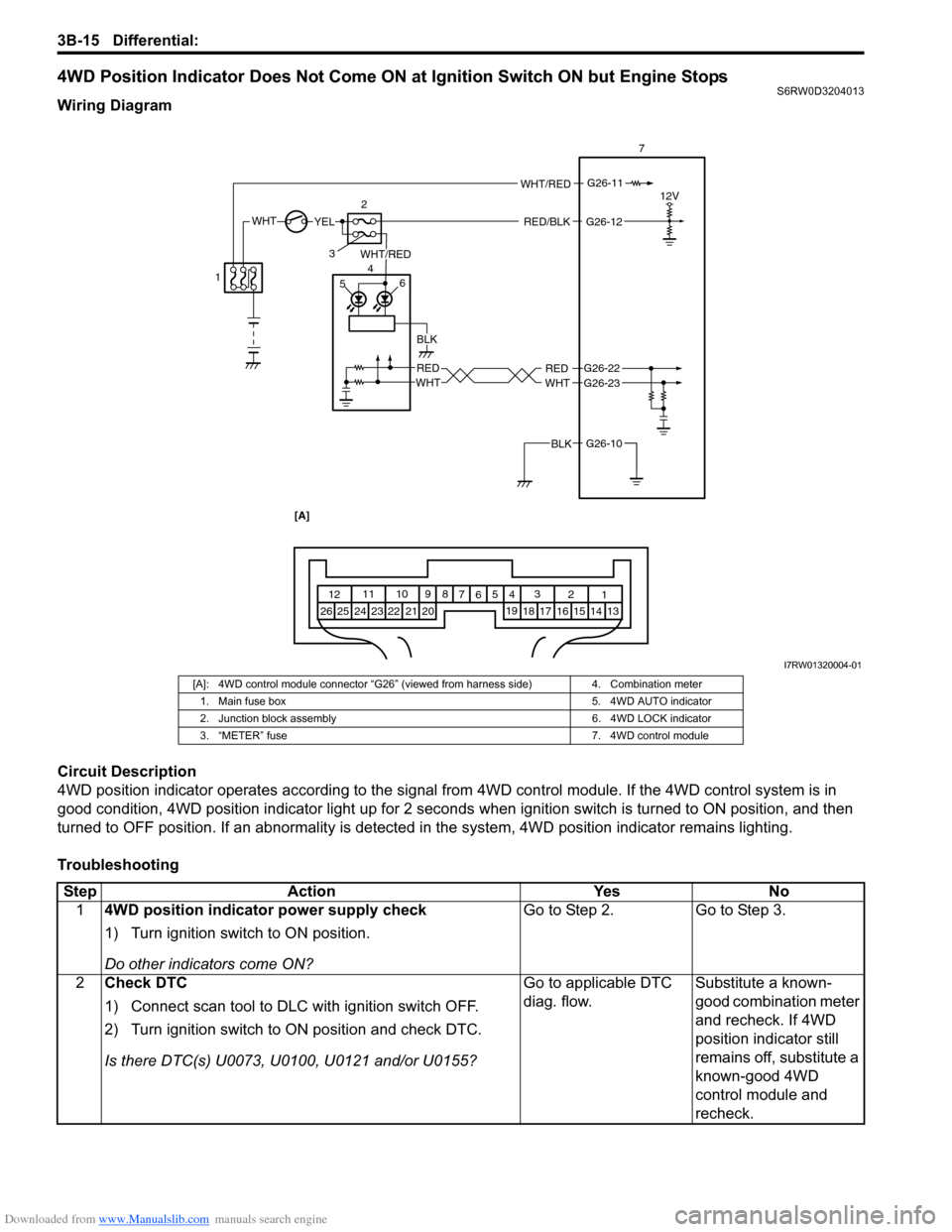
4WD Position Indicator Does Not Come ON at Ignition Switch ON but Engine StopsS6RW0D3204013
Wiring Diagram
Circuit Description
4WD position indicator operates according to the signal from 4WD control module. If the 4WD control system is in
good condition, 4WD position indicator light up for 2 seconds when ignition switch is turned to ON position, and then
turned to OFF position. If an abnormality is detected in the system, 4WD position indicator remains lighting.
Troubleshooting
WHTYELRED/BLK
12
WHT/RED
WHT/RED
G26-12
G26-11
RED
BLK
WHT 56 47
12V
G26-10BLK
G26-22
G26-23REDWHT
3
1 2 3
4 5
6 7 8 9 10 11
12
13
14 15 16
17 18 19
20
21 22
23
24 25 26
[A]
I7RW01320004-01
[A]: 4WD control module connector “G26” (viewed from harness side) 4. Combination meter
1. Main fuse box 5. 4WD AUTO indicator
2. Junction block assembly 6. 4WD LOCK indicator
3. “METER” fuse 7. 4WD control module
Step Action Yes No
14WD position indicator power supply check
1) Turn ignition switch to ON position.
Do other indicators come ON?Go to Step 2. Go to Step 3.
2Check DTC
1) Connect scan tool to DLC with ignition switch OFF.
2) Turn ignition switch to ON position and check DTC.
Is there DTC(s) U0073, U0100, U0121 and/or U0155?Go to applicable DTC
diag. flow.Substitute a known-
good combination meter
and recheck. If 4WD
position indicator still
remains off, substitute a
known-good 4WD
control module and
recheck.
Page 513 of 1556
Downloaded from www.Manualslib.com manuals search engine Differential: 3B-16
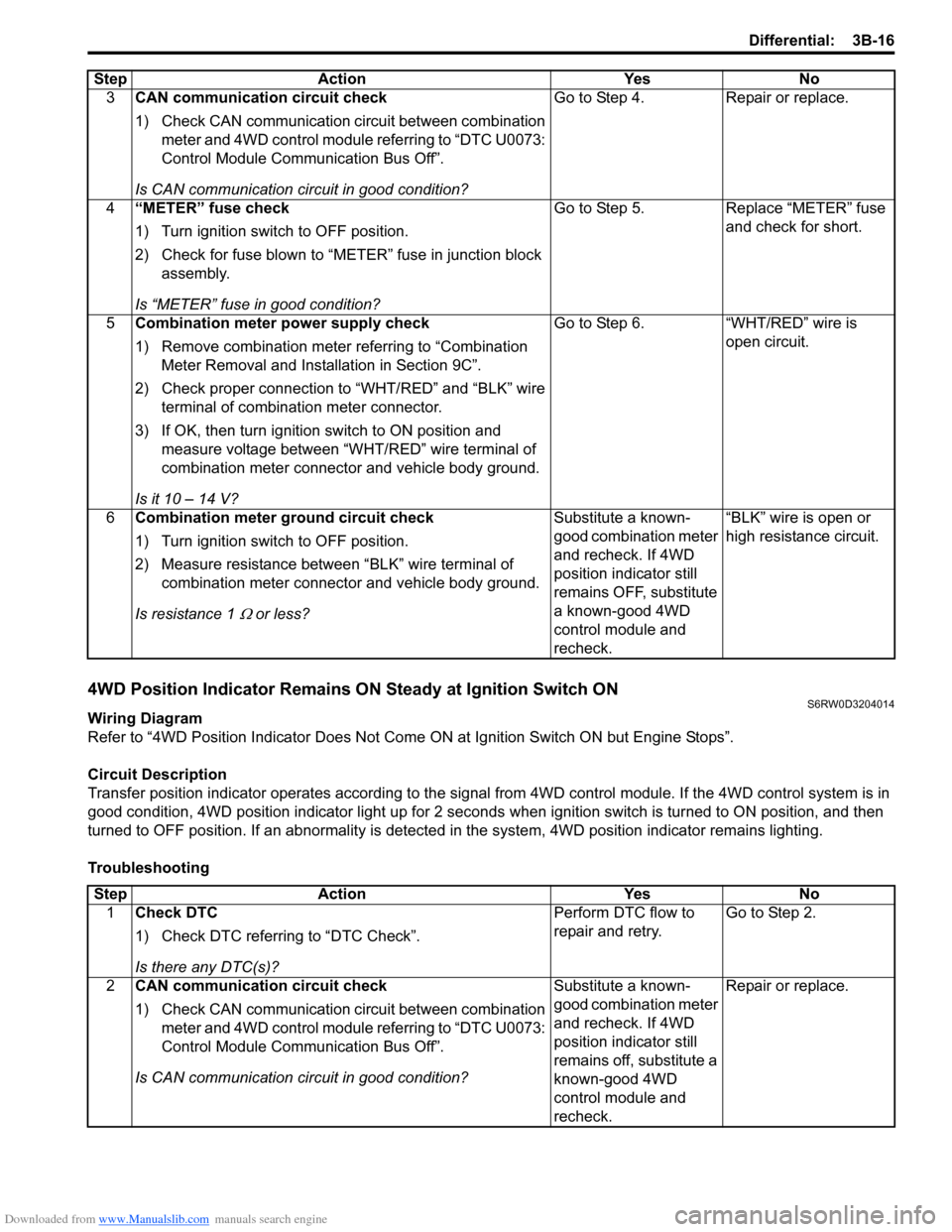
4WD Position Indicator Remains ON Steady at Ignition Switch ONS6RW0D3204014
Wiring Diagram
Refer to “4WD Position Indicator Does Not Come ON at Ignition Switch ON but Engine Stops”.
Circuit Description
Transfer position indicator operates according to the signal from 4WD control module. If the 4WD control system is in
good condition, 4WD position indicator light up for 2 seconds when ignition switch is turned to ON position, and then
turned to OFF position. If an abnormality is detected in the system, 4WD position indicator remains lighting.
Troubleshooting3CAN communication circuit check
1) Check CAN communication circuit between combination
meter and 4WD control module referring to “DTC U0073:
Control Module Communication Bus Off”.
Is CAN communication circuit in good condition?Go to Step 4. Repair or replace.
4“METER” fuse check
1) Turn ignition switch to OFF position.
2) Check for fuse blown to “METER” fuse in junction block
assembly.
Is “METER” fuse in good condition?Go to Step 5. Replace “METER” fuse
and check for short.
5Combination meter power supply check
1) Remove combination meter referring to “Combination
Meter Removal and Installation in Section 9C”.
2) Check proper connection to “WHT/RED” and “BLK” wire
terminal of combination meter connector.
3) If OK, then turn ignition switch to ON position and
measure voltage between “WHT/RED” wire terminal of
combination meter connector and vehicle body ground.
Is it 10 – 14 V?Go to Step 6. “WHT/RED” wire is
open circuit.
6Combination meter ground circuit check
1) Turn ignition switch to OFF position.
2) Measure resistance between “BLK” wire terminal of
combination meter connector and vehicle body ground.
Is resistance 1
Ω or less?Substitute a known-
good combination meter
and recheck. If 4WD
position indicator still
remains OFF, substitute
a known-good 4WD
control module and
recheck.“BLK” wire is open or
high resistance circuit. Step Action Yes No
Step Action Yes No
1Check DTC
1) Check DTC referring to “DTC Check”.
Is there any DTC(s)?Perform DTC flow to
repair and retry.Go to Step 2.
2CAN communication circuit check
1) Check CAN communication circuit between combination
meter and 4WD control module referring to “DTC U0073:
Control Module Communication Bus Off”.
Is CAN communication circuit in good condition?Substitute a known-
good combination meter
and recheck. If 4WD
position indicator still
remains off, substitute a
known-good 4WD
control module and
recheck.Repair or replace.
Page 539 of 1556
Downloaded from www.Manualslib.com manuals search engine Differential: 3B-42
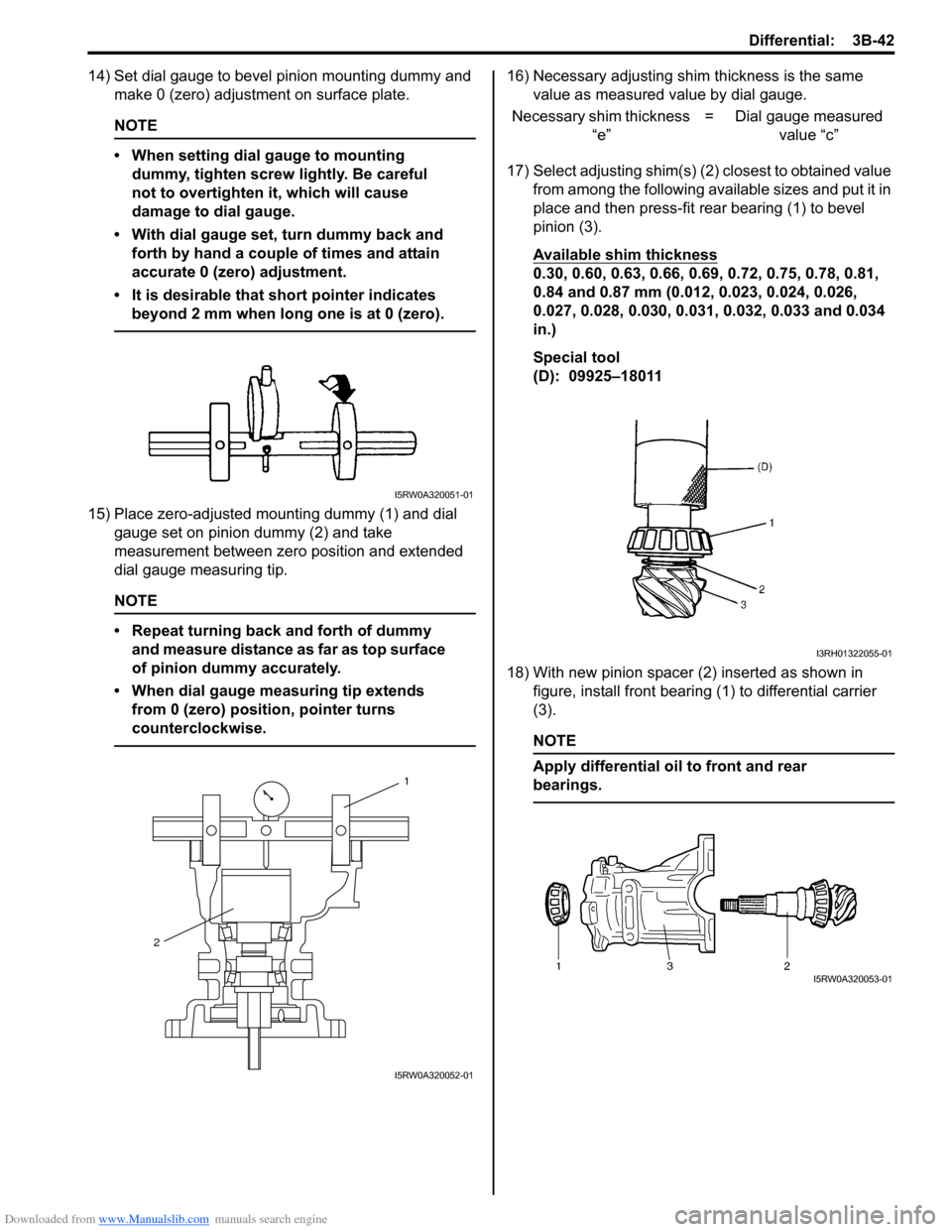
14) Set dial gauge to bevel pinion mounting dummy and
make 0 (zero) adjustment on surface plate.
NOTE
• When setting dial gauge to mounting
dummy, tighten screw lightly. Be careful
not to overtighten it, which will cause
damage to dial gauge.
• With dial gauge set, turn dummy back and
forth by hand a couple of times and attain
accurate 0 (zero) adjustment.
• It is desirable that short pointer indicates
beyond 2 mm when long one is at 0 (zero).
15) Place zero-adjusted mounting dummy (1) and dial
gauge set on pinion dummy (2) and take
measurement between zero position and extended
dial gauge measuring tip.
NOTE
• Repeat turning back and forth of dummy
and measure distance as far as top surface
of pinion dummy accurately.
• When dial gauge measuring tip extends
from 0 (zero) position, pointer turns
counterclockwise.
16) Necessary adjusting shim thickness is the same
value as measured value by dial gauge.
17) Select adjusting shim(s) (2) closest to obtained value
from among the following available sizes and put it in
place and then press-fit rear bearing (1) to bevel
pinion (3).
Available shim thickness
0.30, 0.60, 0.63, 0.66, 0.69, 0.72, 0.75, 0.78, 0.81,
0.84 and 0.87 mm (0.012, 0.023, 0.024, 0.026,
0.027, 0.028, 0.030, 0.031, 0.032, 0.033 and 0.034
in.)
Special tool
(D): 09925–18011
18) With new pinion spacer (2) inserted as shown in
figure, install front bearing (1) to differential carrier
(3).
NOTE
Apply differential oil to front and rear
bearings.
I5RW0A320051-01
1
2
I5RW0A320052-01
Necessary shim thickness
“e”= Dial gauge measured
value “c”
I3RH01322055-01
I5RW0A320053-01
Page 560 of 1556
Downloaded from www.Manualslib.com manuals search engine 3C-13 Transfer:
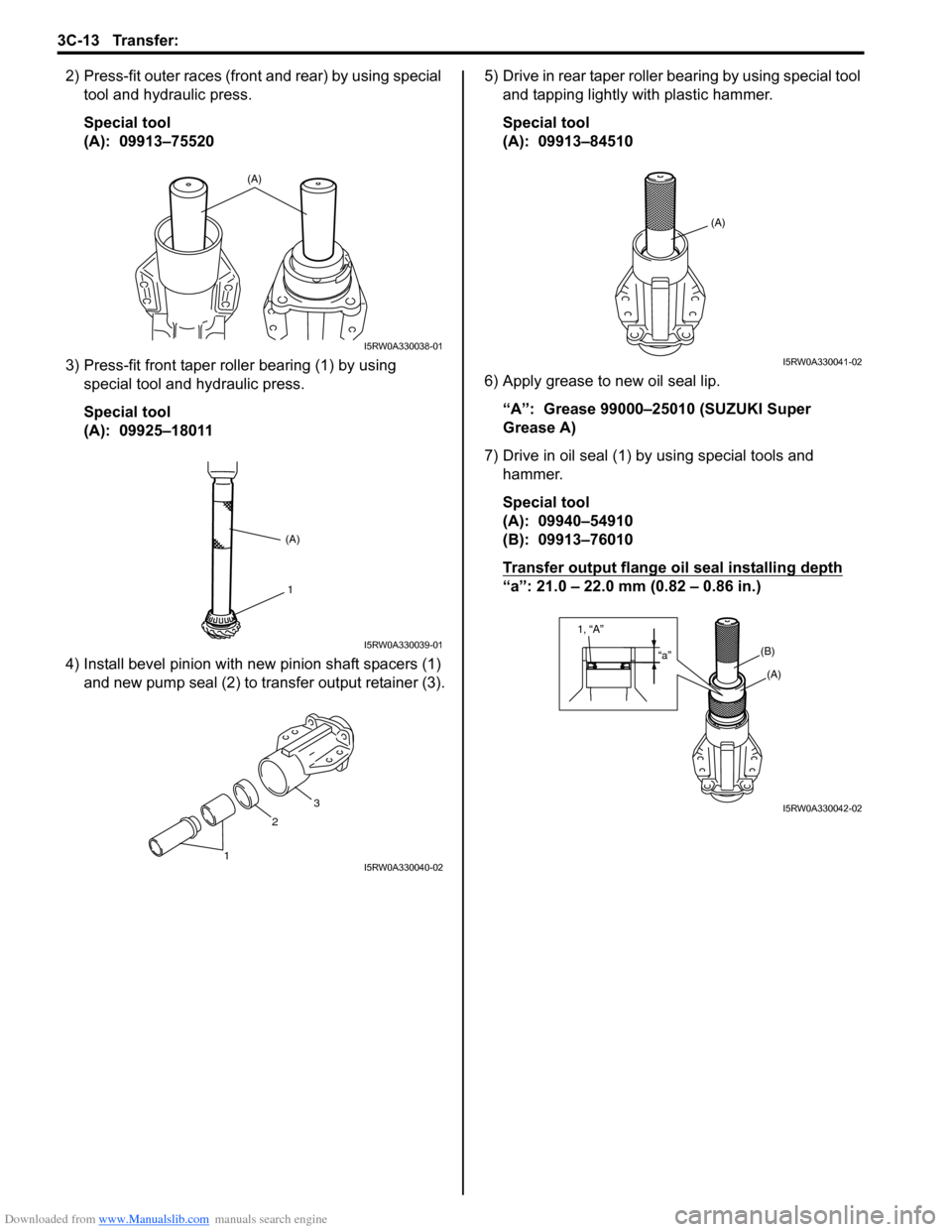
2) Press-fit outer races (front and rear) by using special
tool and hydraulic press.
Special tool
(A): 09913–75520
3) Press-fit front taper roller bearing (1) by using
special tool and hydraulic press.
Special tool
(A): 09925–18011
4) Install bevel pinion with new pinion shaft spacers (1)
and new pump seal (2) to transfer output retainer (3).5) Drive in rear taper roller bearing by using special tool
and tapping lightly with plastic hammer.
Special tool
(A): 09913–84510
6) Apply grease to new oil seal lip.
“A”: Grease 99000–25010 (SUZUKI Super
Grease A)
7) Drive in oil seal (1) by using special tools and
hammer.
Special tool
(A): 09940–54910
(B): 09913–76010
Transfer output flange oil seal installing depth
“a”: 21.0 – 22.0 mm (0.82 – 0.86 in.)
(A)
I5RW0A330038-01
(A)
1
I5RW0A330039-01
1
2
3
I5RW0A330040-02
(A)
I5RW0A330041-02
(B)
(A)
1, “A”
“a”
I5RW0A330042-02
Page 569 of 1556
Downloaded from www.Manualslib.com manuals search engine Table of Contents 4- i
4
Section 4
CONTENTS
Brakes
Precautions ................................................. 4-1
Precautions............................................................. 4-1
Precautions for Brakes .......................................... 4-1
Brake Control System and Diagnosis ... 4A-1
Precautions........................................................... 4A-1
Precautions on Brake .......................................... 4A-1
General Description ............................................. 4A-1
Brakes Construction ............................................ 4A-1
Brake Pedal Foot Protection System
Construction (If Equipped) ................................ 4A-2
Front Brake Hose / Pipe Construction................. 4A-3
Rear Brake Hose / Pipe Construction ................. 4A-4
Diagnostic Information and Procedures ............ 4A-4
Brakes Diagnosis Note ....................................... 4A-4
Brakes Symptom Diagnosis ................................ 4A-5
Repair Instructions .............................................. 4A-7
Brake Pedal Components ................................... 4A-7
Brake Pedal Free Height Inspection ................... 4A-7
Brake Pedal Play Inspection ............................... 4A-7
Excessive Pedal Travel Inspection ..................... 4A-7
Brake Fluid Level Inspection ............................... 4A-8
Brake Light Switch Adjustment ........................... 4A-8
Air Bleeding of Brake System ............................. 4A-8
Front Brake Hose / Pipe Removal and
Installation ......................................................... 4A-9
Rear Brake Hose / Pipe Removal and
Installation ....................................................... 4A-10
Brake Hose and Pipe Inspection ....................... 4A-10
Master Cylinder and Brake Booster
Components.................................................... 4A-11
Master Cylinder Reservoir Removal and
Installation ....................................................... 4A-11
Master Cylinder Removal and Installation......... 4A-12
Master Cylinder Inspection ............................... 4A-13
Booster Operation Inspection ........................... 4A-14
Brake Booster Removal and Installation ........... 4A-15
Brake Booster Inspection .................................. 4A-15
Booster Push Clevis Rod Adjustment ............... 4A-16
Specifications..................................................... 4A-16
Tightening Torque Specifications ...................... 4A-16
Special Tools and Equipment ........................... 4A-16
Recommended Service Material ....................... 4A-16
Special Tool ...................................................... 4A-16
Front Brakes ............................................ 4B-1
Repair Instructions ..............................................4B-1
Front Disc Brake Components ............................ 4B-1
Front Disc Brake Pad On-Vehicle Inspection ...... 4B-2
Front Disc Brake Pad Removal and
Installation ......................................................... 4B-2
Front Disc Brake Pad Inspection......................... 4B-3
Front Disc Brake Caliper Removal and
Installation ......................................................... 4B-3
Front Disc Brake Caliper Disassembly and
Assembly........................................................... 4B-4
Front Disc Brake Caliper Inspection.................... 4B-6
Front Brake Disc Removal and Installation ......... 4B-6
Front Brake Disc Inspection ................................ 4B-7
Specifications .......................................................4B-8
Tightening Torque Specifications ........................ 4B-8
Special Tools and Equipment .............................4B-8
Recommended Service Material ......................... 4B-8
Special Tool ........................................................ 4B-8
Rear Brakes.............................................. 4C-1
Repair Instructions ..............................................4C-1
Rear Drum Brake Components ...........................4C-1
Rear Brake Drum Removal and Installation ........4C-2
Rear Brake Drum and Shoe Inspection ..............4C-2
Rear Brake Shoe On-Vehicle Inspection ............4C-3
Rear Brake Shoe Removal and Installation ........4C-3
Rear Brake Shoe Inspection ...............................4C-4
Wheel Cylinder Removal and Installation ...........4C-4
Wheel Cylinder Inspection ..................................4C-5
Brake Back Plate Removal and Installation ........4C-5
Specifications .......................................................4C-6
Tightening Torque Specifications ........................4C-6
Special Tools and Equipment .............................4C-6
Recommended Service Material .........................4C-6
Parking Brake .......................................... 4D-1
General Description .............................................4D-1
Parking Brake Cable Construction ......................4D-1
Repair Instructions ..............................................4D-2
Parking Brake Inspection and Adjustment ..........4D-2
Parking Brake Cable Removal and
Installation .........................................................4D-2
Parking Brake Lever Removal and Installation ....4D-3
Page 570 of 1556
Downloaded from www.Manualslib.com manuals search engine 4-ii Table of Contents
Specifications .......................................................4D-4
Tightening Torque Specifications ........................4D-4
ABS ............................................................4E-1
Precautions........................................................... 4E-1
Precautions in Diagnosing Troubles ................... 4E-1
Precautions in On-Vehicle Service...................... 4E-1
General Description ............................................. 4E-2
ABS Description .................................................. 4E-2
ABS Hydraulic Unit / Control Module
Assembly Description ....................................... 4E-3
CAN Communication System Description........... 4E-3
Schematic and Routing Diagram ........................ 4E-4
ABS Schematic ................................................... 4E-4
ABS Wiring Circuit Diagram ................................ 4E-5
Component Location ........................................... 4E-8
ABS Components Location ................................. 4E-8
Diagnostic Information and Procedures ............ 4E-8
ABS Check .......................................................... 4E-8
ABS Warning Light Check................................. 4E-10
EBD Warning Light (Brake Warning Light)
Check .............................................................. 4E-10
DTC Check........................................................ 4E-11
DTC Table ......................................................... 4E-11
DTC Clearance ................................................. 4E-11
Scan Tool Data ................................................. 4E-12
ABS Warning Light Does Not Come ON at
Ignition Switch ON .......................................... 4E-13
ABS Warning Light Comes ON Steady ............. 4E-15
EBD Warning Light (Brake Warning Light)
Comes ON Steady .......................................... 4E-16
Serial Data Link Circuit Check .......................... 4E-17
DTC C1013: Control Module Mismatch ............ 4E-20
DTC C1015: G Sensor Circuit (4WD Model)..... 4E-21
DTC 1016: Brake Light Switch .......................... 4E-22
DTC C1021 / C1022 / C1025 / C1026 / C1031
/ C1032 / C1035 / C1036: Wheel Speed
Sensor Circuit / Sensor or Encoder ................ 4E-23
DTC C1033: Wheel Speed Sensor Deviation ... 4E-25
DTC C1041 / C1042 / C1045 / C1046 / C1051
/ C1052 / C1055 / C1056: Inlet / Outlet
Solenoid .......................................................... 4E-26DTC C1057: Power Supply Voltage Too High
/ Too Low ........................................................ 4E-27
DTC C1061: Pump Motor Circuit ...................... 4E-28
DTC C1063: Solenoid Valve Power Supply
Driver Circuit ................................................... 4E-29
DTC C1071: Control Module Internal Defect .... 4E-30
ABS Hydraulic Unit / Control Module
Assembly Power and Ground Circuit Check ... 4E-30
Repair Instructions ............................................ 4E-31
ABS Hydraulic Unit Operation Check................ 4E-31
ABS Hydraulic Unit / Control Module
Assembly Components ................................... 4E-32
ABS Hydraulic Unit / Control Module
Assembly On-Vehicle Inspection .................... 4E-33
ABS Hydraulic Unit / Control Module
Assembly Removal and Installation ................ 4E-33
Front and Rear Wheel Speed Sensor On-
Vehicle Inspection ........................................... 4E-34
Front Wheel Speed Sensor Removal and
Installation ....................................................... 4E-35
Front and Rear Wheel Speed Sensor
Inspection ........................................................ 4E-36
Rear Wheel Speed Sensor Removal and
Installation (4WD Model) ................................. 4E-36
Rear Wheel Speed Sensor Removal and
Installation (2WD Model) ................................. 4E-36
Front Wheel Speed Sensor Encoder On-
Vehicle Inspection ........................................... 4E-37
Front Wheel Speed Sensor Encoder Removal
and Installation ................................................ 4E-37
Rear Wheel Speed Sensor Encoder On-
Vehicle Inspection ........................................... 4E-37
Rear Wheel Speed Sensor Encoder Removal
and Installation ................................................ 4E-37
G Sensor Removal and Installation (4WD
Model) ............................................................. 4E-38
G Sensor Inspection (4WD Model) ................... 4E-38
Specifications ..................................................... 4E-39
Tightening Torque Specifications ...................... 4E-39
Special Tools and Equipment ........................... 4E-39
Special Tool ...................................................... 4E-39
Page 575 of 1556
Downloaded from www.Manualslib.com manuals search engine Brake Control System and Diagnosis: 4A-4
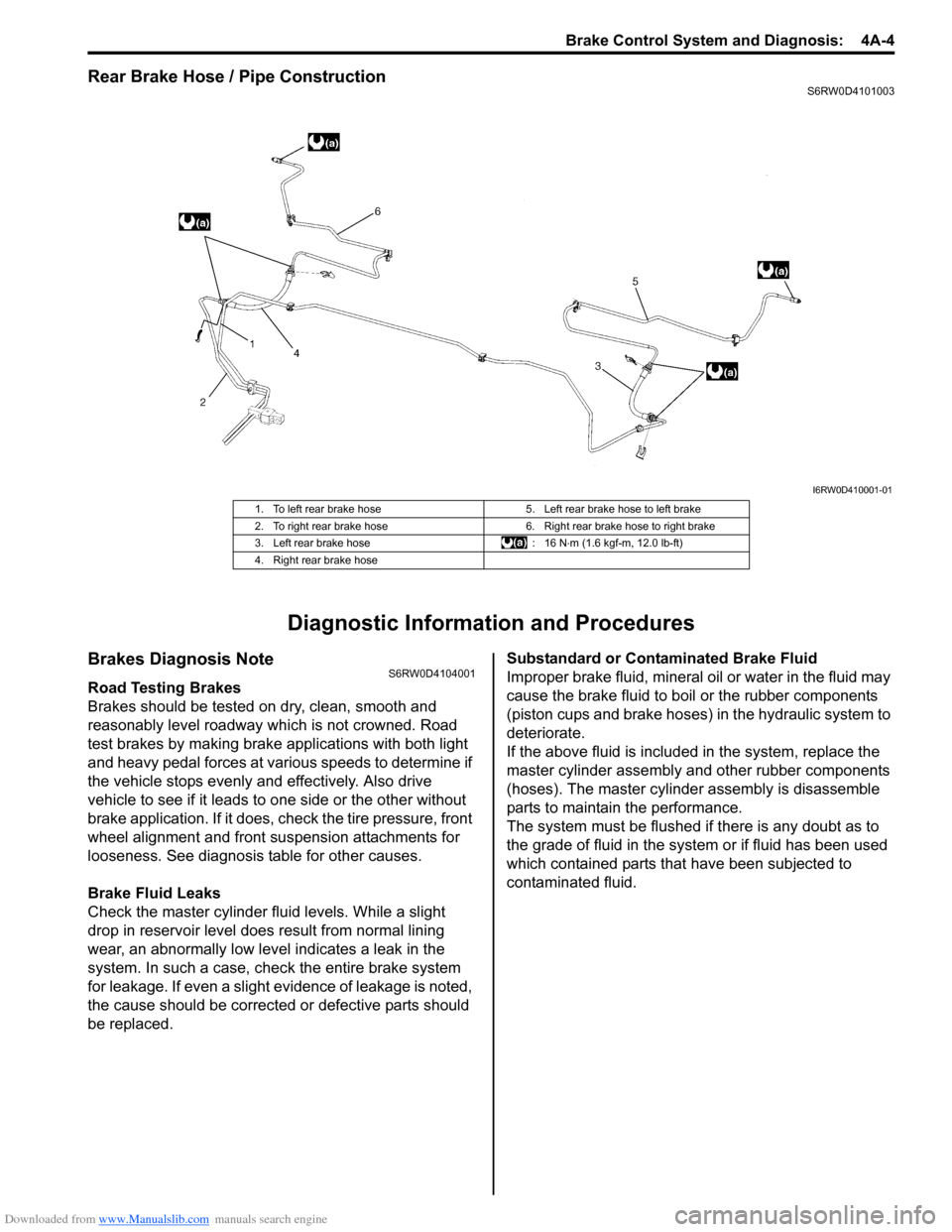
Rear Brake Hose / Pipe ConstructionS6RW0D4101003
Diagnostic Information and Procedures
Brakes Diagnosis NoteS6RW0D4104001
Road Testing Brakes
Brakes should be tested on dry, clean, smooth and
reasonably level roadway which is not crowned. Road
test brakes by making brake applications with both light
and heavy pedal forces at various speeds to determine if
the vehicle stops evenly and effectively. Also drive
vehicle to see if it leads to one side or the other without
brake application. If it does, check the tire pressure, front
wheel alignment and front suspension attachments for
looseness. See diagnosis table for other causes.
Brake Fluid Leaks
Check the master cylinder fluid levels. While a slight
drop in reservoir level does result from normal lining
wear, an abnormally low level indicates a leak in the
system. In such a case, check the entire brake system
for leakage. If even a slight evidence of leakage is noted,
the cause should be corrected or defective parts should
be replaced.Substandard or Contaminated Brake Fluid
Improper brake fluid, mineral oil or water in the fluid may
cause the brake fluid to boil or the rubber components
(piston cups and brake hoses) in the hydraulic system to
deteriorate.
If the above fluid is included in the system, replace the
master cylinder assembly and other rubber components
(hoses). The master cylinder assembly is disassemble
parts to maintain the performance.
The system must be flushed if there is any doubt as to
the grade of fluid in the system or if fluid has been used
which contained parts that have been subjected to
contaminated fluid.
I6RW0D410001-01
1. To left rear brake hose 5. Left rear brake hose to left brake
2. To right rear brake hose 6. Right rear brake hose to right brake
3. Left rear brake hose : 16 N⋅m (1.6 kgf-m, 12.0 lb-ft)
4. Right rear brake hose
Page 577 of 1556
Downloaded from www.Manualslib.com manuals search engine Brake Control System and Diagnosis: 4A-6
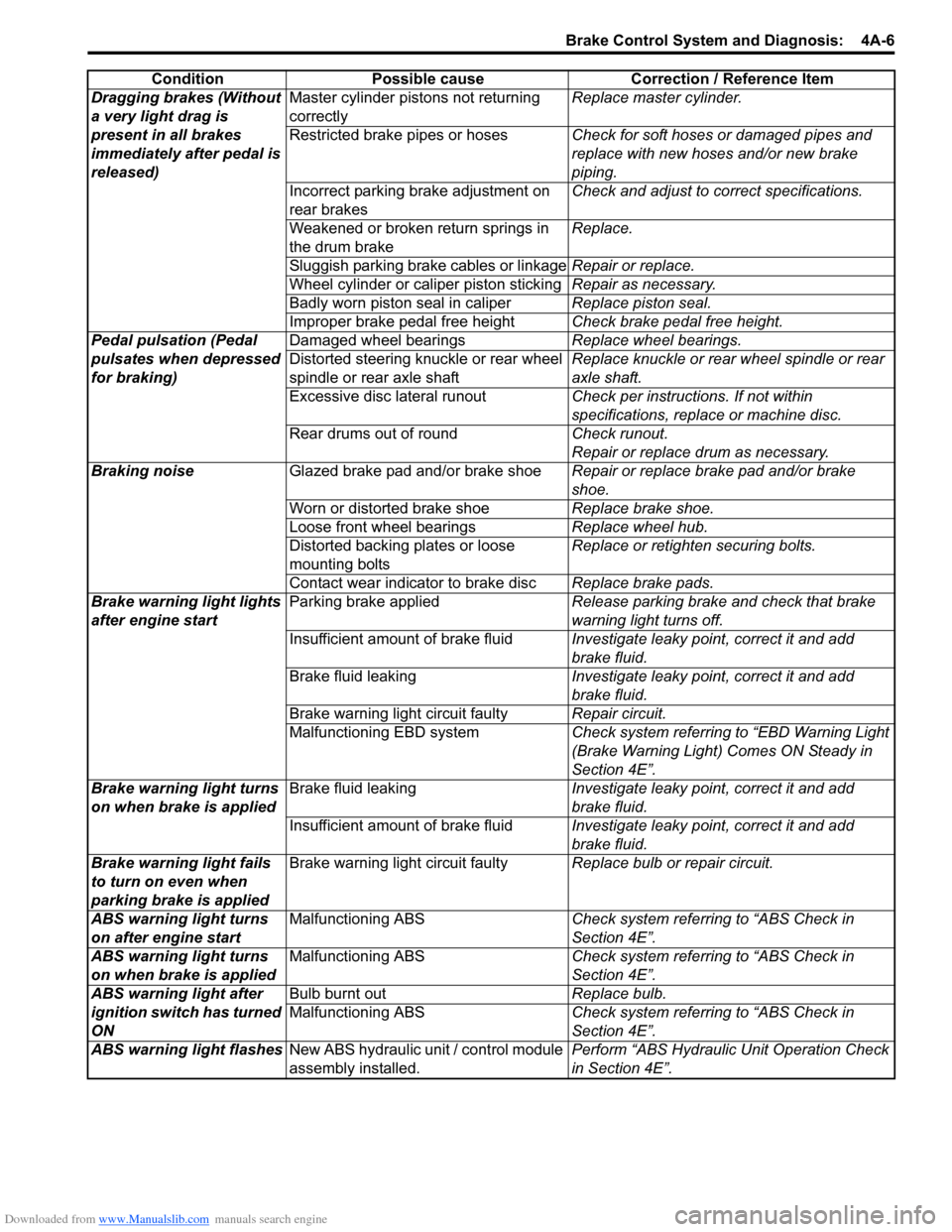
Dragging brakes (Without
a very light drag is
present in all brakes
immediately after pedal is
released)Master cylinder pistons not returning
correctlyReplace master cylinder.
Restricted brake pipes or hosesCheck for soft hoses or damaged pipes and
replace with new hoses and/or new brake
piping.
Incorrect parking brake adjustment on
rear brakesCheck and adjust to correct specifications.
Weakened or broken return springs in
the drum brakeReplace.
Sluggish parking brake cables or linkageRepair or replace.
Wheel cylinder or caliper piston stickingRepair as necessary.
Badly worn piston seal in caliperReplace piston seal.
Improper brake pedal free heightCheck brake pedal free height.
Pedal pulsation (Pedal
pulsates when depressed
for braking)Damaged wheel bearingsReplace wheel bearings.
Distorted steering knuckle or rear wheel
spindle or rear axle shaftReplace knuckle or rear wheel spindle or rear
axle shaft.
Excessive disc lateral runoutCheck per instructions. If not within
specifications, replace or machine disc.
Rear drums out of roundCheck runout.
Repair or replace drum as necessary.
Braking noiseGlazed brake pad and/or brake shoeRepair or replace brake pad and/or brake
shoe.
Worn or distorted brake shoeReplace brake shoe.
Loose front wheel bearingsReplace wheel hub.
Distorted backing plates or loose
mounting boltsReplace or retighten securing bolts.
Contact wear indicator to brake discReplace brake pads.
Brake warning light lights
after engine startParking brake appliedRelease parking brake and check that brake
warning light turns off.
Insufficient amount of brake fluidInvestigate leaky point, correct it and add
brake fluid.
Brake fluid leakingInvestigate leaky point, correct it and add
brake fluid.
Brake warning light circuit faultyRepair circuit.
Malfunctioning EBD systemCheck system referring to “EBD Warning Light
(Brake Warning Light) Comes ON Steady in
Section 4E”.
Brake warning light turns
on when brake is appliedBrake fluid leakingInvestigate leaky point, correct it and add
brake fluid.
Insufficient amount of brake fluidInvestigate leaky point, correct it and add
brake fluid.
Brake warning light fails
to turn on even when
parking brake is appliedBrake warning light circuit faultyReplace bulb or repair circuit.
ABS warning light turns
on after engine startMalfunctioning ABSCheck system referring to “ABS Check in
Section 4E”.
ABS warning light turns
on when brake is appliedMalfunctioning ABSCheck system referring to “ABS Check in
Section 4E”.
ABS warning light after
ignition switch has turned
ON Bulb burnt outReplace bulb.
Malfunctioning ABSCheck system referring to “ABS Check in
Section 4E”.
ABS warning light flashesNew ABS hydraulic unit / control module
assembly installed.Perform “ABS Hydraulic Unit Operation Check
in Section 4E”. Condition Possible cause Correction / Reference Item