wheel sensor SUZUKI SX4 2006 1.G Service Repair Manual
[x] Cancel search | Manufacturer: SUZUKI, Model Year: 2006, Model line: SX4, Model: SUZUKI SX4 2006 1.GPages: 1556, PDF Size: 37.31 MB
Page 642 of 1556

Downloaded from www.Manualslib.com manuals search engine 4E-37 ABS:
Front Wheel Speed Sensor Encoder On-Vehicle
Inspection
S6RW0D4506010
Before inspecting front wheel speed sensor encoder,
remove front drive shaft referring to “Front Drive Shaft
Assembly Removal and Installation in Section 3A”.
• Check sensor encoder (1) for crack, damage or
deformation.
• Turn wheel and check if sensor encoder rotation is
free from eccentricity and looseness.
• Check that no foreign material is attached.
If any faulty is found, clean or replace. Refer to “Front
Wheel Hub, Steering Knuckle and Wheel Bearing
Removal and Installation in Section 2B”.
Front Wheel Speed Sensor Encoder Removal
and Installation
S6RW0D4506011
CAUTION!
Front wheel speed sensor encoder is
included in front wheel hub assembly. If front
wheel speed sensor encoder needs to be
replaced, replace it as a front wheel hub
assembly.
For removal and installation of front wheel hub
assembly, referring to “Front Wheel Hub, Steering
Knuckle and Wheel Bearing Removal and Installation in
Section 2B”.
Rear Wheel Speed Sensor Encoder On-Vehicle
Inspection
S6RW0D4506012
For 4WD model
Refer to “Rear Wheel Speed Sensor On-Vehicle
Inspection”.
For 2WD model
Before inspecting rear wheel speed sensor encoder,
remove rear wheel speed sensor referring to “Rear
Wheel Speed Sensor Removal and Installation (2WD
Model)”.
• Check encoder (1) for crack, damage or deformation.
• Turn wheel and check if encoder rotation is free from
eccentricity and looseness.
• Check that no foreign material is attached.
If any faulty is found, clean or replace. Refer to “Rear
Wheel Hub Assembly Removal and Installation in
Section 2C”.
Rear Wheel Speed Sensor Encoder Removal
and Installation
S6RW0D4506013
CAUTION!
Rear wheel speed sensor encoder is included
in rear wheel hub assembly. If rear wheel
speed sensor encoder needs to be replaced,
replace it as a rear wheel hub assembly.
For removal and installation of front wheel hub
assembly, referring to “Rear Wheel Hub Assembly
Removal and Installation in Section 2C”.
1
I5RW0A450026-01
Page 644 of 1556
Downloaded from www.Manualslib.com manuals search engine 4E-39 ABS:
Specifications
Tightening Torque SpecificationsS6RW0D4507001
NOTE
The specified tightening torque is also described in the following.
“ABS Hydraulic Unit / Control Module Assembly Components”
Reference:
For the tightening torque of fastener not specified in this section, refer to “Fasteners Information in Section 0A”.
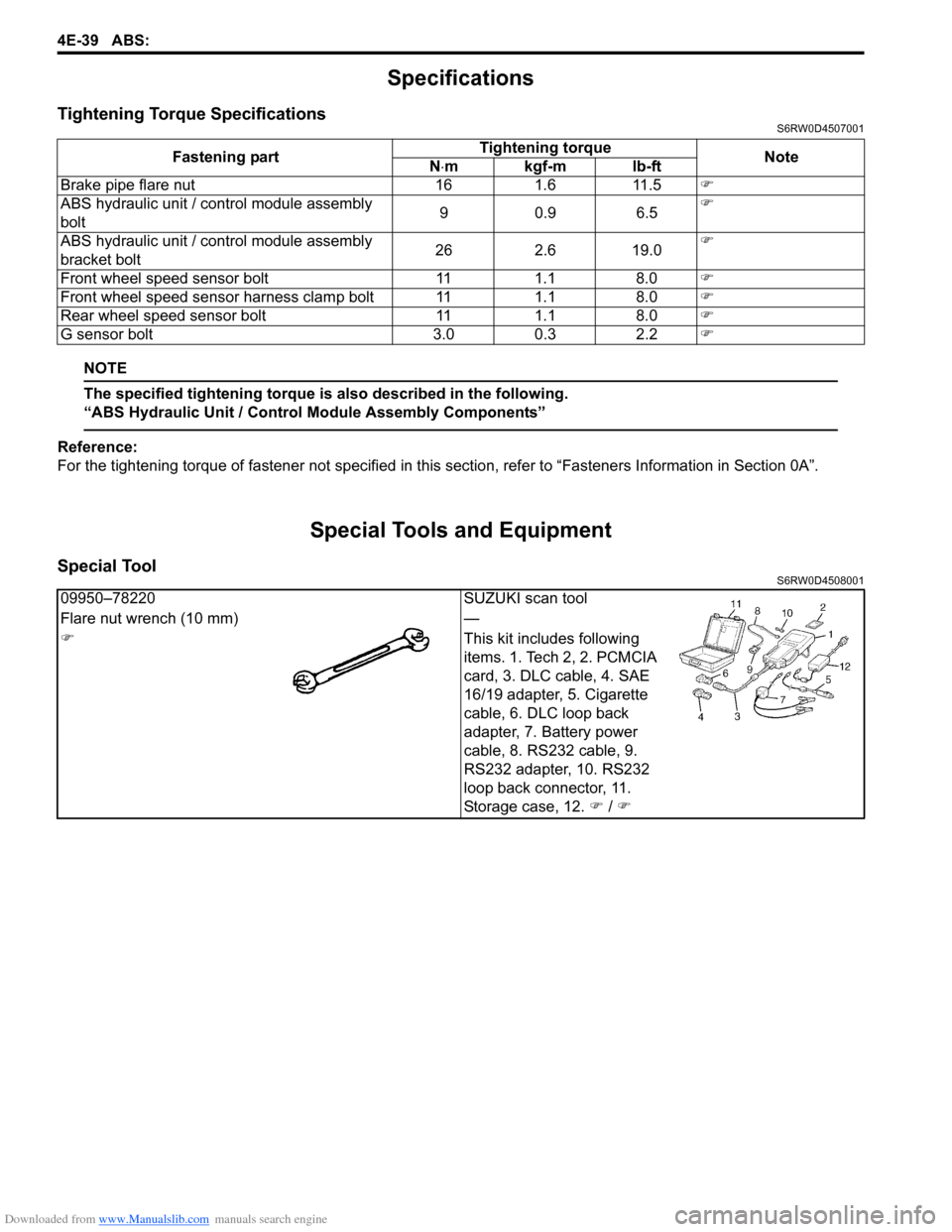
Special Tools and Equipment
Special ToolS6RW0D4508001
Fastening partTightening torque
Note
N⋅mkgf-mlb-ft
Brake pipe flare nut 16 1.6 11.5)
ABS hydraulic unit / control module assembly
bolt90.9 6.5)
ABS hydraulic unit / control module assembly
bracket bolt26 2.6 19.0)
Front wheel speed sensor bolt 11 1.1 8.0)
Front wheel speed sensor harness clamp bolt 11 1.1 8.0)
Rear wheel speed sensor bolt 11 1.1 8.0)
G sensor bolt 3.0 0.3 2.2)
09950–78220 SUZUKI scan tool
Flare nut wrench (10 mm) —
)This kit includes following
items. 1. Tech 2, 2. PCMCIA
card, 3. DLC cable, 4. SAE
16/19 adapter, 5. Cigarette
cable, 6. DLC loop back
adapter, 7. Battery power
cable, 8. RS232 cable, 9.
RS232 adapter, 10. RS232
loop back connector, 11.
Storage case, 12. ) / )
Page 666 of 1556
Downloaded from www.Manualslib.com manuals search engine 5A-18 Automatic Transmission/Transaxle:
Step 2. DTC / Freeze Frame Data Check, Record and
Clearance
First, referring to “DTC Check”, check DTC and pending
DTC. If DTC exists, print or write down DTC and freeze
frame data and then clear malfunction DTC(s) by
referring to “DTC Clearance”. Malfunction DTC indicates
malfunction in the system but it is not possible to know
from it whether the malfunction is occurring now or it
occurred in the past and normal condition has been
restored. In order to know that, check symptom in
question according to Step 5 and then recheck DTC
according to Step 6.
Diagnosing a trouble based on the DTC in this step only
or failure to clear the DTC in this step may result in an
faulty diagnosis, trouble diagnosis of a normal circuit or
difficulty in troubleshooting which is otherwise
unnecessary.
Step 3 and 4. Visual Inspection
As a preliminary step, be sure to perform visual check of
the items that support proper function of the engine and
automatic transaxle referring to “Visual Inspection”.
Step 5. Trouble Symptom Confirmation
Check trouble symptoms based on information obtained
in “Step 1. Customer Complaint Analysis: ” and “Step 2.
DTC / Freeze Frame Data Check, Record and
Clearance: ”.
Also, reconfirm DTC according to “DTC Confirmation
Procedure” described in each DTC flow.
Step 6 and 7. Rechecking and Record of DTC and
Freeze Frame Data
Refer to “DTC Check” for checking procedure.Step 8. A/T Basic Check and A/T Symptom
Diagnosis
Perform basic check of A/T according to “A/T Basic
Check” first. When the end of the flow has been reached,
check the parts of the system suspected as a possible
cause referring to “A/T Symptom Diagnosis” and based
on symptoms appearing on the vehicle (symptoms
obtained through steps of customer complaint analysis,
trouble symptom confirmation and/or A/T basic check)
and repair or replace faulty parts, if any.
Step 9. Troubleshooting for DTC
Based on the DTC indicated in Step 6 / 7 and referring to
“applicable DTC flow”, locate the cause of the trouble,
namely in a sensor, switch, wire harness, connector,
actuator, TCM or other part and repair or replace faulty
parts.
Step 10. Check for Intermittent Problem
Check parts where an intermittent trouble is easy to
occur (e.g. wire harness, connector, etc.), referring to
“Intermittent and Poor Connection Inspection in Section
00” and related circuit of DTC recorded in Step 2.
Step 11. Final Confirmation Test
Confirm that the problem symptom has gone and the
vehicle is free from any abnormal conditions. If what has
been repaired is related to the malfunction DTC, clear
the DTC once and check to ensure that no malfunction
DTC is indicated.
Visual InspectionS6RW0D5104002
Visually check the following parts and systems.
Inspection item Referring
• A/T fluid ----- level, leakage, color “Automatic Transaxle Fluid Level Inspection in
Section 0B”
• A/T fluid hoses ----- disconnection, looseness, deterioration “A/T Fluid Cooler Hoses Replacement”
• Throttle cable (if equipped) ----- play (under warm engine),
installation
• A/T select cable ----- installation “Select Cable Removal and Installation”
• Engine oil ----- level, leakage “Engine Oil and Filter Change in Section 0B”
• Engine coolant ----- level, leakage “Engine Coolant Change in Section 0B”
• Engine mountings ----- play, looseness, damage “Engine Assembly Removal and Installation in
Section 1D”
• Suspension ----- play, looseness “Suspension, Wheels and Tires Symptom
Diagnosis in Section 2A”
• Drive shafts ----- damage “Front Drive Shaft Assembly On-Vehicle Inspection
in Section 3A”
• Battery ----- indicator condition, corrosion of terminal “Battery Inspection in Section 1J”
• Connectors of electric wire harness ----- disconnection, friction “Electronic Shift Control System Components
Location”
• Fuses ----- burning
• Parts ----- installation, damage
• Bolts ----- looseness
• Other parts that can be checked visually
Page 680 of 1556
Downloaded from www.Manualslib.com manuals search engine 5A-32 Automatic Transmission/Transaxle:
Time Lag TestS6RW0D5104014
This test is to check conditions of clutch, brake and fluid pressure. “Time lag” means time elapsed since select lever is
shifted with engine idling till shock is felt.
1) With chocks placed before and behind front and rear wheels respectively, depress brake pedal.
2) Start engine.
3) With stop watch ready, shift select lever from “N” to “D” range and measure time from that moment till shock is felt.
4) Similarly measure time lag by shifting select lever from “N” to “R” range.
Gear shifting time lag
“N” → “D”: Less than 0.7 sec.
“N” → “R”: Less than 1.2 sec.
NOTE
• When repeating this test, be sure to wait at least one minute after select lever is shifted back to “N”
range.
• Engine should be warmed up fully for this test.
• Repeat test 3 times and take average of those data for final time lag data.
Troubleshooting
Line Pressure TestS6RW0D5104015
Purpose of this test is to check operating conditions of each part by measuring fluid pressure in fluid pressure line.
Line pressure test requires the following conditions.
• Automatic fluid is at normal operating temperature (70 – 80 °C / 158 – 176 °F).
• Fluid is replenished to proper level (between FULL and LOW on dipstick).
• Air conditioner switch is turned OFF.
1) Apply parking brake securely and place chocks against wheels.
2) Remove fluid pressure check hole plug bolt.
3) Attach oil pressure gauge to fluid pressure check hole in transaxle case.
Special tool
(A): 09925–37811–001Condition Possible cause Correction / Reference Item
“N”
→ “D” time lag
exceeds specificationMalfunction of transmission fluid
temperature sensorInspect. If NG, replace.
Malfunction of pressure control solenoid
valve (Low line pressure)Inspect. If NG, replace valve body assembly.
Faulty valve body componentReplace valve body assembly.
Clogged oil strainerReplace.
Faulty oil pumpInspect. If NG, replace.
Faulty forward clutchInspect. If NG, replace.
Faulty one-way No.2 clutchInspect. If NG, replace.
Leakage from “D” range fluid pressure
circuitOverhaul or replace valve body assembly.
“N”
→ “R” time lag
exceeds specificationMalfunction of transmission fluid
temperature sensorInspect. If NG, replace.
Malfunction of pressure control solenoid
valve (Low line pressure)Inspect. If NG, replace valve body assembly.
Faulty valve body componentReplace valve body assembly.
Clogged oil strainerReplace.
Faulty oil pumpInspect. If NG, replace.
Faulty reverse clutchInspect. If NG, replace.
Faulty 1st and reverse brakeInspect. If NG, replace.
Leakage from “R” range fluid pressure
circuitOverhaul or replace valve body assembly.
Page 865 of 1556
Downloaded from www.Manualslib.com manuals search engine Table of Contents 6- i
6
Section 6
CONTENTS
Steering
Precautions ................................................. 6-1
Precautions............................................................. 6-1
Precautions on Steering........................................ 6-1
Steering General Diagnosis.................... 6A-1
Precautions........................................................... 6A-1
Precautions for Steering Diagnosis ..................... 6A-1
Diagnostic Information and Procedures ............ 6A-1
Steering Symptom Diagnosis .............................. 6A-1
Steering System Inspection ................................ 6A-2
Steering Wheel and Column................... 6B-1
Precautions........................................................... 6B-1
Service Precautions of Steering Wheel and
Column.............................................................. 6B-1
General Description ............................................. 6B-1
Steering Wheel and Column Construction .......... 6B-1
Diagnostic Information and Procedures ............ 6B-2
Checking Steering Column for Accident
Damage ............................................................ 6B-2
Repair Instructions .............................................. 6B-3
Steering Wheel and Column Construction .......... 6B-3
Steering Wheel Removal and Installation ........... 6B-4
Contact Coil Cable Assembly Removal and
Installation ......................................................... 6B-5
Centering Contact Coil Cable Assembly ............. 6B-6
Contact Coil Cable Assembly Inspection ............ 6B-6
Steering Column Removal and Installation ......... 6B-6
Steering Column Inspection ................................ 6B-8
Ignition Switch Cylinder Assembly Removal
and Installation (Non- Keyless Start Model)...... 6B-8
Steering Lock Assembly (Ignition Switch)
Removal and Installation................................... 6B-9
Steering Lower Shaft Removal and
Installation ....................................................... 6B-10
Specifications..................................................... 6B-11
Tightening Torque Specifications ...................... 6B-11
Special Tools and Equipment ........................... 6B-11
Special Tool ...................................................... 6B-11
Power Assisted Steering System........... 6C-1
Precautions........................................................... 6C-1
P/S System Note ................................................. 6C-1
Precautions in Diagnosing Troubles ................... 6C-1General Description .............................................6C-2
P/S System Description ......................................6C-2
EPS Diagnosis General Description ...................6C-3
On-Board Diagnostic System Description ...........6C-3
Schematic and Routing Diagram ........................6C-4
EPS System Wiring Circuit Diagram ...................6C-4
Diagnostic Information and Procedures ............6C-5
EPS System Check .............................................6C-5
“EPS” Warning Light Check ................................6C-8
DTC Check..........................................................6C-8
DTC Clearance ...................................................6C-9
DTC Table ...........................................................6C-9
Visual Inspection ...............................................6C-11
Scan Tool Data .................................................6C-12
P/S System Symptom Diagnosis ......................6C-13
DLC and Its Communication Check (No
communication to P/S Control Module)...........6C-14
“EPS” Warning Light Does Not Come ON with
Ignition Switch Turned ON before Engine
Starts ...............................................................6C-16
“EPS” Warning Light Remains ON Steady
after Engine Starts ..........................................6C-18
DTC C1111 / C1113 / C1115: Torque Sensor
Circuit Failure ..................................................6C-19
DTC C1116: Steering Torque Sensor Power
Supply Circuit ..................................................6C-21
DTC C1121 / C1123 / C1124: Vehicle Speed
Signal Circuit Failure .......................................6C-22
DTC C1122: Engine Speed Signal....................6C-24
DTC C1141 / C1142 / C1143 / C1145: Motor
Circuit Failure ..................................................6C-26
DTC C1153: P/S Control Module Power
Supply Circuit ..................................................6C-27
DTC C1155: P/S Control Module Internal
Failure .............................................................6C-28
P/S Control Module Power Supply and
Ground Circuit Check ......................................6C-29
Inspection of P/S Control Module and Its
Circuits ............................................................6C-30
Steering Wheel Play Check ..............................6C-34
Steering Force Check .......................................6C-34
Repair Instructions ............................................6C-35
Steering Gear Case Assembly Components ....6C-35
Tie-Rod End Boot On-Vehicle Inspection .........6C-36
Tie-Rod End Removal and Installation..............6C-36
Page 882 of 1556
Downloaded from www.Manualslib.com manuals search engine 6C-2 Power Assisted Steering System:
General Description
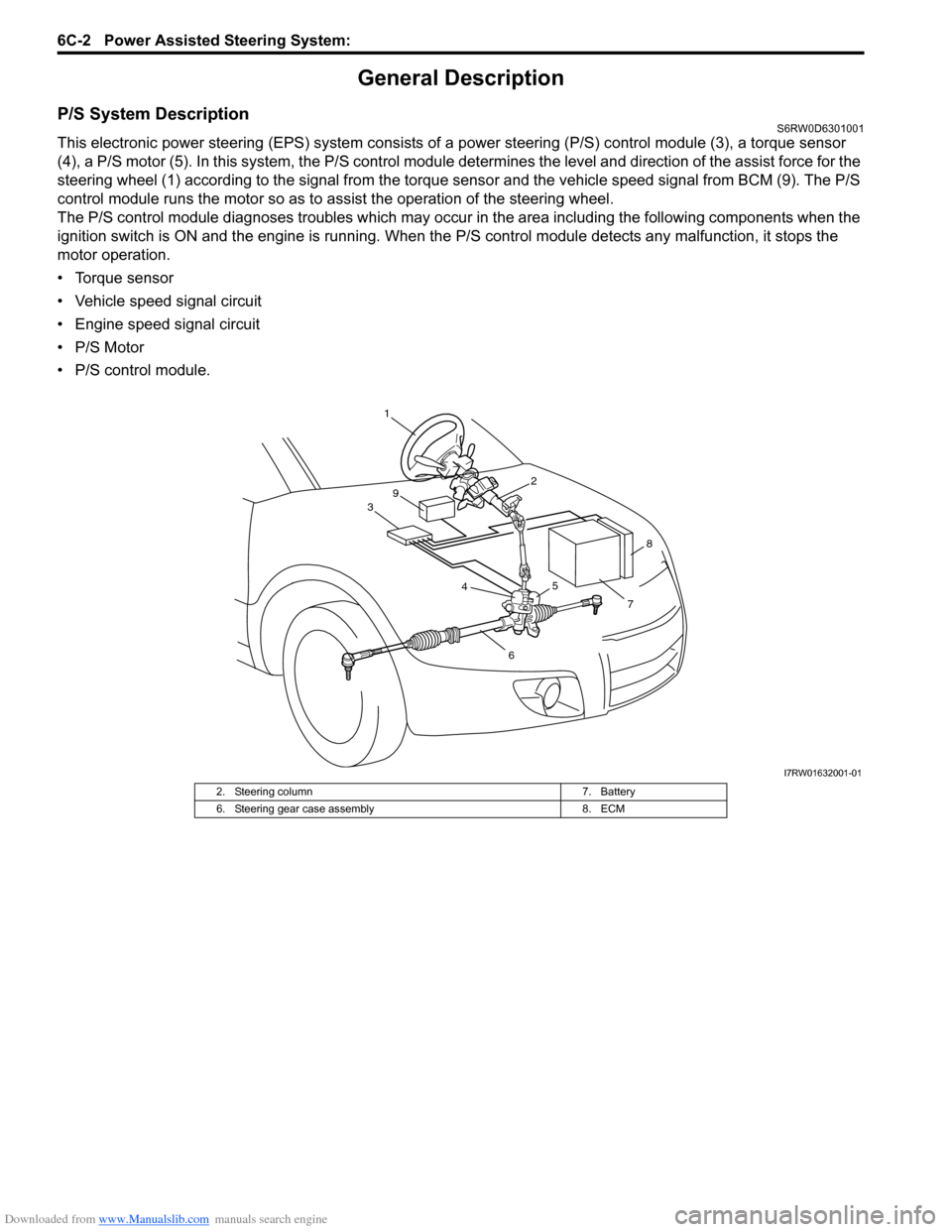
P/S System DescriptionS6RW0D6301001
This electronic power steering (EPS) system consists of a power steering (P/S) control module (3), a torque sensor
(4), a P/S motor (5). In this system, the P/S control module determines the level and direction of the assist force for the
steering wheel (1) according to the signal from the torque sensor and the vehicle speed signal from BCM (9). The P/S
control module runs the motor so as to assist the operation of the steering wheel.
The P/S control module diagnoses troubles which may occur in the area including the following components when the
ignition switch is ON and the engine is running. When the P/S control module detects any malfunction, it stops the
motor operation.
• Torque sensor
• Vehicle speed signal circuit
• Engine speed signal circuit
• P/S Motor
• P/S control module.
1
32
4
6
7
5
8
9
I7RW01632001-01
2. Steering column 7. Battery
6. Steering gear case assembly 8. ECM
Page 884 of 1556
![SUZUKI SX4 2006 1.G Service Repair Manual Downloaded from www.Manualslib.com manuals search engine 6C-4 Power Assisted Steering System:
Schematic and Routing Diagram
EPS System Wiring Circuit DiagramS6RW0D6302001
[A]
123
45
3 21
4
567
8
9 11](/img/20/7612/w960_7612-883.png "SUZUKI SX4 2006 1.G Service Repair Manual Downloaded from www.Manualslib.com manuals search engine 6C-4 Power Assisted Steering System:
Schematic and Routing Diagram
EPS System Wiring Circuit DiagramS6RW0D6302001
[A]
123
45
3 21
4
567
8
9 11")
Downloaded from www.Manualslib.com manuals search engine 6C-4 Power Assisted Steering System:
Schematic and Routing Diagram
EPS System Wiring Circuit DiagramS6RW0D6302001
[A]
123
45
3 21
4
567
8
9 11
10 12 13
141516
17 18 19201
2
[B]
1
2
[C] [D]
10 9 8 7654 3 21
16 15 14 13 12 11
26 25 24 2322 21 20 19 18 17
32 31 30 29 28 27
[F][E]
12
BRN RED/
BLU GRY LT GRN/
BLK
BLK
RED
WHT GRN
BLK
E11-1
E11-5
E11-14
E11-12
[J]:E01-44E01-4
[J]:E01-27E01-26
E12-1
E12-2
E11-10E11-8
E11-9
E11-19
E13-1 GRN
GRY
GRN
WHT
G241-25G241-31
RED/BLK
11
12
1314 3 18
20
21
7 19
4 12
22
12V
E13-2BLK
9V
REDE11-20
12V
12V
E61-2
E61-1
610
55
5V
8
E11-115V
PPL
E11-4
9
23
+BB
BLU/
WHTE04-9
1524YELE11-18E31-5
E31-2
E31-39V
3V
E31-4
E31-1IG11617
C07-25
[H]
[G]
G04-15
[I]:G04-22
25L313-3
[I]
I6RW0D630001-01
[A]: P/S control module connector No.1 “E11” (viewed from harness side) 3. Junction block assembly 15. BCM
[B]: P/S control module connector No.2 “E13” (viewed from harness side) 4. Main fuse 16. Output shaft speed sensor
[C]: P/S control module connector No.3 “E12” (viewed from harness side) 5. Front (left/right) wheel speed sensor 17. TCM
[D]: Combination meter connector “G241” (viewed from harness side) 6. ABS control module 18. Individual circuit fuse box No.1
[E]: Torque sensor connector “E31” (viewed from harness side) 7. Combination meter 19. “IGN” fuse
[F]: Motor connector “E61” (viewed from harness side) 8. “EPS” warning light 20. “P/S” fuse
[G]: M/T model 9. Data link connector (DLC) 21. “IG1 SIG” fuse
[H]: A/T model 10. ECM 22. “MTR” fuse
[I]: Junction block without BCM model (Taiwan model) 11. P/S control module 23. To ABS control module
[J]: M15A engine with 4A/T equipped with slip control model (Hong Kong
model)12. P/S motor 24. To HVAC control module
1. Main fuse box 13. Shield 25. To SDM
2. Ignition switch 14. Torque sensor (built into steering gear case)
Page 892 of 1556
Downloaded from www.Manualslib.com manuals search engine 6C-12 Power Assisted Steering System:
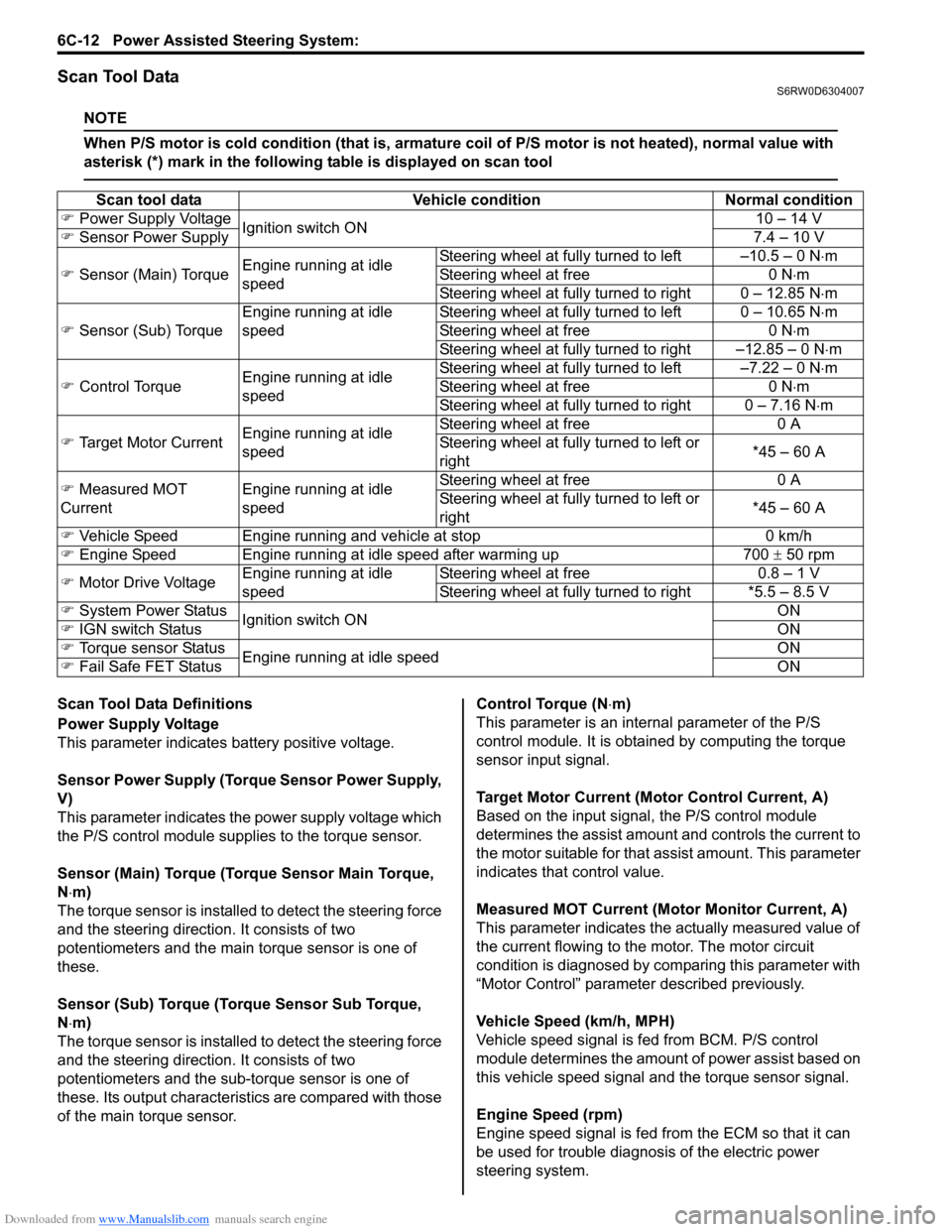
Scan Tool DataS6RW0D6304007
NOTE
When P/S motor is cold condition (that is, armature coil of P/S motor is not heated), normal value with
asterisk (*) mark in the following table is displayed on scan tool
Scan Tool Data Definitions
Power Supply Voltage
This parameter indicates battery positive voltage.
Sensor Power Supply (Torque Sensor Power Supply,
V)
This parameter indicates the power supply voltage which
the P/S control module supplies to the torque sensor.
Sensor (Main) Torque (Torque Sensor Main Torque,
N⋅m)
The torque sensor is installed to detect the steering force
and the steering direction. It consists of two
potentiometers and the main torque sensor is one of
these.
Sensor (Sub) Torque (Torque Sensor Sub Torque,
N⋅m)
The torque sensor is installed to detect the steering force
and the steering direction. It consists of two
potentiometers and the sub-torque sensor is one of
these. Its output characteristics are compared with those
of the main torque sensor.Control Torque (N⋅m)
This parameter is an internal parameter of the P/S
control module. It is obtained by computing the torque
sensor input signal.
Target Motor Current (Motor Control Current, A)
Based on the input signal, the P/S control module
determines the assist amount and controls the current to
the motor suitable for that assist amount. This parameter
indicates that control value.
Measured MOT Current (Motor Monitor Current, A)
This parameter indicates the actually measured value of
the current flowing to the motor. The motor circuit
condition is diagnosed by comparing this parameter with
“Motor Control” parameter described previously.
Vehicle Speed (km/h, MPH)
Vehicle speed signal is fed from BCM. P/S control
module determines the amount of power assist based on
this vehicle speed signal and the torque sensor signal.
Engine Speed (rpm)
Engine speed signal is fed from the ECM so that it can
be used for trouble diagnosis of the electric power
steering system. Scan tool data Vehicle condition Normal condition
) Power Supply Voltage
Ignition switch ON10 – 14 V
) Sensor Power Supply7.4 – 10 V
) Sensor (Main) TorqueEngine running at idle
speedSteering wheel at fully turned to left –10.5 – 0 N⋅m
Steering wheel at free 0 N⋅m
Steering wheel at fully turned to right 0 – 12.85 N⋅m
) Sensor (Sub) Torque Engine running at idle
speedSteering wheel at fully turned to left 0 – 10.65 N⋅m
Steering wheel at free 0 N⋅m
Steering wheel at fully turned to right –12.85 – 0 N⋅m
) Control TorqueEngine running at idle
speedSteering wheel at fully turned to left –7.22 – 0 N⋅m
Steering wheel at free 0 N⋅m
Steering wheel at fully turned to right 0 – 7.16 N⋅m
) Target Motor CurrentEngine running at idle
speedSteering wheel at free 0 A
Steering wheel at fully turned to left or
right*45 – 60 A
) Measured MOT
Current
Engine running at idle
speedSteering wheel at free 0 A
Steering wheel at fully turned to left or
right*45 – 60 A
) Vehicle Speed Engine running and vehicle at stop 0 km/h
) Engine Speed Engine running at idle speed after warming up 700 ± 50 rpm
) Motor Drive VoltageEngine running at idle
speedSteering wheel at free 0.8 – 1 V
Steering wheel at fully turned to right *5.5 – 8.5 V
) System Power Status
Ignition switch ONON
) IGN switch StatusON
) Torque sensor Status
Engine running at idle speedON
) Fail Safe FET StatusON
Page 893 of 1556
Downloaded from www.Manualslib.com manuals search engine Power Assisted Steering System: 6C-13
Motor Drive Voltage (V)
This parameter indicates the voltage between motor
terminals.
System Power Status (EPS System Power, ON, OFF)
This parameter indicates input status of EPS system
power supply.
IGN switch Status (ON, OFF)
This parameter indicates the condition of the power
supply through the ignition switch.Torque sensor Status (ON, OFF)
This parameter indicates the output status of the torque
sensor power supply.
Fail Safe FET Status (ON, OFF)
This parameter indicates the status of the motor drive
power supply circuit.
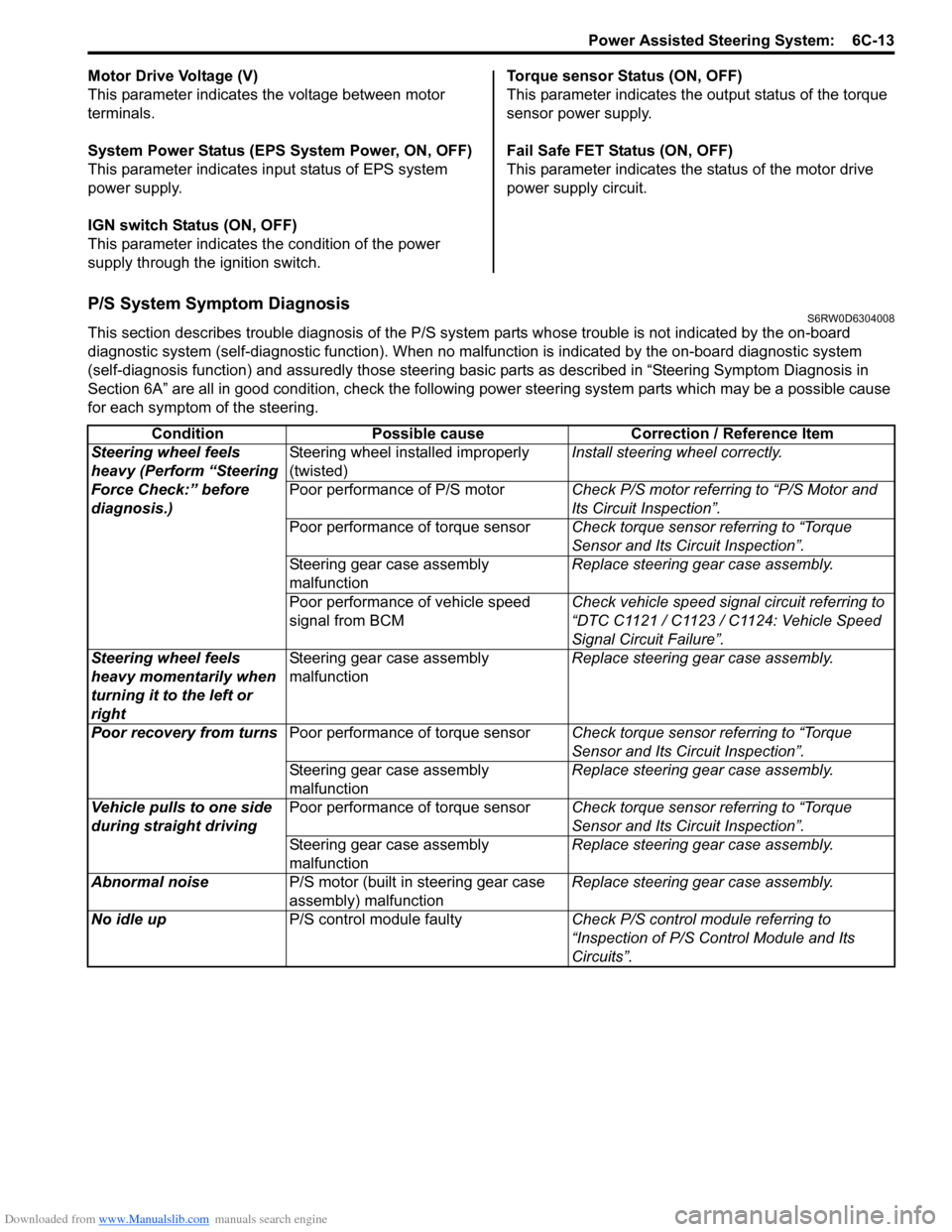
P/S System Symptom DiagnosisS6RW0D6304008
This section describes trouble diagnosis of the P/S system parts whose trouble is not indicated by the on-board
diagnostic system (self-diagnostic function). When no malfunction is indicated by the on-board diagnostic system
(self-diagnosis function) and assuredly those steering basic parts as described in “Steering Symptom Diagnosis in
Section 6A” are all in good condition, check the following power steering system parts which may be a possible cause
for each symptom of the steering.
Condition Possible cause Correction / Reference Item
Steering wheel feels
heavy (Perform “Steering
Force Check:” before
diagnosis.)Steering wheel installed improperly
(twisted)Install steering wheel correctly.
Poor performance of P/S motorCheck P/S motor referring to “P/S Motor and
Its Circuit Inspection”.
Poor performance of torque sensorCheck torque sensor referring to “Torque
Sensor and Its Circuit Inspection”.
Steering gear case assembly
malfunctionReplace steering gear case assembly.
Poor performance of vehicle speed
signal from BCMCheck vehicle speed signal circuit referring to
“DTC C1121 / C1123 / C1124: Vehicle Speed
Signal Circuit Failure”.
Steering wheel feels
heavy momentarily when
turning it to the left or
rightSteering gear case assembly
malfunctionReplace steering gear case assembly.
Poor recovery from turnsPoor performance of torque sensorCheck torque sensor referring to “Torque
Sensor and Its Circuit Inspection”.
Steering gear case assembly
malfunctionReplace steering gear case assembly.
Vehicle pulls to one side
during straight drivingPoor performance of torque sensorCheck torque sensor referring to “Torque
Sensor and Its Circuit Inspection”.
Steering gear case assembly
malfunctionReplace steering gear case assembly.
Abnormal noiseP/S motor (built in steering gear case
assembly) malfunctionReplace steering gear case assembly.
No idle upP/S control module faultyCheck P/S control module referring to
“Inspection of P/S Control Module and Its
Circuits”.
Page 902 of 1556
Downloaded from www.Manualslib.com manuals search engine 6C-22 Power Assisted Steering System:
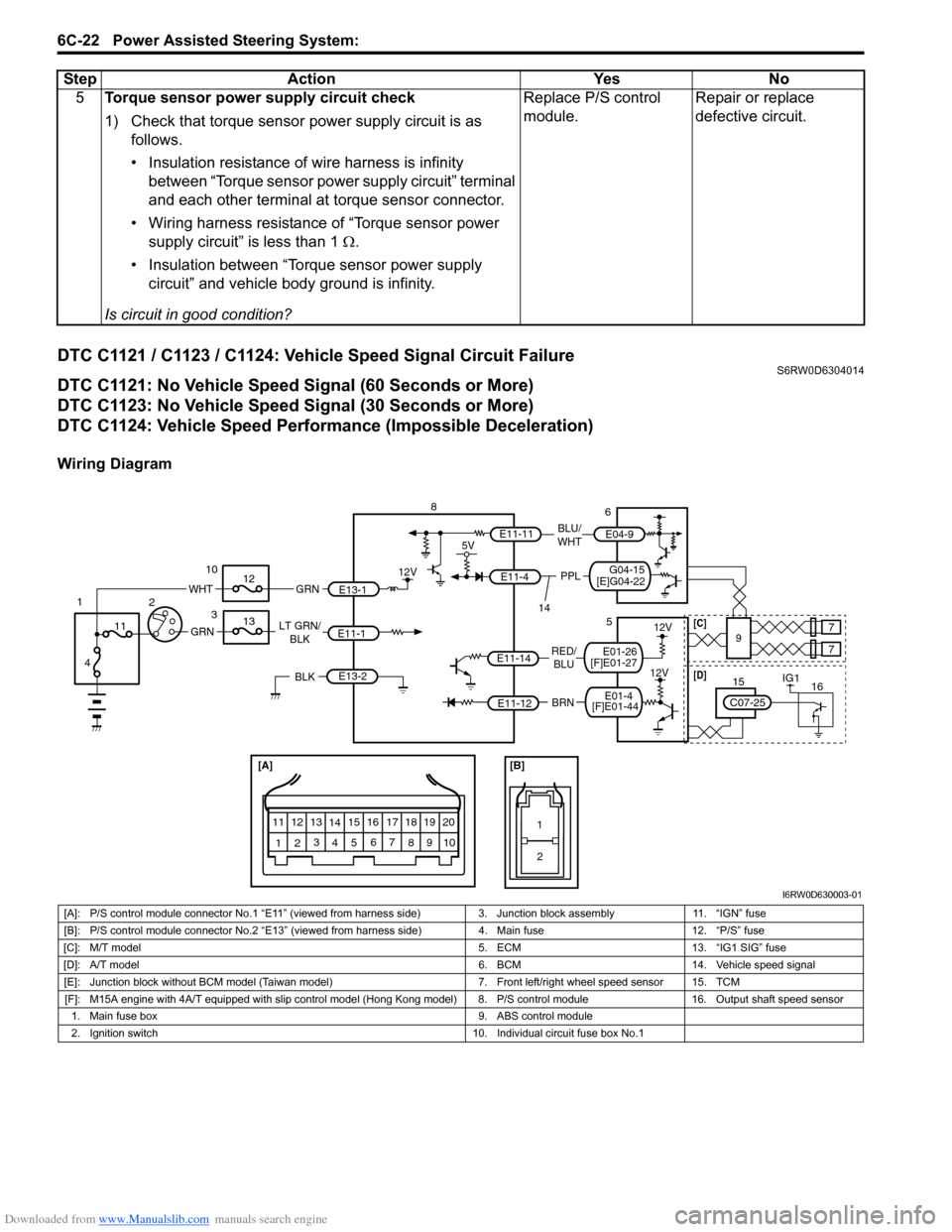
DTC C1121 / C1123 / C1124: Vehicle Speed Signal Circuit FailureS6RW0D6304014
DTC C1121: No Vehicle Speed Signal (60 Seconds or More)
DTC C1123: No Vehicle Speed Signal (30 Seconds or More)
DTC C1124: Vehicle Speed Performance (Impossible Deceleration)
Wiring Diagram5Torque sensor power supply circuit check
1) Check that torque sensor power supply circuit is as
follows.
• Insulation resistance of wire harness is infinity
between “Torque sensor power supply circuit” terminal
and each other terminal at torque sensor connector.
• Wiring harness resistance of “Torque sensor power
supply circuit” is less than 1 Ω.
• Insulation between “Torque sensor power supply
circuit” and vehicle body ground is infinity.
Is circuit in good condition?Replace P/S control
module.Repair or replace
defective circuit. Step Action Yes No
[A]
123
4567
8
9 11
10 12 13
141516
17 18 1920
1
2
[B]
BRN RED/
BLU LT GRN/
BLK
E11-1
E11-14
E11-12
E13-1 GRN
GRN
WHT
8
3 10
12
13
11
4 1
2
12V
E13-2BLK
12V
12V
9 5
77
E11-11
G04-15
[E]G04-22
5V
PPL
E11-4
BLU/
WHTE04-9
6
14
IG11615
C07-25
[D][C]
[F]E01-44E01-4
[F]E01-27E01-26
I6RW0D630003-01
[A]: P/S control module connector No.1 “E11” (viewed from harness side) 3. Junction block assembly 11. “IGN” fuse
[B]: P/S control module connector No.2 “E13” (viewed from harness side) 4. Main fuse 12. “P/S” fuse
[C]: M/T model 5. ECM 13. “IG1 SIG” fuse
[D]: A/T model 6. BCM 14. Vehicle speed signal
[E]: Junction block without BCM model (Taiwan model) 7. Front left/right wheel speed sensor 15. TCM
[F]: M15A engine with 4A/T equipped with slip control model (Hong Kong model) 8. P/S control module 16. Output shaft speed sensor
1. Main fuse box 9. ABS control module
2. Ignition switch 10. Individual circuit fuse box No.1