Cool SUZUKI SX4 2006 1.G Service Repair Manual
[x] Cancel search | Manufacturer: SUZUKI, Model Year: 2006, Model line: SX4, Model: SUZUKI SX4 2006 1.GPages: 1556, PDF Size: 37.31 MB
Page 175 of 1556
Downloaded from www.Manualslib.com manuals search engine Engine General Information and Diagnosis: 1A-125
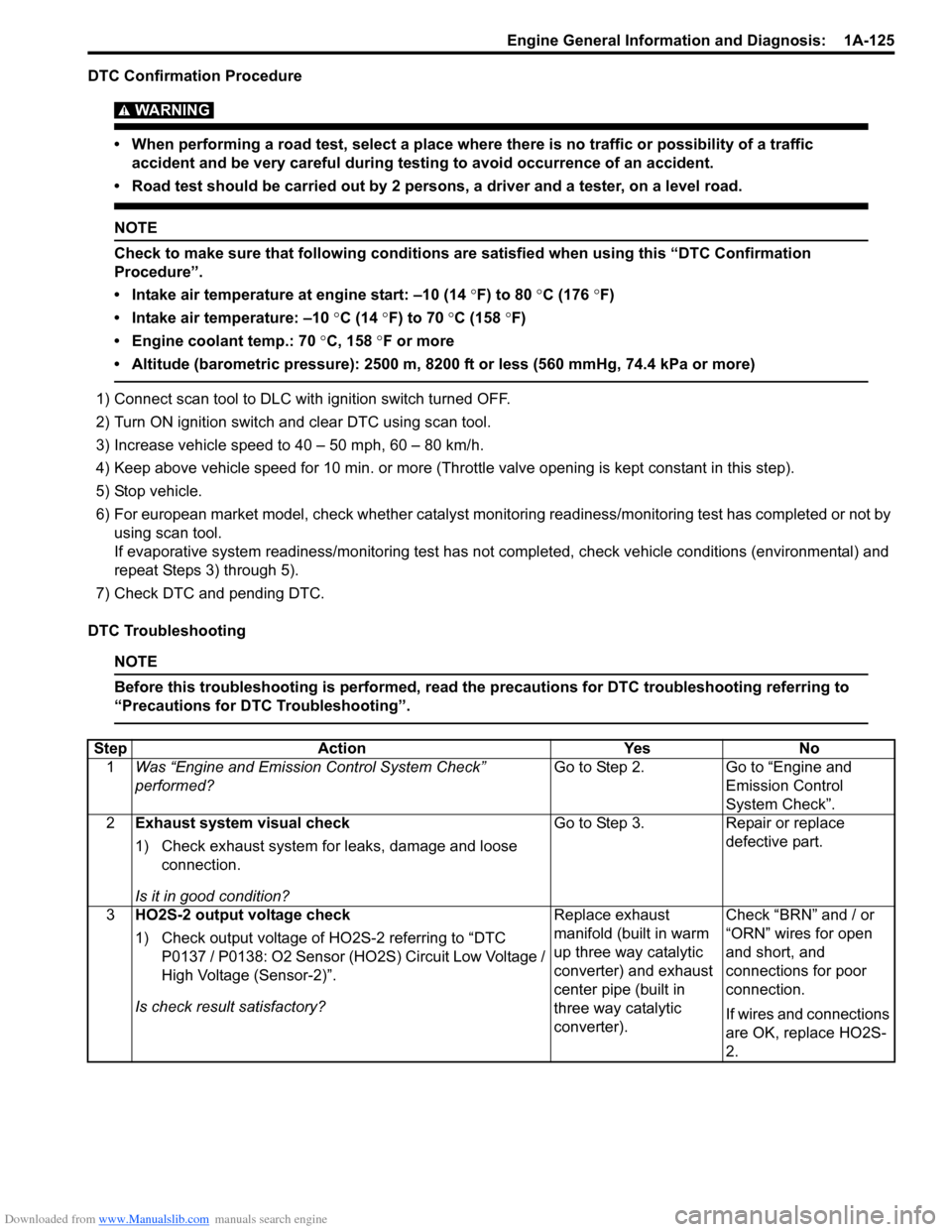
DTC Confirmation Procedure
WARNING!
• When performing a road test, select a place where there is no traffic or possibility of a traffic
accident and be very careful during testing to avoid occurrence of an accident.
• Road test should be carried out by 2 persons, a driver and a tester, on a level road.
NOTE
Check to make sure that following conditions are satisfied when using this “DTC Confirmation
Procedure”.
• Intake air temperature at engine start: –10 (14 °F) to 80 °C (176 °F)
• Intake air temperature: –10 °C (14 °F) to 70 °C (158 °F)
• Engine coolant temp.: 70 °C, 158 °F or more
• Altitude (barometric pressure): 2500 m, 8200 ft or less (560 mmHg, 74.4 kPa or more)
1) Connect scan tool to DLC with ignition switch turned OFF.
2) Turn ON ignition switch and clear DTC using scan tool.
3) Increase vehicle speed to 40 – 50 mph, 60 – 80 km/h.
4) Keep above vehicle speed for 10 min. or more (Throttle valve opening is kept constant in this step).
5) Stop vehicle.
6) For european market model, check whether catalyst monitoring readiness/monitoring test has completed or not by
using scan tool.
If evaporative system readiness/monitoring test has not completed, check vehicle conditions (environmental) and
repeat Steps 3) through 5).
7) Check DTC and pending DTC.
DTC Troubleshooting
NOTE
Before this troubleshooting is performed, read the precautions for DTC troubleshooting referring to
“Precautions for DTC Troubleshooting”.
Step Action Yes No
1Was “Engine and Emission Control System Check”
performed?Go to Step 2. Go to “Engine and
Emission Control
System Check”.
2Exhaust system visual check
1) Check exhaust system for leaks, damage and loose
connection.
Is it in good condition?Go to Step 3. Repair or replace
defective part.
3HO2S-2 output voltage check
1) Check output voltage of HO2S-2 referring to “DTC
P0137 / P0138: O2 Sensor (HO2S) Circuit Low Voltage /
High Voltage (Sensor-2)”.
Is check result satisfactory?Replace exhaust
manifold (built in warm
up three way catalytic
converter) and exhaust
center pipe (built in
three way catalytic
converter).Check “BRN” and / or
“ORN” wires for open
and short, and
connections for poor
connection.
If wires and connections
are OK, replace HO2S-
2.
Page 179 of 1556
Downloaded from www.Manualslib.com manuals search engine Engine General Information and Diagnosis: 1A-129
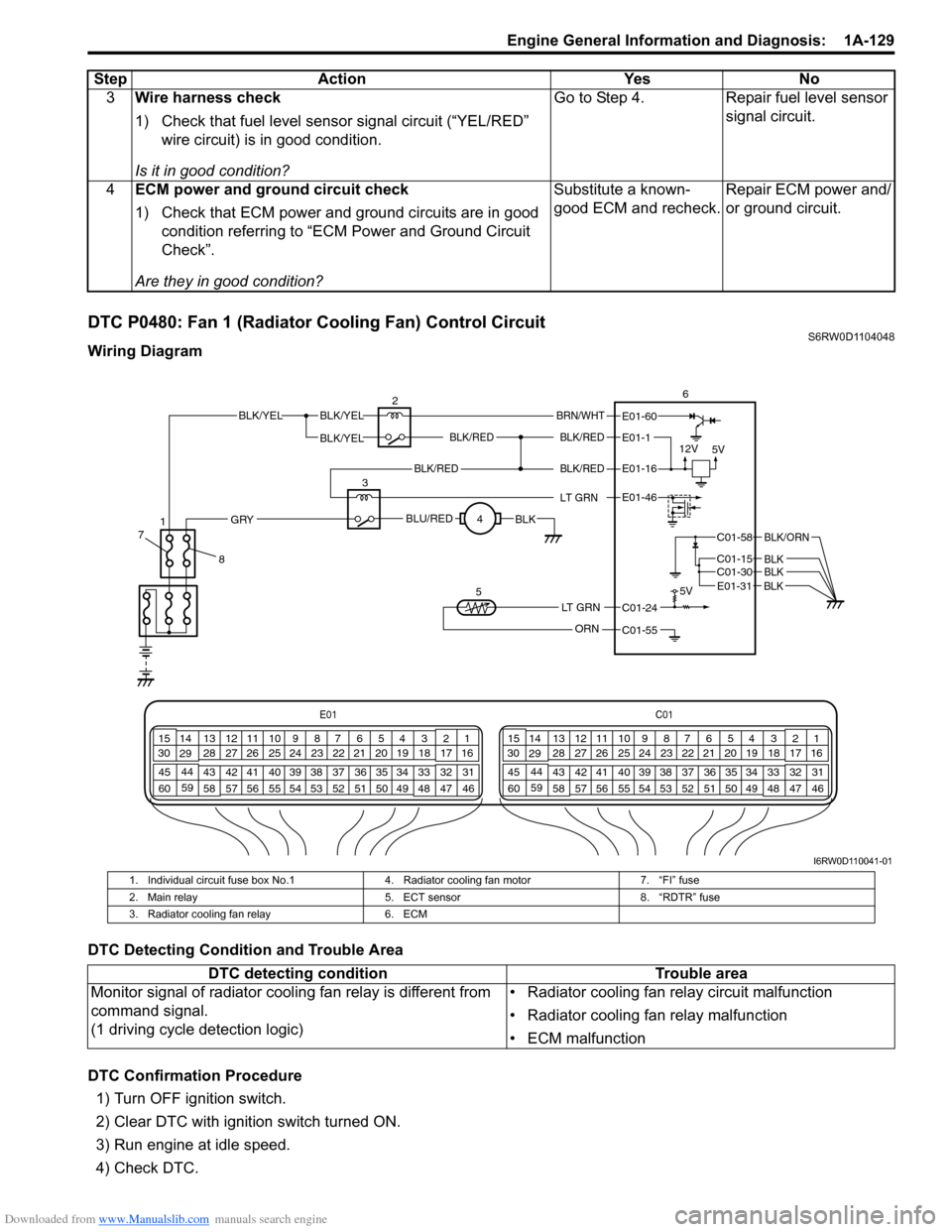
DTC P0480: Fan 1 (Radiator Cooling Fan) Control CircuitS6RW0D1104048
Wiring Diagram
DTC Detecting Condition and Trouble Area
DTC Confirmation Procedure
1) Turn OFF ignition switch.
2) Clear DTC with ignition switch turned ON.
3) Run engine at idle speed.
4) Check DTC.3Wire harness check
1) Check that fuel level sensor signal circuit (“YEL/RED”
wire circuit) is in good condition.
Is it in good condition?Go to Step 4. Repair fuel level sensor
signal circuit.
4ECM power and ground circuit check
1) Check that ECM power and ground circuits are in good
condition referring to “ECM Power and Ground Circuit
Check”.
Are they in good condition?Substitute a known-
good ECM and recheck.Repair ECM power and/
or ground circuit. Step Action Yes No
E01C01
3 4
18 19 5 6 7 10 11
17 20
47 46 49 50 51 21 22
5216 259
24 14
29
55 57 54 53 59
60 582
26 27 28 15
30
56 4832 31 34 35 36 37 40 42 39 38 44
45 43 41 331 12 13
238 3 4
18 19 5 6 7 10 11
17 20
47 46 49 50 51 21 22
5216 259
24 14
29
55 57 54 53 59
60 582
26 27 28 15
30
56 4832 31 34 35 36 37 40 42 39 38 44
45 43 41 331 12 13
238
BLK/REDBLK/RED
BLK/YELBLK/YEL
BLK/YEL
BRN/WHT
12V
5V5V
26
E01-1
E01-60
C01-58
C01-15 C01-30
BLK/ORN
BLKBLK
BLK/RED
LT GRN
BLK/REDE01-16
E01-46
BLU/REDBLKGRY
LT GRN
ORN
C01-24
C01-55 3
4
5
E01-31 BLK
8 71
I6RW0D110041-01
1. Individual circuit fuse box No.1 4. Radiator cooling fan motor 7. “FI” fuse
2. Main relay 5. ECT sensor 8. “RDTR” fuse
3. Radiator cooling fan relay 6. ECM
DTC detecting condition Trouble area
Monitor signal of radiator cooling fan relay is different from
command signal.
(1 driving cycle detection logic)• Radiator cooling fan relay circuit malfunction
• Radiator cooling fan relay malfunction
• ECM malfunction
Page 180 of 1556
Downloaded from www.Manualslib.com manuals search engine 1A-130 Engine General Information and Diagnosis:
DTC Troubleshooting
NOTE
Before this troubleshooting is performed, read the precautions for DTC troubleshooting referring to
“Precautions for DTC Troubleshooting”.
Step Action Yes No
1Was “Engine and Emission Control System Check”
performed?Go to Step 2. Go to “Engine and
Emission Control
System Check”.
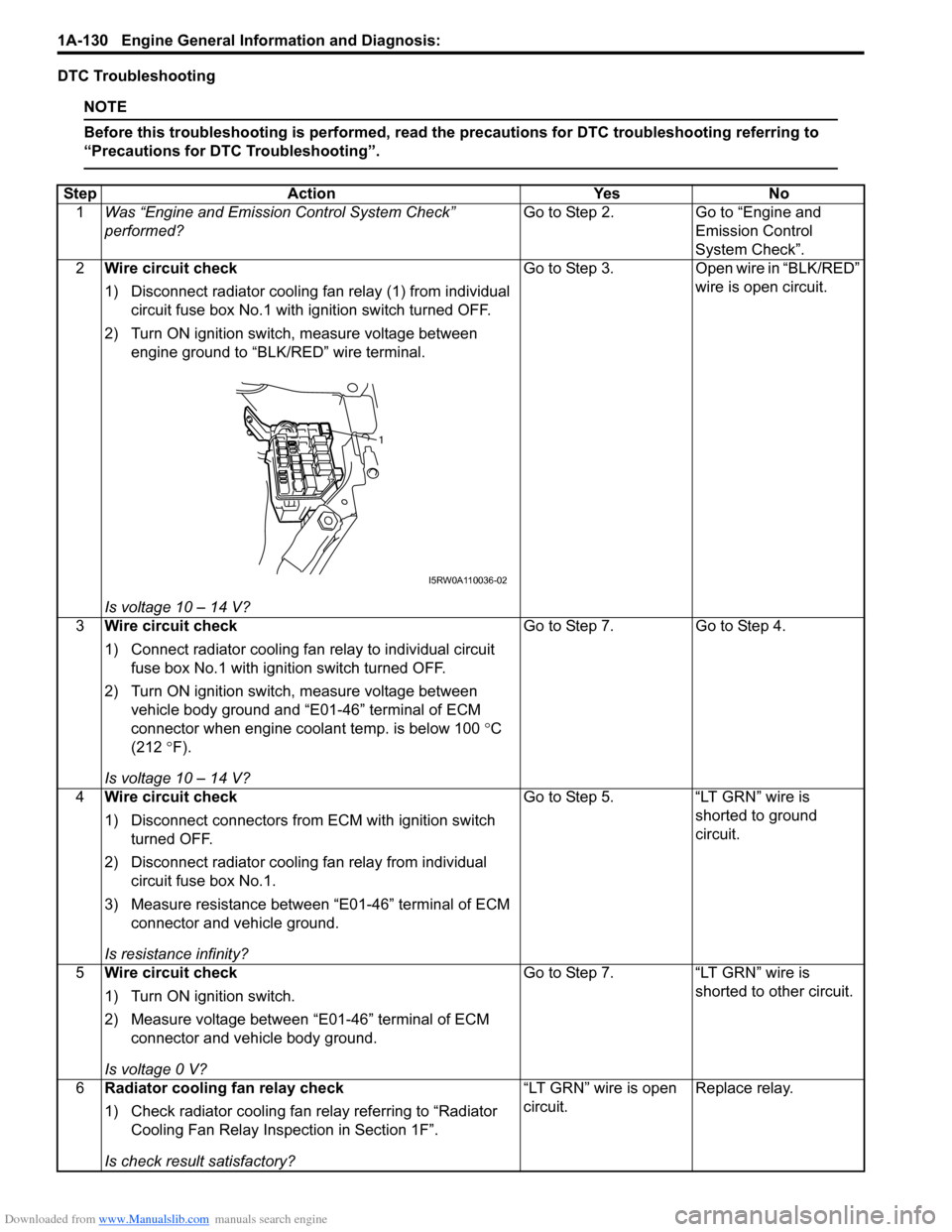
2Wire circuit check
1) Disconnect radiator cooling fan relay (1) from individual
circuit fuse box No.1 with ignition switch turned OFF.
2) Turn ON ignition switch, measure voltage between
engine ground to “BLK/RED” wire terminal.
Is voltage 10 – 14 V?Go to Step 3. Open wire in “BLK/RED”
wire is open circuit.
3Wire circuit check
1) Connect radiator cooling fan relay to individual circuit
fuse box No.1 with ignition switch turned OFF.
2) Turn ON ignition switch, measure voltage between
vehicle body ground and “E01-46” terminal of ECM
connector when engine coolant temp. is below 100 °C
(212 °F).
Is voltage 10 – 14 V?Go to Step 7. Go to Step 4.
4Wire circuit check
1) Disconnect connectors from ECM with ignition switch
turned OFF.
2) Disconnect radiator cooling fan relay from individual
circuit fuse box No.1.
3) Measure resistance between “E01-46” terminal of ECM
connector and vehicle ground.
Is resistance infinity?Go to Step 5. “LT GRN” wire is
shorted to ground
circuit.
5Wire circuit check
1) Turn ON ignition switch.
2) Measure voltage between “E01-46” terminal of ECM
connector and vehicle body ground.
Is voltage 0 V?Go to Step 7. “LT GRN” wire is
shorted to other circuit.
6Radiator cooling fan relay check
1) Check radiator cooling fan relay referring to “Radiator
Cooling Fan Relay Inspection in Section 1F”.
Is check result satisfactory?“LT GRN” wire is open
circuit.Replace relay.
1
I5RW0A110036-02
Page 181 of 1556
Downloaded from www.Manualslib.com manuals search engine Engine General Information and Diagnosis: 1A-131
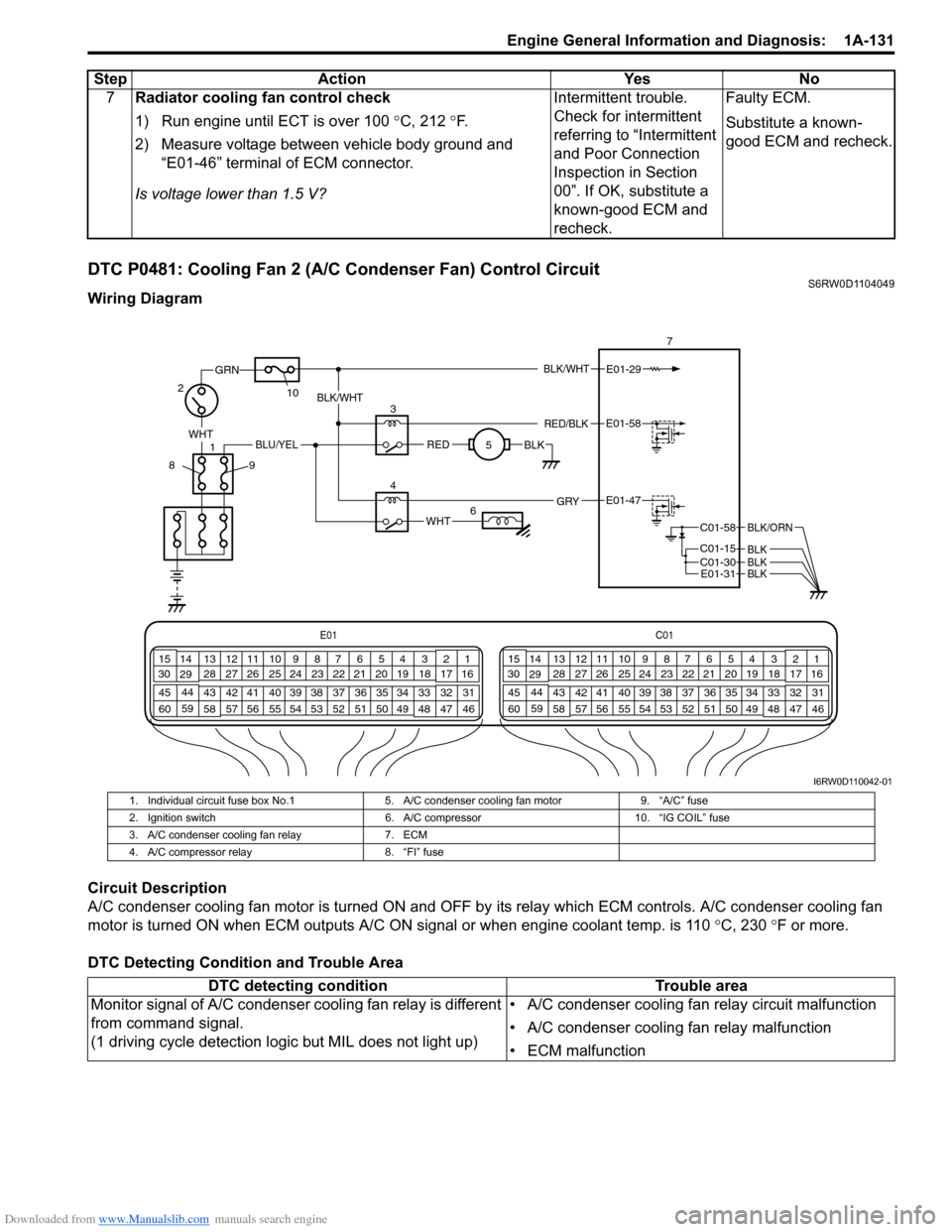
DTC P0481: Cooling Fan 2 (A/C Condenser Fan) Control CircuitS6RW0D1104049
Wiring Diagram
Circuit Description
A/C condenser cooling fan motor is turned ON and OFF by its relay which ECM controls. A/C condenser cooling fan
motor is turned ON when ECM outputs A/C ON signal or when engine coolant temp. is 110 °C, 230 °F or more.
DTC Detecting Condition and Trouble Area7Radiator cooling fan control check
1) Run engine until ECT is over 100 °C, 212 °F.
2) Measure voltage between vehicle body ground and
“E01-46” terminal of ECM connector.
Is voltage lower than 1.5 V?Intermittent trouble.
Check for intermittent
referring to “Intermittent
and Poor Connection
Inspection in Section
00”. If OK, substitute a
known-good ECM and
recheck.Faulty ECM.
Substitute a known-
good ECM and recheck. Step Action Yes No
E01C01
3 4
18 19 5 6 7 10 11
17 20
47 46 49 50 51 21 22
5216 259
24 14
29
55 57 54 53 59
60 582
26 27 28 15
30
56 4832 31 34 35 36 37 40 42 39 38 44
45 43 41 331 12 13
238 3 4
18 19 5 6 7 10 11
17 20
47 46 49 50 51 21 22
5216 259
24 14
29
55 57 54 53 59
60 582
26 27 28 15
30
56 4832 31 34 35 36 37 40 42 39 38 44
45 43 41 331 12 13
238
BLK/WHT
WHT
1
GRN
27
E01-29
10
89
REDBLK
3
5BLK/WHT
RED/BLKE01-58
WHT
4E01-47 GRY
BLU/YEL
6
C01-58
C01-15 C01-30
BLK/ORN
BLKBLKE01-31BLK
I6RW0D110042-01
1. Individual circuit fuse box No.1 5. A/C condenser cooling fan motor 9. “A/C” fuse
2. Ignition switch 6. A/C compressor 10. “IG COIL” fuse
3. A/C condenser cooling fan relay 7. ECM
4. A/C compressor relay 8. “FI” fuse
DTC detecting condition Trouble area
Monitor signal of A/C condenser cooling fan relay is different
from command signal.
(1 driving cycle detection logic but MIL does not light up)• A/C condenser cooling fan relay circuit malfunction
• A/C condenser cooling fan relay malfunction
• ECM malfunction
Page 182 of 1556
Downloaded from www.Manualslib.com manuals search engine 1A-132 Engine General Information and Diagnosis:
DTC Confirmation Procedure
1) With ignition switch turned OFF, connect scan tool.
2) Turn ON ignition switch and clear DTC using scan tool.
3) Start engine and warm up engine to normal operating temperature.
4) Run engine at idle and turn both A/C switch and heater blower switch ON (turn ON air conditioning) for 3 min. or
more.
5) Check DTC and pending DTC.
DTC Troubleshooting
NOTE
Before this troubleshooting is performed, read the precautions for DTC troubleshooting referring to
“Precautions for DTC Troubleshooting”.
Step Action Yes No
1Was “Engine and Emission Control System Check”
performed?Go to Step 2. Go to “Engine and
Emission Control
System Check”.
2Check wire circuit
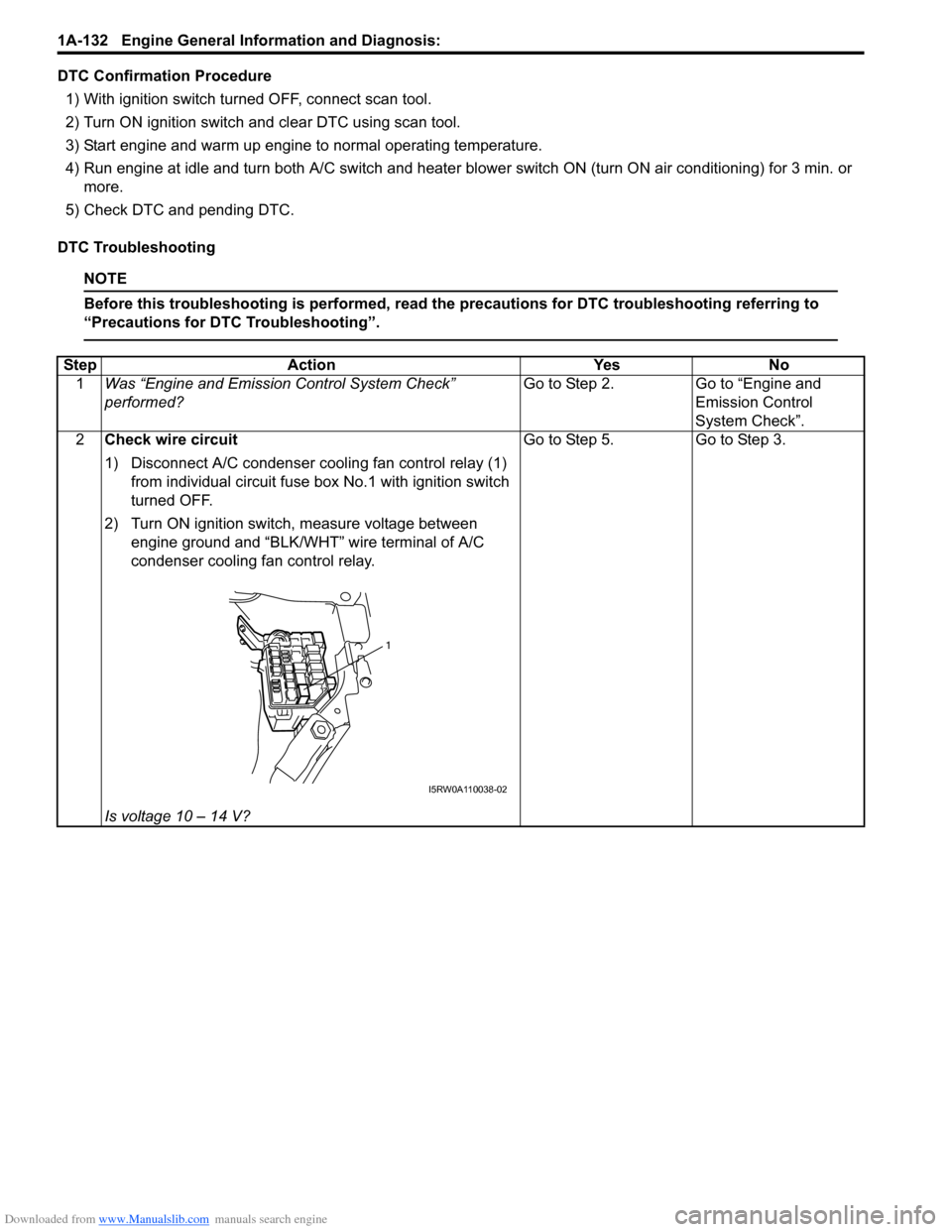
1) Disconnect A/C condenser cooling fan control relay (1)
from individual circuit fuse box No.1 with ignition switch
turned OFF.
2) Turn ON ignition switch, measure voltage between
engine ground and “BLK/WHT” wire terminal of A/C
condenser cooling fan control relay.
Is voltage 10 – 14 V?Go to Step 5. Go to Step 3.
1
I5RW0A110038-02
Page 183 of 1556
Downloaded from www.Manualslib.com manuals search engine Engine General Information and Diagnosis: 1A-133
3Check wire circuit
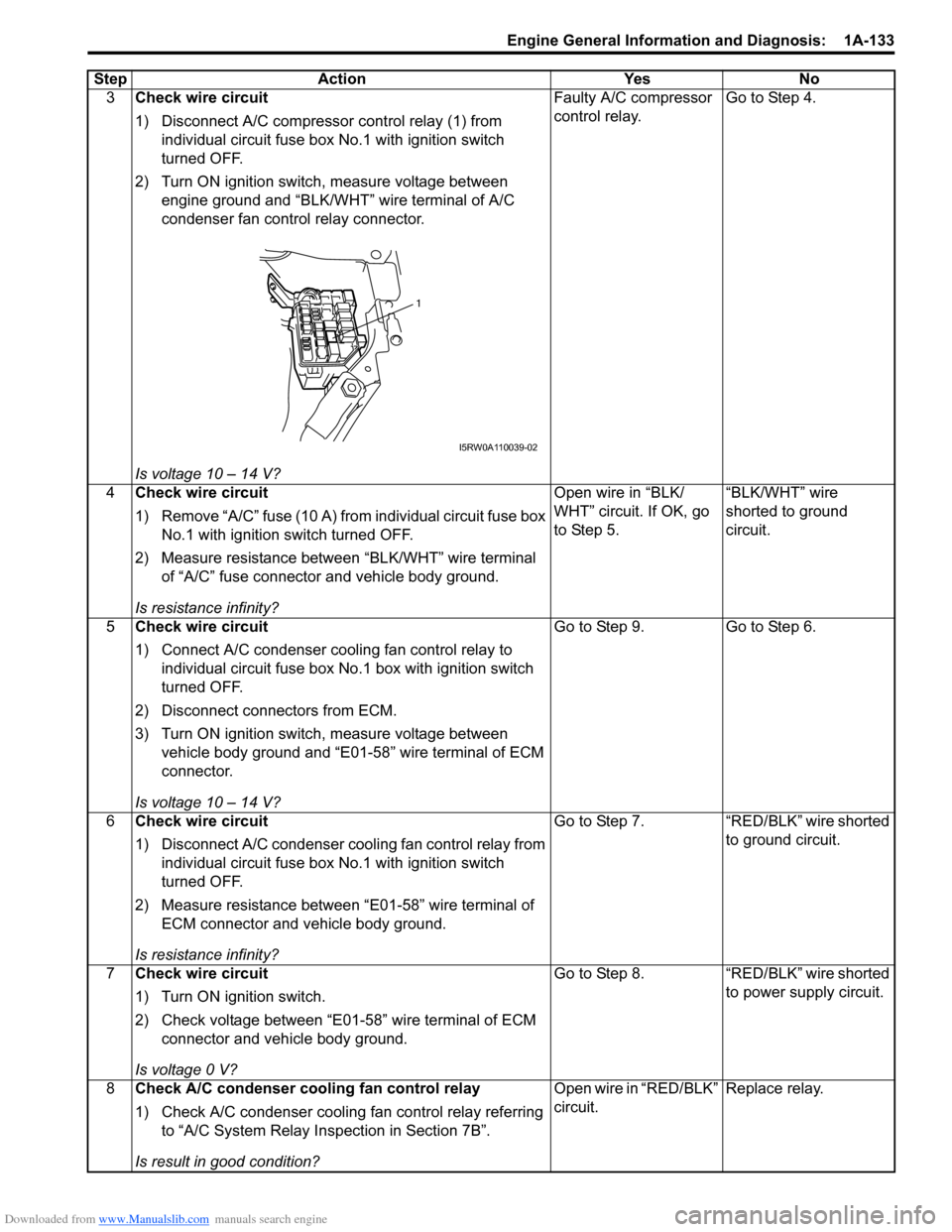
1) Disconnect A/C compressor control relay (1) from
individual circuit fuse box No.1 with ignition switch
turned OFF.
2) Turn ON ignition switch, measure voltage between
engine ground and “BLK/WHT” wire terminal of A/C
condenser fan control relay connector.
Is voltage 10 – 14 V?Faulty A/C compressor
control relay.Go to Step 4.
4Check wire circuit
1) Remove “A/C” fuse (10 A) from individual circuit fuse box
No.1 with ignition switch turned OFF.
2) Measure resistance between “BLK/WHT” wire terminal
of “A/C” fuse connector and vehicle body ground.
Is resistance infinity?Open wire in “BLK/
WHT” circuit. If OK, go
to Step 5.“BLK/WHT” wire
shorted to ground
circuit.
5Check wire circuit
1) Connect A/C condenser cooling fan control relay to
individual circuit fuse box No.1 box with ignition switch
turned OFF.
2) Disconnect connectors from ECM.
3) Turn ON ignition switch, measure voltage between
vehicle body ground and “E01-58” wire terminal of ECM
connector.
Is voltage 10 – 14 V?Go to Step 9. Go to Step 6.
6Check wire circuit
1) Disconnect A/C condenser cooling fan control relay from
individual circuit fuse box No.1 with ignition switch
turned OFF.
2) Measure resistance between “E01-58” wire terminal of
ECM connector and vehicle body ground.
Is resistance infinity?Go to Step 7. “RED/BLK” wire shorted
to ground circuit.
7Check wire circuit
1) Turn ON ignition switch.
2) Check voltage between “E01-58” wire terminal of ECM
connector and vehicle body ground.
Is voltage 0 V?Go to Step 8. “RED/BLK” wire shorted
to power supply circuit.
8Check A/C condenser cooling fan control relay
1) Check A/C condenser cooling fan control relay referring
to “A/C System Relay Inspection in Section 7B”.
Is result in good condition?Open wire in “RED/BLK”
circuit.Replace relay. Step Action Yes No
1
I5RW0A110039-02
Page 184 of 1556
Downloaded from www.Manualslib.com manuals search engine 1A-134 Engine General Information and Diagnosis:
DTC P0500: Vehicle Speed Sensor (VSS) MalfunctionS6RW0D1104050
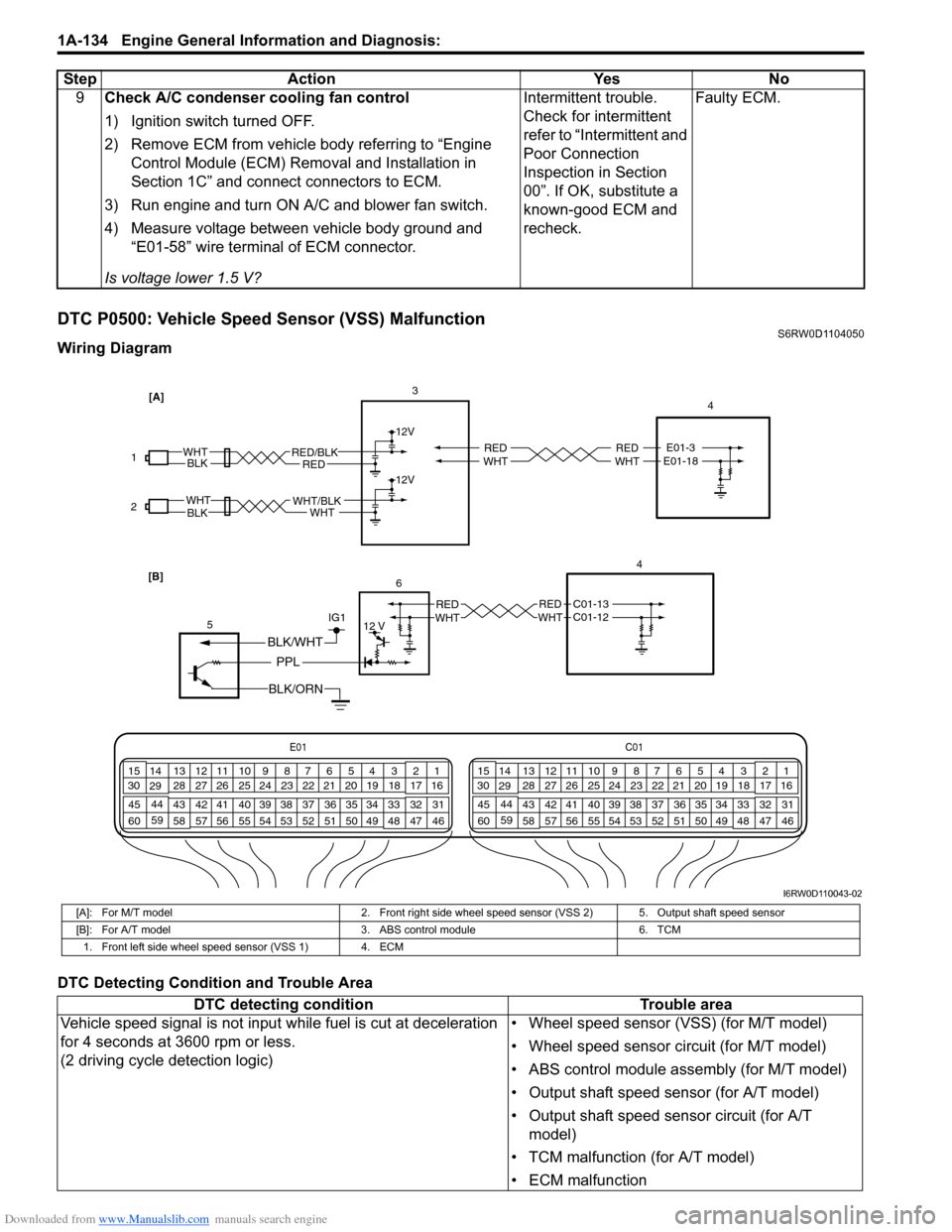
Wiring Diagram
DTC Detecting Condition and Trouble Area9Check A/C condenser cooling fan control
1) Ignition switch turned OFF.
2) Remove ECM from vehicle body referring to “Engine
Control Module (ECM) Removal and Installation in
Section 1C” and connect connectors to ECM.
3) Run engine and turn ON A/C and blower fan switch.
4) Measure voltage between vehicle body ground and
“E01-58” wire terminal of ECM connector.
Is voltage lower 1.5 V?Intermittent trouble.
Check for intermittent
refer to “Intermittent and
Poor Connection
Inspection in Section
00”. If OK, substitute a
known-good ECM and
recheck.Faulty ECM. Step Action Yes No
[B]
REDWHTC01-13C01-12REDWHT
PPL
5IG112 V
BLK/WHT
BLK/ORN
4
6 [A]
E01-3E01-18REDWHTREDWHT
E01C01
3 4
18 19 5 6 7 10 11
17 20
47 46 49 50 51 21 22
5216 259
24 14
29
55 57 54 53 59
60 582
26 27 28 15
30
56 4832 31 34 35 36 37 40 42 39 38 44
45 43 41 331 12 13
238 3 4
18 19 5 6 7 10 11
17 20
47 46 49 50 51 21 22
5216 259
24 14
29
55 57 54 53 59
60 582
26 27 28 15
30
56 4832 31 34 35 36 37 40 42 39 38 44
45 43 41 331 12 13
238
BLK
RED
WHT WHT
12V
12V
1
23
4
WHT/BLK
WHT BLKRED/BLK
I6RW0D110043-02
[A]: For M/T model 2. Front right side wheel speed sensor (VSS 2) 5. Output shaft speed sensor
[B]: For A/T model 3. ABS control module 6. TCM
1. Front left side wheel speed sensor (VSS 1) 4. ECM
DTC detecting condition Trouble area
Vehicle speed signal is not input while fuel is cut at deceleration
for 4 seconds at 3600 rpm or less.
(2 driving cycle detection logic)• Wheel speed sensor (VSS) (for M/T model)
• Wheel speed sensor circuit (for M/T model)
• ABS control module assembly (for M/T model)
• Output shaft speed sensor (for A/T model)
• Output shaft speed sensor circuit (for A/T
model)
• TCM malfunction (for A/T model)
• ECM malfunction
Page 197 of 1556
Downloaded from www.Manualslib.com manuals search engine Engine General Information and Diagnosis: 1A-147
DTC P2103: Throttle Actuator Control Motor Circuit HighS6RW0D1104059
Wiring Diagram
Refer to “DTC P2101: Throttle Actuator Control Motor Circuit Range / Performance”.
DTC Detecting Condition and Trouble Area
DTC Confirmation Procedure
1) With ignition switch turned OFF, connect scan tool.
2) Turn ON ignition switch and clear DTC using scan tool.
3) Ignition switch turned OFF for 20 sec. or more.
4) Turn ON ignition switch and check DTC.4Throttle actuator control relay circuit check
1) Remove throttle actuator control relay from individual
circuit fuse box No.1 with ignition switch turned OFF.
2) Check for proper connection to throttle actuator control
relay at “BLK/RED”, “GRY”, “BRN” and “GRN” wire
terminals.
3) Measure voltage between engine ground and each
“BLK/RED”, “GRY” wire terminal with ignition switch
turned ON.
Is each voltage 10 – 14 V?Go to Step 5. “BLK/RED” wire and/or
“GRY” wire is open or
high resistance.
5Throttle actuator control relay circuit check
1) Disconnect connectors from ECM with ignition switch
turned OFF.
2) Measure resistance at following connector terminals.
• Between “BRN” wire terminal of throttle actuator
control relay connector and “E01-45” terminal of ECM
connector
• Between “GRN” wire terminal of throttle actuator
control relay connector and “E01-32” terminal of ECM
connector
Is each resistance below 5
Ω?Go to Step 6. “BRN” wire and/or
“GRN” wire is open or
high resistance.
6Throttle actuator control relay check
1) Check throttle actuator control relay referring to “Main
Relay, Fuel Pump Relay, Starting Motor Control Relay,
Throttle Actuator Control Relay and Radiator Cooling
Fan Relay Inspection in Section 1C”.
Is it in good condition?Substitute a known-
good ECM and recheck.Replace throttle
actuator control relay. Step Action Yes No
DTC detecting condition Trouble area
Power supply voltage of throttle actuator control circuit is higher than
specified value for specified time even if throttle actuator control relay is
turned off.
(1 driving detection logic)• Throttle actuator control relay circuit
• Throttle actuator control relay
•ECM
Page 198 of 1556
Downloaded from www.Manualslib.com manuals search engine 1A-148 Engine General Information and Diagnosis:
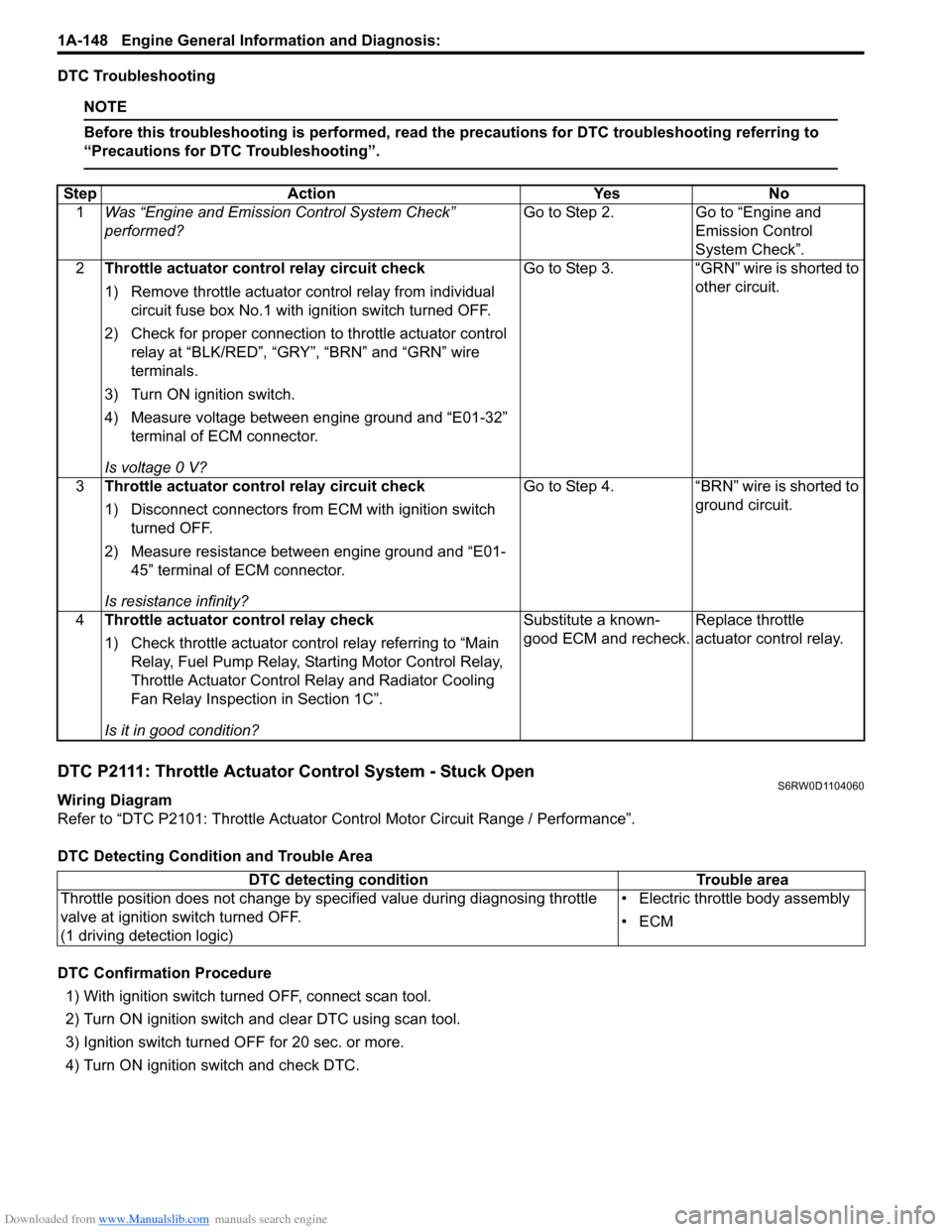
DTC Troubleshooting
NOTE
Before this troubleshooting is performed, read the precautions for DTC troubleshooting referring to
“Precautions for DTC Troubleshooting”.
DTC P2111: Throttle Actuator Control System - Stuck OpenS6RW0D1104060
Wiring Diagram
Refer to “DTC P2101: Throttle Actuator Control Motor Circuit Range / Performance”.
DTC Detecting Condition and Trouble Area
DTC Confirmation Procedure
1) With ignition switch turned OFF, connect scan tool.
2) Turn ON ignition switch and clear DTC using scan tool.
3) Ignition switch turned OFF for 20 sec. or more.
4) Turn ON ignition switch and check DTC. Step Action Yes No
1Was “Engine and Emission Control System Check”
performed?Go to Step 2. Go to “Engine and
Emission Control
System Check”.
2Throttle actuator control relay circuit check
1) Remove throttle actuator control relay from individual
circuit fuse box No.1 with ignition switch turned OFF.
2) Check for proper connection to throttle actuator control
relay at “BLK/RED”, “GRY”, “BRN” and “GRN” wire
terminals.
3) Turn ON ignition switch.
4) Measure voltage between engine ground and “E01-32”
terminal of ECM connector.
Is voltage 0 V?Go to Step 3. “GRN” wire is shorted to
other circuit.
3Throttle actuator control relay circuit check
1) Disconnect connectors from ECM with ignition switch
turned OFF.
2) Measure resistance between engine ground and “E01-
45” terminal of ECM connector.
Is resistance infinity?Go to Step 4. “BRN” wire is shorted to
ground circuit.
4Throttle actuator control relay check
1) Check throttle actuator control relay referring to “Main
Relay, Fuel Pump Relay, Starting Motor Control Relay,
Throttle Actuator Control Relay and Radiator Cooling
Fan Relay Inspection in Section 1C”.
Is it in good condition?Substitute a known-
good ECM and recheck.Replace throttle
actuator control relay.
DTC detecting condition Trouble area
Throttle position does not change by specified value during diagnosing throttle
valve at ignition switch turned OFF.
(1 driving detection logic)• Electric throttle body assembly
•ECM
Page 225 of 1556
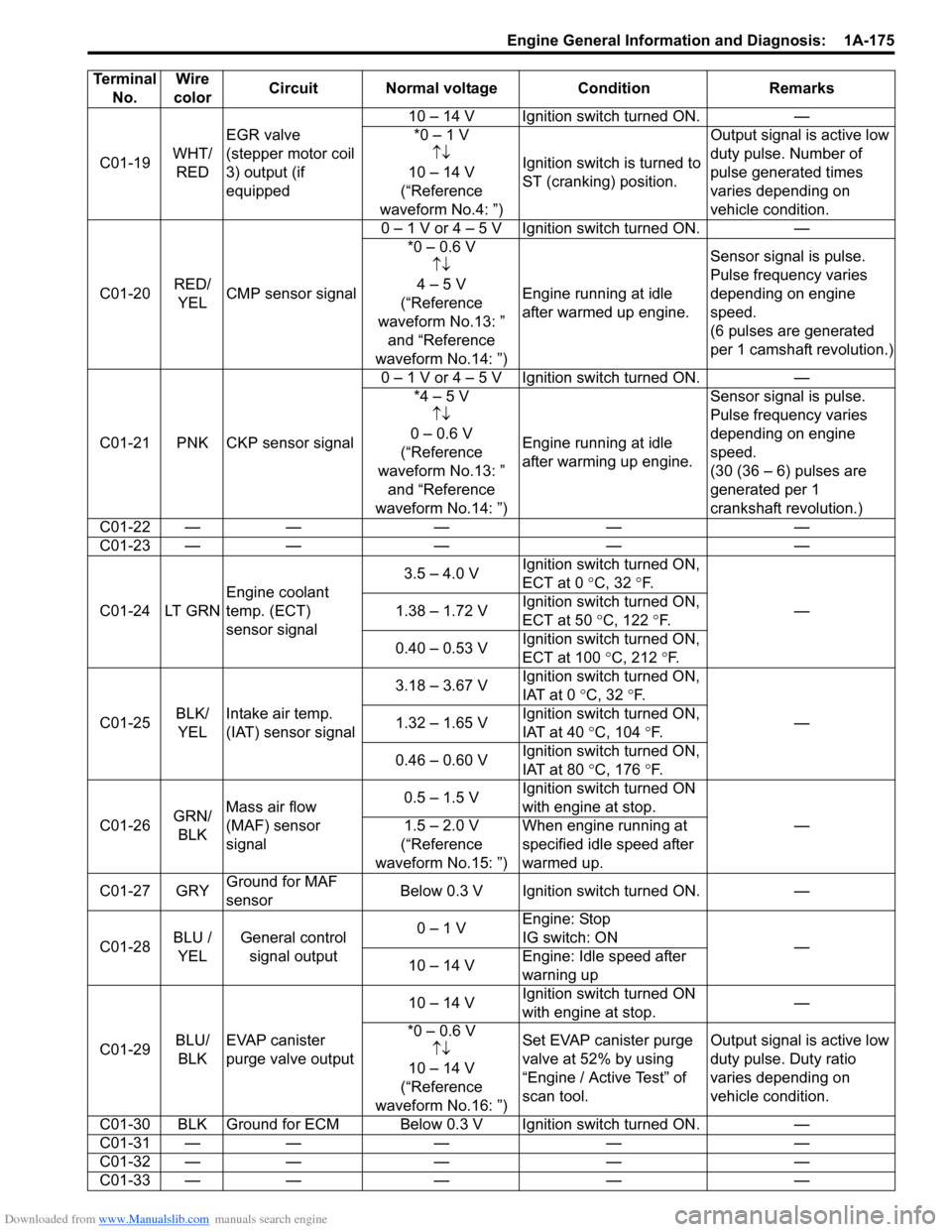
Downloaded from www.Manualslib.com manuals search engine Engine General Information and Diagnosis: 1A-175
C01-19WHT/
REDEGR valve
(stepper motor coil
3) output (if
equipped10 – 14 V Ignition switch turned ON. —
*0 – 1 V
↑↓
10 – 14 V
(“Reference
waveform No.4: ”)Ignition switch is turned to
ST (cranking) position.Output signal is active low
duty pulse. Number of
pulse generated times
varies depending on
vehicle condition.
C01-20RED/
YELCMP sensor signal0 – 1 V or 4 – 5 V Ignition switch turned ON. —
*0 – 0.6 V
↑↓
4 – 5 V
(“Reference
waveform No.13: ”
and “Reference
waveform No.14: ”)Engine running at idle
after warmed up engine.Sensor signal is pulse.
Pulse frequency varies
depending on engine
speed.
(6 pulses are generated
per 1 camshaft revolution.)
C01-21 PNK CKP sensor signal0 – 1 V or 4 – 5 V Ignition switch turned ON. —
*4 – 5 V
↑↓
0 – 0.6 V
(“Reference
waveform No.13: ”
and “Reference
waveform No.14: ”)Engine running at idle
after warming up engine.Sensor signal is pulse.
Pulse frequency varies
depending on engine
speed.
(30 (36 – 6) pulses are
generated per 1
crankshaft revolution.)
C01-22 — — — — —
C01-23 — — — — —
C01-24 LT GRNEngine coolant
temp. (ECT)
sensor signal3.5 – 4.0 VIgnition switch turned ON,
ECT at 0 °C, 32 °F.
— 1.38 – 1.72 VIgnition switch turned ON,
ECT at 50 °C, 122 °F.
0.40 – 0.53 VIgnition switch turned ON,
ECT at 100 °C, 212 °F.
C01-25BLK/
YELIntake air temp.
(IAT) sensor signal3.18 – 3.67 VIgnition switch turned ON,
IAT at 0 °C, 32 °F.
— 1.32 – 1.65 VIgnition switch turned ON,
IAT at 40 °C, 104 °F.
0.46 – 0.60 VIgnition switch turned ON,
IAT at 80 °C, 176 °F.
C01-26GRN/
BLKMass air flow
(MAF) sensor
signal0.5 – 1.5 VIgnition switch turned ON
with engine at stop.
— 1.5 – 2.0 V
(“Reference
waveform No.15: ”)When engine running at
specified idle speed after
warmed up.
C01-27 GRYGround for MAF
sensorBelow 0.3 V Ignition switch turned ON. —
C01-28BLU /
YELGeneral control
signal output0 – 1 VEngine: Stop
IG switch: ON
—
10 – 14 VEngine: Idle speed after
warning up
C01-29BLU/
BLKEVAP canister
purge valve output10 – 14 VIgnition switch turned ON
with engine at stop.—
*0 – 0.6 V
↑↓
10 – 14 V
(“Reference
waveform No.16: ”)Set EVAP canister purge
valve at 52% by using
“Engine / Active Test” of
scan tool.Output signal is active low
duty pulse. Duty ratio
varies depending on
vehicle condition.
C01-30 BLK Ground for ECM Below 0.3 V Ignition switch turned ON. —
C01-31 — — — — —
C01-32 — — — — —
C01-33 — — — — — Terminal
No.Wire
colorCircuit Normal voltage Condition Remarks